Monday, February 07, 2022

Rx label and database linkages plausibly deceive consumers; mostly not precluded by FDCA

Method Pharmaceuticals, LLC v. H-2 Pharma, LLC, 2022 WL 327738, No. 2:20-CV-753-ECM (M.D. Ala. Feb. 3, 2022)

The parties make fluoride products. “Fluoride supplements, often given to children or cancer patients to prevent tooth decay, carry risk of tooth damage if taken in excessive amounts. In consideration of this risk, some manufacturers require that their supplements be dispensed only by prescription.” Method makes prescription-only supplements; H-2 does not, though the FDA has not yet determined whether fluoride supplements should be treated as drugs or as dietary supplements. If they’re drugs, they require serialization—“standardized numerical identifier[s] on each product package” to track potential defects in production. H-2 does not serialize, saving it millions of dollars and allowing it to offer lower prices than Method or other prescription-only competitors.

Despite this, H-2 prints its labels “Rx,” which allegedly falsely represents that the products are prescription drugs and thus serialized per FDA requirements. Those same labels often conspicuously say “dietary supplement,” “fluoride supplement,” and include a “Supplement Facts” panel, but Method alleged that nevertheless, the market considers H-2’s products to be prescription drugs and treats them accordingly. This includes “linking” H-2’s products to Method’s in databases and reimbursing their purchase through Medicare & Medicaid, both of which do not reimburse dietary supplement purchases. H-2 also allegedly misled the market by falsely advertising that its fluoride products have “National Drug Codes,” (“NDCs”), “unique universal product identifier[s] for drugs,” allegedly conveying that the products are prescription drugs. In addition, H-2 allegedly mislead DailyMed, the “official provider of FDA label information and package inserts,” managed by the United States National Library of Medicine because its pages for H-2’s products do not include the customary disclaimer that “[t]his drug has not been found by the FDA to be safe and effective, and this labeling has not been approved by [the] FDA.”

The court largely rejected H-2’s FDA preclusion arguments against Method’s Lanham Act claims. “In Belcher Pharmaceuticals, LLC v. Hospira, Inc., the Eleventh Circuit extended the POM Wonderful rule to Lanham Act claims concerning drug labels. 1 F.4th 1374, 1380–81 (11th Cir. 2021).” As long as courts are not asked “to contradict a conclusion of the FDA or to make an original determination on an issue committed to the FDA’s discretion,” a Lanham Act claim about pharmaceutical labels is not precluded.

There was no allegation that H-2’s actions “violated the FDCA”—there is no direct attempt to “circumvent the FDA’s exclusive enforcement authority” by asking the Court to make an “enforcement determination[ ] that the FDA and other regulatory agencies did not themselves make.” So, the question was whether Method’s claims “stray too close to the exclusive enforcement domain of the FDA.” A court generally may not “make determinations about the safety, legality, and classification of new drugs that are more properly within the exclusive purview of the FDA.” Claims are also precluded “where, in order to determine the falsity or misleading nature of the representation at issue, the court would be required to interpret and then apply FDCA statutory or regulatory provisions,” or “when the FDA has failed to take a position on the particular issue that is the subject of the alleged false representation comprising the Lanham Act claim.”

H-2 argued that, because the FDA “has yet to determine whether [H-2’s] Products are to be regulated, and therefore viewed, as supplements or drugs,” the claims were precluded. H-2 was only partly correct. One count alleged that H-2 simultaneously promoted its products as dietary supplements and prescription drugs, and that this was misleading. But it could be that H-2’s products aren’t dietary supplements at all, such that all fluoride supplement products are to be classified solely as prescription drugs. “Only if H-2’s products are indeed dietary supplements do representations to the contrary mislead the market.” Since the FDA hasn’t weighed in, the court wouldn’t either.

However, other claims were not precluded. A different count alleged that by listing its products with the Drug Databases, H-2 falsely represented that its products “are prescription drugs that comply with federal serialization requirements.” This was not a question about whether the FDA requires serialization of H-2’s products, it’s a question of whether H-2 affirmatively represents that the products are serialized when they aren’t. “The veracity of those two facts is wholly independent of any collateral consideration of whether the FDA requires serialization for H-2’s products.”  [The court is making it easier on itself by characterizing this as a question of affirmative representation. What’s really going on is that if people think H-2’s products are prescription drugs, they then think that all sorts of FDA oversight has gone on that doesn’t exist for supplements, presumably including serialization. I think this should still be actionable, but it’s because of the implications and not affirmative statements.]

H-2 argued that the FDCA still governed this because it requires prescription-requiring drugs to be labeled “Rx only.” Thus, since its products only say “Rx,” it can’t possibly be representing them as prescription drugs. But Method’s argument was not about FDCA requirements. Instead, it alleged that the “Rx” label induces market participants to think that H-2’s products are prescription drugs, “regardless of whether they are or what the regulatory scheme might require. Indeed, if H-2 is correct that FDA regulations do require all prescription drugs to be marked with ‘Rx Only,’ that it marks its products with the similar ‘Rx’ appears to make it more likely that the market would be confused, not less.” Method wasn’t alleging FDCA misbranding. “So, while it may be the case that only prescription drugs are subject to federal serialization requirements, that fact has little bearing on whether H-2’s representations on databases and its labels led the market to think its products were, indeed, serialized.” And the court’s language indicates that it understands this can work through implication: “That Method believes the market will interpret H-2’s alleged representations through the lens of FDA regulations (e.g., that a pharmacist believes the mark ‘Rx’ means the product is serialized because she interprets ‘Rx’ to mean drug, and drugs are serialized under FDA rules) does not mean that the Court is required to determine if those regulations require those interpretations.”

FDCA preclusion aside, were the claims plausible? H-2 argued that the “Rx only” rules made it implausible that consumers would think “Rx” meant “drug.” But “[t]he statute does not answer whether a mark can lead a consumer to think, incorrectly, that a product is a prescription drug, even if that mark does not cause the product to be ‘misbranded.’”

H-2 also argued that the entire context of the label wasn’t false or misleading. The labels clearly say “Supplement,” include “Supplement Fact” panels, and nowhere mention the word, “Drug.” But Method alleged that the pharmaceutical market, as a matter of fact, believes “Rx” to mean the product is a prescription drug, and thus serialized. That was enough. In addition, Method wasn’t just targeting the label. It also identified H-2’s alleged listing of its products with NDC numbers, which Method alleged H-2 knew its products didn’t actually have. Method also alleged that H-2 knowingly omitted the proper disclaimer on DailyMed to indicate its products were not FDA-approved, leading consumers to believe the opposite was true.

Deception/capacity to deceive: H-2 argued that the market here, including pharmacies, pharmacists, wholesalers, or insurance companies, are “sophisticated and well-acquainted with labeling strictures,” making deception implausible. “The market’s greater regulatory sophistication speaks only to the ultimate likelihood that Method’s claims succeed on the merits. But at this early litigation stage, the Court is to take as true all factual allegations.” Method alleged that these sophisticated entities were in fact duped (and indeed if 90% of the market behaves in a predictable way, then even sophisticated entities may not know about the regulatory lacunae for substances of long standing). As the court pointed out, “Method’s complaint teems with examples of such confusion: that H-2’s products appear improperly in the pharmaceutical dispensing software of CVS and Walgreens; that the Drug Databases improperly link H-2’s products to other drugs; that Medicare and Medicaid improperly reimburse purchase of H-2’s products despite not reimbursing for dietary supplements; or that the market prescribes H-2’s products thinking they are prescription drugs.” That was plausible enough to survive a motion to dismiss.

Friday, February 04, 2022

ANSI standards aren't well known enough to be material

Little Giant Ladder Sys. v. Tricam Indus., Inc., 2022 WL 325969, No. 17-cv-1769 (ECT/ECW) (D. Minn. Feb. 3, 2022)

This case previously traveled under a different name/lead plaintiff. The parties compete in the market for articulated ladders, also known as multi-position ladders. Little Giant argued that Tricam violated the Lanham Act and the Minnesota Deceptive Trade Practices Act by falsely representing that its ladders comply with ANSI ASC A14.2, a voluntary industry standard for portable metal ladders (one mandated by Home Depot, the big customer, for all its suppliers). The case was tried to the Court, and Little Giant lost.

ANSI “does not develop standards and will in no circumstance give an interpretation of any [ANSI standard].” And “no persons shall have the right or authority to issue an interpretation of an [ANSI standard] in the name of [ANSI].” The court determined that the interpretation of the standard was a fact question, since it wasn’t a legal rule having the force of law; even if that sometimes happens, it wasn’t at issue here as part of a regulatory regime. And on that question, it sided with Tricam, though the details of interpretation are not worth going into. Tricam did have external testing done for compliance with the standard, and passed that testing using its interpretation thereof. There were also dueling materiality surveys, Little Giant’s focusing on whether compliance with safety standards was important to purchasers and Tricam’s focusing on whether respondents actually knew what ANSI does.

Tricam argued that it didn’t “use” any statements on Home Depot’s website, because Home Depot “developed the ANSI compliance language in its IDM system, specified the compliance language to be used in a drop-down menu, and otherwise exercised substantial control over the website.” The question, the court thought, was whether a business “has ceded so much control that it is no longer ‘using’ the ad.” Here,

the better understanding of the trial record is that Tricam retained control over the statements on Home Depot’s website. Tricam entered the information, not Home Depot. Though Home Depot reviews the submitted information, it relies on vendors to ensure that content is accurate. There is no evidence suggesting Home Depot second-guessed, double-checked, or somehow verified the information vendors submitted through this system. If Home Depot could change the Tricam-related content on its webpage without Tricam’s input, there is no evidence that happened. And no evidence warrants concluding that Tricam was prevented from accessing or editing this content if that became necessary.

Tricam’s argument was that Home Depot required ANSI-compliance statements. But that didn’t remove responsibility from Tricam for making the statements if they weren’t true.

Fortunately for Tricam, Little Giant didn’t succeed in showing falsity. Initially, “statements of ANSI compliance are statements of fact, not of opinion.” The better view of the relevant standard meant that this statement was true. For belt-and-suspenders purposes, if the court was wrong about what ANSI requires, it would have found literal falsity.

“In the Eighth Circuit, materiality is not presumed even when a statement is found to be literally false.” And the statements, even if false, were not material. Defendant’s ANSI-specific survey was more persuasive because it was more specific to which safety standards mattered. The court also liked the survey size (1000 v. 200 for Little Giant) and open-ended questions (compared to a closed list of 10 possibly relevant factors that omitted others that consumers might care about like price, availability, and customer reviews).  Also, Tricam’s expert “spent considerable time in Home Depot stores observing customers shop for and purchase ladders”; Little Giant’s did not. In Tricam’s expert’s survey, in response to an open-ended question about reasons for purchase, none of the respondents mentioned ANSI, OSHA, or industry safety standards. Only 2% of purchasers who bought at Home Depot recalled seeing an ANSI-compliance statement on the label.

As Little Giant’s expert pointed out, Tricam’s survey also featured 87% of respondents answering, in response to a closed-ended question, that information on a ladder’s side label was either “very important” or “somewhat important” to their purchasing decision. “But the tremendous volume of information on the side labels of Tricam’s MPX ladders makes it impossible to know whether—and unwise to conclude that—the ANSI-compliance statement specifically prompted or affected these responses.” Only 42 percent of respondents had heard of ANSI, and that didn’t say whether it was important to purchase decisions.

Nor did non-survey evidence support materiality; fact witnesses had never heard of consumers relying on ANSI to buy a ladder.

selling allegedly stolen/converted merchandise isn't reverse passing off

ML Fashion, LLC v. Nobelle GW, LLC, No. 3:21-CV-00499 (JCH), 2022 WL 313965 (D. Conn. Feb. 2, 2022)

The parties have a dispute over control of a fashion business. The Lanham Act claim is based on alleged diversion/conversion of products from one store to another, allegedly “depicting the real property, stolen products, and fixtures, furniture, and equipment in the store as its own.” The rival store, Nobelle, allegedly sells identical items procured from the same vendors as ML Fashion’s, which are supposed to be exclusive, and uses the same online descriptions “down to the prices and the photographs and text descriptions of the products.” “Since in or about late 2020, ML Fashion has been receiving calls from vendors about unpaid bills or about where to ship certain goods that have turned out to be for Nobelle.” This allegedly showed confusion about whether plaintiffs backed defendants. (I’m skipping details relevant to other claims.)

False advertising: Plaintiffs didn’t allege that Nobelle altered the merchandise in any way; “instead, the false statement arises from implication, from the fact that Nobelle is selling products that are not theirs to sell and, in the case of ‘The Line’ items, products it does not have the authority to sell.” But the complaint didn’t actually allege that defendants advertised items from “The Line,” only that they sold them. Second, more fundamentally, this was conversion/breach of contract, not false advertising. Advertising and selling merchandise that allegedly beloned to ML Fashion was not itself a false statement. The merchandise was neither branded “Nobelle” or with any mark owned by plaintiffs. The Lanham Act “imposes no affirmative duty of disclosure” on advertisers, and that “a claim [generally] cannot be based on the failure to disclose a fact” unless affirmative statements required clarification, and no such affirmative statements were alleged.

Unfair competition: Under the circumstances, this had to be false designation of origin/reverse passing off.  But ML didn’t plausibly alleged that defendants falsely designated an origin. “[T]he plaintiff[s] must allege an affirmative act in which the defendant falsely represented itself as the product’s owner or creator.” While “repackag[ing]” or altering the product in some way might be sufficient, “cases involving a claim for reverse palming off generally” – but not always – “entail the defendant removing the plaintiff’s trademark and replacing it with the defendant’s own mark.” In addition, Dastarwarns that “[t]he words of the Lanham Act should not be stretched to cover matters that are typically of no consequence to purchasers.” One case previously held that “consumers are unlikely to care who owns the product”, provided they are not being deceived in any way about its quality or maker. “It follows logically that a reverse passing off claim based entirely on disputed ownership of the goods being sold – but devoid of any affirmative false representation or allegation that the product being sold was altered in any way – is insufficient to state a claim.” There were no allegations that defendants did anything to deceive consumers into thinking that “The Line” or other branded products they are selling were in reality made by Nobelle.

made-up statistic was false, but not deceptive or material

TrustID, Inc. v. Next Caller, Inc., C.A. No. 18-172 (MN), 2022 WL 318299 (D. Del. Jan. 5, 2022)

(Previous R&R discussed here.) The parties compete to provide anti-spoofing and caller-authentication solutions for companies; TrustID has several relevant patents. It sued NC for patent infringement; the jury found the asserted claims valid but not infringed. TrustID also sued NC for Lanham Act and coordinate state law violations based on NC’s advertising that it would “increase 10% IVR Containment Rate” [IVR=interactive voice system, used to handle inquiries without the help of an agent]and that its service performs its analysis pre-answer. The jury found that NC wasn’t liable for the “pre-answer” claim, but did find Lanham Act liability for the 10% statement, awarding $1.44 million in compensatory damages and an additional $1.44 million in punitive damages. NC moved for JMOL on the Lanham Act claims, which the court granted, rendering moot TrustID’s argument that the jury’s findings mandated a finding of state deceptive practices liability (which would have allowed it to revive that punitive damages award).

The court upheld a finding of literal falsity of the 10% statement based on the rule that a completely unsubstantiated claim is literally false. The jury was instructed: “A claim is completely unsubstantiated if you find that the advertiser had no semblance of support for the claim at the time it was made.” The jury heard and saw evidence that a Next Caller sales executive instructed its sales team to “jack that stat or make up a number like 8%.” Next Caller’s former head of engineering, who testified that Next Caller never verified the 10% statement and that he did not know how the 10% number was determined. The jury could have discounted the testimony of “jack that stat” guy stating that Next Caller used publicly available information and industry research to provide a “reasonable starting point” for the 10% statement as well as evidence that two customers’ experience provided a basis for the 10% number.

However, TrustID was seeking money damages, which requires proof of actual deception even for literally false claims.  Evidence that IVR containment is important to customers was insufficient. “To be sure, there is no requirement of direct evidence and a jury may make reasonable inferences, but the record contains essentially no evidence – direct or circumstantial – that customers were actually deceived by the 10% IVR statement.” The evidence showed that, of the four customers who testified, each was testing the product and engaged in discussions with NC before the false statement was made, and two were already customers.

Nor was the jury finding of willfulness sufficient to presume actual deception, at least in the Third Circuit (citing Johnson & Johnson-Merck Consumer Pharm. Co. v. Rhone-Poulenc Rorer Pharms., Inc., 19 F.3d 125 (3d Cir. 1994) for the proposition that an intent to mislead alone cannot create a presumption of actual deception).

This problem also prevented TrustID from showing materiality. The only customer testimony on point suggested immateriality, e.g., “Next Caller has not been used in the [IVR] for containment purposes at all” and that the customer does not “really use IVR authentication to drive IVR containment.” Likewise, TrustID failed to show injury.

Reading List: Art. 17 implementation

Reading list: Jasmin Brieske & Alexander Peukert, Coming into Force, not Coming into Effect? The Impact of the German Implementation of Art. 17 CDSM Directive on Selected Online Platforms, CREATe Working Paper 2022/1
Will Germany’s user protections prove to be a “paper tiger”? This very interesting paper suggests some risks in that direction. Abstract:

Germany transposed Art. 17 Directive 2019/790 on copyright and related rights in the Digital Single Market (CDSMD) with a new Act on the Copyright Liability of Online Content Sharing Service Providers (OCSSP Act), which entered into force on 1 August 2021. After a brief summary of the state of debate on the EU level regarding Art. 17 CDSMD and of the German OCSSP Act, this paper examines whether the terms and conditions and other publicly accessible copyright policies of eight services, namely YouTube, Rumble, TikTok, Twitter, Facebook, Instagram, SoundCloud and Pinterest, changed upon the coming into force of the German OCSSP Act. For this purpose, we reviewed and analyzed the relevant German-language websites four times between July 2021 and November 2021. Our data collection revealed only few changes in the terms and conditions of platforms over time but significant differences between the services in relation to their use of content recognition technology. The concluding section discusses the implications of these findings for the future of copyright policy in the EU.


Thursday, February 03, 2022

Contextual advertising and the right of publicity

Champion v. Moda Operandi, Inc., --- F.Supp.3d ----, 2021 WL 4340670, No. 20 Civ. 7255 (CM) (S.D.N.Y. Sept. 22, 2021)

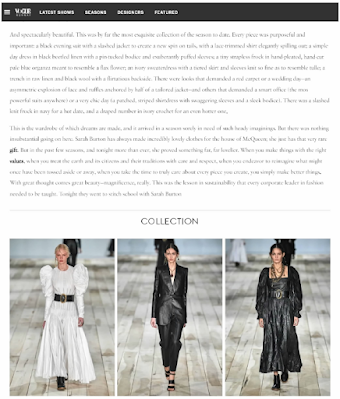
This case should be of interest to people working on contextual advertising. In one way, it's a replay of the Stewart v. Rolling Stone litigation, though the facts are more internet-oriented. Plaintiffs are fashion models whose runway appearances were featured in Vogue. “It is a truth universally acknowledged – so universally as to be worthy of judicial notice – that designers long to have their work featured in Vogue, and that the models who make their living exhibiting designer clothes aspire to have their photographs appear in the magazine – or, today, on its website or social media account.” Yet plaintiffs are suing Vogue, because Vogue has an agreement with the website Moda Operandi to link from Vogue to Moda if anyone wants to purchase the designer clothes featured in Vogue online stories.

example of editorial content with model images

“Plaintiffs believe that they should be paid by Vogue for the use of their photographs if the screen on which their visages are exhibited includes a link to Moda.” So they sued both Vogue and Moda for violations of NY’s right of publicity law and false endorsement under the Lanham Act. Where Moda used recognizable photos of the models on its own website, the claims survive, but Vogue’s own editorial content—even when coupled with links to Moda—was protected under Rogers.

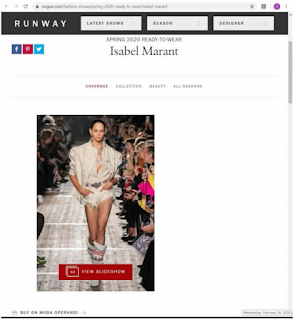
More facts: in 2019, Vogue published an online editorial feature about the 2020 Spring Ready-to-Wear collections, which included coverage of over 50 designers, whose names appear on the editorial’s homepage as hyperlinks to their individual sections, which have slideshows of photos from the designer’s show accompanied by editorial commentary and some additional photos. (“Interestingly, Plaintiffs plead no facts about the terms of their contracts with the designers who hire them to work the runway; the court acknowledges the very real possibility that those contracts govern how images captured from a fashion show are used.”)

Plaintiffs based their complaint on the fact that images appear on pages with links from Vogue to Moda. The cover page for each relevant designer’s collection displays “Buy on Moda Operandi” in small text under the slideshow/featured photo; this link goes to a Moda page featuring that designer. Also, when a viewer clicks through the slide show, each slide has a photo of one item as seen on the runway (that is, on the model). “[A] small red box containing the words ‘Shop This Look’ in white print is superimposed over the bottom of the photograph” for computer users, while the link appears at the bottom of the screen on mobile. Either way, clicking on the link also sends browsers to Moda’s designer page.

"buy on Moda Operandi" link at bottom (mobile)
"shop this look" example on a computer

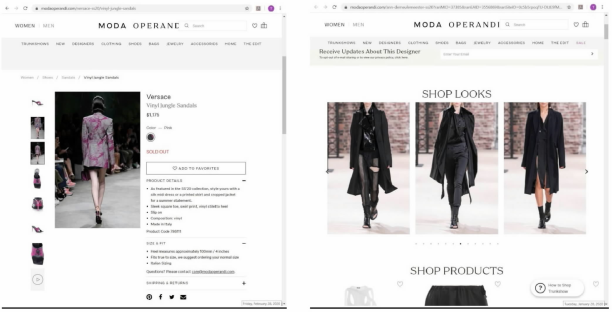
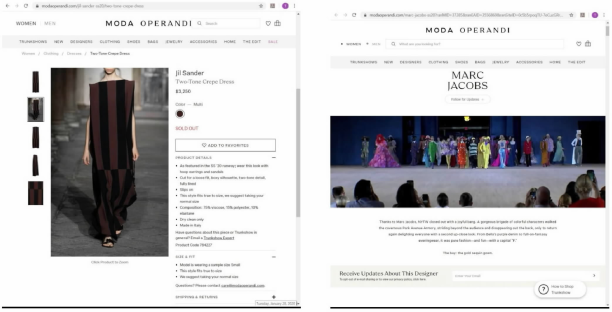
In addition, visitors can browse the “trunk show” on Moda’s website, which displays photos of models wearing a particular designer’s clothing on the runway.

Lanham Act claims: These were false endorsement claims that consumers might be confused into thinking that the models were affiliated, connected or associated with Moda’s brand, and that the models endorsed or promoted consumers’ use of Moda as a venue for buying the clothes they were wearing.

Claims against Vogue/Conde Nast were covered by Rogers, which applies whenever the “unauthorized use of another’s mark is part of a communicative message and not a source identifier,” including to “commentary, ... news reporting or criticism,” “i.e., content that cannot be deemed purely commercial.”

Vogue’s editorial feature “easily” fell within that category. Of course the links had a “commercial purpose.” But the purpose of the editorial, “viewed as a whole,” was reporting, not commercial speech. “The opportunity to purchase clothing is made available to the reader, but only in the context of a preview of the designer’s entire collection and journalistic commentary on that collection.” The links were small and not applied to each photo in the slide show [don’t see why that matters; ads take up a bunch of each hour of broadcast TV, for those of us who still do that sort of thing, but they don’t make the program they break up into commercial speech]. “Common sense tells us that this is not a simple advertisement.”  “It is a work of fashion journalism that, like every fashion magazine, happens to contain advertisements.”

Plaintiffs argued that the “Buy on Moda Operandi” and “Shop This Look” links were not incidental or extricable from the editorial, “because one could not delete them without altering the content of the editorial,” but so what? [Indeed, if commercial and noncommercial speech are inextricably intertwined, precedent dictates treating the speech as noncommercial, so this is a quixotic argument.] “[T]he question is not whether this journalistic feature could have run without including advertiser links; it is whether the photographs used by Vogue in the Runway Editorial are both artistically relevant to the journalistic (non-commercial) aspects of the expressive work and are not explicitly misleading.”

And of course the photos were neither irrelevant nor explicitly misleading. On relevance: “There is no better way to aid the reader in understanding the collections and Vogue’s commentary than to see pictures from the runway shows; and those pictures will necessarily include the models, whose headpieces, hair, and makeup are an integral part of any runway show.”

Explicitly misleading: No allegations supported this.

The only things that are explicitly represented on the allegedly offending pages are (1) this model wore this item of this particular designer’s clothing in a publicly viewed runway show, and (2) the viewer can purchase this particular item of clothing by pressing a link that takes her to some other website (since Vogue, as every reader knows, sells magazines, not clothes). These are not misrepresentations – they are true facts.” Any physical proximity between the pictures of Plaintiffs and either an explicit reference to Moda … or a link to Moda … is insufficient to create an explicit link between the Plaintiffs and Moda.

Separately, 37 of the plaintiffs, the ones whose photos appeared only in slideshows on vogue.com, failed to state a claim against Conde Nast because they didn’t plausibly plead confusion. Only 6 plaintiffs appeared on individual designer “home” pages in the editorial, which was the only place that Moda’s name appeared. The other 37 plaintiffs appeared only in slide shows, and “Moda” appeared nowhere on the pages of the slide show. “Shop This Look” wasn’t plausibly enough to constitute a misleading representation that they endorsed Moda. “For all the consumer knows, the hyperlink might connect to Amazon – or directly to the featured designer’s Madison Avenue store.” [I’m not sure this has ever come up before, but it does make some sense that the rule about unknown source only applies to acquisition/maintenance of trademark rights and not to infringement; hard to see how random confusion, if it existed, would do harm.] The only way for a consumer to find out about Moda would be to click the link and go to an entirely different website. “No reasonable factfinder could infer that a consumer who was browsing through one of the Vogue Runway Editorial slideshows decided to click on ‘Shop This Look’ because she thought the model wearing the outfit she liked had anything to do with Moda. … The only inference that can plausibly be drawn from the pictures of Plaintiffs containing a ‘Shop This Look’ link is that Plaintiffs are associated or affiliated with the clothes they modeled and/or the designers who created them.” And that’s true. “Simply by walking the runway wearing the clothes, Plaintiffs were advertising the items for sale.”

However, some Lanham Act claims against Moda survived, since Moda was just selling clothes.  “The model’s faces as seen on Moda’s website are not incidental to any non-commercial purpose, such that a consumer is unlikely to associate the model with Moda’s brand.” Although the court viewed the confusion argument—that the photos falsely represented the models’ endorsement of Moda as a preferred place to buy the clothes they modeled—as “highly unlikely to succeed,” it was not implausible. Still, the court dismissed all claims from models whose faces weren’t clearly shown on Moda’s site. Models who were only shown on Vogue’s site, or on Moda’s “(1) cropped so that the upper half of the face cannot be seen, (2) shown from the back, or (3) indiscernible because they are part of a crowd of models” failed to state a claim. “[T]he misappropriation of a completely anonymous face [cannot] form the basis for a false endorsement claim, because consumers would not infer that an unknown model was ‘endorsing’ a product.”  Further, “the very fact that their faces are not identifiable renders the allegation that Moda intended to trade on the good will associated with their personas totally implausible.”


cropped and not actionable

That left 25 plaintiffs who could at least give Polaroid a try, though one didn’t sufficiently allege that her face would be recognizable to the general public: “a model working the runway for the first time is not someone who can plausibly assert recognizability.” The court also commented that purchaser sophistication favored Moda, “as it is unlikely that individuals who can afford to purchase designer clothing and who follow fashion design would be easily misled about what it was that the plaintiff models were, and were not, doing.” However, the fact that Moda cropped some images and not others supported an inference that Moda might have had an intent to capitalize on certain models’ recognizability.

NY right of publicity: First, the court kicked out all claims by non-domiciliary plaintiffs. The remaining claims against Moda remained live. [Edited to reflect what's in Conde Nast's filings] For whatever reason, the court didn't engage with Conde Nast's argument that NY’s ROP doesn’t cover editorial content, so the court retained supplemental jurisdiction over the state law claims against Conde Nast, though unhappily. (Conde Nast has moved to dismiss those claims again on newsworthiness grounds, and it's hard to see them surviving; I also think Rogers, itself a ROP case, albeit from a different state, would preclude the claims.)


Helados Mexico and La Michoacana don't suggest Mexican origin to reasonable consumers

Romero v. Tropicale Foods, LLC, No. EDCV 21-1165 JGB (SHKx), 2021 WL 6751908 (C.D. Cal. Dec. 22, 2021)

Plaintiffs brought the usual California claims (and NY claims) against Helados Mexico and La Michoacana paletas, or ice cream products, alleging that they deceived consumers into thinking that they were made in Mexico.

The court held that the complaint didn’t plausibly allege that a reasonable consumer would be misled, particularly by the use of Spanish terms and phrases. Plaintiffs focused on the following arguments: “Helados Mexico” translates into “Mexican Ice Cream,” “Mexico” is featured prominently on the label, along with Spanish phrases describing the type of ice cream, and a “traditional Mexican ice cream cart.” For La Michoacana packaging, plaintiffs focused on: (1) the Spanish name of the product, which translates into “the woman from Michoacan,” a state in Mexico “known for” its paletas; (2) a girl wearing a “traditional garment,” (3) the use of “authentic Mexican flavors” (plaintiffs’ characterization, not a phrase used on the products; the court commented that such a phrase would have tilted in their favor) and (4) “other Spanish words.” The court considered all these “holistically” but also broke them into parts.

Helados Mexico Premium Fruit Bar/Paleta de Fruta "Con Chamoy"
La Michoacana Variedad/Variety pack

Names: “Helados Mexico” does not translate into “Mexican Ice Creams” because “Helados” is plural while Mexico is singular. “Instead, it translates inelegantly to ‘ice creams Mexico.’” “La Michoacana” does translate to “the woman from Michoacán,” but doesn’t include “helado” or “helados” or “ice cream” that would imply that the ice creams were created in Michoacán. “Plaintiff does not cite to any authority which holds, or even suggests, that products named in foreign languages are, by default, deceptive to a reasonable consumer.” A name including Mexico or Michoacán is insufficient to allege that reasonable consumers could be deceived; something more is required, like a specific origin year paired with a place name to suggest that the product is still being made there (citing a case about chocolates holding that “Belgium 1926” represented “both the provenance of the company...and a representation that its chocolates continue to be manufactured there”).  

Were the product descriptions on the packaging the necessary “something more”? No. It wasn’t sufficient that they were in Spanish; on the La Michoacána package, the court described them as “Spanish translations of English product descriptions,” e.g., “Fresas con Crema”/“Strawberries & Cream” and “Paletas”/“Bars.” On the Helados Mexico package, “Con Crema” and “Strawberry/Fresa” were in Spanish only, while other phrases were in both languages. These were ordinary translations, not “Spanish idioms or some other type of phrase that may mislead a consumer about the products origin, such as ‘A Taste of Mexico’ or ‘Authentic Mexican Ice Cream.’” Even if some “Spanish phrases” are sufficient to make it plausible that ackaging misleads reasonable consumers about its origin, “it is far less likely to be the case when (1) the phrases are translations and (2) affirmative representations are only in English.”

Nor were the products’ images “something more.” The plaintiffs focused on the Helados Mexico cartoon cart, allegedly a “traditional Mexican ice cream cart” and the La Michoacána cartoon woman, who wears a “traditional Mexican garment.” Plaintiffs failed to explain the traditional background of the garment, or why a cartoon of an “ice cream cart” was “Mexican,” let alone “traditional” enough to evoke Mexico “(other than viewing through a particularly Anglo-American lens about what makes a community identifiable via caricatures).” Regardless, “[n]either image evokes ‘Mexico’ in such a way that would deceive a reasonable consumer into the belief that the products are manufactured there.” A cartoon “Mexican ice cream cart” wasn’t the same sort of representation of “tradition” or “authenticity” as one such as “Belgium 1926,” “which implies a longstanding history of production and manufacture in a particular origin.” It simply can’t be the case that “any symbol that has some widely accepted connection with Mexico,” like a cartoon sombrero, could be misleading. Prior cases focused on very specific symbols of authenticity such as a Mexican flag and the word “authentic” superimposed on that flag, or a map of a place with an “open invitation” to visit on the package, or even a picture of fruit that suggested the presence of fruit in the snacks.


Monday, January 31, 2022

Ambiguity of claim made to sophisticated buyers defeats software ad suit

TocMail Inc. v. Microsoft Corp., 2021 WL 6750789, No. 20-60416-CIV-CANNON/Hunt (S.D. Fla. Dec. 21, 2021)

Though TocMail made it past a motion to dismiss, it failed at the summary judgment stage in its claim that Microsoft falsely advertised its link scanning service’s capabilities, thus locking TocMail out of a big market. Safe Links is part of Microsoft’s anti-phishing and anti-malware Defender package. It began as a list of dangerous URLs, and later added a reputation/ “detonation” check that analyzes the content linked to by the URL. Hackers’ security evasion techniques include using a visitor’s IP address to determine whether that visitor is a human user or security software and then display different content accordingly, so that a visit from Microsoft’s IP range sees only anodyne content while the actual email recipient would get malware if they clicked; such IP evasion is “common” today. Internally, Microsoft recognized this as a problem as early as 2010 and the problem escalated around 2018, when it launched a new feature that was intended to help counteract IP evasion.

Challenged advertising: (1) "Sophisticated attackers will plan to ensure links pass through the first round of security filters. They do this by making the links benign, only to weaponize them after the message is delivered, altering the destination of the links to a malicious site.... With Safe Links, we are able to protect users right at the point of click by checking the link for reputation and triggering detonation if necessary." (2) "[A]ttackers sometimes try to hide malicious URLs within seemingly safe links that are redirected to unsafe sites by a forwarding service after the message has been received. The ATP Safe Links feature proactively protects your users if they click such a link. That protection remains every time they click the link, so malicious links are dynamically blocked while good links can be accessed." (3) “Ensure users are protected against URLs that redirect to malicious sites. Safe Links will proactively protect your users every time they click a link, ensuring malicious links are dynamically blocked even if they are changed after the message has been received.”

In context, the court determined, these claims weren’t literally false. “Statements that have an unambiguous meaning, either facially or considered in context, may be classified as literally false.” TocMail argued that the ads were literally false because they necessarily and falsely implied that Safe Links “provides effective protection” against URLs that use IP evasion. Meanwhile, Microsoft’s own internal communications identified “gaps” in protection based on IP evasion that could be “easily” bypassed.

Microsoft argued that it didn’t present Safe Links as a solution to IP evasion or guarantee that Safe Links would block every single type of attack every single time, and that (3)’s “[e]nsure document hyperlinks are harmless with ATP Safe Links” was puffery. Microsoft emphasized that the intended audience was technologically sophisticated and, it argued, would not interpret the ads as promising impervious protection. The court rejected the puffery argument: “Although Message #3 is vague and generalized, the Court does not find that the word ‘ensure’ is non-actionable puffery since it is neither a statement of superiority nor quite so exaggerated that no reasonable consumer would be justified in relying upon it. The record demonstrates that at least some Microsoft customers have the ‘common misapprehension’ that ‘no phishing emails ... should reach users.’”

The court then found the ads ambiguous. One possible interpretation was that they just “describe at a basic level what Safe Links does,” including checking when a user clicked on a link. This was a reasonable interpretation in context because other statements in the ads “undercut the impression that Microsoft is promoting 100% protection,” e.g., stating that Safe Links “mitigate[s] malicious content” and “helps prevent users from going to malicious websites when they click them in email” or “No solution is 100% effective, and that makes it important to have an ‘assume breach’ mindset.”

TocMail argued that the ads promised “effective protection,” especially (3), and that was definitely possible, but in context it was only one of the reasonable interpretations of the ads, especially given that Microsoft was advertising to “business enterprise customers, with the intended audience consisting of IT professionals well-versed in the cybersecurity industry,” which fundamentally understands “the reality that security threats are ‘constantly evolving.’” So a reasonable audience could interpret even “ensure” as not guaranteeing 100% threat avoidance. [Microsoft successfully framed this issue: one alternative would be whether “effective” here means “not ignoring known problems.”]

Thus, TocMail needed to present evidence of actual deception, and it didn’t. There wasn’t consumer survey evidence or other expert testimony about deception. Microsoft’s internal documents did reveal one customer question that raises IP evasion as a possible security concern: “[w]hy is an IP-address range used which is easily attributable to Microsoft?” In response, Microsoft touted its use of some IP anonymization and other monitoring activities “to ensure effectiveness,” as well as its “explor[ation of] new ideas.” But the question didn’t show that the customer was deceived into thinking that Microsoft’s product provides foolproof protection against IP evasion.

Tuesday, January 25, 2022

does disparaging a company cast its principal in a false light?

Chaverri v. Platinum LED Lights LLC, 2022 WL 204414, No. CV-21-01700-PHX-SPL (D. Ariz. Jan. 24, 2022)

Plaintiffs (Mito Red) sell red-light therapy products online, in competition with Platinum (which uses the Volkin defendants’ marketing services). Platinum allegedly hired the Volkin defendants to “engage in a strategic defamation campaign online designed to ruin Plaintiffs’ professional reputation and to divert Plaintiffs’ customers away from their products and to Platinum’s competitive products.”

Among other things, Mito Red alleged that blog posts/video such as “Mito Red Light Therapy Scam: What Are They Lying About?” misrepresented their status as neutral reviews or critiques when in fact they were not, and that Platinum told customers that Mito Red “fabricates statistics, uses different LEDs than claimed, and that the lights are cheap and/or low quality knockoffs of Platinum’s lights.”

The statement that “Leaders come first and then all the followers. Mito Red here is the follower” was puffery. Likewise, Mito Red didn’t sufficiently plead falsity as to a blog post that said that Mito Red claims to have up to a three-year warranty even though other parts of its website “say[ ] otherwise,” and that as a result, customers “might just get scammed” out of redeeming their warranties based on “loopholes” on Mito Red’s website. Though the complaint alleged that Mito Red’s warranty terms are clearly stated on its website, that didn’t address the arguably falsifiable part of the statement—that parts of the Mito Red website cut back on the three-year warranty—and the rest was puffery because uncertain terms like “might” and subjective terms like “scam” and “loophole” were generic and vague.

Statements that “Mito Red literally ripped off [Platinum’s] design” and that “[Mito Red] literally took the framing construction of the Platinum LED lights and just changed the logo on the side. Other than that, it’s the exact same as far as a construction standpoint” were, however, sufficiently alleged to be falsifiable given the use of the word “literally” and the reference to specific product characteristics. “Hopefully, from a legal perspective [Mito Red] will get caught,” required more analysis: it came after “a section of the video in which the narrator alleges that Mito Red’s products use three-watt bulbs, which are less powerful than the five-watt bulbs Mito Red says it uses.” Relying on an earlier case with similar “hope” language, the court found it plausible that the statement could be understood as a statement of fact that Mito Red was acting criminally, making it actionable.

But this was “imprecise, generic, and vague” and thus puffery: “The design of the Mito Red Lights devices is not unique either, they mostly take the designs of their competitors’ devices and then use that in their own devices. And they are not providing the customers with anything new with an act like that.”

For other statements about the wattage/irradiance of Mito Red’s products, it was not conclusory to allege that Platinum’s statements were false because the products were truthfully advertised as five watts: that alleged falsity even if there could be a factual dispute over measurement.

The same results followed for the defamation claims.

Interestingly—and it seems to me wrongly—the court likewise refused to dismiss false light invasion of privacy claims brought by Chaverri, even though he was never named, because “statements made about Mr. Chaverri’s business certainly concern him and are about business matters for which he was directly responsible—a fact reasonably discerned from his role at Mito Red. It is plausible, from the facts alleged in the SAC, that the statements created a false implication about Mr. Chaverri even though he was not expressly mentioned.” A false light claim requires “a major misrepresentation of the plaintiff’s character, history, activities, or beliefs, not merely minor or unimportant inaccuracies.” “[A]llegations of negative reviews by a competitor suffice to plausibly state a claim for false light in this case.”


Friday, January 21, 2022

pleading falsity when ads use peer-reviewed scientific study

Guardant Health, Inc. v. Natera, Inc., 2022 WL 162706, No. 21-cv-04062-EMC (N.D. Cal. Jan. 18, 2022)

Guardant sued its competitor Natera over an alleged “campaign of false and misleading advertising directed at” Guardant’s new product Reveal, a liquid biopsy cancer assay for early-stage colorectal cancer (CRC). Natera then filed amended counterclaims alleging a “campaign of false and misleading commercial statements regarding the performance of [Reveal].”

Apparently, a “detailed factual background” can be found in the court’s sealed order denying Natera’s motion for a preliminary injunction, but you and I can’t know it.

The parties offer competing diagnostic tools for CRC—Guardant’s “tumor-naïve” Reveal and Natera’s “tumor-dependent” Signatera assay. Guardant bases its contentions that Reveal works on “[p]eer reviewed data published by Parikh, et al., in the journal of Cancer Research.” Thirty-eight of the 43 authors who undertook the study are affiliated with Massachusetts General Hospital and the remaining five authors are Guardant personnel. 

The Parikh Study evaluated if tests such as Reveal, can detect circulating tumor DNA “with clinically meaningful specificity and sensitivity.” (Specificity: true/false negatives; sensitivity: true/false positives.) The Study allegedly “shows that Reveal offers 91% recurrence sensitivity (i.e., ability to identify which patients will recur based on ctDNA detection) and 100% positive predictive value for recurrence (i.e., all patients Reveal identified as having a ‘positive’ ctDNA test result later recurred).” Of 27 patients who recurred and were counted, Reveal detected ctDNA in 15 of them, resulting in calculated sensitivity of 55.6% and specificity of 100%. After “incorporating serial longitudinal samples” the sensitivity for recurrence prediction improved to 69% and after incorporating “surveillance” samples the sensitivity improved to 91%.

Natera challenged an email from Guardant’s sales team to physicians around the country that said:

“Reveal has higher specificity than CEA [carcinoembryonic antigen tests, which are the current standard of care] in the surveillance setting;

Reveal has a 91% sensitivity in the surveillance setting;

Reveal’s PPV [positive predictive value] is 100% and can have benefits in patients with stage 2 colorectal cancer, including identifying patients who may benefit most from adjuvant therapy;

and Reveal has a greater lead time for detecting MRD [minimal/molecular residual disease] than current methods.”

The court denied a TRO because it was not clear that Guardant’s statements were literally false.

Since these were “clinically proven” claims, they could be shown literally false either by “attacking the validity of the defendant’s tests directly or by showing that the defendant’s tests are contradicted or unsupported by other scientific tests.” If the plaintiff can show that the tests, even if reliable, do not establish the proposition asserted by the defendant, “the plaintiff has obviously met its burden” of demonstrating literal falsity.

However, 9th Circuit precedent doesn’t directly address “whether the test for falsity is altered where the challenged statements relate to a scientific peer-reviewed study.” In ONY v. Cornerstone, the Second Circuit held that there was what this court described as “a safe harbor” for “conclusions from non-fraudulent data, based on accurate descriptions of the data and methodology underlying those conclusions, [and] on subjects about which there is legitimate ongoing scientific disagreement,” holding that these kinds of “statements are not grounds for a claim of false advertising under the Lanham Act,” where they were “presented in publications directed to the relevant scientific community, ideally in peer-reviewed academic journals that warrant that research approved for publication demonstrates at least some degree of basic scientific competence.” Scientists, not courts, should decide such disputes. But ONY didn’t extend the safe harbor to situations where the study at issue was “fabricated” or “fraudulently created” because if “the data were falsified, the fraud would not be easily detectable by even the most informed members of the relevant scientific community.”

The 5th Circuit further declined to apply ONY in situations “where the challenged statements are directed at customers instead of the scientific community.” As the court noted, “Advertisements do not become immune from Lanham Act scrutiny simply because their claims are open to scientific or public debate. Otherwise, the Lanham Act would hardly ever be enforceable ....”

The 9th hasn’t embraced the “deferential” ONY approach or the 5th Circuit’s gloss, but apparently the court here did rely on ONY in denying a preliminary injunction, though we don’t know its full reasoning. It apparently held that there were “compelling reasons to conclude that claims based on the validity of the Parikh Study—or any other peer-reviewed, non-fraudulent scientific study—are likely ‘non-actionable’ in the context of false advertising.” Still, the standard 9th Circuit approach was relevant at the pleading stage, where Natera didn’t have to show that the challenged statements were literally false, only that it was plausible that they were.

Natera alleged that the Parikh Study was based on fraudulent data and inaccurate descriptions of the data and methodology. The claims were plausible under either ONY or the the [governing?] 9th Circuit Southland Sod approach.

First, Natera successfully alleged that several statements were literally false because they were unsupported by the Parikh Study. [Details omitted, but Natera successfully alleged, among other things, that Guardant was using differing definitions of various key terms and mixing and matching results in unacceptable ways.]

It was also plausible that Guardant’s marketing statements falsely and misleadingly touted benefits of Reveal for “early-stage” CRC patients because the Parikh Study included at least 19% late-stage patients and did not make any conclusions specific to “early-stage” cancer patients. Although these claims didn’t cite the Parikh Study, it was the necessarily implied source because it was the “only possible source of such comparisons.” Guardant argued that a claim about Reveal does not necessarily have to be based on the Parikh Study because “[d]rug, device, and testing companies often rely on in-house testing and data-on-file.” But the Parikh Study was the only published study on Reveal, making it plausible that Guardant necessarily implied reliance on it. And it didn’t support those claims. For example, its claims about early-stage patients plausibly wrongly conflated early detection of recurrence after treatment with early-stage cancer.

Separately, Natera successfully pled that the study’s data and methodology themselves were fraudulent. It alleged that (1) the Parikh Study said it looked only at “patients with evaluable ‘surveillance’ draws, defined as a draw obtained within four months of clinical recurrence” but it included patients with draws outside of four months to improperly boost Reveal’s performance (its 4-month cutoff was applied only to false negatives, not to true positives, meaning that 7 of 9 false negatives were excluded and raising sensitivity from 69% to 91%); (2) it said that “ctDNA analysis was performed blinded to the clinical data” but Guardant’s internal documents allegedly showed that Guardant performed ctDNA analysis unblinded to the clinical data; and (3) it said that it was a “single-institution prospective study” but Guardant’s internal documents allegedly showed that Parikh provided samples for analysis by Guardant after the fact and that Guardant retrospectively conducted ctDNA analysis. This satisfied both ONY and Southland Sod. “Where false advertising claims allege that the study’s conclusions are based on inaccurate descriptions of the data and methodology, the claims can be grounds for a claim under the Lanham Act.” That would be less plausible if the study disclosed its potential shortcomings, per ONY.

Guardant argued that the study’s practices on (1) were ok, but the problem was that it didn’t disclose this methodology, creating a factual issue of deception. There were also problems with the study saying that it borrowed its “surveillance” methodology from a prior paper that in fact used a different definition. Guardant argued that even if the study misconstrued the prior study, mistake isn’t the same as fraud. “But the issue here is not whether Guardant made a mistake but whether the Parikh Study improperly failed to disclose its interpretation of the Reinert study’s methodology.”

And Natera sufficiently pled that the alleged falsehoods in the Parikh Study were attributable to Guardant. [It’s not clear to me why this would be required. If the study is garbage, then it doesn’t support the claims that Guardant made, which is all that’s required; knowledge of falsity is not an element of Lanham Act false advertising.]

The discussion of blinding is heavily redacted but, we are told, Natera sufficiently alleged that the Parikh Study fraudulently described its methodology as a blinded analysis when in fact Guardant used unblinded data and modified results to improve Reveal’s performance. So too with the description of the study as “prospective” even though Guardant allegedly manipulated methodology and data post hoc. Guardant’s dispute over what “prospective” means was a factual one.

Wednesday, January 19, 2022

Amicus in Green v. DOJ challenge to 1201

The EFF is litigating a First Amendment challenge to 1201's access control provisions. Pam Samuelson and I filed a brief in support of that challenge. My thanks to Catherine Crump, Erik Stallman, and Tait Anderson of Berkeley's  Samuelson Law, Technology & Public Policy Clinic, who did great work on the brief.

Amicus in ASU v. Doe

ASU sued Doe over a dumb Instagram account, "asu_covid_parties," and correctly lost its TM claims despite Doe's default. Undeterred, ASU appealed. Eugene Volokh and his students have filed an amicus supporting the result below and one of the students will argue the case--an excellent opportunity. Mark Lemley, Mark McKenna, James Weinstein, and I also filed an amicus brief pointing out that, even if there had been a party (there wasn't), it still wouldn't have infringed ASU's trademarks. Although doctrines like Rogers v. Grimaldi and nominative fair use support this result, the deeper core is that the Lanham Act shouldn't be read to cover noncommercial speech in the first place.

are fake reviews actionable if the review content is just puffing?

Marksman Security Corp. v. P.G. Security, Inc., 2021 WL 649821,  No. 19-62467-CIV-CANNON/HUNT (S.D. Fla. Oct. 12, 2021) (R&R)

The magistrate judge joins the split over fake reviews, adopting the position—which I think is wrong—that concededly fake reviews that only include puffery in their content are nonactionable, despite the non-puffing fact of whether the reviews reflect an actual experience with the reviewed product/service.

Marksman sued defendants, who compete with it to provide private security and concierge services in South Florida, for creating an Instagram account that bore Marksman’s name, as well as purchasing domain names similar to Marksman’s that when accessed sent consumers to defendants’ website instead (e.g., marksmensecurity.com and some other TLDs). The magistrate recommended finding an ACPA violation and awarding attorneys’ fees (there was some litigation misconduct).

The Instagram “Marksmansecurity” account, which used Marksman’s logo, said: “We claim to be the best security company but we are not! Our employees steal from clients, we lie to our clients and we sue them if need be.”

Also, defendants paid acquaintances and other people $10 to post five-star positive reviews online about Defendant PG’s services on Google.

Reviews paid for by the reviewed party were commercial speech.  And the reviews were false: “Defendants paid for positive reviews from at least three individuals who never lived in a building that Defendant PG serviced. … These reviews are false and misleading representations of Defendants’ services.” But the reviews were not material because they contained only puffery: the “best,” “great company,” “great company to work for,” and keep “buildings safe and comfortable.” I don’t see how this makes sense: puffery can influence consumers, which is why businesses use it, and a consumer who knew the truth—that these reviews were not posted by people who had actually used the services—would certainly discount them. But anyway—plaintiffs also couldn’t show injury in lost sales or otherwise.

The judge didn’t explicitly rule on the Instagram account, but denied injunctive relief because the account had been deleted and the domain names transferred. However, it did find that this case was exceptional, with reasoning that seems quite cursory: the domains were purchased in bad faith, and “Defendants deliberately engaged in actions using Plaintiff’s marks for their own profits. Regardless of whether Defendants were successful, such actions qualify this case as an exceptional one.”


False advertising-based antitrust claims against Facebook survive motion to dismiss

Klein v. Facebook, Inc., 2022 WL 141561, No. 20-CV-08570-LHK (N.D. Cal. Jan. 14, 2022)

Once in a blue moon, a false advertising-based antitrust claim survives a motion to dismiss in a circuit that imposes a list of excessive requirements on such claims.  That time has come for Facebook. Consumers and advertisers adequately alleged that Facebook has monopoly power in social network/social media (consumers) and social advertising markets. Though I’ll detail the advertising-based claims below, I will also note that the court did dismiss claims based on Facebook’s “Copy, Acquire, Kill” strategy as untimely. Advertiser claims based on Facebook’s Network and Bidding Agreement with Google also survived, while the court dismissed consumers’ unjust enrichment claims with leave to amend.

Plaintiffs successfully alleged that “Facebook acquired and maintained monopoly power by making false representations to users about Facebook’s data privacy practices.” The complaint pled a lot of specifics about how much consumers cared about privacy; how much Facebook advertised its privacy practices as better than they were; and how bad they actually were.

False advertising can violate the Sherman Act if a monopolist’s representations about its own products or its rivals’ products “were [1] clearly false, [2] clearly material, [3] clearly likely to induce reasonable reliance, [4] made to buyers without knowledge of the subject matter, [5] continued for prolonged periods, and [6] not readily susceptible of neutralization or other offset by rivals.”

Falsity: There’s a lot of detail I’m skipping, but in essence, Facebook knew that users wanted privacy and advertisers wanted users not to have privacy, so it concealed the extent of its data use, allowing it to “beat out companies that were truthful about their user data practices or did not collect and sell user data.” “Indeed, Facebook’s initial success in the Social Network and Social Media Markets arose directly from competitors’ failure to keep users’ data private,” particularly Myspace’s. Representative Zuckerberg quote (of which there are many): “I founded Facebook on the idea that people want to share and connect with people in their lives, but to do this everyone needs complete control over who they share with at all times.” Meanwhile, it was collecting and selling user data to third parties in ways that did not match its public representations. E.g., it used Beacon to track users who clicked “No, Thanks” to purportedly opt out; provided user data—and the data of users’ friends—to third party developers despite claiming in multiple fora that “Facebook does not give advertisers access to people’s personal information”; etc. etc. Even after the 2011 FTC settlement, it deceptively tracked users and gave data to third party developers.

The complaint also alleged in detail how these deceptions helped FB obtain and maintain monopoly power. For example, it defeated Google+ in part because of privacy concerns, along with network effects. In fact, “Facebook realized that it could not allow users to find out about Facebook’s privacy practices while Google+ was a viable alternative,” e.g. an executive stating that “it would be unwise to remove privacy protections because ‘IF ever there was a time to AVOID controversy, it would be when the world is comparing our offerings to G+.’” The executive stated that FB could remove those protections after “the directive competitive comparisons begin to die down.”

This “clear[]” falsity was alleged with sufficient particularity. Analogizing to securities fraud, the court required clear falsity to be a material misrepresentation/omission that was capable of objective verification, as opposed to puffery. “Indeed, the Ninth Circuit’s statement that misrepresentations are anticompetitive only if they are ‘clearly false’ and ‘clearly material’ mirror the basic requirements of a securities fraud claim.” Likewise, Rule 9(b) pleading requirements provided a structure for identifying the requisite clarity. Although several of the representations identified were puffery (“[k]eeping the global community safe is an important part of our mission – and an important part of how we’ll measure our progress going forward”), many were not, specifically representations that FB wasn’t sharing private information with third parties; statements about the Beacon tool; and statements that FB didn’t use cookies to collect users’ data for commercial purposes.

Were the claims timely? Non-original observation: If techniques are used to obtain monopoly power, that seems inherently in tension with requiring claims to be brought very quickly. Anyway, the claims weren’t time-barred on the face of the complaint. The limitations period is four years, but the “period of limitations for antitrust litigation runs from the most recent injury caused by the defendants’ activities rather than from the violation’s inception.” To qualify as an “overt act,” the act that restarts the limitations period must satisfy “two criteria: 1) It must be a new and independent act that is not merely a reaffirmation of a previous act; and 2) it must inflict new and accumulating injury on the plaintiff.” (The argument that each misrepresentation about privacy is a mere reaffirmation seems inherently in tension with the big claim of big tech that competition is "only a click away," since continued belief in the representations is necessary to avoid that click.)

The relevant date here was December 3, 2016, and the consumer plaintiffs adequately alleged at least two false representations after then. First, on February 2, 2017, Facebook stated in an SEC filing that Facebook provides only “limited information to [third party application developers] based on the scope of services provided to us.” Second, in March 2018, Zuckerberg called the Cambridge Analytica incident a “mistake,” pledged to take action against “rogue apps,” and stated that “[w]e have a responsibility to protect your data, and if we can’t then we don’t deserve to serve you.” These were adequately alleged to be clearly false, since the 2017 statement “would have given reasonable users the impression that Facebook was not providing third party applications with private information,” whereas Facebook had in fact provided users’ private information to numerous third party applications, including applications for which users were not registered. “For example, although Cambridge Analytica had only 270,000 users, Cambridge Analytica ‘was able to access the personal data of up to 87 million Facebook users.’” Zuckerberg’s statement likewise would have given reasonable users the impression that Cambridge Analytica was a “rogue app” and that Facebook had not been systematically providing users’ private information to third party application developers, but at least 10,000 applications had been able to access similar data for the entire period since the FTC settlement.

FB argued that its false statements after 2016 were mere reaffirmations of a previous strategy, not new and independent acts.  But an act is not a reaffirmation “simply because the defendant has previously committed the same type of act as part of a unified anticompetitive strategy.” The Ninth Circuit has clearly held that “if a defendant commits the same anticompetitive act multiple times, each new act restarts the statute of limitations for all the acts.”

The complaint also sufifciently alleged that the new false representations allowed Facebook to maintain a “critical mass of users” “by convincing users that Facebook was protecting their data.” After all, “improperly prolonging a monopoly is as much an offense against the Sherman Act as is wrongfully acquiring market power in the first place.”

Further, the consumers adequately alleged that the false statements were “ ‘not readily susceptible of neutralization or other offset by rivals.’ ”  From the existing cases, the court derived a perfectly understandable principle that technical product aspects that are difficult for customers to confirm are “not readily susceptible of neutralization.” When “any customer who tried to obtain the defendant’s services could discover that this representation was false,” by contrast, the falsity was readily capable of neutralization. Plaintiffs successfully alleged that the deceptive privacy practices could not have been revealed “by anybody without significant technical expertise.” Indeed, plaintiffs pled that “even sophisticated third parties, such as developers and search engines, cannot access user data without Facebook’s permission, let alone determine what Facebook is doing with user data.”

While FB argued that other firms “could have improved their own policies, or called attention to Facebook’s supposed misstatements,” it didn’t explain how rival firms could have known that Facebook’s statements were false when Facebook made them. “[T]here was no publicly available information that Facebook’s rival could have consulted to determine whether Facebook’s representations about its data privacy practices were true.”

Clearly material: FB argued that the consumers didn’t explain how “Facebook’s alleged misrepresentations prevented other well-resourced firms—like Google or Snapchat—from competing effectively.” Plus, there were other “competing theories for Facebook’s success,” “including Facebook’s ‘realness,’ which is alleged to be Facebook’s ‘distinguishing feature.’ ” But the Ninth Circuit has set out a comprehensive test for whether false advertising can violate the Sherman Act, see above, and alternative explanations aren’t part of the test where materiality is present. Both securities fraud and Lanham Act cases extensively address materiality, and the court used them as guidance: materiality means likelihood of influencing consumer decisions, so “clearly material” requires plaintiffs to show that “customers would consider the representation important in deciding whether to use the defendant’s product or that the representation was likely to influence customers to use the defendant’s product.”

Plaintiffs did that. For example, consumer surveys showed the importance of privacy, and FB’s own statements repeatedly recognized that users would not use Facebook unless Facebook promised privacy protections. E.g., Zuckerberg explained that the reason “Facebook became the world’s biggest community online” was that Facebook “made it easy for people to feel comfortable sharing things about their real lives.” Under these circumstances, it was “more than plausible” that users would have considered these representations important in determining whether to use Facebook.  

There was no requirement that the falsity be the “but-for” or sole cause of consumer behavior, as FB argued. And indeed, FB’s argument ignored that privacy was the foundation of its purported alternative causes—the consumers alleged that FB’s representations about its data privacy practices were essential to creating Facebook’s “realness,” starting with its initial limitation to people who could verify that they were part of college communities.

Causal antitrust injury: The consumers alleged that Facebook’s monopolization of the Social Network and Social Media Markets harmed users because, without competition, Facebook can extract additional “personal information and attention” from users. A cognizable antitrust injury includes harm to a plaintiff’s “business or property.” Consumers adequately alleged that their “information and attention” had sufficient material value to constitute harm to “property,” given that those things have material value to advertisers. “In other words, users provide significant value to Facebook by giving Facebook their information—which allows Facebook to create targeted advertisements—and by spending time on Facebook—which allows Facebook to show users those targeted advertisements.” Indeed, FB’s revenue per user in the US in 2019 was over $41, making the material value of consumers’ information and attention undeniable. Even without FB’s own estimates, the consumers identified other companies willing to pay users for information and attention.

And consumers adequately alleged causation: Had FB not eliminated competition in the social markets, they would have been able to “select a social network or social media application which offers consumers services that more closely align the consumers’ preferences, such as with respect to the content displayed, quantity and quality of advertising, and options regarding data collection and usage practices.” In more competitive markets, some companies pay users for their data. For example, “[w]hen consumers agree to use Microsoft’s ‘Bing’ search engine and allow Microsoft to collect their data, Microsoft ... compensates consumers with items of monetary value.” Plus, with more competition, FB itself would plausibly have collected less data as part of the bargain: The fact that FB acted more hesitantly when G+ was around was indicative of that.

Relatedly, consumers’ request for injunctive relief was not barred by laches, given the timeliness of the claim. FB argued laches because its 2011 FTC settlement was public. But when claims are timely, “the strong presumption is that laches is inapplicable.” Moreover, FB failed to explain why consumers would know, because of the 2011 settlement, that FB continued to deceive them thereafter.


Tuesday, January 18, 2022

"false association with EPA" claim can be brought by competitor

ISK Biocides, Inc. v. Pallet Machinery Group Inc., No. 3:21-cv-386, 2022 WL 122923 (E.D. Va. Jan. 12, 2022)

The parties compete in the market for wood protection products. ISK alleged that defendants misrepresented the safety, environmental impact, and regulatory status of their products. The court denied the motion to dismiss the Lanham Act claims but kicked out the coordinate Virginia state law claims.

Wood pallets, widely used in the supply chain, are at risk for mold, mildew, and fungus, which is bad for cargo and workers. Fungicides like those sold by the parties are one answer. FDA and EPA share regulatory authority—because pallets are used for food—but EPA does the lion’s share of the work. The delightfully named Federal Insecticide, Fungicide, and Rodenticide Act (FIFRA) requires fungicides—which are pesticides under the law—to be registered by the EPA to be sold.

According to the complaint, one of defendants’ products has a hazardous ingredient, IPBC, that “has been found to have certain adverse effects” on humans, “including irritation, sensitivity, and toxicity to various systems,” even at a concentration of 0.5. EPA advises that those who handle products containing IPBC wear personal protective equipment such as “long-sleeve shirt[s] and long pants, chemical-resistant gloves, [and] shoes plus socks.” Others have a different ingredient, OIT, which allegedly “is harmful if swallowed, toxic in contact with skin, causes severe skin burns and eye damage, may cause allergic skin reactions, and is toxic if inhaled.” Thus, people handling products containing OIT should wear gloves, safety goggles, a face shield, and body protection. OIT is on the EPA’s Safer Chemical Ingredients List, but the EPA notes that OIT “is not associated with a low level of hazard concern for all human health and environmental endpoints.” Moreover, ISK alleged that none of the products are registered as pesticides with the EPA.

ISK challenged various ad claims; the court focused on a few.

For example, it was plausibly false/misleading to advertise that users handling one of the products “need not wear protective equipment.” Since defendants’ data sheet said that it contained a maximum of under 10% of IPBC, it was reasonable to infer that it was at least 0.5% of the product, which was allegedly enough to have adverse effects on humans. Given the EPA’s advice about using protective equipment, the complaint plausibly alleged falsity.

Moreover, an ad on a public Facebook page that referred customers to the data sheet was a commercial advertisement within the meaning of the Lanham Act; it was intended to bolster sales and was “sufficiently disseminated” to fall within §43(a)(1)(A). Proximately caused injury was also plausible because the lack of need for personal protective equipment could plausibly drive sales that would otherwise have gone to ISK.

Likewise, against the other defendant, an ad that it plausibly placed in Pallet Central Magazine which said that “WoodLock Bio-Shield Mold Inhibitor is safe for employees and machinery” was also plausibly false advertising. [Side note: I am endlessly pleased by the existence of these niche industry publications. There’s a magazine for pallets! I can only assume that there actually is a magazine for storage jars out there.] Defendants argued that their products were safe for employees “because the products do not exhibit the same characteristics as the hazardous ingredients they contain.” Although this might be borne out by discovery, ISK sufficiently alleged falsity at this stage.

Contributory false advertising: The court predicted that the Fourth Circuit would recognize contributory false advertising, because it recognizes contributory trademark infringement and both causes of action stem from the Lanham Act.

ISK adequately alleged contributory false advertising claim against defendant J&G by alleging that defendant PMG “directly engaged in false advertising that injured” ISK, by placing an advertisement in Pallet Central Magazine. And it alleged that J&G “contributed” to PMG’s conduct “by knowingly inducing or causing the conduct.” Specifically, “by misrepresenting the necessity of personal protective equipment,” J&G allegedly caused PMG to represent the product was safe for employees. “Put differently, PMG endorsed the safety of WoodLock Bio-Shield products in its advertisement based, in part, on J&G’s assurance that those handling WoodLock Bio-Shield I need not wear personal protective equipment.”

Likewise, ISK adequately alleged contributory false advertising claims against PMG.  As noted above, ISK successfully alleged that J&G falsely advertised, and it alleged that PMG “materially participat[ed]” in this conduct by distributing the sales data sheet that J&G created “during advertising and sales.”

False association: PMG allegedly advertised that WoodLock Bio-Shield “is a proven EPA registered product,” but it is allegedly not. This could cause false association with the EPA, to ISK’s detriment.

Virginia Consumer Protection Act: “[C]ompetitors lack standing under the VCPA because the legislature intended the statute to protect consumers.” Although remedial statutes must be construed “ ‘liberally, so as to suppress the mischief and advance the remedy’ in accordance with the legislature’s intended purpose,” “allowing a competitor to sue under the VCPA does not promote fair and ethical standards of dealing between suppliers and the consuming public.” [I don’t see why—it certainly has the potential to enhance deterrence, and in the Lanham Act context the Supreme Court has reasoned that competitors are often in the best position to identify and challenge false advertising.]  Likewise, Virginia’s common law does not protect against false advertising.