Showing posts with label false endorsement. Show all posts

Wednesday, January 28, 2026

False endorsement claim can proceed against gov't issued license plates and gov't facility named for Roberto Clemente

Clemente Properties, Inc. v. Pierluisi-Urrutia, --- F.4th ----, 2026 WL 125574, No. 23-1922 (1st Cir. Jan. 16, 2026)

The representatives of the family of a famous deceased Puerto Rico baseball player, Roberto Clemente, sued the Commonwealth of Puerto Rico and several related defendants over the use of Clemente’s name and image on commemorative license plates and registration tags. The court of appeals partially reversed the judgment in favor of defendants on the trademark claims, showing the breadth of “use in commerce” compared to “commercial advertising and promotion.”

ROBERTO CLEMENTE is registered for various promotional goods and charitable/educational services, though the court of appeals didn’t note the goods and services; it hardly matters given the theories at issue.

Ciudad Deportiva Roberto Clemente operates a youth sports facility (of the same name) on land donated by the Commonwealth, but is in poor repair (plaintiffs blame the Commonwealth); the complaint didn’t make clear what its relationship was with plaintiffs. Appellants authorized Ciudad Deportiva “to use the trademark, name and likeness of Roberto Clemente” on commemorative vehicle license plates.

Then, in 2021 the P.R. legislature enacted new laws requiring any driver who acquired a new Puerto Rico license plate in calendar year 2022 to purchase a special plate commemorating the 50th anniversary of Roberto Clemente’s 3,000th hit for $21 extra; any member of the public who did not need to acquire a new license plate could also pay $21 to exchange their existing license plate for the commemorative plate. Another law added a mandatory $5 surcharge to registration tags issued in calendar year 2022 in return for a commemorative tag. Both the plate and tag had an image of Roberto Clemente; the words “Clemente,” “anniversary,” and “3000 hits”; and the numbers “21” and “50.” The money was to go in “the Roberto Clemente Sports District Fund,” for the exclusive use of the Department of Sports and Recreation. Drivers who got registration tags were also presented the opportunity to make a donation to the Roberto Clemente Sports District Fund.

“Puerto Rico’s citizenry reacted negatively to the new commemorative license plates and registration tags, and the public believed that appellants were receiving some financial benefit for the charges associated with the commemorative items.” Also, the Transportation Secretary made a televised statement, in January 2022, that the funds collected for commemorative plates and tags would go to “the Roberto Clemente Foundation.” And a permit issued by the Department of Transportation and Public Works lists the $5 surcharge for vehicle registration tags next to the words “Roberto Clemente Fund.”

Then the legislature transferred Ciudad Deportiva’s land back to the Commonwealth for the purpose of building the “Roberto Clemente Sports District” “as a sports and recreational facility for the enjoyment of Puerto Ricans and sports tourism.” Plaintiffs alleged that the law communicates “some kind of tacit endorsement of Roberto Clemente to this project” by expressly referring to “his vision of building a Sports City for the benefit of our young people and future generations.” The court of appeals, notably, is open to this theory even though it seemingly doesn’t think much of the lawyering.

The district court found that government-issued plates and permits weren’t use “in connection with goods or services.” But they were: license plates and registration tags are goods, and the Commonwealth collected money for them; the PTO even has a classification for license plates. Also, to the extent that the parties disputed “use in commerce,” the court of appeals suggested that the Second Circuit was right that the definition in the Lanham Act only applied to acquisition of rights, not to infringement—missing the Supreme Court’s fairly clear instruction to the contrary in Hetronic.

“While trademark owners suing state governments have generally lost, neither the district court nor the Commonwealth Defendants cite a case suggesting that government activities are inherently, or even presumptively, non-commercial.” Accepting the well-pleaded allegations of the complaint, “the Commonwealth Defendants did not use Clemente’s name or image simply to offer commentary about Clemente or to conduct some administrative government task.”

What about naming the Sports District after Clemente? Well, those allegations were “tied” to the other claims because “[p]roceeds from the sale of license plates and registration tags were set aside to raise money for the Sports District. And the Commonwealth Defendants invoked Clemente’s name when soliciting donations for the Roberto Clemente Sports District Fund.” If an infringement claim can proceed against “defendants who use someone’s name or image to solicit donations in support of public non-profit services,” which they can—citing United We Stand, about political parties—then it can proceed against the Sports District on remand.  

The 43(a)(1)(A) false association claim survived. Plaintiffs satisfied Lexmark by properly alleging reputational harm: “appellants’ business interests in licensing the Clemente mark for merchandise or other projects were plausibly impacted by this public blowback. This is especially so where appellants’ business reputation is built in part on an association with charitable endeavors, and the public backlash was in response to the perceived extortionate nature of the commemorative license plates and registration tags, goods that all Puerto Rico residents who needed new plates or tags in 2022 were forced to purchase.”

True, plaintiffs didn’t assert valid rights in Clemente’s image—they can’t just claim a trademark in “any pictorial depiction of Roberto Clemente.” However, they can still bring a false endorsement claim without having rights in a specific image. Use of Clemente’s likeness, the court said, was a “symbol” or “device” under 43(a). (This is an anachronistic reading of the meaning of the terms at the time, but that ship has long sailed.)

And likely confusion was plausible. This wasn’t like the use in the case relied on by the district court: a calendar that featured many “[p]hotographs of baseball, its players and assorted memorabilia” where Babe Ruth was just “one ballplayer among the many featured in the calendar.” The use of Clemente’s name and image in connection with a project whose proceeds were to be collected for “the Roberto Clemente Sports District Fund” was different enough to make confusion plausible, especially given the allegations of actual confusion and allegations that Clemente “was a highly recognizable figure whose name and image appellants had licensed for use in a different license plate program.” The Commonwealth expected to collect $15 million from the program, which could be recovered under the Lanham Act. (I have … questions about this statement. After all, the reason for the backlash was that people who needed a license plate during that year had no choice but to pay. Isn’t there a causation problem? Voluntary purchasers aside, as to whom I can see a disgorgement argument, confusion can’t have played any role in the payments made by people following the law that required them to have plates/permits.)

The court also therefore revived the dilution claim. (Household name fame as a mark for goods and services, as opposed to as a figure of baseball history, seems unlikely.)False advertising failed, though, because “commercial advertising or promotion” is substantially narrower than “use in commerce”/“use in connection with goods and services.” At most, the Commonwealth used “methods that communicate information to the public,” but that didn’t make its speech “commercial speech.”

Nor did the alleged infringement constitute a Fifth Amendment taking of appellants’ property. (There’s a further issue the court of appeals didn’t mention, consistent with its lack of interest in the goods/services specified in plaintiffs’ registration: Because of their failure to plead any “trademark” other than the registered matter, their trademark doesn’t cover the uses at issue even if there’s a false endorsement. So whatever exclusive right the registered trademark grants, the Commonwealth’s use shouldn’t be considered within the scope of that right.)

Plaintiffs argued that the Commonwealth engaged in a “categorical taking” because a trademark is property and the Commonwealth violated plaintiffs’ right to exclude. A “categorical taking” doesn’t require a contextual inquiry; a “regulatory taking” requires balancing to figure out if the government did so much damage to the value of property that it ought to pay. A non-physical, regulatory taking is only “categorical” where it “denies all economically beneficial or productive use” of the plaintiff’s property.

This case obviously wasn’t a categorical taking. First, physical invasion (the usual categorical taking) wasn’t possible for intangible rights. Second, the Commonwealth wasn’t alleged to have deprived them of all economically beneficial use of their marks.

Plaintiffs argued that (1) they had a right to exclude others from using the mark and (2) the commonwealth violated that right to exclude, drawing on recent Supreme Court precedent that requiring landowners to allow union organizers access to their land was a taking. But isolated instances of infringement didn’t equate to preventing a trademark owner from exercising their right to exclude, the way that the state’s labor law had prevented landowners from suing organizers for trespass.

Also, a temporary and partial physical incursion is still a physical incursion: “In the case of physical property, allowing even one individual to temporarily occupy or possess the property physically displaces the owner from possession or control of that portion of the property, however small.” But “[u]se of a trademarked word or image does not necessarily have the same effect.” (Note: I think the court should be talking about infringement, not “use.” Not all use of a trademark is within the scope of trademark “property” right, and the court worsens its point w/r/t takings analysis by not being more precise.)

It's not just that the TM owner can keep using the mark in the TM use sense during government infringement. It’s that it can still keep using the right in the “property right” sense during infringement: it can still sue the government, and other alleged infringers, because it still has that right. So the value of the right has not been completely destroyed, as it would have to be for a nonpossessory act to constitute a categorical taking. So balancing it is.

Also, interestingly:

There is special reason for caution in the trademark context: a trademark owner’s right to exclude is less robust when compared to other forms of property—and even when compared to other forms of intellectual property. Thus the “background limitations” on any property interest in trademarks might well be exceptions that swallow the rule, or at least require more careful assessment than the more straightforward limitations that apply in the case of physical property.

(Perhaps another way to say it: infringement is neither trespass nor nuisance; it is infringement, which is why intangible rights have to be analyzed differently.)

However, Puerto Rico had sovereign immunity, so defendants couldn’t be sued in their official capacities. The Lanham Act purports to abolish state sovereign immunity, but the Supreme Court found that unconstitutional for want of sufficient tailoring to the prevention of constitutional violations by the States, and Puerto Rico is, per circuit precedent, treated like a state for sovereign immunity purposes “unless the language of a particular statute demands [a different] result” or “some other compelling reason” exists. 

What about Section 1122(a) of the Lanham Act?  Section 1122(a) provides that “[t]he United States, [as well as] all agencies and instrumentalities thereof, ... shall not be immune from suit ... for any violation under this chapter.” 15 U.S.C. § 1122(a). And the Lanham Act’s definition of the “United States” “includes and embraces all territory which is under its jurisdiction and control.” But the clear statement rule requires any act of Congress that purports to waive or abrogate sovereign immunity to be “unmistakably clear in the language of the statute,” and this wasn’t, because the phrase “territory which is under [the United States’] jurisdiction and control” was open to multiple interpretations. “Whether the word ‘territory’ captures Puerto Rico is itself ambiguous, given Puerto Rico’s status as a self-governing commonwealth.”

The court found that, “[p]articularly in the Lanham Act, it also seems plausible that Congress used the words ‘all territory’ (singular) to ensure that the statute would cover the entire geographic scope of the United States, rather than refer to the territories (plural) of the United States as political or governmental units.” Such a geographical reading would be consistent with provisions of the Lanham Act governing the importation of goods “into the United States,” and defining the fame of a mark based on recognition by “the general consuming public of the United States.” Indeed, it wasn’t even “unmistakably clear” that the attempted revocation of sovereign immunity—which referred to the States—showed an intent to waive Puerto Rico’s sovereign immunity.

Of course, prospective injunctive relief was still possible, but not here. The district court found no ongoing violation of federal law because the sale of license plates and registration tags occurred only during calendar year 2022. What about the “unauthorized use of the Roberto Clemente trademark in connection with the Roberto Clemente Sports District”? This argument was waived. (!)

Qualified immunity: You might think you know how this will go, but these aren’t cops. Also waived at this stage! The individual defendants “specifically argued that appellants had not established a claim ‘under the Lanham Act’ and identified a particular element of one Lanham Act claim that they believed was missing” as their qualified immunity argument, and since they were wrong about that on the law, too bad. However, failing to properly invoke qualified immunity on a motion to dismiss does not necessarily preclude defendants from doing so at a later stage of litigation.

The court also was “skeptical” of plaintiffs’ argument that the Lanham Act abolished qualified immunity by waiving/trying to get rid of sovereign immunity. “[W]hen legislators have chosen to abolish qualified immunity, they have done so with much greater clarity.”

Chief Judge Barron partially dissented and would have affirmed the dismissal of claims for damages against the individual government defendants. The dissent would have read the district court to have found qualified immunity as to them on the ground that it was not clear that “use in commerce” covered the issuance of official license plates. The district court wrote, after discussing that element, that the individual defendants “were merely complying with their official duties to enforce a law as adopted by the legislature. As per the caselaw and other applicable law to date, any reasonable public official in their situation could have concluded that no trademark or proprietary rights were being violated by the imposition of the license fees that Plaintiffs have challenged in this case.” There was no clearly established precedent that governmental conduct akin to that involved here satisfies the “commercial use” element. “[W]hile out-of-circuit precedent establishes that private parties may violate the Lanham Act when they issue ‘marquee license plates,’ it does not speak to the distinct issues that this governmental context raises. Nor are those issues resolved by precedent that provides that, in general, state officials may violate the Lanham Act when they act in their official capacity.”


Thursday, March 28, 2024

adult venue's insurer did not successfully exclude ads from ad injury coverage

Princeton Excess & Surplus Lines Ins. Co. v. R.I. Cranston Entertainment Inc.; 2024 WL 1285631, C.A. No. 21-63-JJM-PAS (D.R.I. Mar. 26, 2024)

Defendant, d/b/a Wonderland, operated an adult entertainment club and was one of the many such sued by various models for using their images in advertising without their consent from 2015 to 2019. Princeton insured Wonderland from 2016-2018 (with a broad exclusion for defamation, invasion of privacy, and various forms of advertising injury in the second year called the Exhibitions and Related Marketing Exclusion), and agreed to defend the club but reserved the right to deny insurance coverage. After settlement negotiations (including Wonderland’s separate counsel), Wonderland agreed to a judgment for $1.895 million, with a covenant not to execute and an assignment of rights against Princeton to the models in lieu of payment. Princeton then sued Wonderland and the models, seeking a declaratory judgment that it has no obligations under the Consent Judgment. Defendants counterclaimed for payment and damages for breach of contract and bad faith.

If policy terms are “ambiguous or capable of more than one reasonable meaning, the policy will be strictly construed in favor of the insured and against the insurer.”

Princeton argued that (1) no coverage was available for claims during the 2017 to 18 Policy Period; (2) Wonderland breached the insurance contract by agreeing to the Consent Judgment in violation of the cooperation and non-assignment clauses; and (3) the Consent Judgment was unreasonable, and thus unenforceable, as a matter of law.

The consent judgment was a lump sum and, Princeton argued, included uncovered claims; most of the images fell within the 2017-18 period. The policy excluded personal and advertising injury, including “publication, in any manner, of material that violates a person’s right of privacy,” disparagement, use of advertising ideas, and trade dress infringement, if such activities “arise out of or are part of ‘exhibitions and related marketing,’ ” which are broadly defined.

The underlying claim alleged false advertising and false association under the Lanham Act, misappropriation, violation of the Models’ common-law and statutory privacy rights, and defamation, “all of which fall squarely under Personal and Advertising Injury. So the burden falls to Princeton to show that its exclusion is valid.”

The problem was that the policy and the exclusion were “clearly worded, specific, and directly contradictory to each other. Under Rhode Island law, policy exclusions must be unambiguous, and ‘contract provisions subject to more than one interpretation are construed strictly against the insurer.’” Also, “Rhode Island courts will not uphold an exclusion that leads to unreasonable results, particularly if doing so will make another part of the coverage illusory.” The court found that definition of “Exhibitions and Related Marketing” was so broad as to “preclude coverage in almost any circumstance.” The Fifth Circuit recently found that, even if all “advertising injury” was excluded by this exact policy language, “personal and advertising injury” was an umbrella provision and not illusory because there was still personal injury coverage. Princeton Excess & Surplus Lines Ins. Co. v. A.H.D. Houston, Inc., 84 F.4th 274 (5th Cir. 2023); but see Princeton Express v. DM Ventures USA LLC, 209 F. Supp. 3d 1252, 1258 (S.D. Fla. 2016) (declining to uphold a “field of entertainment” exclusion on the grounds that it would exclude “anything listed in (d) through (g) listed under Personal and Advertising Injuries” and would thus make the Policies illusory as to advertising coverage).

The court here disagreed with the Fifth Circuit. By its plain language, “exhibitions” encompass almost all forms of production and advertising: “motion pictures, television programs, commercials, web or internet productions, theatrical shows, sporting events, music, promotional events, celebrity image or likeness, literary works and similar productions or work ....” including social media, as well as material produced “in any medium including videos, phonographic recordings, tapes, compact discs, DVDs, memory cards, electronic software or media, books, magazines, social media, webcasts and websites”— “a broad-ranging definition that contradicts Princeton’s purported coverage” for “advertising” (defined as “a notice that is broadcast or published to the general public ... about your goods, products or services”). And the exclusion also withdrew coverage for all related forms of marketing. Rhode Island doesn’t allow insurers to make whole sections of a policy illusory.

It also didn’t save Princeton that exceptions purportedly restored coverage for advertising related to Wonderland’s food and liquor services. Princeton argued that these exceptions preserve coverage for “use of another’s advertising idea or infringement of copyright, slogan, or trade dress in an advertisement for any aspect of Wonderland’s business other than exhibitions or marketing for exhibitions (such as its food or liquor service).” “But the Exhibitions and Related Marketing Exclusion precludes coverage for any commercial, web production, or promotional event, regardless of whether the advertisement relates to a show, a theatrical performance, or purchase of a hamburger. It would exclude the advertising examples that Princeton cites to make its case.”

Thus, Princeton owed Wonderland a duty to indemnify for advertising injury arising out of Exhibitions and Related Marketing under the 2017 to 18 Policy. Moreover, there was no evidence that the consent judgment purported to settle claims outside the policy period; it was based on Princeton’s denial of claims for that period, and its plain language suggested that it was limited to that period.

The policy didn’t apply to “[a]ny punitive damages, exemplary damages, or the multiplied portion of any award, because of any ‘bodily injury’, ‘property damage’ or ‘personal and advertising injury’.” But again, there was no evidence that the consent judgment included these.

Princeton argued that Wonderland breached the terms of the insurance contract by interfering with its right to defend and settling the case in violation of the cooperation and non-assignment clauses. But it was uncontested that Princeton knew about the Models’ offer and took no steps to preserve its rights over the course of many months, so it waived any objection to the terms of the settlement. Also, there was a cooperation clause requiring cooperation in investigation and settlement; this is a reciprocal obligation, and no reasonable jury could look at Princeton’s conduct and find that it used “reasonable diligence” to obtain Wonderland’s cooperation.

Finally, Princeton waived its right to object based on the non-assignment clause:

We think the insured should be allowed, as soon as the insurer denies coverage, to protect its interest by negotiating a settlement. The only valuable asset the insured may have is its cause of action against the insurer and the insured should be able to assign this right to the injured party to protect itself from further liability.

Also, “because an insured’s rights to proceeds vests at the time of loss ... restrictions on the insured’s right to assign its proceeds are generally rendered void.”

Was the consent judgment collusive and unreasonable and thus unenforceable? No, there was no evidence of misconduct. (Princeton was bound because the judgment fixed Wonderland’s liability, triggering the duty to indemnify, and Wonderland properly assigned its claims to the models.) Princeton pointed to statements made by Wonderland’s manager, who stated that the offer of $10,000 per model was “crazy” and was upset that Princeton “did not want to fight it.” It argued that this was incompatible with Wonderland’s decision to settle all claims for $1.895 million, and that the manager hadn’t read the consent judgment so Wonderland could not have truthfully stated that it was reasonable.

“That a party may have opposed a settlement does not render a settlement fraudulent or collusive. And a party’s failure to read a contract does not render it unenforceable. A party may rely on their attorney in drafting settlement documents, and the attorney can be presumed to speak for them regardless of whether they have read the documents.” Any concerns about collusion were “further assuaged by the fact that the judgment was negotiated under the supervision and guidance of a seasoned Magistrate Judge and that other courts have repeatedly found liability on similar facts.”

But the complaint included other policy exclusions that were not yet before the court (exclusions for knowing falsity and the like), so defendants only got partial summary judgment.  They were entitled to summary judgment on liability for breach of contract (the duty to indemnify), but not on damages.

Monday, May 22, 2023

Second Circuit signals some minimal flexibility on Polaroid analysis in another strip club false endorsement case

Souza v. Exotic Island Enters., Inc., 2023 WL 3556053, No. 21-2149-cv, --- F.4th ---- (2d Cir. May 19, 2023)

Whereas the timeshare false advertising cases might be making law largely applicable to other timeshare cases, what’s going on in the strip club advertising cases might have somewhat broader implications. (Both sets feature lots of cases against lots of defendants; the strip club cases seem to be more geographically dispersed, which may also contribute.)

Appellants, current and former professional models, appealed their summary judgment loss on a variety of claims arising from the use of their images in social media posts promoting a “gentlemen’s club” operated by EIE. The court of appeals affirmed, including on the district court’s decision not to exercise supplemental jurisdiction over remaining state claims.  

The basic undisputed allegation was that EIE, through a third-party vendor, used plaintiffs’ images without their permission in social media posts promoting its club.

The district court concluded that plaintiffs’ false endorsement claims were foreclosed by Electra v. 59 Murray Enters., Inc., 987 F.3d 233 (2d Cir. 2021); their false advertising claims were founded upon injury that either fell outside the zone of interests protected by the Lanham Act, or that was unsubstantiated by the record; and the bulk of their state-law right of publicity claims were barred by New York’s one-year statute of limitations for such claims.

In substantially identical declarations, plaintiffs testified that because they “rely on [their] professional reputation[s] to book modeling and advertising jobs,” their reputations are “critical” to the opportunities they are offered, and they therefore “have spent considerable time and energy” protecting and policing their images and reputations, and carefully negotiating their modeling fees based on “informed assessment[s]” of any given job’s effect on their brands. Plaintiffs had “varying levels of success and visibility in their modeling careers.” Several had appeared in magazines, advertising campaigns, television episodes, and films. Some were former Playboy Playmates. Their highest yearly modeling earnings range from around $18,300 to around $107,000. Their social media footprints range from several thousand to a few million followers. They had “fleeting” links to New York, and most no longer work as full-time models.

From 2014-2018, the posts at issue used revealing photos of the plaintiffs against ad copy linked thematically to the visual, e.g., a picture of one plaintiff “in an apparent school uniform that included a short plaid skirt, captioned: ‘Friday Oct 17th SEXY SCHOOL GIRL PARTY! No Cover For Ladies That Wear A Sexy School Girl Skirt[.] All Our Dancers Will Be Wearing Short Plaid Skirts!’” 

In response to interrogatories, plaintiffs couldn’t identify specific jobs or work lost as a result of the posts. Instead, they responded that “prospective clients have no duty to disclose to the model their reasoning for why the model was denied an endorsement opportunity. It is also a widely known fact that on the outset of creating a highly coveted endorsement deal, clients and/or their advertising agencies will conduct due diligence of models in advance of contacting a model to discuss an endorsement opportunity.” Thus, they argued, they couldn’t know their losses.

Is likely confusion an issue of fact or one of law? “[A]lthough our stance may have wobbled over the years, recent cases have solidified our view that, ‘[i]nsofar as the determination of whether one of the Polaroid factors favors one party or another involves a legal judgment – which it often does – we must review that determination de novo.’” Thus, the overall standard of review is de novo: whether confusion is likely is a matter of law.

False endorsement assesses the Polaroid factors. Here, the district court correctly held that strength of the mark favored defendants. Recognizability is the bottom line for strength of a mark. As previously held, “misappropriation of a completely anonymous face could not form the basis for a false endorsement claim.” Although inherent distinctiveness is also relevant to strength generally, there was no argument that plaintiffs’ marks were inherently distinctive. And the court noted that inherent distinctiveness as a concept was “more awkward to apply when it effectively interrogates how much one human being does, or does not, physically resemble another…. The usual criteria for inherent distinctiveness … have little application here.”

For false endorsement, the “mark” in question “is the identity of the purported endorser herself.” But

an endorser’s face and body fall nowhere on the familiar spectrum from “arbitrary” to “generic”; their identity inherently is their mark. And where any face or figure regarded as “attractive,” will do, notwithstanding the anonymity of the actual person whose face or figure is depicted (and the negligible endorsement value derived from that actual person’s connection to the product being sold), the unauthorized use of that person’s image may invade rights granted by other statutes or common law sources, but creates no risk of consumer confusion as conceived under the Lanham Act.

Some limits on the Polaroid spectrum! The other way to say it is that indicia of identity are descriptive, but this works too. Anyway, “recognizability thus serves the purposes of trademark law in the false endorsement context.”

The district court correctly evaluated the relevant evidence of recognizability. It didn’t abuse its discretion in excluding plaintiffs’ proffered expert testimony as unreliable, and there was next to nothing left without that. A district court “should only exclude [expert] evidence if the flaw is large enough that the expert lacks good grounds for his or her conclusions.” The proffered expert’s survey of 812 respondents “who had patronized ... a ‘Bikini Bar/Gentlemen’s Club/Strip Club’ in the past two years,” wasn’t reliable because of methodological problems: The study lacked a control group; had an “overly inclusive” approach to recognition; and failed to show respondents several plaintiffs’ full faces “(which, the court noted, somehow did not appear to have meaningfully affected respondents’ professed ability to recognize the Plaintiffs who were pictured).” The overly inclusive bit was because recognizability is about whether consumers would actually assume sponsorship or approval and not just mere appearance in an ad; finding an image “vaguely familiar” or having “in some manner” seen the plaintiff before taking the survey wasn’t helpful in answering that question.

The remaining evidence was insufficient:

This consisted of (1) vague and conclusory (and identical) written testimony from Plaintiffs that each had “achieved celebrity status and fame” and that “[o]n any given day, regardless of where I’m at, I am recognized by complete strangers and my fans who follow me on social media,” and (2) evidence of Plaintiffs’ relatively modest modeling income, professional prominence, and social media footprints, which the district court determined (in a finding Plaintiffs do not contest on appeal) to be, at best, comparable to evidence the Electra panel had deemed insufficient to establish a strong mark.

After excluding more of the expert’s testimony, actual confusion also favored defendants. That testimony claimed that: (1) 62% of respondents agreed with the statement that “[a]ll the women shown in these ads have some affiliation, connection or association with those clubs in whose ad they appear”; (2) 75% agreed that “[a]ll of the women in these ads have agreed to sponsor, endorse or promote the club represented in these ads”; and (3) 76% agreed that “[a]ll of the women in the ads approve of the use of their image in those Club advertisements in which they appear.”

But this part of the survey required respondents to give their impressions of all the images, rather than differentiating among different images and/or plaintiffs, and the survey neither provided respondents with a “don’t know” option nor instructed them “not to guess.” This wasn’t abuse of discretion (even though other district judges might have done otherwise).

Without that, there was no “meaningful” evidence of actual confusion. At deposition, one of defendants’ witnesses was asked if the fact that one of the posts at issue included the phrase “our girls” would cause a “reasonable customer” to believe “well, they’re saying our girls; this is one of the girls who is going to be there.” He responded: “That’s up to them. I’m not – some may, some may not. It’s the individual’s discretion if they choose to believe what they see.” This was his own subjective perception of the post’s effect on consumers; it “may be probative of his state of mind, but nothing about [his] speculative answer to a speculative question establishes that any actual consumer was actually confused.”

In addition, even if consumers were “hoodwinked” as described, “thus giving rise to a plausible deceptive trade practices claim,” that’s not false endorsement:

A generic misconception that the anonymous, unrecognized models in the posts are in fact the same models who work at [the club] inflicts the same injury on a consumer irrespective of any goodwill those models have cultivated in their own “marks,” because that misconception does not rely upon such goodwill in the first place…. In other words, the misconception goes to the nature of the product itself, not the mistaken belief that someone whose imprimatur the consumer values has vouched for that product.

The district court also correctly held that bad faith weighed in defendants’ favor. As in Electra, they used third-party contractors to create the ads and publish them, and there was no evidence that they ever asked those contractors to use a photo of a specific person.

The district court’s factor balancing was also correct; it focused on three of the eight factors, discussed above, and then assumed without deciding that the remaining ones favored plaintiffs. Although that approach is “discouraged” in this circuit, and to avoid a costly remand district courts should go through all the factors, it was ok here.

Comment: I’m not really sure how to evaluate this argument—if it’s often a matter of law, that suggests remand wouldn’t be necessary in many cases, and if the district court errs in the factors it does analyze, that seems like it would often make remand necessary anyway, but the larger problem is, I think, that not all the factors are always relevant. Like “quality,” for example, which the Second Circuit refuses to go en banc to get rid of (and, by the way, its rule that you have to march through all the factors was a later panel rejecting an earlier panel; shouldn’t they have had to go en banc to do that?) Technically, one could now argue that the nominative fair use factors should be considered in every Second Circuit case, at least where raised by the defendant, but that seems useless and perhaps misdirective where it’s the other factors that are really more relevant.

Anyway, the court concluded, vacatur was not inevitable even when a district court “neglects to account” for all eight factors. Though it’s “risky,” in “rare cases … the weight of binding precedent may obviate the need for a complete Polaroid analysis.” This was such a case, given Electra. “We cannot fault a district court for its reasonable adherence to recent, directly-on-point, binding precedent constructed upon substantially indistinguishable facts.” And plaintiffs didn’t present any reasons to suggest that the other factors weighed more strongly in their favor than they did in Electra.

Plaintiffs argued that, if more factors favored them than disfavored, they should have won, but the balancing isn’t a counting exercise (which, not for nothing, is why the “gotta count them all” analysis is not great).

False advertising: Lexmark was consistent with prior circuit precedent that a viable false advertising claim requires the plaintiff to have been “injured as a result of the misrepresentation, either by direct diversion of sales or by a lessening of goodwill associated with its products.” Likewise, Lexmark supported the circuit rule that, although such injury may be “presumed” from a direct competitor’s “false comparative advertising claim,” in all other cases, a plaintiff must present some affirmative “indication of actual injury and causation.” Lexmark didn’t foreclose courts from granting a presumption of injury to direct competitors while requiring others to present evidence of injury and causation. There was no evidence of direct competition, nor was there evidence of injury and causation.

Plaintiffs claimed that they might have lost out on work due to the “reputational hit” from being linked with a strip club, and that they were deprived of licensing revenue for their images. The first type of injury could satisfy Lexmark; there just wasn’t any evidence that it happened. Even if they couldn’t get direct evidence because people don’t explain why they don’t hire you, there were other things they could have done: There was nothing in the record that anyone who might conceivably have hired them ever saw the posts in question; there was no temporal evidence correlating downturns in their careers with the appearance of the posts; there was no expert testimony of “the effect of this kind of R-rated association on a typical model’s career – much less on these particular models’ careers.”

The second type of injury, lost licensing revenue, didn’t fall within the Lexmark zone of interests test. It wasn’t “reputational” injury, and it didn’t flow from the deception wrought by the ads.  

Finally, the district court correctly found most of the right of publicity claims time-barred. Recent changes to the NY right of publicity didn’t change the limitations period.

Thursday, December 29, 2022

50 Cents of Endorsement: gossip blog plausibly D's agent for purposes of false endorsement, right of publicity

Jackson v. Kogan, 2022 WL 17582560, No. 22-22972-Civ-Scola (S.D. Fla. Dec. 12, 2022)

Jackson, aka 50 Cent, is a famous artist. Defendant MedSpa is run by defendant Kogan; it offers plastic surgery and minimally invasive procedures such as Botox treatments. In 2020, Jackson “happened to be in the proximity” of MedSpa’s location. “At Kogan’s request, Jackson posed for, and took, a picture with Kogan in front of a backdrop stamped with the words ‘PERFECTION MED SPA’ throughout.”

Jackson allegedly believed that Kogan “simply wanted a photograph with [him] exclusively for her own private enjoyment.” (Um, sure.) Nonetheless, MedSpa then uploaded the photo to one of its public Instagram accounts. The photo’s caption: “Thank you @50cent for stopping by the number one med spa @bh_perfection_medspa [ ] [ ] #50cent #bhperfectionmedspa #perfectionmedspa #medspa #celeb #vip #facial #laser.” Kogan posted a version of that same photo on to her public Instagram account with essentially the same hashtags. MedSpa repeatedly reposted the photo and shared it for articles published by a magazine and an online blog.  

In mid-2022, “a celebrity gossip media outlet known as The Shade Room (TSR)” published an article titled “Penis Enhancements Are More Popular Than Ever & BBLs Are Dying Out: Cosmetic Surgery CEO Angela Kogan Speaks On It.” The article was the result of the efforts of Kogan’s talent agent, who introduced Kogan to TSR representatives. On TSR’s Twitter, the link’s thumbnail image was composed of two side-by-side images: on the left was Kogan’s photo with Jackson, and on the right was a “close-up shot of a medical provider presumably performing a penile enhancement procedure on a patient whose face is not visible and whose genitals are obscured by an eggplant emoji.” Kogan also posted a screen capture video scrolling through the TSR article on her Instagram account.

The video shows a part of the article that quotes Kogan as saying, “At the moment we are seeing a major shift in men getting plastic surgery ... [m]en have really stepped up and are getting more surgery than we think.” Directly beneath that quote is Kogan’s photo with Jackson. “The article includes MedSpa’s phone number, statements entreating readers to call for a free consultation, and offers of promotional discounts on cosmetic surgeries and procedures.”

Kogan’s caption for the Instagram video included hashtags such as #plasticsurgery, #theshaderoom, #celebrity, and #penis. “Users responded to the video with crude commentary such as ‘@50cent Can I see the before and after pics?’, ‘Call him 50 inch [ ]’, and ‘Why they got 50 cent up there talking bout [ ] enlargement[.]’”

The complaint includes some interesting tidbits, including that other posts would include a "not our client" disclaimer (but maybe, based on the discussion, Jackson actually was their client, but not for penile enhancement)--see the images below.

replies implying he was a client, which the complaint doesn't directly controvert

"not our client" example of Instagram post (note that this wouldn't remove ROP liability unless the First Amendment protects against it, cf. In re Elster)

blog claiming 50 Cent as a client

"she paid him" comment with reply "I don't need to pay for advertisement"

Jackson brought claims for unauthorized misappropriation of his likeness under the Florida right of publicity statute; invasion of privacy; Lanham Act false endorsement and false advertising under the same statute; conversion; and unjust enrichment. All the claims survived.

Florida law prohibits the unauthorized publication of a person’s name or likeness for a commercial or advertising purpose without express written or oral consent. Defendants argued only that Jackson consented to the photo being used on Instagram without mentioning “the screen capture video and the promotional value it doubtlessly served.” Anyway, consent was a factual issue.

Invasion of privacy: Jackson’s allegations supported misappropriation and false light theories.

Lanham Act false endorsement: Yep. Jackson’s allegations—particularly those concerning the video—sufficiently alleged false endorsement, including by alleging a comment on one of defendants’ posts “in which an Instagram user deduces that Jackson was the Defendants’ paid promoter. Even more clear are the crude comments connecting Jackson to Defendants’ penile enhancement services, which followed the Defendants’ video publication. Again, Instagram users publicly responded with comments like ‘@50cent Can I see the before and after pics?’, ‘Call him 50 inch [ ]’, and ‘Why they got 50 cent up there talking bout [ ] enlargement[.]’”

No mention of Jackson’s name or explicit link was required. “ [A] picture is worth a thousand words. This one in particular depicts a worldwide celebrity next to Kogan with MedSpa’s name repeated all throughout the background. The promotional value is evident.” [Which, again, is why it defies belief that Jackson didn’t consent to something public, though I agree that his implicit consent shouldn’t extend to the penile enhancement stuff.] This wasn’t an incidental use; the photo’s importance derives from his presence in it and the caption directly promoted defendants’ business: “Thank you @50cent for stopping by the number one med spa @bh_perfection_medspa [ ] [ ] #50cent #bhperfectionmedspa #perfectionmedspa #medspa #celeb #vip #facial #laser.”

There was plausibly a specific implied endorsement of defendants’ plastic surgery services or penile enhancement surgery, given the video and the TSR article itself, “insofar as Kogan or her agent procured its publication.” Both of them surrounded the photo of Jackson with images and text that promote penile enhancement surgery and the defendants’ business. “An implied endorsement is, at minimum, reasonably deducible.”

False advertising: Same.

Conversion: The Eleventh Circuit has recognized conversion claims in the context of intangible property rights.  Jackson alleged he would have never consented to the photo had he known it would be used promotionally, and that was enough. [But what makes that conversion? How did defendants deprive him of property to which he was entitled? He still owns his right of publicity!]

Unjust enrichment also survived because of his alleged lack of consent plus the “surely great” promotional value defendants received from repeatedly sharing the photo; even if he received “free medspa services” in return, that wasn’t enough to show that they weren’t unjustly enriched.


Tuesday, February 15, 2022

Failure to show injury dooms ROP/endorsement claim, unusually

Troubleshooter Network, Inc. v. HomeAdvisor, Inc., 2021 WL 6881640, No. 18-cv-2362-WJM-STV (D. Colo. Nov. 24, 2021)

A rare case finding no violation of the right of publicity or trademark law from an allegedly false endorsement based on lack of harm. Benefit to the defendant, the court says, is not itself harm to the plaintiff—see also this recent Note on trademark standing by my former student Lauren Bilow.

Thomas Martino “is a Colorado talk radio host and online consumer advocate who is known as ‘The Troubleshooter.’” Troubleshooter Network runs a referral list website, www.referrallist.com, which offers referral services for various business and also promotes Martino. “Businesses pay membership fees to be reviewed or endorsed by Martino and to be placed on Tom Martino’s Referral List…. Businesses who wish to use the Tom Martino name or the Tom Martino’s Referral List mark in their advertising must pay a fee and be vetted and authorized by Plaintiffs.”

HomeAdvisor “matches consumers’ home improvement service requests to service professionals who are members of HomeAdvisor’s national network.” HomeAdvisor’s services are free to consumers, but service providers must pay for a membership subscription and pay “lead fees” when they receive customer contact information relating to a service request.

HomeAdvisor bid on “tom martino referral list” as a keyword (note: fine!). It also ran “some” search engine advertising which displayed “tom martino referral list.” (Note: not recommended!)  “As a result, on at least 1,524 occasions, individuals searching for Tom Martino or his Referral List were presented with ads that linked to HomeAdvisor’s website. Individuals clicked on the ads and were routed to HomeAdvisor’s website at least 663 times.” [Quite a clickthrough rate if those numbers are roughly accurate in the same magnitude!] “Over 60 individuals who clicked on HomeAdvisor’s ad containing Martino’s name completed service requests with HomeAdvisor and HomeAdvisor generated a ‘net result’ (after refunds) of $2,946.52 from selling other service requests as leads to service providers.” [As Eric Goldman notes, this may be a value-negative lawsuit regardless of recovery.]


Evidence of confusion: An executive producer declared that she received “numerous calls inquiring about certain about certain members of ReferralList.com that they heard advertising during the radio show”; however, “when they searched for the Referral List and Tom Martino, they were directed to a website with a search box on the front page,” and they could not find the business they had just heard advertised. Also, she received a call from an elderly gentleman who believed he had received a roofer referral from ReferralList.com, but had actually received a referral from HomeAdvisor.com. A VP also declared that he received more than a dozen calls complaining that merchants, contractors, or service professionals were not listed on ReferralList.com, as advertised.

Right of publicity: Under Colorado law, the elements are: (1) the defendant used the plaintiff’s name or likeness without consent; (2) the use of the plaintiff’s name or likeness was for the defendant’s own purposes or benefit, commercially or otherwise; (3) the plaintiff suffered damages; and (4) the defendant caused the damages incurred.

Plaintiffs alleged three types of injury (1) sales diversion, (2) negative publicity from false association with HomeAdvisor, and (3) failure to pay for the value of the endorsement.

Consumer/revenue diversion: Plaintiffs couldn’t identify specific lost business. The court agreed that, because the parties’ services were both free to consumers, the fact that some searchers clicked on HomeAdvisor’s ad and then used its website didn’t show that revenue was diverted from plaintiffs. Plaintiffs earn revenue through monthly membership fees paid by businesses who want to be vetted and/or endorsed by Martino, not through lead fees. Because plaintiffs don’t earn revenue from consumers who use services from a Martino-endorsed company, the fact that HomeAdvisor made over $2900 from selling leads didn’t show that any revenue was diverted from plaintiffs. Plaintiffs didn’t show, for example, that any members ended their agreements with plaintiffs as a result, or any service providers declined to sign on with Referral List because of HomeAdvisor’s ads. (Plaintiffs did provide testimony about one professional who threatened to end his relationship if they didn’t “do something” about the deceptive advertising; their witness indicated that the professional did continue the relationship, though.)

Why isn’t customer diversion itself harm? Because of the free-to-consumers nature of both parties’ services: consumers could easily have clicked on both parties’ ads. There was no evidence that plaintiffs actually lost any opportunities to reach consumers.

(2) Negative publicity from false association: The affidavits from plaintiffs’ employees about complaints from confused consumers were hearsay. The court didn’t address the more common reason for admitting such testimony—that it reflects consumers’ present state of mind and thus is not offered for the truth of the reported statements—but rejected plaintiffs’ argument that the affidavits were admissible “lay opinion testimony that is rationally based on the [affiants’] experience and perceptions and are not based on scientific, technical, or other specialized knowledge.” “Because Plaintiffs seek to use the statements as evidence that consumers were confused by HomeAdvisor’s advertisements or had a negative experience with HomeAdvisor,” the reports of customer calls were hearsay, and because plaintiffs had no records identifying the confused customers, there was no prospect that their statements could be presented in admissible form at trial. Thus, there was no evidence of damages from negative publicity generated by HomeAdvisor’s ads.

(3) Use of Martino’s name without paying for its endorsement value. The court excluded plaintiffs’ expert testimony about the value of Martino’s endorsement, and so there was no evidence of the value of Martino’s name in the context of search engine advertising. [Wow—even without evidence of magnitude, I would have thought that the fact that he charges for endorsements would be evidence that there was some amount he would have charged, though—as the exclusion of the expert’s opinion points out—the fact that HomeAdvisor was a kind of competitor makes that harder to figure out; his endorsements were of very different entities. Anyway, not getting money is not itself a loss, but many ROP cases treat it like a loss.]

No damage, no requisite element; summary judgment for HomeAdvisor.

The same flaws doomed the Lanham Act false endorsement/common law TM infringement and unfair competition claims, even though most TM cases don’t impose a separate injury requirement, and the Colorado Consumer Protection Act, negligence, and unjust enrichment claims.

Thursday, February 03, 2022

Contextual advertising and the right of publicity

Champion v. Moda Operandi, Inc., --- F.Supp.3d ----, 2021 WL 4340670, No. 20 Civ. 7255 (CM) (S.D.N.Y. Sept. 22, 2021)

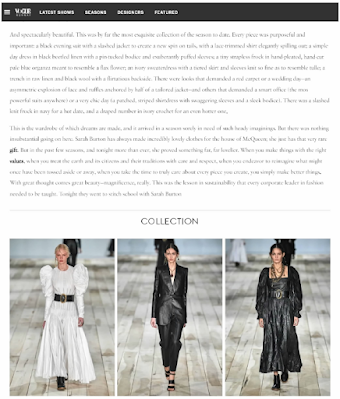
This case should be of interest to people working on contextual advertising. In one way, it's a replay of the Stewart v. Rolling Stone litigation, though the facts are more internet-oriented. Plaintiffs are fashion models whose runway appearances were featured in Vogue. “It is a truth universally acknowledged – so universally as to be worthy of judicial notice – that designers long to have their work featured in Vogue, and that the models who make their living exhibiting designer clothes aspire to have their photographs appear in the magazine – or, today, on its website or social media account.” Yet plaintiffs are suing Vogue, because Vogue has an agreement with the website Moda Operandi to link from Vogue to Moda if anyone wants to purchase the designer clothes featured in Vogue online stories.

example of editorial content with model images

“Plaintiffs believe that they should be paid by Vogue for the use of their photographs if the screen on which their visages are exhibited includes a link to Moda.” So they sued both Vogue and Moda for violations of NY’s right of publicity law and false endorsement under the Lanham Act. Where Moda used recognizable photos of the models on its own website, the claims survive, but Vogue’s own editorial content—even when coupled with links to Moda—was protected under Rogers.

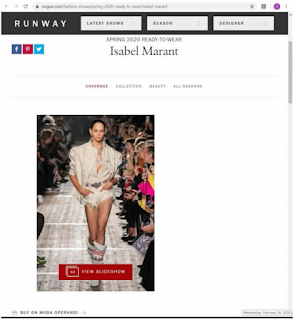
More facts: in 2019, Vogue published an online editorial feature about the 2020 Spring Ready-to-Wear collections, which included coverage of over 50 designers, whose names appear on the editorial’s homepage as hyperlinks to their individual sections, which have slideshows of photos from the designer’s show accompanied by editorial commentary and some additional photos. (“Interestingly, Plaintiffs plead no facts about the terms of their contracts with the designers who hire them to work the runway; the court acknowledges the very real possibility that those contracts govern how images captured from a fashion show are used.”)

Plaintiffs based their complaint on the fact that images appear on pages with links from Vogue to Moda. The cover page for each relevant designer’s collection displays “Buy on Moda Operandi” in small text under the slideshow/featured photo; this link goes to a Moda page featuring that designer. Also, when a viewer clicks through the slide show, each slide has a photo of one item as seen on the runway (that is, on the model). “[A] small red box containing the words ‘Shop This Look’ in white print is superimposed over the bottom of the photograph” for computer users, while the link appears at the bottom of the screen on mobile. Either way, clicking on the link also sends browsers to Moda’s designer page.

"buy on Moda Operandi" link at bottom (mobile)
"shop this look" example on a computer

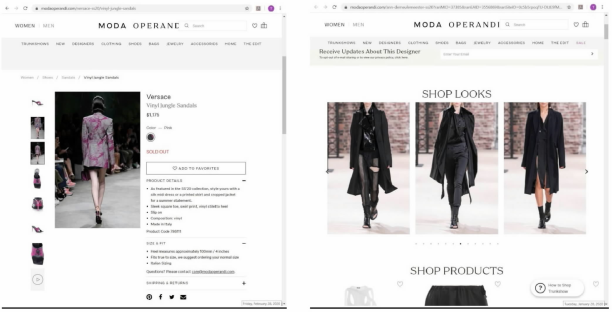
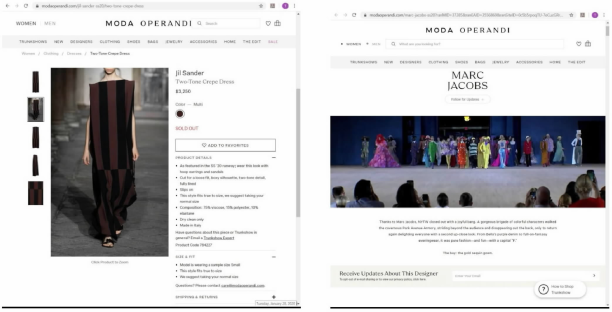
In addition, visitors can browse the “trunk show” on Moda’s website, which displays photos of models wearing a particular designer’s clothing on the runway.

Lanham Act claims: These were false endorsement claims that consumers might be confused into thinking that the models were affiliated, connected or associated with Moda’s brand, and that the models endorsed or promoted consumers’ use of Moda as a venue for buying the clothes they were wearing.

Claims against Vogue/Conde Nast were covered by Rogers, which applies whenever the “unauthorized use of another’s mark is part of a communicative message and not a source identifier,” including to “commentary, ... news reporting or criticism,” “i.e., content that cannot be deemed purely commercial.”

Vogue’s editorial feature “easily” fell within that category. Of course the links had a “commercial purpose.” But the purpose of the editorial, “viewed as a whole,” was reporting, not commercial speech. “The opportunity to purchase clothing is made available to the reader, but only in the context of a preview of the designer’s entire collection and journalistic commentary on that collection.” The links were small and not applied to each photo in the slide show [don’t see why that matters; ads take up a bunch of each hour of broadcast TV, for those of us who still do that sort of thing, but they don’t make the program they break up into commercial speech]. “Common sense tells us that this is not a simple advertisement.”  “It is a work of fashion journalism that, like every fashion magazine, happens to contain advertisements.”

Plaintiffs argued that the “Buy on Moda Operandi” and “Shop This Look” links were not incidental or extricable from the editorial, “because one could not delete them without altering the content of the editorial,” but so what? [Indeed, if commercial and noncommercial speech are inextricably intertwined, precedent dictates treating the speech as noncommercial, so this is a quixotic argument.] “[T]he question is not whether this journalistic feature could have run without including advertiser links; it is whether the photographs used by Vogue in the Runway Editorial are both artistically relevant to the journalistic (non-commercial) aspects of the expressive work and are not explicitly misleading.”

And of course the photos were neither irrelevant nor explicitly misleading. On relevance: “There is no better way to aid the reader in understanding the collections and Vogue’s commentary than to see pictures from the runway shows; and those pictures will necessarily include the models, whose headpieces, hair, and makeup are an integral part of any runway show.”

Explicitly misleading: No allegations supported this.

The only things that are explicitly represented on the allegedly offending pages are (1) this model wore this item of this particular designer’s clothing in a publicly viewed runway show, and (2) the viewer can purchase this particular item of clothing by pressing a link that takes her to some other website (since Vogue, as every reader knows, sells magazines, not clothes). These are not misrepresentations – they are true facts.” Any physical proximity between the pictures of Plaintiffs and either an explicit reference to Moda … or a link to Moda … is insufficient to create an explicit link between the Plaintiffs and Moda.

Separately, 37 of the plaintiffs, the ones whose photos appeared only in slideshows on vogue.com, failed to state a claim against Conde Nast because they didn’t plausibly plead confusion. Only 6 plaintiffs appeared on individual designer “home” pages in the editorial, which was the only place that Moda’s name appeared. The other 37 plaintiffs appeared only in slide shows, and “Moda” appeared nowhere on the pages of the slide show. “Shop This Look” wasn’t plausibly enough to constitute a misleading representation that they endorsed Moda. “For all the consumer knows, the hyperlink might connect to Amazon – or directly to the featured designer’s Madison Avenue store.” [I’m not sure this has ever come up before, but it does make some sense that the rule about unknown source only applies to acquisition/maintenance of trademark rights and not to infringement; hard to see how random confusion, if it existed, would do harm.] The only way for a consumer to find out about Moda would be to click the link and go to an entirely different website. “No reasonable factfinder could infer that a consumer who was browsing through one of the Vogue Runway Editorial slideshows decided to click on ‘Shop This Look’ because she thought the model wearing the outfit she liked had anything to do with Moda. … The only inference that can plausibly be drawn from the pictures of Plaintiffs containing a ‘Shop This Look’ link is that Plaintiffs are associated or affiliated with the clothes they modeled and/or the designers who created them.” And that’s true. “Simply by walking the runway wearing the clothes, Plaintiffs were advertising the items for sale.”

However, some Lanham Act claims against Moda survived, since Moda was just selling clothes.  “The model’s faces as seen on Moda’s website are not incidental to any non-commercial purpose, such that a consumer is unlikely to associate the model with Moda’s brand.” Although the court viewed the confusion argument—that the photos falsely represented the models’ endorsement of Moda as a preferred place to buy the clothes they modeled—as “highly unlikely to succeed,” it was not implausible. Still, the court dismissed all claims from models whose faces weren’t clearly shown on Moda’s site. Models who were only shown on Vogue’s site, or on Moda’s “(1) cropped so that the upper half of the face cannot be seen, (2) shown from the back, or (3) indiscernible because they are part of a crowd of models” failed to state a claim. “[T]he misappropriation of a completely anonymous face [cannot] form the basis for a false endorsement claim, because consumers would not infer that an unknown model was ‘endorsing’ a product.”  Further, “the very fact that their faces are not identifiable renders the allegation that Moda intended to trade on the good will associated with their personas totally implausible.”


cropped and not actionable

That left 25 plaintiffs who could at least give Polaroid a try, though one didn’t sufficiently allege that her face would be recognizable to the general public: “a model working the runway for the first time is not someone who can plausibly assert recognizability.” The court also commented that purchaser sophistication favored Moda, “as it is unlikely that individuals who can afford to purchase designer clothing and who follow fashion design would be easily misled about what it was that the plaintiff models were, and were not, doing.” However, the fact that Moda cropped some images and not others supported an inference that Moda might have had an intent to capitalize on certain models’ recognizability.

NY right of publicity: First, the court kicked out all claims by non-domiciliary plaintiffs. The remaining claims against Moda remained live. [Edited to reflect what's in Conde Nast's filings] For whatever reason, the court didn't engage with Conde Nast's argument that NY’s ROP doesn’t cover editorial content, so the court retained supplemental jurisdiction over the state law claims against Conde Nast, though unhappily. (Conde Nast has moved to dismiss those claims again on newsworthiness grounds, and it's hard to see them surviving; I also think Rogers, itself a ROP case, albeit from a different state, would preclude the claims.)


Thursday, October 07, 2021

Ice Cube's case against Robinhood melts again

Jackson v. Robinhood Markets, Inc., No. 21-cv-02304-LB (N.D. Cal. Sept. 20, 2021)

Previously, the court dismissed Ice Cube’s ROP and false endorsement claims for lack of standing because pleading an appearance in a financial newsletter does not suffice to plead endorsement. (Is that lack of Article III standing? Before TransUnion I would probably have said no, but after TransUnion I’m no longer so sure.

Still used in Robinhood's newsletter, captioned Correct yourself before you wreck yourself


Jackson repled Lanham Act claims only, and the court found that he hadn’t fixed the deficiencies in the complaint. Robinhood’s article described a market correction for tech stocks and paraphrased a line from one of his songs, “Check yo self before you wreck yo self,” as “Correct yourself before you wreck yourself,” illustrated with a picture from a movie in which Ice Cube appeared.

The amended complaint cites congressional testimony and SEC filings to illustrate that [the newsletter] Robinhood Snacks is a commercial product that entices new users to sign up for the app and offers digestible educational content that also satisfies certain financial regulatory requirements. It adds allegations about its demographics and the appeal of celebrities like Ice Cube (and its celebrity endorsers Jay-Z, Nas, and Snoop Dog) to support the point that using Ice Cube’s picture and phrase created consumer confusion and suggested Ice Cube’s endorsement of its products.

However, this still failed to plead injury in fact “Robinhood’s use of Ice Cube’s image and phrase does not suggest Ice Cube’s endorsement of Robinhood’s product.” (The court doesn’t say it this way, but: there are many “commercial products” that consist of “noncommercial speech,” such as Naomi Novik’s new novel The Last Graduate which I am very excited to buy! Implicit in the reasoning is that a celebrity appearance in noncommercial speech is not itself enough to suggest endorsement.)

If unauthorized use of Ice Cube’s image suggested endorsement, that would constitute injury in fact. “But the image and phrase are not an endorsement: they illustrate a point in the newsletter about a market correction in tech stocks.” The case law requires more “more than alleged unauthorized use” to

plead implied endorsement. Again, the court doesn’t say as much, but the cited cases involved conventional ads for a separate product (White v. Samsung, the Waits case, etc.), or appearance on product labels (Monk v. N. Coast Brewing Co. Inc., No. 17-cv-05015-HSG, 2018 WL 646679) (N.D. Cal. Jan. 31, 2018).

I still think this is about substantive failure, not Article III standing, but clearly we’re in a period of standing transition.

Wednesday, October 06, 2021

False endorsement remains broader than many state ROP laws

Walkowicz v. American Girl Brands, LLC, 2021 WL 510729, No. 20-cv-374-jdp (W.D. Wis. Feb. 11, 2021)

Lucianne Walkowicz “has achieved a measure of celebrity as an astronomer,” and contended that  defendants misappropriated distinctive aspects of their personal identity into a space-themed American Girl doll named Luciana Vega. They brought claims under the Lanham Act, Wisconsin’s privacy statute, and Wisconsin’s common law of negligence.

The court found that it was “plausible that one familiar with Walkowicz might be confused about whether Walkowicz endorsed or is somehow affiliated with the Luciana Vega doll, and thus the amended complaint states a claim for false endorsement under the Lanham Act.” However, there were no allegations that defendants actually used Walkowicz’s “name, portrait, or picture” as required by Wisconsin’s privacy statute, and the court was unpersuaded that Wisconsin courts would recognize the duty that Walkowicz alleges was breached by defendants, so the state claims went away.

Walkowicz alleged that they were an astronomer and a TED Senior Fellow at the Adler Planetarium in Chicago whose TED talk has been viewed more than a million times. “In a 2011 presentation, Walkowicz discussed their work on NASA’s Kepler Mission studying the constellation Lyra, including the constellation’s brightest star, called Vega.” Walkowicz alleges that at least one American Girl employee or consultant attended multiple events at which they discussed their work.

American Girl applied for trademarks on a space-themed doll named Luciana Vega, which it began marketing in 2018 as its “Girl of the Year” doll. Walkowicz allegedly had a distinctive personal style, often wearing what they describe as “space themed clothing” and “holographic shoes.” Walkowicz often wears a purple streak in their brown hair. Luciana also has a purple streak in her brown hair, and she is sold with a “space themed patterned dress” and “holographic” shoes. Her accessories include a model telescope, a Mars habitat playset, and a space suit. American Girl’s book about Luciana describes her as dreaming of becoming the first astronaut to travel to Mars.

Walkowicz allegedly received multiple emails and social-media messages commenting on the similarities between Walkowicz and Luciana and inquiries about whether they had endorsed the doll.

American Girl argued independent creation, which seems both plausible and not helpful to a trademark claim. It had applied for trademarks for dolls named “Luciana” and “Princess Luciana” between 2006 and 2010, and its partner Mattel has long produced and sold space-themed dolls and accessories, including “Astronaut Barbie” in 1986. That didn’t establish that the combination into the Luciana Vega doll was done “without any knowledge of Lucianne Walkowicz”; “Princess Luciana” was an entirely different type of doll. “And, in any case, independent creation would be only one factor to consider under the Lanham Act; it would not be a complete legal defense.” [No kidding.]

First, did Walkowicz allege a protectable commercial interest under Lexmark? Yes: They plausibly pled “a commercial interest in giving scientific presentations, appearing on scientific television shows, and participating in science-related events.” And confusion about whether they endorsed the doll allegedly “led to interference with [their] professional public persona” and “dilute[d] the value of [their] name.” I will note here, as I often do, that in a false advertising case these allegations would likely be treated as conclusory at best. Not to mention that “dilution” is not the same thing as false endorsement!

Walkowicz wasn’t required to be engaged in doll-adjacent activity to have a protectable commercial interest. “[A] commercial interest in public speaking and outreach activities … could plausibly be damaged by the perception that Walkowicz was associated with defendant’s commercial activities.”

Confusion: Also plausibly alleged.

Walkowicz is not toiling away anonymously in a lab, but is building a reputation as a celebrity scientist known to the general public. Walkowicz alleges that they are widely recognized for their scientific accomplishments, with some of their presentations having been viewed more than one million times. It’s reasonable to infer that this recognition extends to at least some part of American Girl’s intended market for the Luciana Vega doll.

They also plausibly alleged that their reputation was related to key aspects of the doll and that American Girl’s employees and consultants saw Walkowicz’s presentations. “It’s reasonable to infer from these allegations that American Girl intended to evoke Walkowicz’s public image to lend legitimacy and realism to the Luciana Vega doll.” Plus, they alleged actual confusion, even though it wasn’t clear whether those who were confused were part of the relevant markets. [Some courts distinguish “queries,” as alleged, from confusion—someone who asks whether there’s a relationship is aware that there might not be one. But the cases go back and forth on this.]

Statutory right of privacy: The statute covers uses of a person’s “portrait” or “picture”; it was based on the NY statute and there was no Wisconsin precedent about the scope of those terms, so the court looked to Lohan v. Take-Two Interactive Software, Inc., 97 N.E.3d 389 (N.Y. 2018). Lohan held that the key question under the statute is whether the challenged image is a “recognizable likeness” of the plaintiff. “If a jury could not reasonably conclude that the challenged image is identifiable as the plaintiff solely from the image itself, the court must dismiss the claim as a matter of law.” Walkowicz conceded that their “nationality and skin color” differ from that of Luciana Vega and that the doll’s facial structure was either “entirely identical” or “nearly identical” to every other American Girl “Girl of the Year” doll. Other than their purple-streaked brown hair, there were no bodily similarities, and that wasn’t enough. Similarities in manner of dress and “biographical characteristics that have nothing to do with visual appearance” did not constitute using a name, portrait, or picture.

Likewise, “Luciana Vega” was not an unauthorized use of Walkowicz’s name. Hirsch v. S.C. Johnson & Son, Inc., 90 Wis. 2d 379, 280 N.W.2d 129 (1979), held that retired football player Elroy “Crazylegs” Hirsch could bring a common-law tort suit against the manufacturer of “Crazylegs” shaving gel because “[a]ll that is required is that the name clearly identify the wronged person.” But it wasn’t plausible that “Luciana Vega” would clearly identify Walkowicz. There was no precedent to hold that “Vega”—a word that was [allegedly] associated with Walkowicz to some degree but had never been used to identify them—could be considered their “name.” Inquiries about endorsement didn’t bridge the gap; if Walkowicz meant to suggest that they could put a claim together by referring to other aspects of the doll in combination with the name, that would vitiate the distinction between ROP statutes that list protected characteristics and ROP rules that protect “identity” generally.

Note: When defendants filed an answer, they did not raise a First Amendment defense, but rather argued in various ways that Walkowicz lacked protectable interests in their appearance/variants of their first name. The case was later dismissed with prejudice because the parties represented that it was “resolved pursuant to a mutual release in which no monetary payment has been exchanged.” I’m guessing some sort of donation to a cause supported by Walkowicz, but I’m just guessing.

Monday, September 27, 2021

Video game skates away from liability to pro skateboarder

Miller v. Easy Day Studios Pty Ltd, 2021 WL 4209205, No. 20cv02187-LAB-DEB (S.D. Cal. Sept. 16, 2021)

Gordon v. Drape did mess things up in the Ninth Circuit, but core Rogers cases are still simple. Defendants paid Zachary Miller, a professional skateboarder, to assist in developing a video game, called Skater XL. “Miller believed that the extent of his agreement with Defendants was to model various clothing outfits, which would then be captured by a technique called photogrammetry and applied to a generic character in the video game. Miller alleges that he didn’t consent to the use of his image or likeness in the game, yet one of the characters in it appears to be his exact replica.” He sued for violations of the Lanham Act and state-law claims.

Miller alleged that defendants told him that the motion capture was for a “generic” character in the video game that wouldn’t resemble Miller or have any identifiable characteristics, and assured him that the video game “won’t have your name anywhere or anything if you’re worried about that.” He was paid $250.

Skater XL allows users to “simulate skateboarding tricks and techniques in a realistic skateboarding environment.” Users can select from five different skater characters, including four professional skateboarders and a nameless “generic” skater avatar. “The first four characters are explicitly identified by name and image in the game, while the latter generic character has no name or identifying characteristics. This generic character can be customized according to user preference, including customizing its gender, race, hair color, clothing, and accessories.” However, Miller alleged that the generic avatar was an “exact copy” of him, and easily identifiable as him.

False endorsement: Rogers applies; realism is artistically relevant. “[T]here can be no doubt that including the likeness of a real-life skateboarder in a video game seeking to simulate real-world skateboarders and skateboarding environments obviously has at least some artistic relevance to the work.”

The depiction was not explicitly misleading as to endorsement, which is what is required by the second prong of the test. The court here states it nicely:

Miller argues that Defendants’ actions were explicitly misleading because at least two individuals contacted him after recognizing his character in the video game. But this misses the point. The issue here isn’t whether other consumers could simply recognize Miller’s likeness in the game, but rather whether they would be misled into believing his association with the game means he is somehow endorsing it. Although the issue of customer confusion is factual in nature, it’s simply not plausible that the inclusion of the only anonymous skateboarder in the game, among four other explicitly identified skateboarders, would convince consumers that Miller endorsed their video game.

As in the previous Brown video game case, “[t]he anonymous character’s mere presence in Skater XL doesn’t equate to “an explicit attempt to convince consumers that [Plaintiff] endorsed the game[ ].”

False advertising: Miller failed to plead statutory standing. He didn’t compete with defendants. He didn’t allege that he lost endorsement agreements or suffered any reputational injury, other than in conclusory fashion. Thus, he failed to plead proximate causation. [Compare trademark claims!]

The court declined to exercise supplemental jurisdiction over the state claims.

Tuesday, September 07, 2021

lawyer doesn't make use in commerce by negotiating for client

Big Ligas, LLC v. Yu, 2021 WL 1518993, No. 20-23719-Civ-Scola (S.D. Fla. Apr. 16, 2021)

Big Ligas is owned by three members equally: Daniel Echavarria, also known as Ovy; Christian Andres Salazar; and Paulo Londra. Ovy and Salazar are the managing members, and defendant Yu is an entertainment attorney who represents Londra, an Argentinian “rapper and reggaeton/trap singer.” The parties signed a deal memorandum “to help Londra launch his career as a singer and songwriter.”

Things went well, and then as Londra’s success increased, the parties’ relations deteriorated. Amidst negotiations with other parties about Londra’s second album, Londra hired Yu.

Big Ligas alleged that, among other things, Yu “falsely claimed that she and/or Paulo owned the copyrights that are in fact owned by Big Ligas.”  She allegedly falsely represented that she was authorized to deliver Londra’s “recording artist and songwriting services ... when in fact, any compositions or recordings created under publishing or record deals not authorized by Big Ligas, including those negotiated by Yu, are not commercially exploitable without Big Ligas’[s] authorization, under Paulo’s name or otherwise.”

Big Ligas sued for tortious interference and for false advertising and trademark infringement under the Lanham Act. The tortious interference claims failed for contractual reasons and because Londra’s lawyer was his agent, not a stranger to the contract.

Lanham Act claims: Along with the alleged misrepresentations about authority, Big Ligas alleged that Yu used Londra’s “name and likeness ... to promote his recording services to Warner (and others) and his songwriting services to Kobalt (and others), without Big Ligas’[s] approval or authorization,” confusing third parties.

Yu rejoined that she was, in fact, Londra’s counsel, and using his name was “classical fair use” (that is, descriptive fair use) because “she is not using the name Paulo Londra in the trademark sense, but only to identify her client and describe his relationship to her.” Of course, descriptive fair use requires good faith which sure sounds like it’s hard to decide on a motion to dismiss, but that’s no barrier here. Londra’s stage name and given name are the same [should the result be different if they weren’t?], “and the Plaintiff’s allegations do not prove that Ms. Yu used the Plaintiff’s mark in commerce by referring to and describing her relationship with her client by using his given name.” [Of course this was a use in commerce; in a different situation, this argument would be laughable. Trademark law has ruthlessly been stripped of the tools it needs to say “this is not a trademark claim,” and that’s why the Seventh Circuit approach of just reaching the equitable result can appeal.]

Even if we needed to do a descriptive fair use analysis, Yu would win:

The Court finds that, as Londra’s attorney, Ms. Yu’s use of his name to identify him as her client was other than as a mark, used in the primary descriptive sense, and was undertaken in good faith, that is without the intent to trade on the good will of Big Ligas. To the extent the use of the name Paulo Londra creates some risk of confusion, Big Ligas assumed that risk by establishing Paulo Londra, Londra’s given name by birth, as his stage name. (emphasis added)

This isn’t motion to dismiss language, although it is clearly the right result. 

False advertising: “That Ms. Yu contacted third parties and stated she is Londra’s attorney with authority to negotiate on his behalf is not a false or misleading statement insofar as Ms. Yu was acting on behalf of her client, Londra.” This was a contract dispute, not a Yu problem.

Update: Big Ligas, LLC v. Yu, 2021 WL 4059435, No. 20-23719-Civ-Scola (S.D. Fla. Sept. 7, 2021)

Denying reconsideration, the court added some additional comments, but maybe made things more confusing. False advertising:

[T]he Court is not giving a green light to attorneys everywhere to lie and cheat on behalf of clients. But when an attorney—for the financial benefit of a client—discusses their client and makes representations concerning the scope of their relationship, all while negotiating with another party, that is not a false or misleading “commercial advertisement or promotion” within the meaning of 15 U.S.C. § 1125(a)(1).

In particular, discussions with two third parties that allegedly misrepresented the scope of Yu’s relationship to Londra, weren’t “commercial speech” because they were “in pursuit of her client’s pecuniary interests and the negotiation of a commercial transaction for her client, not herself.” [Comment: um, that’s highly commercial, especially given the court’s appropriate emphasis on the fact that Yu was an agent of her principal, Londra. The court would have been much better served by focusing on “advertising or promotion.”]

Anyway:

To the extent that Big Ligas is concerned that this holding will empower attorneys and their clients to sell property that their clients do not own, the Plaintiff did not cite to any case where that fact pattern constituted a violation of the Lanham Act. There very well may be other causes of action for such conduct, but the Lanham Act is not a catch-all for every purported misrepresentation, particularly those made by a lawyer representing a client in a commercial negotiation.

The court also thought that the Lanham Act wasn’t the right way to attack allegedly false statements “where the falsity of those statements is measured against the interpretation of a contract between the parties (or their agents).” Why not? It’s a contract law dispute. How does that interact with the standard elements of a Lanham Act claim? It doesn’t, which is why the court makes this comment in a footnote—there are Lanham Act cases about whether claims about legal rights can be “false or misleading,” but those cases often hold that statements about legal rights can be falsified, in appropriate circumstances.

Trademark: Also still no.  Big Ligas understandably argued that the court improperly found facts when holding that Yu’s use was “in good faith.” However, assuming the truth of the well-pled allegations, Big Ligas failed to allege any facts from which an inference of bad faith can be drawn, because Yu’s use of the name “Paulo Londra” was “in service of her obligations to her client, Paulo Londra, in order to ‘negotiate and act on behalf of Paulo with respect to his recording artist and songwriting services.’” Of course, this reasoning highlights the extent to which the court’s previous determination that the Lanham Act just didn’t cover this situation is driving the court’s concept of “bad faith.” If, by contrast, some unauthorized distributor had falsely told a buyer that it was authorized to distribute a trademarked product, no court would have trouble finding that the misrepresentation about authorization itself sufficed to infer bad faith (and use as a mark).