Showing posts with label comics. Show all posts

Tuesday, March 07, 2017

Terms and Conditions

Reading list: new comic book, Terms and Conditions: transformative work of the day, using iTunes’ terms and conditions combined with illustrations in the style of various comic artists.
Steve Jobs as Joe Cool

Tuesday, October 20, 2015

Transformative works of the day

R. Sumantri MS, from Indonesia, paints DC and Marvel superheroes juxtaposed with Asian folk and mythological characters. Here: Guan Gong vs. Iron Man, Nezha vs. Batman, and Guan Gong vs. Captain America from his China New Supreme Power series. Discovered via David Tan's chapter in Diversity in Intellectual Property: Identities, Interests, and Intersections, ed. Irene Calboli & Srividhya Ragavan.


Wednesday, April 29, 2015

DC Comics thinks derivative works are creator-less

According to this post by a DC Comics artist (who created Felicity Smoak!).  This raises fascinating contract issues, as well as depressingly highlighting artists' lack of bargaining power.

Wednesday, February 18, 2015

Friday, June 21, 2013

Tuesday, January 22, 2013

Reading list: comic law

James Daily & Ryan Davidson, The Law of Superheroes: Based on lawandthemultiverse.com, this breezy book has the benefit of plenty of illustrations, but its presentation of the law is generally devoid of nuance. While it’s not wrong for the sake of drama the way a Law & Order episode or a comic book might be, it’s probably a much better read for nonlawyers. It starts with two statements of note from an IP perspective, for two different reasons. First, there’s
So why comic books? Well, for one thing, they’re both interesting and popular. The main problem with a lot of legal educational materials is that they are boring…. So rather than making up people who may not even have names, or using cases involving people you’ve never heard of, The Law of Superheroes uses characters you already know and love.
To a copyright lawyer, that sounds intriguingly like a description of using another’s work simply to avoid the drudgery of working up something fresh, or simply to get attention—something that would in theory count against the book in a fair use analysis, even though the book is obviously fair use. You can use someone else’s work to get attention under many circumstances, including when you want to teach them law.

The authors immediately follow with the preposterous statement that “[t]he terms ‘superhero’ and ‘supervillain’ are trademarks co-owned by Marvel Characters, Inc. and DC Comics, Inc. These terms are used throughout this book solely to refer descriptively to Marvel and DC characters.” I don’t presume to know whether Marvel & DC asked for this ridiculous disclaimer in return for agreeing not to contest the extensive and helpful (and fair use!) images in the book, but, just to be clear: (1) superhero and supervillain are generic terms, not trademarks (ETA: yes, I know there's a registration; that just makes Marvel & DC aggressive and well-funded, not trademark owners); (2) even if they weren’t generic, the owner (since a trademark must have an owner, not two who don’t control each other’s behavior) would not have any claim against a book that used a term “wrongly.”

But at least this is a good indication of what you’re going to get: some entertaining/shallow discussion of various legal dilemmas in which comics characters might find themselves. I did like the discussion of masked superheroes testifying in court, and the point that DC has solved this problem with a constitutional amendment allowing “registered meta-humans” to testify masked, which then means that DC has already put in place the very provision that in the Marvelverse sparked Civil War: “while the DC workaround would be effective in the courts, it does not seem as if that universe has fully dealt with the implications of that solution.” Heh.

Unfortunately, while sensitive to the First Amendment implications of anti-mask laws, the authors badly mishandle the idea of newsworthiness when it comes to invasion of privacy, claiming that Peter Parker would have a cause of action against someone who revealed that he was Spiderman because Peter Parker “is just a working stiff, a news photographer and, perhaps most importantly, is often written as a minor. The public probably doesn’t have as much of an interest in knowing these details.” Um, no. Dude is Spiderman. That his secret identity seems like an ordinary Joe is no more relevant to whether the Spiderman-Peter Parker link is newsworthy than the ordinariness of the contents of Anthony Weiner’s boxer-briefs is relevant to the newsworthiness of the fact that a Congressman was sending pictures of his erection around. So, as the authors suggest, don’t take the book as offering legal advice--but it's an interesting entry into the category "what people think the law is."

Sunday, January 20, 2013

Patent law, after xkcd

Patent law explained (perhaps) using the most common ten hundred words.  After xkcd's Upgoer 5, and facilitated by the subsequently created Upgoer 5 Text Editor.  Your call on how ironic that is.

Tuesday, December 04, 2012

Today's transformative works

The Hawkeye Initiative: What it looks like when male comics characters get the crotch-first-attack pose or spine-bending-present-both-chest-and-butt pose treatment.  A picture's worth a thousand words.

Saturday, March 31, 2012

Drake part 5


Panel 5: Copyright Law
Susan Corbett, Senior Lecturer, School of Accounting and Commercial Law, Victoria University of Wellington (N.Z.)
The Photographer and Her Subject: The Case for Joint Ownership of Copyright in Photographs of the Human Image
ECJ: the concept of private life is a broad one which encompasses the right to identity. A person’s image reveals his or her unique characteristics and constitutes one of the chief attributes of her personality – in a case about an unauthorized photo of a newborn. 
Problem: Years of debate over whether photos should have copyright protection + democratization of publishing online; if we own our photos, we have the right to publish them + advanced tech that makes taking photos easy, frequently without the knowledge of the subject. In most countries there’s no absolute right not to be photographed or to prevent publication.  But most of us would claim some sort of rights over our images.
Breach of confidence won’t always work; passing off will also not cover most commercial uses, nor will misappropriation of personality; privacy will generally have high standards for breach.  Free speech interests often seem more compelling.
Early photography required substantial skill & effort by photographer, and the participation of the subject, who’d be told what to wear, how to pose, etc.  Things have changed.  Derrida: whatever precautions you take, … the photograph surprises you. It is the other’s gaze that wins out and decides.  She proposes co-ownership as a more robust protection than privacy.  Copyright has an established int’l regime, a statutory acknowledgement of public interest balance; provides for joint ownership.
But is it true that all photos have the requisite level of originality to be protected by copyright.  Standard in NZ is low: requires skill and effort of a minimal level; it is only that it is “not copied.”  Standard differs elsewhere.  But being in the right place at the right time is an established threshold for copyright in photos—a different standard for socially important events.  Uniqueness also might argue for copyright: we are all unique and therefore our photos must be original.  (Original to whom?  I haven’t done a lot to my own appearance, other than correcting nature’s mistake in failing to make me a redhead.)
Prof. Llewellyn Joseph Gibbons, University of Toledo College of Law
Love’s Labor’s Lost: Marry for Love, Copyright Work Made-for-Hire, and Alienate at
your Leisure
Congress worried that the Soviet Union would enter the CCC, expropriate dissident authors’ copyrights, and then try to suppress them in the US.  Chances of this were slim to none, but Congress amended the law anyway to bar a government from expropriating a copyright unless it had already once been voluntarily transferred, except in bankruptcy.
Is marriage alienation?  Is it a transfer of copyright in a work that does not even exist yet?  How can that be a voluntary transfer?  According to one case, living in California may constitute consent to its community property regime—but in that case wouldn’t living in the Soviet Union constitute consent? (Emigration from the Soviet Union was not voluntary, though, as I recall from many a “free Soviet Jewry” sign from my youth.)
Rodrigue v. Rodrigue, LA: a little bit of preemption, not enough to preempt Louisiana marriage law.  Court made up its own analysis. Distinguishes right to use, right to alienate, and right to enjoy the fruits of use.  Author-spouse retains exclusive managerial control of copyright, but has to split economic benefits of copyright with the community.  What happens when the artist continues to create in his own style?  When is there a new work and when a derivative work of the community property?  Also court suggested a duty, in dicta, to manage copyright for the benefit of the spouse.  Can stopping creation of derivative works, or exercising moral rights under §106, interfere actionably with the economic value of the works shared with the ex-spouse?
Proposal: get rid of marriage and think only of partnership.  Marriages exist and produce external & internal consumption items.  Some workers are highly skilled at selling stuff external to the marriage, others are skilled at household work; they can trade for the benefit of the family.  Would that make a copyright work created during the marriage a WFH/partnership asset?
Prof. Marc H. Greenberg, Golden Gate University School of Law
Creativity Constrained: Comics and the Law
Book project.  Start in 1954 with Seduction of the Innocent, in which Frederick Werther suggests that comics cause juvenile delinquency.  Led to book-burnings and congressional hearings.  Outcome: Comics Code Authority, voluntary guidelines adopting censorship.  Underground comics led to obscenity prosecutions; birth of the Comic Book Legal Defense Fund.  Had a case where a comic artist was ordered not to draw comics for years as part of a resolution of an obscenity case.  His view: SCt was wrong to allow obscenity prosecutions as outside the First Amendment.  New cases: personal possession—when they search your laptop at the border; Stanley v. Georgia allows personal possession but the law bars transportation, so how do you get it? Apparently create your own.
Another big topic: termination rights. Who owns Superman?  Comics companies argue that all these artists’ work was WFH, though heirs got Action Comics #1 and some strips back at the district court level.  The WFH doctrine was changing/evolving during these pre-1978 transfers, creating many puzzles.
Copyright and characters.  Issues arising from blended nature of comics: comics as sequential art.  Storytelling through graphics and text.  Cases deal with the separation of the two; law has real difficulty dealing with them together.  Even in a tax case!  California exempted “authors” sending manuscripts to publishers from definition of sales, but art sent to publishers was a sale.  So which was a cartoon?  Similarly, in an obscenity case, defendant was prosecuted twice for the text and the art in the same work; prosecution said they were different works.
Prof. Doris Estelle Long, John Marshall Law School
Have Copyrights Become the New Anti-Competitive ‘Monopoly’ in the Digital Universe?
Relationship between antitrust and IP.  Past perception that “monopoly” conferred by copyright was very different from a market perspective than the monopoly conferred by patent because of substitutes.  Computer software changed the nature of copyrighted works, as did digital communication.  Result: change view of copyright’s anticompetitive potential. Also why we need to theorize copyright separately from patents under antimonopoly laws. Types of activities giving rise to claims of abuse aren’t similar work- or patent-based claims. Except for software, books don’t fit.  People don’t walk into a bookstore looking for Harry Potter & walk out with Hunger Games.  (Speak for yourself.)  There’s no substitute, but at the same time it doesn’t fit standard antitrust thinking.
Borrowing from patent to copyright often works very badly, and likely to do so with antitrust as well.  Essentiality of copyright—a particular work—is based on its communicative aspect: I need parts of this work to make my own.  Fair use and other limitations already protect that communicative aspect.  Copyright has also developed doctrines about market efficiencies. If you’re talking about needing a work to communicate, that’s communicative essentiality; that’s not antitrust.  Antitrust analysis can be helpful with “distributional” essentiality where copyright enables market dominance.  Where there are switching costs, network effects, etc.—Microsoft v. Apple. First sale, home taping, personal use can also benefit from the concept of distributional essentiality.  Who gets to set the prices for items being sold?  An up-and-coming issue. If you argue that something is being abused—dominant position, essential facility—that language shows up in this area; just be careful not to overlap with communicative essentiality.
People who have the ability to control massive amounts of copyrighted materials can control markets.  Access to wide bodies of works: in the 1940s, motion picture companies controlled access by controlling movie screens; this can fit into antimonopoly analysis.  Ability to abuse an “operating system.”  An essential facility is not the same as an abuse of the market, and we should distinguish them; there is no piece of music that qualifies as an essential facility. Rather it’s software/tech access that pose potential of creating essential facilities. Bayer decision in India shows role of price differentiation where IP is considered essential; we need to theorize the boundaries now and focus on competitive issues as they relate to distribution.  Deal with communicative essentiality separately so as not to muddle the process.
Prof. Liam O’Melinn, Ohio Northern University Pettit College of Law
The Mythology of Common Law Copyright (previous WIPIP version)
Why didn’t Congress address the constitutionality of protecting sound recordings straight-on? Mythologies.  In Golan: Falzone was asked whether the public domain was a substance of its own, or just what happened to be there when things fell out of copyright?  Falzone said the latter.  Was there a public domain before 1790?  Falzone said yes, which was a consistent litigation position, though possibly not wise. Those are strange questions and answers betraying fundamental confusion about the relationship between copyright and the public domain.  Wants to show how common-law copyright thinking has influenced thinking up to today.
Censorship preceded copyright and ultimately gave us the Company of Stationers, who thought that the works that had been their property were still their property after the Statute of Anne.  Result—invention of the author?  A paucity of authors, an abundance of manuscripts circulating before and after the invention of the printing press.  One theorist thought that authorized manuscripts were “good” texts, properly printed, so that unauthorized texts derogated from a norm of permission.  Piracy = bad literature. Respect for norms = good literature.  This story is that long in advance of Statute of Anne (Shakespeare) people were collaborating in this way; O’Melinn thinks that this is pretty fanciful, but contributed to the mythology of common-law copyright.
Other authors talked about this over time: Jonathan Swift said there was no common law copyright in Scotland.  What about America?  His research suggests that Ben Franklin knew of Donaldson v. Beckett, and it seems likely that this was the common American understanding.
Comment for O’Melinn: with pre-1972 sound recordings, you have collectors today collecting cylinders with no clear understanding about what copyright law protects; doing it anyway because of lack of enforcement/perceived lack of market.  With no remedy and no reason to claim rights, myths persist about what the rule is.
For Gibbons: housework can be analogized to back office work supporting the “author.”  Changes the analysis because the author couldn’t be an author were it not for the fact that the spouse is taking care of other issues.
Gibbons, to my comment: I don’t believe living in Louisiana is a choice to a particular property regime with respect to copyright.  But Congress had a statute in search of a problem.  Rodrigue was bad because it’s imposing a common law trust on civil law, and because it’s unique to Louisiana; no real cites/discussion to actual Louisiana law.  So it’s a weak model on its own terms.  Could get rid of §201(e); could have a pre or post-nup.
Yu: for O’Melinn, when you talk about Shakespeare you seem to lump customs and common law together.  Isn’t it worth distinguishing a custom from something that could actually go to court?
O’Melinn: understands custom as source of common law, at least if law ultimately vindicates.  Trying to be fair to people who believe in the common-law authors’ right even though he doesn’t himself believe it.
Q for Corbett: consider the commodification/anticommodification literature—you seem to be choosing commodification.  Maybe the answer is that the photographer has already done that.  Second, what control does joint ownership give to the subject? In the US, either joint owner can license without the other’s permission, so the only control would be over exclusive licensing.  Note that in the US we already blur out TMs often, but not the faces of the crowd.
Corbett: thinks the photo is already commodified because the photographer already has the right.  (Though will often in these objectionable scenarios not be commodifying it, merely sharing it.)  US law is different; in NZ joint owners have to agree.  (Can agreement unreasonably be withheld?)
Liebler: Greenberg focuses on US law, but that’s difficult to do because the obscenity cases are often comics from other countries. Border control/US citizens’ travel are often at issue.  Bring in some unlicensed comic uses—scanlations—and how that works in the US and may stimulate distribution chains in the US.
Greenberg: It’s a multivolume process!  These are important aspects.  Japanese authors are very interested in US attitudes.  Much difficulty seems to be cultural misunderstandings.  In one case, a manga/anime obscenity case, they brought in trial experts on the cultural significance of the genre, and the court wasn’t interested in hearing about artistic/cultural significance.
Me for Corbett: there’s uniqueness, but who’s the origin?
Corbett: My image is personal to myself, unique to me.  We could say that about anything, though; any book owes its creation to other influences on the author. 
Me: why the image then and not the biography? Both owe their existence to the uniqueness of the subject.
Corbett: images are different; the creation of the photo isn’t entirely from the photographer; the subject contributes to the ultimate work. Copyright only covers what the writer adds. 
Me: but that’s just to say the next photographer and the next biographer can make their own representations of the subject.  (The writer didn’t add the facts and doesn’t own them, but neither does the subject own them even though the subject is a but-for cause of the biography as much as she’s a but-for cause of the photo.)
Gibbons: maybe an interest in concealment/private facts.
Greenberg: maybe a person has an interest in their own biological material if used to develop a cure.  (But a copy is not the original.  If I set a photo or a biography on fire, the subject doesn’t get burned.  So the physicality of it can’t be the dividing line between photo and biography.)
Greenberg: character copyright analysis may be taking a step forward with Superman, since DC will own what it created during its ownership; heirs can’t use anything created by DC, and DC can’t create new derivative works without heirs’ consent; this will shape how the character is defined.  It’s the heirs and not the creator, making this particularly interesting. 
Q: does common law copyright mean a right of publication, or something else, in this period?
O’Melinn: More than right of publication, or state common law copyright; instead discussing a theory presented as if it were law that said that before there was a statute there was perpetual protection surviving publication. This theory’s vagueness is its advantage for proponents.

Thursday, February 02, 2012

Georgetown's awesome librarians come through again

With mastheads and some interior material from The Daily Planet, a counterculture paper eventually forced to change its name by DC Comics.

Monday, October 31, 2011

xkcd and false advertising

xkcd today is about false advertising. Check out the alt-text: "Telling someone who trusts you that you’re giving them medicine when you’re not, because you want their money, isn’t just lying--it’s like an example you’d make up if you had to illustrate to a child why lying is wrong.” HT Greg Klass.

Saturday, August 13, 2011

IPSC session 8

Invention/ Teaching
Eric E. Johnson, University of North Dakota School of Law, Intellectual Property and the Incentive Fallacy

IP is nonexcludable and nonrival. Presumption that people need incentives. Rejected by controlled experiments, empirical historical research, etc. There is inherent motivation to engage in creative and innovative activity and share that without the necessity of external incentives. The theory behind the public goods idea of “promoting the progress” needs to be replaced with post-classical economics. We know more about physics than we did in the 18th century; likewise economics.

Note that history of copyright is not one of promotion, rather of aid of censorship; letters patent were designed to provide monopolies (and promote tech transfer from other countries). The d’etre came before the raison. Copyright and patent theory formed from what was left after destroying royal monopoly/censorship.

Research: reward effects in experiments show that tangible rewards (IP, government awards) have a substantially negative effect on instrumental motivation. People lose excitement and vitality. Wasn’t talking about IP specifically, but is a psychological truth. Compensation doesn’t solve a problem in this account, it is a problem. People want to engage in activities because they are interesting and evolving. Art Institute of Chicago: extrinsic motivation was negatively correlated with career success 20 years down the line.

Kind cite to my piece on noneconomic motivations. Public goods problem is not the general condition. Large capital investments are no longer needed to publish. Stock photo market has changed: prices have collapsed, and now you can get a stock photo for $.14, and photographers get only a portion of this—cannot be explained by classical theory. Many are intrinsically motivated to create. One guy received $30 for having his photo appear on the cover of Time.

Exceptions to the classical rule now swallow the rule. Innovation and creative production will generally flourish without external incentives, though there are exceptions.

Big problem: the problem of the firm—large organizations working together to create creative products. Even there, except for a few industries, IP doesn’t have much effect.

Prescriptions for scholarship: A general appeal to the public goods problem commits a fallacy. We cannot expect that more rights means more stuff. For policy: copyright and patent should be sunsetted to the extent they’re based on incentive theory. We should look at industries/situations case by case.

Q: how do people create and earn enough to live on through creating, as opposed to during their free time? He grew the most as a musician when he was doing it professionally, when he could invest. Well-meaning amateurs aren’t enough.

A: that ought to be the default. It may be that industries need incentive effects.

Grimmelman: noncommercial systems can flourish without copyright, but how do we get animation studios? Voluntary creativity is easier in a world with copyright than vice versa.

A: copyright and patent create losses as well. Individual opt-out is not enough.

Grimmelman: then individual content will just outcompete the paid stuff—the amateurs undercut the professional photographers.

A: putting aside whether competition covers the losses incurred by copyright/patent, there is a crowding out effect. Compensating people can decrease their motivation to engage. (I thought there was some evidence that the kind of compensation matters, which has serious implications for patronage v. copyright.)

Q: lots of people engage in amateur sports but they’re better at it if they get paid. I pay to run in the Boston Marathon, but we should still seek to compensate people at the high quality end.

A: he agrees, and he can’t say we’d get all we wanted without copyright. But the belief that creative works require external incentives is just false. Yes, people need to eat, but a lot of people who create art for free do eat. (Look at me!)

Q: some things can be done in spare time, and some can’t.

A: agrees, and his point is that we’ve regarded the public goods problem as the central truth, but it’s not.

Q: lost first mover advantage in the digital environment.

A: yet amateur digital content is exploding.

IP Clause and 1st Amendment

David Ardia, University of North Carolina - Chapel Hill School of Law, Speech Unjoined

Libel plaintiffs have long been allowed only monetary remedies, not injunctions. Injunctions are presumptively unconstitutional as prior restraints. Is this true/good doctrine today? Recent decisions by lower courts have approved injunctions, and this is particularly important for online defamation. Concludes that limited injunctive relief may be appropriate for fully adjudicated matters of private concern found to be defamatory—challenges in structuring a remedy that would be effective.

Prior restraint: prior to what? Consensus appears to be that the doctrine is primarily implicated when the restriction is imposed prior to public dissemination. Some scholars say you have to distinguish between prior and subsequent sanctions, others say the First Amendment is just as concerned with subsequent punishments. Subsequent punishments can dissuade speech as well. But it feels different. A free society prefers to punish the few who abuse the liberty rather than throttle people generally.

Not retracing ground excellently covered by Lemley & Volokh in their article on preliminary injunctions; he wants to think about permanent injunctions. How the doctrine should function: partially litigated prior restraints (preliminary injunctions) never allowed in defamation cases. Fully litigated prior restraints presumptively unconstitutional—Near v. Minnesota said something like troop movements would be an exception. Partially litigated post-publication restraints are likely unconstitutional, though there’s little precedent. But fully litigated post-publication restraints are where the questions are; the Supreme Court has never weighed in.

Problems of overbreadth or underinclusiveness. Even if drafted well, there’s leakage—other blogs might pick up the statement. Time and context also affect whether something is defamatory. Procedural protections for criminal/civil sanctions are less—an enjoined party is collaterally barred from challenging the underlying law, so they can’t defend the statement, only deny saying it.

California SCt held that a narrowly tailored injunction against particular continuing course of speech was acceptable (woman making claims about a bar across the street from her, that it served minors and hosted prostitutes).

Pretty good argument that speech online is irreparable. Echoes of defamation persist. Many defendants are judgment-proof, at least that’s what people believe, though it’s not clear what the empirics are. Old case: plaintiff’s argument that it should get an injunction because the defendant was destitute was rejected.

Liability is disaggregated online, both through publisher/distributor liability and through §230. All of this makes it difficult to think about effective remedies.

Solution: Injunctive relief should be permitted in some cases after final judgment. Relates to matter of private concern (wouldn’t apply to public figures); narrowly tailored; injunction is reparative; no collateral bar rule in enforcement proceedings; no injunctions directed at future speech like “obey the law” or directed at broad subject matter.

Should it be applicable to third parties? Without that, it might not be effective. But with that, it creates significant problems. RipoffReport won’t take down your content even if you ask/even if it’s been found defamatory.

Heymann: How would narrow tailoring work? Isn’t that just a game of whack-a-mole? Is there a substantial similarity analysis?

A: this is often an issue; courts do put an injunction in “similar” terms, but his proposal wouldn’t cover that. Injunction can only require removal, not bar repetition.

Felix Wu: with such a narrow remedy, what’s the harm in applying it to third parties? If we’re worried about speech interests of public at large, then it’s not really going to matter who you apply this injunction to.

A: that’s more or less where he comes down. But implementation is a challenge. Often p sues and d defaults. P goes to online host with default judgment. His §230 study suggests that most hosts take that material down. But what do you do if the host won’t? If the incentive for the p is to sue in a remote jurisdiction, do we allow default judgments to count here? His tentative answer is no.

Ramsey: Third parties should never have monitoring duties. Put the burden on plaintiff to notify third party.

A: General knowledge, already taken care of by §230. Notice of a judgment can be very important for an intermediary, though: onus on plaintiff to notify as to the exact words; this allows d to evade.

My q: why exclude public figures/substantially similar statements? Why would either of those things be entailed by the considerations you focus on? Why not be willing to put liability on the individual (including for saying substantially similar things) and then not put duties on the intermediary? If you say the intermediary could be liable for failing to remove content, you are either saying that (1) the circumstances described satisfy the malice requirement as to the intermediary; perhaps notice of the judgment means the intermediary satisfies the malice standard, which is a possibility, or (2) malice is no longer required.

A: That is the key issue.

Marc H. Greenberg, Golden Gate University School of Law, Comics, Courts and Controversy: A Case Study of the Comic Book Legal Defense Fund

The project is under revision; will look at copyright termination and derivative works issues, including Roy Lichtenstein’s appropriation of romance comics from the 1950s and later deal-cutting with the copyright owners.

Definitional: calling the material comics. A vast majority of the material isn’t funny. First comic books in the US were bound versions of Sunday funnies. This is important because it set a concept/tone in public perception that these are literary works for kids, meaning we should scrutinize them to make sure they’re not bad for kids.

Better term: sequential art. Telling stories through visual/sequential medium. Error in definition led us to suppressing horror comics. Appealing to audience of 10-year-old boys (do we know this from any reliable empirics? People make those claims about anime/manga in the US, ignoring all the women/girl fans). Error in attributing juvenile delinquency to comics because delinquents, like all other kids, read comics.

Comics Code suppressed horror, other things. 1960s gave rise to underground comix, with a lot of explicit sex. Art Crumb, Art Spiegelman, etc. Were prosecuted as obscene works. This led to the foundation of the Comic Book Legal Defense Fund. Cases brought against comic book dealers threatening them with hard time. Christopher Handley case: described as traditional geek who lives in mom’s basement; his hobbies are church and reading manga. He read hentai (explicit sexual comics with young girls). He ordered some. Despite Stanley v. Georgia, saying you have the right to have obscene materials in your own home, it’s not lawful to transport the obscenity to your home. You have to create your own obscenity!

Postal inspector was tipped off, opened the package, and Handley was arrested under the PROTECT Act. This came after the Ashcroft case invalidating the virtual child porn offenses (not featuring real children). Congress passed a new law saying that if you have a obscene graphic depiction that appears to be children engaged in sex, you can get 5 years for a first offense. Handley argued Stanley v. Georgia, but the court said he was transporting it. How do you know the children are under 18? They are a drawing, not an 18-year-old dressed to look 15. It’s a drawing. Unsuccessful on a motion to dismiss. Handley plea bargained to 6 months in prison, 1200 manga seized (7 were the subject of prosecution). CBLDF is concerned about First Amendment implications.

Obscene materials are not protected under the First Amendment, so prosecution argues that all it needs is some justification for going forward. But is obscenity really outside the First Amendment? If we can’t define it with certainty, we can’t say it’s outside the First Amendment. Also, the causal link to harm simply isn’t there. Study after study concluded that, if anything is harmful, it’s violence. But the SCt says that violence is okay. Should back off from prosecuting when there is no person involved.

Ramsey: gateway drug—if people like graphic depictions, they might go to actual child porn. Can’t the government decide to ban the gateway?

A: The counter is the catharsis effect—presence of this material, particularly when you don’t exploit any humans, provides a way to prevent actual conduct. In Japan, which has a high concentration of violent explicit sexual material in cartoons, has one of the lowest rape rates in the developed world. State by state comparisons in the US also find no correlation—no evidence of causation from the presence of this material.

Hughes: Why not download it?

A: you can do that. CBLDF is now defending a case where a guy had material on his laptop and was crossing the border.

Q: politics—this is a way of scoring easy points. What’s the political economy?

A: right, we don’t have an effective lobby of producers of graphic sexual material. Courts are the only recourse. If what we’re really talking about is something we find socially disturbing, we fine it/put the seller out of business. The penalties are so disproportionate, especially in graphic cases not involving photographs.

Hughes: why doesn’t the CBLDF advise comic book artists to establish a character log with an age given? Equivalent to the filed ID in porn.

A: difficulty in contrast to live models is that ID proves something with live models. With graphics it becomes a jury question. This came up in one of the cases: jury was instructed to use its own perception.

Hughes: courts should give weight to authorial intent.

Rosenblatt: one of the cases—the images depicted were of a well-known character who’s 3000 years old.

A: but the reaction of the prosecutors has been “it looks like a child.”

And that’s it. Thanks to the organizers for another great event!

Friday, March 25, 2011

Donald Duck, patents, copyright, and other innovations

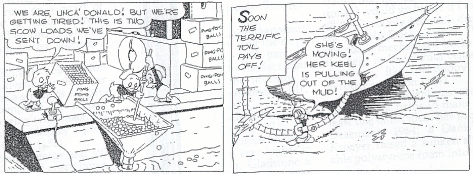
5 Amazing things invented by Donald Duck. Including an actual prior art citation of a comic book scheme to defeat patentability. Though if I could guarantee everyone in the class had seen Inception, I'd be willing to use the dream heist scenario as a substantial similarity problem.

Saturday, December 04, 2010

Law and the Multiverse

A blog exploring legal questions posed by superpowers!  Most relevant to this blog so far: Batman and patents.  (My use of Batman, for comparison: Batman v. the Utility Monster.)

Thursday, December 10, 2009

Saturday, October 31, 2009

A topical Halloween webcomic

Many horror stories are about punishing moral transgression. Here's one. Warnings for violence and racist language.