Friday, January 27, 2017

Identifying Boundaries in Patent and Trademark Law.

The American University Law Review is proud to present its annual Federal Circuit symposium, 
Panel 2: Trademarks
First Amendment Freedom of Speech and Trademarks: What Is, and What Should Be, the Relationship Between the Two?
Christine Farley, American University Washington College of Law (Moderator)

Ned Snow, University of South Carolina
Gov’t interest in not registering marks?  Ultimate question is whether it aligns with the purpose of TM law.  Breyer provided an answer himself: we want a marketplace where people are nice to one another, an economic marketplace w/o namecalling. That’s right. The economic marketplace is better off w/o that.  Both individually and macro perspective.  There are more participants that will join if they’re less offended/excluded.  You could say: if I want fewer people to buy my good, that’s my own business, but there’s a spillover effect on other market participants and other transactions. We want to make the marketplace one that people are not offended to enter into.  Macro: it is more attractive on the whole even if I’m not going to purchase disparagingly marked products.  Gov’t’s interest is preserving a marketplace where individual participants can get along well.

Douglas Rettew, Finnegan
A lot of TM answers at the argument could have been given but weren’t. SCt was looking for a gov’t justification consistent w/consumer protection and business protection from freeloaders. Gov’t interest: if something is disparaging/scandalous, it’s far off from source identifying function, it’s distracting and the non source identifying function overwhelms the source identification function.

Lee Rowland, ACLU
This case is a perfect storm of threats to 1A.  Really reasonable people who think the economic market is better off w/o namecalling.  Breyer asked why the 1A means we can’t have nice things. The reality is that our 1A comes with harm.  Is there something different about the market?  I can’t begin to find a justification for that. The marketplace for ideas is where the gov’t should be most hands off.  Gov’t making choices about the kind of speech we see in the aisles, or should consumers make choices about what to support?  People fill seats at the Washington team’s game; liberty doesn’t always lead to justice or right moral course.  Breadth of disparagement clause: any institution. End the Fed; Yankees Suck. Those are good source identifiers.

Rebecca Tushnet, Georgetown University
No, those are very good expressive messages about the person wearing the T-shirt, not good source identifiers—PTO denies rights to I heart DC, etc. on a regular basis b/c it’s good information not good source identification.  Rowland’s passionate defense of the 1A applied to “the market” is why this case is ultimately about Lochner.  You should hate TM law and registration in its entirety if you really want the gov’t to be hands off.  TM registration (and infringement law) is not common law fraud.

Snow: 1A is all about context.  If you had an anti-disparagement law in political debates, that would be clearly unconstitutional. What about trademark allows or doesn’t allow for gov’t to play a role in the benefit it will give to TM registrants?  We can learn a lot from other provisions of TM law—other criteria for registration should teach us something about the reach of TM law. If we think about source identification—source identification is expressive, self-identification.  Calling your hotel Marriott if your name is Marriott is the ability to communicate something about your product.  Distinctiveness says you can’t get a TM unless it is sufficiently distinct from the product you’re selling.  I can’t call a product Ned Snow, but we’re fine with it—b/c common names require distinctiveness for TM rights.  So the ultimate question is whether criteria other than distinctiveness/lack of genericity are also sufficiently like distinctiveness in aligning w/the purpose of TM. The purpose becomes very important in order to understand the legitimacy: so what is the purpose? If we can find a rational basis for disparagement, we should be good to go with that content-based distinction.

Rowland: I agree, but it’s not content based.  It’s viewpoint based.  We wouldn’t challenge distinctiveness b/c of the implications for other areas of 1A doctrine.  The difference b/t content based and viewpoint based restriction on speech.  You can say things in a public park you can’t in a private place.  Forum law has gotten too robust, often to the detriment of speech. Whether you’re in a forum analysis or gov’t benefit/unconstitutional conditions, there’s a gradation depending on how much the gov’t is trying to manipulate the content or viewpoint of your speech.  TPM=not much scrutiny.  Content-based rule: then you get strict scrutiny, though commercial speech or limited public forum or gov’t program changes the standard. Third rail: no viewpont or speaker-based discrimination: nobody who supports abortion rights can speak in this room b/c it’s owned by the gov’t. Gov’t may never have as valid interest suppression of private speech.  Except for terrorism, Holder.  That’s true in tax benefits.

RT: That’s all cool, and if Tam were denied any registration at all until he stopped using the name, Rowland would be right.  But he’s not.  He’s allowed to enter the room, he just has to sign in with a nondisparaging name; he’s allowed to chant his name while he’s in the room.  What is viewpoint based/why is it bad?  Hating gays is a viewpoint.  Hating is not.

Rettew: 2(a)’s breadth is such that it doesn’t cover any particular viewpoint.

Snow: Content/viewpoint is a mess.  This case is a hard one.  I came down on the side of content, but there’s more there than meets the eye b/c of the human subjectivity involved in determining disparagement. W/deceptiveness, at first glance, that seems objectively verifiable.  [Though I teach two courses almost entirely dedicated to figuring out what’s confusing/deceptive.]  The subjectivity of distinctiveness is different from the subjectivity of disparagement—it turns on morality and the judge’s perception of what the public morals are, which is inherently shaded by one’s moral code, and so there’s a better argument for invalidating this provision than others.  Ultimately I think it’s content based b/c deceptiveness criterion isn’t black and white, when you look at the actual test.  And on morality—which played a bigger role than we realized in the Fed. Cir. decision—that opens up a deeper question about the role of morality in the law. This is not Lawrence, where morality is the reason for the law; instead it’s about upsetting commerce if you upset the public [or specific groups who get excluded].  We can find that in many other legal contexts. 

Farley: inconsistency in results has been made much of by the challengers—examples of TMs approved by PTO compared to those disapproved.  To make the point about inevitable subjectivity. Lingering question of vagueness.  What do you make of that??

Rettew: this is one of the strongest arguments; I’ve argued cases on that.  One thing people are realizing is that TM is messy.  It’s very vague.  WANKER allowed for beer, rejected for clothing. TITMOUSE refused for computer cursor control devices, but ok for animation production services.  PUSSY POWER rejected for entertainment, but PUSSY POWER REVOLUTION for clothing. 

Farley: they do reject all SHIT marks.

Rettew: Madonna for wines was once considered scandalous.  Norms and viewpoints change over time.

Rowland: we don’t see the kind of inconsistency of other content-based rules.  TM bar and PTO: this isn’t an incredibly diverse bar, any more than this panel is. Not a coincidence that Dykes w/ Bikes was rejected, or that Heeb was rejected, but Redskins was approved and a 50-page federal opinion defends it.  It’s not a representative group of Americans.  Almost every group trying to reclaim a word has been rejected.  Nobody batted an eye on Redskins for decades. Combination of vagueness + demographics = viewpoint discrimination.

RT: (1) Vagueness doctrine, if an independent reason, should invalidate all registration system.  Churrascos: same applicant, different results; that’s not about political or demographic characteristics of examiners.  School grades, likewise are going to vary across the country—if vagueness if fatal to a gov’t program, bye-bye public school.  (2) Each examiner has limited time and resources; a lot depends on what the applicant does. Wanker and Titmouse actually have really easy explanations (product differences and audience interests—beer is an adult product and clothing is not so there’s more scope; the Titmouse clothing had a bird logo and the Titmouse computer peripheral was a mouse in the shape of a woman’s breast; Madonna was litigated at a different point in time, but that’s also true of genericity); it’s true that the Pussy ones are more inconsistent.

Snow: the one thing about disparagement/immoral/scandalous that’s different is moral judgments going on. The question as I see it reflects lack of diversity on moral norms/codes, but that doesn’t feed directly into viewpoint/content based Q. It’s about whether law can turn on moral judgments or not.

Rowland: A teacher having lots of rules: can’t write about Civil War b/c this is geography class.  And if you write about Trump, you can only write in favor.  That’s the difference.  Turn on political views of the teacher. Antidiscrimination laws are aimed at conduct.

RT: Can a student get a bad grade for denying the Holocaust? [Rowland says that’s about truth; I think that’s deep waters.] Could you have an assignment “write about someone you admire, not someone you hate”?  I think so.  You can’t disparage anyone is not you can’t disparage Trump; nature of gov’t program also matters—you can get a registration and keep using your disparaging term.

Farley: is denying registration really a huge deterrent?

Rettew: Registration is not that big a deal. Corporation: a lot of time companies can’t clear marks; they do search after search. We often tell them they can use it even if they can’t register it b/c the standard for registration is different from the standard for protectability/noninfringement of others’ marks. Many companies don’t care as much about registration because internet allows nationwide use/rights even without a registration. There are people who have overestimated the value. There are benefits to registration, but not the ones people talk about: (1) counterfeiting. (2) Juries like registrations; it’s a blue ribbon that means something to them.  Those are what matter.  So it really matters only if you’re going to trial or going after counterfeiters.

Rowlands: matters b/c people value it.  It’s definitely a meaningful benefit. If gov’t denies you benefit based on viewpoint or content of speech, that’s a burden.  Simon & Schuster, Son of Sam case.  Commandeered his money and gave it to victims.  When the gov’t is using the power of the purse to penalize speech, that’s a massive burden.  Practically people won’t speak. Denial of benefit should always be considered a burden.  Irony: ACLU really does have weird relation to IP b/c it’s a restriction on speech. If we’re better off w/o namecalling—denying registration allows proliferation of that kind of mark—not accomplishing the goal.  Our positions are bizarre b/c end result doesn’t align.

RT: I think my position aligns.  Depends on whether or not you’re committed to the expressive message!  I heart DC shirts will be more prolific when there’s no registration b/c people can compete to provide the message.  Baking soda sold with racist mascots won’t be. And that probably reflects the right balance—when you have a commercial motive distinct from your expressive motive, you are more likely to modify the message than when you think the expression sells the product.

Farley: 43(a)?

Rettew: yes and no. I don’t know the answer; I think you could and would bet on that side, but then Taco Cabana says otherwise.

RT: [brief precis of my argument]

Farley: what will the Court do?  Gov’t speech, unconstitutional conditions?  Consider some marks expressive and subject to different rules?  Content/viewpoint?

Rowlands: the third rail is gov’t speech.  The four-part test is not great (ACLU was on the other side), but at least makes some sense about observers/gov’t’s historical role.  Administrative involvement isn’t enough.  Adjudicating application is what happens when you apply for a park permit. Gov’t itself has disclaimed that TMs represent gov’t speech.  Far more likely to be unconstitutional conditions.  Distinctions in that case law b/t money and program that isn’t money; this is the latter.  Where they focus in on: the nature of this benefit, and is the gov’t’s role close enough to gov’t speech to justify this regulation?  The worst case scenario for the Justices is gov’t imprimatur for a slur.  There’s no case that really is on point.  Manipulating private viewpoints outside the scope of the program, you lose.

Snow: Agree—think unconstitutional conditions.  One other spin: something to be said for content of speech? Are they more likely to find viewpoint-based discrimination when it deals w/religion or politics v. registration of a commercial TM.  Maybe obscenity is viewpoint based, but we didn’t really know.

Q: any way to reduce vagueness?

Rowlands: blacklists, as state license plate authorities have.  A stretch to interpret the statute that way, but PTO has some discretion.  Or interpret disparaging as meaning of a real person, but “institutions” in statute makes that a dead letter.

Q: how the standard of substantial composite works in practice. 

Rowlands: Badly!

Rettew: Best you can do is analogize to infringement.  15% or higher is usually enough for confusion.

Rowlands: Heckler’s veto.

Q: Reed v. Town of Gilbert/Brown v. EA.  Key issue: morality/content based.  Strict scrutiny.  If this is content based, would it survive?

Rowlands: Reed isn’t in one of these compromised areas of the law—commercial speech, gov’t benefit.  It’s the purest version of what the 1A stands for. We’ve conceded already, if this is just content distinctions, we wouldn’t have filed.  Brown + Reed + Ward v. Rock Against Racism—Ct articulated more of a mushy, touchy-feely definition: gov’t targeting speech b/c of content, and Reed rejects that test and begins more textual analysis.  Get more protection even if the motive is suppressing content even if the law looks content-neutral on its face.  Morality is all through this, but at the same time we’re seeing a Ct rejecting more subjective moral framewk. They will likely back off Reed—pretend it doesn’t mean what it says.  Reed: you could see 2 distinct categories of speech treated differently, and they’ll say Reed only means that. We didn’t mean to eclipse everything else.  Otherwise they can’t issue judgments based on morality, and the new nominee will want to do so.  E.g., new attempts to crack down on revenge porn, mandating filters.

Q: how grandfathering comes into this.  You can find a large segment of Af-Am population that would object to Negro or Colored People, yet NAACP/UNCF are old, established marks. If someone came in today, they probably wouldn’t be able to get it through.

Farley: Whitelist/blacklist.
Snow: Also an issue w/genericity. There is one distinction b/t the two. A markholder can police the mark; these cases lie in a sea of ambiguity and policing will be persuasive to a judge. But we can’t police morality and make sure the morals of society change/don’t change.

Rowlands: it’s a one-way ratchet.  NFL team 40 years ago wasn’t considered offensive, but Tam wants to reappropriate – language gets more offensive over time. Creeping chill about what future society will accept; unfair to ask any markholder.


RT: w/o 1A controlling, you can have an easy doctrinal answer: evaluate at time of application. Madonna! You already showed it wasn’t a one way ratchet. That wasn’t the standard applied to the Washington team.  That means no TM law uncertainty, though societal change may still produce uncertainty.

Thursday, January 26, 2017

If you don't like low-cost imitator brands, you'll love this decision

Moroccanoil, Inc. v. Zotos Int’l, Inc., 2017 WL 319309, -- F. Supp. 3d --, No. 16-7004 (C.D. Cal. filed Jan. 19, 2017)

The court granted a preliminary injunction in this trademark case, using the “serious questions going to the merits” standard, which others consider dubious after eBay.  Irreparable harm came from the potential threat to plaintiff’s high-end brand positioning if people believed it also appeared in discount stores.

Moroccanoil distributes hair and body care products in the United States featuring “argan oil to revitalize and replenish hair.” It has incontestably registered trademarks for MOROCCANOIL and for design marks for hair care products.  It also alleged, and the court found, protectable rights in a trade dress including:

(1) a distinctive turquoise blue color; (2) copper orange lettering, graphics and background design elements; (3) copper orange and white lettering, the word “MOROCCANOIL” in vertical and horizontal orientation, graphics and background design elements on a turquoise blue background; and (4) an amber bottle packaged in a rectangular blue box.

registered marks

trade dress

This combination, the court found, was nonfunctional, inherently distinctive product packaging serving “a purely aesthetic purpose comprised of specific colors, fonts and styles,” and, though suggestive marks are presumptively weak, Moroccanoil’s advertising and promotion in major media outlets had added commercial strength.  Moroccanoil positions itself as a premium product, sold on its own website as well as “premium” salons and spas, “high-end” retailers such as Saks, Neiman Marcus, Barneys, Nordstrom and Sephora, and “upscale” beauty supply stores such as Planet Beauty and Design Collection.

Zotos is a “professional beauty industry leader that manufactures and markets a range of hair care products.” Zotos began to sell hair care products featuring argan oil known as “Luxe Majestic Oil” in packaging with the term “MAJESTIC OIL” in vertical white lettering with an orange fleur-de-lis symbol in front of a blue background.

Majestic oil

Zotos’ largest client is Sally Beauty Supply, a retailer chain that sells beauty supplies at value prices. Zotos’ products appeal to consumers in the market for “a lower-priced alternative to hair care brands that are typically sold at higher price points at high-end department stores and salons.” Zotos used flyers, in-store displays and emails that stated: “Compare to Moroccanoil® and Save” and “If you like Moroccanoil® products, you’ll LOVE our new Luxe Majestic Oil line.”  (I found a saved email online using the tagline “Naturelle Pro Majestic Oil was created to compete as a low cost alternative to MoroccanOil brand”—does adding “compete” change anything?  What about the Sally Beauty webpage where there are a number of different “compare and save” options presented?)
 
compare to display

like/love page from Sally Beauty

like/love ad on the same page for Bed Head/BTZ

like/love ad on the same page for Biolage/Biotera

As to similarity, Zotos argued that vertical lettering was functional and common in hair care products, and that the shades of blue were clearly distinct, and that an amber bottle was functional for liquid products.  The court found that product names “Moroccanoil” and “Majestic Oil” are sufficiently distinct, and the injunction wouldn’t cover the name, but the appearance of the products was “strikingly similar”: similar white vertical lettering, similar placement of an orange symbol, and a similar blue background, even if an amber bottle by itself was functional.

There was no consumer evidence of confusion; Moroccanoil’s survey found that 41% of respondents believed that Majestic Oil products were manufactured by or associated with Moroccanoil.  The survey was flawed—it used the Squirt format, which is “most appropriate where a product with a weak mark is sold in close proximity to the alleged infringer in the marketplace,” and though it’s possible for consumers to encounter both products online, it was unclear that a significant number of consumers would encounter the marks in close proximity.  Still, the court found the survey to be “some evidence” of likely confusion.

Though the products were sold in different types of stores, the court found that the parties targeted the same general class of purchasers – female consumers of hair care products, as evidenced by Zotos’ “efforts to target and capture Moroccanoil customers” through its comparative advertising, such as “If you like Moroccanoil, you’ll LOVE Luxe Majestic Oil!”  Zotos argued that this tactic expressly distinguished its products, but Zotos products are sold on the Internet without the “comparative advertising.” Plus, the term “our” in (one) Zotos’ ad - “If you like Moroccanoil® products, you’ll LOVE our new Luxe Majestic Oil line” – “may appear ambiguous to consumers as to whether the companies are associated with each other.”

The court found Zotos’ intent neutral; it was obviously aware of Moroccanoil but there was no evidence of intent to confuse.

Overall, the factors favored Moroccanoil.

Irreparable harm: since Zotos was targeting Moroccanoil with its like/love ads, Moroccanoil argued that Zotos was interfering with Moroccanoil’s ability to maintain its image as a premium brand.   Moroccanoil’s expert report by “an independent consultant in the professional beauty industry” claimed that once the public perceives a brand is no longer “premium,” it is “difficult, if not impossible, to reinstate the premium position,” using examples of beauty brands such as Miss Clairol and Sebastian Shaper “whose ‘premium’ products declined in sales once such products entered the mass market consumer retail channel.” Given the survey evidence, the court found a risk of irreparable injury to Moroccanoil’s customer good will and reputation.

The court enjoined Zotos from distributing its Majestic Oil products in their current packaging.  It accepted Moroccanoil’s testimony that it might be possible to repackage the product.  Thus, Majestic Oil could be required to recall the product from Sally Beauty’s brick-and-mortar stores and distribution centers.


Tuesday, January 24, 2017

What's in the box? Not a valid agreement to arbitrate!

Norcia v. Samsung Telecommunications America, LLC, --- F.3d ----, 2017 WL 218027, No. 14–16994 (9th Cir. Jan. 19, 2017)

Norcia brought a putative class action bringing the usual California claims against Samsung, alleging that Samsung made misrepresentations as to the performance of the Galaxy S4 phone. Samsung moved to compel arbitration on the ground that an arbitration provision contained in a warranty brochure included in the Galaxy S4 box was binding on Norcia. The court of appeals affirmed the denial of Samsung’s motion.

Norcia bought his phone at a Verizon Wireless store.  When he paid, he got a receipt labelled “Customer Agreement” which included a statement (in all capital letters) that: “I understand that I am agreeing to ... settlement of disputes by arbitration and other means instead of jury trials, and other important terms in the Customer Agreement.” Norcia signed the Customer Agreement, and Verizon Wireless emailed him a copy.

After that, Norcia took the phone, still in its sealed Samsung box, and a Verizon Wireless employee opened the box and helped Norcia transfer his contacts from his old phone to the new phone. Norcia declined the offer by the Verizon Wireless employee to take the box and the rest of its contents, which included Samsung’s “Standard Limited Warranty,” which included a statement that “All disputes with Samsung arising in any way from this limited warranty or the sale, condition or performance of the products shall be resolved exclusively through final and binding arbitration, and not by a court or jury.”  The statement continued that purchasers could opt out of the arbitration agreement by providing notice to Samsung within 30 calendar days of purchase, either through email or by calling a toll-free telephone number.

“[A]rbitration is a matter of contract and a party cannot be required to submit to arbitration any dispute which he has not agreed so to submit.”  Samsung bore the burden of showing agreement by a preponderance of the evidence.

First, Samsung argued that including the arbitration provision in the Product Safety & Warranty Information brochure created a valid contract between Samsung and Norcia. California law governs contract formation.  “A party who is bound by a contract is bound by all its terms, whether or not the party was aware of them.”  Contracts can be made “in any manner sufficient to show agreement, including conduct by both parties which recognizes the existence of such a contract.” Silence or inaction isn’t acceptance, unless the offeree has a duty to respond to an offer and fails to act in the face of this duty (when she’s given the opportunity to opt out) or the offeree retains the benefit offered.  Nonetheless, silence won’t be consent when the offeree reasonably did not know that an offer had been made.

Norcia didn’t expressly assent to any agreement in the brochure, or sign the brochure or otherwise act in a manner that would show “his intent to use his silence, or failure to opt out, as a means of accepting the arbitration agreement.” No exception to the general rule applied; Samsung didn’t identify any duty imposed on Norcia by California law, nor any previous course of dealing between the parties. Nor did Norcia retain any benefit by failing to act, given that the brochure stated that Norcia was entitled to “the benefits of the Limited Warranty” regardless whether Norcia opted out of the arbitration agreement.  Without “outward manifestations of consent [that] would lead a reasonable person to believe the offeree has assented to the agreement,” no contract was formed between Norcia and Samsung.

Samsung argued that the brochure was analogous to a shrink-wrap license, or to terms included in a box sent to the consumer, which the Seventh Circuit has held to be enforceable.  The court of appeals first commented that a previous “unreasoned” Ninth Circuit statement about the enforceability of shrink-wrap licenses in California wasn’t focused on contract formation, and anyway wasn’t free from doubt; there were no identified California cases on the subject.

At most, previous precedent indicated that “a shrink-wrap license of intellectual property is enforceable in California” when it states on the packaging that opening the package constitutes consent to the license. But “[e]ven if a license to copy software could be analogized to a brochure that contains contractual terms, the outside of the Galaxy S4 box did not notify the consumer that opening the box would be considered agreement to the terms set forth in the brochure.”  

How about the in-the-box contract approved by the Seventh Circuit?  In the relevant case, consumers ordered a computer over the phone, but when the box arrived, it contained the computer and “a list of terms, said to govern unless the customer return[ed] the computer within 30 days.”  The Seventh Circuit stated that “[p]ractical considerations support allowing vendors to enclose the full legal terms with their products,” and concluded that “[b]y keeping the computer beyond 30 days, the [buyers] accepted [the seller’s] offer, including the arbitration clause.”  But California hasn’t adopted that rule (though it has held that statements in the box can constitute warranties; warranty and contract law differ).  Even if in-the-box contracts may be binding under certain circumstances, no contract is formed “when the writing does not appear to be a contract and the terms are not called to the attention of the recipient.” 

Samsung’s brochure was called “Product Safety & Warranty Information.” That title indicated that the brochure contained safety information and the seller’s warranty. “A reasonable person in Norcia’s position would not be on notice that the brochure contained a freestanding obligation outside the scope of the warranty.” Nor would a reasonable person understand that failing to opt out of an arbitration provision contained within the warranty constituted assent to a provision requiring arbitration of all claims against the seller, including claims not involving the warranty.

Samsung urged the Ninth Circuit to agree with the Seventh that “the practicalities of consumer transactions require the enforcement of in-the-box contracts and that consumers expect that products will come with additional terms.”  Nope.  Call your legislator if you want a different public policy.


Samsung’s next argument, that Norcia agreed to arbitrate his claims by signing the Customer Agreement with Verizon Wireless, was meritless.  Verizon isn’t Samsung; Samsung isn’t a third-party beneficiary of the contract. 

Monday, January 23, 2017

Are you being served? Omission claim based on "virtualized" server survives

Schellenbach v. GoDaddy.com LLC, 2017 WL 192920, No. CV-16-00746 (D. Ariz. Jan. 18, 2017)

In 2014, GoDaddy issued a press release titled “GoDaddy Launches New Dedicated and VPS Servers with Added Support for Designers and Developers.” Plaintiffs are website designers based in Los Angeles. They bought a “Dedicated Server” hosting plan maintained by Defendant. Plaintiffs allege that, after experiencing “crippling performance issues relating to the server[,]” they hired an independent server expert to diagnose and resolve those issues. They learned that they were actually being provided with a virtualized server, and alleged that they were deceived by GoDaddy’s failure to disclose this.  They brought claims for fraudulent concealment under Arizona law, negligent misrepresentation under California law, violations of the Arizona Consumer Fraud Act (“ACFA”), and violations of California’s FAL and UCL.

The court considered printouts from GoDaddy’s website that were incorporated in the complaint.  GoDaddy argued that one page’s identification of the Dedicated Server as a “single-tenant VM” constituted a clear disclaimer of the virtualized nature of the server. However, GoDaddy didn’t show that plaintiffs or other members of the public understood “VM,” and also the page was from a time after plaintiffs allegedly stopped using the service.

GoDaddy argued that the ACFA claim was barred by a one-year statute of limitations, but the discovery rule applied, and that couldn’t be sorted out on a motion to dismiss. 

GoDaddy then argued that it didn’t have any duty to disclose.  However, the ACFA itself imposes a duty “to refrain from an omission of any material fact with intent that others rely thereon.”  The virtual nature of the “dedicated server” was plausibly a material fact, and plaintiffs sufficiently alleged intentional concealment and reliance.  This also preserved the claim for fraudulent concealment under Arizona law.

However, the California negligent misrepresentation claim was dismissed, because that required a positive assertion; an implied assertion or omission wasn’t enough.


FAL and UCL: The California courts have, though not with consistency, identified four circumstances in which an omission may constitute actionable fraud: “(1) when the defendant is in a fiduciary relationship with the plaintiff; (2) when the defendant had exclusive knowledge of material facts not known to the plaintiff; (3) when the defendant actively conceals a material fact from the plaintiff; and (4) when the defendant makes partial representations but also suppresses some material facts.”  The court found that (2), GoDaddy’s exclusive knowledge, plausibly applied here. 

Pipe dreams: expert spokesperson liable for false statements about competing product

Underground Solutions, Inc. v. Palermo, 188 F. Supp. 3d 717 (N.D. Ill. 2016)

This case is part of contentious relations between Eugene Palermo, a scientist/paid expert for one underground pipe maker, and UGSI, a maker of competing pipe.  Previous case about plaintiff’s website impersonating defendant Palermo.  Previous ruling finding jurisdiction over Palermo in this case.

UGSI sued Palermo for trade libel, intentional interference with prospective economic advantage (dismissed after discovery), and false advertising under California law and §43(a) for his statements as a paid spokesperson for a competitor.  In this opinion, UGSI won partial summary judgment on liability on the Lanham Act claim; Palermo won summary judgment on the trade libel claim; and summary judgment was otherwise denied.

Different kinds of pipe with varying properties are used for municipal and industrial water transmission, including ductile iron pipe, high-density polyethylene (HDPE) pipe, and polyvinyl chloride (PVC) pipe. “[E[ach type of pipe exhibits varying degrees of resistance to puncture, cracking, and other types of pipe failure.”  Rapid crack propagation (RCP) is exactly what it sounds like and can happen up to several hundred feet per second; it can happen in any type of pipe under varying conditions depending on the pipe’s diameter and wall thickness, the internal operating pressure of the pipe, and the pipe’s chemical makeup. Although RCP can’t occur in 100% water pressurized pipe, the inclusion of a small amount of air in a pipe could enable RCP failure.
Source: http://www.grigory.com/images/rcpb.jpg
This is RCP in plastic pipe

UGSI is the only producer of Fusible PVC pipe, which is thermally fused instead of jointed. Palermo is “a scientist who has been involved in the pipe industry for roughly forty years,” who now operates a consulting firm providing litigation consulting and failure analysis services. During the relevant period, Palermo had a consulting agreement with Performance Pipe, which made HDPÈ pipe. Along with two HDPE pipe interest groups, “Performance Pipe paid Palermo to attend trade shows and give presentations about Fusible PVC pipe.”

Palermo’s PowerPoint slideshow for these presentations, which was also uploaded to his website, was called “Plastic Pipe for Water Distribution—What You Need to Know About RCP and Butt Fusion Integrity.”  The presentation was “primarily focused on illustrating the high RCP risk associated with butt-fused PVC pipe.”  Palermo pointed out that PVC pipe was more prone to RCP than HDPE and that “butt-fused PVC pipe’s RCP risk is even higher because without bell-and-spigot joints to relieve pressure, cracks can spread farther and faster without meeting resistance.”
sample slide from presentation

The slide show began with a list of all known Fusible PVC RCP failures in the field: 20 across the US, ranging in length from 43 feet to 3,300 feet. He included “pictures of massive cracks in the butt-fused PVC pipe at some failure sites, and he provided details of the damage done and replacement requirements.” Palermo then discussed laboratory test results.  Palermo showed a graph—which the court found to be unambiguous—indicating that when a PVC pipe has 10% air volume, its critical pressure (the pressure over which RCP is more likely) is 2.3 bar, and from about 10.8% to 100% air volume, its critical pressure is 1.6 bar. The next slide reported the pipe’s critical pressure as “1.6 bar for DR 19 PVC pipe with ≥10% air.” His HDPE graph from the study showed that the pipe’s critical pressure was over 7 bar at 10% air volume, and roughly 3 bar at 23% air volume. He also included data for modern HDPE pipes, whose critical pressure he placed at over 10 bar, which meant that “RCP is never an issue.”  Palermo then shared the results of a “Bent Strap Test” and a “Tensile Test” conducted on butt-fused polyethylene pipe and butt-fused PVC pipe: the former passed and the latter failed.

The result was that some people exposed to the slide show or presentation “expressed reticence to use or recommend Fusible PVC as a result.”  “Julie Morrison, a consulting engineer in Illinois, testified that she had been open to the possibility of recommending Fusible PVC for a project in Illinois but had changed her mind after finding and reading Palermo’s presentation online.” A project manager in Illinois received an e-mail from a contractor, with Palermo’s slide show attached, expressing grave concerns, and UGSI produced a slide show of its own to rebut Palermo’s report and retain the contractor’s business.

For the Lanham Act claim, UGSI argued: (1) Four of the crack lengths that Palermo disclosed in his presentation are grossly inaccurate and that he represented that cracks spread hundreds or thousands of feet farther than they actually did.  (The most extreme alleged misrepresentation was 300 feet for 3 feet; the least was 2200/1700.)  (2) PVC’s critical pressure at 10% air volume in the study was the more favorable figure of 2.3 bar, not 1.6 bar.  (3) He misleadingly used an old study without pointing out that Fusible PVC uses pipe that benefits from many years of scientific advancement in PVC pipe. (4) Even Palermo’s accurately reported crack lengths were misleading, because Palermo described them without disclosing the installation or maintenance errors that caused them to rupture in the first place. (5)  It was misleading to report results from the bent-strap test and the tensile test because these testing models are not designed to test PVC.

Palermo responded that his statements were not “commercial advertising or promotion” but noncommercial speech.  However, he was paid to deliver “presentations to anonymous purchasers and prospective consumers at trade shows throughout the country.”  That triggered the Lanham Act. 

The court found clear falsity in that the study reported that at 10% air volume, the critical pressure of PVC was 2.3 bar, but Palermo clearly said it was 1.6 bar in his slide based on the study.  Although he defended his value as an approximation, his slides didn’t say that, and their only basis was the S4 study that said otherwise.  This was literal falsity.  The court didn’t separately discuss materiality—a real blow for Palermo, it seems to me, given the real difference in critical pressures between PVC and HDPE, and the other uncontested crack lengths.

Palermo didn’t dispute that he was wrong about the amount of pipe that needed to be replaced in one place and the crack lengths in three instances. He argued that “his underestimating a 200-foot crack occurring in a Tampa, Florida project...[that] was substantially longer than 200 feet” is evidence “[t]hat [he] did not set out to exaggerate crack lengths.”  But, “for liability purposes it does not matter whether Palermo made one literally false claim whose inaccuracy was favorable to UGSI,” when there were other literally false statements unfavorable to it.  UGSI was entitled to summary judgment on liability for these statements.

UGSI further argued that the remaining challenged statements were deceptive. UGSI contended that its pipe had a different chemical makeup that made it substantially superior to the pipe used in the experiments fifteen years previous; that showing critical pressure with varying amounts of air was misleading because properly handled pipe will never contain more than 2% air; that accurately reporting crack lengths was misleading without disclosing the initiating event; and that PVC was not meant to be tested by the methodologies Palermo used.  There were factual disputes about each of these.  For example, Palermo and his expert both testified that water-pressurized pipe in the field commonly contains up to 10% air volume.  (I am especially sympathetic to Palermo’s argument that, notwithstanding that RCP might not have happened without mishandling/mis-installation or random error, it’s reasonable to assume that there will be some of that in the future.  The court, though, found that a jury could conclude that describing RCP without disclosing what caused it is misleading.)

Palermo argued that UGSI lacked a survey to show misleadingness, but surveys are not required as a matter of “an iron rule.”  (No pun intended?)  The evidence of concerns from two engineers caused by seeing the slide show supported “a reasonable inference that the slide show’s false or misleading statements confused these consumers, for their worries were apparently assuaged only after UGSI presented information to rebut Palermo’s claims.”

Palermo finally argued that UGSI didn’t show harm, as required by Lexmark, because one of the concerned engineers had no decision-making authority, while the others ended up using Fusible PVC anyway.  “It cannot be the law that where a plaintiff succeeds in retaining its customers by spending an abundance of time, energy, and money to combat false advertising, the defendant who produced and disseminated the false advertisement or commercial promotion escapes liability for violating the Lanham Act.” The evidence that UGSI needed to produce its own rebuttal presentation “permits a reasonable inference that Palermo’s presentation directly led to a diminution in goodwill and reputation for Fusible PVC.”

Trade libel under California law: This requires that the defendant made a false statement of fact, the statement was made with actual malice, and the false statement diverted business away from the plaintiff or diminished the value of the disparaged product.  UGSI argued that, when a person disparages a plaintiff’s only product, he necessarily defames the plaintiff personally, triggering the lower negligence standard for a defamation claim by a private party. The court disagreed.  Also, UGSI failed to adduce evidence that shows that “particular purchasers...refrained from dealing with [it],” and that it was deprived of any particular transactions. “Unlike claims under the Lanham Act, trade libel claims under California law must be centered on particular losses emanating from lost business opportunities.”  Thus, Palermo was entitled to summary judgment on this claim.

California FAL: Proposition 64 restricted standing under the FAL to “any person who has suffered injury in fact and has lost money or property as a result of a violation” of the law. The resources expended to create UGSI’s corrective presentation and meet with clients qualified as lost money or property.  (I wonder about that—if these were salaried employees doing the work, wouldn’t they have been paid anyway?)  Nor did UGSI need to show its own reliance on the false statements to prevail; Proposition 64 wasn’t designed to preclude competitors from bringing false advertising claims.  Summary judgment denied.

Mass. anti-SLAPP law/litigation privilege doesn't cover p's nasty statements about competitor to customers

Riverdale Mills Corporation v. Cavatorta North America, Inc., 189 F.Supp.3d 317 (D. Mass. 2016)

Previous decision—denying a recall when the falsely advertising competitor had already notified consumers—discussed here.  The parties compete in the market for wire mesh used to make marine traps.  Riverdale makes “Aquamesh.” Metallurgica makes “SEAPLAX,” sold in the US by Cavatorta. Both brands are purportedly “galvanized after welded” (GAW), which is allegedly better than “galvanized before welded” (GBW). In 2015, Riverdale learned of a production error at Metallurgica that caused a non-SEAPLAX, non-GAW product to be delivered to certain customers in the United States and Canada.

Riverdale sued for false advertising.  The court enjoined defendants (1) from manufacturing and selling mesh labeled as GAW if it was not actually GAW; (2) from making false statements in advertising that SEAPLAX was GAW if it was not in fact GAW; and (3) to immediately properly label all SEAPLAX product that was not GAW. 

Larry Walsh, vice president of sales and marketing at Riverdale, sent emails to twelve customers of Cavatorta with a 3-page excerpt from defendants’ memorandum in opposition to the motion for preliminary injunction and two affidavits from defendants. The emails varied; “all referenced the attached materials and stated that Plaintiff’s attorney would contact the customers and request additional information.” One email also stated: “If you did get GBW that was labeled GAW you should have received a notice from [Cavatorta] and some sort of monetary compensation .... For a full year [Defendants] were selling mislabeled product and traps are falling apart very quickly.” Another email characterized Cavatorta’s product as “defective wire.”

Metallurgica and Cavatorta counterclaimed for tortious interference with business relations and violations of Chapter 93A, based on communications that Riverdale had made to some of Cavatorta’s customers during the pendency of this lawsuit.

Riverdale argued that Riverdale’s communications with Defendants’ customers were protected by the litigation privilege, which “protects statements made in the institution or conduct of litigation or in conferences and other communications preliminary to litigation.” “[T]he relevant inquiry is not who made the statement, or to whom it was made, but whether the statement is pertinent to the supervening litigation,” even if the statements were uttered maliciously.  However, the privilege does not protect “unnecessary or unreasonable publication to parties outside the litigation ....”

Defendants argued that Riverdale knew before sending the emails that all of the customer-recipients had already been made aware of the issues with the SEAPLAX mesh, and that Walsh wasn’t seeking any information from them.  The court agreed that the privilege didn’t apply.  “The recipients were outside of the litigation, and it did not serve Riverdale’s prosecution of the case to reiterate its claims and forward the selected pleadings to Defendants’ customers, many—if not all—of whom already knew about the lawsuit.…The purpose of the privilege is not served by giving Riverdale immunity to send gratuitous communications to the customers of its competitors.”

However, defendants still failed to state a (counter)claim.  Though they sufficiently alleged the existence of specific relationships and Riverdale’s intent to harm them, they made no specific allegations of harm, such as customers who ended their relationships or bought less as a result.


Riverdale also moved to dismiss the counterclaims pursuant to Mass. Gen. Laws ch. 231, § 59H (the anti-SLAPP statute), which covers claims based on the targeted party’s “exercise of its right of petition.” The courts have construed “petitioning activity” as including all “statements made to influence, inform, or at the very least, reach governmental bodies—either directly or indirectly.” Riverdale argued that its emails were petitioning activity because the statements mirrored the allegations contained in the pleadings.  However, “the mere replication of protected statements sent to governmental entities is not alone dispositive.”  Given the context—direct competition, careful selection of what to send, and the fact that only two customers were later subpoenaed—“the emails have a distinctly commercial flavor.” Thus, the emails were not petitioning activity, and the anti-SLAPP statute didn’t apply.

Thursday, January 19, 2017

National Constitution Center Podcast on Tam

Deborah Gerhardt, Ilya Shapiro,  and I discuss Tam.

The podcast can be found at the National Constitution Center's website, as well as on iTunes and other platforms.

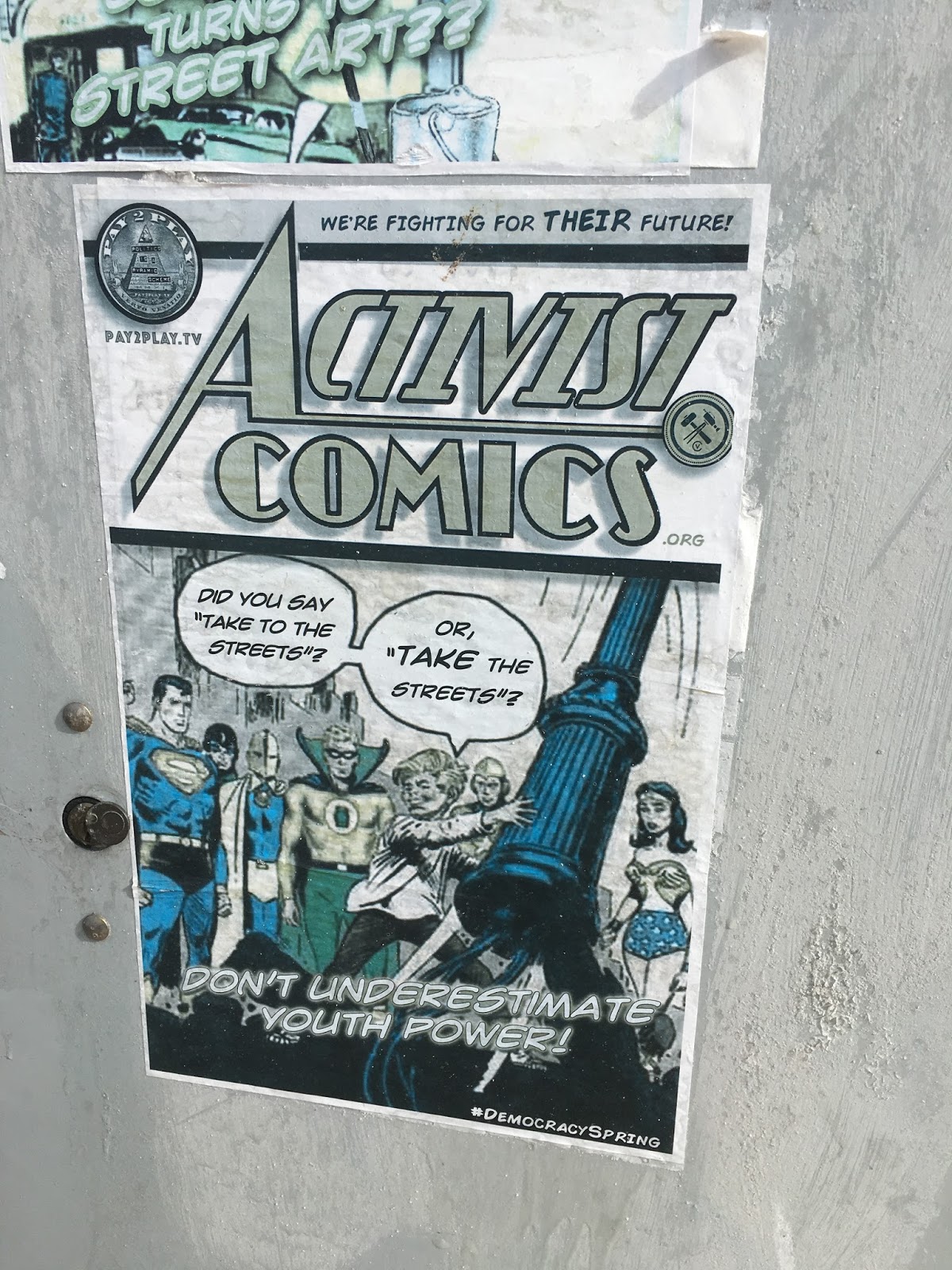
Seen around town: transformative works of the day, inauguration edition.

Seen on my way back from the Tam oral argument:
Activist Comics


9th Circuit rejects Slep-Tone's anti-copying claim couched as TM claim

Slep-Tone Entertainment Corp. v. Wired for Sound Karaoke & DJ Servs., LLC, No. 14-17229 (9th Cir. Jan. 18, 2017) (per curiam)

Slep-Tone makes karaoke music tracks under the trademark “Sound Choice.” They’re released on CDs in a format known as “CD-G,” which accompanies karaoke music with graphics, lyrics, and singing cues when played on compatible equipment.  Karaoke operators may prefer ripped files for convenience; Slep-Tone now allows one digital copy per source CD-G subject to various conditions.  It alleged that defendants performed shows using unauthorized media-shifted files, and that this infringed its trademark rights.  The district court concluded that “[t]his attempt to stuff copyright claims into a trademark container fails.” 

The court of appeals affirmed: “[w]hether we call the violation infringement, unfair competition or false designation of origin, the test is identical—is there a ‘likelihood of confusion?’” And there was not.

Slep-Tone argued that, because the ripped files showed its marks and trade dress when performed, consumers would be confused into thinking that the tracks originated with Slep-Tone, rather than with defendants.  But that theory didn’t identify “consumer confusion about the source of an appropriate ‘good,’” only possible confusion over the source of content. Dastar says “origin” has to mean tangible goods offered for sale.  And, though Dastar was about §43(a), the same standard applies to §32.  Slep-Tone identified the new digital files created by ripping as the relevant tangible goods.  But those “new goods” weren’t relevant goods.  The “good” at issue must be the “ ‘tangible product sold in the marketplace’ rather than the creative content of that product.” Phx. Entm’t Partners v. Rumsey, 829 F.3d 817, 828 (7th Cir. 2016) (quoting Dastar, 539 U.S. at 31).

There wouldn’t be confusion about the source of the tangible good sold in the marketplace, because “[c]onsumers are not aware of the new, media-shifted digital files about which Plaintiff asserts confusion.”  Any confusion isn’t about the source of the goods.  There’s no use of the Sound Choice marks “in connection with the sale, offering for sale, distribution, or advertising” of the files under 15 U.S.C. § 1114(1)(a) or “in connection with” the files under § 1125(a)(1).

[Query whether this result is consistent with the Second Circuit’s recent pronouncement that confusion over sponsorship or affiliation must also be considered before rejecting a confusion theory.]

This is really a case about unauthorized copying, and Dastar cautions against creating a “species of mutant copyright law” under the Lanham Act.  Slep-Tone was really complaining about allegedly unauthorized use of the content of the karaoke tracks, and Dastar bars such claims.  “The words of the Lanham Act should not be stretched to cover matters that are typically of no consequence to purchasers.” Hey, it’s materiality!  Hi, materiality! 


Lee v. Tam post-argument

Lee v. Tam

My thoughts on observing the argument: I was surprised how much attention the Justices paid to the copyright comparison.  The SG centered his response around the idea that copyright is historically a mechanism to stimulate expression, while trademark lacks the same speech-promoting role (and indeed serves a speech-suppressing function).  I might have spent more time saying that, under unconstitutional conditions doctrine, an exclusion from copyrightability for disparaging works would almost by definition be trying to affect speech outside the government program at issue—that is to say, it would be trying to leverage the government’s power to grant protection to expression to deter people from speech that includes disparaging ideas; therefore the unconstitutional conditions analysis would be sharply different if Congress decided to disallow copyright in disparaging works.

I have no prediction at all.

Post-argument panel at AU:

John Connell, Archer Law (Counsel for Respondent)
Denial of registration is always b/c gov’t finds mark disparaging, offensive to 3d party.  Gov’t disfavors that. That’s inherently viewpoint discrim b/c positive/neutral views are permitted to register.  Lanham Act is widely available to broad range of mark holders.  Selectively denying mark b/c of negative views expressed by mark is viewpoint discrimination.

Ilya Shapiro, Cato Institute (representing Cato Institute on amicus brief): added examples of offensive marks like Raging Bitch beer.  Beyond black letter law on viewpoint discrimination or unconstitutional conditions. Not thrown into jail, but denied a gov’t benefit for exercising his first amendment rights.  TM registration is an important statutory right—easier to defend infringements. Record label won’t sign w/o registration.

Mike Carroll: how does Wash. Football team dispute bear on this?

Jesse Witten, Drinker Biddle (representing Amanda Blackhorse, et al. on amicus brief)
No question that our case hangs over Tam, especially locally.  Overshadowing our case is the n word.  If you open the door to the Slants, you have to issue registrations for everything. Maybe that’s good policy, maybe not, but many judges will be leery of official registrations for incredibly racist marks.  We have examples of horrific marks registered before the statute was changed in the 1940s.  Gov’t felt it couldn’t be quite as brazen.  Intended to complement gov’t’s brief.  Simple argument: there’s no burden on the speaker.  Can still make claims under §43(a).  TM empowers you to silence somebody else. It’s not a 1A issue, it’s an exception to the 1A.  Refusal of registration reduces marginal ability to silence, but that’s not a 1A right.  J. Sotomayor asked some relevant questions. 

Q: unregistered owner can bring claim?

Prof. Rebecca Tushnet, Georgetown University (representing Law Professors on amicus brief)
TM is a right to suppress speech.  If Tam gets trademark protection for the expressive aspects of his mark, he is able to suppress other speakers—including a racist band using the term to express its racism.  This characteristic of TM and TM registration means that 1A analysis targeted at traditional punishments is inappropriate—there is no neutral baseline.  It also highlights that the gov’t is regulating only the registration aspects, not the expressive aspects of the mark.

Not denied a gov’t benefit outside the contours of the gov’t program itself. Unconstitutional conditions is a doctrine that prevents attempts to leverage a gov’t benefit to change constitutionally protected behavior outside the program.  Gov’t can decline to pay for abortion, but it can’t decline to provide other health care to someone who has exercised her const’l right to abortion.  Simon Tam can register TMs in logos, names, other features; if he were denied any TM registration until he changed the name, Shapiro would be right.

Why is viewpoint discrimination bad?  Because it targets a particular group for suppression.  Disparagement bar doesn’t do that.  Hating gays is a viewpoint; hating is not.  Materiality: do consumers care about the feature at issue?  If a blanket ban on disparagement is viewpoint based, then a ban on material falsehoods and not immaterial falsehoods is also viewpoint based because it depends on whether consumers care about the feature you’re discussing or not.

Shapiro: Agree that this is about unconstitutional conditions.  Also issues of scope of IP more broadly. If you’re going to have a registration system, it’s the gov’t administering and not speaking.  It can’t discriminate in this way.

Joel MacMull, Archer Law (Counsel for Respondent)
Notion that Simon Tam has not been burdened.  Keep in mind: this is a facial challenge to a constsitutional provision.  In all instances, §2(a) is discriminatory. When you have a facial challenge, you don’t have to demonstrate individual burden.  He can only continue using the mark if he’s not second in time in a given territory.  He’s based in Portland Oregon—someone could beat him if he didn’t have the benefit of the nationwide priority from the registration, which would allow him to prevent other people from using it nationwide.  43(a) isn’t a good enough fallback for those reasons.

Jesse Witten: the burden is that it’s harder for him to silence people outside of Portland?

MacMull: he may not be first in these other territories.

Witten: SCt has identified TM as an exception to free speech, not an instance of free speech.  Gay Olympics case: passes muster as a legit. regulation of commercial speech, satisfying intermediate scrutiny.

[RT: I hate that case but think it’s distinguishable.]

Shapiro: none of that has to do with registrability. Bracketing suppression, we take the law as given, and it’s an equal protection question.  Can your registration be denied b/c the gov’t doesn’t like it.

RT: on 43(a) and distant users: why wouldn’t they have 1A rights to do so? Denying them rights based on registration’s nationwide priority can’t be about protecting consumers in Michigan who don’t know about the Portland Slants and can’t be confused.  It is about another objective: helping businesses manage relations.

Carroll: what happened at argument?

Connell: the Ct wanted to rule unanimously against both sides. [h/t Mark Lemley]

Shapiro: Ct was struggling w/how to write the opinion. Justices weren’t satisfied w/gov’t or petitioners in terms of bright line for what they’re going to do.  He thinks 5 votes for pet’r; Breyer on fence; Sotomayor leaning towards gov’t; Thomas was silent but was deciding vote on Confederate flag case.  That’s distinguishable b/c nobody thinks every TM is endorsed by the gov’t.

Witten: no established doctrinal bucket.  I felt like a surprisingly large number had an open mind.  There are good arguments & weaknesses on both sides.

Connell: false association/no names w/o consent is a right of publicity issue, a completely different animal.

Shapiro: surprised Court wasn’t that interested in vagueness issues.  Dykes on Bikes: name approved but logo rejected b/c had name in it.  Denied to Have you heard Satan is a Republican but not The Devil is a Democrat.

Carroll: SG said no one rejected non-disparaging marks that were rejected.

Shapiro: Fag-dog has been registered 2x and refused 2x.

MacMull: it’s the gov’t’s burden.

Witten: open Qs: can you do a facial challenge on vagueness grounds?  SCt has said yes and no.  There may be some cases that are really hard and others, like N-word, are not hard.  Should not facially invalidate in such cases.  Marsh v. Chambers: SCt articulated a test that prayer was fine as long as it didn’t proselytize or disparage. If that’s the word employed to interpret Establishment Clause, hard to find that “may disparage” is vague.

MacMull: threw in constitutional stuff as a side issue; initial issue was an evidentiary one.  Vagueness, I long thought, was one of the strongest arguments, but it was never the one the Court or the Fed Cir en banc put in front of the parties. 

Q: reappropriation as potential distinction?

MacMull: PTO shouldn’t care about applicant’s intent, for many reasons not the least of which is that intent can change.  Tam’s intent could be different tomorrow.  TMs are freely assignable [w/goodwill]. 


Shapiro: vile marks are registrable, but that’s not a guarantee of success in the commercial marketplace. College football teams changed names b/c they found it untenable. It wasn’t the gov’t telling them to do so. Private solutions matter.  If The Slants’ name hurts ticket sales, that will take care of the problem.

Tuesday, January 17, 2017

Monday, January 16, 2017

Transformative work of the day, Lin-Manuel Miranda edition

What's Next?  Since I'm working on 512 roundtable reply comments right now, it seems particularly appropriate to remind everyone that clips can be fair use.

Friday, January 13, 2017

It's a Tam, Tam, Tam world

Along with a podcast for the American Constitution Center and an NPR interview running the morning of the Tam argument (next Wednesday), I'll also be on a post-argument panel at AU--the panel before features none other than Tam himself.

American University Washington College of Law 
Program on Information Justice and Intellectual Property 
Presents
Supreme Court Series:
Lee v. Tam
Post Argument Discussion
Wednesday, January 18, 2017
3:15pm Registration
3:30pm Policy Panel
4:15 Legal Panel
Reception to follow

NT01 Ceremonial Classroom in Warren Building
American University, Washington College of Law
4300 Nebraska Ave., NW Washington DC 20016 

Registration & CLE information:Lee v. Tam
In PIJIP’s ongoing Supreme Court Series, a panel of counsel for amici and parties will discuss the case on the afternoon following oral argument before the Court.

Issue in Lee: Whether the disparagement provision of the Lanham Act, 15 U.S.C. 1052(a), which provides that no trademark shall be refused registration on account of its nature unless, inter alia, it “[c]onsists of . . . matter which may disparage . . . persons, living or dead, institutions, beliefs, or national symbols, or bring them into contempt, or disrepute” is facially invalid under the Free Speech Clause of the First Amendment.

Prof. Michael Carroll, American University Washington College of Law (Moderator)

3:30pm - First Panel - Policy Discussion
  • Simon Tam, The Slants (Respondent)
  • Prof. Victoria Phillips, American University Washington College of Law
4:15pm - Second Panel - Legal Discussion
  • John Connell, Archer Law (Counsel for Respondent)
  • Joel MacMull, Archer Law (Counsel for Respondent)
  • Jesse Witten, Drinker Biddle (representing Amanda Blackhorse, et al. amicus brief)
  • Prof. Rebecca Tushnet, Georgetown University (representing Law Professors on amicus brief)
  • Ilya Shapiro, CATO Institute (representing CATO Institute on amicus brief)

Trump's trademarks


Selling, first and foremost, would not eliminate possibilities of conflicts of interest. In fact, it would exacerbate them. The Trump brand is key to the value of the Trump Organization’s assets. If President-elect Trump sold his brand, he would be entitled to royalties for the use of it, and this would result in the trust retaining an interest in the brand without the ability to assure that it does not exploit the office of the presidency.

First, there is absolutely no requirement that any transaction divesting Trump of the Trump trademarks must have royalties attached.  Lump sums—that is, outright sales—are perfectly acceptable methods of carrying out such transactions.  Fixed license fees with no relationship to sales are also possible.  The lawyer’s claim is a misstatement of the law, and one that should not have been made by anyone with even minimal trademark transaction experience.  I take it that in essence this statement is meant to be coupled with the later, and contestable in its own right, claim that President-Elect Trump shouldn’t have to (comply with the Constitution if that would mean he’d) suffer financially from being President, plus the implicit assertion that lump sums or fixed fees would be less financially attractive than royalties.  But “we think he couldn’t make as much money from a true sale” is not the same as “a sale would entitle him to royalties” and thus continue his financial interest in the brand no matter what. 

Second, to the extent that Trump is in fact (if you believe he is) isolated from information about and management of the brands, he has a bigger trademark problem: that would mean abandoning the mark.  If he is to be the owner, he needs to control the quality of the products and services sold via that mark.  If all he promises to do is step back so that he’s not involved in any decisions but just reaps the rewards, he’s just engaging in naked licensing, which in the US results in the abandonment of the mark.  So this “explanation” is flat wrong at best, backwards at worst.  [I wonder what would happen if someone brought a cancellation petition after he takes office.  I suppose one could claim that the non-blind trust is the legal owner, and is making management decisions, which just happen to inure to his benefit.  At last look, he was personally the owner of record of a bunch of the Trump registrations according to TSDR; I wonder if/when that will change.  But the real point is: without true divestment, no trust arrangement can keep him from having a financial interest in the Trump marks and businesses and thus from being vulnerable to influence in his official duties.]


Now, that doesn’t mean that these misstatements will ever have any consequences for the President-Elect, any more than other, more significant ones have done.  But let’s make a record anyway.

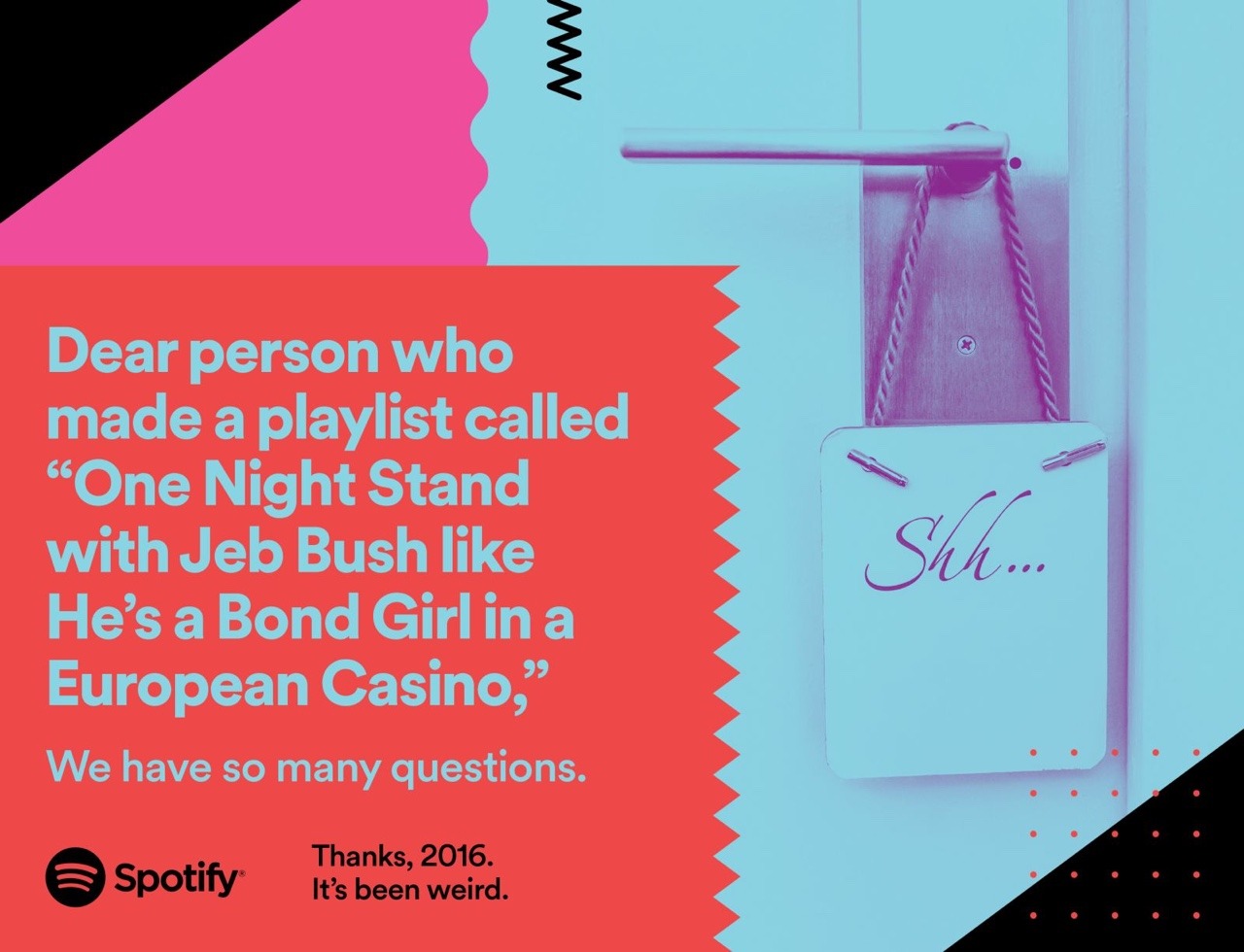
Question for those who know European privacy law

Is this ad campaign for Spotify a problem?
"Dear person in the Theater District who listened to the Hamilton soundtrack 5,376 times this year, can you get us tickets?"
and
"Dear person who played 'Sorry' 42 times on Valentine's Day, What did you do?"
Bonus: if these aren't actual Spotify customers, is this false advertising?  (By my calculations, you couldn't listen to the full Hamilton soundtrack 5,376 times in one year.  Maybe if you listened to mostly Act I, to avoid too much gross sobbing.)