![]() |
| Activist Comics |
Thursday, January 19, 2017
9th Circuit rejects Slep-Tone's anti-copying claim couched as TM claim
Slep-Tone
Entertainment Corp. v. Wired for Sound Karaoke & DJ Servs., LLC, No.
14-17229 (9th Cir. Jan. 18, 2017) (per curiam)
Slep-Tone makes karaoke
music tracks under the trademark “Sound Choice.” They’re released on CDs in a
format known as “CD-G,” which accompanies karaoke music with graphics, lyrics,
and singing cues when played on compatible equipment. Karaoke operators may prefer ripped files for
convenience; Slep-Tone now allows one digital copy per source CD-G subject to
various conditions. It alleged that
defendants performed shows using unauthorized media-shifted files, and that
this infringed its trademark rights. The
district court concluded that “[t]his attempt to stuff copyright claims into a
trademark container fails.”
The court of appeals
affirmed: “[w]hether we call the violation infringement, unfair competition or
false designation of origin, the test is identical—is there a ‘likelihood of
confusion?’” And there was not.
Slep-Tone argued
that, because the ripped files showed its marks and trade dress when performed,
consumers would be confused into thinking that the tracks originated with
Slep-Tone, rather than with defendants.
But that theory didn’t identify “consumer confusion about the source of
an appropriate ‘good,’” only possible confusion over the source of content. Dastar says “origin” has to mean
tangible goods offered for sale. And,
though Dastar was about §43(a), the
same standard applies to §32. Slep-Tone
identified the new digital files created by ripping as the relevant tangible
goods. But those “new goods” weren’t relevant goods. The “good” at issue must be the “ ‘tangible product
sold in the marketplace’ rather than the creative content of that product.”
Phx. Entm’t Partners v. Rumsey, 829 F.3d 817, 828 (7th Cir. 2016) (quoting
Dastar, 539 U.S. at 31).
There wouldn’t be
confusion about the source of the tangible good sold in the marketplace,
because “[c]onsumers are not aware of the new, media-shifted digital files
about which Plaintiff asserts confusion.”
Any confusion isn’t about the source of the goods. There’s no use of the Sound Choice marks “in
connection with the sale, offering for sale, distribution, or advertising” of
the files under 15 U.S.C. § 1114(1)(a) or “in connection with” the files under
§ 1125(a)(1).
[Query whether this
result is consistent with the Second Circuit’s recent pronouncement that
confusion over sponsorship or affiliation must also be considered before
rejecting a confusion theory.]
This is really a
case about unauthorized copying, and Dastar
cautions against creating a “species of mutant copyright law” under the Lanham
Act. Slep-Tone was really complaining
about allegedly unauthorized use of the content
of the karaoke tracks, and Dastar
bars such claims. “The words of the
Lanham Act should not be stretched to cover matters that are typically of no
consequence to purchasers.” Hey, it’s materiality! Hi, materiality!
Lee v. Tam post-argument
Lee v. Tam
My thoughts on
observing the argument: I was surprised how much attention the Justices paid to
the copyright comparison. The SG centered
his response around the idea that copyright is historically a mechanism to
stimulate expression, while trademark lacks the same speech-promoting role (and
indeed serves a speech-suppressing function).
I might have spent more time saying that, under unconstitutional
conditions doctrine, an exclusion from copyrightability for disparaging works
would almost by definition be trying to affect speech outside the government
program at issue—that is to say, it would be trying to leverage the
government’s power to grant protection to expression
to deter people from speech that includes disparaging ideas; therefore the unconstitutional conditions analysis would be
sharply different if Congress decided to disallow copyright in disparaging
works.
I have no prediction
at all.
Post-argument panel
at AU:
John Connell, Archer
Law (Counsel for Respondent)
Denial of
registration is always b/c gov’t finds mark disparaging, offensive to 3d
party. Gov’t disfavors that. That’s
inherently viewpoint discrim b/c positive/neutral views are permitted to
register. Lanham Act is widely available
to broad range of mark holders.
Selectively denying mark b/c of negative views expressed by mark is
viewpoint discrimination.
Ilya Shapiro, Cato
Institute (representing Cato Institute on amicus brief): added examples of
offensive marks like Raging Bitch beer.
Beyond black letter law on viewpoint discrimination or unconstitutional
conditions. Not thrown into jail, but denied a gov’t benefit for exercising his
first amendment rights. TM registration
is an important statutory right—easier to defend infringements. Record label
won’t sign w/o registration.
Mike Carroll: how
does Wash. Football team dispute bear on this?
Jesse Witten,
Drinker Biddle (representing Amanda Blackhorse, et al. on amicus brief)
No question that our
case hangs over Tam, especially locally.
Overshadowing our case is the n word.
If you open the door to the Slants, you have to issue registrations for
everything. Maybe that’s good policy, maybe not, but many judges will be leery
of official registrations for incredibly racist marks. We have examples of horrific marks registered
before the statute was changed in the 1940s.
Gov’t felt it couldn’t be quite as brazen. Intended to complement gov’t’s brief. Simple argument: there’s no burden on the
speaker. Can still make claims under
§43(a). TM empowers you to silence
somebody else. It’s not a 1A issue, it’s an exception to the 1A. Refusal of registration reduces marginal
ability to silence, but that’s not a 1A right.
J. Sotomayor asked some relevant questions.
Q: unregistered
owner can bring claim?
Prof. Rebecca
Tushnet, Georgetown University (representing Law Professors on amicus brief)
TM is a right to
suppress speech. If Tam gets trademark
protection for the expressive aspects of his mark, he is able to suppress other
speakers—including a racist band using the term to express its racism. This characteristic of TM and TM registration
means that 1A analysis targeted at traditional punishments is
inappropriate—there is no neutral baseline.
It also highlights that the gov’t is regulating only the registration
aspects, not the expressive aspects of the mark.
Not denied a gov’t
benefit outside the contours of the gov’t program itself. Unconstitutional
conditions is a doctrine that prevents attempts to leverage a gov’t benefit to
change constitutionally protected behavior outside the program. Gov’t can decline to pay for abortion, but it
can’t decline to provide other health care to someone who has exercised her
const’l right to abortion. Simon Tam can
register TMs in logos, names, other features; if he were denied any TM
registration until he changed the name, Shapiro would be right.
Why is viewpoint
discrimination bad? Because it targets a
particular group for suppression.
Disparagement bar doesn’t do that.
Hating gays is a viewpoint; hating is not. Materiality: do consumers care about the
feature at issue? If a blanket ban on
disparagement is viewpoint based, then a ban on material falsehoods and not
immaterial falsehoods is also viewpoint based because it depends on whether
consumers care about the feature you’re discussing or not.
Shapiro: Agree that this
is about unconstitutional conditions.
Also issues of scope of IP more broadly. If you’re going to have a
registration system, it’s the gov’t administering and not speaking. It can’t discriminate in this way.
Joel MacMull, Archer
Law (Counsel for Respondent)
Notion that Simon
Tam has not been burdened. Keep in mind:
this is a facial challenge to a constsitutional provision. In all instances, §2(a) is discriminatory.
When you have a facial challenge, you don’t have to demonstrate individual
burden. He can only continue using the
mark if he’s not second in time in a given territory. He’s based in Portland Oregon—someone could
beat him if he didn’t have the benefit of the nationwide priority from the
registration, which would allow him to prevent other people from using it
nationwide. 43(a) isn’t a good enough
fallback for those reasons.
Jesse Witten: the
burden is that it’s harder for him to silence people outside of Portland?
MacMull: he may not
be first in these other territories.
Witten: SCt has
identified TM as an exception to free speech, not an instance of free
speech. Gay Olympics case: passes muster
as a legit. regulation of commercial speech, satisfying intermediate scrutiny.
[RT: I hate that
case but think it’s distinguishable.]
Shapiro: none of
that has to do with registrability. Bracketing suppression, we take the law as
given, and it’s an equal protection question.
Can your registration be denied b/c the gov’t doesn’t like it.
RT: on 43(a) and
distant users: why wouldn’t they have 1A rights to do so? Denying them rights
based on registration’s nationwide priority can’t be about protecting consumers
in Michigan who don’t know about the Portland Slants and can’t be confused. It is about another objective: helping
businesses manage relations.
Carroll: what
happened at argument?
Connell: the Ct
wanted to rule unanimously against both sides. [h/t Mark Lemley]
Shapiro: Ct was
struggling w/how to write the opinion. Justices weren’t satisfied w/gov’t or
petitioners in terms of bright line for what they’re going to do. He thinks 5 votes for pet’r; Breyer on fence;
Sotomayor leaning towards gov’t; Thomas was silent but was deciding vote on
Confederate flag case. That’s distinguishable
b/c nobody thinks every TM is endorsed by the gov’t.
Witten: no established
doctrinal bucket. I felt like a
surprisingly large number had an open mind.
There are good arguments & weaknesses on both sides.
Connell: false
association/no names w/o consent is a right of publicity issue, a completely
different animal.
Shapiro: surprised
Court wasn’t that interested in vagueness issues. Dykes on Bikes: name approved but logo
rejected b/c had name in it. Denied to
Have you heard Satan is a Republican but not The Devil is a Democrat.
Carroll: SG said no
one rejected non-disparaging marks that were rejected.
Shapiro: Fag-dog has
been registered 2x and refused 2x.
MacMull: it’s the
gov’t’s burden.
Witten: open Qs: can
you do a facial challenge on vagueness grounds?
SCt has said yes and no. There
may be some cases that are really hard and others, like N-word, are not
hard. Should not facially invalidate in
such cases. Marsh v. Chambers: SCt
articulated a test that prayer was fine as long as it didn’t proselytize or
disparage. If that’s the word employed to interpret Establishment Clause, hard
to find that “may disparage” is vague.
MacMull: threw in
constitutional stuff as a side issue; initial issue was an evidentiary
one. Vagueness, I long thought, was one
of the strongest arguments, but it was never the one the Court or the Fed Cir
en banc put in front of the parties.
Q: reappropriation
as potential distinction?
MacMull: PTO
shouldn’t care about applicant’s intent, for many reasons not the least of
which is that intent can change. Tam’s
intent could be different tomorrow. TMs
are freely assignable [w/goodwill].
Shapiro: vile marks
are registrable, but that’s not a guarantee of success in the commercial
marketplace. College football teams changed names b/c they found it untenable.
It wasn’t the gov’t telling them to do so. Private solutions matter. If The Slants’ name hurts ticket sales, that
will take care of the problem.
Tuesday, January 17, 2017
video of Evil Twin debate on Tam
Available here. Tomorrow I'll have my third NPR interview on Tam; interest seems quite high.
Monday, January 16, 2017
Transformative work of the day, Lin-Manuel Miranda edition
What's Next? Since I'm working on 512 roundtable reply comments right now, it seems particularly appropriate to remind everyone that clips can be fair use.
Friday, January 13, 2017
It's a Tam, Tam, Tam world
Along with a podcast for the American Constitution Center and an NPR interview running the morning of the Tam argument (next Wednesday), I'll also be on a post-argument panel at AU--the panel before features none other than Tam himself.
American University Washington College of Law
Program on Information Justice and Intellectual Property
Presents
Supreme Court Series:
Lee v. Tam
Post Argument Discussion
|
Wednesday, January 18, 2017
3:15pm Registration
3:30pm Policy Panel
4:15 Legal Panel
Reception to follow
NT01 Ceremonial Classroom in Warren Building
American University, Washington College of Law
4300 Nebraska Ave., NW Washington DC 20016
Registration & CLE information:Lee v. Tam
|
Issue in Lee: Whether the disparagement provision of the Lanham Act, 15 U.S.C. 1052(a), which provides that no trademark shall be refused registration on account of its nature unless, inter alia, it “[c]onsists of . . . matter which may disparage . . . persons, living or dead, institutions, beliefs, or national symbols, or bring them into contempt, or disrepute” is facially invalid under the Free Speech Clause of the First Amendment.
Prof. Michael Carroll, American University Washington College of Law (Moderator)
3:30pm - First Panel - Policy Discussion
4:15pm - Second Panel - Legal Discussion
|
Trump's trademarks
Selling, first and foremost, would not eliminate possibilities of
conflicts of interest. In fact, it would exacerbate them. The Trump brand is
key to the value of the Trump Organization’s assets. If President-elect Trump
sold his brand, he would be entitled to royalties for the use of it, and this
would result in the trust retaining an interest in the brand without the
ability to assure that it does not exploit the office of the presidency.
First, there is
absolutely no requirement that any transaction divesting Trump of the Trump trademarks
must have royalties attached. Lump sums—that
is, outright sales—are perfectly acceptable methods of carrying out such
transactions. Fixed license fees with no
relationship to sales are also possible.
The lawyer’s claim is a misstatement of the law, and one that should not
have been made by anyone with even minimal trademark transaction
experience. I take it that in essence
this statement is meant to be coupled with the later, and contestable in its
own right, claim that President-Elect Trump shouldn’t have to (comply with the
Constitution if that would mean he’d) suffer financially from being President,
plus the implicit assertion that lump sums or fixed fees would be less financially
attractive than royalties. But “we think
he couldn’t make as much money from a true sale” is not the same as “a sale
would entitle him to royalties” and thus
continue his financial interest in the brand no matter what.
Second, to the
extent that Trump is in fact (if you believe he is) isolated from information
about and management of the brands, he has a bigger trademark problem: that
would mean abandoning the mark. If he is
to be the owner, he needs to control the quality of the products and services sold
via that mark. If all he promises to do
is step back so that he’s not involved in any decisions but just reaps the
rewards, he’s just engaging in naked licensing, which in the US results in the
abandonment of the mark. So this
“explanation” is flat wrong at best, backwards at worst. [I wonder what would happen if someone brought
a cancellation petition after he takes office.
I suppose one could claim that the non-blind trust is the legal owner,
and is making management decisions, which just happen to inure to his benefit. At last look, he was personally the owner of
record of a bunch of the Trump registrations according to TSDR; I wonder
if/when that will change. But the real
point is: without true divestment, no trust arrangement can keep him from
having a financial interest in the Trump marks and businesses and thus from
being vulnerable to influence in his official duties.]
Now, that doesn’t
mean that these misstatements will ever have any
consequences for the President-Elect, any more than other, more significant ones have done. But let’s make a record anyway.
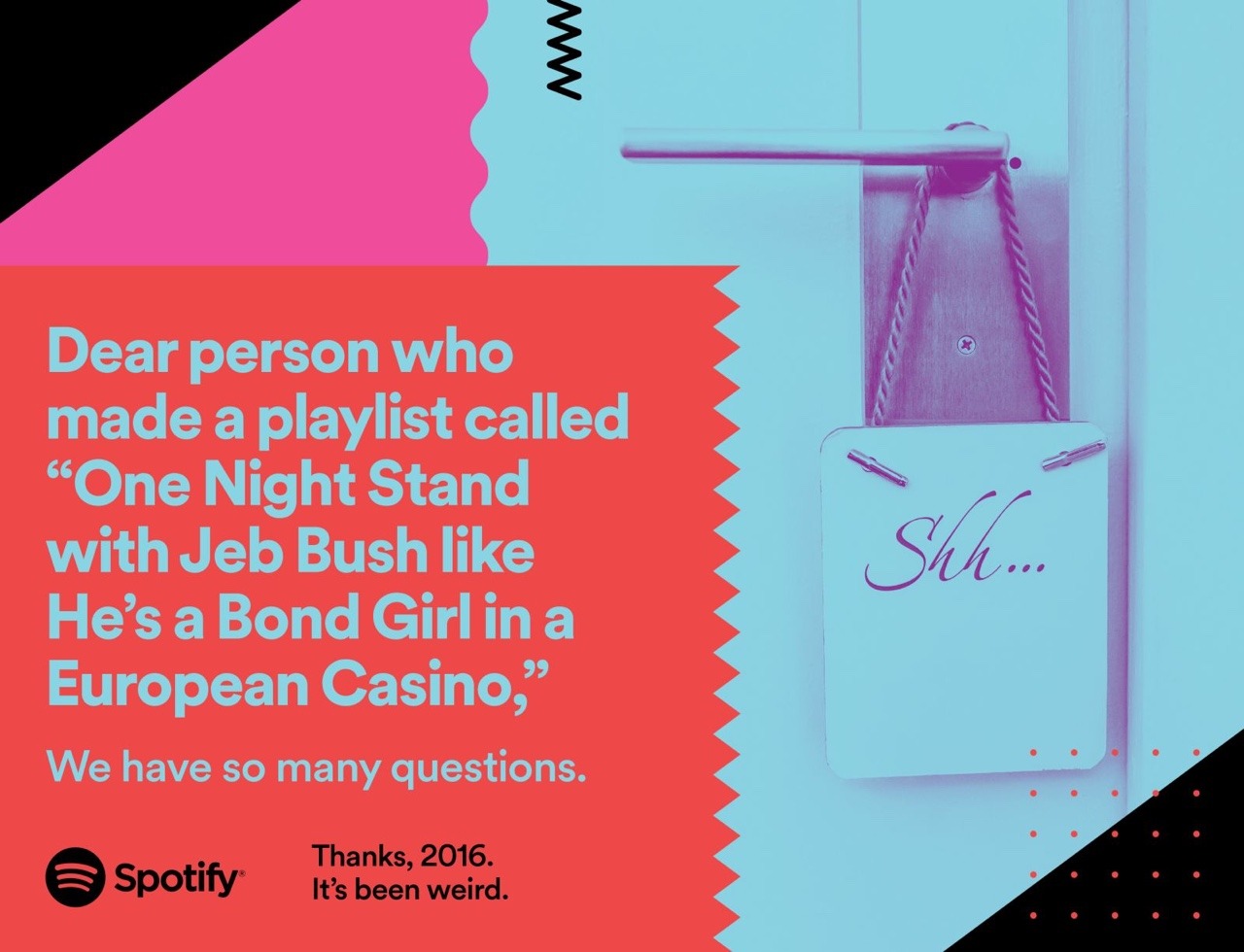
Question for those who know European privacy law
Is this ad campaign for Spotify a problem?
Thursday, January 12, 2017
Harvard IP fellowship: applications sought
PROJECT ON THE
FOUNDATIONS OF PRIVATE LAW POSTDOCTORAL FELLOWSHIP IN PRIVATE LAW AND
INTELLECTUAL PROPERTY, 2017-2019
CALL FOR
APPLICATIONS
The Project on the
Foundations of Private Law is an interdisciplinary research program at Harvard
Law School dedicated to scholarly research in private law. Applicants should be
aspiring academics with a primary interest in intellectual property
(especially, patent, copyright, trademark and trade secret) and its connection
to one or more of property, contracts, torts, commercial law, unjust
enrichment, restitution, equity, and remedies. The Project welcomes applicants
with a serious interest in legal structures and institutions, and welcomes a
variety of perspectives, including economics, history, philosophy, and
comparative law. The Qualcomm Postdoctoral Fellowship in Private Law and
Intellectual Property is a specifically designed to identify, cultivate, and
promote promising IP scholars early in their careers. Fellows are selected from
among recent graduates, young academics, and mid-career practitioners who are
committed to spending two years at the Project pursuing publishable research
that is likely to make a significant contribution to the IP and private law,
broadly conceived. More information on the Center can be found at:
http://www.law.harvard.edu/programs/about/privatelaw/index.html.
PROGRAM: The
Qualcomm Postdoctoral Fellowship in Private Law and Intellectual Property is
a full-time, two-year
residential appointment, starting
in the Fall
of 2017. Like other postdoctoral fellows, IP Fellows devote their full
time to scholarly activities in furtherance of their individual research
agendas in intellectual property and private law. The Project does not impose
teaching obligations on fellows, although fellows may teach a seminar on the
subject of their research in the Spring of their second year. In addition to
pursuing their research and writing, fellows are expected to attend and
participate in research workshops on private law, and other events designated
by the Project. Fellows are also expected to help plan and execute a small
number of events during their fellowship, and to present their research in at
least one of a variety of forums, including academic seminars, speaker panels,
or conferences. Through organizing events with outside speakers, helping to run
programs, and attending seminars, fellows interact with a broad range of
leading scholars in intellectual property and private law. The Project also
relies on fellows to provide
opportunities for interested students to consult with them about their areas of
research, and to directly mentor its Student Fellows. Finally, fellows will be
expected to blog periodically (about twice per month) on our collaborative
blog, New Private Law (blogs.harvard.edu/nplblog).
STIPEND AND
BENEFITS: Fellows have access to a wide range of resources offered by Harvard
University. The Center provides each fellow with office space, library access,
and a standard package of benefits for employee postdoctoral fellows at the Law
School. The annual stipend will be
$55,000 per year.
ELIGIBILITY: By the
start of the fellowship term, applicants must hold a J.D. or other graduate law degree. The Center
particularly encourages applications from those
who intend to
pursue careers as
tenure-‐track law professors
in intellectual property and
private law, but will consider any applicant who demonstrates an interest and
ability to produce outstanding scholarship in the area. Applicants will be
evaluated by the quality and probable significance of their research proposals,
and by their record of academic and professional achievement.
APPLICATION:
Completed applications must be received at conner@law.harvard.edu by 9:00 a.m.
on March 1, 2017. Please note that ALL application materials must be submitted
electronically, and should include:
1. Curriculum Vitae
2. PDFs of transcripts from all post-secondary
schools attended.
3. A Research Proposal of no more than
2,000 words describing the applicant’s area of research and writing plans.
Research proposals should demonstrate that the applicant has an interesting and
original idea about a research topic that seems sufficiently promising to
develop further.
4. A writing sample that demonstrates the
applicant’s writing and analytical abilities and ability to generate
interesting, original ideas. This can be a draft rather than a publication.
Applicants who already have publications may also submit PDF copies of up to
two additional published writings.
5. Three letters of recommendation,
emailed directly from the recommender. Letter writers should be asked to
comment not only on the applicant’s writing and analytical ability, but on his
or her ability to generate new ideas and his or her commitment to pursue an
intellectual enterprise in this area. To the extent feasible, letter writers
should provide not just qualitative assessments but also ordinal rankings. For
example, rather than just saying a candidate is “great,” it would be useful to
have a statement about whether the candidate is (the best, in the top three,
among the top 10%, etc.) among some defined set of persons (students they have
taught, people they have worked with, etc.).
All application
materials with the exception of letters of recommendation should be emailed by the applicant to conner@law.harvard.edu. Letters
of Recommendation should be
emailed directly from the recommender to the same address.
For questions or
additional information, contact: Bradford Conner, Coordinator,
conner@law.harvard.edu.
Federal Circuit Symposium at AU on Patent & TM law, Jan. 27
AMERICAN UNIVERSITY LAW REVIEW PRESENTS ITS FEDERAL CIRCUIT SYMPOSIUM :
IDENTIFYING BOUNDARIES IN PATENT AND TRADEMARK LAW
Jan. 27, 2017 at American University College of Law
REGISTER AT: WWW.WCL.AMERICAN.EDU/SECLE/REGISTRATION CLE CREDIT AVAILABLE
Jan. 27, 2017 at American University College of Law
REGISTER AT: WWW.WCL.AMERICAN.EDU/SECLE/REGISTRATION CLE CREDIT AVAILABLE
Monday, January 09, 2017
10th Annual Evil Twin Debate,"Free Speech or Free to Reject?: Trademark Registration & the First Amendment”
Sponsored by the University of Richmond School of Law and the AALS IP Section and hosted at Golden Gate University School of Law. Mark Lemley & I debated, and though I usually try to point out that my summaries may not be complete, here my summary of Lemley's statements is very disjointed, because in this case I was trying to prepare my rebuttal while taking occasional notes, so for a fairer explication of his arguments you should read his amicus brief on behalf of Dykes on Bikes, linked below. I also hope a recording of the event will be made available.
My presentation: Four big things the parties and amici disagree on, and some thoughts about vagueness and inconsistency in 2(a) refusals:
Our odyssey: the only evidence was that lesbians were perfectly happy w/our use of the term dyke. What we did see was that the second examiner looked it up and found bad terms including dykes. Counsel said “I’m a dyke,” and you could hear an audible gasp—this examiner was personally shocked. Even if we say we will apply it neutrally, we use gov’t as listener, gov’t as decisionmaker, and that’s why you get crazy inconsistent decisions.
My presentation: Four big things the parties and amici disagree on, and some thoughts about vagueness and inconsistency in 2(a) refusals:
First: Whether
43(a)(1)(A) incorporates the same policy based limits as registration under
section 2. If 43(a) protection is still available
when use of an unregistered symbol causes confusion then the impact of denying
registration will be much less. The
problem for those arguing that 43(a) is still available is that the text of the
provision leaves us with no real way to distinguish the bars in 2 that we
definitely want to apply to 43(a)—like the bar on protecting generic terms as
such—from bars that we don’t. So, you
get cases like Belmora in the 4th Circuit, which essentially removed
territoriality as a limit on 43(a). By
contrast, the Renna case from New Jersey said that a section 2
registration-barred mark couldn’t be protected by 43(a) and explained why it
thought that such a result was sensible in light of the underlying policy
behind the Lanham Act and questions of administrability. Regardless of which way one comes out on
Belmora and Renna, the point is that this question has implications far beyond
disparagement, and I think that it’s a bad idea to try to answer that broader
question merely as a waystation to the First Amendment question about
disparagement.
Second: TM’s effects
on non-owners or non-registrants. In what way, if at all, should it matter that
granting Tam a registration enhances his capacity to suppress the speech of
others? Most of those on Tam’s side, Lemley’s brief excepted, don’t say much
about this. Relatedly, and the source of
troubling inconsistencies in those on Tam’s side, is a trademark commercial
speech? Tam says it isn’t always commercial speech and some amici say it never
is because there’s always non-trademark meaning in a mark; if that’s so we’re
subjecting infringement cases to far less scrutiny than necessary. Implicit in
Tam’s argument seems to be that trademark owners have messages but infringers
don’t – except that Tam also says one of his objectives is to prevent a racist
band from calling itself the Slants.
From Lemley’s amicus
brief: Dykes on Bikes wants to control commercialization of the mark. Which is to say it wants to prevent other
people from using the mark in expressive ways such as on T-shirts and
mugs. Mark Lemley and Stacey Dogan,
among others, have argued that this shouldn’t be understood as trademark use,
but at the very least it has both commercial and message-delivering aspects. The difference between the infringer’s desire
to speak and Tam’s situation is, supposedly, the harm done by confusion—but as
we know, there’s usually no such evidence of harm, and no legislature has made
factual findings that confusion itself does harm. Lemley’s brief gives another example of the
benefits of registration by pointing to his client’s ability to use the Sunrise
registration process to control a Dykesonbikes.xxx domain name registration: like it or not, though,
that website would have expressed a message, and not one inherently based on
confusion with the existing organization.
Third: What
framework to analyze 2(a) under: is it government speech, commercial speech
under Central Hudson, viewpoint discrimination, unconstitutional conditions, or
something else? One of the problems is our
ornate First Amendment doctrine, which grows new protrusions every year. But another is the problem of applying the
First Amendment to government programs that change the structure of the
marketplace; trademark registration, not to mention trademark infringement
doctrine, does that, and so does the existence of public schools. When the government is deeply embedded into
the structure of an institution, how does that affect our understanding of the
government’s freedom to make choices about what to support, as long as it’s not
fining people for speech or sending them to jail? I conclude that the best
framework is unconstitutional Conditions: the government can’t leverage its
program to affect speech outside the program.
And on that framework, it’s clear that there is no effect on Tam’s
ability to communicate his message outside of the trademark context. He doesn’t
have to give up the name to get trademark protection for the content that
includes the name, the way that a prohibition on copyright for disparaging
works would require the author to give up on disparagement in order to get
protection.
Fourth: Viewpoint
versus content discrimination. The line
between the two can be unclear, and I think especially in combination with the
previous problem it is very important to understand exactly what the
government’s trying to do. Is the
government trying to suppress discussion of racial issues? Stigmatize abortion? Or something else? For better or worse, the government in 2(a)
disparagement is trying to limit registrations to those not perceived as
disparaging to a targeted group. To me,
that is content discrimination, not viewpoint discrimination. The government doesn’t care which person or group
you target.
The government also
doesn’t care why you chose the symbol at issue—maybe you want to reclaim the
number fourteen for non-Nazis, or maybe you want to show your Nazi bona fides;
either way, it’s the reaction of the targeted group that matters and not your
malign or benign viewpoint. Of course
your choice will express a viewpoint;
that’s not the issue. The issue is
whether the overall system, not just the outcome in your case, discriminates
against the holders of any coherent class of viewpoints. One can say that true threats express a
viewpoint, but that just highlights the point that it’s possible to reframe
almost any content regulation as a viewpoint regulation. In my opinion, the better path is to ask: why
do we care about viewpoint regulation more than content regulation? As the Supreme Court has previously said,
viewpoint discrimination is when the state is “attempting to give one group an
advantage over another in the marketplace of ideas,” and that’s just not what
the disparagement bar is.
Relatedly: The
applicant’s viewpoint about the term or the targeted group matters not at all.
The understanding of the targeted group is the key. And many on Tam’s side says
that consulting the views of the targeted group constitutes viewpoint
discrimination, even though heretofore we’ve used the idea of viewpoint
discrimination to identify discrimination based on the speaker’s viewpoint. You
can, I suppose, create a new category of viewpoint discrimination “in the air,”
to borrow a phrase from Learned Hand. But
if relying on the reaction of the audience to determine registrability makes
disparagement viewpoint based then so are descriptiveness and deceptiveness,
also dependent on audience understanding.
Final issue:
vagueness. I think this is frankly the
most serious issue for the government, and here I do have to appeal to the
nature of registration as a government program in its defense. We’re up to half
a million applications a year. If we are
going to have registration as an individualized determination at that scale, we
are going to have inconsistencies. My
analogy is to public schools: if we’re going to have them, then some history
teachers are going to give better grades to the same essay than other history
teachers (which some plagiarists have surely learned to their sorrow). We cannot have the scale of the government
participation in the marketplace without inconsistency; if we want the program
to continue to exist—which not everyone does for public schools, but Tam’s
supporters definitely want registration to continue to exist—then we have to
deal with inconsistency in procedural and not substantive ways. That is, we
have to provide mechanisms for making records and challenging adverse
decisions. And we have this, though
there’s a reasonable argument to be made that the TTAB should take more account
of precedent.
If we decide that
disparagement is too vague a standard, then it will be difficult to distinguish
almost anything in trademark that we discuss with our students—the line between
suggestive and descriptive, which has significant consequences for
registrability; so too with the line between descriptiveness and genericity;
the standard for confusion refusals under 2(d) as well as the infringement
standard under 32 and 43(a); the definition of false advertising; and so
on. Someone like Justice Breyer, who
likes to balance, could readily conclude that the game isn’t worth the candle
for disparagement but is for these other exclusions, but most of the Justices
on the Court are uncomfortable with that kind of ad hoc balancing. I fear that if they accept the vagueness
argument they will just encourage other courts to lie about how vague the other
parts of trademark law are, and that makes our law less law-like.
Vagueness & the
contradictory Dykes on Bikes rulings, discussed in Lemley’s brief, where the word mark was allowed but a later
stylized word mark was refused even though it was just a narrower version of
the word mark: Great example because there’s a recent exact match in the
genericity space: Churrascos, which was allowed as a standard word mark for restaurants, then
rejected for being generic when the registrant tried to register a stylized
mark. Is this dumb? Yes.
Should we change the rule so that there’s more issue preclusion at the
PTO? Maybe, though I’m concerned given
the installed base of decisions, and given the lack of true adversity in many
of these cases in which the applicant is the sole source of information about
the meaning of the applied-for matter.
But more to the point, I think we should be asking administrative
procedure questions about dealing with inconsistencies—if we constitutionalize
this process, then we’re inviting the process to grind to a halt, or convert
into a filing-based rather than truly examination-based regime.
Mark Lemley: Viewpoint/content
doesn’t matter for the outcome because Tam wins either way. Under any kind of reasonable way, this has to
be viewpoint based. Redskins, if it goes down in TM office, goes down b/c it’s
offensive to Native Americans. But “Native Americans” is ok. They want to discourage bad messages and not
discourage good ones. Sorrell:
Regulation b/c of disagreement w/message it conveys is subject to heightened
scrutiny. NAACP is registrable but not
Nat’l Ass’n for Colored Persons—that’s classic viewpoint discrimination.
At the very least,
this is content based restriction on speech. They are applying this new and
special law b/c of the topic discussed. That makes it content based. It is true that the justification is that
people are upset by disparagement. Heckler’s
veto.
Our odyssey: the only evidence was that lesbians were perfectly happy w/our use of the term dyke. What we did see was that the second examiner looked it up and found bad terms including dykes. Counsel said “I’m a dyke,” and you could hear an audible gasp—this examiner was personally shocked. Even if we say we will apply it neutrally, we use gov’t as listener, gov’t as decisionmaker, and that’s why you get crazy inconsistent decisions.
Can’t pass strict
scrutiny under content based. Gov’t has no interest justifying rule other than
suppression of speech itself. Less restrictive alternatives. Gov’t can
disassociate itself from the speech. Could say on each registration. Could even probably get away with only not
endorsing some of them. But there’s no
way in which they can survive strict scrutiny.
Commercial
speech/not doesn’t matter. TM can promote and repress speech. But that fact
doesn’t change the fact that what we’re doing when we regulate disparaging
speech is regulating things w/real expressive impact.
We’ve all assumed
that 43 protection was available w/refusal of registration, but there aren’t
any cases saying that. Most of the other aspects of 2 have been incorporated
into 43, so it wouldn’t be surprising to have this one either. If you’re restricting the right to have TM
protection at all, that’s well beyond unconstitutional conditions. This isn’t just a gov’t benefit; it has real
significant consequences in enforcement.
It was impossible for a small nonprofit to prevent blatant knockoffs w/o
registration: eBay, Etsy, CafePress all want registrations to pull merchandise.
If you can’t show them TM registration, they say go away. That’s perfectly
reasonable; they don’t know who has common law rights or who’s the first user. At least TM registration makes them
comfortable. Practical effect isn’t just additional remedies. It’s the difference b/t effective enforcement
and lack of effective enforcement. Even
if that weren’t true, unconstitutional conditions cases don’t necessarily
apply—just b/c I can impose a harm on you, doesn’t mean I can do it for reasons
or purposes themselves directed at the repression of speech. Even w/ no right to benefit, some reasons on
which gov’t may not rely.
Real problem: even
if we try to fit this in unconstitutional conditions doctrine, doesn’t avoid
scrutiny of purpose. US v. Playboy:
distinction between burden and ban is just a matter of degree; burdens must
satisfy the same rigorous scrutiny as bans.
If this is
unconstitutional, what else goes down with it?
This is a slippery slope argument. Refuse to do the right thing today
for fear of being forced to do the right thing tomorrow. If we applied rigorous First Amendment, most
results would be salutary. We might lose scandalousness. One
way might be to decide this on viewpoint discrimination and then say the rest
are just content-based.
RT: It’s not
viewpoint discrimination. Other groups
are protected to the same extent as Native Americans. That’s not viewpoint
based b/c it doesn’t promote any group over any other. Content based sure, as is the rest of TM law.
Note all the quotes in
Lemley’s presentation about prohibition, and ban, and suppression, and
punishment—these quotes make sense when you are talking about sending people to
jail or fining them for their speech. But the government deciding not to
include specific words in their program is different. If Tam couldn’t get a registration until he
gave up using Slants, everything Lemley said would be correct. But he can, so it isn’t.
Sorrell:
disagreement w/the message = heightened scrutiny. Consider this statement: The Holocaust
happened. Can public schools teach this and give students bad grades if they
don’t acknowledge it on tests? Don’t
want to impose Sorrell’s standard when the gov’t is creating the program, and
that’s why we have unconstitutional conditions.
Can fund abortion and not contraception or vice versa. Democracy promotion but not authoritarianism
(or perhaps, upcoming, vice versa).
All
of TM law is content based. That’s the
problem. The rest of TM registration
can’t survive strict scrutiny either; the less restrictive alternative is
always fraud, or even the common law.
Gov’t as
decisionmaker: he says that vagueness of disparagement is why you get crazy
inconsistent decisions. But it’s not—Churrascos
is the same. The size of the program is why you get crazy inconsistent
decisions.
Gov’t interest is
nonparticipation in disparagement by gov’t.
Shelly v. Kraemer type rationale.
He says: “what we’re
doing when we regulate disparaging speech is regulating things w/real
expressive impact.” But that’s the point: because the alleged infringers will
have an expressive impact too, there is no neutral position from which to
evaluate a rights-granting program.
If we applied
rigorous First Amendment, he says most results would be salutary. I like that
with infringement, sure, but not so much ITUs and nationwide protection and
extension of protection under Paris Convention. And TM plaintiffs get to yell property
rights and not have the same rules apply to them. Note the majority in Tam said that protecting
investment was unquestionably one of the okay purposes of TM law, so I fear
that only some parts would get real scrutiny.
Jake Linford: why
doesn’t SCt pretend that TM are just like © and find some traditional
contour—there’s enough 1A protection in the system already?
Lemley: That would
be wrong. There are substantial differences explaining why the court hasn’t
said a 1A free ride. You’ve built in more speech protections to © than TM. Fair
use might or might not be sufficient, but it’s an effort to protect expressive
uses.
The Court is
influenced by existence of Patent/© clause in Constitution; couldn’t say that
with a straight face re: Commerce Clause.
Linford: recent UHS of Delaware case: pleading standards for 32 and 43 increase
the requirements for success under 43: does that shift your perspective on harm
to TM owners who can’t get registrations?
RT: No, b/c I think
it’s ok not to give 43 protection to disparaging marks.
Jennifer Rothman:
Whether it matters who’s filing w/r/t disparagement. It does seem that perspective is based on
who’s filing. Dykes on Bikes. Even if
it’s just content based, not convinced that gov’t interest is sufficient, b/c
it’s not gov’t speech.
RT: I don’t think
the record bears that out. Democrats and Republican examples, not to mention
all the Bitch and anti-woman marks, suggest differently. They go all different ways.
Gov’t doesn’t have
to be speaking to have an interest in not endorsing. Shelly v. Kraemer is not about public
perception but about what positions the gov’t can accept without implicating
itself in discrimination, e.g., it's acceptable to call women the c-word.
Irene Calboli: A
child wearing Dykes on Bikes would be sent home from public school. That’s
suppression of speech. How do you reconcile that?
Lemley: True in
elementary school; untrue in college; shouldn’t be true in high school. If they throw me out of college, I’ve got a
slam-dunk First Amendment case. We
pretend that kids aren’t actual people.
Ann Bartow: My sense
became that it mattered if someone complained; that can help make sense of
inconsistent outcomes.
Lemley: that
certainly matters. In Dykes on Bikes
there was one guy who thought lesbianism was bad; lost for lack of
standing. My sense is same as Rothman’s—this
is not neutrally applied, but gendered, even as it is supposedly protecting
minority groups. Systematically
reinforces some standards.
Bill McG:
prediction?
Lemley: affirm. Viewpoint; or content discrimination with bad
justification; may not say anything about the rest of the system. As a
practical matter, there’s not much reason to be concerned. Beyond scandalous marks and maybe emblem or
insignia, where there is a plausible confusion based or search cost based
justification, courts will just continue as is.
Tyler Ochoa: Does
not registering suppress speech?
Granting TM gives Tam a right to suppress others’ speech: on balance
registration suppresses more speech than it encourages.
Lemley: always true
that there are speech interests on both sides. It’s burdening Tam’s speech to
shunt him towards certain types of speech rather than others. That’s problematic
under 1A even if the result is more infringement.
RT: The registration
will also shunt potential defendants towards certain types of speech rather
than others. Lemley is right that it’s
impossible to add this up and that we should probably look to reasons
instead. Then we disagree about whether
the reasons are ok.
Q: Institutional
counterfactual about vagueness: The PTO is weak; it can’t write substantive
rules. In an alternative universe where it were like the EPA or SEC, would a
code have helped?
Lemley: it would
have helped if you think the problem is vagueness, not an affirmative burden on
speech.
Friday, January 06, 2017
Reading list: anti-surcharge rules and behavioral economics
Todd J. Zywicki, Geoffrey A. Manne & Kristian Stout, Behavioral
Law & Economics Goes to Court: The Fundamental Flaws in the Behavioral Law
& Economics Arguments Against No-Surcharge Laws
I found this quite interesting, though I am much less skeptical
of behavioral economics than the authors.
Most significantly, I am very sympathetic to the Occam’s Razor argument
that the no-surcharge rule serves obvious consumer protection functions across
a range of plausible circumstances, and I’m intrigued by the authors’ claim
that countries that allow surcharges are plagued with complaints about
excessive charges and insufficient disclosure.
Summary:
During the past decade,
academics—predominantly scholars of behavioral law and economics—have
increasingly turned to the claimed insights of behavioral economics in order to
craft novel policy proposals in many fields, most significantly consumer credit
regulation. Over the same period, these ideas have also gained traction with
policymakers, resulting in a variety of legislative efforts, such as the
creation of the Consumer Financial Protection Bureau. Most recently, the efforts
of behavioral law and economics scholars have been directed toward challenging
a number of state laws that regulate retailers’ use of surcharge fees for
consumer credit card payments. In part as a result of these efforts, the issue has
come before multiple courts, with varying outcomes.
In 2016 the issue reached the
Supreme Court, which granted certiorari in Expressions Hair Design v. New York
for the October 2016 term. The case, which centers on a decades-old New York
state law that prohibits merchants from imposing surcharge fees for credit card
purchases, represents the first major effort to ground constitutional law
(here, First Amendment law) in the claims of behavioral economics.
In this article we examine the
merits of that effort. Claims about the real-world application of behavioral
economic theories should not be uncritically accepted—especially when advanced
to challenge a state’s commercial regulation on constitutional grounds. And
courts should be especially careful before relying on such claims where the
available evidence fails to support them, where the underlying theories are so
poorly developed that they have actually been employed elsewhere to support
precisely opposite arguments, and where alternative theories grounded in more
traditional economic reasoning are consistent with both the history of the challenged
laws and the evidence of actual consumer behavior.
The Petitioners in the case (five
New York businesses) and their amici (scholars of both behavioral law and economics
and First Amendment law) argue that New York’s ban on surcharge fees but not
discounts for cash payments violates the free speech clause of the First
Amendment. The argument relies on a claim derived from behavioral economics:
namely, that a surcharge and a discount are mathematically equivalent, but
that, because of behavioral biases, a price adjustment framed as a surcharge is
more effective than one framed as a discount in inducing customers to pay with
cash in lieu of credit. Because, Petitioners and amici claim, the only
difference between the two is how they are labeled, the prohibition on
surcharging is an impermissible restriction on commercial speech (and not a
permissible regulation of conduct).
Assessing the merits of the
underlying economic arguments (but not the ultimate First Amendment claim), we
conclude that, in this case, neither the behavioral economic theory, nor the
evidence adduced to support it, justifies the Petitioners’ claims. The indeterminacy
of the behavioral economics underlying the claims makes for a behavioral law
and economics “just-so story”—an unsupported hypothesis about the relative
effect of surcharges and discounts on consumer behavior adduced to achieve a
desired legal result, but that happens to lack any empirical support. And not
only does the evidence not support the contention that consumer welfare is
increased by permitting card surcharge fees, it strongly suggests that, in fact,
consumer welfare would be harmed by such fees, as they expose consumers to potential
opportunistic holdup and rent extraction.
As far as we know, this is the
first time the Supreme Court has been expressly asked to consider arguments
rooted in behavioral law and economics in reaching its decision. It should
decline the offer.
Wednesday, January 04, 2017
Reading list: 2016 TM year in review
Mark P. McKenna & Shelby Niemann, 2016 Trademark Year in Review:
This brief essay reviews some of the most significant developments in trademark law during the past year. In most cases we have interpreted “year” fairly liberally, particularly to highlight some longer-term trends. We focus on six areas: (1) the constitutionality of § 2(a) of the Lanham Act; (2) the Fourth Circuit’s Belmora decision and the availability of § 43(a) claims when the plaintiff has not used a mark in the United States; (3) the effect of B&B Hardware; (4) injunctive relief and the presumption of irreparable harm; (5) nominative fair use; and (6) initial interest confusion.
Tuesday, January 03, 2017
Lexmark harm requirement reopens gap between registered and unregistered TM infringement
UHS of Delaware, Inc. v. United Health Services, Inc., 2016
WL 7474801, No. 12-CV-485 (M.D. Pa. Dec. 29, 2016)
If other courts follow this logic, this could be big. Plaintiff UHS Delaware sued United Health Services, Inc., and
related defendants for trademark infringement under §32 and unfair competition
under §43(a), and related state claims.
The parties cross-moved for summary judgment, and the court denied most
of the motions, with a significant exception.
And there’s a bit about how (not) to admit evidence of consumer
confusion through hearsay exceptions.
UHS Delaware is the healthcare management company for
Universal Health Services, Inc., a for-profit company whose subsidiaries run more
than 235 acute care and behavior health facilities and surgery centers in a
number of states, though not New York. UHS Delaware doesn’t itself provide
healthcare services, but rather manages an affiliated network of healthcare
service providers. UHS Delaware owns incontestable federal registrations for
two trademarks: a UHS word mark and a UHS stylized mark, for use in connection
with hospital services and hospital management services.
United Health Services is eight nonprofit corporations which
together comprise an integrated healthcare system headquartered in the southern
tier of New York. Defendants began using
“UHS” around 1982. In 1997, it adopted a
new system-wide brand:
In 2010, it rebranded again with a new logo, and adopted a
policy that, for all its entities, “UHS” would be followed by a specific
location or services identifier, such as “UHS Delaware Valley Hospital.” UHS
Delaware sued in 2012.
“Claims for trademark infringement and unfair competition
share the same essential elements under both the Lanham Act and Pennsylvania
law.” Except: Lexmark applies to all
§43(a)(1) claims, given the clear language of the opinion and the statute. To maintain a cause of action under §
1125(a), “a plaintiff must plead (and ultimately prove) an injury to a
commercial interest in sales or business reputation proximately caused by the
defendant’s misrepresentations.”
UHS Delaware submitted no evidence of injury to sales or
reputation. It withdrew its claim for
actual damages, and argued that damage to its business and goodwill wouldn’t be
calculable without undue burden and expense.
“This deficit of proof necessarily precludes any assessment of proximate
cause.” Thus, defendants won summary
judgment on the §43(a) false association claim and state common law unfair
competition claims.
This conclusion, while it could shake up quite a lot of
§43(a) cases, wasn’t as important here because of UHS Delaware’s federal
registration. Turning to §32: Likely
confusion is fact-intensive, and the court found this case was not one-sided
enough to justify summary judgment for UHS Delaware. The marks were highly similar. The Third Circuit has said that when “products
are directly competing, and the marks are clearly very similar, a district
judge should feel free to consider only the similarity of the marks
themselves.” However, there were genuine disputes about the overlap, if any,
between plaintiff’s and defendants’ respective target markets, so the court
didn’t stop there.
UHS Delaware maintained that its mark was inherently
distinctive (though not because of incontestability, which doesn’t bear on
strength); defendants didn’t disagree, presumably because of their own
interests, because an initialism like UHS is really just as descriptive as the
words for which they stand. However,
defendants argued “that any conceptual strength the marks may have in isolation
is diluted by widespread third-party use of the ‘UHS’ logo in both medical
services markets and beyond,” and the court found they’d submitted a fair
amount of evidence to that effect. Similarly, there wasn’t strong evidence of
commercial strength, and general ad expenses don’t equate to promotion directed
specifically at the UHS marks. Nor did any consumer surveys or focus groups
establish actual market recognition. Without
such evidence, “[t]he dilutive effect of third-party usage clearly undermines
the marks’ overall strength. Consequently, this factor is neutral.”
Though the consumers included ordinary patients, the
sophistication of that group could still be expected to use “a heightened
standard of care” in selecting medical services, favoring defendants.
Length of use/actual confusion: isolated and idiosyncratic
examples of confusion don’t count. The
court discounted a pre-rebranding email in which one of defendant’s employees
observed to a colleague that “there are a few UHSs out there” and “we sometimes
get e-mails and inquiries meant for them.”
Other evidence was: a CNBC broadcast in November 2010 in
which defendants’ logo was displayed on screen while plaintiff’s chief
executive officer was speaking about Universal; testimony of three of
defendants’ officers that both UHS Delaware and United Health Services
employees received telephone calls and other communications meant for the other;
testimony about a subordinate’s 2013 report to her that a news report had run
in Binghamton, New York, referring to a United Health Services facility as a
Universal facility in both online and on-air stories; a 2015 tweet including
United Health Services’ Twitter handle when referencing Universal; testimony of
a Universal employee about a misdirected 2015 email received from Healthgrades about
a potential award to defendants’ Wilson hospital; and a 2016 billing dispute
letter addressed to “United Health Services” but mailed to both United Health
Services and to Universal.
Defendants argued that this evidence was both inadmissible
and irrelevant. Kos Pharmaceuticals, Inc. v. Andrx Corp., 369 F.3d 700 (3d Cir.
2000), held that the first level of hearsay—employees recounting customer
statements evincing confusion—aren’t excludable hearsay because they aren’t
submitted for their truth, but rather for their error. “It is the second level of hearsay—statements
by employees to the deponent describing telephone calls—that must satisfy an
exception to the hearsay rule.” UHS
Delaware failed to identify an exception justifying the admission of this
second-level hearsay. “Officers may permissibly testify to the fact that they
received reports of confusion from their employees, but the hearsay rule
prohibits any substantive recount of underlying conversations.” Anyway, the excluded evidence wouldn’t change
the summary judgment ruling, because none of the conversations seemed to
establish actual confusion based on the marks, and “[a]necdotal evidence of
misdirected telephone calls or letters is usually insufficient to prove actual
confusion, particularly when the communications are relayed by interested
employees and do not concern the purchase of products or services.”
The court also pointed out, as to the CNBC interview
associating defendants’ logo with Universal’s CEO, “that error may just as
likely have derived from the incredible irony that both companies’ CEOs shared
the name ‘Alan Miller.’” The other instances of alleged confusion were “few and
far between,” “negligible” compared to more than six years’ use of similar
marks.
Defendant’s intent: this requires intent to confuse, not
just intent to copy. “[M]ere knowledge”
of a competing mark is insufficient to prove intent to confuse. All UHS Delaware showed was “a potential
awareness of Universal’s presence in the general healthcare marketplace,” and
defendants’ stated objective was, at least in part, “to distinguish itself from
competitors such as United Healthcare and Universal Health System.”
The existence and degree of overlap among the parties’ trade
channels and target markets: the parties both advertised hospital and
healthcare services through print, online, and television media. But there was a factual dispute about things
like how much UHS Delaware advertising NY consumers would be exposed to; UHS
Delaware runs ads in national publications, including the NYT and the WSJ, but
doesn’t target New Yorkers. Some New
Yorkers receive services from Universal entities, but not many—only 1% of
clients were New Yorkers, except for one facility with a 4% New Yorker population. “The court cannot ascertain from the record
whether the cited examples of overlap derive from UHS Delaware’s marketing
efforts and consumer brand recognition, or the sheer happenstance of New York
residents requiring hospital services on vacation.”
Relationship of the goods in the minds of consumers: the
services are very similar, favoring UHS Delaware.
Likely expansion: This isn’t actually a great shorthand,
because it’s supposed to encompass “other facts” “from which a consumer might
expect that the trademark owner, through expansion or otherwise, is affiliated
with the alleged infringer.” This was neutral, because there was no evidence
about consumers’ expectations about expansion; the fact that New York law bars for-profit
corporations like UHS Delaware and Universal from operating healthcare
facilities in the state wouldn’t necessarily be known to consumers.
The court also denied United Health Services’ motion for
summary judgment on its §33(b) senior user defense, given questions about
whether its rebranding in 1997 constituted an abandonment of “UHS.” Most of the uses after that seemed residual,
which isn’t enough to avoid an abandonment finding. Third-party uses of an abandoned mark in news
reports wouldn’t be enough, either.
Extraterritorial conduct isn't relevant to laches, but clear house mark defeats counterfeiting charge
Gibson Brands, Inc. v. John Hornby Skewes & Co. Ltd., No.
CV 14-00609, 2016 WL 7479317 (C.D. Cal. Dec. 29, 2016)
Gibson sued JHS for infringement of its trade dress rights
in guitar body shapes.
The court first rejected JHS’s motion for summary judgment
on laches and acquiescence as to one claimed mark. In 1994, Gibson and JHS entered into an
agreement allowing JHS to sell guitars with a certain body shape, not at issue here
(the Les Paul shape). In 2004, however, JHS received a C&D from Gibson’s
attorneys asking JHS to stop producing guitars that infringe on Gibson’s Les
Paul and SG trademarks. JHS reminded Gibson about the previously negotiated
agreement about the Les Paul shape. As
to the SG, JHS said that it “incorporate[d] significant detail changes” to
avoid confusion with Gibson’s guitars and noted that Gibson “holds no UK
registration” on the SG shape. However,
JHS said it was willing to consider Gibson’s suggestions for changes. Gibson replied
that “[o]thers have typically exaggerated the asymmetrical nature of the design
by lifting the lower left portion of the guitar and extending the upper left
horn on the guitar.”
JHS alleged that it made the suggested changes, but received
another letter stating that JHS’s VS6 model wasn’t as distinctive as its LVS6
model, and requesting the same exaggeration in the horn for the VS6. JHS replied that “we are confident there is
no confusion in the marketplace.... the VS6/LVS6 horn shapes are mirror images
of one another and the ‘exaggerated’ horn is used on both right-handed and
left-handed models.” This was the final
message.
Afterwards, JHS began selling guitars that allegedly
infringed the SG body shape in the United States. JHS argued that it reasonably
relied on Gibson’s 2004 correspondence as an “active representation” that JHS’s
VS6 guitar did not infringe on the SG trade dress.
The court refused to grant summary judgment in JHS’s favor,
even though Gibson was aware of the UK business in 2004 and waited to sue until
2014. Gibson successfully argued that
the relevant date for measuring laches was when JHS first sold its guitars in
the US market, giving rise to a Lanham Act claim. (Given what courts have said about
extraterritorial application of the Lanham Act, I’m not sure this is completely
consistent—there are circumstances in which JHS’s UK sales could still have
triggered a Lanham Act claim had Gibson brought it.) The court cited Hearst Corp.
v. Stark, 639 F. Supp. 970 (N.D. Cal. 1986), a copyright case rejecting a
similar laches argument based on extraterritorial conduct.
The same problem existed for the acquiescence argument. The court agreed with Gibson that Gibson’s
2004 letter “cannot be understood as a blanket concession that JHS’s guitar did
not infringe on Gibson’s trademark nor can it be interpreted as consenting to
JHS doing business in the United States where Gibson had potentially actionable
trademark rights.” Gibson might decline to litigate extraterritorial trademark
violations “for any number of reasons,” while still intending to assert
domestic rights. Also, even assuming JHS’s reasonable reliance on the 2004
exchange, there was still a requirement of inexcusable “delay between the
active representation and assertion of the right or claim.” And the delay here
between US sales and suit was reasonable.
JHS did win summary judgment on Gibson’s counterfeiting
claim. The Lanham Act defines a
counterfeit mark as “a spurious mark which is identical with, or substantially
indistinguishable from, a registered mark.” This targets “hard core” infringement, “stitch-for-stitch
copies of those of another brand.” JHS argued that each allegedly infringing
guitar—guitars including either an allegedly infringing body shape or headstock—bore
its trade name. Guitars are typically
identified by the name on the guitar, something that Gibson’s own
representatives and experts confirmed (e.g., “If you want to know who made a
guitar, you should look at the name that’s on the guitar. That’s common sense”;
“I don’t know who manufactured this guitar. It’s a Gibson body shape,
certainly, but as we can’t see anything else, I can’t tell you for certain who
made that guitar.”). Every guitar
headstock had the JHS trade name, “Vintage” in a stylized font, on the front
and “Vintage A John Hornby Skewes Product” on the back.
Gibson argued that “Vintage” wasn’t enough because the word
“vintage” might be misunderstood as indicating the age of a guitar rather than
as a brand name or source identifier. One of JHS’s own sales managers testified
that U.S. consumers were confused by the trade name Vintage because they
thought it meant old and not that it was the guitar brand, and Gibson also pointed
to several other instances where people were confused by the brand name Vintage
and misidentified a JHS guitar as a Gibson.
Gibson also argued that the marks on the back were put where a consumer was
unlikely to see them and printed in a small font that was difficult to read.
The court determined that no reasonable jury could find that
JHS used counterfeit Gibson marks. “Without determining the specific level of
similarity, if any, between the guitars, the court finds that the body shapes
and headstocks of the JHS guitars in question are not identical or
substantially indistinguishable from the Gibson body shapes and headstocks.” Along
with those differences, the parties both acknowledged that guitars are
typically identified by the branding on the headstock. “[N]o rational jury could find that a
particular body shape or headstock stamped with a different guitar brand is a
counterfeit of a Gibson trademark.”
Even if a consumer might read a “Vintage” ad as a reference to an older
guitar, “it is implausible that a consumer looking at a guitar would understand
the stylized Vintage logo to be an indicator of the guitar’s age rather than a
brand name.” Distinguishing the
Costco/Tiffany ring case as one in which Costco used the Tiffany mark to
identify essentially identical copies of the Tiffany design, the court observed
that inconspicuous disclaimers might be insufficient to defeat a counterfeiting
claim based on product design trade dress, but “[t]o find that anything less
than an ‘identical’ or ‘substantially indistinguishable’ product can give rise
to a counterfeit claim would risk rendering ‘all trademark infringement claims
... counterfeiting claims.”
Subscribe to:
Posts (Atom)