Friday, August 07, 2015

IPSC, Copyright Theory III

Copyright Theory III
 
Abraham Bell, Bar Ilan University
The Dual-Grant Theory of Fair Use
 
Granted rights are limited in order to avoid unnecessarily exceeding the requirements for incentivizing. Fair use is a broad reservation of privileges for the public during the term of protection.  Maximizing incentives with broad rights, but also broad privileges—alternative would be fewer rights or more limited times.
 
Protected uses have widespread, nonpecuniary follow-on benefits. Privilege focuses on non-“use” utility, meaning indirect benefit—not the person using the © expression who receives utility but other parties beyond this user. The idea is not that there are transaction cost problems, though there might be such problems, but that there’s no reason to include this in the grant of rights in the first place. Fair use is an allocational tool.
 
Proposed two-step test: (1) is this a presumptively fair use? (2) would recognizing this category of use as fair for this work eliminate incentives to create this work?  Less fact intensive inquiry.  Parodies v. satires—cases are almost entirely wrong.  A work satirized in order to create political commentary, such as Cat NOT in the Hat, that’s a perfect fair use.  Transformativeness isn’t the issue.
 
Factors one and three deal with presumptively fair use: nature and purpose; can you accomplish your goal with the amount of the portion used/a good faith test.  Preserving incentives: factors two and four.
 
Lunney: Preserving incentives or preserving creation?
 
A: We want to cut back on incentives. 
 
Q: how general do you want the second inquiry to be?  If Texaco does this, will it drive the publishers out of business?  Or if everyone does what Texaco is doing?  SCt favors the latter approach and I think you must too.
 
A: we are asking this type of use, but for this work, not for all works.  [But that work has already been created.]  This catgory of works?
 
Christopher Buccafusco, IIT Chicago-Kent College of Law/Benjamin N. Cardozo School of Law
A Theory of Copyright Authorship 
 
Relationship between a person we call an author and an entity we call a work/writing.   What is the scope of Congress’s power? What aspects of works can qualify for copyright protection?  Related questions.
 
Statutory works of authorship are a smaller set than “writings of authors” under the Constitution.  What do authors do?  Express ideas?  What’s the idea in a piece of classical music or photo? What’s the idea in a taxonomy or computer program?  This approach is a massive failure, see Mannion.  Application of §102(b) has been incoherent; idea of unconstrained choice has not been helpful.
 
Authorship entails the intentional production of mental effects in an audience; a writing is any medium capable of producing mental effects. Copyright can attach to any fixed object that expresses this.
 
Semantic intentions: what does the work mean?  Is it a satire?  Categorical intention: the thing the author has written is a poem and not a laundry list—the kind of thing she has created. We need not care about semantic intentions for categorical issue of protectability.  Did the author intend to create some aspects of the thing to create mental effects in an audience?  If yes, those aspects are “authorship” and can be copyrighted if appropriate.
 
Caretesian duality: paintings, novels, pohotos, music, all create mental effects, produce thoughts, feelings, emotions.  Copyright: mind/brain. Patent = rest of the world. This language is preferable to expressing ideas, b/c not all works express ideas/have semantic content. Idea/expression is too rationalist.
 
Manner or form: © attaches to the manner or form by which the author produces mental effects, not to the effect itself. Authors select, arrange, and combine formal elements like line, color, notes, words. The manner or form constitutes authorship.  Protectable if original, creative, and fixed; §102(b) drops out/is unnecessary.  Don’t have to figure out what a taxonomy is or what a dance is.
 
“Writings” is significantly broader than has been appreciated: gardens, cuisine, yoga, tactile medium—creating experiences for others that authors expect to have influence on others.  (Paths through the world/order of walking through a museum, as long as fixed in written path?)  Potential aspects of authorship.  But this does not mean that these things are or have to be protected in the current © system—still potentially outside the statutory works of authorship.  But things could change.  If 3D printed food becomes a problem and threatens to drive chefs out of business, we could figure out a way to deal with that, but not if we decide they aren’t authorship. 
 
Also helps us understand what aspects of a given work are protectable. Only certain aspects count.  Everything else must be filtered out.  If it doesn’t create mental effects in audience, it’s not authorship. Find aspects of the work intended to create mental effects in the audience; those constitute authorship, not manner or form choices choices made for purposes of convenience, interoperability, etc. This obviates need to resort to 102(b). Photos: Which of photographer’s choices are minimally creative.  Same with taxonomies: is there some aspect of the manner or form in which these things were arranged that the author intended us to experience something about them? Software: also limits.
 
Dan Burk: you have to deal with operating systems, and personal diaries locked in a drawer.
 
A: add on: if they were perceived.  If MS-DOS was intended to produce some effect, then ok. 
 
Lemley: doesn’t find that satisfactory. The point of the code is not to induce a mental state in anyone.  You can only get © for software under your view is high level gestalt, not low level code.
 
A: might not protect anything in code.  Not a programmer. 
 
RT: Your standard reminds me of Chicago: “I guess you could say we broke up because of artistic differences. He saw himself as alive. And I saw him dead.” Or maybe Se7en. Lots of acts are intended to create effects in an audience, like racially motivated killings.  Seems to be a reframing of the speech/conduct distinction in First Amendment law—there, it tends not to solve the problem it is offered to solve.  For example, Duchamp’s toilet: fixed, and intended to create mental effects, but copyrightable? 
 
A: may not make differences in easy cases where it’s clearly authorship. [I don’t believe there is consensus in this room of © scholars about whether it is an easy case that Duchamp is an author.]  Duchamp got a thing and presented it in such away, unambiguously to create mental effects—clears the © hurdle; we then have to ask harder questions about originality and creativity. My inquiry isolates other stuff that was getting in the way.
 
Dan Burk, University of California, Irvine, School of Law
Copyright and the Cybernetic Circuit
 
Legacy assumptions of ©: romantic author, original genius, classical narrative.  A classical narrative has: plot, chronology, setting, sequential events, causality, characters, point of view.  The paradigm case for © is text.  But we find it in AV works as well.
 
Then you get to computer games and other types of digital media. Ted Friedman wrote an influential piece: no real characters/protagonists in SimCity and Civilization—you end up identifying with cognitive maps.  Whole new type of work.  Has narrative but not in the way we used to think about it. Cybernetic circuit: player, system, and content: something emerges in storytelling from that interaction. 
 
Reader-response theory: reinterpretation/reimagination.  Hands-on: you’re creating new storylines, characters, outcomes as you go along.  Reader is now co-creator with developer of content but also with the technical system in something like Donna Haraway’s cyborg.
 
Friedman had huge effect on analysis of new media: hypertext, DVDs—once skip/fast forward is in viewer’s hands, DVD becomes cybernetic circuit that’s not the director’s cut/what the director intended.
 
Can help us think about a number of cases: Duke Nukem in 3D/MicroStar v. Formgen: video game architecture—library of images; game engine; map files that were instructions to game engine of when and where to place items from the library.  Developer encouraged users to develop extra levels of the game—new MAP files.  Someone copied a bunch and sold them on a disc, and developer didn’t like that. MAP files don’t on their face have any content that belongs to the game developer, and weren’t written by game developer.  Kozinski said they were derivative works—which takes a lot of hoop-jumping. They’re somehow sequels to the game—new stories about Duke Nukem. But that’s a weird characterization; there’s no content there, just code that specifies where the content goes. Potential narratives.  Games don’t play themselves—they only become stories in the context of a technical system and a player generating an output.  More sensible way to think about it than Kozinski used.
 
ClearPlay—easier to think about with this approach.  Useful work in narratology that helps us think about digital works in ways we haven’t before.
 
Is this reductionist in breaking down works too far?  Unstable texts: dynamically generated content.  Multiple versions, drafts continually stored in computer’s memory—where does © attach?
 
RT: Vanity of vanities, all is vanity: Not a distinctly digital problem.  Kozinksi’s dissent in Garcia asks what about the dailies of nondigital film—when is that chunk of film a work? DVD skip v. a book that falls open to the most-reread passage. Is this just an effect of RAM copies that © even cares about this? How should we think differently in ClearPlay?
 
A: True, it’s been true all along but less salient. 
 
Buccafusco: it’s all about authorship.  Who is the author in video games?  (Is there a game in this class?)  Rethink what people are doing that might constitute protectable authorship.
 
A: Players are contesting this question now, though contracts purport to give developer complete control.  Not the romantic author but the collaborative genius.
 
Lunney: why is authorship the right source of insight here? If it’s a matter of who gets the spoils from the entertainment, should it just be allocation of rights?
 
A: Authorship isn’t the only place to push down on this.
 
Kwall: is authenticity applicable here?  Economic rights v. moral rights.
 
A: rereading Walter Benjamin because of that.  It’s a political decision.  Authenticity has a particular connection to the romantic author he’s not sure works here. May need a radically different notion of authenticity—maybe we can’t say “This is Blizzard’s game,” or maybe it goes by the wayside in some cases.
 
Mike Carroll: How important is narrative to the question: if we treat reader as perfomer or performer as athlete?  Dancers perform choreography; players carry out sports play; Twitch asks what makes them different. Sport contest is a kind of story, but doesn’t fit as neatly into your explanation of narrative.
 
A: What Friedman is saying is that there are other nontraditional kinds of narrative, and the way we have baked in narrative into copyright may be wrong; revisiting sports performances might be one consequence of rethinking.
 
Thomas Byron, Boston University
A la recherche du sens perdu: Deconstructing the Creativity Standard in Copyright
 
Rutgers researchers wrote a program to take in images and algorithm measures originality/novelty historically, can determine what’s creative. Used 62,000 pieces of art from Renaissance to modern times.  Mondrian and Da Vinci were identified as creative, others not so much. This could be really helpful for ©.
 
Feist set a very minimal standard, but didn’t give you any way to calibrate creativity—a yardstick without any inches on it.  No notion of the positive: what is creative? 
 
Idea/expression: The higher you go with an idea, the more alternatives there are. Some courts seem to view idea/expression as coextensive with creativity, like the ADA v. Delta Dental: if you can find alternatives for doing something, it’s creative.  Other courts play up authorial choice between the alternatives—a fairly common approach. Other courts are probabalistic: there are less probable and more probable choices and we favor the less probable ones. But that’s a minor tweak.
 
Alito’s opinion in Southco v. Cambridge: parts number taxonomy was uncopyrightable. Photos by contrast have complex and indeterminate ideas.  Should distinguish creativity from idea/expression.  Author’s engagement w/cultural landscape around them that creates creativity, not isolated imagination of a bunch of alternatives. 
 
Proust’s novel In Search of Lost Time—there are no alternatives for his first sentence.  “For the longest time I went to bed early.”  He made a wildly creative choice (throws off your sense of time), but having chosen to say this he had almost no choice in how it would be done.  But choice is not the right methodology for choosing creativity. It’s not realistic as to how creativity works: a creative work is not assessed as having chosen one of many alternatives. Creativity = unpredictable.
 
Bergson: Nobel Prize for literature in 1920s.  We think of things as being repeatable, reversible in a lot of ways. We like to break things down into chunks, rather than the whole movement or process.  Cinematographic method.  Faults humans for reducing events to things and states.  The possible only becomes possible when it becomes real: a nub of the alternative approach to creativity.  The choice idea presupposes a lot of possibles that never come into being, but they don’t exist and maybe never will.  Think about creativity as movement, processes—the work is never done.  The process that led to that particular artifact matters.
 
Burk: distinguish creativity from obviousness/nonobviousness: what part of creativity is relevant for ©?

IPSC: Copyright again

Copyright History
Shyam Balganesh University of Pennsylvania Law School The Questionable Origins of the Copyright Infringement Analysis
 
Jerome Frank’s infamous/canonical © infringement test from Arnstein v. Porter, influential across the country. Step 1: actual copying, dissection allowed, expert testimony allowed, question of fact. Step 2: improper appropriation: was the taking enough to be wrongful?  Lay observer is the standard, subjective/intuitive; also a question of fact for the jury.  A new account based on Frank’s papers. By 1946, Frank had a developed judicial philosophy.  Had disdain for the jury in general; so why trust the jury here?
 
District court’s opinion seems to rub Frank the wrong way—complains about heavy workload and says he won’t analyze Arnstein’s remaining arguments.  The Second Circuit was at the time the most prominent court in the country—a lot of New Deal academics while the SCt lacked strong personalities.  The Arnstein panel was Frank; Learned Hand (who’d crafted the © infringement test up to then); and Charles Clark.  Clark is a civ pro legend.  Principal architect of FRCP, especially Rule 56 (summary judgment). 
 
Frank has a unique/outlying legal philosophy in Legal Realism.  Core ideas: (1) legal indeterminancy, rules don’t ever constrain; (2) hunches are more important than rules—judgments are rationalizations; (3) fact-skepticism: rights and rules are myths and everything depends on facts, but fact-finding can be manipulated, so there’s no point in talking about rules/rights; facts are subjective guesses because the process is flawed; lower courts are deluded and manipulative, finding facts to fit their chosen outcomes; hated summary judgment.  Compare to other Legal Realists who are rule-skeptics, not fact-skeptics. 
 
Arnstein comes from a New Deal feud: Frank and Clark disagreed about everything; personal and professional distaste.  Of 200 appeals they were on the same panel, in 58 one wrote a dissent.  Felix Frankfurter told Frank to be nicer to Clark. 
 
Practice: one week after oral argument, judges would not meet and could only exchange written memos.  Frank’s initial memo: listened to both compositions and thought there was a marked resemblance, and so did his secretary, “who improvises music.”  Don’t jeer this fellow out of court simply because he appears a little touched.  Newton was also odd.  No reference to summary judgment or copyright law.  Worried that Judge Caffey had not done his job.
 
Clark’s first memo: went and spent time with Professor Luther Noss, a Yale musician: really good musician = no doubt there’s nothing to this.  Dismayed at attack on summary judgment.
 
Frank was deeply offended by Clark’s “enlightened” view of procedure and SJ. He appears to have scribbled notes on the infringement standard, almost anticipating Clark’s response—what would eventually become the std.
 
Clark accuses Frank of sidestepping the “musical analysis” altogether—but Frank never returns to the musical issue itself. Never articulate their disagreement on that.
 
Frank accuses Clark of secretly calling in an expert witness, an irregularity that shouldn’t make its way into the opinion.
 
Hand finally weighs in. Troubled by the case.  Initially assigned it to himself, but then agreed with Frank and gave it to him.  His ear detected some resemblance, but has no doubt that jury would not find infringement. Our country loves litigation, so let this go forward and let the black arts be practiced.
 
Two of them never give up on Arnstein in later exchanges.  Frank basically admits he was testing a musical hunch, not prejudging the case.  Hunches weren’t bad things unless rationalized ex post. 
 
Frank hid behind Hand’s copyright expertise; badly put together research memo.  Clark: the cases you cite show how hard you must grub for not even a faint suggestion of what you have done.  Five days later, Frank was willing to sign off on Heim, where they granted SJ on lack of substantial similarity. 
 
Put in place his philosophy of deep fact skepticism: trial courts would fudge the facts. Needed a mechanism that would take the entire logic of infringement away from the judge.  Some decisions could not be rationalized and reasoned, and one of them is music.  Treating copying as a question of fact separate from improper appropriation: Only way to keep an expert report on improper appropriation out, and test the hunch.  He knew no expert would let this get past summary judgment.  Arnstein was in the image of Frank’s fact skepticism and we still live with it despite the death of the distrust of district judges.
 
Copyright & Other IP [the ‘sorry, we are not even trying any more’ panel]
Christina Mulligan Brooklyn Law School
Killing Copyright
 
Digital world makes reproduction right, previously central to copyright but not implicated by every act of experiencing the work, work differently. Makes selling a digital work difficult w/out a license, unless we get rid of RAM copy doctrine—even then, backing up or switching devices creates issues forcing us into licensure. 
 
General critiques of boilerplate contracts; increased transaction costs of idiosyncratic licenses.  Need a workable legal system default rule allowing people to buy a digital work and use it in a reasonable way.  Consumer expectations should generally line up with law: a good in itself and encourages respect for law.
 
Would eliminate reproduction right and create distribution, performance, and display rights.  Would be private and public performance/display.  Revised 109(a): owner of a particular lawfully distributed copy can sell or otherwise transfer the possession of a copy and also the right to privately perform and privately display the copyright work.  Downloader of unauthorized copy would infringe by privately performing, though not by mere reproduction.  Could sell Kindle book and not be liable if you never read the book again.
 
Would doing this retroactively be a taking? It’s a rejiggering of the rights—regulatory, giving rights and getting rights, could be more valuable.  There are also problems with Berne, which requires a reproduction right, so you’d have to say this was the same result—but really there are Berne problems.  The wheels are coming off the bus of ©’s conceptual framework. Even though this proposal isn’t likely to be enacted, we should recognize that moments of value extraction are important and not reproductions.
 
Q: Originally © only had a right to vend, not reproduction.  Could use history to help.
 
Pam Samuelson: Also true of Berne for a long time.  National Academies 1999 digital dilemma report—computer scientists said repro. rt shouldn’t be focus.
 
Q: Does this destroy the ability to price discriminate?  Or do you still have the ability to lease software.  If so, wouldn’t that put more pressure to lease music/movies.
 
A: intentionally designed to be allowed to flex minimally/maximally.  License for a company’s workers is different from one digital work.
 
Matt Sag: maybe you want to say © is already killed.
 
RT: When I buy a Kindle book am I an owner of a copy?  Why would you need to delete/not read the Kindle book again under this language?
 
A: could have rules not allowing certain transactions to be characterized as “licenses.” Neutral as to that.  Some back and forth around the proposed language; she wants to have a rule where if you transfer one of the many copies you (as owner of legitimate copy) are allowed to make, then you lose your right of private display/performance of the other copies, but can transfer that right along with the copy you transfer.  Language as drafted doesn’t currently say that, but it could.
 
Aaron Perzanowski Case Western Reserve University
"Buy Now" and Other Lies
 
When we buy a Kindle book we get something different from a hardcover, but most consumers don’t understand that distinction in a particularly sophisticated way.  1984 story: Amazon remotely deletes book from 1000s of people’s devices. You wake up no longer owning a copy—a bit ironic.

Why does this matter?  Apple and Amazon use phrases like “buy now” and “Own it in HD!”  That may be deceptive: statement that consumers interpret in a way that isn’t true and that changes consumers’ behavior. 
 
Broader concern: shift in our relationship to the idea of ownership.  (Cf. the cars that automatically turn themselves off if you miss a lease payment.)  We need to have a conversation about what ownership means, rather than having a subtle and slow redefinition of what ownership means.
 
Surveying in attempt to find out how consumers understand this language. 1000 person panel. Looking for people in market for digital goods; presented with fake product page offering eBook using “buy now,” with tiny print link to terms of use.  Another group sees a physical product with “buy now,” and third variation is eBook that says something else.  Struggled with what that should be—needed to be more precise than ToS.  Ended up with “license now.”
 
Then we ask what they think they can do with the thing they just bought.  Lend it to friend, sell it, leave it to someone in a will, use on a device of your choice.  All things consumers might associate with the idea of ownership.  Then ask about materiality: how much they care about ability to lend, sale, transfer by will. 
 
Buccafusco: how are you recruiting subjects?
 
A: qualtrix panel; demographics we care about—nationally representative in age, gender, income. Screened based on questions on purchase/intent to purchase these kinds of goods.  Average Amazon shopper.  Telling them it’s a survey about media.
 
Q: License now—will people see this as legalistic/not like it?
 
A: that’s the response they should have! They don’t know what it means and that very realization is important.
 
Q: what about “access now”?  Also, people can lend things by handing over a Kindle or by sending a digital copy.  You may want to get at that difference by having different versions of the question.
 
A: “access” is an interesting option, but we wanted some indication that you are paying for what you obtain.  Apple has made some changes on its app buttons.  Apple used to say “free,” then “free+” for in-app purchases. Then maybe someone at the FTC had a conversation: it moved to “get.”  “Get” and “access” suggest no payment at this point.
 
Q: is order of questions randomized?
 
A: Believes so.
 
Q: are there questions checking comprehension/attention?  50% were not paying attention in his bad experience w/them.
 
A: They are including check questions and we are not paying for people who flunk; they are also excluding people who fill in the questions in less than 1/3 of the average time.
 
Q: Amazon experience has been such a big part of people’s experiences for so long—is that an issue?
 
A: you want this to replicate real world experiences as much as possible, so that’s not necessarily bad.  But enough people have heard the 1984 story that they could be influenced. We don’t just want an Amazon survey.
 
Sag: ownership is elastic—you may own a concert ticket, but “no reentry” is a common feature. Our expectations may depend on context.  Are you looking for the physical/digital dislocation?  Do you think everyone’s beliefs will be different in 10 years.
 
A: I expect a shift over time, but not clear which way it will go or how long people will remain confused/deceived, which could lead us to different kinds of interventions.
 
RT: Mortgages: lien theory/title theory states; in title theory states the mortgagor is not the legal owner of her own house, but there’s been a modern convergence of treatment in the states—turns out that practical realities of ownership may override legal distinctions in terms of how courts will consider equitable treatment. Title theory states have used trust theories to reach these outcomes.  Concept of property being held in trust as useful?  Similar to consumer protection rationale but also has a property basis.
 
Edward Lee IIT Chicago-Kent College of Law
Music Fair Use
 
Fair use originated in text/literary works.  Blurred Lines verdict rekindled his interest in why we don’t see fair use in music cases that often.  Blurred Lines: Transposed to be in A major but actually G major—argument for transformative use?
 
Why so rare?  Defendants prevail on other issues?  Forgo fair use because it’s not part of music industry practice?  It’s a losing argument?  He doesn’t think there’s precedent that bars it (see also Campbell).
 
Found just 4 fair use defenses: 3 parodies: Campbell, Bourne v. 20th Cent. Fox, Fisher v. Dees, and one non-parody, Bridgeport v. UMG (6th Cir. 2009) (no fair use of George Clinton’s Atomic Dog).  Will be looking for more—all musical work cases under the 1976 Act.  Trying to figure out their characteristics; also trying to identify cases in which fair use is raised but fails.
 
Q: when defense is no copying, fair use would be inconsistent.  No access is now harder to argue, which may encourage more fair use defenses.
 
Kristelia Garcia: Music folks think that there’s no such thing as fair use, only lack of substantial similarity which does the work of fair use.
 
A: but isn’t that fascinating?  §107 doesn’t exclude musical works.  Maybe it’s hard to have fair use in architectural works. What’s the explanation?  Fair use doesn’t do the same work as substantial similarity.
 
Q: Agrees w/Garcia about what the music industry does in demand letters. Very effective to end discussion of fair use.  [But that would’ve been true of many fields for a while—other types of parodies etc.  Why has this industry proved so resistant to change?]
 
Buccafusco: The option of adding authorship credit/negotiating to that result in music makes it easier to reach agreement than in cases like Prince v. Cariou.  Selection effects/outliers in litigation.  Hard to say anything meaningful about outliers. 
 
Samuelson: Dancing Baby case—user generated content cases involve fair use of music.  Fair use does quite a bit of work.  MP3.com made a fair use defense on behalf of its users, as did RIAA v. Diamond Multimedia.  If you’re going to say those cases don’t count, then you have to narrow your discussion—even Napster involved fair use claims.  Zomba karaoke case should be in there.
 
A: I think those cases make this pattern more surprising.  The industry just doesn’t believe in fair use.  [See also their comments in the PTO/NTIA Green Paper discussion, saying just that.]
 
Roberta Kwall: early section on even anecdotal evidence of music industry norms would help/provide counterpoint to data.
 
Rosenblatt: (1) may have more difficulty assessing transformativeness when you have no idea what the first work means; (2) situations in which fair use is likely to come up are just less likely to be lawsuits b/c in many musical cultures quotations and recontextualization of musical/harmonic elements is celebrated and accepted; (3) changing genre using the cover right simply isn’t actionable, but we might get fair use out of custom arrangements.
 
District court cases: Abilene Music, Inc. v. Sony Music Entertainment, Inc., 320 F.Supp.2d 84 (SDNY 2003) (It’s a Wonderful World); Henley v. DeVore, 733 F.Supp.2d 1144 (C.D. Cal. 2010) (All She Wants To Do Is Dance).  Pre-1978: Berlin v. E.C. Pub’g, 329 F.2d 541 (2d Cir. 1964); Elsmere Music, Inc. v. National Broad. Co., 482 F. Supp. 741 (S.D.N.Y.).

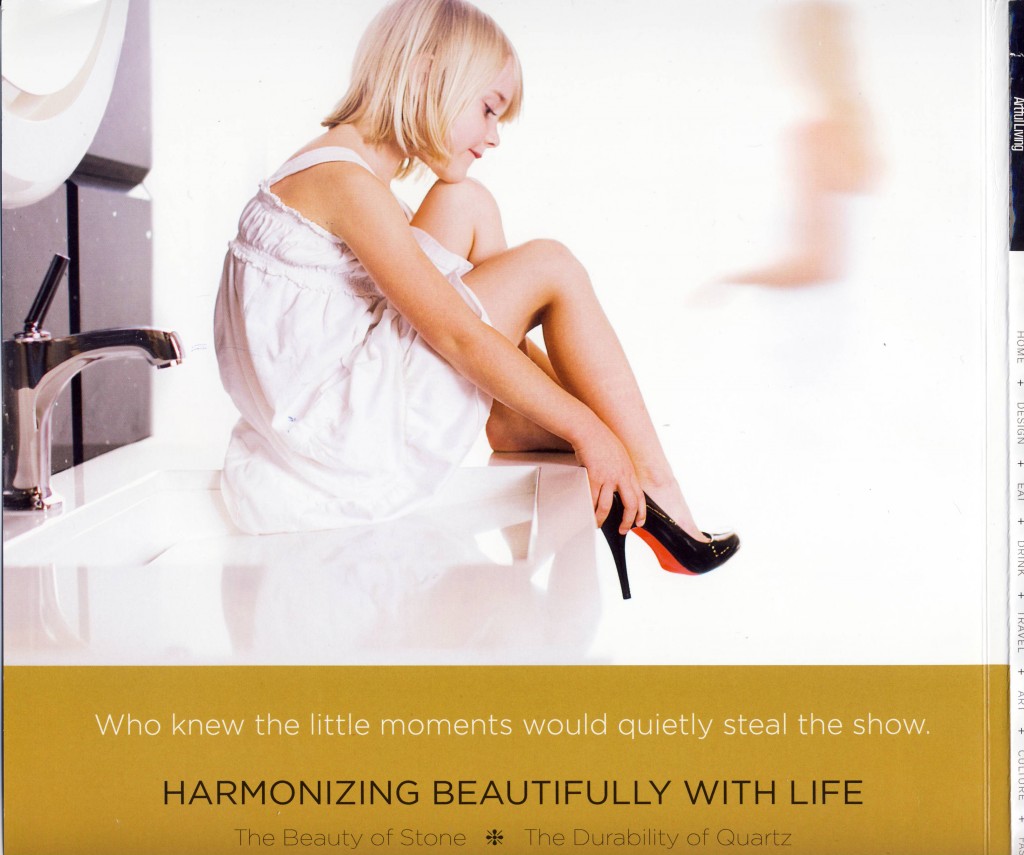
Ad of the day: does Louboutin have a claim?

Association? Dilution? Would any of the dilution exceptions apply?
Via SocImages.

IPSC, Copyright Theory II

Copyright Theory II 
 
Brad Greenberg Columbia Law School
Bizarro Copyright
 
Does having lots of different antennas in one place v. all over the place make a difference to whether there is public performance? Central question of Aereo: looks like cable, must be cable.  Aereo follows a long line of cases about new tech asking whether judges should look inside the machine or just look at the inputs and outputs.  The case is thus fairly ordinary.  Why it matters: constanct conflicts over behavioral perspective (majority) or technological/structural perspective (dissent).  Who should decide how © touches new tech: the answer is determined by behavioral v. structural perspective.  Statutory signals theory applied in Aereo and Google Book Search.
 
Napster and Grokster: different tech, same result.  Goes back at least to White-Smith Music; also occurred in video game cases. Majority position in White-Smith is structural: absent machine, piano roll is unintelligible.  Dissent takes behavioral perspective: no reason to decouple roll from machine; makes a sound that sounds like the song.
 
Structural perspective: narrower rights and narrower limits.  Behavioral: broader rights and broader limitations, like fair use.
 
Who should decide? Congress has increasingly punted on tailoring © to new tech. Presumptively, courts and CO articulate limitations. Two key features of 1976 signal congressional deference: tech neutrality and standards over rules.  Tech neutral: §101, 102, 106 exclusive rights.  Tech specific: §108, 111, 115-119, 122.  The choice of provisions is important signal for how © should be applied by future courts—behavioral or structural.
 
Google Books: outcome would be different if it were a full digital library, not just snippets, and so it should be. Fair use is tech neutral and flexible. Behavioral is the right perspective because §106 rights are tech-neutral.  Even if the cable analogy is wrong, it’s likely that it doesn’t matter b/c the court had to find some way to shoehorn its decision into §106.
 
Counterargument: Congress has tinkered plenty w/satellite tech, compulsory license, etc. That’s true, and when you ask about §119 etc. you probably do need a structural inquiry/ask about Congress’ particular mindset, but for now everything else falls under §106 by default.
 
Christina Mulligan: If Aereo is rightly decided, is the RAM copy doctrine wrong?
 
A: It should be wrong, but it’s probably not b/c Congress did tinker w/§117 in response.  First sale is a similar issue. 
 
Jake Linford: One way to read Aereo is just Breyer as Cong. intent and Scalia as text—isn’t this the same dumb point that isn’t really about ©?
 
A: would make the same argument regardless.  Second Circuit was much more about behavior v. structure.
 
Q: Ambiguity in question of who should decide.  What has Congress done? Who ought to be deciding various parts of the © system?
 
A: taking an imperfect world—judges regularly look to statute for answers.  Judges often choose a perspective w/o explaining why or even saying that they are. Maybe Congress isn’t the best source of innovation policy, but it’s what we’ve got.
 
Peter DiCola: White-Smith isn’t as clean as that either. The president had weighed in publicly; there were already negotiations in Congress.  I’ve interpreted that case as being about the Court pushing the parties to bargain; composers weren’t coming to the table and were being punished for bad behavior in licensing only one company.  1976: §106(4) and 106(6) are tech-specific and Congress did decide to do it that way.  They’re broad in rights and narrow in most exceptions—which signal is Congress giving? It will always be mixed.
 
A: see those as tethered to tech mindset of Congress—intent to be tech neutral to the extent that something can be publicly performed (?) regardless of whether tech was known in 1976.
 
Sag: number of aerials didn’t matter in Aereo. What mattered was interposition of lots of copies (even though that wasn’t before the Court).
 
A: Aereo is a tough example b/c so many people don’t like it, but that still shows his point.
 
RT: Behavior: is that right?  B/c I think you mean audience reception. Connects Aereo to Tasini, a connection made by the Court itself. Connected to what you mean by tech neutrality. Both parties claimed the mantle of tech neutrality.  Neutrality means different things to different people, as in equal protection.
 
Kevin Hickey, University of California, Berkeley, School of Law, Center for Law & Technology
Paternalism in Copyright
 
Aims: explore tension between incentive model of © and its paternalistic provisions; envision legal structure of © if we took paternalistic impulse seriously—a thought experiment, not a normative endorsement.
 
What do we mean by paternalism? State limits choices of individuals to protect them from consequences of their own decisions. Nothing inherently wrong with intervention.
 
Soft paternalism tends to fail for the very reasons that motivated the regulation in the first instance.  (RT: And the existence of entities motivated to make it fail, pace Lauren Willis!)
 
Potential behavioral market failures: creation stage (intrinsic motivation; judgment under uncertainty—© as distant, uncertain, indirect incentive, but contrary to that are lottery effects).  Also assignment stage: bounded willpower/short-sightedness; social preferences for “fair” allocations v. the endowment effect.
 
Paternalism in ©: termination rights; elimination of formalities; limitations on alienability (writing requirement); moral rights. Due to lack of bargaining power, short-sightedness, poverty, uncertain valuation.
 
Tension between incentive model with its rational actors and paternalistic provisions; rational actors respond to 20 additional years of protection after life +50, but paternalistic provision supposes an author incapable of protecting her own interest, making bad deals—if those bad deals are made, then the prospect of future rewards wasn’t driving creation in the first place.
 
Normative and policy implications: current hybrid model risks costs of moral rights like system without the benefits. Social costs of expansive, default © through eliminating formalities.  Fails in curing perceived unfairness and actually securing a piece of the profits for the author. Existing author protections are weak and ineffective for the vast majority of authors (whose rights aren’t that valuable 35 years later).  Writing requirement might help a bit, but it just means they sign away rights for a pittance instead of orally granting them for a pittance. 
 
Taken seriously, we’d either eliminate paternalistic provisions and reintroduce formalities, or do more in the way of author protection such as EU-style voidable terms, mandated fair compensation; incentives would focus on present-time, direct, certain outcomes.
 
Betsy Rosenblatt: how much is paternalism v. market uncertainty/accounting for an unknown future?  Formalities are value-neutral; others are harder to chalk up to that.
 
A: often given as justification for termination, but publishers are also subject to uncertainty; transferring risk to publishers may make sense given publishers’ portfolio.  Regardless whether it’s short sighted or difficulty in valuing, it’s paternalistic in operation. 
 
RT: What if it doesn’t matter what the law is? Abraham Drassinower & Jessica Silbey: if all you’re about is incentives, then there’s really just one entity, TM/©/patent/IP.  Also Laura J. Murray, S. Tina Piper, & Kirsty Robertson, Putting Intellectual Property in Its Place: Rights Discourses, Creative Labor, and the Everyday: Rather than listening to experts, “people actually choose to understand the law through information and opinion gathered from friends, strangers, coworkers, and the media.” If you gave up on people understanding the law, at least at the point of creation, then you could essentially ignore the creation stage in terms of making authors better off.  You’d be led to focus on the assignment or commercialization stage.
 
A: thinks the law matters.  (But I think you can’t have that as the assumption for this project.)  Would also be led to think about access to lawyers as well.  (Again, that’d be after creation, which has implications for which provisions would work to help authors.)
 
Sag: Add in compulsory remuneration.  How is this different to distributional concerns in ©?
 
Q: difference b/t irrational and uninformed.  (Hmm, not sure that’s true. Chicago school people would disagree b/c the choice to become informed is itself a cost that people choose to bear or not bear.)  In formalities, formalities limit my freedom.  Creators wouldn’t understand that they needed to give notice. There’s a nonpaternalistic explanation in terms of market structure.  (?  But notice requirements are useful in forcing information so that markets can more easily form.)
 
A: There is evidence that termination rights exist to protect the impecunious/irresponsible author.  These are fairly weak default rules; if we are serious we’d want something stronger.   Push back on formalities elimination as nonpaternalistic. Depends on whether your baseline is © as natural right or statutory right.  Elimination does depend on conception of authors as careless.
 
Q: Keep an eye on the context of the time: eliminating formalities was also about joining Berne.  (Which pushes the issue back to a different entity: why were formalities eliminated from Berne? Answer may well be that it wasn’t paternalistic but based on authors’ rights view, a kind of romanticism—but consider that elevating authors as more important than other kinds of people and thus giving them special rights is just the flip side of paternalism, as the sexism inherent in the term indicates—putting on a pedestal = putting in a cage in many ways.)
 
VARA allows for waiver, but not transfer.  That may hurt authors.
 
Margot Kaminski & Guy Rub, Ohio State University College of Law
Zoom-in Zoom-out of Copyright
 
Outcome of cases/scope of copyright protection is determined by court’s point of reference. If you evaluate a small unit (God’s finger touching Adam’s in the Sistine Chapel), you give strong copyright protection/shrink the public domain.  You get lots of different IP rights/transaction costs.  If you zoom way out (the whole ceiling) you frustrate other interests by weakening ©, and maybe unfairly punish people who create complex works.
 
Natural tendency of © in US is that © owners argue for zooming in as much as possible for statutory damages/fair use, but only up to the point of invalidity.  Statutory framework: the word “work” is not defined. After formalities were limited, authors can do whatever they want at the point of claiming infringement, and registration is a huge mess for these purposes.
 
Our work is about zooming as a framing decision that judges or regulators or legislators make. It’s not about defining a work.  Judicial framing move takes place across doctrines.  Initial findings: courts often set level of zooming without noticing the issue; if noticed, do it without principled reasoning; if do reason, adopt different tests across and even within doctrines.
 
Example: statutory damages.  Factors: independent economic value; can each TV episode be consumed separately; was each episode produced separately; registration as an additional factor. W/two albums, 2d Cir. rejected independent economic value test because (1) statutory text says one compilation is one statutory damages award; (2) © owner decided to bundle the songs together.  Under Arista Records, SDNY 2010, court says that if, before infringement, the copyright owner offers an unbundled product, zooming in is appropriate.  (Of course even before iTunes there was sample licensing for individual songs, so there was “unbundling” of a sort even w/in songs since the 1990s at least.)

Registration to the rescue? Author expressing intent through registration system; cost of registration at least helps.  But it doesn’t work because it has its own zoom problem. 9th Cir. found that registration of database of stock photos registers every photo; SDNY has found to the contrary. Having the DB registration reach individual works w/o having to list indiv. works eliminates the utility of registration and don’t have transaction costs identifying each work as a work. 
 
New Copyright Office compendium: (1) registration policy sometimes conflicts w/statutory damages approach—allows author to register one CD as unit of registration, which reaches each individual song. That’s the opposite of the result in the courts. (2) registration policy is calibrated against statutory damages!  CO sets policy as a result of what CO thinks result would be in statutory damages case.  CO assumes that unpublished works should be registered as individual works, not compilation, b/c it wants to preserve statutory damages.
 
There are multiple inconsistent tests where they exist.  Four factor fair use test also has zooming problems: factor three amount (factor four also has a zooming problem).  Photocopying cases show this: Williams & Wilkins looked at all the magazines; Texaco looked at each article and was the only one that engaged in reasoning; Princeton Univ. Press looked at each article; Cambridge Univ. Press v. Patton zoomed out & thought the issue was raised too late.
 
Zooming and substantial similarity: total concept and feel of rugs in 2d Cir.; Calabresi wants zoom in to make sure that public domain works are discounted.
 
Zooming and authorship: Garcia v. Google.  Majority says: this is one work.  If so, she’s not a joint author.  Kozinski fights the zooming and looks at 5 seconds as relevant reference point.  Maybe she can be the author of that.  (I think it’s worse than that—it’s not the 5 seconds but the performance in that 5 seconds.) 
 
Also finds zooming in other areas: Notice; revision of collective work; separability with PGS works; etc.
 
Questions: other areas of IP law where this happens?  Scope of project—descriptive v. presecriptive?  Judges versus regulators v. legislatures?
 
Q: some of these questions are more about sets than zooming in and out.
 
Andrew Gilden: is this an evidentiary q—how to courts prove their conclusions?  But if it’s more a conceptual issue, then looking at briefs in the cases might help.
 
Ramsey: songs in an album are easier to count than characters in a book—there might be a bunch of ways to count in a book.  [I’d also note, as above, that chunks of a song can be counted in particular contexts, such as ringtones and sampling.]
 
Sag: some approaches have no limiting principle—turtles all the way down. Those approaches are probably wrong.
 
A: we can probably agree that Garcia’s position won’t work.
 
Q: market effect in fair use, definition of nascent markets—it also occurs.  Choosing which it is pervades © generally.
 
Q: if you take the 2d Cir. approach, I have serious issues with newspapers/photo collections. You just couldn’t register at an acceptable cost.  But newspapers will license individual articles.
 
Niva Elkin-Koren, Haifa Center for Law & Technology, & Orit Fischman-Afori, The Haim Striks School of Law, College of Management Academic Studies
Rulifying Fair Use 
 
Presented by Fischman-Afori.  The trigger was the Cambridge Univ. Press case, a rule against fair use rulification.  Fair use is a standard; can courts develop the standard into more concrete guidelines? 

Their position: rules/standards is a spectrum, not a dichotomy. Fair use was not meant to foreclose evolution into more concrete guidelines. Rulification can serve copyright goals. Courts should do more rulifying and the 11th Cir. is wrong. Ancillary rules to assist the court—does fair use prohibit any such ancillary rules or is it a mandatory rule against rulification?  Designed as a permissive standard.  Lower courts have allowed some rulification, with Cambridge Univ. Press being the big (and bad) exception.
 
Advantages: avoid uncertainty creating a chilling effect; allows both flexibility and certainty.  You can have your cake and eat it too because rules/standards are a spectrum.  Transparency: avoid manipulation of the fair use four-factor analysis. Rulification may force judges to fully disclose underlying analysis.
 
Q: Appellate court in Cambridge Univ. Press was concerned w/ 10% being pulled of thin air; we have more rulification than you suggest.  Timeshifting = fair use is also a rule.  Transformativeness is also quickly becoming a rule of its own—Neil Netanel’s work.
 
Q: SCt doesn’t say every parody is fair use.  DCt went much further than any previous court.  Safe harbor = not the same as a rule.
 
A: our paper does address difference b/t common law style rulification and safe harbors. We should check what the rules are. There are 75% safe harbors, etc. 
 
Sag: doesn’t think categories are the same as rules—reverse engineering, genuine parodies, digitizing library to make a search index—but maybe we’re just debating terminology.  Clear categories do provide guidance.  10% rule also, but that’s subject to gaming, so there’s a huge difference.  If we could rulify fair use we wouldn’t need fair use.

Another circuit agrees that Dastar-barred claims can't be repled as false advertising

Kehoe Component Sales Inc. v. Best Lighting Products, Inc., --- F.3d ----, No. 14–3347, 2015 WL 4635824 (6th Cir. Aug. 5, 2015)
 
Best asked Kehoe (“Pace”) to make specialized lighting products for Best.  After Pace made enough units to fill Best’s product orders, it used the same molds to make thousands of additional units of exactly the same products. Pace then sold those “cloned” products under its own name to several of Best’s customers.  Unsurprisingly, a lawsuit resulted.  The district court found Pace liable to Best for misappropriation of trade secrets under Ohio law, “reverse passing off” and false advertising in violation of the Lanham Act, breach of contract, tortious interference, conversion, and breach of warranties, and awarded compensatory and punitive damages, attorneys’ fees, and injunctive relief.  The court of appeals overturned everything but the breach of contract and tortious interference liability.
 
Before Best contracted with Pace, Pace had never manufactured any emergency lighting products, so Best’s founder spent a significant amount of effort instructing Pace on how to make the molds necessary to make the specific products that Best sought.  At first, there was no contract barring Pace from competing with Best. However, in 2004, he emailed Pace’s president complaining that Pace not only had begun selling products that were identical to the products that it made for Best, but also that Pace had begun selling them to Best’s established customers.
 
In 2005, Best then complained that some products Pace made for it were defective.  The parties negotiated and Pace transferred some of the molds used to make the products in question to Best.  In 2006, Best refused to pay for a substantial number of products that Pace had delivered to it, and Pace stopped shipments to Best. The parties then negotiated a one-year supply agreement under which Best agreed to pay its outstanding debt to Pace and to purchase a minimum of $7 million worth of products from Pace annually.  Pace agreed to a variety of provisions, including to warrant the quality of the goods, not to “use any [molds] owned by Best other than for the manufacture of products for sale to Best,” to “assign[ ] to Best all designs and intellectual property ... for products developed or to be developed at or by Pace for Best,” and neither to “sell emergency lights or exit signs nor ballasts, nor solicit sales of these items to any party in North America without Best’s prior written consent.”
 
Pace received several purchase orders for “cloned” products from North American companies before this agreement came into effect, and it shipped products to fill these orders after the agreement came into effect.  Best continued to complain about the quality of Pace products, and by 2008, Best told Pace that “we are at a point where we both know we will not be doing any more business.” When the relationship ended, Pace had all the molds that had been used to manufacture both Best’s products and the cloned products, and Best owed Pace almost $900,000 for products delivered but not yet paid for.
 
In 2008, Pace sued Best for breach of contract for failing to pay. Best requested a setoff of damages for breach of warranty and counterclaimed for breach of contract, tortious interference, misappropriation of trade secrets, conversion, and fraud. The case was ongoing when, two years later, Pace sued Best for misappropriation of trade secrets and tortious interference.  Best counterclaimed with its existing counterclaims and also counterclaims under the Lanham Act and for patent infringement (the last of which was dropped).
 
After finding for Best (though finding it liable for breach of contract), the district court awarded Best roughly $1.1 million in compensatory damages, $200,000 in punitive damages, and $850,000 in attorneys’ fees, as well as an injunction barring Pace from making the cloned products and from using or referencing products that “originated with Best” in its marketing materials.
 
First, the court of appeals found that the trade secret claims were time-barred. Ohio’s Uniform Trade Secrets Act (OUTSA) requires that an action must be commenced within four years after the misappropriation is discovered or by the exercise of reasonable diligence should have been discovered. A continuing misappropriation constitutes a single claim.  Best learned of the sales to Best’s customers in August 2004, but didn’t counterclaim under OUTSA until October 2008.  The district court held that Pace misappropriated anew when it brought products to market after 2007.  But this was an improper “property-based theory of trade-secret misappropriation, under which each successive use of a trade secret is an additional wrong.”  The limitations period runs from discovery/reasonable discovery, so the claims were time-barred.
 
The district court also erred by finding that Pace engaged in false designation of origin via reverse passing off, because of Dastar.  The district court reasoned that Pace misrepresented its cloned products by stating that they originated with Pace rather than with Best. But the cloned products did originate with Pace. “Only by denominating the cloned products as ‘Best’s products’ could the district court find that Pace was misrepresenting someone else’s products as its own.” But Dastar barred that interpretation of “origin.” (Citing Mark P. McKenna, Dastar’s Next Stand, 19 J. Intell. Prop. L. 357, 374 (2012) (“A trademark cannot be taken to indicate anything about the origin of the intellectual creation embodied in that good.”)  “Thus, reselling goods that have been manufactured by someone else carries different consequences than making your own copies of those goods and marketing them under your own mark.”
 
Best argued that it “commissioned or assumed responsibility for (‘stood behind’) production of the physical product,” Dastar.  But that assumed a trademark owner who allowed the use of its mark on a product, and Best never claimed to own a relevant trademark in the Pace-branded cloned products.  More fundamentally, Best neither “commissioned” nor “assumed responsibility” for the cloned products. “As tangible objects, the cloned products are in every respect Pace’s alone—Best would much rather that they never have been produced at all.”  Even assuming that Best’s cited cases, which allowed a reverse passing off claim when a defendant markets another’s product that’s been only slightly modified and then relabeled, survived Dastar, that wasn’t the situation here.
 
And here’s some useful language, though it’s sad that this needs to be said: “To the extent that the district court’s liability finding stemmed from an intuition that the Lanham Act prohibits wholesale copying, that intuition is misplaced. Protection against imitation and mimicry ordinarily is found in patent and copyright law, not in the Lanham Act.” It doesn’t matter whether Best created the market for these goods.
 
The false advertising claim failed for the same reasons.  The district court found that Pace’s use of “Best products” in Pace’s own catalogs was a misleading representation of the products’ origin and thereby violated §43(a)(1)(B).  Even if false advertising were an appropriate head of liability, we already know that “origin” only refers to the maker of the tangible object under Dastar.  But regardless, §43(a)(1)(B) covers a false “designation of origin” or other factual misrepresentation about “the nature, characteristics, qualities, or geographic origin” of the goods or services. Geographic origin wasn’t at issue, and a misrepresentation about the source of ideas embodied in a tangible object “is not a misrepresentation about the nature, characteristics, or qualities of the object.”  The characteristics of the good itself—its properties or capabilities—must be implicated.  The only falsity here was the misrepresentation that Pace, rather than Best, was the intellectual origin of the products, and that’s not enough.
 
However, the court of appeals affirmed the finding of breach of contract, including breach of a noncompete clause.  Pace retained the molds pursuant to its valid lien for unpaid deliveries of products, so it wasn’t liable for conversion. But it was liable for tortious interference with established business relationships and also tortious interference with business expectations.  Pace’s breach of confidence—coupled with the breach of a specific contractual promise intended to shore up that confidence—was a sufficiently “improper” means of competition to give rise to liability for tortious interference.
 
Remand for this and an issue about the breach of warranty counterclaims; the court of appeals emphasized that the district court was not barred from awarding “the damages and fees (including punitive damages and attorneys’ fees, to the extent that they are available) merited by the parties’ conduct.”

Thursday, August 06, 2015

IPSC, Copyright and Society

Third Breakout Session: Copyright & Society
 
Clemens Appl & Philipp Homar, Vienna University of Economics & Business, Education 4.0: Recent Challenges to Copyright
 
From user-generated content to user-generated copyright. Use of materials for educational purposes is one of the most important aspects of the project.  Standing on the shoulders of giants: research and teaching is based on preexisting knowledge.
 
Creation of content in education also matters.  MOOCs, other forms.  Public as distinct from users/“prosumers,” educational institutions, other intermediaries; European collecting societies are intermediaries who collect remuneration and fulfill social and cultural purposes. 
 
Typical forms of digital learning: digital coursepacks; collaborative learning; student generated content—looking to determine which are the most common/relevant.  Reliability and accessibility of resources on multiple devices is required.  In terms of ©, we have reproduction and distribution/performance/sharing.  Private and public sphere convergence: not a small group in the classroom but all over the world.
 
E-learning exceptions exist in Austria and Germany, but they’re different so that you can’t have cross-border classes without infringing. Uncertainty despite 2001 Directive allowing use for illustration for teaching or scientific research with credit “to the extent justified by the non-commercial purpose to be achieved.” 

Equitable remuneration or Ginsburg’s concept of “permitted but paid” replacing fair use.  Statutory licenses for redistribution/not new creativity.  Free as in free speech, not free as in free beer.  [I don’t much like this formulation.] Equitable remuneration.
 
Desired outcomes: Regulations with a clear scope; general clauses aren’t enough for the educational sector. Prevent double remuneration of rights holders.
 
Kristelia Garcia, University of Colorado Law School, Facilitating Competition by Punitive Regulation
 
Majors (60% of market) tried to withdraw digital rights from ASCAP.  Universal secured a rate nearly 2x that ASCAP secured.  First time they’d tried to license the digital rights by themselves; collectives have always been justified on ability to minimize transaction costs and use bargaining power, but this result (2x rate!) suggests a weirdness.  Assignment is not exclusive; Sony/Universal could have done a deal w/o withdrawing digital rights from ASCAP.  ASCAP’s contracts didn’t allow partial withdrawal: voluntary, but if you’re in you’re all in.
 
Doubling of the rate: ASCAP is responding to needs of differently situated members and operating under consent decrees; thus might not have been able to charge market optimal price. Alternately: pathological private ordering, her position.  Negotiations amounted to parallel pricing/tacit collusion.  Collective bargaining made more sense in analog world; can’t go around to every restaurant. Easier to know what Pandora played and how many times. 
 
ASCAP had to amend its governing documents to allow partial withdrawal; SDNY as rate court rejected that. This doesn’t bode well for ASCAP, or for majors who don’t want to monitor every restaurant.
 
Why should we care?  Potential for anticompetitive behavior to stifle innovation in the distribution space.  Sony/Universal went to the strongest streaming service first—doesn’t encourage new entrants. Can also be a method to cut out artists’ royalties.  ASCAP requires royalties to go to artists. 
 
What should we do?  The rate court? Antitrust?  Antitrust may have difficult time here—parallel pricing and tacit collusion don’t violate the Sherman Act etc. They are concerning, but not enough to violate the law.  Merger review is usually effective but doesn’t work here, partly b/c of history of nonintervention by DoJ.  When we went from 4 major publishers to 3, it didn’t make the situation worse because it was already crappy.  Consent decrees: the big hammer—but it’s already in use; the individual publishers don’t operate under it.  Withdrawal = more concern for competition than collectives governed by consent decrees. Network effects in content and tech.
 
Proposal: have gov’t set prices, but allow opt out of regulation if you can show robust competition in an area. Similar to private utility regulation.  That increases the cost of private ordering, but also opens up regulatory gaming/lobbying.
 
Removing digital rights only = remove lots of revenue while leaving lots of overhead for the group, including the smaller players.  Total withdrawal might eventually lead to a market clearing solution/lower payments for smaller players.
 
Brauneis: §115 is always an option for covers. When you’re talking about petitioned opt-out, do you also mean that you want publishers to be able to exempt themselves from the §115 license?
 
A: No.  Thinking of it on the other end—mandatory so that you can’t go around it, even with Harry Fox.  If the licensee doesn’t want to go to the mandatory route and thinks it can work out a better rate w/the publisher, it can do so only if it shows the market is competitive. But should give more thought to the licensor side as well.
 
§115 is less concerning than public performance rights, b/c Sony and Universal wanted the right to deny licenses altogether. 
 
Matt Sag: how significant is the antitrust exemption for webcasting? Otherwise this looks like a solid antitrust case.
 
A: We don’t have the smoking gun. 
 
Sag: that’s because they collude with immunity at SoundExchange. Structural problem.
 
A: agreed. Not enough competition for traditional tools to work.
 
Sag: in other industries that are this concentrated, the actors are very careful—the publishers found out that they shouldn’t do this in the Apple Books case.  But in music, they have a special room where they can discuss how to kill Pandora. Maybe that’s the problem.
 
A: root problems w/in the industry are a big deal.  We could move on to full on barriers to entry, if Sony/Universal pull their content they might be able to prevent successful streaming services other than the ones they allow/control.
 
Pam Samuelson: who out there could do some worthy regulation?  Before we say let’s go, who can do it?  The Copyright Office isn’t well situated for that kind of market power analysis.  They don’t know enough about the music industry and their report was not warmly embraced.  Where is there institutional competence to right this particular balance?  Maybe the FTC over others, but they’d need some congressional delegation of authority.
 
A: that’s the sticking point.  (Samuelson suggests Tim Wu’s Copyright’s Communications Policy.)
 
Lisa Macklem, University of Western Ontario
Cash For Content: Profiting from Copyright on the Internet
 
© uses boundaries to control, while the internet was designed to increase communication/exchange knowledge.  Schumpeter’s theory: evolutionary—different flows that disrupt existing equilibria.  Posner: overregulation = artificial rents through scarcity.  Virtually all transactions have some uncompensated third party effects.  Differences in the kinds of IP make them inappropriate for property treatment—sui generis understanding is best.
 
New entrants: internet intermediaries.  Technological neutrality isn’t obviously connected to ©, but changing the form of the internet has important implications for ©.  Courts approach new technologies with new understandings—TV through internet is not legally the same as TV through the air.
 
Aereo: search for the best analogy. If the goal is to be technologically neutral, are they finding the right analogy? Unintended winners in Aereo: consumers insofar as the service spurred TV companies to speed up authorized online access.
 
Cloud computing: technologically the decision could have applied to it, but distinguished—this is a danger of getting the analogies wrong.
 
ESA v. SOCAN, 2012 SCC 34 (Canada 2012)—ESA wanted to double-dip when video games were played online.  Licensed music w/in a video game doesn’t justify an additional royalty when the game is downloaded; that shouldn’t be different than when a physical disk is purchased.
 
CBC v. SODRAC: CBC uses incidental copies to produce an end copy that is ultimately shown; simple matter of creating final product. Now before the Canadian court.  Tech neutrality as central to ©.  Part of the balance b/t copyright owners and copyright users.  [History of discourse around what counts as “equal treatment” suggests that agreement on what neutrality is will be hard to come by.]
 
How Netflix gets it right: tech neutrality can foster increased distribution/dissemination of knowledge.  More rights owners may have to be satisfied with smaller slices of the pie. Netflix doesn’t rely on standard Nielsen ratings—pushing the boundaries of innovation on content.
 
Lea Shaver, Indiana University Robert H. McKinney School of Law
Social Publishing 
 
Book proposal: Book hunger: economic demand for published works is different from cultural demand. Zulu language—10 million speakers, a lot of them poor, so standard publishing model doesn’t work and doesn’t generate many books for them. When social entrepreneurs/nonprofits have taken up the challenge, though, there is great demand.  Pratham Books in India—sold cheaply largely to institutional buyers—huge interest.  Unexpressed demand: publishing for the blind. 
 
Social publishing: Driven by sense of social mission. Rely on social subsidies to make the revenue model work—charitable contributions, gov’t support. More creative approaches to © because not dependent on recouping costs from sales.  Social distribution: want to deliver books at the lowest possible price.
 
Business model innovation: they are forced by necessity, b/c going after hard to reach market niches, to radically innovate v. traditional publishing model.  Amazon innovated at one point in the product market; but these organizations have to innovate at every step to drive down costs of doing business.
 
Content acquisition: First Book is US based organization that works with for profit publishers who agree to make copies of works available at 70-90% discount to closed marketplace of organizations, about 70,000 across the US, that serve low income children. They’ve targeted diverse books—minority characters and authors, not produced by standard market—they’ve set up an advance purchase commitment w/publishers to change what gets published.
 
Book Dash: South Africa. Come together to write a book and give it away. 

Pratham Books: Illustrations are donated to a bank.  Any person can tell a story in their language using these pictures.  Disrupts our construct of authorship, revealing it as an effect of the conventional publication model.
 
Distribution/printing/education: African Storybook Project distributes works in the form of PowerPoint—the costs of 50 print copies shipped across bad roads is much greater.  Enables teachers to translate slides into other languages.

Bookshare in US: Often approached by for-profit publishers interested in their expertise in ebook platforms and publishing. 
 
Marketing and sales: PJ Library: Funding comes from Jewish philanthropic sources; Jewish themed books, and work w/different community orgs to identify Jewish families and mail them a free book each month.  Book serves as marketing for the organizations.
 
Pratham books—reaching the most remote villages, “the last child.”  Tried partnership with post office; with Unilever.  Even if we could ride the Coca-Cola trucks, it wouldn’t work—because books aren’t a commodity like Coca-Cola. It’s important that the book be relevant to this particular person in this particular language.  Digital distribution can have a broad selection and address niche market as well as mass.
 
“Mission-driven innovation.” These organizations not focused on money/profit are able to innovate better than for profit organizations especially in areas of market failure.  We should fund organizations that are willing to do the difficult and expensive work of innovation, which carries large risks of failure.   Future of publishing industry more broadly?
 
Q: Consider also failures.  Wikimedia Foundation’s Wikibooks, which has been around for years but hasn’t succeeded very well. [Great point: taking lessons only from success is a classic problem of examining innovation.]  Ways to quantify/reward community production, e.g., with tokens.
 
Samuelson: Brewster Kahle’s Bookmobile in developing countries: prints out books and gives them away.
 
A: signs of the variability of the possible form.
 
Q: What about “altruistic piracy”?  People who are disseminating cheap copies but not following all the rules.
 
A: Reminds her of questions about the history of publishing for the blind—doesn’t know if that story has been told.
 
Matt Sag: There are places where exemptions for blind are rarely used—other factors are preventing production.
 
A: that’s the story this book plans to tell. You need more than an exemption.