I spent the weekend at the Cultural Environmentalism at 10 conference. It was wonderful.
Larry Lessig introduced the conference: Ten years ago saw developments that we thought would be foundational – John Perry Barlow’s statement, the Communications Decency Act, the 1996 Telecom Act – which are now irrelevant, and Boyle’s book, which is still foundational, helping shape the politics of IP. This conference celebrates the beginning of a movement that continues today. Questions: how shall we architect IP? How should we think about the disciplines within which we approach IP?
James Boyle: liveblogged by Joe Gratz.
A couple of things I wrote down, expanding on Joe's account: Boyle says that he came up with a metaphor that described well what others were doing. Getting credit is like wrapping other people’s presents and getting called Santa. (Here he’s engaging in the practice of disclaiming credit appropriate to academia!)
The environmental metaphor was about making visible the invisible, about linking communities of interest, so that they saw common roots of their struggles in concepts of private property that ignored externalities and scientific theories that assumed we could tamper with a species or place with impunity. The political movement had to be connected to academic themes about complicated ecological connections, externalities, and humility about intervention. The environmental movement succeeded in making these ideas accessible to high school students.
In terms of scholarly aims: There’s more history to be done, such as how the philosophical differences between droit d’auteur and common law countries have successfully been submerged at the international level.
Perfect price discrimination – selling the same work for ¼ rupee to a poor Indian and $1000 to a Park Avenue socialite – is attractive to elite policymakers but will never survive in politics. Too many people think it’s not fair.
Monday, March 13, 2006


Sunday, March 12, 2006
Non-DMCA case about printer cartridges
In re HP Inkjet Printer Litigation, 2006 WL 563048 (N.D. Cal.)
Plaintiffs sued HP for false representations about its printer cartridges. Specifically, they allege that HP’s “smart chip” technology, which can provide alerts via email or cellphone, deliberately misinforms consumers that the ink level is low when substantial ink remains, causing consumers to buy more ink. The cartridges also allegedly have an undisclosed, preprogrammed expiration date after which they won’t work, even if ink remains. Moreover, the technology interferes with consumers’ ability to buy from third-party manufacturers.
HP argued that the plaintiffs failed to allege they themselves suffered harm from this conduct; the court agreed and granted leave to amend. The court rejected HP’s argument that the plaintiffs failed to identify HP’s allegedly misleading statements with sufficient particularity; the plaintiffs pointed to several statements in HP’s advertising describing the “smart chip” features, touting them as consumer-friendly and saying things like “SureSupply … provides alerts via email or cell phone when toner or ink is low.” Comment: if low ink isn’t actually the trigger, that’s explicitly false, though the complaint appears to cast this as a failure to disclose limits on the chips, using phrases like “Absent from HP’s marketing material is any mention of …” and “HP has deliberately withheld … information ….” For once, this seems like underpleading the claim.
Plaintiffs’ unjust enrichment claims also survived, though the court dismissed their breach of implied warranty claim for lack of vertical privity and held that their breach of express warranty claim didn’t sufficiently identify the precise warranty terms on which they allegedly relied.
Plaintiffs sued HP for false representations about its printer cartridges. Specifically, they allege that HP’s “smart chip” technology, which can provide alerts via email or cellphone, deliberately misinforms consumers that the ink level is low when substantial ink remains, causing consumers to buy more ink. The cartridges also allegedly have an undisclosed, preprogrammed expiration date after which they won’t work, even if ink remains. Moreover, the technology interferes with consumers’ ability to buy from third-party manufacturers.
HP argued that the plaintiffs failed to allege they themselves suffered harm from this conduct; the court agreed and granted leave to amend. The court rejected HP’s argument that the plaintiffs failed to identify HP’s allegedly misleading statements with sufficient particularity; the plaintiffs pointed to several statements in HP’s advertising describing the “smart chip” features, touting them as consumer-friendly and saying things like “SureSupply … provides alerts via email or cell phone when toner or ink is low.” Comment: if low ink isn’t actually the trigger, that’s explicitly false, though the complaint appears to cast this as a failure to disclose limits on the chips, using phrases like “Absent from HP’s marketing material is any mention of …” and “HP has deliberately withheld … information ….” For once, this seems like underpleading the claim.
Plaintiffs’ unjust enrichment claims also survived, though the court dismissed their breach of implied warranty claim for lack of vertical privity and held that their breach of express warranty claim didn’t sufficiently identify the precise warranty terms on which they allegedly relied.
Grandfathered pediatric drugs: compare and save, or compare and be deceived?
PediaMed Pharmaceuticals, Inc. v. Breckenridge Pharmaceutical, Inc., 2006 WL 544525 (D. Md.)
This case involves an unusual situation: competing prescription drugs that haven’t been through the FDA’s extensive evaluation and testing scheme, because the active ingredient has been used since before that scheme existed. Plaintiff PediaMed focuses on developing medicines for children. It makes Viravan-S (active ingredients: a nasal decongestant and an antihistamine), using a patented process that allegedly allows for sustained release, masks the taste better, and results in fewer impurities. PediaMed has heavily promoted Viravan to doctors.
Defendant Breckenridge is a generic drug company that produces a generic version of Viravan under the name . V-Tann’s advertising materials state: “Compare the active ingredients in Viravan-S.” Defendant markets primarily to drug wholesalers, distributors, chain drugstores, and pharmacists. The labels on both products list the same amounts of the two active ingredients.
PediaMed asserted that the two medications are not pharmaceutically equivalent because of differences in the amount of active ingredients and the variation from ideal accepted by Breckenridge (80%-120% of the label amount in any given batch, while PediaMed accepts only 90%-110%). Also, Viravan is made with United States Pharmacopeia/National Formulary ("USP")-grade ingredients, while V-Tann contains non-USP grade active ingredients – except that, the court noted, there are no USP standards for these active ingredients, so Viravan’s active ingredients are also non-USP. Moreover, the manufacturing processes differ. Defendant didn’t test V-Tann for bioequivalence before launching it.
Maryland law follows the FDA, whose Orange Book allows substitution of a generic for a brand name drug if there’s therapeutic equivalence, which requires the same active ingredients, dosage form, method of administration, and strength or concentration. The generic has to meet the same quality and purity standards, but may differ in such characteristics as shape, flavors, preservatives, and expiration date. However, V-Tann isn’t in the Orange Book, since Viravan was grandfathered into the pharmacopoeia. If the original/brand name drug is grandfathered, the drug that claims to be the generic equivalent doesn’t have to go through an abbreviated new drug application (requiring a demonstration of therapeutic, pharmaceutical, and bioequivalence), and thus doesn’t end up in the Orange Book.
PediaMed alleged false advertising and unfair competition under the Lanham Act, common law unfair competition, and tortious interference with its business relationships with distributors, pharmacists, etc. It also requested a declaratory judgment that pharmacists may not lawfully fill prescriptions written for Viravan with V-Tann.
The FDA has sole and exclusive jurisdiction to enforce the FDCA. But the federal courts have jurisdiction over false advertising claims. Which is this? Mylan Laboratories, Inc. v. Matkari, 7 F.3d 1130 (4th Cir.1993), the relevant circuit precedent, is not quite on point because it dealt with a non-grandfathered drug, as to which the FDA had made a determination of equivalency. The court found that PediaMed could litigate whether Breckenridge’s claims of generic or pharmaceutical equivalence are false because that doesn’t require the court to interpret any FDA rules or reject an FDA determination. However, PediaMed’s claims based on the argument that the V-Tann label is literally false because it misstates the amount of the active ingredient fall within the FDA’s exclusive jurisdiction over labeling and are precluded. Breckenridge’s unclean hands argument, which alleged that Viravan was poorly manufactured and adulterated, suffered the same fate.
But Breckenridge had another unclean hands argument: PediaMed falsely advertised Viravan – though its advertising suggests children prefer Viravan, PediaMed never conducted any testing to support this claim, and it uses fictitious testimonials. The court found that Breckenridge hadn’t shown it was harmed by the false advertising, so it couldn’t invoke the unclean hands defense. (This seems weak to me: unless there are a lot of competitors in the market, Breckenridge seems like the obvious target of PediaMed’s superiority claims; if those claims are false, Breckenridge has suffered harm from them.)
PediaMed argued that Breckenridge’s “compare” statement was a literally false claim that the two drugs are equivalent and pharmacists may substitute V-Tann for Viravan at will. PediaMed also submitted survey evidence showing that, when 150 pharmacists reviewed Breckenridge’s specification sheet, which states “compare the active ingredients,” 51.3% believed the two drugs to be pharmaceutically equivalent.
While PediaMed argued that all four differences mentioned above make the drugs non-equivalent, its expert witnesses only opined that the different amounts of active ingredient and different specification ranges mattered.
Breckenridge argued that its claims were true. The manufacturing process concededly starts with more active ingredient than stated on the label, but time and loss during processing account for that; in testing, the actual amount of active ingredients in the finished product ranged from about 110% to 114% of the label. As to specifications, Breckenridge argued that, given that the active ingredients are not in the USP, other federal regulations provide authoritative guidance; those regulations require a drug to have at least 100% of its stated active ingredients. For a non-USP drug, only a manufacturer can determine appropriate ranges, because of variations in production processes; Breckenridge argued that its range was within industry standards. In addition, it argued that PediaMed had no tests to show that PediaMed’s process was unique or distinguishable from standard manufacturing processes.
Finally, Breckenridge argued that “compare” is not literally false because it has many possible meanings, citing Zoller Labs., LLC v. NBTY, Inc., 111 Fed.Appx. 978 (10th Cir.2004) (there is more than one reasonable interpretation of "compare to the ingredients"). The court distinguished Zoller, however, because it involved advertising claims made to the general public, not claims made to pharmacists, who may understand the word "compare" as having certain specific connotations.
Thus, the court concluded that there was a dispute of material fact. Both sides’ evidence showed that some deviation from the amount stated on the label is acceptable, although the parties dispute what is the acceptable amount of deviation, how to calculate it, and whether the end result allows Breckenridge to claim that V-Tann is equivalent and therefore substitutable.
PediaMed’s request for a declaratory judgment that it’s unlawful for pharmacists to substitute V-Tann for Viravan was inapt because it hadn’t named any pharmacists in the suit.
This case involves an unusual situation: competing prescription drugs that haven’t been through the FDA’s extensive evaluation and testing scheme, because the active ingredient has been used since before that scheme existed. Plaintiff PediaMed focuses on developing medicines for children. It makes Viravan-S (active ingredients: a nasal decongestant and an antihistamine), using a patented process that allegedly allows for sustained release, masks the taste better, and results in fewer impurities. PediaMed has heavily promoted Viravan to doctors.
Defendant Breckenridge is a generic drug company that produces a generic version of Viravan under the name . V-Tann’s advertising materials state: “Compare the active ingredients in Viravan-S.” Defendant markets primarily to drug wholesalers, distributors, chain drugstores, and pharmacists. The labels on both products list the same amounts of the two active ingredients.
PediaMed asserted that the two medications are not pharmaceutically equivalent because of differences in the amount of active ingredients and the variation from ideal accepted by Breckenridge (80%-120% of the label amount in any given batch, while PediaMed accepts only 90%-110%). Also, Viravan is made with United States Pharmacopeia/National Formulary ("USP")-grade ingredients, while V-Tann contains non-USP grade active ingredients – except that, the court noted, there are no USP standards for these active ingredients, so Viravan’s active ingredients are also non-USP. Moreover, the manufacturing processes differ. Defendant didn’t test V-Tann for bioequivalence before launching it.
Maryland law follows the FDA, whose Orange Book allows substitution of a generic for a brand name drug if there’s therapeutic equivalence, which requires the same active ingredients, dosage form, method of administration, and strength or concentration. The generic has to meet the same quality and purity standards, but may differ in such characteristics as shape, flavors, preservatives, and expiration date. However, V-Tann isn’t in the Orange Book, since Viravan was grandfathered into the pharmacopoeia. If the original/brand name drug is grandfathered, the drug that claims to be the generic equivalent doesn’t have to go through an abbreviated new drug application (requiring a demonstration of therapeutic, pharmaceutical, and bioequivalence), and thus doesn’t end up in the Orange Book.
PediaMed alleged false advertising and unfair competition under the Lanham Act, common law unfair competition, and tortious interference with its business relationships with distributors, pharmacists, etc. It also requested a declaratory judgment that pharmacists may not lawfully fill prescriptions written for Viravan with V-Tann.
The FDA has sole and exclusive jurisdiction to enforce the FDCA. But the federal courts have jurisdiction over false advertising claims. Which is this? Mylan Laboratories, Inc. v. Matkari, 7 F.3d 1130 (4th Cir.1993), the relevant circuit precedent, is not quite on point because it dealt with a non-grandfathered drug, as to which the FDA had made a determination of equivalency. The court found that PediaMed could litigate whether Breckenridge’s claims of generic or pharmaceutical equivalence are false because that doesn’t require the court to interpret any FDA rules or reject an FDA determination. However, PediaMed’s claims based on the argument that the V-Tann label is literally false because it misstates the amount of the active ingredient fall within the FDA’s exclusive jurisdiction over labeling and are precluded. Breckenridge’s unclean hands argument, which alleged that Viravan was poorly manufactured and adulterated, suffered the same fate.
But Breckenridge had another unclean hands argument: PediaMed falsely advertised Viravan – though its advertising suggests children prefer Viravan, PediaMed never conducted any testing to support this claim, and it uses fictitious testimonials. The court found that Breckenridge hadn’t shown it was harmed by the false advertising, so it couldn’t invoke the unclean hands defense. (This seems weak to me: unless there are a lot of competitors in the market, Breckenridge seems like the obvious target of PediaMed’s superiority claims; if those claims are false, Breckenridge has suffered harm from them.)
PediaMed argued that Breckenridge’s “compare” statement was a literally false claim that the two drugs are equivalent and pharmacists may substitute V-Tann for Viravan at will. PediaMed also submitted survey evidence showing that, when 150 pharmacists reviewed Breckenridge’s specification sheet, which states “compare the active ingredients,” 51.3% believed the two drugs to be pharmaceutically equivalent.
While PediaMed argued that all four differences mentioned above make the drugs non-equivalent, its expert witnesses only opined that the different amounts of active ingredient and different specification ranges mattered.
Breckenridge argued that its claims were true. The manufacturing process concededly starts with more active ingredient than stated on the label, but time and loss during processing account for that; in testing, the actual amount of active ingredients in the finished product ranged from about 110% to 114% of the label. As to specifications, Breckenridge argued that, given that the active ingredients are not in the USP, other federal regulations provide authoritative guidance; those regulations require a drug to have at least 100% of its stated active ingredients. For a non-USP drug, only a manufacturer can determine appropriate ranges, because of variations in production processes; Breckenridge argued that its range was within industry standards. In addition, it argued that PediaMed had no tests to show that PediaMed’s process was unique or distinguishable from standard manufacturing processes.
Finally, Breckenridge argued that “compare” is not literally false because it has many possible meanings, citing Zoller Labs., LLC v. NBTY, Inc., 111 Fed.Appx. 978 (10th Cir.2004) (there is more than one reasonable interpretation of "compare to the ingredients"). The court distinguished Zoller, however, because it involved advertising claims made to the general public, not claims made to pharmacists, who may understand the word "compare" as having certain specific connotations.
Thus, the court concluded that there was a dispute of material fact. Both sides’ evidence showed that some deviation from the amount stated on the label is acceptable, although the parties dispute what is the acceptable amount of deviation, how to calculate it, and whether the end result allows Breckenridge to claim that V-Tann is equivalent and therefore substitutable.
PediaMed’s request for a declaratory judgment that it’s unlawful for pharmacists to substitute V-Tann for Viravan was inapt because it hadn’t named any pharmacists in the suit.
Wednesday, March 08, 2006
Read all about it -- please, we need the numbers
Crab House of Douglaston, Inc. v. Newsday, Inc., --- F.Supp.2d ----, 2006 WL 522456 (E.D.N.Y.)
This case began with circulation misstatements by two Long Island newspapers, Newsday and Hoy (a Spanish-language paper launched by Newsday) – they’d overstated circulation by 40,000 daily/60,000 Sunday and 15,000/4,000, respectively. The supposedly independent auditor (ABC) tasked with monitoring actual sales wasn’t and didn’t. Two of the individual defendants even created a computer program called “Fudge ABC” to simplify the fraud. The court pointed out that “Newsday reported the scheme in its own pages.” That didn’t stop the lawsuit, though, filed as a class action on behalf of advertisers who’d overpaid for advertising, which is priced in part based on circulation.
The court dismissed RICO claims against a number of defendants for failure to allege the necessary elements – RICO, no less than ERISA, has become a “complex and reticulated statute,” for which you may read “mess” if you like. Perhaps some RICO-savvy blogger will analyze the decision, but I haven't the heart.
Plaintiffs' Lanham Act claims were dismissed because they were not plaintiffs' competitors. Standing under the false advertising portion of the Lanham Act requires a competitive injury, not an injury to the plaintiff in its role as consumer, which was what happened here. (Note: federal courts made this requirement up, because they didn't want to be small claims court for disgruntled consumers. Understandable, yet hard to find in the text of the statute, especially given that there's no such competition requirement for trademark. Harm to "commercial interests" could be in the statute and cover both trademark and false advertising. It just isn't.)
So the state law claims were dismissed, presumably to be refiled in state court.
Off to California; that's the end of this posting barrage, which reflected a backlog.
This case began with circulation misstatements by two Long Island newspapers, Newsday and Hoy (a Spanish-language paper launched by Newsday) – they’d overstated circulation by 40,000 daily/60,000 Sunday and 15,000/4,000, respectively. The supposedly independent auditor (ABC) tasked with monitoring actual sales wasn’t and didn’t. Two of the individual defendants even created a computer program called “Fudge ABC” to simplify the fraud. The court pointed out that “Newsday reported the scheme in its own pages.” That didn’t stop the lawsuit, though, filed as a class action on behalf of advertisers who’d overpaid for advertising, which is priced in part based on circulation.
The court dismissed RICO claims against a number of defendants for failure to allege the necessary elements – RICO, no less than ERISA, has become a “complex and reticulated statute,” for which you may read “mess” if you like. Perhaps some RICO-savvy blogger will analyze the decision, but I haven't the heart.
Plaintiffs' Lanham Act claims were dismissed because they were not plaintiffs' competitors. Standing under the false advertising portion of the Lanham Act requires a competitive injury, not an injury to the plaintiff in its role as consumer, which was what happened here. (Note: federal courts made this requirement up, because they didn't want to be small claims court for disgruntled consumers. Understandable, yet hard to find in the text of the statute, especially given that there's no such competition requirement for trademark. Harm to "commercial interests" could be in the statute and cover both trademark and false advertising. It just isn't.)
So the state law claims were dismissed, presumably to be refiled in state court.
Off to California; that's the end of this posting barrage, which reflected a backlog.
I'm your only plumber but I'm not actually your plumber
Just Water Heaters Inc. v. Affordable Water Heaters and Plumbing, Inc., 2006 WL 449136 (N.D.Cal.)
Plaintiffs sued defendants for, among other things, copyright infringement, false advertising, and fraud. According to the complaint, plaintiffs "have applied for copyright registration with the U.S. Copyright Office covering the protectible content of stickers containing emergency water heater shutdown procedures." Hmm … any guesses about defendants' possible reasons to dismiss the copyright claims? Anyway, defendants are copying, modifying and selling these emergency stickers. Moreover, defendants have been including statements with their materials designed to mislead consumers into thinking they've previously done business with defendants. In particular, Affordable sent stickers with new telephone numbers to customers with instructions to place stickers over Affordable’s old stickers – except, of course, they weren’t Affordable’s old stickers, they were plaintiffs’. Customers were thus deprived of contact information for plaintiffs and simultaneously induced to think they’d been dealing with Affordable all along. (This is a false advertising claim that is a trademark claim in all but name.)
There's no jurisdiction over a copyright claim until the copyright has been registered. There's a split over when jurisdiction attaches: when a certificate issues, or when the registration is pending. Surprisingly, the Court of Appeals for the Hollywood Circuit has yet to weigh in (or maybe it's not so surprising – mature industry players tend to get their registrations in as a matter of course), and the district courts are not in agreement (no reason to be ashamed -- panels on the Ninth Circuit are not always in agreement). This district court picked the side with which I agree – that the issuance of a certificate is a prerequisite to bringing an action.
Plaintiffs’ unjust enrichment claims would ordinarily be preempted by the Copyright Act, but the false advertising claims offered an alternative basis to sustain the claim. Plaintiffs also claimed that defendants’ false statements violated the California Business and Professions Code’s prohibition on fraudulent deceit, but they failed to plead that consumers suffered an injury in fact and lost money or property because of the deceit, as required by the law, so the court dismissed that claim. Likewise with plaintiffs’ fraud claim – they failed to plead how they relied on any of defendants’ representations to their detriment.
The Lanham Act claim, however, survived. Though the court found that plaintiffs had only minimally alleged the elements of false advertising based on defendants’ instructions to place their sticker “over our old sticker,” they had done enough – even though the statement may not be literally false, it is “plausible” that it could mislead or confuse consumers. Comment: I’m not sure what’s minimal about this. If the facts are as plaintiffs allege, this seems to be a calculated scheme to capture plaintiffs’ goodwill through the false implication – I would say necessary implication, since “our old sticker” can have no other meaning in this context – that defendants are the people with whom customers have already been doing business.
In any event, plaintiffs requested a preliminary injunction, including the transfer of the phone number on the stickers to them. The court denied the injunction – which seems right, since there’s no mention of any evidence being submitted either way.
Plaintiffs sued defendants for, among other things, copyright infringement, false advertising, and fraud. According to the complaint, plaintiffs "have applied for copyright registration with the U.S. Copyright Office covering the protectible content of stickers containing emergency water heater shutdown procedures." Hmm … any guesses about defendants' possible reasons to dismiss the copyright claims? Anyway, defendants are copying, modifying and selling these emergency stickers. Moreover, defendants have been including statements with their materials designed to mislead consumers into thinking they've previously done business with defendants. In particular, Affordable sent stickers with new telephone numbers to customers with instructions to place stickers over Affordable’s old stickers – except, of course, they weren’t Affordable’s old stickers, they were plaintiffs’. Customers were thus deprived of contact information for plaintiffs and simultaneously induced to think they’d been dealing with Affordable all along. (This is a false advertising claim that is a trademark claim in all but name.)
There's no jurisdiction over a copyright claim until the copyright has been registered. There's a split over when jurisdiction attaches: when a certificate issues, or when the registration is pending. Surprisingly, the Court of Appeals for the Hollywood Circuit has yet to weigh in (or maybe it's not so surprising – mature industry players tend to get their registrations in as a matter of course), and the district courts are not in agreement (no reason to be ashamed -- panels on the Ninth Circuit are not always in agreement). This district court picked the side with which I agree – that the issuance of a certificate is a prerequisite to bringing an action.
Plaintiffs’ unjust enrichment claims would ordinarily be preempted by the Copyright Act, but the false advertising claims offered an alternative basis to sustain the claim. Plaintiffs also claimed that defendants’ false statements violated the California Business and Professions Code’s prohibition on fraudulent deceit, but they failed to plead that consumers suffered an injury in fact and lost money or property because of the deceit, as required by the law, so the court dismissed that claim. Likewise with plaintiffs’ fraud claim – they failed to plead how they relied on any of defendants’ representations to their detriment.
The Lanham Act claim, however, survived. Though the court found that plaintiffs had only minimally alleged the elements of false advertising based on defendants’ instructions to place their sticker “over our old sticker,” they had done enough – even though the statement may not be literally false, it is “plausible” that it could mislead or confuse consumers. Comment: I’m not sure what’s minimal about this. If the facts are as plaintiffs allege, this seems to be a calculated scheme to capture plaintiffs’ goodwill through the false implication – I would say necessary implication, since “our old sticker” can have no other meaning in this context – that defendants are the people with whom customers have already been doing business.
In any event, plaintiffs requested a preliminary injunction, including the transfer of the phone number on the stickers to them. The court denied the injunction – which seems right, since there’s no mention of any evidence being submitted either way.
False Advertising Case Alert from Proskauer
Lawrence Weinstein, Co-Chair of Proskauer's Trademark and False Advertising Practice (who kindly sent me a copy of one of the ads involved in the Clorox Leaky Goldfish case), has a new client alert here about an important Massachusetts case cutting back on the ready availability of consumer class actions in that state.
We advertising law folks have to stick together, if only because we'll be confused and saddened if we try to hang out with the "ad law" crowd.
We advertising law folks have to stick together, if only because we'll be confused and saddened if we try to hang out with the "ad law" crowd.
NY appellate court keelhauls Pirate's Booty settlement
Klein v. Robert's American Gourmet Food, Inc., --- N.Y.S.2d ----, 2006 WL 240592 (N.Y.A.D. 2 Dept.)
This appeal was brought by an objector to the certification of a nationwide settlement class for fraud and violation of, among other laws, New York's General Business Law, sections 349 and 350, which cover deceptive advertising. The defendant sells snacks known as Pirate's Booty, Fruity Booty, and Veggie Booty (celebrated in a Salon article here as "crack for babies"). The lawsuit, like others in California, Florida, and New Jersey, began after the Booties were revealed to have higher fat and calorie contents than the label indicated – more background here.
The proposed settlement involved $3.5 million in coupons for defendant's snacks, for about 20% of the retail price, distributed so as to result in the redemption of approximately $780,000 per 6-month period. In addition, the snacks were to be tested for fat and calorie content at regular intervals and the results reported to class counsel for four years. Finally, defendant would pay up to $790,000 in attorney's fees.
The lower court conditionally certified the class for settlement purposes only. The appellant was the plaintiff in an individual action in New York who became a member of the class and objected. Her objections included that the settlement didn't provide enough value for the class and that the proposed fees were excessive. When her objection was rejected, she sought to opt-out; this led the defendant to argue that she lacked standing. Then she rescinded her opt-out, but the lower court agreed with the defendant. The appellate court concluded that she had standing both because her opt-out notice was defective and untimely and because she opted back in before the final deadline.
New York class actions work pretty much like federal ones. The appellate court, acting as guardian of absent class members, had three concerns. First, the class definition. Except for GBL § 349, all the causes of action required proof of reliance. But the class encompassed all purchasers during the relevant period, even though some – perhaps many – of the buyers would have bought it even if they'd known they were getting 8.5 grams of fat instead of 2.5. Given that there was no reason to adopt a fraud-on-the-market theory here, the class definition was too broad. And there was no record evidence supporting the trial court's conclusion that common issues of law and fact predominated, since reliance would be determined individually.
The GBL § 349 claim doesn't require proof of reliance, but is strictly limited to purchases made in New York, while the class is a US class.
Doesn’t this reasoning make it impossible for deceptive trade practices cases to be litigated or settled as class actions? No, the court says: The existence of individual issues is just one of several factors to be weighed by the court. But the record here doesn't show the trial court considered that factor at all, so remand is required.
Second and independently, the reasonableness of the settlement is at issue. There was no indication that the proposed discount coupons had any intrinsic cash value, or that they could be assigned, aggregated, or transferred in any way, which made it harder to find that they provided definite value to the class. Moreover, the settlement didn't propose to distribute the coupons directly to the class, but instead to the general public. Where it's difficult to locate class members or distribute funds directly to them, this cy pres distribution may be a "useful complement" to more traditional formulas. But the record didn't show that the trial court considered the alternatives, and this is particularly troubling because the coupons are unlikely to benefit class members with the most serious grievances.
After all, the defendant changed the label, not the fat and calorie content. People who relied on the misrepresentation are unlikely to buy the correctly labeled product.
Though this also required remand, the court made a very important point: given the absence of proof of purchase, the cost of litigation, and the individually modest sums at stake, many of the class members would face significant obstacles litigating individually and might not pursue their claims at all. (As is true of almost any consumer class action.) This broadens the range of reasonableness against which the settlement's value should be measured.)
Third, the court was concerned about the attorney's fees because the record was insufficient to show the value of services rendered.
So, it was back to the trial court. Any bets on a final settlement?
This appeal was brought by an objector to the certification of a nationwide settlement class for fraud and violation of, among other laws, New York's General Business Law, sections 349 and 350, which cover deceptive advertising. The defendant sells snacks known as Pirate's Booty, Fruity Booty, and Veggie Booty (celebrated in a Salon article here as "crack for babies"). The lawsuit, like others in California, Florida, and New Jersey, began after the Booties were revealed to have higher fat and calorie contents than the label indicated – more background here.
The proposed settlement involved $3.5 million in coupons for defendant's snacks, for about 20% of the retail price, distributed so as to result in the redemption of approximately $780,000 per 6-month period. In addition, the snacks were to be tested for fat and calorie content at regular intervals and the results reported to class counsel for four years. Finally, defendant would pay up to $790,000 in attorney's fees.
The lower court conditionally certified the class for settlement purposes only. The appellant was the plaintiff in an individual action in New York who became a member of the class and objected. Her objections included that the settlement didn't provide enough value for the class and that the proposed fees were excessive. When her objection was rejected, she sought to opt-out; this led the defendant to argue that she lacked standing. Then she rescinded her opt-out, but the lower court agreed with the defendant. The appellate court concluded that she had standing both because her opt-out notice was defective and untimely and because she opted back in before the final deadline.
New York class actions work pretty much like federal ones. The appellate court, acting as guardian of absent class members, had three concerns. First, the class definition. Except for GBL § 349, all the causes of action required proof of reliance. But the class encompassed all purchasers during the relevant period, even though some – perhaps many – of the buyers would have bought it even if they'd known they were getting 8.5 grams of fat instead of 2.5. Given that there was no reason to adopt a fraud-on-the-market theory here, the class definition was too broad. And there was no record evidence supporting the trial court's conclusion that common issues of law and fact predominated, since reliance would be determined individually.
The GBL § 349 claim doesn't require proof of reliance, but is strictly limited to purchases made in New York, while the class is a US class.
Doesn’t this reasoning make it impossible for deceptive trade practices cases to be litigated or settled as class actions? No, the court says: The existence of individual issues is just one of several factors to be weighed by the court. But the record here doesn't show the trial court considered that factor at all, so remand is required.
Second and independently, the reasonableness of the settlement is at issue. There was no indication that the proposed discount coupons had any intrinsic cash value, or that they could be assigned, aggregated, or transferred in any way, which made it harder to find that they provided definite value to the class. Moreover, the settlement didn't propose to distribute the coupons directly to the class, but instead to the general public. Where it's difficult to locate class members or distribute funds directly to them, this cy pres distribution may be a "useful complement" to more traditional formulas. But the record didn't show that the trial court considered the alternatives, and this is particularly troubling because the coupons are unlikely to benefit class members with the most serious grievances.
After all, the defendant changed the label, not the fat and calorie content. People who relied on the misrepresentation are unlikely to buy the correctly labeled product.
Though this also required remand, the court made a very important point: given the absence of proof of purchase, the cost of litigation, and the individually modest sums at stake, many of the class members would face significant obstacles litigating individually and might not pursue their claims at all. (As is true of almost any consumer class action.) This broadens the range of reasonableness against which the settlement's value should be measured.)
Third, the court was concerned about the attorney's fees because the record was insufficient to show the value of services rendered.
So, it was back to the trial court. Any bets on a final settlement?
SDNY gives Procter & Gamble heartburn
Mylan Pharmaceuticals, Inc. v. Procter & Gamble Co., 2006 WL 435471 (S.D.N.Y.)
Mylan sued P&G over ads for the over-the-counter version of Prilosec (omeprazole). Mylan makes an FDA-approved generic version of prescription omeprazole. P&G, under a license from Astra Zeneca, makers of prescription Prilosec, made and advertised FDA-approved Prilosec OTC.
Mylan alleged that P&G's ads falsely claimed that Prilosec OTC was the same drug as prescription omeprazole and that Prilosec OTC was approved for conditions as to which prescription omeprazole, but not Prilosec OTC, had been proven safe and effective. (Prilosec OTC is only approved for frequent heartburn; omeprazole is approved for Gastroesophageal reflux disease (GERD), erosive esophagitis, duodenal ulcers, gastric ulcers, and pathological hypersecretory conditions.) The court, ruling that some of P&G's statements could be read to expressly claim equivalance between OTC and prescription omeprazole, held that there were material disputes of fact about whether the two were equivalent, which was an objectively verifiable question. Thus, summary judgment was denied to both sides.
Mylan also argued that any claim that Prilosec OTC is the same as prescription omeprazole implies that the OTC version has been approved for the same conditions for which the prescription version has been approved. There is no private cause of action under the Food, Drug and Cosmetics Act for a claim that the product has been unlawfully promoted for a non-approved or off-label use. Furthermore, given that the FDA approved the labeling, there can be no claim that the name Prilosec OTC is inherently misleading because it's associated with the prescription version. In this case, however, Mylan presented a consumer survey showing that P&Gs statements of equivalence confuse consumers into thinking that the two products have been approved for the same condition. The court concluded that this theory was not barred by the Lanham Act, and disputed issues of material fact meant a denial of summary judgment.
This is an important result. There has always been a tension in FDA-related Lanham Act cases: one strand says that which the FDA has approved, let no court put asunder. Another says that consumer deception, if proved to be occurring, is actionable. Here, the idea that the challenged claim was implied through advertising provides a way to manage the tension: Victory for the plaintiff would not necessarily require P&G to change the labeling, which requires FDA approval. But what if a survey showed that the name Prilosec applied to an OTC product would always lead consumers to believe it was approved for all prescription indications? Then we'd be forced to pick which matters more, FDA approval or deception.
Background: because P&G and Astra Zeneca believed that the FDA would not approve Prilosec for OTC use for conditions requiring a doctor's diagnosis, they only sought approval for frequent heartburn. The parties dispute whether the OTC version can in fact safely and effectively treat the other gastrointestinal conditions for which prescription omeprazole is approved; the FDA said at one time that Prilosec OTC was "an appropriate treatment for erosive esophagitis and Barrett's esophagus," though it's not approved for those conditions.
The approved label says that Prilosec OTC may be used to treat "frequent heartburn," warning consumers that certain symptoms "may be signs of a serious condition." The label doesn't explicitly say that Prilosec OTC may not be used to treat conditions other than heartburn. In fact, whever the label, doctors may legally recommend Prilosec OTC for any use.
While approval was pending, generic manufacturers submitted citizen petitions to the FDA, arguing that extending the brand equity of Prilosec to an OTC version would inevitably confuse and mislead consumers about their ability to self-treat more serious diseases. While the Lanham Act suit was pending, the FDA denied these citizen petitions. The FDA's response observed that reports of the use of Prilosec OTC for prescription-labeled conditions represented a miniscule fraction of the amount of Prilosec and Prilosec OTC sold. A number of OTC products have the same active ingredient and product name as a prescription counterpart even though they have different indictations, including Motrin AB, Zantac 75, Pepcid AC, and Tagamet HB. Given that both products contain omeprazole, there's no risk of confusion as to the pharmacalogical effect.
The initial ads made a number of "heritage" claims referring to the prescription version of Prilosec, such as "One of the world's largest selling prescription medicines is now over the counter as Prilosec OTC."
P&G argued that the FDA's approval was a dispositive determination that its packaging and labeling, including the name, are neither false nor misleading. In prior cases, courts have distinguished between ads that merely repeat approved labeling information and those making claims not approved for labeling or packaging; only the former are protected against Lanham Act claims. Indeed, the FTC, not the FDA, directly regulates advertising for OTC drugs, indicating that the FDA is not necessarily the final authority.
The court accepted that three of P&G's ad statements might be literally false:
• "One of the world's largest selling prescription medicines is now over the counter as Prilosec OTC."
• "One of the world's top-selling prescription drugs in its class now over the counter."
• "This was the world's # 1 selling prescription medicine. And now, it's over the counter right in your store." (The court also allowed other, slightly different wordings to go to the jury.)
The basic problem is that Prilosec OTC is not identical to prescription omeprazole, which remains available only by prescription. A reasonable jury could conclude that, though the active ingredient is the same, they have different formulations (OTC has magnesium and is a tablet, whereas the prescription version is a capsule, and P&G concedes they aren't bioequivalent), making the claims literally false.
As for the implied falsity of being approved for the same conditions, Mylan submitted a consumer survey by frequent Lanham Act flyer Jacob Jacoby. Jacoby's survey concluded that two-thirds of respondents were misled by P&G's TV and print ads – they were iether led to believe that Prilosec OTC and prescription omeprazole were the same drug product, or that the two had been approved for the same indications. In addition, P&G's own records reveal "voluminous" complaints from consumers who believed that P&G's ads promised equivalence (and were presumably disappointed).
P&G argued that any gap between the ads and the truth was not material. Though the drugs are not bioequivalent, they are similarly bioavailable, which means that they achieve approximately the same concentrations in the bloodstream. The court found that a reasonable jury could conclude that the falsity (if any) would likely influence consumers' decisions. Given that Prilosec OTC is available as a tablet and the prescription version only as a capsule, and consumers prefer the tablet form, they might use the OTC version if they believed the two were the same. Moreover, it's undisputed that the FDA has approved them for different indications.
Though it's not quite clear, it seems that the court thinks a reasonable jury could conclude that the mere fact of FDA approval for an indication is material, which seems right to me. Even if the underlying evidence is the same, consumers might prefer an FDA-approved product on the theory that the FDA has more experience in evaluating that evidence, which consumers are largely unequipped to evalute on their own. With explicit claims, "our product works" or even "tests show our product works" would be less persuasive than "the FDA agrees our product works," and it should be no different for implicit claims.
Mylan sued P&G over ads for the over-the-counter version of Prilosec (omeprazole). Mylan makes an FDA-approved generic version of prescription omeprazole. P&G, under a license from Astra Zeneca, makers of prescription Prilosec, made and advertised FDA-approved Prilosec OTC.
Mylan alleged that P&G's ads falsely claimed that Prilosec OTC was the same drug as prescription omeprazole and that Prilosec OTC was approved for conditions as to which prescription omeprazole, but not Prilosec OTC, had been proven safe and effective. (Prilosec OTC is only approved for frequent heartburn; omeprazole is approved for Gastroesophageal reflux disease (GERD), erosive esophagitis, duodenal ulcers, gastric ulcers, and pathological hypersecretory conditions.) The court, ruling that some of P&G's statements could be read to expressly claim equivalance between OTC and prescription omeprazole, held that there were material disputes of fact about whether the two were equivalent, which was an objectively verifiable question. Thus, summary judgment was denied to both sides.
Mylan also argued that any claim that Prilosec OTC is the same as prescription omeprazole implies that the OTC version has been approved for the same conditions for which the prescription version has been approved. There is no private cause of action under the Food, Drug and Cosmetics Act for a claim that the product has been unlawfully promoted for a non-approved or off-label use. Furthermore, given that the FDA approved the labeling, there can be no claim that the name Prilosec OTC is inherently misleading because it's associated with the prescription version. In this case, however, Mylan presented a consumer survey showing that P&Gs statements of equivalence confuse consumers into thinking that the two products have been approved for the same condition. The court concluded that this theory was not barred by the Lanham Act, and disputed issues of material fact meant a denial of summary judgment.
This is an important result. There has always been a tension in FDA-related Lanham Act cases: one strand says that which the FDA has approved, let no court put asunder. Another says that consumer deception, if proved to be occurring, is actionable. Here, the idea that the challenged claim was implied through advertising provides a way to manage the tension: Victory for the plaintiff would not necessarily require P&G to change the labeling, which requires FDA approval. But what if a survey showed that the name Prilosec applied to an OTC product would always lead consumers to believe it was approved for all prescription indications? Then we'd be forced to pick which matters more, FDA approval or deception.
Background: because P&G and Astra Zeneca believed that the FDA would not approve Prilosec for OTC use for conditions requiring a doctor's diagnosis, they only sought approval for frequent heartburn. The parties dispute whether the OTC version can in fact safely and effectively treat the other gastrointestinal conditions for which prescription omeprazole is approved; the FDA said at one time that Prilosec OTC was "an appropriate treatment for erosive esophagitis and Barrett's esophagus," though it's not approved for those conditions.
The approved label says that Prilosec OTC may be used to treat "frequent heartburn," warning consumers that certain symptoms "may be signs of a serious condition." The label doesn't explicitly say that Prilosec OTC may not be used to treat conditions other than heartburn. In fact, whever the label, doctors may legally recommend Prilosec OTC for any use.
While approval was pending, generic manufacturers submitted citizen petitions to the FDA, arguing that extending the brand equity of Prilosec to an OTC version would inevitably confuse and mislead consumers about their ability to self-treat more serious diseases. While the Lanham Act suit was pending, the FDA denied these citizen petitions. The FDA's response observed that reports of the use of Prilosec OTC for prescription-labeled conditions represented a miniscule fraction of the amount of Prilosec and Prilosec OTC sold. A number of OTC products have the same active ingredient and product name as a prescription counterpart even though they have different indictations, including Motrin AB, Zantac 75, Pepcid AC, and Tagamet HB. Given that both products contain omeprazole, there's no risk of confusion as to the pharmacalogical effect.
The initial ads made a number of "heritage" claims referring to the prescription version of Prilosec, such as "One of the world's largest selling prescription medicines is now over the counter as Prilosec OTC."
P&G argued that the FDA's approval was a dispositive determination that its packaging and labeling, including the name, are neither false nor misleading. In prior cases, courts have distinguished between ads that merely repeat approved labeling information and those making claims not approved for labeling or packaging; only the former are protected against Lanham Act claims. Indeed, the FTC, not the FDA, directly regulates advertising for OTC drugs, indicating that the FDA is not necessarily the final authority.
The court accepted that three of P&G's ad statements might be literally false:
• "One of the world's largest selling prescription medicines is now over the counter as Prilosec OTC."
• "One of the world's top-selling prescription drugs in its class now over the counter."
• "This was the world's # 1 selling prescription medicine. And now, it's over the counter right in your store." (The court also allowed other, slightly different wordings to go to the jury.)
The basic problem is that Prilosec OTC is not identical to prescription omeprazole, which remains available only by prescription. A reasonable jury could conclude that, though the active ingredient is the same, they have different formulations (OTC has magnesium and is a tablet, whereas the prescription version is a capsule, and P&G concedes they aren't bioequivalent), making the claims literally false.
As for the implied falsity of being approved for the same conditions, Mylan submitted a consumer survey by frequent Lanham Act flyer Jacob Jacoby. Jacoby's survey concluded that two-thirds of respondents were misled by P&G's TV and print ads – they were iether led to believe that Prilosec OTC and prescription omeprazole were the same drug product, or that the two had been approved for the same indications. In addition, P&G's own records reveal "voluminous" complaints from consumers who believed that P&G's ads promised equivalence (and were presumably disappointed).
P&G argued that any gap between the ads and the truth was not material. Though the drugs are not bioequivalent, they are similarly bioavailable, which means that they achieve approximately the same concentrations in the bloodstream. The court found that a reasonable jury could conclude that the falsity (if any) would likely influence consumers' decisions. Given that Prilosec OTC is available as a tablet and the prescription version only as a capsule, and consumers prefer the tablet form, they might use the OTC version if they believed the two were the same. Moreover, it's undisputed that the FDA has approved them for different indications.
Though it's not quite clear, it seems that the court thinks a reasonable jury could conclude that the mere fact of FDA approval for an indication is material, which seems right to me. Even if the underlying evidence is the same, consumers might prefer an FDA-approved product on the theory that the FDA has more experience in evaluating that evidence, which consumers are largely unequipped to evalute on their own. With explicit claims, "our product works" or even "tests show our product works" would be less persuasive than "the FDA agrees our product works," and it should be no different for implicit claims.
Tuesday, March 07, 2006
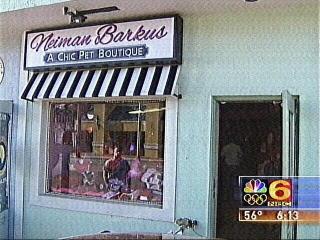
Neiman Barkus
Apparently several people thought that Neiman Barkus was a good name for a pet store (see also the Neiman Barkus store at the Canine Hilton in Texas, which might have some extra trademark problems) and the Pampered Pooch store, whose slogan is "A Neiman Barkus for your pooch!"). Neiman Marcus is suing at least one of them. Neiman Marcus sells $750 Gucci pet carriers, so the goods and services may overlap a bit.
What about "Needless Markup" as a name for a store?

What about "Needless Markup" as a name for a store?
Orphan Works, Panel 2, part 2
Last panelists and audience questions:
Jay Rosenthal, Recording Artists Coalition: There are four different issues that need more study. The basic idea is good, but we need a bigger tent for creators.
(1) Conceptual problem: There's a lack of accountability for the initial search process. It's in the prospective user's best interest to fail. The Canadian system for unfound owners is no good, but in a commercial context at least, we should require people to use professional copyright search companies. Sample clearance has created a whole induistry that can do this for music. (Comment: sounds like bankruptcy reform, requiring you to pay a credit counseling service regardless of why you went bankrupt.)
(2) Particular problem with artists: They're the hardest to find and have the fewest resources to fight the designation. There needs to be an attorney's fees provision to get them the right to contest orphan works claims. Rosenthal likes the idea of a copyright small claims court.
(3) Work for hire/termination rights: This isn't outside the scope of the inquiry because it goes to who is the owner for whom you're required to search. You should have to search for the possible owner of a future interest, if the primary owner can't be found. A work might have two sets of parents, one off hiding and another that will return. (Comments: If the artists and industry directly involved can't figure out who owns the masters, I just don't think libraries are going to be able to cut the Gordian knot. Also, this whole parenthood metaphor is beginning to creep me out.)
(4) Moral rights: The vast majority of uses will be wonderful, but a work could be used in a way that damages an artist's integrity. Most artist fight for approval rights over the use of music in movies. If a label disappears, the artist loses that contractual protection. Imagine the use of music in a porn film – and worse, the proposal compels attribution, so the artist will be blamed. It might not happen often, but would be a staggering blow to a particular artist. Consider adding a small step toward moral rights in US law by allowing artists to stop disparaging uses, whether they're works for hire or not. (Comment: small step or giant leap?)
Eric Schwartz, Smith & Metalitz: Schwartz wanted to make some practical points. He's worked with orphan books and film clips – nothing happened to the users and nothing will, because those works were orphans. Section 412 is the starting point: you can usually determine the registration status of a work. When statutory damages and attorneys' fees are unavailable, ultimately you'll be okay. (Ah, Holmes's bad man! What with the libraries and their risk aversion, I'd almost forgotten about him!)
Still, there is an orphan works problem. Preservation is allowed under section 108, and there's fair use, but those aren't convenient – section 108, for example, doesn't cover online access. Everyone wants orphans to come work for them, but no one wants to praise orphanages – they exist because libraries etc. have spent millions on retention and preservation.
Overall, Schwartz likes what the Office did, focusing on (1) facilitating voluntary licensing and (2) ensuring safe steps if (1) fails. The burden of proof and search obligations are in the right place: on the user. Reasonable search has to be different for different classes of works because licensing is different in each. The Office could rejigger the proposal to make clearer that reasonable search varies. A higher threshold for photos and graphics might be appropriate because they lack collective societies and registries. (Comment: this has to be a higher standard for pursuing what information you have, right? Because you're a lot less likely to have that information in the first place, and that's very hard to change by setting a high standard for search.) Maybe born-digital works will make search easier, but that hasn't happened yet. These steps may be inconvenient, but you are using anotherr's work.
Unpublished works are a concern: the proposed rule is antithetical to the civil law system. The right of divulgation is a problem, which needs to be watched.
Congress should also spend the $35 million to put the Copyright Office database online, as a starting point.
As to the distinction between commercial and noncommercial uses, if an archive spends $20,000 on restoring a film, it will never recoup its costs even if it sells copies. We should give it the ability to count the production costs (I wasn't clear whether that meant treating its uses as noncommercial or simply saying that a reasonable license fee would only kick in after restoration costs were recouped). This is fair because, but for their efforts, the material wouldn't exist.
On derivative works, the proposal needs clarification. Incorporating photos into a movie set background isn't transformative, but no injunction should issue in such cases either.
Jennifer Urban, USC Law IP Clinic: The clinic represented independent and documentary filmmakers – follow-on creators -- in the comments. These filmmakers hope for commercial success but aren't assured of it; they depend on copyright themselves, but have limited resources and budgets.
Reasonable compensation is a worry. The Copyright Office has tried to define it, but it's still difficult for small users who lack resources and lack the ability to spred risk. They're putting their films on credit cards. An E&O insurer, despite the reality of the situatin with respect to unregistered works, will be a conservative gatekeeper, and it's dealing with lots of filmmakers who are competing for insurance. Thus, a damages cap is quite important. Attorneys' fees for bad faith make good sense; also a small claims court. She's also willing to consider some sort of affidavit or statement of good faith, as long as the standard is flexible.
Question: From a lawyer who works with jewelry and textile designers: copyright information is taken off of works and knockoffs are produced in Asia. How can we deal with that?
Answer from panelists: That's the same problem as with illustrations and photos – it's hard to identify the source. The pirates certainly aren't performing due diligence. (In other words, not really an orphan works problem.)
Question from me: The Report says that only a handful of comments addressed attribution, yet it's half the proposed solution. Why is that?
Answer from Copyright Office folks: It came up in the roundtables, and there seemed to be consensus that it was basically fair. Jonathan Band added that attribution makes it easier for orphans to find their guardians – the name of the photographer might enable heirs to appear. Of course, you might get a problem of 7 more minutes of movie credits (kind of like the fine print in ads, useful only to regulators and probably not to heirs). Rob Kasunic said that it's a matter of basic good faith, showing that the work wasn't the creation of the user (query: do people reading historians' works need to be told that?) and also allowing the user and creator to get together. I find the former explanation more persuasive than the latter, since everyone agrees that creators/heirs are extremely unlikely to reappear.
Question from me: Say more about derivative works.
Answer from Copyright Office folks: Does putting a photo in a book create a derivative work of that photo? Case law is unclear. If it doesn't, the proposed language may offer no protection against injunction even though that's what we want. Secondary users should be protected when someone needed to use the work and added new material, but not when they just put one photo with a bunch of others and don't really rely on that particular work. (E.g., Google Print, if Google tried first to find owners.) The Office is struggling with alternative language – suggestions welcome!
Question: What about the problems with visual artists generally?
Answer: One of the points of the Report is that we should try to eliminate the problem in the future. There is an orphan works problem – often you just can't find the owner – and we should incentivize finding aids. You can't herd cats, but you can move their food, and that's what the proposal tries to do.
Question: Mostly people would have to come to DC to search the Copyright Office records, or pay to have it done – how much diligence do you have to do to find a company that disappeared 25 years ago?
Answer: Peter Jaszi said that best practices, sectorally, were a big part of the answer. Jonathan Band: In publishing, thousands of houses were bought and sold over time. The AAP is in the best position to put together family trees; if they did that once, people could rely on it.
Question from Brad Holland: One group tried to create a registry of artists through the Copyright Clearance Center, which didn't cooperate. Illustrators have tried to get together with photographers for a visual artists' collecting society, but it hasn't happened. Why not have Congress allocate money to do it, or give artists ten years before this provision kicks in to let them get their act together? (Comment: see above re: cats. If I told my cat I was going to move her food in ten years, she'd … yawn. She's got more important things to do just this minute.)
Answer from Copyright Office folks: A registry is not just difficult and costly, but hard to adapt to technical change. The Copyright Office doesn't know illustrators' business and licensing models. You guys should design a registry for your own needs to create a functional marketplace. You need a system for credit and collective licensing whether or not we get orphan works legislation. If you're successful, you'll solve a lot of orphan works problems, but there are lots of true orphans now, which is why it's a bad idea to wait. The proposed sunset provision allows adjustments to be made.
Then we were out of time. Once again, Peter Jaszi and his crew created an excellent program.
Jay Rosenthal, Recording Artists Coalition: There are four different issues that need more study. The basic idea is good, but we need a bigger tent for creators.
(1) Conceptual problem: There's a lack of accountability for the initial search process. It's in the prospective user's best interest to fail. The Canadian system for unfound owners is no good, but in a commercial context at least, we should require people to use professional copyright search companies. Sample clearance has created a whole induistry that can do this for music. (Comment: sounds like bankruptcy reform, requiring you to pay a credit counseling service regardless of why you went bankrupt.)
(2) Particular problem with artists: They're the hardest to find and have the fewest resources to fight the designation. There needs to be an attorney's fees provision to get them the right to contest orphan works claims. Rosenthal likes the idea of a copyright small claims court.
(3) Work for hire/termination rights: This isn't outside the scope of the inquiry because it goes to who is the owner for whom you're required to search. You should have to search for the possible owner of a future interest, if the primary owner can't be found. A work might have two sets of parents, one off hiding and another that will return. (Comments: If the artists and industry directly involved can't figure out who owns the masters, I just don't think libraries are going to be able to cut the Gordian knot. Also, this whole parenthood metaphor is beginning to creep me out.)
(4) Moral rights: The vast majority of uses will be wonderful, but a work could be used in a way that damages an artist's integrity. Most artist fight for approval rights over the use of music in movies. If a label disappears, the artist loses that contractual protection. Imagine the use of music in a porn film – and worse, the proposal compels attribution, so the artist will be blamed. It might not happen often, but would be a staggering blow to a particular artist. Consider adding a small step toward moral rights in US law by allowing artists to stop disparaging uses, whether they're works for hire or not. (Comment: small step or giant leap?)
Eric Schwartz, Smith & Metalitz: Schwartz wanted to make some practical points. He's worked with orphan books and film clips – nothing happened to the users and nothing will, because those works were orphans. Section 412 is the starting point: you can usually determine the registration status of a work. When statutory damages and attorneys' fees are unavailable, ultimately you'll be okay. (Ah, Holmes's bad man! What with the libraries and their risk aversion, I'd almost forgotten about him!)
Still, there is an orphan works problem. Preservation is allowed under section 108, and there's fair use, but those aren't convenient – section 108, for example, doesn't cover online access. Everyone wants orphans to come work for them, but no one wants to praise orphanages – they exist because libraries etc. have spent millions on retention and preservation.
Overall, Schwartz likes what the Office did, focusing on (1) facilitating voluntary licensing and (2) ensuring safe steps if (1) fails. The burden of proof and search obligations are in the right place: on the user. Reasonable search has to be different for different classes of works because licensing is different in each. The Office could rejigger the proposal to make clearer that reasonable search varies. A higher threshold for photos and graphics might be appropriate because they lack collective societies and registries. (Comment: this has to be a higher standard for pursuing what information you have, right? Because you're a lot less likely to have that information in the first place, and that's very hard to change by setting a high standard for search.) Maybe born-digital works will make search easier, but that hasn't happened yet. These steps may be inconvenient, but you are using anotherr's work.
Unpublished works are a concern: the proposed rule is antithetical to the civil law system. The right of divulgation is a problem, which needs to be watched.
Congress should also spend the $35 million to put the Copyright Office database online, as a starting point.
As to the distinction between commercial and noncommercial uses, if an archive spends $20,000 on restoring a film, it will never recoup its costs even if it sells copies. We should give it the ability to count the production costs (I wasn't clear whether that meant treating its uses as noncommercial or simply saying that a reasonable license fee would only kick in after restoration costs were recouped). This is fair because, but for their efforts, the material wouldn't exist.
On derivative works, the proposal needs clarification. Incorporating photos into a movie set background isn't transformative, but no injunction should issue in such cases either.
Jennifer Urban, USC Law IP Clinic: The clinic represented independent and documentary filmmakers – follow-on creators -- in the comments. These filmmakers hope for commercial success but aren't assured of it; they depend on copyright themselves, but have limited resources and budgets.
Reasonable compensation is a worry. The Copyright Office has tried to define it, but it's still difficult for small users who lack resources and lack the ability to spred risk. They're putting their films on credit cards. An E&O insurer, despite the reality of the situatin with respect to unregistered works, will be a conservative gatekeeper, and it's dealing with lots of filmmakers who are competing for insurance. Thus, a damages cap is quite important. Attorneys' fees for bad faith make good sense; also a small claims court. She's also willing to consider some sort of affidavit or statement of good faith, as long as the standard is flexible.
Question: From a lawyer who works with jewelry and textile designers: copyright information is taken off of works and knockoffs are produced in Asia. How can we deal with that?
Answer from panelists: That's the same problem as with illustrations and photos – it's hard to identify the source. The pirates certainly aren't performing due diligence. (In other words, not really an orphan works problem.)
Question from me: The Report says that only a handful of comments addressed attribution, yet it's half the proposed solution. Why is that?
Answer from Copyright Office folks: It came up in the roundtables, and there seemed to be consensus that it was basically fair. Jonathan Band added that attribution makes it easier for orphans to find their guardians – the name of the photographer might enable heirs to appear. Of course, you might get a problem of 7 more minutes of movie credits (kind of like the fine print in ads, useful only to regulators and probably not to heirs). Rob Kasunic said that it's a matter of basic good faith, showing that the work wasn't the creation of the user (query: do people reading historians' works need to be told that?) and also allowing the user and creator to get together. I find the former explanation more persuasive than the latter, since everyone agrees that creators/heirs are extremely unlikely to reappear.
Question from me: Say more about derivative works.
Answer from Copyright Office folks: Does putting a photo in a book create a derivative work of that photo? Case law is unclear. If it doesn't, the proposed language may offer no protection against injunction even though that's what we want. Secondary users should be protected when someone needed to use the work and added new material, but not when they just put one photo with a bunch of others and don't really rely on that particular work. (E.g., Google Print, if Google tried first to find owners.) The Office is struggling with alternative language – suggestions welcome!
Question: What about the problems with visual artists generally?
Answer: One of the points of the Report is that we should try to eliminate the problem in the future. There is an orphan works problem – often you just can't find the owner – and we should incentivize finding aids. You can't herd cats, but you can move their food, and that's what the proposal tries to do.
Question: Mostly people would have to come to DC to search the Copyright Office records, or pay to have it done – how much diligence do you have to do to find a company that disappeared 25 years ago?
Answer: Peter Jaszi said that best practices, sectorally, were a big part of the answer. Jonathan Band: In publishing, thousands of houses were bought and sold over time. The AAP is in the best position to put together family trees; if they did that once, people could rely on it.
Question from Brad Holland: One group tried to create a registry of artists through the Copyright Clearance Center, which didn't cooperate. Illustrators have tried to get together with photographers for a visual artists' collecting society, but it hasn't happened. Why not have Congress allocate money to do it, or give artists ten years before this provision kicks in to let them get their act together? (Comment: see above re: cats. If I told my cat I was going to move her food in ten years, she'd … yawn. She's got more important things to do just this minute.)
Answer from Copyright Office folks: A registry is not just difficult and costly, but hard to adapt to technical change. The Copyright Office doesn't know illustrators' business and licensing models. You guys should design a registry for your own needs to create a functional marketplace. You need a system for credit and collective licensing whether or not we get orphan works legislation. If you're successful, you'll solve a lot of orphan works problems, but there are lots of true orphans now, which is why it's a bad idea to wait. The proposed sunset provision allows adjustments to be made.
Then we were out of time. Once again, Peter Jaszi and his crew created an excellent program.
Orphan Works, Panel 2, part 1
Panel 2, evaluating the Copyright Office proposal:
Matt Skelton & Rob Kasunic, Copyright Office: There was a huge response to the Notice of Inquiry, about 850 comments total. Roundtables and informal meetings were also important to the process. The Office made a real effort to deal with the situation holistically – it could have gone to complex sectoral limitations, but instead wanted an allover scheme.
The attribution requirement, in some situations, merely calls for an indication that the owner is unknown and that the material is not original to the author of the new work.
The Office was surprised that users didn't want specific regulatory guidance on what reasonable search was – they wanted to establish best practices through negotiation. Also surprised that people who are comfortable with "reasonable search" are uncomfortable with "reasonable compensation." (I can't see why: same adjective, very different potential consequences.)
Looking at the derivative works language in the proposal, they may not have fully captured the idea, which was not necessarily to distinguish between derivative works and nonderivative works, but to take into account the extent to which a user relied on a particular work in creating a new work. (As I understood it, the concern is that a book reprinting an orphan photo probably isn't a derivative work of the photo under existing caselaw, but the selection and printing of that particular photo still creates enough of a reliance interest that injunction should be unavailable to a newly appeared owner. It seems to me, however, that "the extent of reliance" is an equally awkward way to address the problem; most especially, it would be a bad idea to have a court deciding that, since another photo would adequately illustrate the same point, the user's reliance isn't sufficient to avoid injunctive relief.)
The Office is looking for other ways to express that concept. Where there's no reliance on the underlying work, its use could be enjoined, though the court should take into account whether there was some reliance. (Thus, the Office may not agree with my parenthetical concern – if the photo could be replaced in later editions of a book, for example, maybe that should be the result. It seems to me that this would have the greatest consequences for online exhibits and the like, since a resurfacing copyright owner could often argue that the changeability of the online form means that reliance interests are minimal.)
Jonathan Band, Library Copyright Alliance: The sunset provision is a horrible idea (he's the one who suggested trading for a Title I DMCA sunset). Given the hard work everyone's done defining the problem, a sunset makes no sense.
A damage cap as opposed to reasonable compensation would be better for certainty. However, the LCA understands political reality and is willing to consider reasonable compensation, as long as there's additional certainty about what reasonable means. The Report has pretty good definitions, which should be incorporated into statutory language, not legislative history.
Other, more technical issues are resolveable. What's a noncommercial use – a library gift shop? (Libraries have gift shops?) A university coursepack?
Attribution of photos is a very real problem. Maybe we need to lean on publishers to do that in the future. A statutory requirement of attribution for photographs is not a good idea because it gets into moral rights territory, but it would be good to mitigate the problem on a going forward basis.
Brad Holland, Illustrators' Partnership: Holland's organization was joined by architectural, medical, scientific and other illustrators, along with cartoonists and organizations that represent artists' estates in opposing orphan works protection. At least, illustrations and photographs should be treated specially because authors produce a limited number of books (tell that to Isaac Asimov!) and can keep track, whereas illustrators and photographers have thousands or tens of thousands of works to manage.
As an aesthetic matter, it hurts a photograph to have credit attached. Imagine the Sistine Chapel with Michelangelo's name and "all rights reserved" across the painting.
Nine times in the Report, it says that most works have no economic value soon after publication – this is a basic premise.
That's false: anecdotally, artists get more value after 20 years because of their reputations. (My comment: the plural of anecdote is not data.) Moreover, before 1976, an artist's drawing for the New Yorker was unlikely to be reused; that was perceived as unethical. Now secondary rights are contentious and valuable. Bill Gates is buying up photos and illustrations by the hundreds of millions – smart businessmen don't spend so much money on works with no commercial value. (My comment: we're back to Google again – aggregation's value is greater than the sum of the parts.)
Holland's group objects to two loopholes in particular. First, the Report says that information on the face of a work of art is highly relevant to whether a user's search is adequate. Holland told the story of an artist, Cutler, who always used © as the C in his name on his art. A stockhouse took the work, breaching his contract and infringing his copyright, but he was unable to go to court against a giant corporation. Holland saw his work reproduced in a Singapore newspaper which had cut the C off of his name. The information was false – the most diligent search in the world wouldn't have found Utler, and this isn't Cutler's fault. (As someone in the comments noted, none of this is an orphan works problem.)
Second, the proposed remedies are too limited. The Report acknowledges that illustrators can't go to court over infringements, but the requirement that reasonable search parameters be developed on a case-by-case basis will mean that no ground rules will ever develop, since no one will sue to develop them.
There are also problems of retroactivity: artists have done work in good faith with no information on the face of the work. (I began to get the sense that Holland was treating "face" somewhat more literally than I would have. Also, do artists expect that, because they can't be found, no reuse will be made of their works? By definition, they can't really expect economic benefit. So what orphan works protection denies them is some certainty that their work will not be disseminated – a type of moral right.)
Holland's group concedes that legitimate problems exist, such as family portraits taken by professional photographers. But in every small town, there's someone who doesn't know that copyright law exists or is willing to break the law – it's like jaywalking, a law to be winked at. (Wow. So much for moral rights.) The Netherlands allows reproduction of family photos by or on behalf of the person(s?) portrayed or the heirs. We should adopt the same rule instead of an omnibus bill.
In conclusion, the Report offers a blueprint for a license to infringe.
Next: more panelists, and questions.
Matt Skelton & Rob Kasunic, Copyright Office: There was a huge response to the Notice of Inquiry, about 850 comments total. Roundtables and informal meetings were also important to the process. The Office made a real effort to deal with the situation holistically – it could have gone to complex sectoral limitations, but instead wanted an allover scheme.
The attribution requirement, in some situations, merely calls for an indication that the owner is unknown and that the material is not original to the author of the new work.
The Office was surprised that users didn't want specific regulatory guidance on what reasonable search was – they wanted to establish best practices through negotiation. Also surprised that people who are comfortable with "reasonable search" are uncomfortable with "reasonable compensation." (I can't see why: same adjective, very different potential consequences.)
Looking at the derivative works language in the proposal, they may not have fully captured the idea, which was not necessarily to distinguish between derivative works and nonderivative works, but to take into account the extent to which a user relied on a particular work in creating a new work. (As I understood it, the concern is that a book reprinting an orphan photo probably isn't a derivative work of the photo under existing caselaw, but the selection and printing of that particular photo still creates enough of a reliance interest that injunction should be unavailable to a newly appeared owner. It seems to me, however, that "the extent of reliance" is an equally awkward way to address the problem; most especially, it would be a bad idea to have a court deciding that, since another photo would adequately illustrate the same point, the user's reliance isn't sufficient to avoid injunctive relief.)
The Office is looking for other ways to express that concept. Where there's no reliance on the underlying work, its use could be enjoined, though the court should take into account whether there was some reliance. (Thus, the Office may not agree with my parenthetical concern – if the photo could be replaced in later editions of a book, for example, maybe that should be the result. It seems to me that this would have the greatest consequences for online exhibits and the like, since a resurfacing copyright owner could often argue that the changeability of the online form means that reliance interests are minimal.)
Jonathan Band, Library Copyright Alliance: The sunset provision is a horrible idea (he's the one who suggested trading for a Title I DMCA sunset). Given the hard work everyone's done defining the problem, a sunset makes no sense.
A damage cap as opposed to reasonable compensation would be better for certainty. However, the LCA understands political reality and is willing to consider reasonable compensation, as long as there's additional certainty about what reasonable means. The Report has pretty good definitions, which should be incorporated into statutory language, not legislative history.
Other, more technical issues are resolveable. What's a noncommercial use – a library gift shop? (Libraries have gift shops?) A university coursepack?
Attribution of photos is a very real problem. Maybe we need to lean on publishers to do that in the future. A statutory requirement of attribution for photographs is not a good idea because it gets into moral rights territory, but it would be good to mitigate the problem on a going forward basis.
Brad Holland, Illustrators' Partnership: Holland's organization was joined by architectural, medical, scientific and other illustrators, along with cartoonists and organizations that represent artists' estates in opposing orphan works protection. At least, illustrations and photographs should be treated specially because authors produce a limited number of books (tell that to Isaac Asimov!) and can keep track, whereas illustrators and photographers have thousands or tens of thousands of works to manage.
As an aesthetic matter, it hurts a photograph to have credit attached. Imagine the Sistine Chapel with Michelangelo's name and "all rights reserved" across the painting.
Nine times in the Report, it says that most works have no economic value soon after publication – this is a basic premise.
That's false: anecdotally, artists get more value after 20 years because of their reputations. (My comment: the plural of anecdote is not data.) Moreover, before 1976, an artist's drawing for the New Yorker was unlikely to be reused; that was perceived as unethical. Now secondary rights are contentious and valuable. Bill Gates is buying up photos and illustrations by the hundreds of millions – smart businessmen don't spend so much money on works with no commercial value. (My comment: we're back to Google again – aggregation's value is greater than the sum of the parts.)
Holland's group objects to two loopholes in particular. First, the Report says that information on the face of a work of art is highly relevant to whether a user's search is adequate. Holland told the story of an artist, Cutler, who always used © as the C in his name on his art. A stockhouse took the work, breaching his contract and infringing his copyright, but he was unable to go to court against a giant corporation. Holland saw his work reproduced in a Singapore newspaper which had cut the C off of his name. The information was false – the most diligent search in the world wouldn't have found Utler, and this isn't Cutler's fault. (As someone in the comments noted, none of this is an orphan works problem.)
Second, the proposed remedies are too limited. The Report acknowledges that illustrators can't go to court over infringements, but the requirement that reasonable search parameters be developed on a case-by-case basis will mean that no ground rules will ever develop, since no one will sue to develop them.
There are also problems of retroactivity: artists have done work in good faith with no information on the face of the work. (I began to get the sense that Holland was treating "face" somewhat more literally than I would have. Also, do artists expect that, because they can't be found, no reuse will be made of their works? By definition, they can't really expect economic benefit. So what orphan works protection denies them is some certainty that their work will not be disseminated – a type of moral right.)
Holland's group concedes that legitimate problems exist, such as family portraits taken by professional photographers. But in every small town, there's someone who doesn't know that copyright law exists or is willing to break the law – it's like jaywalking, a law to be winked at. (Wow. So much for moral rights.) The Netherlands allows reproduction of family photos by or on behalf of the person(s?) portrayed or the heirs. We should adopt the same rule instead of an omnibus bill.
In conclusion, the Report offers a blueprint for a license to infringe.
Next: more panelists, and questions.
Orphan Works, continued
This post comes from notes I jotted down before I spoke, so it may not reflect actual content, whereas I think I basically captured what other people said. (It's come to my attention that some people consider my notes on other people's presentations freakishly complete. I blame eight years of policy debate.)
Most of my experience with orphan works comes from contacts with historians. Images are the biggest problem: you may know where you found them and sometimes who's in them, but rarely who created them. We have a family photo from early in the 20th century that shows members of my husband's family posing with their favorite socialist newspaper. Another historian wanted to use the photo in a book about Jewish politics in New York; we sent him a copy and gave permission. Did we have any right to give permission? Who knows? The use wasn't conventionally transformative but may have been a fair use – the historian was using it to illustrate his argument about the importance of small differences in politics by showing that the choice of newspaper was significant enough for a family to use it as a means of self-definition. Regardless, the publisher wanted the empty ritual of permission.
More generally, authors are hard to trace, and if anything the problem is worse when the copyright owner was an organization that's now defunct. The successors often don't know what they own or if they own it. They worry about giving permission, so refuse or don't respond to inquiries, or they blithely give permission without owning the rights.
A story from the heirs' side: My grandfather, Leonard Tushnet, wrote short stories and a few books. They were all published after 1963, so renewal was automatic; he passed away before the first terms ended, so the renewal terms went to his heirs (my father and aunts). To my surprise, I found one of his stories reprinted in a recent anthology. I'm sure the publisher sought permission from the original publisher – and got it – in good faith, but it was nonetheless mistaken, and strictly liable. The heirs have no plans to enforce the copyright, but I tell this story to point out how easy it is even for repeat players to screw up.
The basic question I'm interested in: How hard should we make new users work? Carnegie Mellon invested several million dollars in digitization, a substantial chunk for permissions. Very roughly – read more here or here -- they found 1/3 of the publishers fairly easily, 1/3 with difficulty, and 1/3 not at all. (And, as noted above, some of the ones they found didn't necessarily have the rights.) Is this game worth the candle?
Most of my experience with orphan works comes from contacts with historians. Images are the biggest problem: you may know where you found them and sometimes who's in them, but rarely who created them. We have a family photo from early in the 20th century that shows members of my husband's family posing with their favorite socialist newspaper. Another historian wanted to use the photo in a book about Jewish politics in New York; we sent him a copy and gave permission. Did we have any right to give permission? Who knows? The use wasn't conventionally transformative but may have been a fair use – the historian was using it to illustrate his argument about the importance of small differences in politics by showing that the choice of newspaper was significant enough for a family to use it as a means of self-definition. Regardless, the publisher wanted the empty ritual of permission.
More generally, authors are hard to trace, and if anything the problem is worse when the copyright owner was an organization that's now defunct. The successors often don't know what they own or if they own it. They worry about giving permission, so refuse or don't respond to inquiries, or they blithely give permission without owning the rights.
A story from the heirs' side: My grandfather, Leonard Tushnet, wrote short stories and a few books. They were all published after 1963, so renewal was automatic; he passed away before the first terms ended, so the renewal terms went to his heirs (my father and aunts). To my surprise, I found one of his stories reprinted in a recent anthology. I'm sure the publisher sought permission from the original publisher – and got it – in good faith, but it was nonetheless mistaken, and strictly liable. The heirs have no plans to enforce the copyright, but I tell this story to point out how easy it is even for repeat players to screw up.
The basic question I'm interested in: How hard should we make new users work? Carnegie Mellon invested several million dollars in digitization, a substantial chunk for permissions. Very roughly – read more here or here -- they found 1/3 of the publishers fairly easily, 1/3 with difficulty, and 1/3 not at all. (And, as noted above, some of the ones they found didn't necessarily have the rights.) Is this game worth the candle?
Monday, March 06, 2006
Orphan Works find home at AU
On February 24, I attended "Orphan Works: New Prospects for a Solution" at American University's Washington College of Law, sponsored by the Intellectual Property Law Clinic and introduced by Peter Jaszi. A webcast is available on the law school's site. The first panel considered what the orphan works problem is (if there is one).
Prue Adler, Association of American Libraries: She offered the library community perspective, which is similar to that of archives and museums. Libraries see solving the orphan works problem as offering huge benefits to scholarship from greater public accessibility. There are many rich special collections nationwide, and libraries are trying to digitize them, but massive numbers of the documents are orphan works. Many of these are on unstable, deteriorating media such as acidic paper. Moreover, users demand electronic formats – print and other media no longer satisfy.
Three examples from one institution, Cornell. First, Cornell has a core collection of agricultural texts from the mid-19th to mid-20th century, covering forestry, nutrition, etc. It took $50,000 in staff time solely to deal with copyright – contacting authors' children and publishing houses and dealing with international issues. For 14% of the works, Cornell was denied permission; the librarians couldn't determine ownership for 58% (and these are people who know how to research!). The killer – how many texts did that $50,000 cover? Three hundred and forty-three (343) mongraphs.
Second, Cornell's Center for Labor/Management Relations has 350,000 unpublished photographs. One percent (1%) have indications of who took them. Without orphan works, there is no way this collection will be digitized.
Third, the Rare Book and Manuscript collection includes a manuscript from a Japanese-American relocation camp from WWII. The author gave permission to reproduce it once, but has since disappeared, which means a wait of 120 years from creation before it can be used again.
Access and preservation are linked – each time someone handles many of these materials, they deteriorate. Orphan works protections are necessary, especially given the uniquely risk-adverse counsel who operate on-campus. Any doubt about whether the use requires permission leads to a veto.
Alex Curtis, Public Knowledge: We know that from 1923-1942, 3 million copyrights were registered, some of which were renewed; 2% were being commercially exploited in 1998. That 98% represents a great opportunity – including for commercial exploitation – except for the problem that the costs of seeking permission overwhelm the benefits to be had, especially since even those who do the work often can't find the owner.
The Copyright Office's proposal is pretty close to PK's goals of (1) encouraging registration, (2) matching works with lost owners, and (3) minimizing the risks and costs to users. PK thinks legislation needs to provide a high degree of certainty, since the search alone will be expensive. PK doesn't like the distinction between commercial and noncommercial endeavors for the absolute bar on damages, and also thinks the reasonable compensation requirement is too uncertain. The last decade saw lots of bad copyright policy – this is a big chance to go the other way.
Kathleen Franz, AU history department: Franz is a cultural historian who uses visual and sound sources. She's also a public historian, which means she works on all the things historians do outside the classroom, including museums and digital history. Her 20th century colleagues are often faced with questions of what they can use. Permissions take time and corporate archives charge a lot. Working in an early period, she often relies on fair use, but other historians don't have that choice.
She offered an example from museum life: doing a show with 500 to 1000 postcards, you could take up all your staff time looking for permissions. She'd like to see some legal changes to help out academic and public historians.
Mitch Glazer, RIAA: Here I will interrupt to say that Mr. Glazer was personable, reasonable, and very smart – but apparently not smart enough to avoid the heat for inserting a teeny, tiny change in the definition of works for hire back in 1999 (though Courtney Love spelled his name wrong).
Glazer was present to talk about commercial exploitation of orphan works. RIAA companies are both owners (sound recordings) and users (musical works). What we have here is a need to balance a reasonable degree of business certainty with fairness to creators. As with most copyright legislation, there are interests to respect on both sides. The RIAA always believes in licensing, but if you can't find the owner but do have the work, how do you make it available for public use?
The Copyright Office did a pretty good balancing job. Now we need to find the right examples to define a reasonably diligent search: there should be no automatic entitlement just by searching Copyright Office records, nor a zillion-step requirement. We need examples so Congress can give guidance without a regulatory scheme (I took this to mean that he wanted legislative history, not rulemaking).
Glazer made what I thought was the most interesting theoretical (and practical!) point of the session: the proposed attribution element cries out for balance as well. If you're 50% certain of a work's authorship, giving attribution may be inappropriate – you may falsely accuse the supposed author.
We also need guidance on reasonable compensation. He thinks the sunset provision proposed is appropriate – this should be a pilot program so we can evaluate it, though we need to figure out what happens to works used before the sunset. (Later on, one commenter said that he'd be happy to have an orphan works sunset if the copyright industries would trade us a section 1201 anticircumvention sunset.)
People not usually on the same sides agree: there's room for a legislative solution. Commercializing orphan works benefits the public by allowing access to material we wouldn't otherwise have heard.
Eugene Mopsik, American Society of Media Photographers: This proposal is a disaster of biblical proportions. (Good contrast to Glazer's conclusion!) Mopsik's organization, which mainly represents publication photographers, has come together with other artists' and photographers' organizations to object.
The basic problem is that, as a matter of trade practice, the vast majority of ASMP members' works are routinely reproduced without credit. They've done everything possible under the law, including registering, to protect themselves. They're not missing, not hiding, not making themselves hard to find. (And here's what nobody ever said to him directly: they're not making themselves hard to find; they're nonetheless hard – indeed, impossible -- to find. So it's not like the current rule is helping.) The orphan works proposal resurrects a notice requirement where context makes notice impossible.
It's been suggested that the Copyright Office create a searchable image registry. In the report, the Office said that was beyond the scope of its mandate and an administrative nightmare besides, but meanwhile it would be great if the photographers did that themselves. Mopsik said that, since they're already overwhelmed and underpaid, that's not going to happen.
The proposal encouarages theft by libraries at the expense of photographers. He understands the need for access; getting permission takes time and costs money, sure. He'd like free stuff too, say at the car dealership, but doesn't see why creators are supposed to pay.
At most, any orphan works solution should only allow noncommercial use by nonprofits. Congress should create a copyright small claims court so it's worth suing over ordinary infringements. Attorneys' fees should also be allowed where the user refuses to pay or is otherwise abusive.
I was the last speaker on the panel; I'll post about what I said in the next post. (It'll be shorter than this!)
Prue Adler, Association of American Libraries: She offered the library community perspective, which is similar to that of archives and museums. Libraries see solving the orphan works problem as offering huge benefits to scholarship from greater public accessibility. There are many rich special collections nationwide, and libraries are trying to digitize them, but massive numbers of the documents are orphan works. Many of these are on unstable, deteriorating media such as acidic paper. Moreover, users demand electronic formats – print and other media no longer satisfy.
Three examples from one institution, Cornell. First, Cornell has a core collection of agricultural texts from the mid-19th to mid-20th century, covering forestry, nutrition, etc. It took $50,000 in staff time solely to deal with copyright – contacting authors' children and publishing houses and dealing with international issues. For 14% of the works, Cornell was denied permission; the librarians couldn't determine ownership for 58% (and these are people who know how to research!). The killer – how many texts did that $50,000 cover? Three hundred and forty-three (343) mongraphs.
Second, Cornell's Center for Labor/Management Relations has 350,000 unpublished photographs. One percent (1%) have indications of who took them. Without orphan works, there is no way this collection will be digitized.
Third, the Rare Book and Manuscript collection includes a manuscript from a Japanese-American relocation camp from WWII. The author gave permission to reproduce it once, but has since disappeared, which means a wait of 120 years from creation before it can be used again.
Access and preservation are linked – each time someone handles many of these materials, they deteriorate. Orphan works protections are necessary, especially given the uniquely risk-adverse counsel who operate on-campus. Any doubt about whether the use requires permission leads to a veto.
Alex Curtis, Public Knowledge: We know that from 1923-1942, 3 million copyrights were registered, some of which were renewed; 2% were being commercially exploited in 1998. That 98% represents a great opportunity – including for commercial exploitation – except for the problem that the costs of seeking permission overwhelm the benefits to be had, especially since even those who do the work often can't find the owner.
The Copyright Office's proposal is pretty close to PK's goals of (1) encouraging registration, (2) matching works with lost owners, and (3) minimizing the risks and costs to users. PK thinks legislation needs to provide a high degree of certainty, since the search alone will be expensive. PK doesn't like the distinction between commercial and noncommercial endeavors for the absolute bar on damages, and also thinks the reasonable compensation requirement is too uncertain. The last decade saw lots of bad copyright policy – this is a big chance to go the other way.
Kathleen Franz, AU history department: Franz is a cultural historian who uses visual and sound sources. She's also a public historian, which means she works on all the things historians do outside the classroom, including museums and digital history. Her 20th century colleagues are often faced with questions of what they can use. Permissions take time and corporate archives charge a lot. Working in an early period, she often relies on fair use, but other historians don't have that choice.
She offered an example from museum life: doing a show with 500 to 1000 postcards, you could take up all your staff time looking for permissions. She'd like to see some legal changes to help out academic and public historians.
Mitch Glazer, RIAA: Here I will interrupt to say that Mr. Glazer was personable, reasonable, and very smart – but apparently not smart enough to avoid the heat for inserting a teeny, tiny change in the definition of works for hire back in 1999 (though Courtney Love spelled his name wrong).
Glazer was present to talk about commercial exploitation of orphan works. RIAA companies are both owners (sound recordings) and users (musical works). What we have here is a need to balance a reasonable degree of business certainty with fairness to creators. As with most copyright legislation, there are interests to respect on both sides. The RIAA always believes in licensing, but if you can't find the owner but do have the work, how do you make it available for public use?
The Copyright Office did a pretty good balancing job. Now we need to find the right examples to define a reasonably diligent search: there should be no automatic entitlement just by searching Copyright Office records, nor a zillion-step requirement. We need examples so Congress can give guidance without a regulatory scheme (I took this to mean that he wanted legislative history, not rulemaking).
Glazer made what I thought was the most interesting theoretical (and practical!) point of the session: the proposed attribution element cries out for balance as well. If you're 50% certain of a work's authorship, giving attribution may be inappropriate – you may falsely accuse the supposed author.
We also need guidance on reasonable compensation. He thinks the sunset provision proposed is appropriate – this should be a pilot program so we can evaluate it, though we need to figure out what happens to works used before the sunset. (Later on, one commenter said that he'd be happy to have an orphan works sunset if the copyright industries would trade us a section 1201 anticircumvention sunset.)
People not usually on the same sides agree: there's room for a legislative solution. Commercializing orphan works benefits the public by allowing access to material we wouldn't otherwise have heard.
Eugene Mopsik, American Society of Media Photographers: This proposal is a disaster of biblical proportions. (Good contrast to Glazer's conclusion!) Mopsik's organization, which mainly represents publication photographers, has come together with other artists' and photographers' organizations to object.
The basic problem is that, as a matter of trade practice, the vast majority of ASMP members' works are routinely reproduced without credit. They've done everything possible under the law, including registering, to protect themselves. They're not missing, not hiding, not making themselves hard to find. (And here's what nobody ever said to him directly: they're not making themselves hard to find; they're nonetheless hard – indeed, impossible -- to find. So it's not like the current rule is helping.) The orphan works proposal resurrects a notice requirement where context makes notice impossible.
It's been suggested that the Copyright Office create a searchable image registry. In the report, the Office said that was beyond the scope of its mandate and an administrative nightmare besides, but meanwhile it would be great if the photographers did that themselves. Mopsik said that, since they're already overwhelmed and underpaid, that's not going to happen.
The proposal encouarages theft by libraries at the expense of photographers. He understands the need for access; getting permission takes time and costs money, sure. He'd like free stuff too, say at the car dealership, but doesn't see why creators are supposed to pay.
At most, any orphan works solution should only allow noncommercial use by nonprofits. Congress should create a copyright small claims court so it's worth suing over ordinary infringements. Attorneys' fees should also be allowed where the user refuses to pay or is otherwise abusive.
I was the last speaker on the panel; I'll post about what I said in the next post. (It'll be shorter than this!)
Friday, March 03, 2006
BadBusinessBureau accused of monkey business
Hy Cite Corporation v. Badbusinessbureau.com, L.L.C., 2005 WL 3811420 (D.Ariz.)
According to plaintiff (which sells cookware), defendant is in the business of soliciting complaints about businesses – even offering compensation to good complainers – posting them on its website, and then offering to fix the problems thus generated by mediating between the targeted businesses and their disgruntled customers, for only $50,000 and a $1500 monthly fee. Rather than pay up, plaintiff sued.
Eric Goldman has written about the CDA section 230 immunity issues raised by the case, since it's one of the few in which a court rejected a section 230 defense by a service provider and refused to dismiss the defamation claims.
Plaintiff's RICO claims also survived defendant's motion to dismiss. Not so plaintiff's false advertising claim. Although plaintiff alleged that defendant solicited trumped-up complaints on its site, which it would then use to extort money from targeted businesses, the Lanham Act doesn't cover false claims made by noncompetitors. Another way to frame the conclusion, in this case, was that the complaints on the site weren't advertising, and thus didn't fall under the Lanham Act even if they were false and even if they were designed to generate business for defendant.
The court engages in what seems to me a superfluous discussion of Bosley Medical, a trademark case that held that allegations that the defendant's gripe site constituted extortion and prevented users from reaching the plaintiff's site wasn't enough to trigger Lanham Act liability. It is surely true that "no one will mistakenly purchase cookware or dinnerware from Defendants in the mistaken belief that it is Plaintiff's cookware or dinnerware," but that's not why the false advertising claim should fail. The court may have mushed the two causes of action together because (a) the Lanham Act does, which is actually a pretty good reason -- the standing requirements for false advertising are a judicial creation -- or (b) because lack of competition is relevant to trademark cases too; it's just not dispositive in a classic trademark infringement case the way it is in a classic false advertising case. Also, plaintiff brought common-law trade libel claims under the heading "trademark infringement and unfair competition," which likely muddied the waters further. Given its conclusion on the defamation issue, the court easily found that plaintiff had adequately alleged that strand of common law unfair competition, once again demonstrating the utility of the rump trade libel cause of action even with the Lanham Act's far lower standards for false advertising liability.
Speaking of trademark, anyone think that the Better Business Bureau has a claim against BadBusinessBureau?
According to plaintiff (which sells cookware), defendant is in the business of soliciting complaints about businesses – even offering compensation to good complainers – posting them on its website, and then offering to fix the problems thus generated by mediating between the targeted businesses and their disgruntled customers, for only $50,000 and a $1500 monthly fee. Rather than pay up, plaintiff sued.
Eric Goldman has written about the CDA section 230 immunity issues raised by the case, since it's one of the few in which a court rejected a section 230 defense by a service provider and refused to dismiss the defamation claims.
Plaintiff's RICO claims also survived defendant's motion to dismiss. Not so plaintiff's false advertising claim. Although plaintiff alleged that defendant solicited trumped-up complaints on its site, which it would then use to extort money from targeted businesses, the Lanham Act doesn't cover false claims made by noncompetitors. Another way to frame the conclusion, in this case, was that the complaints on the site weren't advertising, and thus didn't fall under the Lanham Act even if they were false and even if they were designed to generate business for defendant.
The court engages in what seems to me a superfluous discussion of Bosley Medical, a trademark case that held that allegations that the defendant's gripe site constituted extortion and prevented users from reaching the plaintiff's site wasn't enough to trigger Lanham Act liability. It is surely true that "no one will mistakenly purchase cookware or dinnerware from Defendants in the mistaken belief that it is Plaintiff's cookware or dinnerware," but that's not why the false advertising claim should fail. The court may have mushed the two causes of action together because (a) the Lanham Act does, which is actually a pretty good reason -- the standing requirements for false advertising are a judicial creation -- or (b) because lack of competition is relevant to trademark cases too; it's just not dispositive in a classic trademark infringement case the way it is in a classic false advertising case. Also, plaintiff brought common-law trade libel claims under the heading "trademark infringement and unfair competition," which likely muddied the waters further. Given its conclusion on the defamation issue, the court easily found that plaintiff had adequately alleged that strand of common law unfair competition, once again demonstrating the utility of the rump trade libel cause of action even with the Lanham Act's far lower standards for false advertising liability.
Speaking of trademark, anyone think that the Better Business Bureau has a claim against BadBusinessBureau?
Thursday, March 02, 2006
Recent Press
Downloading Empathy to Your iPod: The reporter found me, indirectly, through one of my favorite footnotes (it's a tossup between that one and the list of DC Elseworlds, with explanatory parentheticals, in the Trademark Reporter). But the clearest statement of the point that selection and arrangement of playlists are creative, self-defining acts comes from a grieving mother: "'I can't write a song, I can't write a poem, but this helps,' she explained. 'Whenever I find something that has helped me, I share it.'"
Subscribe to:
Posts (Atom)



 Posts
Posts


