Thursday, October 30, 2025

claims about game provider's bot use in "fair" and "skill-based" games must go to trial

Skillz Platform Inc. v. Papaya Gaming, Ltd., 2025 WL 3012836, 24cv1646(DLC) (S.D.N.Y. Oct. 27, 2025)

Most recent previous opinion discussed here. Skillz sued its competitor in the “real-money skill-based mobile gaming” market for violating the Lanham Act and NY GBL § 349 by stating or implying that its games pit human players against each other when in fact Papaya employed bots against human players. Here, the court denies summary judgment to Papaya.

“In RMSB games, players are matched by the platform with other users on games created by third parties and compete to win cash prizes or for game rewards.” Skillz most commonly offers head-to-head competition between two players, while Papaya offers multi-player tournaments with larger cash prizes. In various ads, Papaya has described its games as “fair” and “skill-based,” represented that Papaya has “no vested interest” in and does not “profit” from who wins or loses its tournaments, and refers to “players” “over the age of 18,” “individuals,” and “winners” as the users on its platform. Its video ads showed images of humans playing games, and claimed that its games “are directly determined by your level of skill” and that Papaya will “match [you] against players with similar skills.”

It was undisputed that Papaya used bots in its games from 2019 until at least November 2023. Its liquidity bots filled in user slots to ensure that a tournament “won’t stay open for too long” as it awaits players. Its tailored bots were used to create “a predetermined outcome” where Papaya “want[s] the player to finish at some predefined rank,” which requires “control[ling] the scores of the rest of the players.” All players in a tailored-instance outside the ‘receiving’ player” are bots. “Papaya customers inquired between 2021 and 2023 whether they were playing against other human beings or against a computer or a bot. Papaya’s responses generally emphasized that it matched players with similar skill levels and assured the complaining customers over 200 times that ‘we do not use bots.’” Papaya even closed the accounts of two players who expressed suspicion about Papaya’s use of bots.

Papaya regularly identified Skillz as its largest direct competitor and benchmark for performance assessments. During Papaya’s bot era, Skillz saw a decrease in market share while Papaya saw an increase.

Papaya argued that Skillz lacked sufficient evidence that any of its advertising statements communicated a false message to consumers, were material, or caused Skillz injury. The court disagreed.

A reasonable jury could find literal falsity or falsity by necessary implication, leading to a presumption of deception. Papaya’s representations that its tournaments are “fair,” “skill-based,” and only between “players” and “individuals” who are “over the age of 18” could be false based on the undisputed evidence of bot use. Similarly, statements that Papaya has “no vested interest” in who wins or loses, and that it does not “profit on the outcome of a Tournament,” could be literally false because there is evidence that Papaya used bots to control the outcomes of tournaments (and speed them up so players could use their winnings on new games). [Frankly, I’d be inclined to grant summary judgment to Skillz on falsity!]

Papaya argued that it never expressly stated in its advertisements that there were no bots in its games. “The issue is what a reasonable consumer would understand Papaya’s statements to mean. Should a jury find, for instance, that the advertising necessarily and unambiguously implied that only human players competed in Papaya’s games, it would be entitled to find that the advertising was literally false.”

Papaya argued that “skill-based,” “fair,” “players,” and “individuals” were not literally false because those terms had multiple meanings. [Insert goose meme: what meanings? What ones???]. The jury could find that, in context, they were literally false or false by necessary implication. Papaya’s expert concluded that skill played a greater role than chance in the outcome of Papaya’s tournaments, regardless of bot usage. So what? It was undisputed that Papaya used tailored bots to control the outcomes of tournaments. Papaya “could prevent players from winning–or allow them to win–no matter how they performed in the game.”

Papaya also argued that its statements that it had “no vested interest” in and did not “profit” on tournament outcomes were accurate, because Papaya made less money in sessions with bots because bots do not pay entry fees. Its experts opined that human players received more in total cash prize awards due to Papaya’s use of bots. That was a jury question. [Seems pretty inconsistent with the profit motive—did human players walk away with more money total because of bots, or did they play more games/stay longer?]

Implied falsity: This can be shown through either “extrinsic evidence of consumer confusion” or “evidence of the defendant’s deliberate deception,” the latter of which must be “egregious” to “create[] a rebuttable presumption of consumer confusion.”

There was sufficient evidence for a reasonable jury to find deliberate deception, given Papaya’s repeated denials of bots’ existence. E.g., when one player asked, “Is every single player I play against in a tournament a real player or are there computers playing at times?”, Papaya responded, to “clarify that we do not use bots or computer players” and that “if it were possible to control [tournaments] manually, it would not be fair to other players.” Papaya CSRs were instructed to escalate any complaints that referenced bots to management, and one employee stated that a customer service representative “displayed poor judgment” by keeping open an account of a consumer who had complained about bots and demanded a refund. Papaya had an internal policy of removing posts in its Facebook group that mentioned bots.

Papaya argued that there should be no presumption of deception because Skillz failed to provide evidence that any intent to deceive was linked to a specific challenged statement. But internal statements by executives and the company’s awareness of consumer confusion, among other things, are relevant to intent. Here, there was evidence that Papaya and its executives recognized that its use of bots “did not align” with its public statements and that this “misalignment” confused customers.

Indeed, executives decided to respond to a consumer who asked for a direct answer on whether Papaya used bots by informing the user that the platform has “real players” and placing the blame on “rare cases where players use automated systems.” Recognizing that consumers noticing bots on the platform was a growing issue and impacted “trust in our fairness,” Papaya executives modified its bots’ performance to make bot profiles appear more human so that fewer users would detect their usage going forward. Another employee stated: “While understanding the need for bots, the margin of their winnings should be smaller and less obvious to our players.” A reasonable jury could find intentional deception, despite the testimony of Papaya’s Rule 30(b)(6) witness, who stated that instances in which Papaya told customers that it did not use bots were “an unfortunate mistake” committed by the customer support vendor and “not Papaya’s position.” The court noted that “Papaya’s executives have not made similar representations. They invoked their Fifth Amendment privilege to remain silent during their depositions and have not offered affidavits in support of this motion.” [Yikes.] Regardless, there was enough to go to a jury.

Skillz also offered extrinsic evidence of consumer confusion created by Papaya’s use of the terms “skill-based,” “fair,” “players,” “winners,” “individuals,” and “no vested interest,” in its advertising. Along with individual consumer responses, Skillz provided survey evidence.

Respondents had played at least one of four games that Skillz and Papaya offer on their platforms. Upon watching a Papaya ad, 45.8% of respondents indicated that they believed that the game used solely human players. The survey next presented respondents with a mock app store description constructed from Papaya’s public statements:

Solitaire cash makes sure to match players against other opponents with a similar skill level to ensure a fun and fair experience for everyone. You’ll be matched with other players within the same skill level, and you will get the same deck – so the game is totally fair and skill-based. The outcome of Solitaire cash is based on the skill of the players, rather than luck or chance. Solitaire cash has no vested interest in who wins or loses, nor does it profit on the outcome of a tournament that we provide.

After reading the description, 60% of respondents indicated that they thought the game included only human players.

Papaya argued that the survey was inadmissible because it did not use a control, stripped the statements to which respondents reacted of their “real world” context, and did not survey the appropriate populations, excluding prospective game players and thereby including too many men. These were issues for cross-examination, not demanding exclusion.

Papaya didn’t explain what kind of control could have improved the survey’s reliability. [This is a missed opportunity! A control ad could have just described the game mechanics and not the opponents and tested whether consumers thought they’d received any message about whether they were playing against other humans. I wouldn’t be at all surprised if the net confusion levels were still pretty high, given the explicit claims. Still, the court didn’t appear to understand the purpose of a control: “The survey is designed to test the impression created by the words Papaya chose to describe its games. Testing responses to statements that Papaya did not use in its advertising would be neither relevant nor illuminating.”]

Papaya also argued that the survey wrongly screened for past players of RMSB games, not prospective consumers to whom the ads were directed towards, who differed demographically. Skillz’ expert filed a supplemental report looking at what happened when he removed randomly selected male respondents to match the ratio of male to female respondents in Skillz’s own survey of Skillz’s actual customers. The differences were, he reported, statistically insignificant.

Materiality: While the materiality of the falsity and the injury to the plaintiff resulting from the defendant’s falsity are “separate essential elements ... where the defendant and plaintiff are competitors in the same market and the falsity of the defendant’s advertising is likely to lead consumers to prefer the defendant’s product over the plaintiff’s,” proof of injury to the plaintiff may also demonstrate the materiality of the falsehoods.

Skillz relied on evidence that consumers complained to Papaya and closed their accounts with Papaya when they came to believe that Papaya was using bots in its games, as well as on Papaya’s efforts to deceive consumers about its use of bots. It also offered a second survey that sought to measure the likelihood of consumers continuing to play if they learned that some of their opponents in real-money games whom they thought were human were actually bots.

Half the respondents were randomly asked if they would “continue” to play if they were informed that some of their opponents were bots, and the other half were asked if they would “stop” playing. Of the former group, 51.2% of respondents indicated they would be unlikely or very unlikely to continue playing. Of the latter, 66.8% indicated they would be likely or very likely to stop playing.

[It seems to me that with less evidence of deception, that amount of a swing (over 15% of respondents) from a small wording change would be concerning—but frankly, even if you take 51.2% as a midpoint and say that it might reflect only a range from 35%-66% materiality, those are big enough numbers that it shouldn’t matter. Which is also to say that I’m not sure that you should draw anything but qualitative conclusions from surveys like this. Also:]

The survey had a control: half the respondents were also asked if they would continue playing – with the other half being asked if they would stop – if they were informed that they had to wait one hour to learn the results of the game. Here, the numbers were 40.8% (unlikely or very unlikely to continue playing) and 54.8% (likely or very likely to stop playing), suggesting that the wording affected about 15% of respondents, which with these numbers didn’t matter much. “At bottom, regardless of how the question was phrased, a significant number of respondents showed a propensity to cease playing when they learned there were bots in the games.”

Papaya argued that the survey didn’t measure the materiality of bots, but rather the materiality of learning of intentional deception. That went to the weight of the survey, not its admissibility. [Especially if there was intentional deception!]

Papaya also argued that bots are so ubiquitous in the industry that consumers “fully expect” them to be deployed, and that its failure to disclose was in line with industry practice. “These arguments fail to engage with the evidence of deception and materiality offered by Skillz.”

Injury: Injury “can be established when defendant and plaintiff are competitors in a relevant market and plaintiff demonstrates a logical causal connection between the alleged false advertising and its own sales position.” Papaya regularly identified Skillz as its largest competitor and benchmark for performance assessments, and Papaya’s growth in market share in 2021 coincided with Skillz’s decline in market share. “Even if Skillz were unable to quantify its damages with sufficient certainty to recover those damages, it could seek injunctive relief and disgorgement of the defendant’s ill-gotten profits.” And Skillz offered an expert to calculate both damages to Skillz and Papaya’s unjust enrichment, the latter of which was between $650 and $719 million, depending on whether that profit was measured by Papaya’s cost savings from its use of bots or by how much less it would have earned without deception. That report was admissible and relevant.

Papaya argued that “the but-for world in a false advertising case must be one in which the false statements were never made and cannot be one in which the accused business practice did not occur.” But the expert’s choice was not unreasonable. “There is evidence that Papaya may not have been able to operate in the RMSB marketplace at all if it publicly and accurately disclosed its use of bots.” If it did so, it might have been classified as a gambling platform by app stores—unlike RMSB platforms, gambling platforms hold a stake in the results. RMSB games don’t involve “playing against the house” and are supposed to collect the same revenue regardless of who wins, whether from entry fees, advertising revenue, or in-app purchases. “[H]ad Papaya disclosed its use of bots, Papaya may have been faced with the regulatory and tax requirements with which gambling platforms must comply. In addition, it may have lost access to app stores and payment processors and have been excluded from the RMSB market.”

GBL claims survived for the same reasons.


bad Lanham Act claim, swept up with bad patent claim, triggers Rule 11 sanctions

Raydiant Oximetry, Inc. v. ALC Medical Holdings LLC, --- F.Supp.3d ----, 2025 WL 3022882, No. 25-cv-00392-VC (N.D. Cal. Oct. 29, 2025)

Baseless patent and false advertising claims produce a big Rule 11 award. The patent stuff is eye-popping, and it’s hard to imagine that Rule 11 would have been appropriate just for the false advertising claim, which was baseless only because the challenged statements didn’t occur in “commercial advertising and promotion”/weren’t part of an organized campaign to penetrate the market. But still—a warning!

I’ll let the court introduce the facts:

This dispute began when ALC Medical Holdings sent Raydiant Oximetry a demand letter alleging that Raydiant’s medical device [a uterine device used to treat postpartum hemorrhaging] infringed ALC Medical’s patent. This accusation was false. Raydiant’s device has a “placement marker” that is permanently affixed, while the device claimed in ALC Medical’s patent requires an adjustable placement marker. In fact, the Patent and Trademark Office declined to approve the patent application until it was narrowed to require that the placement marker be adjustable.

Unfortunately, patent plaintiffs send baseless demand letters to defendants with some regularity. But this was no ordinary fishing expedition. To the contrary, all evidence available to ALC Medical and its lawyers at the time they sent the letter pointed strongly towards noninfringement. The sole founder of ALC Medical, Jennifer West, used to work at Raydiant. She helped develop Raydiant’s device and knew that it did not have a moveable placement marker. There was a reason for this design choice: Raydiant concluded that if the device’s placement marker were moveable, it would be dangerous to the patients who use it. Presumably for the same reason, the device West developed after she left Raydiant does not contain a moveable placement marker, even though her company’s patent requires one.

Thus, when Raydiant brought an action in this Court seeking a declaratory judgment of noninfringement, ALC Medical and its lawyers should have apologized and walked away.… Instead, they doubled down. They brought counterclaims against Raydiant, including one for infringement, asserting again that Raydiant’s device possessed a moveable placement marker. They also falsely alleged that West’s own device practiced the invention—that is, that her device had a moveable placement marker.

In support of the infringement counterclaim, ALC Medical and its lawyers submitted several diagrams depicting Raydiant’s device. On each diagram, they cited the YouTube video of a presentation Raydiant gave at an industry conference, indicating that the diagrams originated from the slide deck used in that presentation. But that was not entirely true. The lawyers manipulated one of the diagrams, superimposing dotted lines to make it seem like Raydiant’s device had a moveable placement marker. Nothing in Raydiant’s actual slide deck or the video of the presentation suggested that was the case.

Subsequently, Raydiant allowed ALC Medical and its lawyers to inspect the device. The inspection confirmed what all the evidence had previously suggested: the placement marker was not moveable…. ALC Medical and its lawyers … embarked on a ham-fisted scramble to avoid liability for Raydiant’s attorneys’ fees. First, they refused to dismiss their infringement counterclaim (or their equally frivolous false advertising counterclaim) unless Raydiant also agreed to dismiss its declaratory judgment action, with each side to bear its own fees and costs. Naturally, Raydiant refused. Then, ALC Medical and its lawyers filed a frivolous motion to dismiss Raydiant’s declaratory relief action for lack of jurisdiction, claiming falsely that Raydiant’s device was an “investigational device” immune from infringement claims. Later, they cobbled together a covenant not to sue that they argued mooted Raydiant’s declaratory relief claim, even though it clearly did not. At each step of the way, the position taken by ALC Medical and its lawyers became increasingly disconnected from the reality of the situation ….

Raydiant was awarded over $1.4 million in attorneys’ fees, with ALC Medical and its law firm Womble Bond jointly and severally liable.

The false advertising counterclaim was based on Raydiant’s presentation of its device at the Stanford Medicine Pediatric & Maternal Innovation Showcase, a pitch competition. Sanctions are warranted under Rule 11 if “(1) ‘the [challenged pleading, written motion, or other paper] is legally or factually baseless from an objective perspective,’ and (2) the attorneys failed to conduct ‘a reasonable and competent inquiry before signing and filing [it].’ ” The court found that both counterclaims “easily [met] this test.”

Just a bit from the patent discussion: Womble Bond denied bad faith in submitting the altered exhibit, asserting that the annotated dashed lines were made with a different font and in red color to distinguish the exhibit from the original slide. “This is difficult to swallow, particularly because counsel only submitted a black and white copy of its counterclaims to the Court, and the two fonts apparently used on [the exhibit] are not easily distinguishable. If Womble Bond and ALC Medical had truly been concerned about not misleading the Court, as opposed to disguising the baselessness of the infringement counterclaim, they could have easily included a disclaimer alongside the image clarifying that it had been annotated.” Practice tip ahoy!  

The Lanham Act counterclaim alleged that Raydiant’s discussion at the pitch session of its device’s being “cleared” or “approved” by the FDA was misleading because the device is a Class II device exempt from premarket notification requirements. “ALC Medical and its counsel knew or should have known that the claim was objectively baseless under Ninth Circuit law,” because only “commercial advertising or promotion” is actionable under 15 U.S.C. § 1125(a)(1)(B). This requires: (1) commercial speech; (2) made by a defendant who is in competition with the plaintiff [note that this is not necessary post-Lexmark]; (3) for the purpose of influencing consumers to buy the defendant’s goods or services; and (4) “disseminated sufficiently to the relevant purchasing public to constitute ‘advertising’ or ‘promotion’ within that industry.” A presentation at a one-off grant competition, “clearly” does not constitute “commercial advertising or promotion” under that definition. The court distinguished cases involving a press release and a conference presentation whose slides were posted on the defendant’s website. The pitch competition was more akin to “private statements made to actual and potential customers” that were insufficient to constitute sufficient dissemination. Thus, the counterclaim was “frivolous from the time it was filed.”


Tuesday, October 28, 2025

allegedly false claims for compounded weight loss drugs didn't plausibly threaten Eli Lilly's reputation

Eli Lilly & Co. v. Mochi Health Corp., 2025 WL 2998166, No. 25-cv-03534-JSC (N.D. Cal. Oct. 24, 2025)

Another of the cases in which Eli Lilly’s attempts to protect its GLP-antagonist market do surprisingly badly, once again highlighting the higher standards imposed on false advertising plaintiffs compared to trademark plaintiffs. Lilly sued defendants, alleging a scheme to mislead consumers into purchasing compounded versions of Lilly’s FDA-approved medications, Mounjaro and Zepbound, under California state and federal false advertising law. Defendants compound tirzepatide, which is the key ingredient in Lilly’s drugs.

Mochi allegedly changed the dosages for all its customers without consulting them or receiving a clinical indication from a physician, in violation of California’s prohibition on the corporate practice of medicine. In addition, Lilly alleged that Mochi also included “additives” such as niacinamide and pyridoxine, without patient consent or a clinical indication. Lilly points to a complaint posted by a Mochi customer on the Better Business Bureau’s website, indicating their dissatisfaction with the unilateral decision to add niacinamide to the compounded medication; the complaint said that the customer had broken out in a rash, which a dermatologist opined was caused by the niacinamide. Mochi released statements in response to customer queries, claiming that the additives were “not clinically significant” and changes were dependent on the pharmacy used to fill the prescription. Lilly alleged that this again violated the prohibition on the corporate practice of medicine.

As for false advertising, Mochi allegedly misrepresented the source of its products by claiming that it is a generic of Lilly’s Mounjaro and Zepbound; misrepresented its compounded tirzepatide medications as safe and effective based on studies conducted of Lilly’s products; falsely claimed that its compounded tirzepatide drug was “personalized”; falsely claimed that its pharmacy partner voluntarily stopped compounding tirzepatide medications; and falsely advertising Mochi’s founder and CEO as a licensed physician.

How did this allegedly harm Lilly? Lilly alleged that it suffered irreparable harm to its brand and goodwill because Mochi promised unobtainable results and traded on the credibility of Lilly products. The complaint alleged:

When consumers fail to achieve desired results from Mochi Health’s combination injection, consumers may conclude that tirzepatide is ineffective in general— an outcome made more likely given Defendants’ reliance on Lilly’s clinical studies and their explicit claims that their product functions identically to Lilly’s products, with the additives having no clinical significance. Worse still, if consumers are harmed using compounded tirzepatide products from Defendants—where their dosage and formulation are subject to repeated arbitrary changes based solely on Defendants’ business relationships without any clinical justification—consumers may even draw unwarranted conclusions about the safety and effectiveness of Lilly’s FDA-approved tirzepatide medicines.

The court found no Article III standing. The only harm Lilly alleged to itself was reputational: if Mochi’s products didn’t work, consumers might conclude that Lilly’s products were also ineffective, and if they harmed consumers, consumers might conclude that Lilly’s products were also harmful.

Lilly argued that, given its claim of reputational injury, competition wasn’t required for proximate cause; it was enough to allege that the defendant damages the product’s reputation “by, for example, equating it with an inferior product.” But that still required Lilly to allege a factual basis to support its conclusion that its reputation has been damaged by comparison to an inferior product. The complaint didn’t do so; it didn’t allege that Mochi’s compounded product failed to help consumers lose weight, nor did it allege facts that plausibly support an inference of failure. “Lilly appears to argue the mere fact a medication is compounded makes it an inferior version of an FDA-approved product with the same active pharmaceutical ingredient. But compounding is a federally recognized and regulated pharmaceutical practice ….” As a result [this is a proximate cause “as a result,” not a but-for cause “as a result”], “the existence of compounded tirzepatide medications does not, in itself, plausibly support harm to the reputation of a tirzepatide manufacturer.” More would be required for this theory: “facts supporting an inference that Mochi Health’s compounded medication fails to meet consumer expectations about tirzepatide.”

Similarly, Lilly didn’t plausibly allege that Mochi customers were harmed by the compounded medications “such that they could draw unwarranted conclusions about the safety and efficacy” of Mounjaro or Zepbound. A “lone internet post by an unidentified individual” didn’t support a plausible inference that Mochi customers could reasonably draw a negative inference about Lilly’s product. There were no allegations that Health misled consumers into thinking there was no niacinamide, pyridoxine, or glycine in the medication; “the customer who allegedly complained of a rash knew of the niacinamide in the product prior to using it, and remarked on how it was a new addition compared to their previous prescription.” Thus, this allegation showed a customer who understood the difference, which wouldn’t support an inference that Lilly could be harmed.   

No Article III standing, no federal case.  


Friday, October 24, 2025

Coinbase can't force claim for injunctive relief into arbitration

Khan v. Coinbase, Inc., 2025 WL 2985378, No. A172063, --- Cal.Rptr.3d ----, (Ct. App. Oct. 23, 2025)

The appellate court affirmed the denial of Coinbase’s attempt to send Khan’s false advertising claims to arbitration, holding that Khan sought public injunctive relief and that the arbitration agreement’s attempted waiver of the right to seek public injunctive relief was invalid. It rejected Coinbase’s argument that the relief sought was not for the “public” because only people who signed up for a Coinbase account were exposed to the targeted representations.

Coinbase is a digital currency exchange. Khan alleges that Coinbase charges customers a “hidden” transaction fee, the spread fee. “For example, when a customer seeks to make a purchase, the spread fee is not displayed on any of the screens that the customer reviews when placing an order. Nor is the spread fee included in the amount of the ‘Coinbase fee’ that is displayed to consumers.” Instead, Coinbase quotes a market price for various digital currencies, and after the customer indicates how much of a particular currency he or she wants to purchase, the customer is shown an “Order Preview” with a slightly higher price, either one or two percent. The only way for a customer to discover that Coinbase is charging this added fee is if the customer clicks a “tooltip” icon next to the word “Price.”

Coinbase allegedly designed its platform to take advantage of less sophisticated customers by charging a spread fee only to consumers who use Coinbase’s “default trading option,” and not imposing a spread fee on customers who select the platform’s “Advanced” trading option. He brought UCL and FAL claims.

Coinbase’s TOS include an arbitration clause with a “Waiver of Class and Other Non-Individualized Relief.” It states that “only individual relief is available,” and it precludes any customer or user from consolidating his or her dispute with that of another customer or user. Additional language expressly prohibits an arbitrator from awarding non-individualized relief: “Subject to this Arbitration Agreement, the arbitrator may award declaratory or injunctive relief only in favor of the individual party seeking relief and only to the extent necessary to provide relief warranted by the party’s individual claim.” And a severability clause provides that if the waiver is deemed “unenforceable as to a particular claim or request for relief (such as a request for public injunctive relief),” that claim or request for relief shall be severed and litigated in court. All disputes relating to the purported waiver of class or other non-individualized relief “shall be decided by a court of competent jurisdiction and not by an arbitrator.”

The trial court found that the arbitration agreement contained an impermissible waiver of the right to obtain public injunctive relief, and that Khan was indeed asserting claims for public injunctive relief. “[T]he injunctive relief sought is not limited to private parties or the putative class and will benefit the public at large,” and the “nature of the harm alleged” and “the statutory basis” for Khan’s claims showed that he was seeking public injunctive relief. Thus, he could not be required to arbitrate.

The California Supreme Court has held that a provision in the parties’ arbitration agreement that purported to waive the right to seek public injunctive relief in any forum was invalid. Injunctive relief available under California’s consumer protection statutes can be either public or private: “public injunctive relief ... is relief that has ‘the primary purpose and effect of’ prohibiting unlawful acts that threaten future injury to the general public”; by contrast, relief “that has the primary purpose or effect of redressing or preventing injury to an individual plaintiff—or to a group of individuals similarly situated to the plaintiff—does not constitute public injunctive relief.”

Public injunctive relief is available to private plaintiffs suing for violations of California’s consumer protection statutes, notwithstanding amendments to those laws that require private plaintiffs to have suffered individual injury. A private plaintiff who has suffered an injury in fact due to a violation of the UCL or FAL is filing the lawsuit “on his or her own behalf, not ‘on behalf of the general public,’ ” even if one of the remedies sought is injunctive relief, “ ‘the primary purpose and effect of’ which is ‘to prohibit and enjoin conduct that is injurious to the general public.’ ”

The waiver of public injunctive relief was invalid under Cal. Civil Code section 3153, which provides: “Any one may waive the advantage of a law intended solely for their benefit. But a law established for a public reason cannot be contravened by a private agreement.” Waiver of a statutory right is permissible only if the “ ‘statute’s “public benefit ... is merely incidental to [its] primary purpose,” ’ ” and “ ‘ “any public purpose” ’ ” would not be seriously compromised by the waiver. This is not true of waiver of public injunctive relief under consumer protection laws.

Here, “Khan alleges that particular Coinbase conduct in operating its online cryptocurrency exchange constitutes a deceptive business practice that is likely to deceive or confuse the public; he alleges this unlawful conduct is ongoing; and he seeks injunctive relief solely to prohibit Coinbase from continuing to violate the statutes in this manner.” That was enough to establish the public nature of the relief Khan sought, and how that relief would benefit the general public if he is able to establish his claim. “[A] complaint to enjoin future violations of California’s consumer protection laws seeks public injunctive relief when the relief sought is not limited to the plaintiff or a defined group, but is oriented to and for the benefit of the public at large.”  Here, Khan sought relief against practices that allegedly mislead members of the public who seek to buy, sell, or convert digital currency on Coinbase’s platform.

Thus, the waiver was invalid, even if included in an arbitration agreement; arbitration is on an equal footing with other contracts, but the FAA’s savings clause permits courts to declare arbitration agreements unenforceable “ ‘ “upon such grounds as exist at law or in equity for the revocation of any contract.” ’ ” “The principle that a law established for a public purpose cannot be contravened by private agreement is a generally applicable contract defense, not a defense that applies only to arbitration or that derives its meaning from the fact an arbitration agreement is at issue.”


Coinbase contended that the relief sought in the complaint was private because Khan sought to compel Coinbase to make additional disclosures to existing customers, and thus challenged conduct that is not directed at the public. But the complaint didn’t seek an order compelling Coinbase to make any disclosures specifically to Khan or any defined group of individuals.

Coinbase responded that the injunction Khan seeks couldn’t possibly benefit the public because only existing Coinbase customers could access the platform on which the allegedly unlawful conduct occurs. But the court wasn’t willing to allow Coinbase to “insulate itself from a public injunction simply by requiring a consumer to create a user account before engaging with Coinbase and its platform. In our view, the unlawful business practice that Khan describes and seeks to enjoin affects the general public because any member of the public may access and elect to use Coinbase’s online platform.” The user account requirement was “simply the online equivalent of driving to, parking at, and walking into a brick-and-mortar store,” “the threshold a potential customer must cross before transacting business with Coinbase.” Coinbase did not “demonstrate that it restricts access to its services in a meaningful way,” or that “any member of the public cannot simply create credentials and access Coinbase’s services.” “[W]e would surely say that an injunction preventing a grocery store from advertising one price in the grocery aisle, while charging a higher price at the register, was a public injunction even though it protected only customers who entered the store to buy groceries.”

Coinbase argued that the threshold of establishing a user account was materially different from walking into a store because signing up for a user account requires a potential customer to sign a contract agreeing to arbitrate claims, “but of course no agreement to arbitrate a claim seeking public injunctive relief is enforceable, so we do not see this difference as dispositive.”

In addition, conduct directed at a defendant’s customers can at least sometimes support a request for public injunctive relief. “When the primary purpose of an injunction is to prohibit an ongoing violation of consumer protection laws, the relief sought is usually public relief because the benefit to the plaintiff or a group of similarly situated individuals is not materially different from the benefit that inures to the broader public.” Here, Khan wasn’t seeking a specific change to Coinbase’s platform that would benefit him alone, or existing account holders alone, but not members of the public who become future users of the Coinbase platform. An injunction can both benefit a business’s existing customers and also benefit the public generally.


Wednesday, October 22, 2025

"GMO-free" avocado oil isn't deceptive even if all avocado oil is GMO-free

Whiteside v. Chosen Foods, LLC, --- F.Supp.3d ----, 2025 WL 2460192, No. 3:25-cv-00481-CAB-DDL (S.D. Cal. Aug. 26, 2025)

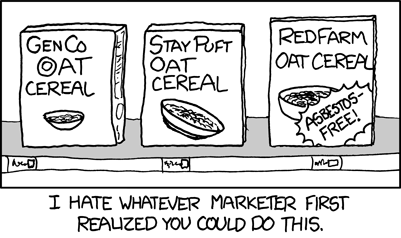
xkcd, "Free"
XKCD may hate it, but the law will allow it.

Plaintiff alleged that defendants misleadingly advertised their avocado oil by using a non-GMO label, because all avocado products are free from GMOs. The court found that reasonable consumers would not receive the message that other avocado oils had GMO ingredients from the label claims “non-GMO” and/or “non-GMO Project Verified.” The latter was literally true. “As a matter of law, the reasonable consumer and purchaser of the Products would understand that the Non-GMO Project Verified label means that the Products are certified by the Non-GMO Project,” and nothing more. The court agreed with defendants “that a reasonable consumer who cares about the GMO status of ingredients knows that there are no commercially available genetically engineered avocados, and if consumers had any questions about the Non-GMO Project’s certification standards, they would review those standards.”

Given that reasonable consumers are expected to know a fair amount about the world, “as a matter of law, the reasonable consumer of the Products would understand that only certain foods are available in both non-GMO and GMO forms, that certain ingredients—including avocado oil—are only available in a non-GMO form, and that avocado oil is a non-GMO alternative to canola or vegetable oils.” I think this is a lot to expect of reasonable consumers—a far better justification would be that reasonable consumers don’t think through the implications of a claim for other products unless they’re given more reason to do so than this. “Given this context, a reasonable consumer would not interpret the Products’ label to represent anything about whether other avocado oil products contain GMOs or the GMO-free status of commercially available avocados.”

Tuesday, October 21, 2025

Another "natural" claim proceeds for pet food labeled "natural + vitamins, minerals, and other nutrients”

Cobovic v. Mars Petcare US, Inc., --- F.Supp.3d ----, No. 24-CV-7730 (ARR) (JAM) (E.D.N.Y. Jun. 20, 2025)

Cobovic alleged that the use of the word “natural” on the front label pet food was false and misleading under NY law because the products actually contain “multiple synthetic ingredients.” True, the label includes the phrase “Plus Vitamins, Minerals and other nutrients,” but Cobovic alleged that a reasonable consumer would assume that the vitamins, minerals, and other nutrients are themselves “natural” rather than “synthetic.” She also alleged that “some of the synthetic ingredients in the Products,” such as xanthan gum, cannot be categorized as vitamins or minerals, such that the label is false either way.


The court read past cases to come to a consensus that “the relevance of the product’s ingredient list depends on whether or not the allegedly deceptive statement is considered ‘ambiguous.’” Where the plaintiff’s claim “turns on” the “unavoidable interpretation” of the statement in question, “the reasonable consumer is not expected to consult the ingredient list to ascertain the label’s meaning,” but ambiguity requires a reasonable consumer to consult the ingredient list “in order to clarify his or her understanding of the label.” “Consumers who interpret ambiguous statements in an unnatural or debatable manner do so unreasonably if an ingredient label would set them straight.”

Plaintiff satisfied that standard. Labelling a product that contains synthetic and/or artificial ingredients as “natural” may be false or misleading, and it need not state that the product is “all natural” or “100% natural” for a reasonable consumer to infer that the product is free from synthetic ingredients. Moreover, at this stage, defendants didn’t meaningfully contest the allegations that the products contain multiple synthetic ingredients.

Defendants did argue that the phrase “+ vitamins, minerals, and other nutrients” indicates that things that are not ingredients might not be natural, rending the label “true and accurate.” But, on the allegations, even assuming that the adjective “natural” does not modify the words “vitamins, minerals, and other nutrients,” at least one ingredient—xanthan gum—appeared to be neither “natural” nor a “vitamin, mineral, or other nutrient[ ].” Moreover, the ingredient list didn’t definitively resolve the grammatical ambiguity concerning the application of the adjective “natural.” The problem with consulting the ingredient list here was that it assumed that a reasonable consumer can identify which listed ingredients are natural and which are not. But that was not a factual assumption the court was willing to endorse, especially because many “naturally occurring forms of the same vitamins and minerals have similarly difficult-to-pronounce names.” A jury might ultimately conclude that the ingredient list would be intelligible to an ordinary shopper, and that “the appearance of ingredients that are obviously synthetic on [the Product’s] ingredient list undercuts plaintiff’s theory of deception,” but not on a motion to dismiss.


claims about scientific studies might imply FDA approval

BioGaia USA, LLC v. Probiotiv Naturals LLC, 2025 WL 2946910, No. CV 25-3592 PA (MBKx) (C.D. Cal. Sept. 5, 2025)

BioGaia sued Probiotiv – a competitor in the sale of priobiotic dietary supplements for oral health, for false advertising; Probiotiv counterclaimed for false advertising and the court declines to dismiss the counterclaim.

Probiotiv allged that BioGaia made unlawful health claims that BioGaia products “[d]efend against common dental issues,” provide “that good bacteria that your body needs to stay healthy every day,” and “promote healthy gums and teeth” that violate the Lanham Act. Priobiotiv further alleged that BioGaia’s claims that probiotics are backed by research and are clinically studied mislead consumers to believe that BioGaia products are effective like drugs, convey a false sense of scientific consensus and regulatory compliance, and mislead consumers to believe that the products provide the therapeutic benefits mentioned on the labels. Statements that its products are subject to clinical trials and longstanding research and trusted worldwide were allegedly likely to cause confusion and deceive consumers as to the scientific approval or endorsement of the products. [New category of endorsement confusion found!]

BioGaia argued FDCA preemption/preclusion. Although “the Fourth Circuit has held that false advertising claims based on allegations of implied governmental approval are not allowed absent an allegation that there was an explicit representation of government approval,” Mylan Lab’ys, Inc. v. Matkari, 7 F.3d 1130 (4th Cir. 1993), and many courts have followed it, courts have also recognized a false advertising claim based on a theory of implied government approval where it is adequately alleged that “the message ‘our product is FDA-approved’ was actually conveyed to consumers.” That just requires the court to be convinced of the plausibility of the plaintiff’s theory of deception, usually because of statements that are drug- or FDA-adjacent (e.g., references to “off-label” use or use of formularies/systems that are usually reserved for FDA-approved products).

Here, BioGaia’s use of phrases such as “clinically proven,” “most clinically studied,” and “backed by 30+ years probiotic research” allegedly conveyed a false sense of scientific consensus and regulatory compliance. That was more than implied governmental approval [from silence]. [That is, this court seems to read the preemption line as rejecting any theory that people assume that products are legally on the market, thus making their mere presence an implicit representation about legality. But people probably do assume this. I’m not sure why even that wouldn’t be enough if you proved the elements required for a Lanham Act violation (communication of a false/misleading message, materiality, harm) along with a clear enough FDCA violation. I understand the problems with predicting how the FDA would come out where it has discretion; that’s a decent reason for declining to find determinable falsity, but there are some pretty clear scenarios out there where a Lanham Act claim doesn’t require agency interpretation to determine falsity, or where the interpretation is statutory and thus the agency has no special expertise.]

Anyway, this also allowed a state-law false advertising claim to survive.

Friday, October 17, 2025

New Jersey would not recognize a common law tort of false advertising, says fed ct

Pim Brands, Inc. v. New Cibo Vita LLC, No. 25-cv-01418(MEF)(AME), 2025 WL 2938602 (D.N.J. Oct. 16, 2025)

The parties compete in the market for yogurt-covered fruit snacks, and the plaintiff alleged false advertising, including unfair competition claim under New Jersey common law. Here, the court rules that New Jersey does not recognize an unfair competition claim that is based, as here, only on an allegation of false advertising that is not comparative and does not involve passing off, and thus doesn’t assert interference with some property-type interest. (Also, in a footnote, unfair competition can include “antitrust-type claims” or “what amount to claims for tortious interference with contract”; query how an antitrust claim is an interference with the plaintiff’s property.)

The court characterized the tort as relatively new (late 19th century) in origin, but quickly assumed a definite shape: “The essence of the wrong in unfair competition consists in the sale of the goods of one manufacturer or vendor for those of another; and if defendant so conduct its business as not to palm off its goods as those of complainant, the action fails.” Howe Scale Co. of 1886 v. Wyckoff, Seamans & Benedict, 198 U.S. 118 (1905). Thus, the tort was about “palming off.” It protected consumers, but only indirectly and only by protecting a company’s “brand equity.” [Not a particularly contemporaneous term.] It differed from trademark by covering, e.g., “palming off of what we would today call service marks” and “palming off based on brand symbols that for one reason or another could not be formally registered as trademarks.”

But the tort stretched “a bit” to encompass INS v. AP misappropriation. They still shared the “core DNA” of being property-like. But “[i]f a company engages in false advertising—if it says something untrue about its own product—how is it potentially taking property from another company? … [L]osing out on possible future business is a long way from being deprived of here-and-now property (or quasi-property).”

Thus, a false advertising claim is not an unfair competition claim. American Washboard Co. v. Saginaw Manufacturing Co., 103 F. 281 (6th Cir. 1900), was the key case involving false advertising that a washboard was made with aluminum, rejecting a false advertising claim on the ground that “the private right of action in [unfair competition] cases is not based upon fraud or imposition upon the public, but is maintained solely for the protection of the property rights of a complainant.” Courts around the country “routinely stick to the line [American Washboard] drew.”

Thus, the court predicted that the New Jersey Supreme Court would hold that there can be no unfair competition claim based only on a false advertising theory, as the one relevant NJ appellate case had held. Tris Pharma, Inc. v. UCB Manufacturing, Inc., 2016 WL 4506129 (N.J. Super. Ct. App. Div. Aug. 29, 2016).

True, the Third Circuit stated in an infringement case, pre-Tris Pharma, that “the federal law of unfair competition under § 43 (a) [of the Lanham Act] is not significantly different from the New Jersey [common] law of unfair competition[.]” But that was only true with respect to passing off (and other things like the relevance of common-law agency principles).

Finally, the court noted, the Third Circuit has indicated that “where two competing yet sensible interpretations of state law exist, we should opt for the interpretation that restricts liability, rather than expands it, until the Supreme Court of [New Jersey] decides differently.” Travelers Indem. Co. v. Dammann & Co., Inc., 594 F.3d 238 (3d Cir. 2010) (cleaned up). [I’m not sure Chief Judge Becker of blessed memory would endorse this view—he thought of judging as the process of doing justice, and he was willing to evolve the common law towards that end.]


Conspicuous Consumers, NYU Engelberg Center

Welcome and Keynote: Nancy Mahon, SVP, Global Corporate Citizenship & Sustainability, The Estée Lauder Companies

Interesting talk; I learned that UK consumers respond well to claims that a product decreases the company’s carbon footprint, but US consumers aren’t interested in that and want to know about the effect on their own carbon footprint.

Sustainability in the Eye of the Beholder

Rochelle Dreyfuss, Engelberg Center on Innovation Law & Policy, NYU School of Law (moderator)

Anna Tischner, Jagiellonian University in Krakow: European TM law can override sustainability despite EU’s attempted commitment to carbon neutrality. Hermes won a case against an atelier that incorporated scarves into new clothes. But her research shows consumers understand that refurbished etc. goods have qualities not reflecting on the TM owner. Need more space for this. British case didn’t allow refurbishment to convert devices to electric, but only b/c the advertising was confusing—which is correctable, and thus perhaps a positive sign.

Maggie Chon, Seattle University School of Law: Discussed certification marks as ways to build consumer trust/purchase interest. Issues: standards represented by certification mark can be opaque; hard to figure out what they really require. Also, certifications can compete and have different standards—consumers aren’t equipped to figure out which “fair trade” marks are more stringent or less stringent.

Jessica Silbey, Boston University School of Law: Project w/Mark McKenna on interviews with designers: insist on design as a process, not an outcome; they want to unify form and function; and they consider themselves human-focused, oriented to solving problems. In the sustainability context, they want to act as moral entrepreneurs. Coherence, minimalism, sustainability, accessibility, and inclusivity are goals—coherence and minimalism seem aesthetic but they’re also about avoiding material waste. The last three are considerations they think necessary for good designs/progress: the ability for everyone to use the design. E.g., designing for an insulin pen that will actually be used (many people don’t take their meds). OXO dustpan designed to be used by all kinds of hands.

Aaron Perzanowski, University of Michigan Law School: Right to repair and sustainability—appliances, electronics, vehicles need fixing; can that be done outside authorized channels? Firms have strong incentives to assert control over repair process, which can be incredibly lucrative. Fixing cracked phone screens is $3 billion/year in US alone. Expensive repairs also drive new device purchases. 150 million mobile phones are discarded per year; 60 million metric tons of e-waste a year. About 70% of toxic waste in US landfills is e-waste. DMCA as a big problem; 1201 exemptions allow repair of, e.g., tractors, but no one is allowed to distribute a tool to others to do this, so farmers better be good programmers.

Patent law can also be an issue, as can individual component parts covered by utility or design patents, giving power over price and availability. Especially problematic given incredibly low standards for design patent—big uptick in auto parts as well as home appliances. Fed Cir did away with longstanding test for obviousness of design patents in GM v. LKQ; what that means in long term is not yet clear but could mean fewer low value design patents. Trade secrets are also an issue, but claimants can’t usually defend them—the info is generally ascertainable through simple reverse engineering. We don’t need to respect your wishes not to disclose info just b/c you’d make more money if you kept it to yourself.

TM too (already covered by other speakers). Biggest problem here is importation—exhaustion. But TM law prevents “material differences” and courts are much too eager to find such differences—a difference in warranty; existence of phone support (even for ball bearings). Nominative fair use does a good job in its lane, though.

So far we’ve passed right to repair laws covering 100 million people in US, including in California. Also worked on National Defense Authorization Act to get right to repair requirements in any purchase DoD makes.

Tischner: EU design law has a repair clause for spare parts. This allows independent manufacturers to make & sell parts that reproduce a protected design as long as it’s genuinely for repair. The real tension comes from TM law, not design law—the design law exception doesn’t apply horizontally across IP, so companies use TM to block repair and control markets. Surveyed professionals: saw logo on repair part as description of part, not indication of origin. TM law is also normative, but results of our and similar empirical studies should inform TM policy.

Q: do designers think about repair?

Silbey: They think about durability.

Perzanowski: there’s a tradeoff b/t durability and repairability, which we need to recognize and educate about. Sometimes the market recognizes this, as for cars. Not so much whether it’s designed for repair but who gets to do the repair there. Consider relatively direct regulatory intervention in design: mandating user-replaceable batteries on consumer electronics, for example. If Apple was required by law to make a swappable battery, it would probably do a really good job, but it won’t if it’s not forced to; we’ve already seen this work with USB-C.

The Consumer Scientist

Chris Morten, Engelberg Center on Innovation Law & Policy, NYU School of Law (moderator)

Fran Visco, National Breast Cancer Coalition: created a science education program for patient advocates: how to analyze clinical trials, interpret statistical information, understand the cell cycle—important for determining endpoints.

Hilary Koch, Advocate for people living with diabetes: continuous glucose monitors existed, but couldn’t be monitored remotely—advocates like Koch created an open source solution for this. Likewise, devices didn’t talk to each other; created open solution for that. Able to sleep through the night for the first time in 10 years! Huge improvement in diabetes management. Non-FDA approved device was better than anything on the market b/c patients came together to make it themselves. Everyone had to make it themselves (adding software to FDA-approved devices) to avoid FDA [and 1201?]. But someone was available to provide advice 24/7. Now there’s an FDA approved device to talk to other devices, and one reason is b/c of the earlier patient-based devices. Non-approved devices are also still out there and ahead of the FDA-approved devices thanks to patient scientists.

She also had a really interesting discussion of how each patient’s experience is different and they’re experts on their own experiences and need more control: women want information on how their menstrual cycles affect them and want to be able to press a button on their device to flag this; many hospitals don’t allow insulin pumps, but today’s insulin pumps take care of everything and this rule makes diabetics terrified to go into hospitals for other issues.

Steve Woloshin, Dartmouth Geisel School of Medicine: patients are often underrepresented in product design, testing, and regulatory approval. Communication with patients to understand what the products (tests, devices, drugs) do and how to use them is vital but it’s often an afterthought. DTC ads: oversight is spotty and they aren’t required to tell you how effective they are. Covid home test kits example: Although they did test the instructions, which was good, they didn’t test whether people understood what results they were getting—have to use Bayes’ law to understand the chance that you’re infected, given a positive or negative test result. It’s easy to get wrong and the instructions didn’t explain it at all. Empirical tests showed that 33% of people in a high risk group (symptoms, exposed to someone with determined covid) would not understand the risks of a negative result. Were able to reduce that to 14% with revised instructions, and to decrease unnecessary quarantine decisions. An untested communication can be as dangerous as an untested drug.

DTC ads: Billions of dollars spent on them; people see 9 drug ads/day. But they overstate benefits/downplay harms/overstate certainties. There’s a lot of opportunity to make ads better but the system is reactive/slow. FDA announced that it will revisit DTC ads. Dozens of warning letters about ads, largely b/c visual messages were allegedly misleading (take this drug and you’ll be able to climb mountains). Good start, but tip of iceberg. Basic problem: ads fail to tell consumers how well the drug works. Often unclear what outcomes the drug treats, or even conditions. Quantify the outcome! Same for common serious harms.

Current regs say you have to discuss benefit, but benefit just means indication under current rules—so if you say “decreases cholesterol” you’re done. But does that affect your chance of having a heart attack? Does it cut it in half from 2% to 1%? Something else? Nothing in current regs about quantifying benefits or harms; nothing about pretesting ads for accurate communication. Should have a drug facts box like a nutrition facts box.

Charles Duan, American University Washington College of Law: standard IP incentive theories don’t explain open source innovations here, which involve huge amounts of effort donated to the community. People who change their diets to improve their health are also experimenting on themselves—self-motivation is very important. Need to think about how to regulate open source devices, where there isn’t a wealthy drug company behind them.

IP Rights as a Signal to Consumers

Jeanne Fromer, Engelberg Center on Innovation Law & Policy, NYU School of Law (moderator)

Chris Cotropia, University of Richmond School of Law: Do patent claims matter to consumers? No, not really. There’s a false marking provision in patent law that seems to think that they might. Patent is more about communication between competitors/producers, less about consumers. Patent’s justification: Incentive for invention, and for commercialization. Get the new, useful, nonobvious thing created and produced. But can communicating to consumer create a direct feedback effect?

Notice statute: can’t get patent damages unless infringer has notice. Can be actual, or constructive by marking the patented product. The audience is not the consumer, but competitors. False marking statute, though, has consumers in mind—can’t mark product as patented or patent pending if that’s not true; initially empowered qui tam actions. Theory was a consumer oriented theory—that there was potential harm to the consumer. Lots of people engaged in false marking b/c they had, e.g., plastic molds; the patent would expire and they’d keep using the molds. Entrepreneurial lawyers started suing; then AIA changed the law to require competitive harm from the false marking. So, what information are consumers getting from the patent marking?

Study by Alexander Billy & Neel Sukhatme: convinced drugstores to let them enhance marking on actually patented products in some drugstores and not others; they found essentially a perfect null effect. Tried again on Mechanical Turk with vignettes and found the same null effect. Do find that “patented” label leads survey respondents to think that the product was more innovative; didn’t translate into willingness to buy. Another study, Gavin Milczarek-Desai & Derek E. Bambauer: showed ads, some said patented, patented pending, Consumer Reports supports, or nothing, and found no variation, but “patent pending” may have a slight effect on reported willingness to buy. His own study: crowdfunding campaigns. Found same (lack of) effect. Patent label didn’t change success right, but “patent pending” had higher success rate. In lab, people are 2x as likely to invest in a project that says “patent pending” as opposed to “patented” or nothing. Consumers are just looking at the products and deciding if they want to buy. Why might “patent pending” be different? Might seem even more innovative—haven’t even had time to get a patent yet! But we don’t know.

Jacob Noti-Victor, Cardozo Law: Copyright side—copyrights are also not strong signals to consumers. There may be a theory that the © next to a work confers legitimacy, but hasn’t seen empirical studies. Maybe video game industry achieved some legitimacy by using ©? But we do know that consumers don’t know what © means when they see it.

©’s human authorship requirement and effects of AI: enabled or even manufactured consumer-facing signals of things consumers do care about, such as authenticity. There’s no authorship for computer generated works as such—long tradition of not recognizing nonhuman authorship. Trickier when there’s a human and an AI system. Human prompting isn’t sufficient for human authorship, CO says, even with detailed prompt engineering/iterative prompting. Office based this on a reading of the law and the mechanics of the technology—there’s too attenuated a connection b/t the prompt and the final output; the prompter can’t predict or conceptualize the expressive output—there’s no requisite causation/connection b/t idea and expression. Like Chapman Kelly garden case where 7th Circuit says a garden is too unpredictable to be ©able. But there can be protection for human selection, coordination, and arrangement of AI products—curatorial decisions around AI content, not AI content itself; will be thin copyright.

Office’s choices here are coextensive with consumer preferences for process: preferences tied to the means of production and not solely to the output. Fair trade coffee. Consumers are more likely to want to buy non-AI work; this isn’t just squeamishness but ethical priorities and desire for authenticity that affects consumer decisionmaking especially in aesthetic contexts. Authenticity can have dark sides, but it’s also a way to acknowledge the social role of art and its role in moral identity/self-identification.

Office requires disclaimers of AI generated material. Registration potentially provides info to consumers. Could be a good record, assuming copyright claimants are telling the truth. But more can be done.

Mark McKenna, UCLA School of Law: Most obvious way IP rights might signal to consumers is by being a marketing tool: claimant advertises it has an IP right to show the product is meritorious or unique compared to other products, and that might work even w/o a clear idea of the content of the right. The patent evidence is interesting; maybe there’s an analogy here to how some colleges publicize percentage of faculty w/terminal degrees and others don’t feel the need to do so; maybe at the top end, producers assume you know they’re innovative (Apple) and don’t prioritize patents.

GIs: could also publicize the characteristic of a good as being (supposedly) geographically  unique.

What about feedback loops where existence of rights feeds back into scope of rights? TM: b/c those rights depend on consumer understanding, but consumer understanding can be shaped by their beliefs about what law allows/requires. The existence of rights depends on consumer understanding, b/c it determines whether there’s been trademark use, or secondary meaning to make it a TM; the scope of rights depends on consumers’ beliefs about what others are allowed to do. The rules on secondary meaning give a lot of weight by actions taken by putative owner to claim the existence of rights: creates incentives to publicize claims—the nature of putative mark’s presence in ads matters a lot. Matters even more when the claimed matter is complex; courts will often condition protection on “look for” advertising—to call it out from the background noise.

Claims of rights in relation to certain kinds of uses of TM can also shape consumer understandings in ways that turn out to affect legal scope. This is true at the retail level—particular uses of a particular mark, like NFL’s assertion of extremely broad rights in “Super Bowl” TM. Threatens bars, churches, community organizations that advertise they’ll (legally) show the Super Bowl. Even if there’s no suggestion of sponsorship other than the use of “Super Bowl.” These are paradigmatic nominative fair uses and shouldn’t be w/in the scope of the NFL’s rights, but the NFL has been unbelievably successful with these threats, so most references are to “the Big Game,” which itself is both cause and effect of consumer beliefs. But by the same logic, NFL can claim rights in “the Big Game.”

This effect can also work at the wholesale level—entire categories of uses like merchandising—50 years ago no one thought universities had the sole right to use university marks on T-shirts. Madison, like every other college town, was full of T-shirts featuring UW marks, some of which predated UW’s own use on t-shirts. But a major campaign branded these as counterfeits; leveraged relationship with university bookstores to control major apparel companies. Strategy seems to have worked; many people now believe the law requires university permission even though no one thinks the university is responsible for the quality of the t-shirts. PTO even made up the “secondary source” rule: use on the front of a T-shirt functions as a mark if the mark is known in some other setting. Created ©-like rights in anything related to them, justified by reference to the consumer understanding they’ve created. Can also be used for, e.g., mid-century modern design—association of design w/designer can be leveraged into “source” claims for the actual furniture.

Consumer understanding can be shaped, and some claimants are well situated to do so and have strong incentives to do it; but we shouldn’t hand over the game to claimants.

Rebecca Tushnet, Harvard Law School

I decided to frame my part of this panel as “can claims of IP rights mislead consumers in a way that triggers general advertising law?” I’m going to start with two requirements of false advertising law that don’t generally apply to IP rights. First, federal false advertising law targets only false or misleading statements in “commercial advertising or promotion.” This is probably not a big barrier for the kinds of claims at issue here, but it’s worth keeping in mind: use instructions, as discussed in the previous panel, might not be advertising (though it likely depends on the product). Second, materiality: to be actionable, a false or misleading statement has to be the kind of statement that is likely to affect consumers’ decisions, as opposed to TM law, which doesn’t require materiality for infringement.

As we already heard, materiality is often a problem in litigating alleged IP-related falsehoods, including false patent marking – most of the time, consumers don’t really care about patent rights. In addition, a Supreme Court case, Dastar v. Twentieth Century Fox, limited the scope of the federal Lanham Act in a way that turns out to be relevant to IP-related signals. That case interpreted the language barring any "false designation of origin, false or misleading description of fact, or false or misleading representation of fact, which ... is likely to cause confusion ... as to the origin ... of  goods" to mean only references to physical origin, rather than the source of ideas or expressions embodied in a product.

Lower courts have subsequently held that Dastar limits the scope of federal false advertising law b/c representations about IP rights aren’t representations about physical origin; thus, falsely stating or implying that your music is properly licensed does not constitute a false representation covered by the act. Courts also interpret many state consumer protection laws to be coextensive w/the Lanham Act, though it’s possible to argue that some are broader. There is also a limiting case where the representations are not just about IP rights but also state or imply facts about the physical product: Crocs, Inc. v. Effervescent, Inc., No. 2022-2160 (Fed. Cir. Oct. 3, 2024).

Crocs sued competitors for patent infringement; defendant Dawgs counterclaimed for false advertising about the characteristics of the primary material Crocs uses to make its footwear products, a material it promoted as the “patented,” “proprietary,” and “exclusive” “Croslite.” But “authorship, like licensing status, is not a nature, characteristic, or quality, as those terms are used in Section 43(a)(1)(B) of the Lanham Act.” By contrast, “here, the false claim that a product is patented does not stand alone. Dawgs presents allegations and evidence that the falsity of Crocs’ promotional statements is rooted in the nature, characteristics, or qualities of Crocs’ products.” So the question will generally be whether the statement about IP rights conveys a factual claim about the more tangible characteristics of the good (or service) at issue.

Finally, I want to introduce as an additional framing point that law, including product liability law, often doesn’t require TM licensors to take responsibility for their products even when consumers might expect that and even when the TM probably drove the sales—arguably false advertising should not accept this result. Example: Troncoso v. TGI Friday’s Inc., 2020 WL 3051020 (S.D.N.Y. Jun. 8, 2020)

Troncoso purchased a bag of snack chips labeled “TGI Fridays Potato Skins Snacks,” mistakenly believing the chips to contain real potato skins given that the restaurant chain TGI Fridays sells a Potato Skins appetizer that includes the flesh and peel of the potato. But, even though the TGIF branding is probably what led consumers to have a lot of their expectations about the product, and even though the court found that the product was plausibly deceptive, the trademark owner was off the hook. The court said: “TGIF may be liable for that misleading labeling under GBL §§ 349 and 350 and principles of common-law fraud only if it engaged in making the misleading labeling.” The allegation of licensing “does not suggest that TGIF was involved in any aspects of the labeling beyond its own trademark, which Plaintiff does not allege is misleading”

It’s an example of IP rights—the right to license the mark to others—as false signals. I’ll end with a potentially contrasting case: Puma v. Wal-Mart Stores East, LP, No. A-1-CA-38023, 2022 WL 3221810, -- P.3d – (N.M. Ct. App. Aug. 9, 2022) The Pumas alleged that defendants violated the New Mexico Unfair Practices Act based on their purchase of a Black & Decker-branded coffeemaker.

Based on Black & Decker’s reputation, the Pumas thought the coffeemaker would be better than the lower-priced store brand and paid more for it as a result. However, Black & Decker did not in fact design, manufacture, distribute, or warrant the coffeemaker. The district court, after a bench trial, found that defendants’ conduct constituted an “unfair or deceptive trade practice.”

Thus, the presence of the trademark plus the absence of any disclosure on the product or the advertising could deceive reasonable consumers about either (1) the relationship between Black & Decker and Applica; or (2) that the product was in fact a product of Applica, rather than of Black & Decker. The court pointed out that the name, “Black & Decker 12 Cup Programmable Coffeemaker” “emphasized that the ‘Black & Decker’ name was an important characteristic of the Coffeemaker; these statements tended to deceive a reasonable consumer, and Defendants knew or should have known that potential purchasers of the Coffeemaker would likely regard information about the Coffeemaker being a Black & Decker product as material.”

The court emphasized that it was not holding “that the use of a trademark by a licensee pursuant to a trademark licensing agreement by itself constitutes an unfair or deceptive trade practice,” or that individual or widespread licensing was “per se irrelevant” to the inquiry. Nor was evidence of the quality of the licensed product “per se irrelevant.” Rather, the court of appeals was simply holding that the Lanham Act did not govern the UPA claim, “and that, under the circumstances of this case, Defendants’ knowing and willful use of ambiguity as to material fact, which tended to deceive a reasonable consumer, constituted an unfair or deceptive trade practice.” I tend to believe we’d be better off if we held TM owners more clearly to their bargain—when they license in order to make a product more attractive, we should recognize that the TM is helping to sell the licensed product and thus hold them jointly liable for quality.

Monday, October 13, 2025

California's limits on use of "doctor" in healthcare settings are constitutional regulations of commercial speech

Palmer v. Bonta, 2025 WL 2882948, No. EDCV 23-1047 JGB (SPx) (C.D. Cal. Sept. 19, 2025)

Plaintiffs alleged that California Business and Professions Code § 2054(a), on its face and as enforced, violates the First Amendment because it provides, in relevant part:

[a]ny person who uses in any sign, business card, or letterhead, or, in an advertisement, the words “doctor” ..., the letters or prefix “Dr.,” ... or any other terms or letters indicating or implying that the person is a physician and surgeon ... without having at the time of so doing a valid, unrevoked, and unsuspended certificate as a physician and surgeon under this chapter, is guilty of a misdemeanor. No person shall use the words “doctor” or “physician,” the letters or prefix “Dr.,” ... or any other terms or letters indicating or implying that the person is a physician and surgeon ... in a health care setting that would lead a reasonable patient to determine that person is a licensed “M.D.” or “D.O.”

The Board of Registered Nursing supported this law only if it allowed nurses with a terminal degree (i.e., Doctor of Nursing Practice) to use “Dr.” “regardless of setting” so long as they indicated their profession or specialty on their badge and in communication. Bonta, on behalf of the Board of Registered Nursing, filed an Accusation against Erny, who is a Doctor of Nursing Practice (DNP), for “representing to patients that she was a medical doctor” in violation of Section 2054; the District Attorney for San Luis Obispo County then sought an injunction, civil penalties, and other equitable relief against her. She was ordered to pay $19,750 in civil penalties.

Plaintiff Palmer also holds a DNP. Between 2020, when she earned her DNP, and 2023, Palmer (1) wore a clinician’s jacket embroidered with “Dr. J. Palmer, FNP-C”; (2) introduced herself to patients, “I’m Dr. Jacqueline Palmer. I’m a nurse practitioner”; (3) signed her name on official clinic documents using the title “Dr.” and “FNP” as a post-nominal; and (4) was not aware that it was illegal to use the title “Dr.” on her clinician’s jacket or in any other way so long as she disclosed that she was a nurse practitioner. Palmer always disclosed to patients that she is a nurse practitioner and never practiced outside of her scope of practice for licensure.

Nonetheless, patients have assumed that Palmer was a medical doctor. The American Medical Association’s survey results that show that 39% of patients believe that a DNP is a physician.

After learning about the legal actions against Erny, Palmer stopped wearing her clinician’s jacket, stopped signing official clinic documents using the title “Dr.,” and asked others not to refer to her as “Dr.” She would like to return to her previous practices. Other plaintiffs had similar stories.

There is nothing that a nurse practitioner that has a DNP can do that a nurse practitioner that does not have a DNP cannot. DNP programs range from one to two years; they can be online with no in-person classes; they don’t have stringent admission requirements; they may not have, and plaintiffs’ programs didn’t have, courses in, e.g., anatomy, biology, biochemistry, immunology, physiology, pathology, or pharmacology; so too for clinical work with patients/patient interaction.

One plaintiff testified that he believed that he would attract more patients to his aesthetic clinic if he can call himself “Dr. Hanson” as opposed to not using the title “doctor,” because “[i]f patients were given the opportunity to pick between two clinics, one with Dr. Hanson and one with Mr. Hanson written on it, most would gravitate to the former.” Plaintiffs didn’t know whether patients know what the letters DNP, PHN, MSN, MASE, BSPT, or FNP-C mean (all relevant terms for credentialing) and largely didn’t know the terms until they sought more credentials.

Plaintiffs argued that Section 2054 is a content-and speaker-based restriction on speech, and thus subject to strict scrutiny. The court rejected this argument.

Facial challenge: Plaintiffs argued that the law “sweeps in its ambit an array of professionals who are not physicians or surgeons but who still can truthfully (and regularly) call themselves ‘Dr.’: psychologists (PsyD), pharmacists (PharmD), naturopaths (ND), physical therapists (DPT), and Ph.Ds (including honorary Ph.Ds).” In a First Amendment facial challenge, “[t]he question is whether a substantial number of the law’s applications are unconstitutional, judged in relation to the statute’s plainly legitimate sweep.”

“The first step in the proper facial analysis is to assess the state laws’ scope.” “What activities, by what actors, do the laws prohibit or otherwise regulate?” The second step “is to decide which of the laws’ applications violate the First Amendment, and to measure them against the rest.” The party bringing the First Amendment facial challenge has the burden to show the full scope of the law’s coverage; to identify which of the law’s applications are constitutionally permissible and which are not; and, ultimately, to show that the law “prohibits a substantial amount of protected speech relative to its plainly legitimate sweep.”

The California Court of Appeals has found that the “purpose of [S]ection [2054] is to protect the public,” specifically by regulating the use of certain professional titles associated with the medical field—i.e., “Dr.” and “doctor”—in healthcare-related advertising and healthcare settings. The court found this was a regulation of commercial speech. The “use of professional titles and certifications in advertising, yellow-pages listings, business cards, and stationery is commercial speech.”

Plaintiffs argued the law expanded into noncommercial space by adding the phrase “in a healthcare setting that would lead a reasonable patient to determine that person is a licensed ‘M.D.’ or ‘D.O.’ ” Because the patient is already seeking out care from plaintiffs by the time they use “Dr.” or “doctor” in a healthcare setting, they argued that they were engaged in noncommercial speech and that any commercial speech was inextricably intertwined with fully protected speech.

Although using “doctor” in a healthcare setting wasn’t a traditional ad format, it was still commercial speech: The “specific product” plaintiffs sought to advertise when using “Dr.” or “doctor” in healthcare settings was “the expertise, knowledge, and quality of services these professional titles convey to patients and colleagues.” And they had an economic motive for the speech: “to solicit [and retain] a patient base” and improve their professional brand.

The facial challenge failed because the law regulated misleading speech, and even if it went beyond that, was ok under Central Hudson.

As-applied challenge: The Supreme Court has distinguished between “inherently misleading” speech and “potentially misleading” speech. When “advertising is inherently likely to deceive or where the record indicates that a particular form or method of advertising has in fact been deceptive,” the advertising enjoys no First Amendment protection. The government may ban this type of commercial speech entirely. But if the speech is only “potentially misleading,” in other words, “if the information also may be presented in a way that is not deceptive,” Central Hudson (intermediate) scrutiny is required.

But here, the record indicated that plaintiffs’ particular form or method of advertising has “in fact been deceptive.”  It was undisputed that patients assumed Palmer was a medical doctor and that plaintiff Hanson makes it a point to explain to patients that he is not a physician when they call him “Dr.” Thus, the speech was inherently misleading even though it communicates truthful information. Plaintiffs conceded as much by agreeing that the use of “Dr.” or “doctor” in healthcare settings without further clarification generally refers to licensed physicians or surgeons. Accordingly, “[t]he assumption that substantial numbers of potential clients would be so misled is hardly a speculative one.”

California not only regulates the title “doctor,” it regulates the licensing and practice of physicians and surgeons. Plaintiffs didn’t meet these statutory requirements, and thus their use of “Dr.” or “doctor” was inherently misleading.

Even if it was only potentially misleading, the regulation would still satisfy Central Hudson in advertising and healthcare settings. California has a substantial interest in “protecting consumers from those who falsely hold themselves out as licensed physicians but [who] have not been duly licensed.” What about the fit between the legislature’s ends and the means it chose?

Plaintiffs argued that “at least as applied to nurse practitioners with DNPs, [who truthfully refer to themselves as “Dr.” or “doctor,”] [S]ection 2054[ ] does not directly advance Defendants’ only stated interest because it does not prevent fraudulent misrepresentations.”

Under Central Hudson, “the State must demonstrate that the challenged regulation advances the Government’s interest in a direct and material way,” which requires it to show “that the harms it recites are real and that its restrictions will in fact alleviate them to a material degree.” Empirical data, studies, anecdotes (whether in-state or extra-jurisdictional), history, consensus, and common sense are all relevant. Here, the “harms [California] recites are real” because the speech has caused some patient confusion. And it was reasonable to infer that some consumers will assume that Plaintiffs are licensed physicians or surgeons if they use “Dr.” or “doctor” in healthcare settings and in advertising materials promoting medical services even if Plaintiffs also identify themselves as DNPs, as borne out by the AMA survey showing 39% of patients believe that a DNP is a physician and plaintiffs’ own ignorance of what the letters DNP meant until they started pursuing higher education.

What about less restrictive alternatives? Plaintiffs argued that they were already required to disclose and explain their license and credentials, and California’s false advertising and unfair business practices laws already address concerns about patient deception. However, “[i]n considering the restriction imposed on commercial speech, [courts] do not require that it be the least restrictive means available.” Rather, what is required is “a reasonable fit between the legislature’s ends and the means chosen to accomplish those ends.”

Here, Section 2054 didn’t limit plaintiffs’ ability to describe themselves as DNPs or to otherwise accurately state their credentials. So there was a reasonable fit.

Tuesday, October 07, 2025

court allows false advertising claim based on manipulation of Amazon's "variation" system

Corsair Gaming, Inc. v. Choice Electronics Inc., 2025 WL 2822691, No. 5:25-cv-00045-BLF (N.D. Cal. Oct. 3, 2025)

Corsair sued Choice for alleged infringement by selling used, unauthorized, or counterfeit Corsair computer/gaming products. This opinion deals with Choice’s counterclaims. The false advertising part of those counterclaims rests on Amazon’s “variation” system.

The court declined to dismiss counterclaims for declaratory judgment of noninfringement and cancellation of Corsair’s mark for naked licensing. Although use by a related company (here, a different Corsair entity than the owner of record) counts as use, the allegations here were that the entity that used the mark wasn’t supervised at all by the owner of record and thus didn’t qualify as “related.” The Lanham Act specifically defines “related company” as “any person whose use of a mark is controlled by the owner of the mark with respect to the nature and quality of the goods or services on or in connection with which the mark is used.”

False advertising: Vendors and third-party sellers can create “variation” relationships between substantially similar products that differ only in specific, narrow ways. Such products will appear on the same product detail page, with each variation, e.g., color, size, or count, selectable. Because of variations’ close similarity, the product detail page displays the total number of ratings and the average star rating for all products in a given variation relationship. Amazon’s  “variation policy” prohibits vendors from grouping together fundamentally different products within the same variation relationship.

Choice alleged that Corsair “knowingly manipulates Amazon listings in order to show inflated and unwarranted reviews for its products by misleadingly listing new products as ‘variations’ of pre-existing products, instead of creating new listings for new products,” causing consumers to be “deceived and confused into believing that Corsair Products have amassed significant amounts of positive reviews and high ratings, when, in fact, such reviews and ratings merely relate to a prior product.” The court agreed that this stated a claim.

First, Choice plausibly alleged competitive harm enough to satisfy both Article III and the Lanham Act. And, even assuming that Rule 9(b) applied, the counterclaims adequately pled with specificity how Corsair allegedly created a variation relationship between three different computer monitors despite substantial technological differences. Choice wasn’t required under Rule 9(b) to catalogue every single instance in which Corsair improperly created a variation listing.

Related state law claims also survived, except for counterclaims about the Corsair warranty, which was allegedly misleading to consumers but not causally connected to harm to Choice. The warranty allegedly was unenforceable under state law precluding sales-channel restrictions on warranties, but allegedly misled consumers by creating the false impression that Corsair Products purchased through Choice’s Amazon storefront were not subject to the same protections and thus “discouraged and dissuaded consumers from purchasing genuine Corsair Products from Choice Electronics.” But these allegations were “conclusory and wholly speculative.” [Could a survey have fixed this?] Similarly, Choice couldn’t sue based on the alleged legal violation under an “unlawfulness” theory under California or New York law because it lacked sufficient injury.


Monday, October 06, 2025

court rejects affiliation confusion theory for lack of harm, declines to order tarps over P's goods

Survitec Survival Prods., Inc. v. Fire Protection Service, Inc., 2025 WL 2782332, No. H-21-312 (S.D. Tex. Sept. 30, 2025)

This case demonstrates exactly why harm to the plaintiff should be explicitly a part of a trademark case that relies on extended theories of confusion (that is, non-source confusion). It shows in great detail why any theoretical confusion about affiliation would have been completely irrelevant to both parties’ customers—which is why they make assumptions/don’t bother to think about the issue.

The court introduces the case:

Survitec Group Ltd. is the parent of a large group of corporate entities, including some that make maritime survival equipment, such as life rafts. Fire Protection Service, Inc. sells and services this kind of equipment. Beginning in the 1970s, Fire Protection and some Survitec entities operated under an oral agreement allowing Fire Protection to use Survitec-entity trademarks, trade names, and brand names and to serve as a dealer and servicer of Survitec-branded products. Survitec Group Ltd. terminated that agreement in 2017 after it acquired a Houston company that serviced life rafts and could compete with Fire Protection and similar companies in the Houston area.

Survitec here alleged that Fire Protection continued to use its trademarks without authorization, in violation of Texas and Louisiana law and the Lanham Act. After a bench trial, the court found that Survitec failed to prove its claims. [There are a lot of trademarks, I assume because of a private equity rollup trying to decrease competition in the field, but it turns out their specific identities don't matter.]

Survitec’s termination letters demanded that Fire Protection “cease using all trademarks, trade names and brand names of Survitec and its group companies,” with each notice listing a different, but overlapping, group of trademarks. “The letters did not prohibit Fire Protection from accepting Survitec-branded life rafts needing service or repairs and sending the rafts to a certified third party to do the work. Nor did the letters require Fire Protection to inform customers that it was outsourcing service and repair work to certified third parties.”

To service life rafts, both the U.S. Coast Guard and the equipment manufacturer—in this case, a Survitec entity—must certify the servicing technician. The certifications of two Fire Protection technicians were set to end the same month that Survitec Group Ltd. sent the termination letters, but Survitec Group Ltd. extended their certifications through the December 2017 termination date and immediately terminated the certifications of a third technician.

Fire Protection tried to sell its inventory of Survitec-branded products during the pre-termination period, including working to facilitate the repurchase of that inventory by a Survitec entity whose standard practice is to repurchase leftover inventory from terminated dealers. But the Survitec delayed in doing so, including by waiting until December 2018 to issue Fire Protection a return authorization. Because of that delay, and because Survitec’s termination letters forbade Fire Protection from selling its Survitec-branded inventory to third parties after the termination date, some of the inventory expired.

The parties agreed that under the first-sale doctrine, Fire Protection could resell genuine Survitec goods that Fire Protection had purchased before the termination. Thus, Survitec’s actions and inactions prevented Fire Protection from recovering the value of that inventory.

After the termination, Survitec entities filled orders from Fire Protection for the resale of safety equipment other than life rafts, such as personal flotation devices and worked with Fire Protection to service life rafts for the entities’ customers. Those Survitec entities serviced life rafts for some of Fire Protection’s customers. And Fire Protection serviced some third-party-branded life rafts for Survitec when, for example, customers had rafts that were subject to an exclusive servicing arrangement with Fire Protection.  

“After its termination as a licensed Survitec dealer, Fire Protection continued to assist customers who needed Survitec-branded life rafts serviced by subcontracting the servicing work to certified third-party servicers…. Fire Protection would accept orders to service customers’ life rafts; outsource the service work to a certified subcontractor; and return the life raft to the customer with an invoice that included all the work.” Sometimes, Fire Protection notified its customers that it was no longer a Survitec-authorized service station and that it was outsourcing the service work on the customers’ rafts.

Fire Protection used a brochure and line sheet that it used at trade shows and posted to its website before the termination that included some Survitec logos among over fifty brands for which Fire Protection offers some good or service, which it removed when a Survitec representative notified Fire Protection that they were still accessible online. Fire Protection also continued to use its pre-termination stock of printed brochures at trade shows after termination, until it ran out of brochures sometime in 2020. It also displayed lists of domestic and international products that it sells; Fire Protection updated its website in January 2021 to remove two remaining references.

brochure

website listing

In addition, the U.S. Coast Guard continued to list Fire Protection as an authorized servicer of Survitec-branded products after the termination. But the website included a disclaimer stating that the Coast Guard is not liable for “any reliance on its [website’s] accuracy, completeness, or timeliness.” No party told the Coast Guard to update its website until Fire Protection did so in April 2023.

Coast Guard listing

In addition, when Fire Protection shipped customers’ rafts to authorized service stations, the Survitec marks were on the life rafts, and Fire Protection’s name was on the transporting vehicles. And when Fire Protection’s subcontractors returned the Survitec-branded life rafts after servicing them, the certificates that were required by federal regulations included the Survitec entities’ marks as the manufacturer. Regulations required both identification of the manufacturer and of the facility that had serviced the life raft.

There was no evidence that any of these uses caused harm or confusion that affected Survitec’s goodwill. Two witnesses testified that they thought Fire Protection was still an authorized service station after the termination, but didn’t convince the court that Fire Protection’s limited use of the Survitec marks caused any economic or other harm to the plaintiffs.

One witness testified that her former employer used Fire Protection to service its Survitec-branded life rafts; that she did not know that Fire Protection outsourced the servicing work; and that she assumed Fire Protection serviced the life rafts itself because federal regulations require the manufacturer’s certification to service life rafts. The court gave this (paid) testimony little weight, since she didn’t testify that Fire Protection’s use of the plaintiffs’ marks confused her; rather, she testified that she simply assumed Fire Protection was an authorized service dealer doing the service work itself because it accepted a request to service Survitec-branded life rafts. A rare and welcome intervention of causation reasoning in a trademark case!

Her assumption that there would be no outsourcing was unreasonable, as subcontracting is a normal part of the industry. In addition, as part of her job, she reviewed certificates of servicing, which identify the entity that serviced a life raft, including the certificates that Fire Protection returned, which showed outsourcing on Survitec-branded rafts to an authorized, third-party service provider. She had no complaints about the quality of Fire Protection’s work or the price it charged. After she left her company, Fire Protection told employees that it had to outsource some of their requests for life-raft servicing, and the employees continued to use Fire Protection to service the company’s rafts. Thus, Fire Protection did not retain the company as a customer by failing to disclose that it subcontracted the servicing of Survitec-branded life rafts. (The theory here is really a false advertising theory.)

The other witness testified similarly, though he said that, if he had known that Fire Protection outsourced the life-raft servicing, he might have sought another service provider. But he lacked personal knowledge of the transactions with Fire Protection, and he did not testify that Fire Protection’s limited use of the plaintiffs’ marks caused his assumption that Fire Protection was doing the service work itself. He also testified that Fire Protection told one of his technicians that it had to ship their rafts to a different facility for servicing. The possibility of outsourcing its life-raft servicing did not cause him to look for other service providers with no complaint about the quality or price.

Indeed, Fire Protection was the only local service station in Corpus Christi, and ships often face a short period between docking and their next voyage, creating the need for “tried-and-true service providers that can service or repair life rafts in a short timeframe.” Further, “many customers’ vessels often have life rafts and other safety equipment from multiple manufacturers and are unlikely to use multiple service providers to avoid outsourcing service work on life rafts from a single manufacturer.” Thus, there was simply no causal link between use of Survitec’s marks and Fire Protection’s sales, or any damage to Survitec. (The court also noted that, even had some customers stopped using Fire Protection if they knew that Fire Protection was subcontracting its servicing work on Survitec-branded rafts, there was no credible evidence that those customers would have chosen a Survitec-owned service station to do the work. In non-TM fields, this could be an Article III standing problem.)

Nor was there any evidence of damage to the plaintiffs’ brand image or goodwill from the conduct at issue—the plaintiffs conceded that Fire Protection could subcontract the work, just argued that Fire Protection should have disclosed it. The court found no legal basis to conclude “that Fire Protection infringed Survitec’s trademark by accepting work on Survitec-branded rafts without disclosing to customers that it was not an authorized service station.”

Survitec’s harm theory was that the failure to disclose might give customers the impression that Survitec-branded rafts are expensive. But there was no supporting evidence; “Fire Protection delivered its customers a quality service at a price they paid without any evidence of complaints.”

Legal conclusions: Some of plaintiffs’ claims failed because Fire Protection did not use the marks in commerce. Specifically, marks used on the Coast Guard website weren’t use in commerce under trademark law. The plaintiffs cannot state a claim for Fire Protection’s miscellaneous uses of their marks. Use on a government website related to “regulatory approval,” not to the sale of goods or services. “The Coast Guard does not accept payment for listing information on its website, does not accept payment for individuals’ use of its website, and does not contain advertising or links to other commercial websites. The presence of a mark on that website is not actionable, commercial use.”

It was also not actionable to ship life rafts and resell servicing certificates because of first sale. It was inevitable that Survitec’s marks would be used in reselling its products. Also:

Plaintiffs’ counsel later suggested that, to avoid infringement, Fire Protection should have draped tarp over Survitec-branded life rafts that Fire Protection picked up from a ship and drove to a servicing facility in a truck bearing Fire Protection’s name. Plaintiffs’ counsel argued that the rafts had to be covered to avoid suggesting to onlookers that Fire Protection had manufacturer and Coast Guard authorization to service Survitec-branded rafts. This argument presents an absurdity that the first-sale doctrine is supposed to prevent.

“In the absence of any credible evidence of confusion or harm supporting the plaintiffs’ theory of infringement based on Fire Protection’s transporting Survitec-branded rafts from ships to servicing facilities, the court ‘decline[s] to expand the reach of’ trademark protections.”

So too with Fire Protection’s use of plaintiffs’ marks on servicing certificates that it returns to customers along with their serviced life rafts. The servicing certificates are “valid and authentic documents, created by life-raft manufacturers, including the plaintiffs, and sold to authorized service stations. Federal regulations require their use and prescribe their content and form.” Thus, the use of these certificates wasn’t commercial use, and also subject to first-sale.

There was some potential for confusion about whether Fire Protection was authorized to perform service work on Survitec-branded rafts after Survitec had terminated that authorization.

The court started with the multifactor test, though it’s not really suitable for affiliation confusion. It recognized this problem by reasoning that nominative fair use and first sale “inform the likelihood-of-confusion analysis.” Thus, Fire Protection would not be liable for using the plaintiffs’ marks on its website or in its brochure if doing so merely identifies the goods or services it offers. “Fire Protection infringes the plaintiffs’ trademarks, however, if its advertisements suggest that it is selling specific goods or services with the plaintiffs’ endorsement.”

But the website, brochure, and line sheet weren’t likely to cause a consumer to believe that the plaintiffs have an association with, or endorse, Fire Protection. The court noted that the line sheet put plaintiffs’ marks among about 50 others, offered both sales and services, and also touted that Fire Protection is the only manufacturer-authorized Viking service station in Texas. Likewise, the website includes a long list of manufacturer names (without logos) whose goods Fire Protection sells.

These types of “crowded, list-based advertisements, with no other special indication of affiliation,” are the kind as to which no reasonable jury could find affiliation confusion. Even with the special feature that, because of federal regulation, a representation that Fire Protection services, as opposed to merely sells, Survitec-branded rafts comes with a consumer expectation that the service station has technicians certified by the manufacturer, “[a] consumer is unlikely to believe that Fire Protection has technicians certified by over fifty brands.” Few service stations are certified by more than a handful of manufacturers. And the express statement that it was a Viking-authorized service station “create[ed] the inference that it was not manufacturer-authorized to service other brands.”

Plaintiffs’ failure to provide evidence of actual confusion confirmed this finding. Their confusion witnesses “testified only that they thought Fire Protection was affiliated with the plaintiffs because it accepted their requests to service Survitec-branded life rafts, not because of Fire Protection’s use of the plaintiffs’ marks. This is not evidence of confusion; it is evidence that some consumers made faulty, and unwarranted, assumptions that Fire Protection was not subcontracting the servicing of some life rafts.” The relevant misrepresentation has to come from the defendant, not from some other source, including an assumption that a seller of legitimate goods is an authorized dealer or repair shop. “An erroneous and unreasonable consumer assumption is not actionable infringement. The fact that this is the strongest evidence of confusion that the plaintiffs introduced at trial generates an additional inference against finding a likelihood of confusion.”

There was one exception—page 7 of the brochure indicated that Fire Protection was authorized to service some of Survitech’s brands.  This was likely to lead consumers to believe that the parties were affiliated, because only service stations with technicians certified by manufacturers can service that manufacturer’s life rafts. [For what it’s worth, I don’t even think that’s true, if “affiliation” is read in its ordinary legal meaning—I’m not “affiliated” with the place I got my driver’s license; I’m a graduate of various schools, but hardly an affiliate of most of them.]

Page 7 claiming to service some Survitec brands

But this “technical” infringement didn’t entitle them to actual or statutory damages. There was no proof of monetary harm, as required for actual damages.  As discussed above, Fire Protection neither gained nor retained customers because those customers thought Fire Protection was authorized to service Survitec-branded life rafts. Thus, Fire Protection was not unjustly enriched by its misrepresentation.

Also, kind of hilariously,

complicating the plaintiffs’ proof of injury is the fact that Fire Protection used Survitec entities as subcontractors. If Fire Protection had lost its customers, the plaintiffs could have lost the customers that Fire Protection had referred to it. Third-party service stations could have captured a greater proportion of the business that left Fire Protection. In other words, Fire Protection’s subcontracting may have helped, rather than hurt, the plaintiffs’ business.

Thus, the court could find neither actual damages nor unjust profits from the infringement.

Survitec had another theory: Fire Protection damaged their goodwill by accepting servicing work for the plaintiffs’ branded life rafts, outsourcing that work, and increasing the prices the customers paid to cover the prices that the third-party servicers charged Fire Protection for the servicing work. This would allegedly cause consumers to believe that Survitec-branded rafts are more expensive. [Wouldn’t it more plausibly prompt you to find a cheaper servicer?]

The record undermined the theory: there was no evidence that Fire Protection charged more than other raft-servicing establishments for similar work, whether done in-house or outsourced; no one complained about the price; and the record suggested that plaintiffs’ goodwill and reputation were not particularly price-sensitive. In particular, Survitec didn’t control the price that its authorized service stations charge their customers or the profit margin the service stations may generate from servicing. “If the plaintiffs were concerned about associating their brand with high prices, they could have contracted to limit the prices that the authorized service stations could charge. There is no record evidence that they did so.” As to Fire Protection allegedly encouraging customers to switch to Viking by raising prices on Survitec, “an authorized service station could, without infringing on the plaintiffs’ marks or violating any other obligation to the plaintiffs, raise the servicing prices on Survitec-branded rafts to influence customers to select other brands. Generally, switching customers from one brand to another is not improper business behavior; the law favors competition among manufacturers selling different brands of the same type of product.’”

Ultimately, the plaintiffs didn’t tie their damages theory to their theory of trademark infringement.

What about counterfeiting and statutory damages? The marks/uses remaining in the case didn’t qualify. Two marks were unregistered; one was registered, but not for the services at issue, only for the underlying life rafts.

Dilution: Ugh.  Survitec argued that Fire Protection’s failure to disclose to customers that it was subcontracting the service work on Survitec-branded rafts gave customers the impression that Survitec-branded rafts were expensive.

First, there was no federal fame. Slightly misstating the law, the court says that marks must be both registered and famous, not just distinct, so the unregistered marks couldn’t qualify. Even for the registered marks, they introduced no proof that those marks were “famous,” that is, “widely recognized by the general consuming public of the United States.”

Texas dilution: there was no proof of tarnishment via Fire Protection’s acceptance of requests to service Survitec-branded rafts or Fire Protection’s outsourcing of that work. The fact that the plaintiffs did not control the prices that authorized service stations could charge also weighed against any finding that Fire Protection charged prices that tarnished the plaintiffs’ reputation.

False designation of origin/reverse passing off (because the subcontractor provided the services): The traditional concern in a reverse-passing-off case is that the actor “misrepresent[s] the relative capabilities or accomplishments of the parties, thus creating the likelihood of a future diversion of trade to the actor.” Thus liability attaches “only if the actual producer can establish both the fact of a misrepresentation and a likelihood of harm to its commercial relations.”

Most of the Survitec entities lacked standing, only the ones Fire Protection used as a subcontractor and whose servicing work Fire Protection allegedly passed off as its own. Plus, there was no proof of passing off. “The case law does not recognize an affirmative duty on the part of a seller to disclose the identity of the manufacturer or producer of goods offered for sale; liability is imposed only on the basis of an express or implied misrepresentation that the goods have been produced by the actor or a third person.” Fire Protection hadn’t been shown to represent to customers that it did the servicing work on Survitec-branded life rafts in-house. Whatever witnesses assumed, Fire Protection always provided its customers with the servicing certificates that clearly identified the entities that serviced the Survitec-branded rafts. Customers are required by regulation to maintain these certificates, which customers review “to ensure that they show that the life rafts are properly serviced and to log the date of inspection so that the life raft is serviced again at the proper time.” Because the service station name and number are conspicuously next to the date of inspection, a Fire Protection customer “would immediately know that a subcontractor—in this example, Donovan Marine—serviced the rafts.”

certification example


big Survitec stamp on document provided to customer

Finally, the plaintiffs didn’t show harm.  In a subcontracting situation, there is a stronger presumption that the subcontractor “implicitly consented to sales under the seller’s trade name or trademark.” The plaintiffs didn’t try to protect its commercial interests through contractual arrangements with Fire Protection. They sent to Fire Protection and its customers certificates that identify Survitec Survival Products, with special stamps to clearly mark that a Survitec entity serviced the raft:

No reverse passing off.

False advertising:

The market for life raft services had multiple players, so there was no presumption of damage from false comparative advertising. And there was no evidence of harm from Fire Protection’s failure to change its brochure after the termination to remove the statement that it was an authorized service station, nor of unjust enrichment to Fire Protection. Plaintiffs’ damages expert provided no causation analysis.