Thursday, August 11, 2016

IPSC breakout session II

IPSC Breakout Session II: Trademarks, Advertising & Consumers

Relying on Reputation
Jim Gibson

Reputation: what rational consumers would use to decide what products/services to buy. We shouldn’t expect that info to be widely available to consumers w/o some help, and yet the law assumes that the market for reputation works enough to rely on it.

Public goods problem: each of us has our own reputational experiences w/firms. We can generally rely on it but it’s anecdotal: we want aggregate information.  My review externalizes my benefit but without reward, so we’d expect underproduction. Reputational aggregators can help. But their interests may not be aligned with consumers’; no movie has ever had less than 3 stars on Fandango, and Yelp sells its services to businesses rather than to consumers. 

IP rights: find a party interested in creating/disseminating the good & give them exclusive control. The firm: They don’t have the externalities problem b/c they internalize benefits of buying.  But the firm’s interest is in creating positive/bottom-line maximizing info, not accurate representations of quality, price etc.  Consumers are manipulated into believing untrue things simply through repetition. If a firm tells consumers that its coffee isn’t bitter, that affects consumer perception even though consumers know the info comes from self-interested firm.

Courts think that info about firms will solve problems with boilerplate contracts.  Reputational constraints as keeping firms from enforcing onerous terms. If reputation doesn’t work that well, reliance is misplaced.

TM law: core infringement dovetails well w/reputation approach, but expansions don’t—dilution by tarnishment; lack of control over assignments/licensing; ways in which mark itself is viewed as having a reputational value qua reputation as opposed to something that provides accurate information.

Defamation: Really about the truth, not about reputation. I can destroy reputation by revealing the truth.  Bill Cosby: invested a lot in reputation as America’s dad, which has since been destroyed. Defamation has it right.

RT: Many people enjoy providing reviews/perceive it as a positive.  Why isn’t that enough? Do those people who enjoy providing reviews differ in some systematic way from those who don’t?

A: Spite is a powerful motivator; what about good experiences?  There’s probably a relatively low level of crowdsourcing that’s necessary; eBay is probably a really good reputational system b/c it’s costless to share.  People are more attentive to recent ratings than aggregate ratings.  It may not be enough.

Lisa Ramsey: there are fake comments; sometimes there are verified reviews.  I also look for number of comments/negative comments.  It’s so easy to comment now.  [I think this is a matter of leveraging reciprocity norms; Ramsey mentions guilt.]  I feel good when I reply to surveys about performance—I’m performing a public service.

A: True, but that feedback often just goes to the firm—helpful, but not fully solving the problem.

Michael Madison:  Doesn’t buy the tragedy of the commons framing. There are all sorts of info problems, including overproduction, reciprocity problems (seller worried about giving poor rating out of fear of getting poor rating), asymmetry, information that is out of date (right to be forgotten), etc. Account for what’s going on in the world by adding more of the complexities.  Push back on reputational information as a “good.”  [Arrow’s information paradox.] As if there were a simple definition of what that means; as if there is a natural social interest in “accurate” reputation as opposed to collection of opinions.  Precisely because we have all these mechanisms to share opinion, how much of that is the right amount is a contestable thing. As you frame this question, which is an important one, you need more dimensions to the model to capture some of the looseness and fluidity of what’s going on rather than treating reputation as a species of good that was produced by manufacturing.

Going Native: Can Consumers Recognize Native Advertising? Do They Care?
David Hyman & David Franklyn

A couple of small empirical studies and armchair empiricism; lots of regulatory interest.  Lots of argument by invective (John Oliver) and blanket denials and media angst. Regular ads as control; native ads as treatment.  If consumers don’t do a good job ID’ing them, can we change the disclosures to improve that?  What do labels even mean to consumers? 

Online survey of 1000 respondents, who saw 18 images/2 videos. We tested things like Forbes content by Fidelity aka “ForbesBrandVoice” which doesn’t have “paid,” “ad,” or “sponsored.” The Onion also has paid content: Woman Going to Take Quick Break After Filling Out Name, Address on Tax Forms: small “sponsored,” actually for H&R Block.  NYT’s Netflix article w/very tiny “paid ad,” and Atlantic’s native ad for Scientology that looks exactly like Atlantic article except for “sponsored content.”

Respondents do much worse identifying native ads than regular ads.  Native: 37% thought it was paid content.  Regular: 81% ads.  49% thought native ads were unpaid v. 12% for non-native; remainder unsure.

What if we tweak the label?  In-your-face “paid ad” bar across the Fidelity ad: those who saw “paid ad” went to 56% understanding from 40%, suggesting that modifications to labeling can make a difference, though still well short of understanding for regular ads.

Finally, asked whether respondents thought each label was paid, unpaid, don’t know.  Paid ad/paid content/this content was paid for by/paid post/ad all did better than 80%; sponsored did 79%, sponsored content and sponsored post 76%; brand voice/brand publisher/presented by in the 60s and partnered content/partner was at 57%. Written by: 23%.  So many labels are bad and the diversity is not helping anything.

Limitations: representativeness of our ads?  Of our sample population? Used reputable organization but replication should be tried.  Validity of our approach: we threw out people who went through too quickly or didn’t answer our attention question, but this isn’t in the wild, and we’re open to alternative methodologies if they exist.

Consumers do much worse at identifying native ads than “regular” ads, regardless of brand, platform, architecture, and labeling.  If they’re trying to hide the fact that they’re running ads, mission accomplished.  Evidence of two-way blurring; even modest tweaks materially improve recognition; does any of this rise to the level of deception?

RT: two-way blurring?

A: if you give people unpaid editorial content, a material number think it’s actually paid, 35%.  A little variation across examples.  From consumer protection perspective, that’s not something the FTC would much care about.

Barton Beebe: will consumers develop sophistication about this?  People have learned about movie sponsorship.  [armchair empiricism?]

A: Possible, but the variability is much higher.  Movie = single thing that people see together, but native ads have huge variation and narrowcasting.  Harder to police given speed of emergence.

Lisa Ramsey: 4% of people thought it was unpaid when it said paid—are there certain kinds of people who are making that mistake?

A: people who participate are over 18, relatively good cross-section of community.  Disconcerting that people don’t always recognize “paid ad” as ad, but that’s how people are—they don’t look at labels.

McKenna: consistent w/TM surveys!

Laura Heymann: what would deception mean here?

A: FTC says: you don’t have to prove actual deception; the more you blur the lines, the easier FTC enforcement action would be. We did ask whose content you think this is, advertiser or platform or both—w/native ads, pretty substantial #s thought it represented both the advertiser’s viewpoint and the platform’s, though that’s not the same as deception.

Q: wide variety of examples—they may involve different relations between the platform and the sponsor. Sometimes the content was written by the platform but paid for by someone else v. written by advertiser and posted on the platform. Does that make a difference?

A: A lot of the media companies have set up in-house operations for native ad campaigns to be sold to advertisers.  We don’t see a difference based on that issue in people’s perceptions.  The development of in-house units probably increases the likelihood of deception b/c they can frame the content to be exactly like the publication they’re working for.

Naming and (Re)Claiming
Laura Heymann

What makes something a name and how much do audiences assume that a name has connotative and denotative functions?  The meaning of a name comes from the public. You can announce your name as whatever you like, but it’s not unless a sufficient number of people adopt it for you, even if you use it. Same for a TM—recognition of a mark as a mark/name is what gives it existence. Richard Craswell’s great article on sports nicknames—crowdsourced. Research on prison nicknames: bestowed upon people, not given to themselves.  Inherent in this process is recognition that a lexical unit is functioning as a referent and not as a description. 

Referring: repetition and reinforcement.  If meaning of a term becomes fixed, is it apt to say that a name has truth value?  We don’t expect a man named “Rich” to be wealthy; we recognize that as his name.  A “rigid designator”: our beliefs about qualities of subject aren’t relevant to the referential process. It doesn’t matter if someone loses a limb; they’re still the same person with the same name; so too if it turns out they plagiarized a paper. TM embodies that in some way—TM doesn’t require TM owner to surrender TM if it changes ingredients, suppliers, employees who make the product.

If names are rigid designators, we might return to In re Tam and ask whether a name can offend or disparage, qua name.  A word can do so when used to describe others, and research on slurs would say that a slur is offensive b/c it is uttered by a person toward another person, not necessarily the word itself. This is Tam’s entire point: the ability to reclaim a word means that whether that word has communicative/truth value depends on the identity of the speaker.  One reason offered by court to refuse to approve a name change was b/c of speech burden imposed on others who’d have to use the name in exchanges w/others.  This is a strategy employed by Starbucks customers in reverse: give name as “black lives matter” so barista will have to say that out loud.

Slurs convey expressive content: conveying attitude of speaker.  The idea of reclaiming is to deprive the word of meaning and transform it into a rigid designator, same as when McDonald’s reclaims MickeyD’s.  Are names truth?  Pursuing America’s Greatness v. FEC: can independent political committees use candidates’ names in the names of their committees or projects?  DC Circuit finds that’s content based discrimination, and it’s not enough to be able to use the candidate’s name in the content of the project/webpage.  That’s what she’s interested in—what do we mean when we say that something functions as a name? Are they sometimes true, never true, etc.?  Bands named “Cheap Girls” w/no women performing in them: is that deceptive? Is it a signal?  Would the Slants be disparaging or not depending on the ethnicity of its members?

Relevant doctrines: When we allow TM to reemerge from genericity: Singer, Best Buy (once it argued in court that the phrase was generic!); public use doctrine allowing TM owner control over a term that the public uses to identify the TM owner but the TM owner doesn’t; abandonment; §2(a) bar on deceptive marks.  ORGANIK for clothing not made from organic fibers: if people use that to tell what the clothing is made of, then they’re seeing it as informational device and not as a rigid identifier and therefore it isn’t functioning as a TM should.

Madison: how much do you need to invest in framework of rigid identifiers, partly b/c there’s an enormous literature around that.  Tam case may be too rich; what about the dispute over the ownership of “Stephen Colbert,” the “character” from CC’s “The Colbert Report.”   Captures the themes you’re talking about w/o triggering disparagement concerns.

A: two different things embodied in the same person! 

Q: Whose perspective are we taking? What happens if they intend it as a name, and it’s understood as a name by some people and not by others.

Ramsey: slogans can be identifiers, but they don’t have to be.  How do you think about them?  “Make America Great Again” is not the same as “Trump.”  Also, Lee et al.’s paper on how context is key—you don’t know if a name is a mark until you see how it’s presented.

A: there has to be an initial moment associating the name with the thing; they don’t exist in the abstract.

[Still marshalling thoughts about this. I think the answer is often that a TM can be a rigid identifier and convey lots of information, including w/Best Buy and ORGANIK—in fact, the aim of creating a rigid identifier may often be to convince consumers that certain characteristics are embedded in the product being sold no matter what the facts are, the ingredients are, etc.  That’s why TM owners like descriptive marks; that’s why VIAGRA invokes vigor, Niagara, etc. Thus, making a binary may not be hugely helpful.]

Why Does Trademark Law Protect the Strong More Than the Weak?
Barton Beebe & Scott Hemphill

Strength, scope, and competition in TM law: Not a purely original argument—we’ve all been thinking this forever, but people haven’t systematically presented this basic argument except in a Judge Rich opinion in 1988, suppressed by J. Rader very quickly thereafter.

Standard view: there’s a positive relation b/t strength and scope. This is wrong, at least in part.  Rationale for standard model: strong marks are more easily activated in consumer’s mind; consumers will infer that junior use originates in senior user; infringers can be assumed to target stronger marks; consumers approach more famous marks with less consumer care—just asserted by Fed. Cir.

Assuming identical marks, a product dimension (x), and a percentage of consumers confused (y), a curve describes consumers likely to be confused by use on competing goods, related goods, or even unrelated goods.  Consumer population is diverse.  Maximum acceptable percentage of consumer gives us the scope of the right at issue.  Increased strength of a mark may push up the curve and broaden the scope of the mark, but the standard model assumes the shape of the curve remains the same as it’s pushed up.

Now assume identical products, a mark dimension (z), and percentage of consumers confused (y), same thing.  A 3D distribution will describe the proportion of consumers likely to be  confused by junior use of mark identical, similar, or dissimilar to senior mark on identical, similar, or dissimilar goods.

Standard model assumes that increased strength increases likely confusion and increases scope of mark. Other assumptions: The relation between strength and confusion/scope is always positive—except in the limited cases of reverse confusion and, controversially, parody.  Strength operates the same way in identical mark, different goods cases as it does in different mark, same good cases.  Case law under either situation is interchangeable. Inherent/acquired strength operate in the same way, and cases about inherently distinctive marks can be cited in cases about secondary meaning.

Judge Rich: BVD v. Body Action Design (Fed. Cir. 1988): BVD v. B.A.D. for men’s undergarments. The fame of a mark cuts both ways. Better known it is, the more readily the public becomes aware of even a small difference. BVD would trigger the observer to notice at once that BAD, with or without periods, is a different symbol.  See also Jiffy v. Jordan (CCPA 1973) (Rich, J., dissenting). A few other cases have made similar observations.  A few articles also question the correctness of the claim, but Jerre Swann defends it.

Kenner Parker Toys v. Rose Art (Fed. Cir. 1992) (Rader, J.) Play-Doh v. FUNDOUGH for toy modeling compounds.  TTAB applied BVD and dismissed opposition.  Rader says: free riding justifies the positive relation—competitors want to snuggle as close as possible to a famous mark. Fame could never be a liability in TM—while scholars might debate as a factual proposition whether fame heightens or dulls the public’s awareness of variances in marks, the legal proposition is beyond debate.  If investors forfeit legal protection by increasing fame, the law would then countenance a disincentive for investments in TM.

But we can solve this problem: begin w/assumption that TM’s guiding purpose is to promote competition; consumer protection is underneath. Free rider justification isn’t persuasive w/r/t continuously positive relation b/t strength and scope/confusion. Identical marks, there is a positive relationship b/t strength and scope/confusion. But for similar marks, competing products, there is a local maximum.  The 3D distribution may rise, but also changes shape. Proportion of consumers confused may increase, but scope of protection narrows.  Follows a fortiori that superstrong marks would also be less protected for similar marks, similar products and similar marks, dissimilar products.

Heymann: does sponsorship/affiliation confusion complicate this?  E.g., Boy Scouts and Peewee Scouts.

Beebe: Best I can do for now is to fall back on the idea of TM as both prescriptive and descriptive; can prescribe a condition in which consumers learn.  It may be that the association challenge is devastating for some things, but similar marks/similar products and similar marks/dissimilar products might be different b/c of consumer understandings about famous brands. If you saw something like the Apple logo on a very low-end tech product, you might reject the idea that it came from Apple.

McKenna: This isn’t really an empirical rule, but modern doctrine’s obsession w/confusion requires it to pretend that it is.  Your argument at the end seemed nonempirical. You need to clarify: is this empirical? If so: Look at brand extension literature.  Also: when you talk about similarity, note that people have hard time w/specificity of visual marks but may do better on word marks.  [Though there is also a huge difference b/t production and recognition worth thinking about, since it’s recognition that TM law is generally concerned w/.]  Then if it’s empirical, think hard about different forms of confusion.

Branded
Irina Manta

TM provides important incentivizing functions that make it more like © or patent than conventionally assumed, and we should care about that. Traditional story: TM are instrument of commerce, protected under Commerce Clause, not incentive for creation/innovation.  TM as red-headed stepchild of IP family.  Three traditional functions: source identification, advertising, and quality guarantee.  Neglected incentivizing functions: creation of original marks; hedonic benefits of loving TMs; socially desirable behavior [work hard so you can afford your Louboutins, or at least your Nikes].  [This is like claiming that securities law exists to encourage people to work hard and make more money.  It has a level of generality problem, among others. Also query whether all incentives to work hard and make more money, if those are the same thing, are socially desirable; see, e.g., drug money, Wall Street finance, Donald Trump.]

Expansion of TM law over time beyond source confusion to affiliation confusion, dilution, initial interest confusion, post-sale confusion.

TM as creations: often the most valuable asset of a business, e.g., Starbucks.  [Deven Desai would say this is conflating a TM with a brand.]  Companies invest $ in infusing brands w/a personality: SoulCycle isn’t just a name, it’s a lifestyle, also Harley Davidson.  [Though note that these lifestyles are usually shared w/ other brands as well—they’re not creative/unique even if it takes intelligence, luck, and even creativity to come to “symbolize” that lifestyle.  Or you could just be like PBR and be adopted by hipsters for a time.] Takes on life of its own.  TMs can be included in art exhibits.

TMs as hedonic goods: experience of goods = happiness, just as via © or patent. TMs are inherent parts of products; there is no defensible distinction b/t “real” and “artificial” experiences of marks.  [Though the research on body image etc. suggests that people who spend a lot of time thinking about their presentation to the world end up unhappier and also poorer off in other ways, so I’m not sure that conclusion holds here even if it might re: your perception of a car’s value.]

TMs as socially desirable behavior incentives: People use branded goods as self-rewards; I can have Starbucks b/c I did such a good job today. Possible correlation in US b/t working longer hours and desire for brand consumption. Use of branded goods to overcome bias and achieve community status—anti-aristocratic b/c you can become more equal by wearing certain things or appearing a certain way.  Wearing a nice suit to interviews.  [A branded suit? Tressie McMillan Cottom has a great essay about this, but TMs don’t seem to be required.]

These incentivizing functions have increased in importance over time. This brings TM closer to copyright and patent, and needs to be considered in making policy.

Gibson: what implications are there for TM scope?  If we had a law that focused on source confusion and not dilution etc., would people not find alternative hedonic pleasures/ways to reward themselves for working hard?

A: given the state of the empirical data, it would be speculative to say. Doesn’t know whether we need dilution to get those things. This is the law we have.  Not necessarily enforced strongly, but might still provide a deterrent. There are also 1A implications w/dilution. But we can’t divorce TM law from other social policy as others have done, where we pretend that only confusion is at issue.

Madison: Timing of the shift in case law in relation to this?

Manta: thinking about how we could measure brand development—going from TM as boring, traditional function to powerful.   Measuring strength of marketing, penetration of advertising.

McKenna: circularity: you say we have to account for how people interact socially w/brands, but that’s the result at least in part of how the law has treated brands.  Even if we wanted to preserve hedonic value, consumers would likely find it somewhere else, and if we don’t know that, the policy payoff is unclear.  Also, there are other people who get hedonic value from access to brands, or access to similar brands; if we do a whole hedonic calculus we have to consider them too. If we want to consider incentives to work hard, TM would not be the place to start—tax, education policy would be more appropriate.

Manta: yes, utilitarianism is hard, but we have to start somewhere. This matters too.  Hedonic value of access to brands, knockoffs—but there are also people who don’t care much about brands.  [?]  In this room, we probably chose our jobs b/c we cared less about money than making partner, but others chose differently.  Some criticisms of dilution have disregarded these incentives, and have assumed that brands are just about false needs.

Ramsey: even if the empirical research shows that people are doing what you say, should we care? The costs of dilution protection are also higher—protecting these values has different tradeoffs than protecting against confusion over source.


Manta: there haven’t been economic discussions about dilution’s harm/benefits.  It’s all highly theoretical, speculative.  I don’t know which way it cuts, but that doesn’t mean it’s not a real effect. Skeptical that dilution has had more than a marginal impact on speech.

IPSC Breakout Session I

IPSC Breakout Session I: Copyright: Music & Remixes

Assessing France’s Graduated Response Scheme Against Piracy & State Interventionism in the Marketplace for Copyrighted Content
Nicholas Jondet

Strong philosophical attachment to ©, and economic interests—Universal Music is French-owned.  In practice, low fines and no convictions despite misdemeanor status of infringement and possible 3-year sentence and €30,000 possible penalties.  2006: wide consensus for adapting criminal provisions. Proposal of €150 fines for uploading and €38 for downloading. Struck down by constitutional court: infringement is the same whether it’s offline or online.  2007: review of system, which recommended a graduated response adminstered by a dedicated body b/c private parties on their own couldn’t deal with mass piracy.

Constitutional council said that proposals didn’t fit the French human rights framework, notably the 1789 Declaration on Human Rights, requiring balance of copyright and freedom of expression; disconnection must be done by courts.  Two phases.  Authority sends warning; access to internet isn’t absolute but penalty must be imposed by court.  Internet user has duty to secure network against use for infringement.  Hadopi: 2010.

2012: Hollande was elected; his party wanted to get rid of Hadopi.  But he personally was more circumspect.  Tension in independent administration from the start: the carrot and the stick.  Budget was large, but decreased and went up last year to €8.5 million.

If you’re a rightsholder, you collect info and notify Hadopi. 5 million first warnings sent; 500,000 second warnings and 3,000 third warnings.  Last year there were 1.6 million first warnings sent.  2221 deliberations about referring a case to the courts. 361 cases brought to courts. Courts assess the infringer; 51 decisions reported back to Hadopi. Fines between €50-1,000. Copyright societies think the courts are too lenient. One disconnection reported so far.

A lot of studies about whether it works.  Hadopi argues that it doesn’t have enough funding to fulfill its mission.  There’s a database of legal French services done by Hadopi—making it easier for people to find content.

Justin Hughes: detection is the responsibility of a rightsholder.  Data collection has to be approved by the relevant authority, as opposed to what happens elsewhere.

Annemarie Bridy: we use the Copyright Alert system in the US, though it’s not producing any reports or information.  They’re renegotiating the MOU.  Talk about relative benefits of gov’t system?

A: public scrutiny.  The fact that you have an authority in charge of checking that privacy is respected helps w/due process and ability to appeal.  Real issue w/French system is costliness for taxpayer.  The rightsholders should/could put money into the system.


Copyrightability of Digital Remixes and the Right of Remixers
Yahong Li

Remix as a general condition of culture; digital remix brings back Read-Write culture, as argued by Lessig. Musical remixes as prominent examples: Grey Album, Mix the City, Girl Talk.  Legal reality: protection has been strengthened for copyright owners, ISPs, mainstream social media, but remixers and creators fall into a legal vacuum, potentially oppressed both by ISPs and by copyright owners.  Peter Menell: mashup as defining genre, but uncertain contours of copyright pushed this underground and stunted its development, depriving artists of compensation and further alienating netizens from © as a system. Recent cases not just in US; many remixes in Soundcloud were taken down.  Righthaven trolling; FUD in uncertainty of remix.  Andy Baio: “the chilling effect is palpably real.” 

Legislative developments: Canada, UGC exception for noncommercial remix.  UK: new fair dealing exceptions didn’t include UGC; other countries have rejected/not mentioned. US Green Paper says still needs exploring. Questions: is fair use enough? Predictable v. unpredictable. Is it a defense or a positive right?  Does the P have to rebut the defense or does the D have to prove the four factors?

Q: what rights does a downstream remixer have?

A: Right included in copyright.

Q: does the legal culture affect whether uncertainty is good or bad for production?  Or is it more about whether the producers are noncommercial producers?  Compare to dojinshi in Japan.  There, it’s a huge commercial business, in essentially open conflict with formal Japanese law, but there are very few legal conflicts. Why, and can it be exported?

Q: what about eliminating the possibility of injunctive relief?

The New Problem with Music
Peter DiCola

Spotify: huge net losses. The more they make, the more they lose. Partly owned by © owners. What’s going on?  “Why Tech is Eating the Music Industry,” from Digital Music News.  Apple, Alphabet, Microsoft, Amazon, have bigger market cap than ExxonMobil; FB is just behind. Compared to 2006, when it was just Microsoft at the top.  Amazon is about to jump into streaming; like Google & Apple, has deep pockets and doesn’t actually need the music side to be profitable. Music as an add-in to Amazon Prime increases customer loyalty; if they move the needle on retention of a few percentage points, that’s worth billions to Amazon.  The other piece is that music services have special data about us.  Wal-Mart was the biggest music seller before the internet; cheap prices on music got people into the stores.  Music now is not about its own value, but about keeping people on platforms and collecting data about them. Think about how customer data has changed in the new music industry.  Think about changes in the broader context.  Music industry used to require a lot of trains and trucks shipping; big box retailers made music stores smaller part of business and music stores concentrated into chains; labels had little customer data other than record clubs.  In 2000s and 2010s, consolidated into major labels while unauthorized copying exploded. Retail inventory becomes enormous, stable, and generally always growing. Interaction w/customer data—digital retailers have data; shipping is no longer a problem. 

Steve Albini, The Problem w/Music, 1993, the Baffler: recording engineer on Nirvana’s last album; also band members. Net income from a year on a major label contract: $4,031.25.  Today, he thinks Spotify and streaming are great. He says: We never made any money from selling records; now I can reach fans worldwide and support touring and other ways musicians make money.  What could contracts look like in industrial organization terms? Hard to imagine © owners having leverage; not just largeness, but large user base: you have to be on YT, even Taylor Swift agrees.  Hard to imagine Amazon agreeing to give music companies a cut of lawnmower sales, even if data from music helps shape the pitch Amazon gives for the lawnmower.  So downward pressure can be expected to increase. Customer data: could they negotiate for access to who’s buying?  Could © require this?  Raises serious substantive privacy questions, and questions about ©/privacy overlap.

Q: South Korea: Samsung launched “Milk,” w/every phone sold.  Free music service, but rightsholders and fans objected—if people become used to getting free music, then no one will want to pay for it.  Samsung withdrew the music service.

RT: How does this interact w/§512 and the industry’s complaints that YT drives down prices?

A: Everything structural is going against the music industry. Consumer surplus is huge; music fans are saving $100s per year w/access.  So that’s why you have to go look at the development of industry; makes §512’s configuration less pressing/solving the last problem.  Changing §512 is not going to solve these problems.

Q: is Tidal working?

A: No. $19.99 initial price point; market says no, that’s not the price point for music.  Consumers aren’t yet interested in higher quality.  Hard to get consumers to care about artist-owned services, and part of that is that artists make it hard for audiophiles to buy the highest quality FLAC; it’s so much easier to use Spotify.

Annemarie Bridy: Tussle b/t Spotify and Apple re: antitrust w/r/t in-app purchases.  So interesting to watch evolution of exclusivity/fragmentation in availability of content, attempts to differentiate v. antitrust.

A: may need to formally model incentives of people to be in and out of exclusive deals.  What contracts we should expect is a really interesting question; also affected by DoJ ruling on ASCAP.  There are people in the industry who think Spotify can’t survive on its own b/c it doesn’t make any money.

Q: Is Albini saying that artists’ interests are more aligned w/intermediaries than w/labels at this point b/c intermediaries aren’t acting as bottlenecks?

A: Yes, but the one point is the data—if you want to tour, you want to know where you’re popular.

Who Killed the Radio Star? How Music Blanket Licenses Distort the Production of
Creative Content
Ariel Katz & Eden Sarid

Cultural production in radio’s Golden Age: mix of music and talk, mostly talk. In-house production, mainly live.  Mid-50s/60s shift in content to much more music, less talk.  Less quality in talk that remained. Music is prerecorded; content is outsourced, not live/commissioned by radio stations.  Explanations: television; other tech changes; social and cultural changes (video killed the radio star).

Alternative explanation: music is crucial to radio; broadcasters get blanket licenses to perform music from CROs. Conventional wisdom: CROs produce efficient reduction of transaction costs; but raise concerns about lack of competition, market power.  Our point: blanket licenses also distort cultural production, artificially diverting resources away from other cultural products and to music. Where marginal price of playing another song is zero, you play more songs and have less talk.  Unless you’re a publicly funded radio station that need not behave according to pure economic rationality.

But why only after the mid-1950s?  Sound recordings aren’t fit for broadcasting yet; broadcasting is live and all content has to be performed in the studio. The cost advantage of blanket license is less pronounced.

RT: these last two papers have a dialogue about the effects of “all you can eat” both on intermediaries and end users.  Increased social value overall, decreased value to individual input.  Both papers also have a dialogue about placing music within the context of other economic outputs, and the effects of that on what look like internal doctrinal and market issues.  Glynn Lunney’s work is also of note here.  Question: Commercial radio: what’s the role of diversity/niches such as Rush Limbaugh?  Role of product differentiation, as discussed in plenary?  There is an incentive to capture the non-music fans somehow.  Maybe people are satisfying their talk needs with the internet and PBS Newshour.  Also: When you say distortion, you might be asked: compared to what? What would the world look like without CROs? 

A: We could do without them, and so we should be mindful of what they actually do.  Talk radio: may need public funding to produce it.

Hughes: Not clear that there’s any evidence this increases or decreases users’ utility.  Would pay per play be a better system? We could certainly do that, and that might distort less than a blanket license, but that’s only true if the people negotiating a blanket license don’t know much about the radio station, which they do.  I negotiate a blanket license = I know a lot about their users and how much music they play; it actually represents something closer to pay for play than you seem to assume.  “All you can eat” can be predictable if you know who you’re feeding and you’ve been doing it a while.  [nicely said]

A: compare to situation w/o CMOs.  That doesn’t mean pay for every play necessarily; that could be inefficient.  Sony might bundle all its music. 

Hughes: recorded music, not blanket licenses, might be the cause.  Session performers were driven out by recorded music—would have to be really high price before it would justify live music.

A: true, it’s a combination.

How Law Defines Music
Joseph Fishman

Law has focused on melody.  Blurred Lines case: lawyers and music professors agreed that it’s only been melody.  Musicologists saw a sea change b/c all that’s been protected before is melody.  ?uestlove says there was no plagiarism b/c the melody different. But recent cases, not just Blurred Lines, have adopted a more multidimensional view of what counts.  Until about a decade ago, the commentators would have been right.  How did we get here? Older view was in tension w/what other genres went through, where any aspect could in theory be the basis of a © claim. If what we want is theoretical purity, then the trajectory is good; healthy outcomes for music, however, would return to the old focus on melody. The reasons for rejecting melody only were good ones but we end up with a suboptimal, unpredictable, overly broad law as the result.

Commentators in the West used to think melody was the most important, influential part of a musical work. Music publisher rearranged serious opera into light dance music; court rejected defense of fair abridgement b/c melody was that in which the whole meritorious part of the invention consists.  Thus, it wasn’t an abridgement, in reality.  But melody’s dominance is not true of lots of music today, from jazz to pop music.  Producers are paid lots to contribute elements long before melody enters.

Traditional justification is weak, so we shouldn’t be surprised by Blurred Lines type cases in which courts don’t feel bound to dismiss claims notwithstanding the absence of melodic copying.  Other recent cases: New Old Music Gp. v. Gottwald (SDNY 2015)—purely about percussion.  BMS Entm’t v. Bridges (SDNY 2005)—case about reuse of phrase “like that.”  Court says original selection and arrangement is enough: jury question for total concept and feel.  Blurred Lines fits both these templates.  Each individual element isn’t de minimis isn’t a matter of law. Not as much of an outlier as sometimes portrayed. If there’s a trend, where do we go?

There is a better, doctrinally neglected reason to focus on melody: would make infringement assessment more predictable. Music is relatively modular. It’s often possible for composers to break off a discrete chunk called melody and focus on that as the thing to avoid copying. You don’t have to play the impossible game of divining a similarity index with elements of unknowable weights, from melody to orchestration to percussion to timbre etc.  Good for downstream creativity.  This rule would be an improvement b/c it cabins the inquiry. Only problem is that ex ante predictability as a policy lever for substantial similarity has never gotten much traction, though it’s been tried.

Shyam Balganesh: take a look at Mark Rose’s new book, Authors in Court, w/behind the scenes study of case in which the attempt was tried.  The plaintiff’s atty had written a treatise on breaking down works.

Hughes: is this shift b/c of the rise of recorded music and the fading of the score into the background?  You said in the paper jazz musicians understood this melody rule about ©, but I don’t think that’s true.

A: Mark Osteen studied bebop in 50s and 60s and said it; have to go back and check his sources.  Popular legal consciousness: not terribly nuanced, but understood that melody = lawsuit but borrowing arrangement would not.

Andrew Gilden: wouldn’t this make it easier for famous artists to take from nonfamous artists?

A: why asymmetry?  Would make it just as easy for relatively unknown artists to copy nonmelodic stuff. 


Pam Samuelson: writing was pretty much the melody prior to 1976, so that history might support your thesis.  Might not be bad idea to go back and bolster the argument around the 1976 Act by looking at what the cases were focused on at that time. One question: is music different now than it was at the time these issues were being decided by Congress?  

IPSC First Plenary Session

Scarcity of Attention in a World without IP
Jake Linford

We impose artificial scarcity so authors can pick up sunk costs. But costs of creation have fallen; perhaps © should be narrowed as a result.  Wrinkle: attention scarcity. Cheaper dissemination = information gluts.  Imposes costs on consumers.  The scarce resource today is attention.  People compete for attention by riffing on cultural artifacts.  Some of the competition is zero sum.  Internet time has shifted 2008-2013, from chat and news sites to social media and video. 

Trademark is a way of dealing w/scarce attention, but © is different.  Music played in restaurants: it draws in consumers.  Attracting attention w/© expression so they can charge you.  [Is attracting customers for food the same thing as attracting attention?]

If we had less copyright protection [compared to what?], then what?  Perhaps: Less entry; less glut.  Narrower protectionàlower expression costs, lower costs of creating around, lower barriers to entry from building off of existing ©.  Retain protectionàmore costs of inventing around.  Less creative/distinct entry. Things that are more similar.  Abramowicz/Yoo have talked about this as rent dissipation/product differentiation: more resources dissipated racing to capture first mover advantage.

Fishman’s work: ©  may impose useful restraint on entry.  [I have written a response to Fishman here.] Constraints on type of creativity: sonnet constrains output more than free verse, which can make work more creative/better by several metrics.  George Lucas wanted to do a Flash Gordon remake; he couldn’t get permission so he gave us Star Wars—wouldn’t have been the same cultural phenomenon.  [Because reboots of existing franchises, like Batman, never become cultural phenomena!]  Reducing © protection is therefore premature.

Mark Lemley: If you think we’re creating too much derivative stuff, ok, but challenges premise that attention scarcity causes that. Attention scarcity = difficulty sorting is the theory, but people have worried about disintermediation for a long time, and crowdsourcing is at least as good and maybe better than expert selection in allowing us to find good/bad. If 20 people make a derivative Star Wars movie, but the crowd is good at finding the right one.

Linford: if the crowd tells us the first Star Wars movie is good, 20 people rush to follow, and Lucas has to rush out his sequel.  There is also intermediation via FB, Google, and Spotify, and maybe they’re not sorting in our interests. [But that is not the same thing at all as causing an overload problem.] We’re not getting the full picture. [We never were.]

Q: why allow the public domain then?  Pride and Prejudice and Zombies.

Linford: that’s a strong form of the argument—doing something with a work that I don’t like is wrong b/c I have a strong connection to the argument. Different question about length v. breadth while in place. People share that intuition, but the evidence isn’t strong enough.

Betsy Rosenblatt: we live in a world with trends.  The solution is that people tire of sameness. Doesn’t seem to be a need to do anything other than let the trend run out.

Linford: The more you narrow ©, the more similar the horror movies are.

Rosenblatt: Why is that bad?

Linford: negative quality.  Bigger rush to move sequels through the process. What we really want is new takes on the trend, and © provides some discipline to make things at the margin more different than they would be.  [This is not what the literary scholars think.  See David Roh’s book.  More production around a type by people trying to work with what audiences liked about the original is how you get the kind of variation that creates whole new genres and subgenres.  Consider Twilight and its progeny; you may not like them, but there’s no question that Twilight, a sexualized but not explicit supernatural romance, was part of a causal chain creating a billion-dollar “New Adult” genre.]

Q: reputation?

Linford: reputation matters in part b/c of incentive to produce the next installment.  [This account works ok for movies if you ignore that people care about who the actors/directors are, but terribly for singers.  Very few albums are “sequels,” even Adele’s.]

Q: it’s an empirical Q whether variety makes people better off, or whether things that are more different from each other are actually better b/c of that.  It’s complicated. You need to support that at the level of a particular genre or market.

Linford: genres might matter, but we do a lot of thinking about theoretical work/modeling w/o empirics. 

Q: but the models don’t predict that variety makes people better off. You need an empirical analysis of the genre/market.

Linford: disagree w/©. 

[I think the argument conflates lack of scarcity and diversity except when it equivocates about them.  We also impose artificial scarcity to incentivize dissemination.  The idea is that we get “more” copyrighted works overall.  There are two kinds of “more,” creating the classic incentives/access tension.  But you have to define your “more”—is it lots of Batman merchandise/Frozen merchandise, which © incentivizes and lack of © incentivizes, or is it lots of comic books?  To the extent that ©’s idea/expression distinction allows close cousins, it also allows you to manage your attention very easily: I tune out ads for horror movies; I don’t tune in to Fox News.]

What's In vs. What's Out: How IP’s Boundary Rules Shape Innovation
Mark McKenna & Christopher Sprigman

McKenna: Every IP rule defines itself in some way through negative relation to patent. TM doesn’t allow utilitarian functionality. © is the same. Design patent focuses nominally on ornamentality, defined as inverse of functionality; concern was of people avoiding rigor of utility patent standard by getting design patent instead. Doctrine is noticeably weaker in exclusion than TM and ©, but in all cases the matter isn’t excluded b/c it doesn’t meet ordinary standards for protection in ©, TM, etc. but rather b/c this matter is for utility patent: to avoid undermining utility patent supremacy.

This only works if other systems have a reasonably clear and stable sense of what kinds of things belong to utility patent.  IP sense of patent’s domain is mostly reductive and intuitive; undertheorization of utility patent’s boundaries is one reason courts have struggled so much to channel. Utility patent law itself has been quite inconsistent on its domain. This is more than a doctrinal problem. If you believe that IP exists to create incentives, you can’t be ambivalent about this point.  IP rights as substitutes for each other: create incentives that create types of production. You also still need an explanation for the subject matter of our different rules even if you don’t care about incentives.

Sprigman: Utility patent focuses on technological innovation, but what does that mean? Historical sense of meaning of Useful Arts, working from machines, chemical compositions, etc.  Most important to this is nonobviousness.  Patent law has been inconsistent: look at utility patent for mixed cut gemstone which enables appreciation of desirable characteristics of a diamond in ways that prior cuts don’t allow. Is that functionality? Design patent for gemstone cut was also granted; court says that’s just pretty, not functional.  Patent on method for assessing character: what kind of utility is this?  Not technological.  Utility patent is thus inconsistent about its own grounding.

McKenna: Conundrum: widespread belief in utility = tech innovation, but in practice inconsistently enforced, yet every other are of IP acts as if tech innovation is where they should defer to utility patent. But in many cases TM courts struggle to understand with what it means to be functional—and then there’s aesthetic functionality, which has always been controversial b/c some people consider it an oxymoron.  Even though the SCt endorses the idea, it applies different rules—competitive need rather than Inwood/Traffix rules.  Undertheorization of functionality thus means courts don’t even recognize that they’re using functionality in a particular way. Features can be useful as marketing tools, to make things look better, etc.; tech utility is a normative choice, which doesn’t make it wrong but does make it worth talking about.

Star Athletica panel agreed that the design should be evaluated by asking what the functions were and then seeing if they were separable.  For majority, function was to cover the body. For dissent, the purpose of the design was inescapably to identify the wearer as a cheerleader, making chevrons etc. inseparable.  Case turns on court’s understanding of what should be kept out of © as functional.

Sprigman: how to fix? One approach: if patent is open to aesthetic utility, then exclude much more from other fields.  Or we could explicitly limit utility patent to tech innovation and be rigorous about it w/in patent too.

Q: Ted Sichelman: a lot of this goes back to historical differentiation of guilds, dividing tech and fine arts. Based on institutional concerns, modes of production; do changes in these things justify rethinking the boundaries?

Sprigman: the kind of education of people who enter into the patent system is very different; part of difficulty w/design patents is that the PTO doesn’t attract people w/aesthetic education to understand trends and prior art.

McKenna: Perhaps the features of the patent system are suited to the kinds of innovation it generally covered.  If that’s the case, then we might want to avoid growing the system.

Q: what’s the right answer?

McKenna: collective effort is required. The paper tries to show that IP has a problem as a system and that it needs to be addressed.  Makes it easier for people to use one right to protect that which other rights want to leave free for general use—overprotection. Most areas of IP haven’t internalized the systemic costs, not accounted for overlapping rights, thus haven’t calibrated right.

Sprigman: if pill efficacy depends in part on color b/c of placebo effect: is utility patent going to treat that as patentable? Might be within patent subject matter but not patentable because obvious.  If so, TM will kick it out. Is that good?  If utility patent doesn’t accept pill color, then will TM accept it? Or will TM start thinking about competitive need for pill color?  If you think placebos respond to incentives, we might want to exclude it from TM.

Q: If all regimes have delineations, why do we need to worry?

McKenna: Not everything will fit somewhere; we also need to be concerned b/c TM etc. make claims about what utility patent is/does and if those are wrong we have issues.

Patent Clutter
Janet Freilich

We don’t know much about what’s in patent claims. They’re supposed to point out and distinctly claim the invention.  Many empirical studies about patent litigation, few about claims. Textual analysis of 25,000 patents. Are claims really only about the invention?  Test: does claim language appear in the specification?  Result: about 25% of claim language appears rarely or never in the specification.

Invention in claims must be discussed in the specification; if not discussed, unlikely to be new/used in a new way/combined in a new way/etc.  “Non-inventive language.”  E.g., list of pharmaceuticals that are known to be delivery devices—not really what the invention is about.  Average of 9.4% of claim words are nowhere in the specification.  About 90% of noninventive language is in dependent claims. Highest in chemistry and pharma (27%), computer lowest (21%). Patents w/more noninventive language roughly correlates w/fewer forward citations and lower renewal rates.

Limitations: probably underestimates noninventive language b/c a claim term can be mentioned many times in specification and not be about the invention. Can’t account for drawings.

Why?  Signaling: patents are marketing documents.  Decoy function: if you claim 100 different things, competitor doesn’t know which you’ll choose. To avoid rejection during prosecution. Insurance against future commercial uncertainty or litigation—to make it more likely that your claim covers the commercial embodiment.

Implications: may not satisfy §112.  Clarity. Have to be one sentence long; sometimes noninventive elements make a claim 4 pages long. Words by definition aren’t defined in specification, and if they’re vague that increases the challenge. But exemplars can increase clarity of general terms.  Prosecution: examiners struggle w/noninventive language; can be part of strategy to run down examiner; creates difficulty of search by generating false positives; creates impresssion of patent thicket, but if term is part of noninventive language, patents may not be relevant.

Claims are doing more than just describing an invention.  Is there a heart of the invention?  What does the ideal claim look like? What is its purpose? May not be possible for claims to be only about the invention.

Jeanne Fromer: amended claims are written by lawyers, not inventors.  Hard to make comparisons.

Freilich: synonyms are discouraged; prosecuting attys are careful about trying to satisfy written description/enablement.  Great idea to look at amended claims. About half of patents add noninventive language during prosecution, apparently in response to examiner rejections. 25% take out noninventive language during prosecution, and the remainder stay the same.

What We Buy When We “Buy Now”
Aaron Perzanowski & Chris Hoofnagle

What does it mean to own or buy something in the digital economy?  Amazon’s remote deletion of copies of 1984 was a particularly notable incident, but happens quite often.  Empirical testing of different consumer options.

Takeaway: consumers are confused about what rights they acquire.  We asked: can you lend this book to a friend, resell it, give it away, leave it to someone in your will, keep it as long as you want?  Most people believed of digital goods that they could own, keep, have it on any device; 1/3 think they can leave ebooks in will, give them away; ½ think they can lend them.  Resale and copy were the only ones where about 15% thought they could do it.  “License now” instead of “buy now” created many fewer responses that they “owned” the book but the other operations like lend, give in will, etc. remained very similar.  Short notice about rights for ebooks did a bit better in terms of reducing beliefs in right to lend, gift, resell (though many percentages were still above the #s that often indicate deception in reasonable consumers).  Women and people over 65 tended to be more correct than younger white men, who tended to have a sense of entitlement over what they could do with their “purchases.”  [Which is a reminder that entitlement has good and bad aspects.]  On average, people who saw “license now” and “buy now” got less than ½ of questions about rights correct; short notice increased correct answers by one, whereas “buy now” for hard copy were mostly right, though not all thought they had the rights they did.  Preferences in terms of rights were the same for ebooks and hard copy; 54% were willing to pay more for at least one of three control rights, often $1-3 for products ranging from $6-12.  Lack of rights makes them more likely to download illegally and to stream.

Justin Hughes: did you adequately separate digital file from device in Q about lending/gift?

A: we tried to make it clear that you were asked about lending a digital file, not a device, but that is definitely a concern.

Eric Goldman: Another story to be told from your data: it’s really hard to inform consumers. Many still aren’t getting the message w/the short notice.

A: They had one exposure to the short notice—I would think that repeated exposure might increase results. [Probably not, which he then notes as a potential for ignoring the standard notice.]  We aren’t pro designers/ UIX designers—a professional might well do a much better job. What this tells me is that this is a promising avenue for improving consumer understanding.  [Richard Craswell has done excellent work on the CBA aspects of this—how much we should invest to inform those consumers who can be informed, even if we can’t fix everything.]

Q: re change over time.


A: there’s a level of dissatisfaction w/inability to get kinds of rights they expect. The only thing growing as quickly as streaming is vinyl records: people are willing to pay for permanence, but the sellers don’t want to sell.  [And of course there’s the classic xkcd making this point, not to mention Calibre and its easily available plugins for your ebook backup needs.]

Wednesday, August 10, 2016

failure to speak can be advertising but not presentations to trainers

WIKA Instrument I, LP v. Ashcroft, Inc., 2015 WL 11199059, No. 13-CV-43 (N.D. Ga. Jul. 10, 2016)

WIKA sued Ashcroft, a competing maker of pressure gauges, for false advertising and related claims, and Ashcroft counterclaimed similarly.  WIKA sells the XSEL Process Gauge, available with either a dry case or a liquid-filled case, and Ashcroft’s competing models are the Ashcroft Type 1279 Duragauge and the Type 1259 Duragauge.

Of broader note: Durability claims made in PowerPoint slides created by Ashcroft for use in a “Train the Trainer” presentation shared with Ashcroft’s sales force and product specialists at its distributors:  These people weren’t members of the relevant purchasing public. The only evidence that the advertisement may have been disseminated to an actual consumer was one exchange.  This wasn’t enough to constitute “commercial advertising or promotion,” given the size of the pressure gauge market.

Ashcroft’s counterclaims: Ashcroft alleged that WIKA mislead consumers regarding the composition of its gauges by selling consumers its gauge made of thermoplastic material despite consumers identifying in their requests for quotation (“RFQ”) that they sought a phenolic gauge. Ashcroft claimed that WIKA should have filed an “exception” to any RFQs for a phenolic gauge to notify customers of the discrepancy.  WIKA argued that this wasn’t commercial advertising or promotion because it was merely a failure to speak, but the cases didn’t support a distinction between affirmative and negative conduct. “False advertising claims often turn on what was not said or disclosed by the defendant; less than full disclosure may constitute actionable false advertising.”

WIKA argued that only consumers had standing to challenge its practice because they decided whether WIKA needed to “except” to a bid specification.  But that didn’t distinguish WIKA’s practices from those of advertisers in general; consumers might be injured too, but the Lanham Act isn’t for them.

As for durability claims, Ashcroft argued that cited tests didn’t support WIKA’s claims. For example, Ashcroft argues that the tests only showed, on average, that the XSEL lasted 4.46 times longer than the 1279 rather than 5 times longer, and the test included only Ashcroft and no other competitors. WIKA responded that the difference between 5 and 4.46 was “a partial truth, at worst,” and that WIKA reasonably assumed that its gauge would outlast other, cheaper competitors.  The court left this dispute for the finder of fact.

Ashcroft did offer testimony about harm about specific consumers who bought XSEL gauges rather than 1279 gauges when WIKA failed to except to bid specifications for phenolic gauges.  Moreover, a presumption of injury could apply in this case, given that there was sufficient evidence for a reasonable trier of fact to conclude that some comparative statements were willfully deceptive: “Specifically, there is evidence that WIKA did not have access to the tests performed by its German parent company prior to making the 5 times longer claim based on the tests. There is also evidence that WIKA did not perform its own testing for the 2.5 times or more representation; WIKA relied only on an anecdote from a consumer.”

The same evidence failed for tortious interference, though, because Georgia requires more than circumstantial evidence that the plaintiff would have received the business—it requires direct evidence. 

WIKA Instrument I, LP v. Ashcroft, Inc., 2013 WL 12061904, No. 13-CV-43 (N.D. Ga. Jul. 3, 2013)


Showed up in the same Westclip search (I’m getting a lot of these oldsters recently).  Of possible greater relevance: the court declined to require WIKA’s Lanham Act claim to satisfy Rule 9(b).  In addition, WIKA was not required to plead that it had consumer surveys supporting its allegations of misleadingness. “[T]he standard on summary judgment is different than the standard on a motion to dismiss for failure to state a claim pursuant to Rule 12(b)(6). WIKA is not required to prove every element of its claim at this stage of the proceedings.”

Monday, August 08, 2016

Confusion bans are content-based so disclaimers must be tried first, court rules

Pursuing America’s Greatness v. Federal Election Comm’n, No. 15-5264 (D.C. Cir. Aug. 2, 2016)

I wonder whether INTA is worried about this case.  If not, why not?

The Federal Election Commission prohibits unauthorized political committees, like Pursuing America’s Greatness, from using candidates’ names in the titles of their websites and social media pages.  The Federal Election Campaign Act (FECA) creates two kinds of naming restrictions.  A committee that is “authorized” by a candidate to receive or spend money on his behalf must use the candidate’s name in its name. Unauthorized committees may not. FECA’s naming rules reach only committee names, but the FEC also restricts the names of committee projects, including online projects, such as websites or social media pages whether or not a committee’s project involves fundraising.  An exception allows unauthorized committees to use candidate names in titles that “clearly and unambiguously” show opposition to the named candidate, because “the potential for fraud and abuse is significantly reduced.”

To support Governor Huckabee’s most recent run for the White House, plaintiff PAG used a website and a Facebook page named “I Like Mike Huckabee.” PAG sought a preliminary injunction to prevent the FEC from enforcing its naming rules. 

PAG and the FEC first disagreed on whether this was a mere disclosure requirement or a speech ban.  A disclosure rule is one that  requries the speaker “to provide more information to the audience than he otherwise would.” The rule here wasn’t a disclosure requirement, because it prevented PAG from conveying information to the public [in its name/project title].  By contrast, FECA’s requirement that unauthorized committees disclose their lack of authorization is “garden-variety” disclosure, even though the required disclosure necessarily bans one statement (the false statement that the committee is authorized).  By barring the use of candidate names in titles of communications, the FEC banned more speech than that covered by FECA’s provisions requiring disclosure.

This speech restriction is content-based because the FEC has to look at the content of the title of PAG’s website/Facebook pages to figure out if there’s any violation.  The fact that unauthorized committees can still use candidate names other than in titles doesn’t mean the regulation is content-neutral; that fact just goes to narrow tailoring.  Anyway, titles are important:

The title is a critical way for committees to attract support and spread their message because it tells users that the website or Facebook page is about the candidate. Without a candidate’s name, the title does not provide the same signaling to the audience. Allowing a committee to talk about a candidate in the body of a website is of no use if no one reaches the website.

Query: is this true, given current search engine practices?  My guess is that Google would recognize the relevance without the candidate’s name in the title. 

As a content-based regulation, the FEC rule needed to be narrowly tailored to serve a compelling interest.  It wasn’t, despite having the same  basic structure as trademark law! The court assumed that avoiding voter confusion was a compelling interest.  Now, consider typical infringement remedies—not to mention significant portions of §2—held to this standard:

Here, the FEC reasonably fears that voters might mistakenly believe an unauthorized committee’s activities are actually approved by a candidate if the committee uses the candidate’s name in its title. But there is a substantial likelihood that section 102.14 is not the least restrictive means to achieve the government’s interest.  For example, as amicus pointed out, the FEC could require a large disclaimer at the top of the websites and social media pages of unauthorized committees that declares, “This Website Is Not Candidate Doe’s Official Website.”


Disclosures are less restrictive alternatives, and the FEC’s rejection of them was based on its belief that disclosures would impose burdens without solving the confusion problem.  But the FEC didn’t offer any evidence that “larger or differently worded disclosures would be less effective at curing fraud or abuse than a ban on speech” or would be burdensome.  The FEC needed “more than anecdote and supposition” to support a regulation subject to strict scrutiny. “Where the ‘record is silent as to the comparative effectiveness of . . . two alternatives’—one of which burdens more speech than the other—the more burdensome restriction cannot survive strict scrutiny.”  So that’s it—disclaimers for everyone! 

Thursday, August 04, 2016

Strict liability means competitor can create literal falsity by bringing out better product

SharkNinja Operating LLC v. Dyson Inc., No. 14-cv-13720 (D. Mass. Aug. 3, 2016)

In 2013, Dyson launched an ad campaign claiming that some of its vacuums had “twice the suction of any other vacuum” on the market. In July 2014, however, SharkNinja released a vacuum called the Shark Powered Lift-Away, as to which the “twice the suction” claim was untrue. SharkNinja sued Dyson for false advertising and Dyson counterclaimed based on SharkNinja’s packaging for the Shark Rocket upright stick vacuum, which claimed that the product “deep cleans carpets better vs. a Full Size Dyson.”

Twice the suction: On May 7, 2014, counsel for SharkNinja sent a letter to in-house counsel at Dyson, advising him that in July 2014, SharkNinja intended to launch a new vacuum, and that the performance capabilities of this new vacuum would render Dyson’s TTS claim literally false, though SharkNinja didn’t enclose any test results. On July 9, 2014, SharkNinja’s general counsel sent another letter, telling Dyson that the Shark Lift-Away was officially on the market, and that testing demonstrated that Dyson’s “twice the suction” claim was literally false. Dyson then bought Shark Lift-Away units for testing. By early September, 2014, Dyson had received both internal and third-party test results confirming that the Shark Lift-Away had more than half the suction of its models.

Dyson conceded that the launch of the Shark Lift-Away rendered its TTS claim literally false as of July 8, 2014. Dyson argued that it took prompt, commercially reasonable steps to remove the “twice the suction” claim from the marketplace, while SharkNinja argued that Dyson dragged its feet. Dyson did not begin stickering over the claim on product packaging in stores until mid-November, and SharkNinja argued that the false claim remained on the market until early 2015.

The court found that Dyson’s promptness, or lack thereof, was irrelevant to its basic liability.  Intent or lack of good faith isn’t required under the Lanham Act, which is a strict liability statute and which was enacted to remove the common-law requirements of intent to deceive/willfulness.  Dyson’s citation of cases in which courts allowed advertisers a reasonable period of time to remove false claims from the market involved court-issued injunctions.

The language of the statute is compulsory, and it includes no exceptions for cases in which a manufacturer undertakes good faith, commercially reasonable efforts to remove a false claim from the marketplace upon learning of its falsity. Good faith is simply not a defense to a false advertising claim under the Lanham Act. Thus, the case law and the statute seem to appropriately establish that an advertiser that puts a claim into the marketplace bears all of the risk of the claim being false or becoming stale. An approach that allowed such an advertiser to continue to benefit from false or stale claims, so long as reasonably commercial efforts were undertaken to remove the advertising, would not adequately disincentivize the behavior prohibited by the Lanham Act or foster vigilance about the accuracy of advertising claims. Further, it would unfairly shift the cost of stale or inaccurate claims from the sponsor of such claims to its competitors, as long as the sponsor made reasonable efforts to remove those claims.
  
Thus, SharkNinja was entitled to partial summary judgment on Lanham Act liability.  SharkNinja also showed that the “twice the suction” claim was material as a matter of law. Suction is an “inherent quality or characteristic” of vacuum cleaners, and materiality was presumed. Likewise, literal falsity leads to a presumption of deception. “Dyson is liable for any damages proximately caused by its false TTS advertising claims appearing after July 8, 2014, assuming that SharkNinja proves such causation and damages at trial.”  There were also factual issues about whether Dyson’s conduct was willful.

The Rocket “deep cleans carpets better than a full-size Dyson”: The claim had an asterisk, corresponding to a footnote that said “*Based on the Dyson DC40 ASTM F608 (imbedded dirt removal on carpet).” The comparative claim claim appeared on five out of the six box panels for the Rocket vacuum, but the footnote appeared only on one side panel, at the very bottom, in tiny print. Dyson argued that the disclaimer was too small and discreetly placed for consumers to take notice of it, so the claim made was that the Rocket outperformed every full-sized Dyson upright vacuum, which was false.


SharkNinja argued that its claims were literally true, but literal falsity is usually an issue of fact.  The factual dispute about what message was actually communicated couldn’t be resolved on summary judgment.  Dyson also argued misleadingness and offered a survey; SharkNinja challenged the survey, but the court didn’t find flaws sufficient to exclude it at trial.  As for materiality, cleaning ability is also an “inherent quality or characteristic” of vacuum cleaners, so materiality was presumed.

Annemarie Bridy takes on the Copyright Office's overreach

Here, on the set-top box FCC rulemaking. The Copyright Office wants people to believe that copyright is a general right to control commercial exploitation, and that if cable companies want to cut deals with content providers trading away customers' fair use rights, the FCC has no business saying otherwise.

Can functionality become nonfunctionality with new data?

C5 Medical Werks, LLC v. CeramTec GMBH, 2016 WL 4092955, No 14-cv-00643 (D. Colo. Jun. 10, 2016)

C5 competes with CeramTec in the ceramic hip implant market. In 1998 CeramTec patented a ceramic composite used in hip implants, advertising that the chromium oxide in its composite increased the hardness of its hip implant and made it pink.  CeramTec sought trademark protection for pink in hip implant components after its patent expired.  The PTO first rejected the application for failing to show acquired distinctiveness; subsequently it put the color mark and COLOR PINK on the Supplemental Register.  (Which shows that the PTO often doesn’t have the necessary information about the affected industry to find functionality.)

C5 sued CeramTec for cancellation of its mark and a declaration of no trademark infringement. CeramTec answered and counterclaimed for infringement, asserting in part that its testing once suggested that chromium increased the hardness of ceramics, but that more recent and more accurate testing demonstrates that chromium does not increase the hardness of ceramics.  This, it claimed, defeated C5’s functionality argument.  (But is chromium the reason the product works?  If so, Traffix teaches, nothing else need be tried.)  C5 responded by adding false advertising claims.

The court found that C5 lacked Article III standing to bring its false advertising claim.  The court first found that there was only a presumption of injury “in false advertising cases where the defendant’s representations are literally false or demonstrably deceptive…. ‘i.e., when the defendant has explicitly compared its product to the plaintiff’s or the plaintiff is an obvious competitor with respect to the misrepresented product.’”   But … if chromium doesn’t make ceramics harder and CeramTec said it did, that’s literal falsity.  The court doesn’t explain itself here.

Regardless, 10th Circuit precedent was only dicta, and the court therefore declined to apply a presumption of injury to obvious competitors.  The court also rejected Sunlight Saunas, Inc. v. Sundance Sauna, Inc., 427 F. Supp. 2d 1032 (D. Kan. 2006), because that case applied the presumption to the merits of the claim and not to standing.  C5’s other allegations were bare allegations of harm.  It might be enough to plead that “CeramTec’s false advertising injured C5 because it strengthened CeramTec’s market position and erected barriers to C5’s market entry,” but that’s not what the complaint said.

Anyway, C5 failed to allege a fairly traceable connection between its injury and the complained-of conduct.  In what sounds a lot like pre-Lexmark reasoning, the court said that, to find causation, it would have to infer the following speculative facts: “(1) consumers chose CeramTec’s hip implant because they believed that one of its ingredients, chromium oxide, increased the hardness of the implant; (2) consumers acquired that belief because of CeramTec’s false statements; and (3) this strengthened CeramTec’s market position and created barriers preventing C5 from entering the market.”  The court considered (2) “particularly problematic because C5 claims that the relevant industry, including industrial manufacturers of ceramic powders, scientists, and consumers such as orthopedic surgeons believed, and still do believe, that chromium oxide increases hardness.” But C5 failed to explain how it was harmed by CeramTec’s statements rather than by the beliefs of the industry as a whole.


Finally, C5 failed to properly allege redressability.  It sought disgorgement of CeramTec’s profts and injunctive relief.  First, because C5 failed to allege a specific injury as discussed above, the court couldn’t determine whether disgorgement of CeramTec’s profits would be an appropriate remedy. Second, CeramTec now claims that chromium oxide doesn’t make its products harder, so an injunction is no longer necessary.  C5’s requested corrective advertising—ordering CeramTec to advertise chromium oxide’s nonfunctionality—would be particularly odd given C5’s current advertising that chromium oxide is functional.

Wednesday, August 03, 2016

Dirty Dancing remake: court grants reconsideration on dilution

Lions Gate Ent. Inc. v. TD Ameritrade Servs. Co., No. cv 15-05024  (C.D. Cal. Aug. 1, 2016)

Previous discussion and images from the campaign here.  Lions Gate claims common-law marks in DIRTY  DANCING and NOBODY PUTS BABY IN A CORNER, while Ameritrade’s ads used the line  “Nobody puts your old 401k in a corner” and a depiction of a man  lifting a piggy bank over his head.  The court granted reconsideration of the dismissal of the trademark dilution claims, because it previously required the that the defendant use a mark identical or nearly identical to the plaintiff’s mark.  The Ninth Circuit has held (wrongly, in my opinion) that the defendant’s mark need not be identical, nearly identical, or even substantially similar to the plaintiff’s mark under the TDRA.  Levi Strauss & Co. v. Abercrombie & Fitch Trading Co., 633  F.3d 1158, 1172 (9th Cir. 2011).  

RT: The court of appeals based its reasoning on the existence of a multifactor statutory test for blurring which mentions only the degree of similarity, without setting a threshold for similarity.  But the multifactor test also lists various elements of distinctiveness/fame, without setting a threshold—and nonetheless, in order to be “famous,” the mark at issue will already have satisfied a threshold requirement of very high distinctiveness.  Given the power accorded the owner of a “famous” mark under the dilution statute, and the lack of clarity over what dilution even is, not to mention the fact that the legislative history exclusively discusses identical marks such as “Buick Aspirin,” a requirement of (near) identicality would be more appropriate.  However, the district court here can’t ignore circuit precedent—it’s not as if the district court is a 9th Circuit panel.


Anyhow, revisiting the issue, while the court initially concluded that Ameritrade didn’t seem to be using the mark as a mark for its own goods and services, which is a requirement under the TDRA, it now devoted more attention to the issue and found that Lions Gate had sufficiently alleged use as a mark.  Ameritrade allegedly admitted that they used “Nobody puts your old 401k in a/the corner” as a tagline, which was tantamount to admitting use as a mark.  (What about the dance lift with the piggy bank?)  Slogans can be trademarks, and Ameritrade has previously sought registration for other slogans.  Because the complaint alleged that the tagline, “used alone and with other allusions to the  motion picture, such as the Dance Lift and the reference to the  song … is likely to cause people to falsely or  incorrectly believe that Lions Gate has approved, licensed,  endorses, sponsored, and/or authorized, or is associated with, TD  Ameritrade’s products and/or services,” that was sufficient to allege use as a mark.  Note the oddity here that allegations about confusion, which don’t seem to have been revived, turn into allegations about trademark use—perhaps another reminder of the poor fit of dilution into American theories about what trademarks are for.

Transformative use of the day?

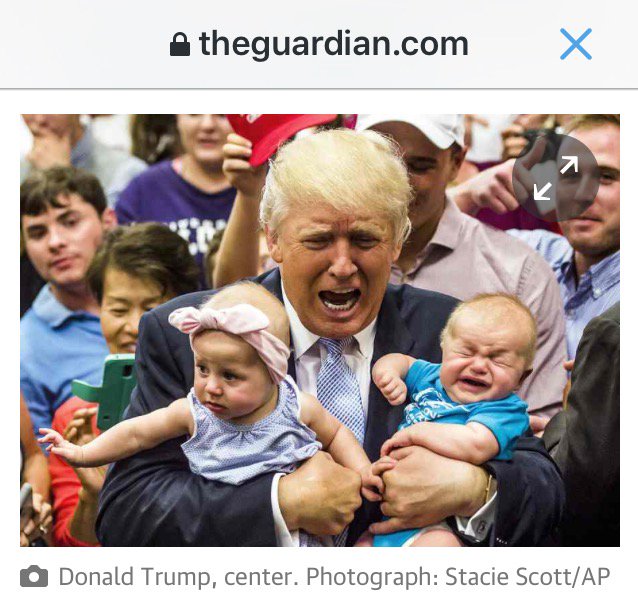
Is a caption contest for a photo a transformative use?  It does seem to rely heavily on the content of the photo!

See https://twitter.com/TheSteveBurnio/status/760579894900293633/photo/1: The winner of the caption contest:
Caption: "Donald Trump, center."

Monday, August 01, 2016