Monday, October 31, 2022

"objectively baseless" patent infringement claims can constitute tortious interference/defamation

Lite-Netics, LLC v. Nu Tsai Capital LLC, NO. 8:22CV314, 2022 WL 15523245 (D. Neb. Oct. 27, 2022)

A rare tortious interference/business defamation case that results in a preliminary injunction (converted from a TRO), based on claims of patent infringement made to plaintiff’s customers.

The parties sell “magnetic light strands used to illuminate homes and businesses during the holidays” and related products, such as magnetic clips that convert plastic light sockets to magnetic ones.
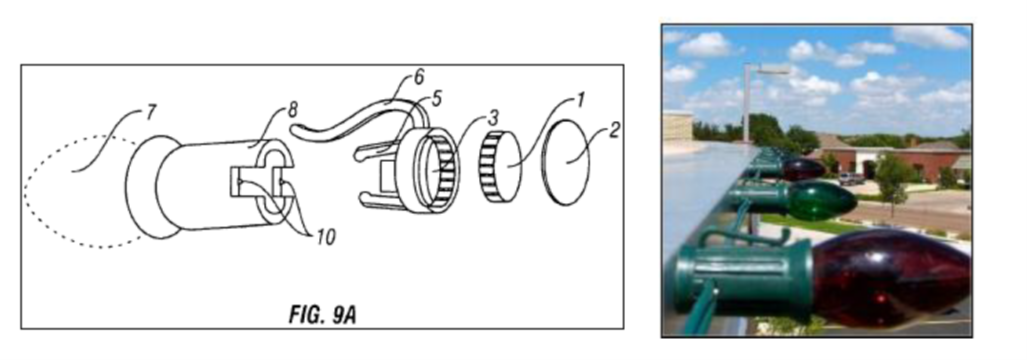
one relevant patent diagram and photo from opinion

Lite-Netics sued defendant HBL for direct and contributory patent infringement; HBL counterclaimed for Lanham Act false advertising and state unfair competition/deceptive trade practrices, as well as tortious interference with business relations and prospective business relations and defamation and “bad faith patent infringement communications under Colorado law.”

Only tortious interference and defamation were at issue here, based on Lite-Netics’ accusations of HBL’s misconduct. HBL argued that, based on the parties’ communications, Lite-Netics should have known early on that there was no infringement (consistent with the analysis performed by the district court, which also found that the accused designs didn’t infringe).

Despite that, Lite-Netics’s counsel sent several letters to HBL’s clients and customers “alerting” them of activities allegedly infringing Lite-Netics’s patents, though Lite-Netics argued that it was contacting its own customers “after its customers asked how HBL could sell the same product as Lite-Netics’s patented product.” Although early letters didn’t name HBL, after Lite-Netics sued, its communications to HBL’s clients and customers accused HBL by name of infringing the its patents and threatened to sue HBL resellers; Lite-Netics contended that it was contacting its own top customers to notify them that it had taken action to protect its rights and that it was unaware of any business relationship they might have had with HBL, though it didn’t have exclusivity agreements with the customers.

Tortious interference in Nebraska (as elsewhere) requires (1) the existence of a valid business relationship or expectancy, (2) knowledge by the interferer of the relationship or expectancy, (3) an unjustified intentional act of interference on the part of the interferer, (4) proof that the interference caused the harm sustained, and (5) damage to the party whose relationship or expectancy was disrupted.

“State tort claims based on enforcing a patent, including for tortious interference, are preempted by federal patent laws, unless the claimant can show that the patent holder acted in bad faith.” This requires that infringement claims be objectively baseless. The court found this standard satisfied given the prior art and the differences between HBL’s products and the patents.

Lite-Netics’ knowledge of HBL’s business relationships could be inferred from the lack of exclusivity in its relationships with its own customers, and the fact that “one does not ordinarily threaten one’s own customers with a lawsuit,” as its communications seemed to do. The court also found Lite-Netics’s assertions that it did not know these companies were HBL’s customers to be “rather disingenuous when retailers routinely offer similar products from various vendors. Also, all Lite-Netics would have to do to ascertain whether one of its customers was also selling products from another vendor is check the retailer’s website or walk into its store.”

The accusations caused HBL difficulty with its customers. The threats to sue customers were also, separately, improper because the infringement allegations were objectively baseless.

Similar logic led to HBL’s likely success on the merits of its defamation claim. The litigation privilege did not extend to making baseless claims about infringement. Baseless claims, which the court thought Lite-Netics should have known to be baseless, were in bad faith.

Lost reputation and goodwill also constituted irreparable harm, and HBL didn’t unduly delay—it sought relief in the same month in which Lite-Netics accused it by name; the earlier communications didn’t name it, and the parties were also at that time still in direct communication with each other “apparently pursuing negotiations, even if without much hope of success.”  

The injury was also not merely speculative, given an affidavit that worried customers have called asking whether HBL will be able to meet supply commitments for the accused products and how the litigation would affect their orders and shipments, and given that HBL’s accused product was also patented and entitled to its own protection. In addition, “the timing of Lite-Netics’s communications to HBL’s customers at the height of the sales season for retailers to be purchasing stocks of holiday lights is reasonably likely to exacerbate the impact on HBL’s reputation and goodwill, as customers may reasonably be expected to choose a different vendor if they have questions about HBL’s ability to perform and if they are unaware that Lite-Netics’s threat to add them to this lawsuit is an empty one under the applicable law.” The court also pointed to a declaration from an Ace Hardware store manager which explained “the impact of Lite-Netics’s communications to customers on his own business decisions and the concerns about the impact of those communications on his own customers,” and also that “these concerns on his part were alleviated by the Court’s entry of a TRO.” This was more than mere speculation.

With that out of the way, the balance of equities and the public interest also favored a preliminary injunction.

Lite-Netics was restrained from making statements “suggesting ‘copying’ by HBL, suggesting HBL customers will be burdened as additional defendants in this or any lawsuit, or suggesting that HBL is a patent infringer.” Lite-Netics was ordered to send the court’s order to “all persons who in the past have received the marketplace communications identified above.”

Zamfir, master of the Casper blockchain protocol?

Zamfir v. CasperLabs, LLC, No. 21-CV-474 TWR (AHG), 2022 WL 14915618 (S.D. Cal. Oct. 25, 2022)

Previous discussion. Note that plaintiff loses on all claims where he has to allege damage, but for TM claims one doesn't, so his proceed.

Zamfir is a researcher in blockchain technology and adopted the name “Casper” for his blockchain consensus protocol. He alleged trademark and related claims based on CasperLabs’ use of the name.

Zamfir’s branch of research was called “CBC Casper,” currently known throughout the industry as “Casper.” He alleged that he used the CBC Casper and Casper names exclusively to promote his work to the public, and that, by 2017, he used the Casper mark in commerce in connection with distributing downloadable Casper CBC software and specifications under open-source licensing agreements in the United States. He alleged that his work on Casper has brought him attention and material rewards.

In 2018, CasperLabs asked Zamfir to collaborate on developing a new blockchain. “Zamfir entered into a Licensing Agreement with CasperLabs, granting CasperLabs limited rights in the use of his name and image to promote the collaboration in exchange for CasperLabs helping to fund Zamfir’s work on CBC Casper.” But the relationship broke down. Nonetheless, CasperLabs allegedly continued to associate CasperLabs’ Casper products and services with Zamfir and his Casper products and services.

CasperLabs registered the CASPERLABS mark in its own name. The same year, CasperLabs allegedly represented that it would register the CASPER mark on Zamfir’s behalf, but instead filed to register it in its own name for services related to cryptocurrency; one application issued in 2020 and another is still pending. Zamfir alleged that, though continued to inquire about the status of the CASPER trademark application CasperLabs represented it would file on his behalf, he didn’t learn that CasperLabs had registered the CASPER mark until early 2021.

Zamfir alleged that CasperLabs’ products would be confused with his own work, and that CasperLabs’ protocol never met Zamfir’s advertised design requirements for CBC Casper, risking his reputation and forcing him to “resolv[e] ambiguity and phras[e] communications to avoid unintentionally promoting CasperLabs, making it harder for Zamfir to market the genuine products of his research.” He alleged that he was regularly contacted by people who were confused about his affiliation with CasperLabs and that the confusion lead to difficulty securing funding for his further research/investment in CBC Casper.

Lanham Act false association/common-law unfair competition: Previously, Zamfir didn’t sufficiently allege harm, and that continued, even though he pled likely confusion. Confusion was plausible based on CasperLabs statements like “The consensus protocol is built on Vlad Zamfir’s correct-by-construction (CBC) Casper work.” “The statements in the Second Amended Complaint can be read to mean CasperLabs’ protocol not only parallels Zamfir’s CBC Casper protocol, but also meets Zamfir’s standards for the CBC Casper Protocol…. Any assertion that Zamfir’s CBC Casper is the process behind CasperLabs’ protocol would be false, as Zamfir does not believe the process implemented by CasperLabs follows CBC Casper specifications.”

To me, this highlights the serious First Amendment problems with current open-ended confusion doctrines. By the allegations, there is a historical relationship. At most, Zamfir should be able to get an additional disclaimer, not suppression of the historical story of the firm. But the court was unpersuaded “that the confusion arises from the prior relationship with Zamfir and not the use of the mark is also unpersuasive,” given the continued use of the Casper name. The court cited tweets stating that CasperLabs should try to “distinguish themselves and perhaps change their name[ ], it just confuses people” and that a consumer had seen emails from CoinList and wrote, “I am an example of how CasperLabs’ marketing material easily confused investors.” This wasn’t just from the prior relationship.

Damages: Zamfir identified: (1) having trouble seeking funding from the Ethereum Foundation and other potential investors; (2) lessening of “the marketable value of his reputation and goodwill in the industry;” and (3) being forced to let go of contractors, and thereby delay the production of promised protocols under the Casper name.” Specifically, he allege that he encountered trouble seeking funding from the Ethereum Foundation because of “industry confusion.” But this was still too conclusory and generalized.

Trademark infringement under state and federal law: Still sufficiently pled. Zamfir has the burden of rebutting the presumption of ownership conferred by CasperLabs’ registered mark, but that burden can be met by showing that the registrant had not established valid ownership rights in the mark at the time of registration. Even if he wasn’t using Casper as the name of his consulting service, he might have made trademark use or analogous use sufficient to generate public association, given that he allegedly named his formal specification CBC Casper and provided consulting services in relation to it. “This is not a case where the trademark bears ‘no reference to, or association with’ the consulting service at issue; rather, Zamfir’s use of CASPER is in direct connection to the service he is providing.”

Zamfir also sought to cancel CasperLabs’ trademark registrations and sufficiently pled that under 2(d). He didn’t sufficiently plead fraud based on alleged misrepresentations that CasperLabs would register Casper for him. He pled falsity, but didn’t sufficiently plead harm. On falsity, a promise to apply for a registration on Zamfir’s behalf is not puffery because it’s capable of objective verification. He also adequately alleged reliance on the statement that CasperLabs was “trying to get [the] Casper trademark [registration] set up and done for CoorTech.” Adding further support to Zamfir’s reliance, CasperLabs allegedly assured Zamfir “that [it] would not use the CASPER mark to refer to [its] blockchain and/or blockchain token.” That was sufficient to be the basis of reliance.

But his claimed damage—that he didn’t seek his own registration—wasn’t enough to be sufficent harm. The court was, however, unimpressed by CasperLabs’ argument that the promise was futile because any transfer to Zamfir would have failed as an assignment in gross, because there could have been an assignment of the registration + underlying business to fulfill the promise, and anyway the harm was also that Zamfir didn’t seek his own registration. Moreover, “CasperLabs’ argument is especially questionable because its General Counsel … a member of the California bar, asserted that the trademark would be registered and transferred, and that … another attorney, was ‘handling’ this registration. Even if obtaining a trademark on Zamfir’s or CoorTech’s behalf would be invalid, it would be reasonable for Zamfir to expect that [the lawyers] would be privy to that information and would not promise a legal impossibility.”

California UCL based on the 43(a) claim: Failed for want of sufficient connection to California and want of injury. Zamfir is a Canadian resident, though CasperLabs’ principal place of business is in California. Still, that wasn’t enough to presume that the falsity originated from California; Zamfir didn’t allege conduct occurring in California. He also didn’t allege lost money or property, as required under the UCL. While numerous courts have held that the “[d]evaluation of ... intellectual property or intangible business assets is sufficient to meet the injury requirements under § 17200,” Zamfir offered no non-conclusory allegation that the value of the his Casper service had decreased.

1202 and Lanham Act claims can't save lawsuit against embedding photos

Logan v. Meta Platforms, Inc., 2022 WL 14813836, No. 22-cv-01847-CRB (N.D. Cal. Oct. 25, 2022)

Logan alleged that Facebook’s embedding tool enables third parties to infringe his copyrighted photos uploaded onto his Facebook account by embedding them to third-party websites and allowing embedding on Facebook from other websites, creating both direct and secondary liability. He also alleged removal of his CMI in violation of the Lanham Act and the DMCA §1202. The court granted Meta’s motion to dismiss.

Logan alleged that third-party websites embedded various of his copyrighted photos from his Facebook accounts. In addition, he alleged that Meta itself embedded and thereafter displayed some of Logan’s photos from Wikimedia Commons and saved them onto Facebook’s servers. Algthough Logan published the photos on Wikimedia under a Creative Commons license, he alleged that Meta stripped the photos of all identifying information and falsely identified itself as the owner by displaying its “copyright tag on the bottom of each Facebook user page,” breaching the license.

Secondary liability: requires direct infringement by someone else. But under Perfect 10, embedding is not infringement. “The closest Logan gets to pleading third-party infringement under the server test is by alleging that third parties ‘can’ save his embedded photos onto their servers. But the FAC fails to assert that any specific third party actually did so.” But he gets leave to amend! Hard to see how he can deal with the other requirements for secondary liability, though.

Direct infringement: Logan alleged that “Facebook took [his] content from other sites,” such as Wikimedia, making his theory of direct infringement distinguishable from claims based on his own posting to Facebook. Thus, the complaint adequately pled that Meta saved Logan’s photos onto its servers, satisfying the server test. [Really, it pled that someone did—the court flags the volitional conduct requirement, which is going to be a barrier.] But the claim still failed for failure to plead registration of those photos, though again there was leave to amend.

Lanham Act false advertising: The theory was that Meta misrepresented “the creation and ownership” of Logan’s photos. Dastar doesn’t clearly bar false advertising §43(a)(1)(B) claims in general, but it does bar the claim as pled here: “a copyright claim repackaged under a trademark statute.” Sybersound Recs., Inc. v. UAV Corp., 517 F.3d 1137 (9th Cir. 2008), applied

Dastar to false advertising claims that turned on putative misrepresentations about “the copyright licensing status of karaoke recordings,” which did not qualify as the “nature, characteristics, or qualities” of goods. Thus, “litigants cannot bring false advertising claims for misrepresentation of authorship” under the Lanham Act. Misattributed authorship is the same for these purposes as misattributed licensing status—allowing the claim would interfere too much with copyright and the Federal Circuit has understandably applied Ninth Circuit law to hold that authorship is also not a nature, characteristic, or quality of goods. Baden Sports, Inc. v. Molten USA, Inc., 556 F.3d 1300 (Fed. Cir. 2009).

While Sybersound suggested that “the original song and artist of [a] karaoke recording” could be a potential “characteristic of [a] good,” that didn’t help the photographer here. “In the specific context of karaoke recordings, misrepresenting the artist of a song goes toward the content of the recording, not the recording’s originator or author.” Were the authorship of the song itself at issue, Dastar and Sybersound would bar the claim. But there was leave to amend to allege some other misrepresentation about his photos.

DMCA §1202: First, the Meta © displayed at the bottom of each Facebook page isn’t CMI as to the photos, because it isn’t “conveyed in connection with” the photos, and thus it can’t be false CMI. A generic copyright notice not located on or next to the photos, located at the bottom of the webpage, is not CMI as to the photos. SellPoolSuppliesOnline .com, LLC v. Ugly Pools Ariz., Inc., 804 F. App’x 668 (9th Cir. 2020).

CMI removal:  Although the complaint clearly specified the CMI allegedly removed—Logan’s “name, the title of the Photograph, and a link to a Creative Commons website ... setting forth the terms and conditions for use”—it still failed to plead the requisite knowledge. The removal/distribution provisions “require the defendant to possess the mental state of knowing, or having a reasonable basis to know, that his actions ‘will induce, enable, facilitate, or conceal’ infringement.” Stevens v. Corelogic, Inc., 899 F.3d 666 (9th Cir. 2018). Although the FRCP provide that “intent, knowledge, and other conditions of a person’s mind may be alleged generally,” the complaint still didn’t plead the requisite double scienter. Since none of the photos themselves contained any watermark, the only identifiable CMI was on Wikimedia, where Logan’s name, licensing information, and use permissions were listed directly below each photograph. “The FAC’s theory thus seems to be that embedding the photos itself evidences Meta’s intent to remove Logan’s CMI from his photos.” But that wasn’t enough. “Unlike editing a plaintiff’s watermark out of a photo, automatically omitting CMI by embedding a photo out of the full context of the webpage where the CMI is found cannot itself plead intentionality as required by the DMCA.” So too with the distribution claim: “embedding Logan’s photos from Wikimedia does not itself establish that Meta ‘kn[ew] that copyright management information ha[d] been removed or altered.’” Third parties embed “hundreds of thousands or even millions of registered copyrighted works” using Facebook’s embed tool, and “[m]ore than 2 billion people use Facebook every month.” “These facts do not plausibly plead that Meta knew third parties removed Logan’s CMI by embedding his photos onto other websites.” Again, leave to amend, though hard to imagine what changes with more pleading.


Thursday, October 20, 2022

Warhol v. Goldsmith, purpose, and character

A small thought on Warhol v. Goldsmith: Justice Jackson seemed interested in whether there was anything to be gained by parsing “purpose” and “character” separately in factor one. Although I don’t think there is given the intentional breadth and flexibility of Congress’s adoption of the common law concept into a still-broad and flexible test, it occurred to me that Professor Tony Reese presciently identified a division in the cases that corresponds to those two words. Professor Reese’s Transformativeness and the Derivative Work Right, 31 Colum. J.L. & Arts 467 (2008), whose analysis I followed in Content, Purpose, or Both?, pointed out that many of the big data/evidentiary use-type fair use cases are well-described by the idea of a transformative purpose—a purpose orthogonal or unrelated to the expressive content of the original work or works used. Cases involving criticism and parody, by contrast, tend to involve changes in content, which could be mapped on to a parodic/critical/etc. “character.” 

The reason I’m not convinced this gets us very far is that one still needs to identify favored “purposes” and “characters,” since that’s not self-evident.  For example, although the justification for appropriation art is different than the justification for parody, appropriation art could easily be said to have a distinctive favored “character” in the context of how it is understood by audiences. And though I classified evidentiary use (Bond v. Blum, Dorling Kindersley, etc.) as a different “purpose,” the way the audience reacts to an evidentiary use as compared to how it reacts to an ordinary consumptive use could easily justify saying that it has a different “character” as well.

However, this approach might help make sense of the otherwise fairly incomprehensible approach advocated by the SG, with respect to some favored “purposes.” The SG wanted to split the baby by allowing the Foundation to continue to display the Warhol lithographs, but not allow it to license them for use in articles about Prince, but if the creation of the lithographs was fair (or authorized) then it’s not clear why further uses would be unfair, and if the uses are unfair then why would there be a valid copyright in the lithographs under §103?

Moreover, evaluating every single use of a newly created work for fairness seems like a really bad idea. That is, one should never have to relitigate whether a parody or review is a fair use even if one, say, licenses it for film adaptation, or distributes it in a different market. (Shades of the old obscenity standard where something that was ok for a gentleman would not be ok for a chambermaid.) Such a standard is likely to substantially suppress publishers’ circulation of fair uses in case “this time is different.” Especially when the accused use is argued to be a derivative work instead of a pure reproduction—as here—this test is very dangerous to fair users who would never be confident that they had their own valid copyrights.

On the other hand, there are purpose-based fair uses, usually involving reproductions and not derivative works, where it does make sense to say that the fairness is inherently tied to the specific use: We believe Google made its big database of books only to show snippets and not to distribute full copies, so its backup copies are fine. 

So one reason the SG’s position seemed so odd (along with its terrible endorsement of some sort of “necessity” standard) was that it probably shouldn’t make a difference in this case, where there is a new work that either has a valid copyright, or, under §103, doesn’t. 

Relatedly: it would be deeply ironic if the result of this round of fair use cases was that big data uses are definitely fair use, so Google wins its cases, while each individual artist has to establish the importance of their specific fair use, even with very explicit parody or criticism.

Wednesday, October 12, 2022

Clone wars: truthful statements about cloned horses don't constitute false association

La Dolfina S.A., LLC v. Meeker, 2022 WL 6507718, NO. 20-82231-CIV-CANNON/Reinhart (S.D. Fla. Aug. 19, 2022)

Judge Cannon has done some other stuff, too. “This case concerns major players in the world of professional polo, their efforts to produce and clone genetically superior horses, and the ownership disputes that have arisen from those efforts.” Plaintiffs raise allegedly awesome polo ponies. Defendants compete with La Dolfina; an individual plaintiff previously dealt with defendant Meeker for purposes of exploring the possibility of equine cloning, allowing a defendant to “select four mares from [plaintiff’s] stock for the purpose of extracting tissue samples for cloning” at a price of $250,000 per mare. The defendant was initially given “complete and exclusive licensing rights in and to [the selected mares] and all cloned foals.” Eventually, the parties parted ways. Then defendants entered into agreements with “entities associated with La Dolfina’s competitor, the Park Place Polo Team.” Litigation ensued, with lots of claims, including the Lanham Act claims on which I will focus, though breach of contract claims were prominent and survived a motion to dismiss.

The Lanham Act claims were styled as false association, “false association with celebrity status,”  false designation of origin, and false advertising.

The court found that plaintiffs failed to state a claim; the gravamen of the claim was “explicit and implicit representations” that defendants “were authorized to clone and sell the La Dolfina horses at issue.” Allegedly, these statements, plus the use of the horses’ names as given by La Dolfina, constituted false advertising and false association.

However, “truthful and undisputed acknowledgement that the horses at issue are genetically identical copies of La Dolfina horses” didn’t constitute an “actionable representation of association or endorsement.” Judge Cannon is not alone in using ipse dixit to get over the significant difficulties that endorsement theories pose for truthful statements of historical fact. The full reasoning, which courts usually avoid because it acknowledges the existence of trade-offs, is: There is important consumer value in being able to tell the truth (these products have some historical connection to X). But some consumers might take away the misleading implication of continued connection to X. Given the importance of the truth and the unimportance of the implication, that risk is justified and, indeed, forcing defendants to bear the costs of litigation is unjustified. The lack of plausibility here is actually the result of a cost-benefit analysis. And in many first sale cases, like the ongoing luxury resale cases, courts have not been willing to protect truthful statements of historical origin.

What about statements about the right to sell clones? That, the court said, “concerns the scope of their rights under the parties’ numerous and somewhat ambiguous agreements; it does not mislead as to the ‘origin, sponsorship, or approval’ or ‘nature, characteristics, qualities, or geographic origin’ of the identical clones themselves."

Tuesday, October 11, 2022

marketing may be material even to very expensive/complex business purchases

Pegasystems Inc. v. Appian Corp. No. 19-11461-PBS, 2022 WL 4630231, --- F.Supp.3d ---- (D. Mass. Sept. 30, 2022)

Pegasystems alleged that defendants, which compete with it in the business process management (BPM) software field, engaged in false advertising and commercial disparagement in an online report that portrayed Pegasystems unfavorably. (Previous discussion.) Appian counterclaimed similarly (previous discussion); having denied a preliminary injunction, the court now slightly reduces the issues remaining for trial.

The parties’ products sell for millions of dollars to large corporations or government agencies, and there are many other vendors besides them. Defendant BPM.com reported on the BPM industry. Appian hired BPM.com to prepare a report that would “clearly identify and articulate[ ] the value delta of Appian over Pega.” The result portrayed Appian more favorably than its competitors. E.g., “Pega customers reported spending on average 11 times more than Appian customers, and nearly twice that of IBM customers,” and other quantitative claims about time and scope. Appian disseminated the report through its sales team, social media, and other marketing.

Appian’s counterclaims targeted Pegasystems marketing materials that claimed that Pega was better at scalability than Appian, including allegedly false claims that “Appian lacks basic backend performance/tuning tools,” “There is no way to have more than one person working on a process at one time,” and “Because Appian requires a great deal of JavaScript, especially for the user interface, it is not truly model-driven.”

Pegasystems also hired Sinur, “a researcher and influencer within the BPM community,” to draft a report comparing Pegasystems’ and Appian’s platforms. The report didn’t disclose that Pegasystems commissioned it. 

Appian also challenged a a LinkedIn post by a Pegasystems Senior VP/CMO after the court denied Appian’s motion to dismiss:

We all encounter examples of business ethics we find questionable ... patent trolls, paid content promoted as ‘unbiased truth,’ and sometimes just blatant lies. I’m proud to work for a company that is not afraid to undertake the unpleasant action of litigating against those whose actions we believe are unlawful and unethical. If you’re thinking about Appian, you should read this first[.]

The linked to an article (not mine) that summarized the Court’s ruling; Pegasystems encouraged salespersons to share the post and to use it when competing against Appian.

Starting with Pegasystems’ claims, Appian and BPM argued that there was no proof of cognizable injury, and that there was no presumption of injury because multiple firms compete in the BPM market. But a two-player isn’t always required for a presumption, where there’s a false/misleading comparison to a specific competing product. “Because the BPM.com Report’s comparative statements would diminish Pegasystems in the minds of consumers, it is entitled to the presumption of injury at this stage.” There was also a fact question on reputational injury, since three Pegasystems customers raised questions about the BPM.com report’s claims to Pegasystems following its publication. “These customers did not move their business from Pegasystems, but a reasonable jury could infer, based on their concerns, that the BPM.com Report generated similar concerns in the marketplace.”

Money damages: Pegasystems conceded at various points during discovery that it had not identified any business it lost because of the BPM.com report. It later identified an allegedly lost opportunity, but its evidence was weak—an internal Appian email saying that the potential clients “were really excited to hear about” the BPM.com report. There was no testimony or documentary evidence from the client that the report was a substantial factor in its decision. No reasonable jury could conclude that Pegasystems lost that opportunity because of the BPM.com report. So Appian got summary judgment on Pegasystems’ claim money damages for lost business.

However, disgorgement remained possible, using old language from false advertising cases rather than from Romag (suggesting that willfulness would matter/was uncontested at this point in the proceedings). Since the parties were direct competitors, disgorgement of profits would depend on:

(a) the degree of certainty that the actor benefitted from the unlawful conduct; (b) the relative adequacy to the plaintiff of other remedies, including an award of damages; (c) the interests of the public in depriving the actor of unjust gains and discouraging unlawful conduct; (d) the role of the actor in bringing about the infringement or deceptive marketing; (e) any unreasonable delay by the plaintiff in bringing suit or otherwise asserting its rights; and (f) any related misconduct on the part of the plaintiff.

Injunctive relief was moot because Appian submitted a declaration that it instructed its personnel to discontinue use of the BPM.com report, and won’t resume doing so.

Pegasystems also moved for summary judgment on liability for its own Lanham Act claim, but there was a genuine issue of fact on whether the BPM.com report’s claim that the average total cost of ownership of Pegasystems’s products was more than ten times greater than that of Appian’s products was literally false. Pegasystems contested its methodology but didn’t show the actual cost to own its solutions as compared to Appian’s. Internal Pegasystems emails stated that Pegasystems is much more expensive than Appian, and an independent report concluded that Pegasystems is “relatively expensive.”

Pegasystems argued that Appian’s Lanham Act counterclaim was barred by laches (the analogous state limitations period being four years under Mass. Chapter 93A). The period is triggered not when Appian knew or should have known the advertising caused it injury, but when it knew or should have known of the false advertising. Under that standard, a presumption of laches applied to the claims about the Sinur paper with the undisclosed sponsorship, but not others. Appian didn’t show that its delay in suing over the Sinur paper was reasonable or that Pegasystems was unharmed by the delay; indeed, Pegasystems lost certain emails, some of which may have been on point, in a 2017 system upgrade. But Pegasystems didn’t show laches with respect to the remaining materials.  The same result occurred on the Chapter 93A claims using the statute of limitations.

Were the remaining Pegasystems marketing materials disseminated broadly enough to be “commercial advertising or promotion”? The BPM market is large. Pegasystems distributed its scalability White Paper 6 times to 5 organizations, and another comparison 30 times to 15 organizations, and also circulated them internally and encouraged salespersons to use them with customers. A reasonable jury could conclude that they were advertising or promotion, but not other documents without such a documented dissemination history.

The court also rejected Pegasystems’ argument that the BPM sales process is so lengthy and complex that its marketing materials could not have influenced purchaser decisions as conclusory. Appian claimed that it lost seven customers at least in part because of Pegasystems’ conduct, which its expert said cost Appian $26 million in lost profits. For example, one customer that chose Pegasystems over Appian informed Appian that it needed a platform that could perform “on enterprise architecture level,” which mimicked Pegasystem’s criticism of Appian’s inability to handle the “needs of an enterprise BPM program.” A reasonable factfinder could infer such customers chose Pegasystems at least in part because of the marketing materials. And a jury could also find that scalability was material; one of Pegasystems’ own employees testified that scalability is “one of the things that you would need to be able to show to compete for business,” while Appian’s expert stated that scalability is an essential factor in the decision-making processes of potential purchasers.

There was also a triable issue on falsity. Statements that Appian “lacks key capabilities needed to scale” were “unambiguous.” Pegasystems argued that its statements that Appian’s total cost of ownership is “higher” couldn’t be literally false because “[h]igher than what is not specified.” “But any reasonable reader would understand the documents to compare the [total costs] of Appian and Pegaystems.” Plus, statements of Pegasystems employees “suggesting that they knew their claims about Appian’s scalability were made up” were probative of falsity, e.g., “[w]hat we have stated about [Appian’s] scalability does not seem to jive with the Appian documentation.”

Likewise, there was a triable issue on commercial disparagement, which doesn’t require commercial advertising or promotion, with the exception of time-barred claims arising from the Sinur paper.

Appian also counterclaimed for defamation based on the LinkedIn post, which allegedly implied that the Court’s prior opinion supported the notion that Appian had told “blatant lies” in the BPM.com Report. Although defamation usually has lots of First Amendment protections, a jury could reasonably find that the post was commercial speech, as it encouraged readers to review an article about the Court’s opinion if they are “thinking about Appian” and Pegasystems urged its sales force to share the post. A jury could also reject the “fair reporting” privilege and find that the post created the mistaken impression that the Court found that Appian told “blatant lies.” “[A]ccusing another party of being a ‘liar’ has generally been held to be defamatory” and “[a]lthough the LinkedIn Post ostensibly relied on this Court’s prior opinion regarding Pegasystems’ claims against Appian, that opinion does not support the statement that Appian told ‘blatant lies.’ ” Actual malice was not required because Appian was not a public figure for purposes of this dispute.

copying competitor's website & reviews creates (c), TM, false advertising problems

Boston Carriage, Inc. v. Boston Suburban Coach, Inc., No. 1:21-cv-10688-IT, 2022 WL 4626918 (D. Mass. Sept. 30, 2022)

Plaintiff, d/b/a Logan Car Service, has offered limousine and transportation services primarily in the Greater Boston area since the 2000s and uses logancarservice.com to do so. Boston Suburban is a competitor. The parties used to have an ongoing business relationship in which both companies outsourced clients to each other and engaged in regular communications regarding their business operations. “Boston Carriage’s principals voluntarily shared their business knowledge with Boston Suburban, including Boston Carriage’s business and marketing strategies and its online presence.”

Boston Suburban registered the domain name “logan-car-service.com.” It had a similar color scheme, page layout and website architecture, font type, and artwork and photographs to Boston Carriage’s. On several pages, text, client reviews, and other content “matched, almost verbatim, the content that originally appeared on Boston Carriage’s website.” When Boston Carriage found out, the relationship deteriorated. Although Boston Suburban removed its website from the “logan-car-service.com” domain address after it complained, for several months visitors to the “logan-car-service.com” domain address were automatically rerouted to Boston Suburban’s other website, “bostonsuburbancoach.com.”

Boston Suburban allegedly continued to use the “Logan Car Service” mark in online keyword advertising and in metatags, and continued to copy customer reviews from Boston Carriage’s website and publish them on online review platforms. It also allegedly resumed promoting and advertising the domain name “logan-car-service.com” and re-routing visitors to its own website.

The court refused to dismiss copyright claims (plaintiff amended its complaint when it had registered its copyright, which was timely and ok).

Trademark infringement in “Logan Car Service”: This was a descriptive term; plaintiff successfully alleged secondary meaning by alleging use for nearly 20 years and “substantial time, money, and effort in building up the goodwill associated” with the mark, along with substantial exclusivity until Boston Suburban came in. “Further, Boston Carriage alleged that Boston Suburban’s use of the mark confused one of Boston Carriage’s clients, who was mistakenly sent to Boston Suburban’s domain when looking for Boston Carriage’s website.”

False advertising: Beyond the use of the mark, Boston Suburban allegedly took customer reviews from Boston Carriage and assigned fictitious names to the customers when it copied the reviews onto the “copycat” website. This was plausibly “a separate act intended to mislead customers that Boston Suburban, rather than Boston Carriage, had actually performed these services.” Of note: Unlike some other courts, this one (correctly) doesn't require that the content of the review be more than puffery. The actionable alleged misrepresentation is that defendant performed the relevant services.

An ACPA claim also survived, as did some state law claims (not state TM claims requiring state registration based on conduct before that registration occurred, which was in 2018). This included a state-law dilution claim, since state law required only distinctiveness. But tortious interference didn’t succeed for want of sufficiently specific losses: the one confused client ended up calling in her order to Boston Carriage, and it was insufficient to plead an otherwise “inexplicable” loss in sale volumes. That didn’t amount to a “reasonable expectancy” of future business which was interfered with by Boston Suburban. And conversion of the website content also failed: Claims based on the parts of the site that Boston Carriage owned copyright to were subject to copyright preemption. Its registration specifically excluded client testimonials; this shouldn’t have changed the preemption analysis for those, but the court considered them separately anyway. Boston Carriage argued that it had a legal right of immediate possession to the original content posted to its website by its customers through a non-exclusive license. But as a non-exclusive licensee, it couldn’t alone bring a claim of conversion, which requires a right of possession.

And RICO claims failed because they were RICO claims.

Court permanently enjoins Arkansas anti "fake meat" law

Turtle Island Foods SPC v. Soman , 2022 WL 4627711, -- F. Supp. 3d --, No. 4:19-cv-00514-KGB (E.D. Ark. Sept. 30, 2022)

After previously winning a preliminary injunction, plaintiff (Tofurky) got Arkansas’s prohibition on using meat terms to describe non-meat products permanently enjoined, some entirely and some as applied to its conduct.

Tofurky uses terms like “chorizo,” “ham roast,” and “hot dogs,” alongside qualifiers like “all vegan,” “plant based,” “vegetarian,” and “veggie.” “Tofurky has never been the subject of enforcement action by any federal agency for marketing or labeling its products in a misleading manner. Tofurkey is not aware of a single consumer communication sent to Tofurky or to any government agency complaining that a consumer mistakenly believed Tofurky’s plant-based meat products were, or contained meat, from slaughtered animals.” Further, Tofurky argued that it couldn’t “accurately and effectively describe its products without comparison to the conventional meat products with flavor profiles Tofurky’s products are designed to invoke.”

But Arkansas banned selling edible agricultural products “under the name of another food”; representing it as a food for which the FDA has a definition and standard of identity unless it matched; representing it “as meat or a meat product when the agricultural product is not derived from harvested livestock, poultry, or cervids” with similar provisions specific to beef/“derived from a domesticated bovine” and pork/“derived from a domesticated swine”; or using “a term that is the same as or similar to a term that has been used or defined historically in reference to a specific agricultural product.” This was touted as consumer protection legislation.

Although it seems like even the last provision could have been read to exclude Tofurkey’s conduct without much strain, the state seemed to disavow an interpretation that excluded “veggie chorizo” from counting as “representing” itself as meat, etc. Thus, Tofurkey had Article III standing (many pages’ discussion omitted) and abstension was inappropriate.

Starting with the as-applied challenges, the state argued that Tofurkey’s labels were inherently misleading “because they use the names and descriptors of traditional meat items but do not actually include the product they invoke,” and “Tofurky designs its food products to approximate the texture, flavor, and appearance of meat derived from slaughtered animals” (to distinguish it from, e.g., “almond butter”).

Tofurky responded that words such as “meat,” “burger,” and “steak” “have been used for decades—and in some cases centuries—to describe foods that are not made from slaughtered animals.” Plus, its labels and marketing materials prominently identified its products as “all vegan,” “plant based,” “vegetarian,” “veggie,” or “made with pasture raised plants” on the front of its packages. As to texture/flavor/appearance, Tofurkey argued that it couldn’t “accurately and effectively describe its products without comparison to the conventional meat products with flavor profiles Tofurky’s products are designed to invoke.”

Considering the label as a whole, the court found Tofurky’s use of the terms not inherently misleading. The words that the law banned Tofurky from using “convey meaningful, helpful information to consumers about the products they are purchasing, and Tofurky’s repeated indications that the food products contained in these packages contain no animal-based meat dispel consumer confusion.” Tofurky wasn’t burying key information in miniscule type, and removing the animal-based names might be more confusing. The state hadn’t shown that reasonable consumers would disregard the other words on the label.

Although theories of potential misleadingness might justify a disclosure requirement, this was a speech ban not subject to Zauderer treatment. Nor could the state short-circuit constitutional analysis by adopting definitions of, e.g., “chorizo.” “[T]he simple use of a word frequently used in relation to animal-based meats does not make use of that word in a different context inherently misleading.”

Thus, Central Hudson applied. While “combatting deceptive, misleading, or false advertising is a legitimate and substantial interest,” the law at issue didn’t “directly and materially” advance the state’s asserted interest in “protect[ing] consumers from being misled or confused by false or misleading labeling of agricultural products that are edible by humans,” given that Tofurky’s speech was neither false nor misleading. [This analysis merges Central Hudson’s third prong with its fourth, making it into a narrow tailoring requirement. Does that matter?]

Thus, the law was “more extensive than necessary to serve the State’s interest.” In the narrow context of an as-applied constitutional challenge, the government “must demonstrate that the harms it recites are real and that its restrictions will in fact alleviate them to a material degree.” But the state didn’t. It could instead “require more prominent disclosures of the vegan nature of plant-based products, create a symbol to go on the labeling and packaging of plant-based products indicating their vegan composition, or require a disclaimer that the products do not contain meat if further laws are deemed necessary to advance its stated purpose.”

Tofurkey was entitled to a permanent injunction against application of the Arkansas-specific/meat-specific provisions of law to its (existing) labels.

It was also entitled to a permanent injunction against application of parts of the law that copied the FDCA to its existing labels. The FDCA, which is also therefore held unconstitutional if applied to prohibit “fake meat” labels, deems a food misbranded “[i]f it is offered for sale under the name of another food” or if it “purports to be or is represented as a food for which a definition and standard of identity has been prescribed by regulations … unless (1) it conforms to such definition and standard, and (2) its label bears the name of the food specified in the definition and standard ….”

Noting that the feds hadn’t tried to enforce this against Tofurky, the court found that the as-applied analysis was the same for these more broadly worded provisions.

Facial challenge to the Arkansas fake meat-specific provisions: Although overbreadth analysis doesn’t generally apply to commercial speech regulation, a plaintiff whose own constitutionally protected speech is prohibited can bring a facial challenge.

Tofurky argued that “the State may not place an absolute prohibition on speech that is potentially misleading if the information may also be presented in a way that is not deceptive.” But although Tofurky’s use of the terms wasn’t inherently misleading, the court wasn’t willing to conclude that all uses of the terms wouldn’t be inherently misleading. Tofurky couldn’t rely on its own labels to establish that “no set of circumstances exists” under which the law would be valid. The court could envision plant-based products without qualifiers on their packaging identifying the products as “plant-based” or “vegan,” and those might be inherently misleading. [It follows that the state could actually punish those sellers, not just make them use disclosures in the future. Whether that’s framed as a ban on unmodified use of meat terms for plant-based meat or a disclosure requirement, that result seems correct.]

One Arkansas-specific provision was also void for vagueness. The provision at issue bars “[u]tilizing a term that is the same as or similar to a term that has been used or defined historically in reference to a specific agricultural product.” Tofurky pointed out that, while the law defined “meat” as “a portion of livestock, poultry, or cervid carcass that is edible by humans,” other sources, including the King James Bible and FDA guidance documents, use “meat” for the flesh of fruits or nuts. Since the 1930s, likewise, “burger” has been used to describe all sorts of sandwiches, including nut burgers, fish burgers, turkey burgers, and veggie burgers. This provision could cover peanut butter, oat milk, buffalo wings, and beetballs. [Ed. note: beetballs?] Thus, it was not clear to a manufacturer or distributor of ordinary intelligence what the statute prohibits, even taking the entire law as a whole as relevant context. The state didn’t explain what was meant by “same as or similar to a term that has been used or defined historically in reference to a specific agricultural product.” Thus, this provision was facially invalid.

Monday, October 03, 2022

Call for IP Law Articles from the William & Mary Business Law Review

Volume 14 of the William & Mary Business Law Review is currently accepting intellectual property law articles for its final issue, set to print in spring 2023.

The journal aims to publish cutting-edge legal scholarship and contribute to significant and exciting debates within the business community.

Authors may submit articles via Scholastica or email to wm.blr.articlesubmission@gmail.com, together with their curriculum vitae and cover letter (optional). Submissions received by October 15 will receive priority consideration.

I can reasonably believe it's butter: claims against "Butter No-Stick Spray" without any butter survive

Strow v. B&G Foods, Inc., No. 21-cv-5104 (N.D. Ill. Sept. 30, 2022)

Very 7th-Circuit style opinion refusing to dismiss false advertising claims against a “Butter No-Stick Spray” with no butter in it. Lots of encomiums to butter (many based on the complaint)—short version: butter is not the same thing as oil in ways that are material to consumers both for taste and cooking-functionality reasons. Also, the FDA considers false and misleading any product labeled “Butter” or using the word “butter” in conjunction with its name “unless all of the shortening ingredient is butter.”

Butter Non-Stick Spray

The court noted that “Butter” was the most prominent word on the can, and that it was used as a noun, which “communicates that it is butter, not that it has a butter-like attribute.” The image also shows a pat of butter on the pancake, and the can was yellow, “shaped kind of like a stick of butter. It doesn’t take too much imagination to think that the good people at Crisco have somehow figured out how to put a nozzle on a stick of butter itself.”

The front label also says, in “hazy” font, “Natural & Artificial Flavor,” as well as “0g Trans Fat,” “For Fat Free Cooking,” “0g Sat Fat,” and “0 Calories.” The court noted that “anyone who spots that text should have a moment of pause” because those aren’t butter attributes. Maybe consumers could think that “Crisco had created a miracle: fat-free, calorie-free butter. But that’s an issue for a later day.” The back label discloses the ingredients: oils etc. but no butter. Indeed, the back label touts “Buttery Flavor For Your Food Without The Butter.”

Buttery Flavor without the Butter caption over calorie/serving comparisons to Butter/Margarine and Oil

ingredient list featuring no butter

B&G’s other no-stick sprays, like olive oil spray, which “actually contains its namesake ingredient.” Competitor products prominently feature “butter flavored” identifications.

Although B&G might prevail later, it was not unreasonable to read the word “Butter” to mean butter. “If B&G didn’t want consumers to think that the can contained butter, one wonders why it said ‘Butter,’ front and center.”

B&G argued that the properties of butter were incompatible with a room-temperature liquid spray. But butter does exist in liquid (melted) form. “At the very least, it is not so far outside the realm of possibility that it fails to state a claim…. Reasonable consumers are not chemists. The law does not expect consumers to be well-versed in butter’s thermodynamic properties.” They are not required to stop and think about whether butter can be liquid at room temperature (the parties disputed whether this could happen with appropriate additives). “It is not as if the spray can told consumers that it could help them fly.” Only “unreasonable and fanciful” interpretations should be kicked out at the motion to dismiss stage, and this wasn’t.

What about the back of the can, with its “without the butter,” ingredient list, and comparisons to the calories in butter and oil? “[T]he Seventh Circuit has limited the ability of truthful information on a product’s back label to immunize deceptive advertising contained on the product’s front label.” As it ruled in the “100% Grated Parmesan Cheese” case, “the reasonable consumer standard does not presume, at least as a matter of law, that reasonable consumers will test prominent front-label claims by examining the fine print on the back label.” Since “[c]onsumers don’t study grocery labels like books in a library,” they could plausibly rely on the largest word on the can and the image of a melting pat of butter atop pancakes in a skillet. “A consumer pushing his cart down the aisle confronts only this imagery and labeling during the few seconds spent deciding whether to purchase the product.”

What about “Natural & Artificial Flavor” on the front of the can? B&G argued that it had to mean that the spray was only butter-flavored. But the court would “not impose on average consumers an obligation to question the labels they see and to parse them as lawyers might for ambiguities, especially in the seconds usually spent picking a low-cost product.” Anyway, it was plausible that a consumer who sees the word “natural” next to “butter” would expect to find natural butter in the product. And “Natural & Artificial Flavor” next to “Butter” could mean different things to different consumers. “Maybe it means that the can contains butter, and some artificial flavors.” B&G could not change the plain meaning of “butter” to “buttery” by argument.

Friday, September 30, 2022

Suffolk University Law School IP Center, Fourth Annual Intellectual Property & Innovation Conference

Panel: Design Patents, moderated by Sarah Burstein, Suffolk University Law School, panelists include:

Meredith Lowry, Partner, Wright Lindsey Jennings

John Maltbie, Director of Intellectual Property, Civil Enforcement, Louis Vuitton Americas

Darrell Motley, Shareholder, Banner Witcoff; Adjunct Professor of Law & Supervising Attorney for IP Clinic – Patents, Howard University School of Law

Burstein: What role do design patents play in LV’s strategy?

Maltbie: Looking predominantly through TM, anticounterfeiting as bread and butter. Design patents play a role when we have them, typically a handbag/jewelry/diamond cuts/chain designs/shoes. Always nice to throw in but not a mainstay of protection program. Issue: legal is often the last to know of new designs, so you need to know before the design is launched: need to explain that legal needs to be part of the process. Seems like a lower bar for entry for design patent than TM protection. Growing area for us; not core but nice to have.

Lowry: For many people/products, the first few years are the only years that matter, and design patents are a tool for that. [Burstein notes that you can pay a fee for faster prosecution, 4-6 months, even 60 days is possible.]

Motley: Useful when utility patent protection isn’t available. [Burstein: even when you don’t pay, design patents issue faster than utility patents. There is a lot of demand right now that is slowing design examination.] Apple v Samsung changed perceptions. [Apparently Shark Tank also talks about design patents.]

Burstein: what changes have you seen?

Lowry: people are now more likely to be aware of design patents when they come in. More partial designs. Interest in having more assets to tout to investors/venture capitalists.

Burstein: in the past, small inventors were sometimes diverted to design patents by skeevy methods (even though the design patent may have been broader in some ways than the utility patent); this may have contributed to the disrepute/neglect of the design patent regime.

Maltbie: they used to have a bad rap but that is changing/changed.

Q: important issues now?

Maltbie: Article of manufacture definitions, as Burstein has written about. Is the text that defines the article or is it the drawing? What you call it makes a difference—and can make a difference to anticipation as well. But manipulation of the description is then a risk.

Virtual designs: how do you get potential IP protection on the design patent side for designs that don’t exist in physical space? Can you enforce physical design patents against someone in the virtual space?

Lowry: you can file hundreds of embodiments and the PTO will say one design. You either dedicate all of those other embodiments to the public or you file another application claiming priority to the first. Pending design patents are not published. If that happens there’s no real way of knowing about submarine design patents. You get the first through and 99 more are pending. Any later designs aren’t based off the first dates—they’re 15 years from issuance, not filing. So in theory there are certain product packaging manufacturers that are essentially doling those out when they see their competitors starting to use a slightly similar design & they can push one specific design through quickly while the others continue pending. Potential for continuing for 50 years! She doesn’t have a good proposal for fixing this, but it’s open. [Why not shifting to application date as with utility patents?]

Burstein: would publishing design applications after 18 months like utility patents help?

Lowry: wouldn’t help with the child applications. Instead, would propose that child applications should be disclosed with issued patents so people can understand there’s still a risk.

Burstein: there are still children pending from the iPhone application filed in 2007.

Maltbie: would like to see more on enforcement: how close does it have to be? Attorneys in practice often like a multifactor test, whereas design patents seem more black & white. Consider My Other Bag: did design patent cover a 2D image of a 3D bag printed on a tote bag? Ultimately decided not to litigate that, thought (apparently wrongly) that the TM claims were strong enough.

Lowry: lack of an ornamentality threshold is a problem. You see things that aren’t designs but, e.g., slabs of granite.

Maltbie: with fashion designs it’s possible to miss your window—you can get a TM registration and have no one to enforce it against by the time it issues. One strategy we’ve seen: use design patent period to build secondary meaning, as happened with Coca-Cola bottle.

Presentation: High Hopes: Cannabis Trademarks at the USPTO, Rachael Dickson, Visiting Assistant Professor, Intellectual Property and Entrepreneurship Clinic, Suffolk University Law School

State-legal marijuana is widespread, but TM act requires lawful use in federal commerce. PTO policy: if record indicates that goods/services violate federal law, registration is refused. If currently unlawful, ITU will be refused where actual lawful use isn’t possible at the time of filing; applicant can’t have bona fide intent to lawfully use the mark. Refusals can’t be overcome if goods contain marijuana or intended for use with marijuana. After 2018 farm bill defining hemp as distinct from marijuana: Appropriate identification w/correct wording can allow hemp goods, but FDCA refusal may still apply even if Controlled Substances Act doesn’t apply b/c hemp can’t be turned to CBD for ingestible/medicinal/therapeutic use—but huge spike in CBD-related applications occurred as a result of 2018 change. False statements to PTO do occur and are bad ideas.

CSA doesn’t apply to clothing/ornamental matter, slogans, information about controlled substances even if it seems to encourage use of marijuana, marks for clearly legal goods (e.g. smoking cessation, drug testing), and marks that include “weed” or other references but don’t actually contain cannabis and say so in the ID.

PTO is checking specimens more closely, so even if you have magic words in your ID, if your specimen clearly shows therapeutic etc. use, it can be rejected. Generally approves fabric goods infused with CBD if they don’t claim medicinal/therapeutic benefits. W/r/t non-cannabis derived CBD, other cannabinoids, other drugs, the practice is sometimes inconsistent/evolving but also generally refused.

What’s next? After Farm Bill, applicants were allowed to amend to filing date as of first legal date for hemp sales and amending ID to meet the legal requirements. PTO is likely to move slowly and conservatively post-federal legalization; FDCA refusals still likely for many products unless marijuana is completely descheduled.

RT: Interested in reaction to Robert Mikos’s recent paper which would seem to attack the statutory authority for many of these rejections.

A: Generally agree with it but getting the PTO to agree is a very different matter.

Monday, September 26, 2022

standard setting bodies don't proximately cause Lanham Act injury when states adopt their recommendations

Geomatrix, LLC v. NSF Int’l, 2022 WL 4369950, No. 20-13331 (E.D. Mich. Sept. 21, 2022)

Geomatrix sued defendants for Sherman Act violations and false advertising in the market for onsite wastewater treatment systems, aka septic systems. The antitrust claims failed because they were antitrust claims/because of Noerr-Pennington (First Amendment protection for petitioning government trumps antitrust laws); the false advertising claims also failed.

Two competitors are defendants, as well as NSF, a nonprofit accredited by ANSI that “certifies many of the onsite wastewater products brought into commerce.” Both NSF employees and employees of product manufacturers sit on the relevant committee, and one defendant’s employee served as chair of a subcommittee charged with the development of a new standard for high-strength wastewater, and allegedly essentially ran the Wastewater Technology standard-setting process on behalf of NSF between 2010 and 2020.

According to the complaint, increasing environmental regulations and other constraints have led for demand for more advanced technologies to ensure sewage is thoroughly treated before it reenters the water table. There are two main options: an “aerobic treatment unit” known as an “ATU,” or “Contained System,” which “works more like a mini-municipal wastewater treatment plant, cleaning the water within a controlled environment before its release.” The majority of plaintiff’s competitors allegedly produce contained systems. The second option is “Treatment and Dispersal”/“Open Bottom” systems, which operate much more like a traditional septic system, but use more advanced dispersal devices which allow in oxygen (thereby increasing the growth of microorganisms) and provide additional filtration as effluent leaches back into the ground. Geomatrix largely produces treatment and dispersal systems, which are allegedly both cheaper to install and operate than contained systems. But competitors have allegedly used misinformation to limit their uptake.

Each manufacturer pays NSF annually to renew the “listing” for each wastewater products it has certified under its standards. So, Plaintiff theorizes that NSF participated in the conspiracy to protect its own revenue since the majority of the products it certified are contained systems.

The advertising-related allegations involved disparaging a Geomatrix product that was already certified; adopting the disparaging term “uncontained” system to refer to its products; and otherwise disparaging the safety and efficacy of treatment and dispersal. Geomatrix was allegedly “unable to receive approvals in most states” for its product in states that had adopted statutes and regulations “requiring NSF Standard 40 certification” for onsite wastewater systems, and was under threat of being excluded from the new standard for high-strength wastewater.

Lanham Act claims: Geomatrix alleged that NFS misrepresented its own services, e.g., marketing that “NSF provides a fair and open process for standards-setting;” falsely informing Geomatrix “that it abides by the Standards Development Process and Antitrust Guide;” “publishing an issue paper stating that Treatment and Dispersal Systems did not fit under NSF/ANSI Standard 40;” “[m]aking public statements that require NSF Standard 441 to incorporate all technologies and subsequently placing blame for the delay in the standard-setting process on Geomatrix.” Other defendants allegedly used their roles in the standard setting process “to disparage and preclude Geomatrix products from the market.”

Both types of claims flunked Lexmark’s proximate cause requirement, and the court commented that the claim against NSF also didn’t fall within the Lanham Act’s zone of interest; NSF was essentially a supplier of services and Geomatrix most analogous to a customer, who lacks Lanham Act standing. “Put simply, ‘it is impossible to trace a straight line’ from Defendants’ alleged conspiracy to disparage GeoMat by questioning their effectiveness and environmental impact (the illegal conduct) to Plaintiff’s inability to sell its GeoMat products in various states (the injury).” The actual cause of Geomatrix’s inability to sell its GeoMat products in an unspecified number of states was the “independent decision of each state’s environmental regulators not to approve the products for sale.”

State law claims failed for similar reasons, including Noerr-Pennington.


"Zestimates" are nonactionable opinion, but state law might govern alleged listing agent misrepresentation

Demetres v. Zillow, Inc., 2022 WL 4367597, No. 3:21cv00802 (JBA) (D. Conn. Sept. 21, 2022)

Demetres, a real estate salesperson/broker, alleged that Zillow violated the Lanham Act, the Sherman Act, and the Connecticut Unfair Trade Practices Act, and engaged in tortious interference with contractual relationships. The court dismissed some of the claims.

Demetres challenged Zillow’s use of Advertising Agents (real estate agents) and “Zestimates.” Zillow’s customers are real estate agents, and they allegedly pay Zillow “so they can be associated with properties [with] which they do not have a listing relationship ....” and “directly solicit [ ] prospective homebuyers [ ]via other agents’ exclusive listings.” This practice allegedly harms the listing agent and reroutes prospective homebuyers so they can’t reach the actual listing agents for properties that interest them. Agents found on Zillow allegedly have “a greater incentive to steer the buyer to a property other than the property that caused them to initiate the process in the first place.” And this allegedly increases the number of dual agency situations “without the careful disclosures normally required.”

As for Zestimates, these are Zillow’s “own, self-devised, internally-standardized opinion of the value of the particular property.” Zestimates allegedly competes for a “listing price that is developed through proper industry appraisal standards; and also through the listing agent’s actual, personal, intimate knowledge of the property in question and the neighborhood where it is situated.” Demetres alleged broken agreements with property sellers and buyers as a result of Zestimates.

Falsity: First, Zestimates weren’t plausibly alleged to be literally or impliedly false. The complaint didn’t identify specific advertising statements that would plausibly misrepresent what the Zestimates were, “or even a particular home estimate produced by the Zestimate tool that allegedly conflicts with the real market value.” The facts alleged didn’t establish falsifiability—only Zillow’s “opinion of the value of properties.” Demetres argued that consumers viewed a Zestimate as a factual statement of the home’s value due to Zillow’s popularity and influence in the housing market. But Demetres didn’t allege that the Zestimates were an incorrect estimate of the property’s value— “only that it was different from her own appraisal as the listing agent.”

However, Demetres did plausibly allege that using Advertising Agents on its site created a false impression that the agents who pay Zillow for access were the listing agents for a given property, misrepresenting Zillow’s relationship with listing agents and the Advertising Agents alike. “For example, when a consumer views a particular property it may be offered what appears to be a URL link to reach the listing agent, but when it is clicked on the consumer is again sent straight to a screen asking it to provide lead information to an Advertising Agent.” In short, “displaying an option for a customer to contact a listing agent, which does not in fact allow the customer to contact the listing agent, is a falsity actionable under the Lanham Act.”

But was that material? In the Second Circuit, that’s a question of whether it’s a misrepresentation of an “inherent quality or characteristic,” but it’s really just materiality.

The court thought that this wasn’t material, but conflated false advertising and false association (which was plausibly alleged). Zillow arguably presents itself as a resource to consumers when in fact, it is an advertising platform for agents, but that’s true of almost all websites. Dismissed. (This seems like a fixable problem with an amended complaint if it’s essentially bait and switch: consumers want help with that particular listing and don’t get it/get someone who may charge them more.)

Sherman Act: failed because it’s an antitrust claim (deficient market definition/conspiracy allegations/monopoly power allegations).

CUTPA: Covers both deceptiveness and unfairness. Unfairness under CUTPA requires consideration of

(1) [W]hether the practice, without necessarily having been previously considered unlawful, offends public policy as it has been established by statutes, the common law, or otherwise—in other words, it is within at least the penumbra of some common law, statutory, or other established concept of unfairness; (2) whether it is immoral, unethical, oppressive, or unscrupulous; [and] (3) whether it causes substantial injury to consumers, [competitors or other businesspersons].

Can Zestimates be unfair if they are opinions? The court thought the answer was no. But the ad relationships with agents plausibly violated CUTPA by creating a false impression that they were the listing agents for a given property. And plaintiff alleged an ascertainable loss thereby.

Tortious interference was also plausibly alleged; “Plaintiff was not required to include proof at the motion to dismiss stage that actual contracts exist.”

disparagement of a non-market participant doesn't provide Lanham Act standing

PharmacyChecker.com v. National Ass’n of Bds. of Pharm., No. 19-CV-7577 (KMK), 2022 WL 4368036 (S.D.N.Y. Sept. 20, 2022)

Plaintiff PCC sued NABP, a nonprofit whose membership consists of state/similar political unit boards of pharmacy (some other pharmacy associations/partnerships are also separate defendants), alleging violations of the Sherman Act and false advertising under the Lanham Act. NABP counterclaimed for violations of the Lanham Act and NY/DC false advertising laws. The court granted a motion to dismiss the counterclaims.

PCC “operates a website that is purportedly designed to allow U.S. consumers to search for and purchase drugs from PCC’s ‘accredited’ foreign pharmacies, which PCC claims are more affordable than drugs purchased from U.S. pharmacies.” NABP alleged that “PCC is engaged in the business of misleading consumers about the safety, legality, and pricing of unlawfully imported drugs from foreign ‘pharmacy’ affiliates that are subject to PCC’s ‘verification program’ ” and that “PCC directly and indirectly profits from misleading consumers and facilitating consumer purchases of these drugs from PCC’s affiliate suppliers.” Along with misleading consumers about the safety and legality of imported drugs, PCC allegedly disparaged NABP.

PCC repeatedly claimed that while the FDA has not legalized personal importation of foreign drugs, no consumer has ever been prosecuted for personal importation. NABP alleged that these statements encouraged consumers to “break the law by purchasing foreign pharmaceuticals via PCC’s website and the links PCC provides to its affiliate[ ] foreign drug suppliers.” NABP also alleged that PCC misled consumers by obfuscating the fact that “[e]ven a brand-name drug sold under the same name in multiple jurisdictions may differ,” including because “the drugs may use different inactive ingredients, different release mechanisms, or be manufactured in different facilities.” [Pause to note that TM claims would be much easier if material differences are alleged, but that would likely have to be case by case. Also would require arguing that different inactive ingredients/release mechanisms/place of manufacture are material, which might be a stretch, though I can imagine allergens might make a difference.]

NABP also alleged that PCC “hides that the ‘pharmacy’ websites it links to are not pharmacies at all” but actually intermediaries that merely dispense prescriptions from unidentified, third-party pharmacies. Also, many of the “pharmacies” listed on PCC’s website and “verified” or “accredited” by PCC allegedly use a misleading name or logo to deceive consumers into believing that the “pharmacy” is Canadian or Canada-based, when in reality, the “pharmacy” dispenses drugs from a number of other countries, such as India, Mauritius, and Turkey. Likewise, PCC allegedly affirmatively represents that all of the “pharmacies” listed on PCC’s website are “safe, trustworthy, and operating in compliance with Canadian or other regulatory requirements,” when this is often not the case, and endorses similar misrepresentations made by these “pharmacies” themselves via PCC’s accreditation process in which PCC guarantees that the marketing claims made by these “pharmacies” are “truthful and not misleading.”

Further, despite promising consumers that it is helping consumers find the lowest price for their prescription drugs, PCC allegedly steers consumers away from cheaper, generic drugs dispensed by U.S. pharmacies and toward more expensive and illegal foreign drug importation.

Disparagement: NABP alleged that “PCC has, through its PharmacyChecker.com and blog sites, maliciously and specifically attacked NABP” in an effort to “falsely undermine NABP’s reputation” via claims such as that “NABP bears responsibility for the opioid crisis or that NABP is responsible for pharmacy errors.” NABP alleged that PCC used such “false claims to drive consumers away from safe domestic pharmacies and towards riskier foreign pharmacies that PCC ‘verifies.’ ”

All this allegedly harmed NABP by forcing it to “divert resources from its core mission as a non-profit to respond to false, misleading, and scurrilous attacks from PCC,” to “respond to claims from consumers who have been misled by PCC, some of whom have reached out directly to NABP,” and “to devote a significant amount of staff and contractor time—dozens of in-person hours—and other resources to determining whether PCC itself violated NABP policies—and possibly state or federal law relating to the sale and dispensing of prescription drugs.”  

Under Lexmark, NABP failed to allege a cognizable Lanham Act injury. Injury to NABP couldn’t be presumed because NABP specifically alleged that PCC and NABP are not competitors, nor did it allege that PCC made any statements directly comparing a specific service of PCC’s to a specific service of NABP’s. Fundamentally, NABP failed to allege that it was a market participant, “which fatally undermines any claim of injury proximately caused by PCC’s conduct.” “NABP does not allege that it markets a particular product or service or that it is a participant in the market for pharmacy accreditation or verification such that PCC could have plausibly caused NABP to suffer any ‘injury to a commercial interest in reputation or sales.’” As a result, NABP couldn’t allege that PCC’s “deception of consumers cause[d] them to withhold trade” from NABP, as required to allege injury under the Lanham Act.

The counterclaim allegations could potentially state a claim for injury on behalf of a “safe domestic pharmacy,” but not behalf of NABP, which is not itself a pharmacy. Even if it alleged that it received a cut of domestic pharmacy sales, that wouldn’t be required direct injury.

What about the disparagement campaign? “[A]n allegation of ‘reputational harm’ on its own is not sufficient to state a claim for injury under the Lanham Act; rather, ‘a plaintiff must allege an injury to a commercial interest in reputation or sales.’” There were no allegations that reputational injury caused consumers to “withhold trade” from NABP.

Alleged diversion of resources from its mission was relevant to Article III standing, but not Lanham Act standing.

NY GBL §§ 349 and 350:  Same problem. Under those laws, a plaintiff may not recover for an “indirect” or “derivative” injury; that is, “when the loss arises solely as a result of injuries sustained by another party.”  Its resource diversion allegations were “ultimately dependent on an alleged injury to consumers.” Also, as a non-market participant, “the only purpose of expending resources to counter PCC’s attacks on NABP’s integrity and credibility is to protect NABP’s reputation with consumers and other industry actors so that NABP can better protect consumers from harm in the future.”

D.C. Consumer Protection Procedures Act Claim: Covers only “consumer goods and services that are purchased or received in the District of Columbia.” NABP failed to allege a sufficient nexus between PCC’s alleged conduct and the District of Columbia. NABP is organized under the laws of Kentucky with its principal place of business in Illinois, and PCC is a limited liability company organized under the laws of New York and with its principal place of business in New York. It wasn’t enough that there were consumers in DC and also the board of pharmacy of DC was a NABP member. “NABP’s bare allegations that one of its member-organizations is located in the District of Columbia and that it has brought this Action on behalf of consumers who reside in the District of Columbia, who may have accessed PCC’s website, are textbook ‘naked assertions devoid of further factual enhancement.’” Thus, even though DC allows nonprofits to represent consumers, NABP didn’t sufficiently allege that a consumer within the District of Columbia actually “purchased or received” a good or service from PCC, as required by the law.
