Sunday, January 22, 2006
International survey of nontraditional marks
This excellent site, available in English or German, includes useful surveys of applications and registrations for smell, taste, sound, motion, and other nontraditional marks -- a topic I'll be covering in my trademark class on Tuesday. It seems hard to imagine a taste mark that would be distinctive of the goods and nonfunctional, since (unless you're a baby) you tend to taste objects only when taste is a product feature.


Laches, patent claims, and false advertising
Icon Health & Fitness, Inc. v. The Nautilus Group, Inc., 2005 WL 3681813 (D. Utah)
False advertising cases, like trademark cases, are often decided at the preliminary injunction stage. Because one of the factors in granting preliminary relief is whether the plaintiff delayed in bringing its case, indicating that immediate relief is unnecessary, there is substantial Lanham Act caselaw on the topic. There is somewhat less precedent on the related subject of laches, which was at issue in Icon Health. Laches will bar an action if the plaintiff inexcusably delays in bringing suit and the defendant is prejudiced by that delay.
Icon, which produces fitness equipment under brand names including NordicTrack and Reebok Fitness, challenged two of the Nautilus Group’s claims for its Bowflex exercise machine: (1) that the Power Rods on the Bowflex were patented, and (2) that the Poly-Hexamethaline-Adipamide ("PHA") used in the Power Rods was "developed exclusively by Bowflex" and "not available anywhere else in the world." (Though it doesn’t appear in the decision, it seems likely that PHA is a misspelling of polyhexamethyleneadipamide, also known as nylon.)
The Bowflex patents were issued in 1986 and 1988, and Nautilus has made the claim that the Power Rods are patented for many years. In 1995, Nautilus asked its manufacturer what the Power Rods were made of, and, upon receiving the answer, added the PHA claims to its advertising.
Icon is a large Nautilus competitor with its own patent portfolio, but, the court found, in such a competitive market (at least 100 serious competitors), it cannot reasonably monitor everyone’s patents. The court accepted Icon’s testimony that there is so much advertising in the exercise industry – including via infomercials - and so much work to be done selling one’s own products that keeping track of every competing claim is impossible. Icon occasionally examines competitors’ products when it suspects patent infringement or is developing a similar product. The court found it significant that Nautilus, too, did not generally attempt to verify its competitors’ claims.
The claims at issue here came to Icon’s attention when it developed its own resilient-rod exercise machine, the Crossbar, and Icon had outside patent counsel investigate the matter in 2002. Icon had, however, encountered the Bowflex before, in 1987 when its creator was seeking marketing partners. The creator testified that he always brought along a copy of the patent in his marketing presentation. He sent marketing materials and a product sample to Icon before their meeting, and at the meeting the parties discussed the Bowflex patents as well as the function and features of the Bowflex machine. Icon chose not to invest in Nautilus. The court found that, though the parties are now competitors, they weren’t in 1987 and Icon had no reason to investigate further (presumably because Nautilus was still struggling to get off the ground, and thus was like every other self-promoting small business convinced that it had the Next Great Idea; Nautilus, unlike most ventures, might have been right, but Icon couldn’t have known that at the time).
Aside from that specific encounter, the Bowflex has been widely marketed since the 1980s, and Icon’s witnesses were generally aware of it, whether they watched SportsCenter and saw Bowflex ads or couldn’t sleep and therefore saw infomercials.
The Lanham Act has no limitations period; courts recognize a laches defense using an analogy to the most appropriate state limitations period as a starting point. The parties agreed that the analogous limitations period is Utah’s 3-year statute of limitations for fraud. (This is not a foregone conclusion, since state unfair competition law or even state trademark law are also candidates for the analogy.) Utah applies a discovery rule that starts to run when the plaintiff knew or should have known of the facts constituting the fraud or mistake.
The question was not when Icon knew of the Nautilus statements, but when it should have looked into the truth or falsity of those statements. The court found that Icon had no reason to investigate before 2002, and filed suit shortly thereafter. Its actions, in the context of the highly competitive and claim-clogged exercise market, were not unreasonable. Thus the Lanham Act claim will proceed. (A similar result obtained with respect to Icon’s claims for false patent marking.)
Other observations: (1) Critics of competitor suits for false advertising have pointed to cases like this (objections to a competitor's claim of patent protection) as evidence that competitors sue over matters about which consumers in fact care little. Materiality will still be an issue as the case proceeds, but I think it's reasonable for consumers to be influenced by claims of uniqueness and patent protection, both of which imply special efficacy. Consider patent medicine, which used the legal concept of patent (or, more often, trademark) to give nostrums a convincing mystique.
(2) This case features a 1:14 ratio of plaintiff’s attorneys (attorney, actually) to defendant’s attorneys. The race is not always to the swift, nor the battle to the strong – though, present result notwithstanding, that’s the way to bet.
Thursday, January 19, 2006
I suppose it was inevitable
Ned Snow, writing in the Syracuse Law Review (unfortunately unavailable at the Law Review's site), argues that Grokster makes Tivo liable for inducing infringement, because commercial-skipping undercuts the economic basis for commercial-supported TV. I told my copyright law students that there's no such thing as a natural right to a business model, but Congress can always provide.
I disagree vigorously with much of what Snow says; what I found downright puzzling was his claim that "In Sony, the claim of contributory infringement against the VCR manufacturer stemmed solely from the fact that the manufacturer sold VCRs; the manufacturer did not encourage VCR users to reproduce copyrighted broadcasts." Take a look at this ad, if the absurdity of Snow's claim isn't plain on its face.
Full cite: Ned Snow, The Tivo Question: Does Skipping Commercials Violate Copyright Law?, 56 Syr. L. Rev. 27 (2005).
Wednesday, January 18, 2006
Remember that hypothetical about whether taping lectures infringed on rights in the prof's notes?
Hypothetical no more: UCLAProfs.com offers money for tapes and notes of targeted professors' classes. The idea is to expose ideological bias. Once students are taping, or even taking notes, for pay, they probably have exceeded the scope of any implied license. And here's an instance where the copy-shop cases pose a problem for students: while UCLAProfs.com's political program undoubtedly offers it a fair use defense for reproducing portions of lectures/notes that show professors' bias, students who provide the entirety of a semester's content -- as required by the site's offer - are engaging in wholesale, for-profit copying, and the fact that this copying is in the service of someone else's ultimate fair use is, under current precedent, unlikely to help.
A couple of points: The disclaimer says the site won't accept any tapes if the professor hasn't agreed to be taped, so that could solve the taping problem, but that still leaves the issue of whether detailed notes of a class could be a derivative work of the professor's notes.
The disclaimer also says the site won't pay "for copyrighted materials in any form." Yet students only get full payment for "full, detailed lecture notes, all professor-distributed materials, and full tape recordings of every class session." Plainly (and understandably, since I doubt anyone behind the site is a copyright lawyer) they're ignoring the copyright in the lecture notes -- no matter who holds that copyright, it exists unless the class is entirely unoriginal even in selection and arrangement -- and the tape recordings. I guess the disclaimer means students are supposed to turn over their John Stuart Mill handouts but not their Re-Elect Obama handouts.
Ben & Jerry's Ice Cream
Ben & Jerry's Ice Cream Greeting Cards ... from Florida State University. Photomicrographs (photos taken through a microscope) of popular Ben & Jerry's ice cream flavors, available as greeting cards. FSU apparently licenses the production of various decorative/promotional goods from its photos to Amber Lotus. Available bookmarks, for example, include PowerPC 620 and Cherry Garcia.
Pretty, but possibly infringing? Though Chocolate Chip Cookie Dough is generic, the line of greeting cards is called "Ben & Jerry's Ice Cream," and Chunky Monkey and Wavy Gravy are arbitrary/fanciful. Under the microscope, Wavy Gravy is no more psychedelic than the other flavors.
Nominative fair use?
When I was in law school -- but clearly on my way to becoming an IP prof -- I wrote Ben & Jerry's asking about the trademark aspects of the name change from Coffee Heath Bar Crunch to Coffee Toffee Crunch and back. This was before they'd been bought out; I got an answer, which was that, though they had used Heath Bars to make Coffee Toffee Crunch (and thus its presence in the Flavor Graveyard is a mite misleading), they decided to pay to use the trademark because taste tests showed that people liked the ice cream more when it was called Coffee Heath Bar, a result whose physiological basis has now been suggested by Read Montague's brain-imaging studies of Coke v. Pepsi preferences: people like Coke more in non-blind taste tests but Pepsi more in blind taste tests; the name "Coke" triggers positive memory associations.
Under Champion Spark Plug and the nominative fair use cases, did Ben & Jerry's really need to pay to use the name if they were using real Heath Bars?
Friday, January 13, 2006
Don't read
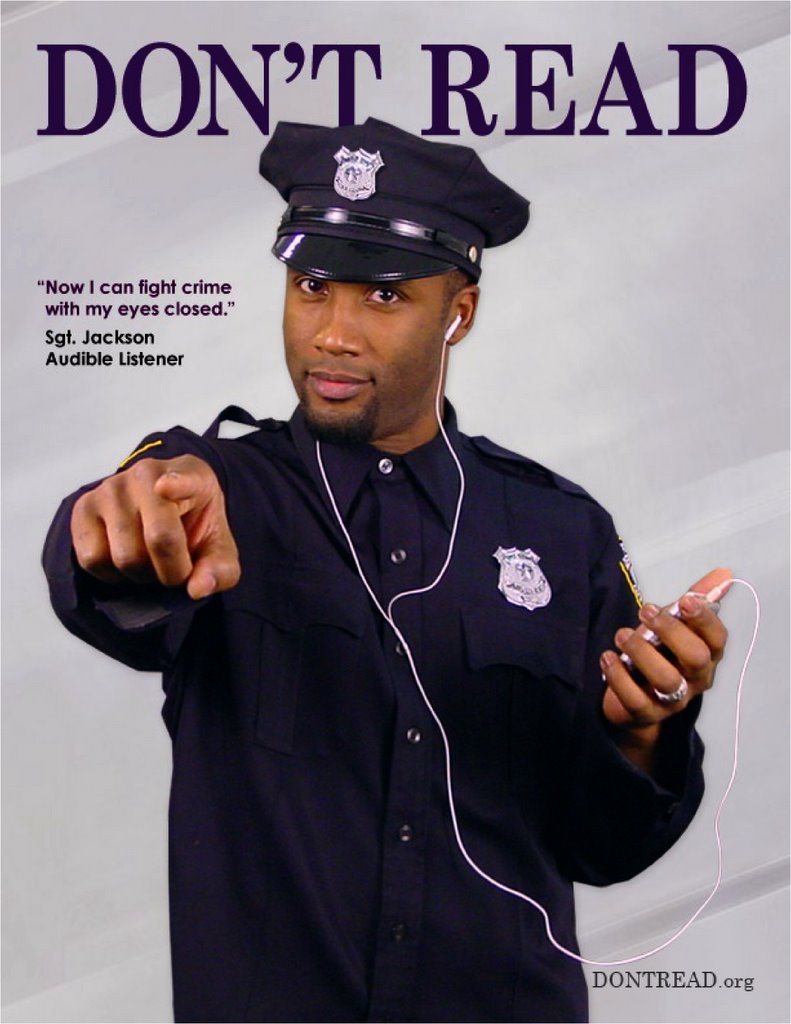

So, apparently the American Library Association sent a cease and desist letter alleging that Audible.com's Don't Read campaign "violates" the trademark of the ALA's "Read" campaign. Oh, ALA, how you have betrayed me! You're so good on copyright; wherefore are you making such a silly trademark claim?
Yesterday, as I was saving the Audible "Don't Read" posters, which were available from the website in PDF form, that feature was disabled, so I only got a few. I guess that change, which eliminates the version of the ads most like the ALA's poster-based campaign, was made in response to the threat letter, but I continue to see the "Don't Read" ads pop up on sites I visit.
I think the Don't Read campaign is icky, but that doesn't make it infringing. I do wonder about the use of a .org domain as the website, which seems a teeny bit misleading.
Thursday, January 12, 2006
False advertising over domain names
C.E. Petit pointed out this IPKat piece on Nominet's Australian victory against companies that mined data from Nominet's database of .uk registrants and then sent them what looked like official invoices, offering .com domain names. The decision, which I have not yet read, apparently rests both on the copyright in the database and on unfair trade practices. As might be expected, I think the former is silly (though it might well be within the law, if defendants extracted a substantial portion of the database contents) but the latter is sensible. As I understand it, this sort of invoice fraud happens with all sorts of basic business supplies.
Lawrence Lessig on Google Book Search
Lawrence Lessig has produced a typically impressive audiovisual presentation on Google Book Search as fair use He updates Wilde to point out that, in America, all men sue the thing they don't like.
Though I understand exactly why he does it, I began to get uncomfortable with his repeated references to Google's willingness to let copyright owners opt out of Book Search. (I understand why Google does it, too.) If Google's project is fair use, consent or objection should be irrelevant, right?
In a case in which a person selected a particular work to criticize or even just quote, the fact that the person refused an "opt-out" request from the copyright owner shouldn't affect the fair use analysis one jot. Is Lessig prepared to endorse the idea that large-scale digitization, where the transformation (if any) comes from turning individual objects into data for a search engine, should allow opt-out in order to be fair use? That's not a crazy principle by any means, but it is a different principle than that applicable to individual, non-aggregating fair uses.
AALS Section on Intellectual Property, part four
2006 AALS Meeting, Jan. 7
Section on Intellectual Property
Trademarks at the Supreme Court: Evolution or Revolution?
Jessica Litman’s theme was “Neither Evolution Nor Revolution.” Like Barton Beebe, she also surveyed Supreme Court trademark decisions over time, and in an illustration of the limits of empiricism came up with different results. The Supreme Court’s Lanham Act jurisprudence involves many unanimous rulings against trademark owners, about twice as many rulings against as for. Also, many pro-owner decisions end up with a narrower standard than what the lower courts had applied: Color is registrable, but not without a showing of secondary meaning. Before the Lanham Act, the pattern is similar. Outlier cases exist in all periods (e.g., Taco Cabana), but Litman finds 130 years of marked, often unanimous skepticism towards expansion.
She is always afraid that the Court is going to bollix IP cases. The Court has been unwilling to recognize the danger in metastatic copyright law, so it’s surprising to see it resist metastatic trademark law, especially since lower courts are equally vulnerable to calls to expand both. (Perhaps the Court thinks copyright is Congress’s business whereas the Lanham Act, with its basis in common law, is fair game for the Court to slice up.) The Supreme Court doesn’t pay much attention to lower courts, so when it looks at past cases it sees an unbroken line of precedent saying trademark is about competition, not incentives or free riding. And the precedent seems relevant because the trademark statute, unlike the Copyright Act, is substantially similar to the law in effect sixty years ago.
Sure, there have been some big changes -- intent to use being a major procedural change, but not one that altered the scope of trademark; dilution, ACPA, and treaty-based limits on geographic marks are others nibbling around the edges -- but the core is still the same. I’d also note, in support of Litman’s argument, that the trademark statute is still pretty much as compact as it was when enacted, whereas “metastatizing” is a fair description of the Copyright Act’s word count, reflecting a move from standards to technical rules that hasn’t penetrated very far in trademark.
But if all this is true, what’s up with the lower courts’ expansive interpretations, which make it easy to miss that Congress hasn’t changed the law much? Litman suggested that courts tend to see cases with copyright and patent claims alongside: They see trademark as a looser form of IP, so if copyright claims fail over some technicality – like the work being in the public domain [cue laughter] – trademark claims can still succeed.
The Supreme Court’s jurisprudence fails to constrain lower courts because each opinion leaves room to argue that courts should follow its rule only in narrow, factually identical circumstances. After each decision we see a lot of CLE and scholarship saying that whatever section of the Lanham Act was at issue should still be construed broadly – Dastar caused a huge epidemic of this reasoning. While Sears/Compco was enough to quash general unfair competition law for ten years, that’s not the case today.
Lower courts’ expansionism may not be completely pernicious. At least it keeps INTA from running to Congress with a 200-page wish list that would be opposed by the ACLU, Public Citizen, automobile insurers and nobody else.
My reaction is that INTA may have reached equipoise, at least with respect to rights granted against competitors if not rights granted against artists, critics and the like. The INTA wish list for dilution contains some major cutbacks in the scope of the right. Unlike the situation in copyright, where – even though all new works have their roots in earlier ones – expansive copyright systematically benefits entrenched interests, trademark battles routinely involve major companies on both sides. Although trademark, too, can be used against new entrants – think of the effect of a ban on using another’s mark in comparative advertising – repeat players tend to be both plaintiffs and defendants on a regular basis. Interestingly, Litman made the same argument with respect to false advertising law: Because it is so common for the same party to be on both sides of advertising cases, she said, we see more articulation of the competing principles instead of a unidirectional thrust to expand the law. I agree; the question is whether you’re comparing trademark law to copyright law (in which case the heavy legal firepower in the private sector looks much more balanced in comparison) or to advertising law (in which case the heavy legal firepower looks concentrated on the side of ownership claims in comparison).
Litman’s goal is to have courts remember why a narrow scope for trademark is a good thing. She wants to separate producer goodwill from product goodwill, so that trademark will protect the former but not the latter. She liked Laura Heymann’s argument about letting consumers choose, a rhetoric that hasn’t been invoked enough to date. We also should talk more about the interests of new market entrants in competing with established brands. My thought: The free speech claims we academics like to make, though usually in reference to noncommercial speech, are also very likely to be extended to competitors and even noncompetitors as the First Amendment provides ever more protection to commercial speech.
As I mentioned above, Litman sees potential for borrowing principles from false advertising law generally. I agree, with the same caution I expressed in the previous post: Consumer competencies with respect to evaluating trademarks may be much greater than with respect to other things. We should be careful about the feedback effects on false advertising law; I would hate to see consumers required to exercise as much care in evaluating misleading substantive claims as they should be in evaluating trademarks. I would also be very interested to hear Litman’s take on the relevance of doctrines like puffery to trademark. Some scholars claim that allowing puffery has a corrosive effect on overall consumer beliefs, leading us to discount all claims more or less equally and pushing us toward the inefficient and unhappy market for lemons. Do similar mechanisms operate in trademark?
AALS Section on Intellectual Property, part three
2006 AALS Meeting, Jan. 7
Section on Intellectual Property
Trademarks at the Supreme Court: Evolution or Revolution?
Laura Heymann spoke about the concept of the public domain in trademark law. She defined a trademark commons/public domain not by abandoned or genericized terms, or by a pool of shared expression, but by private parties’ ability or inability to control the meaning and associations of marks. That is, she was concerned not primarily with relations between competitors, but relations with consumers. We should recognize consumers’ capacity to negotiate multiple associations with marks rather than controlling the meanings to which they’re exposed.
Trademark meaning is not just made by producers, but by consumers whose intellectual dexterity lets them recognize what’s at stake. We can get the joke “Where’s the Beef?” in a political campaign, know what a swoosh on clothing means, know that Continental Airlines and Continental Bank aren’t the same. The public can select, accept or reject meanings. That playfulness is guided by advertising but still not fixed. We need to trust consumers to manage and negotiate meanings, and to make distinctions. (This reminds me very much of Ann Bartow’s work on trademark law’s gendered assumptions about consumers’ gullibility.) We should tolerate multiple associations with a mark; not all meaning should be controlled by trademark owners.
Though Heymann is no fan of Dastar’s reasoning, she notes that the Supreme Court at least placed trust in the consuming public to choose wisely. Relatedly, Dastar undercuts Boston Professional Hockey Ass'n v. Dallas Cap & Emblem, 510 F.2d 1004 (5th Cir. 1975), and other promotional goods cases in which the consumer wants to display allegiance to some group but doesn’t much care about the official endorsement of that group; the distinction between expressing allegiance and assuming endorsement is not too fine for an average consumer to make. Likewise, K.P. Permanent posits that, faced with two competing associations, one used as a trademark and one not used that way, courts need not step in because consumers can often tell the difference (or, at least, the existence of some confusion doesn’t justify legal intervention when the difference remains visible and useful to many other consumers).
In dilution, Moseley limits the cases in which consumers are thought not to distinguish marks. Just because one mark reminds a consumer of another doesn’t mean she will fail to separate the two. Indeed, often the second-comer depends on the consumer’s ability to make the distinction and thus get the joke, whether it’s Victor’s Secret or The Greatest Snow on Earth.
Returning to Dastar: Heymann thinks the court made a mistake about the role of attribution in copyright law (to wit, copyright doesn’t protect attribution, though authors may sometimes leverage their copyrights to get contractual protection). Though she wants to trust consumers generally, she sounded a cautionary note about the Court’s trust in consumers’ ability to sort matters out and not mistakenly buy both sets of tapes. That trust is warranted in some cases, especially parodies, but by refusing to consider the possibility of deception at all, the Court put too much burden on consumers. Traditionally courts have held consumers of high-end goods to a higher standard of care, but in Dastar that’s extended to a mass market video and in Moseley to adult novelties.
Given that the war buffs I know tend to have dozens of books about the same events, I find it easy to believe that most consumers of WWII videos who’d consider buying two sets wouldn’t mind some repetition. If it’s just a case of slipping them into different sleeves, as Morrissey sings, that could be deceptive – but the Supreme Court seems to have preserved the possibility of a false advertising claim under such circumstances.
Heymann ended with the suggestion that the trust in consumers displayed in Dastar and K.P. Permanent might affect initial interest confusion, which evidences a lack of faith in consumers’ ability to sort things out for themselves. That would be a great result. My take: In false advertising law, consumers are often held to too high a standard in judging substantive matters – reading nutrition claims, for instance – when they have no relevant expertise. At the same time, trademark law presumes that the very same people are easily confused in an arena in which we are all experts: modern marketing practices.
AALS Section on Intellectual Property, part two
2006 AALS Meeting, Jan. 7
Section on Intellectual Property
Trademarks at the Supreme Court: Evolution or Revolution?
Graeme Dinwoodie began by saying that the Court’s decisions looked slow and cautious, filled with routine textual interpretation – even if you think the result in Moseley is strange, the tools used to reach it are familiar. It’s tempting to see a conscious attempt to change the law by finding for defendants, especially given the strained logic of some of the cases, not to mention the important role played by Justice Scalia’s view about what consumers look for when they go to stores. (I bet Scalia does know what it’s like to shop for himself a bit more than George H.W. Bush did, but Dinwoodie’s point is still fair.)
The dicta give more clues to what the Court wants, but the themes are consistent with classical trademark theory. Prudential concerns abound: the Court seeks to promote commercial certainty, as in Wal-Mart, where the secondary meaning requirement was designed to prevent costly litigation, and Dastar, where the concern was that the defendant was likely to get sued no matter what it did as long as failure to attribute was actionable. In K.P. Permanent, the Court didn’t want to burden people with surveys if they could rely in good faith on fair use.
Given recent opinions’ brevity and incoherence, they raise more questions than they answer (which, I hasten to point out, is true in most areas of the law these days; the Court grants cert to deal with circuit splits, then dodges the question or creates a new rationale that itself requires interpretation – trademark is by no means unique). In K.P. Permanent, this incoherence allowed the 9th Circuit to ignore the decision on remand. In Traffix, the questions include how the two tests for functionality (competitive necessity/cost or quality) relate and how, if at all, one rebuts the evidentiary inference generated by an expired utility patent.
Competitiveness has always been a central part of trademark, as is avoiding bad interactions with copyright and patent law. K.P. Permanent’s conclusion that we can live with some level of confusion is thus consistent with functionality doctrine and not tremendously radical.
It’s true that trademark law has expanded since Kellogg and Sears/Compco. So is the Supreme Court pushing a version of “trademark law in exile”? No, there’s no revolution at hand. Much of the expansion was justified by changes in the social and commercial environment, but courts never fully jettisoned common-law principles. The Lanham Act was just supposed to make the common law easier to apply, and courts have always been willing to impose limits on its scope.
We should also remember that the Supreme Court cases are not really about the bulk of trademark law. The recent haul includes two trade dress cases (when most marks are word marks); dilution (only for famous marks, a small subset even if fame is construed broadly); public domain works; fair use where likely confusion is shown – these aren’t core trademark issues, which are fact-intensive. They are important as signals of how the ordinary tests should be applied, though, and Dinwoodie thinks such signals matter. The Third Circuit’s recent Lending Tree decision, for example, extended K.P. Permanent to nominative fair use (I would note that a panel in the 9th Circuit had already determined that nominative use trumped likely confusion, though what a precedent on nominative use means in the 9th Circuit is anybody’s bet). Courts are likewise following the Supreme Court’s signals in trade dress, finding configurations to be product design instead of packaging where the classification is contested.
In the long term, Dinwoodie foresees more deviations back towards expansion. The biggest thing to fear is the assimilation of unfair competition to trademark, so that any free-riding becomes infringement. A major problem is that the Court’s analytic tools are too blunt to deal with trademark’s current goals, which, as Barton Beebe noted, deal with expression and identity, not just search costs.
AALS Section on Intellectual Property, part one
2006 AALS Meeting, Jan. 7
Section on Intellectual Property
Trademarks at the Supreme Court: Evolution or Revolution?
My notes only – I understand that podcasts will eventually be available at the AALS website.
Barton Beebe began by saying that we are in the fourth wave of trademarks, in which the brand is a symbol of itself and everything is branded, including every product feature and tagline. Everything is distinctive of itself – it has an identity or at least could have an identity -- and this seems to occur spontaneously, a process he called semiogenesis (if I understood him correctly). TRIPS, which allows assigment of marks in gross, recognizes this detachment of mark from underlying product, though the US may not have fully incorporated that particular change into law yet.
Beebe traced the legal recognition of this phenomenon to Breyer in Qualitex, who refused ontological distinctions and said anything can be a mark. The new subject matter of trademark is not products or services but meaning itself. This is the key to the recent wave of Supreme Court case law, which, with the exception of K.P. Permanent and Moseley, concerns what can count as a mark rather than issues such as infringement, assignability, etc.
What’s the Court’s response to the potentially infinite expansion of non-ontologically-defined trademarks? Functionality or efficiency are the limits offered. The Court’s opinions tend to be terse and conclusory – there have been no dissents beginning with Two Pesos. Dissents were pretty scarce before that, too, present in Bulova, Park ‘n Fly, and Kellogg, but no others in Beebe’s survey.
Why such unanimity? Two Pesos and Qualitex came back to haunt the Court in Wal-Mart and Traffix respectively. The Court in recent years has thus been burned badly by what appears to be a small field but has lots of confusion. In Moseley, the Court spent a little time on the issue and got out. No one wants to write another disaster. (I’m not sure this is anything but a recipe for another disaster; Beebe may well agree, but he didn’t comment.)
The panel’s title indicates a perception that the Court is cutting back on trademark rights, but it could have been even more restrictionist in results. Has Moseley, for example, made any difference in lower courts? Beebe alleged that courts were already hostile to dilution before the Supreme Court acted.
I must disagree; having clerked in the Third Circuit, with its awful Sporting News decision, I’d say that lower courts were deeply divided about dilution, with some handing out plaintiffs’ verdicts on very thin reasoning. I haven’t checked recently, but at least for a year after Moseley I found no reported cases in which a dilution claim succeeded that didn’t also involve a successful infringement claim, which suggests to me that lower courts responded aggressively to the Supreme Court’s anti-dilution signal. (And by the way, it’s pretty wacky how state dilution claims get dragged around by the scruff of their necks in this process, with courts routinely saying “the analysis is the same” based on circuit precedent that preceded Moseley’s declaration that state and federal dilution claims are very different creatures.)
But Beebe’s broader point is more persuasive – he argued that the Court could have insisted on an explanation for trademark rights founded in search costs rather than accepting the overall expansion. Slowing that expansion doesn’t count as restrictionist in his book.
What about Dastar? People have read it as an apology for Eldred. Beebe thinks the Court rendered “origin” in the Lanham Act meaningless. Contrary to what the Court said, origin need not refer to a producer. In modern trademark, Beebe argued, a mark is essentially a certification mark. Dastar illustrates the whack-a-mole approach of the Supreme Court: each case solves a single problem, but that creates problems for the rest of the doctrine. (I wonder if the metaphor of epicycles helps here; is trademark’s Copernicus anywhere out there?)
Beebe ended by talking about a particular kind of commodity fetishism. Modern marketing encourages us to assume the natural existence of products: they just appear on store shelves, with no need to trace origin or investigate conditions of production. Trademarks are about speaking to us, not about product origin. Dastar did nothing to attack this basic arrangement.
AALS Section on Law and Anthropology, part four
2006 AALS Meeting, Jan. 6
Section on Law and Anthropology
A Cultural Analysis of Intellectual Property
Alexander Bauer, an anthropologist from the School of International Affairs at George Washington University, bravely ventured among the lawyers. He spoke about the lack of protection for cultural property.
Cultural appropriation, mutilation, and commercialization are all threatening to traditional cultures, which are swept up into fusion cuisine and world music and the like. In the past, cultural protection policy has overemphasized tangibles and ownership, as with the Elgin Marbles. “Cultural heritage” may be a better term than “cultural property” for explaining the subject of concern. IP rights are also not good enough, because their time and scope limits leave too much in the public domain for others’ appropriation.
UNESCO requires states to draw up lists of cultural resources and make plans to protect them. But the intervention of law can destroy what it’s supposed to preserve. State policies often require the definition of authentic culture and the adoption of correct practices, which can destroy the practices of those who don’t quite meet the standards of official approval and can calcify an evolving culture.
One example is the Indian Arts & Crafts law, which essentialized the notion of Indian artists, excluding people without official tribal memberships, and also essentialized appropriate subjects for Indian art. Law tends to lead to objectification and commodification of what was supposed to be protected. (Similarly, I wonder whether the greater identifiability and manipulability of artifacts pushes cultural preservation policy in the direction of identifying things rather than practices.) What’s particularly painful about this is how preservation isolates art from dynamic change, the kind of creativity that produced the tradition in the first place.
What are the interests we want to protect? (1) Control (authenticity, integrity, secrecy/sacredness); (2) acknowledgement or proper credit; (3) just compensation – this last is often not as important or is valued only in reaction to perceived Western rapaciousness.
What are the solutions? IP, as noted above, fails because it protects individual rights in specific, novel creations for limited times. Sui generis laws? They struggle with cultural changes and with who’s authorized to do what. Defensive disclosures and prior art databases can at least help with interest (2) and parts of (1). But even proper credit is dicey – oftentimes neighboring groups have competing claims to the same knowledge. Moral rights legislation, as proposed in Australia? That would address (1) and (2).
But what gets lost is that culture always moves, for all that people are committed to the version they know. It is difficult and often detrimental to compartmentalize cultures, which are often products of contact with others, as the use of tomatoes in Italian food or wool for Navajo blankets shows. Law may not be the answer.
AALS Section on Law and Anthropology, part three
2006 AALS Meeting, Jan. 6
Section on Law and Anthropology
A Cultural Analysis of Intellectual Property
Susan Scafidi summarizes her participation on the panel at her blog. I will add a few comments.
According to Scafidi, the value IP is charged with supporting is creativity, which, unlike equality, autonomy, and democracy, cannot be mandated or well-defined. I agree with everything except the parts about equality, autonomy, and democracy, which have their own problems of definition and preservation through legal structure. But I did very much like Scafidi’s explanation of the basic tension in IP law: Creativity is only successful if good ideas are copied.
Our cultural values are revealed by and embedded in decisions about what kinds of creativity get legal protection. Some things (like fashion) are generally excluded from IP protection, decreasing their economic and cultural value, for reasons tied to race, class, and gender. I particularly liked Scafidi’s discussion of how class and gender popped up in policy debates: People who opposed extending IP rights to fashion in the 1930s asked rhetorically what the poor working girl would wear, but neglected to ask what the poor working girl would read.
Mark Lemley argued in the comments period that we should not fall into the trap of “if value, then right.” Specifically, fashion’s economic value could be increased by refusal to protect, and I think that’s right, but Scafidi’s point about cultural value – and about why we’re so kind to fashion when we ruthlessly grant copyright and patent protection to software – is still valid. Moreover, Lemley’s argument is systemic: the overall value of fashion as an economic sector may be higher because no one can take monopoly profits based on legal rights to exclude. But highly creative individuals within that sector may make less money because we’ve judged their creativity to be less worthy of protection than the advances made by individuals in other creative fields.
The gender aspects of the problem are the most salient for me. Low-protectionists like me are comfortable with the argument that people will create art even without legal protection because of the intrinsic, reputational, and other non-copyright rewards for creativity. Empirically, this is true. Nonetheless, when you start to compare fields that get IP protection (software, sculpture) with fields that don’t (fashion, cooking, sewing), it becomes uncomfortably obvious that our cultural policy has expected women’s endeavors to generate surplus creativity but has assumed that men’s endeavors require compensation, just as our society has expected women to do the hard work of raising children and keeping house out of love and duty but not expected men to show up at the factory for the same reasons. Propertization of work done out of love would lead to the horrors of the market (bravely borne by men) – where have we heard that before?
Lemley invoked the principle that ideas are too important to be protected by monopoly IP rights. Although I agree with him, even if Scafidi was understood to be arguing for equalizing protection upwards, nothing she said suggested that ideas should be protected – a dress is no more (and no less) an idea than a painting.
I agree with Lemley that the solution is probably not to grant new IP rights in traditionally excluded areas but to decrease the rights available to other kinds of creativity. But somehow I don’t see that happening any time soon. This is the kind of dilemma Catharine MacKinnon described when she analyzed the conflict between equality and difference feminism. Where, I wonder, is the dominance theory of IP?
Wednesday, January 11, 2006
AALS Section on Law and Anthropology, part two
2006 AALS Meeting, Jan. 6
Section on Law and Anthropology
A Cultural Analysis of Intellectual Property
Sonia Katyal returned to discuss the relationship between the cultural analysis of IP and other approaches. She began with the initial reaction to the Chicago social norms theorists and the debate over whether this was new or just recycled insights. (Given my theoretical approach to originality, which is somewhat similar to that found in Ecclesiastes, I find this dispute almost meaningless; the question I’d ask is whether the social norms folks offered tools and concepts that were good to think with.) There’s been a similar debate in IP for years, focused on what economic incentive theory has to offer. Interdisciplinarity can help.
Katyal identified trademark law as a field where the limitations as well as the possibilities of economics are visible. Trademarks exist, dominant legal theory tells us, for the benefit of the public, but trademarks carry excess meaning: They support multiple simultaneous non-exclusive identities. (I’m not entirely sure what this means – is it that the person wearing branded apparel tells us something about himself, a meaning that is enriched, complicated, or even contradicted by other contextual elements, like location, physical appearance, or other brands? Or is it that various trademarks – American, “Where’s the Beef?” – have multiple meanings depending on the contexts in which they appear? Or something else?)
The official story of trademark is that branding is socially valuable. It facilitates information transfer, closely identifying a product with its source. In economic theory, a trademark is a way to promote efficiency. Against this theory, what role does cultural analysis have?
Here Katyal invoked the work of Barton Beebe on the semiotics of trademark. The economic approach fails to explain doctrines like dilution and distinctiveness. Trademarks are themselves status-signalling goods, and this social meaning – the meaning invoked when you wear a Coke T-shirt or, for that matter, one that says Enjoy Cocaine – is protected by law.

Trademarks function to draw consumers into relationships; they can work as floating signifiers that can be used for any purpose and don’t have to be tethered to any particular product. But, at the same time, trademarks don’t have to carry the owner’s meaning; they can be flipped (like Burberry’s adoption by chavs?). Social and cultural theory can help us understand why trademarks have become so powerful and how their meanings can be altered.
Katyal identified the recent Falwell case as one in which the court allowed the semiotic function of the term Falwell (or Fallwell) to remain floating. (I wasn’t clear on whether she thought the court’s reasoning followed the same paths semiotic theory would take.) A semiotic model of trademark pushes in the direction of a speech-oriented theory, whereas the economic model leads to a product-oriented theory.
Finally, Katyal suggested that the idea of corporate personality helps explain why corporations would invest in making marks meaningful beyond their products. And this – as one commenter pointed out – is why the normative thrust of adding semiotic theory to trademark law is less clear than you might first think, given the whiff of high academia about semiotics. Economic theorists have at least sometimes been skeptical of dilution and other extensions of trademark precisely because only core trademark infringement has an easy incentive/information story to tell. Semiotics explains why it would be worthwhile for a corporation to control meaning more broadly, even if the theory also suggests that such endeavors will often be futile. Corporate personality is the propertized (and smiling) face of semiotics.
Subscribe to:
Posts (Atom)


 Posts


