2006 AALS Meeting, Jan. 6
Section on Law and Anthropology
A Cultural Analysis of Intellectual Property
The panel was arranged by Madhavi Sunder, but was chaired in her absence by Mark Lemley. Standard disclaimer: this report is transcribed from my notes, not complete or necessarily completely accurate. With respect to Julie Cohen’s work in particular, I may have missed a helpful concept or two.
The basic topic was whether and how to construct a cultural analysis of IP that would counter the dominant economic analysis. A better, and longer, description is available at the AALS site (scroll down).
My colleague Julie Cohen began by talking about the recent methodological debate of which the panel was a part. IP has had a fairly insular debate over whether one should start with a law and economics view or a natural rights view; law and economics has been opposed to deontological, Lockean, individual-oriented theories of IP rights. With those two theories setting the terms of the debate, natural rights theories have made the case for the self while law and economics presents itself as looking at overall structure and society. Economics, however, also refers ultimately to the individual by making individual preferences king; one needs a theory of utility to make sense of the rest of the analysis.
(Wendy Gordon, in the comments period, referred to her own work building a Lockean case for IP limitations. I think the dominant meaning of natural rights has been IP expansionism, just as the dominant meaning of law and economics has been IP expansionism; within both theories there is room to criticize the relentless growth of IP, and Gordon’s work is the foremost example of that criticism within the natural rights tradition.)
The natural rights v. law and economics divide ignores social and cultural theory, which can talk about other things. Such theories are empiricist in orientation, focusing on thick description of cultural practices. They promise insights not so much into the behavior of cultural goods after production (supply and demand), but into the process of creation. One still needs a normative argument at the end of the day, but social and cultural theory have rigorous tools to bring to the table (to the shop?).
What can these theories add? (1) Attention to the endogeneity not just of preferences but of processes and products as well; the world looks different under regimes that enable different kinds of practices. (2) Focus on everyday practices that contribute to the production of creative and intellectual culture. (3) Attention to processes of creation that are relational, that involve networks of individuals, artifacts, and groups. Cohen mentioned narrative and myth, spatiality and physicality – you make new things by using what’s around you, which often involves creative and unpredictable play. This type of creation is hard to model in law and economics because of its lack of intentionality, and hard for natural rights theories to comprehend for similar reasons (and perhaps because of its incrementalism; it is both accidental and cumulative).
Cohen’s preference is for using the toolkit from science and technology studies (STS). STS builds on Kuhn’s central insight, the paradigmatic quality of scientific knowledge; artistic practices also evolve cyclically. STS has as a central concern how artifacts are configured for everyday life and how they configure the user. (I have a piece on libraries coming out soon that relates to this, including how the metaphor of DRM as “speed bump” turns out to be richer than you might think – speed bumps themselves are highly contested technologies that have prompted the creation of technical workarounds, which then forces regulators back to using law to make sure people obey the rules.)
Cohen called her view a milder version of actor-network theory (ANT): Artifacts crystallize more or less durable relations of power; though they are not actors, they exert causal control over others in the network. Further work to be done: How do artistic works crystallize patterns of belief and practice?
Larry Lessig’s Code, Cohen said, does not make the same arguments as the ones she wants to see. The idea of code = law has become very technocratic and is used in debates over how to design technology for regulatory purposes. ANT is more about unintended consequences that, while not inevitable, come to seem natural and determined.
Wednesday, January 11, 2006


AALS Section on Art Law, part four
2006 AALS Meeting, Jan. 6, Section on Art Law
Art Law and Intellectual Property Law: Convergence and Conflict
K.J. Greene of Thomas Jefferson spoke about piracy, black appropriation, and copynorms. This is a series of thoughts, he said, that he is working through, so the connections between them may not yet be fully formed. He argued that considering the impact of intellectual property on black cultural productions and the treatment of black artists could offer opportunities to strengthen artists’ rights, improve antipiracy norms, and provide some atonement for what has been taken from black artists over the years.
He began by saying that the copyright system doesn’t address modes of black cultural production, for example by requiring fixation when black music is often improvisational. In addition (and perhaps at the other extreme), copyright’s low standard of originality, allowing minor variations to be copyrighted but affording no protection to ideas, means that black innovators end up contributing the “idea” that gets appropriated and commercialized by white artists. Formalities historically also posed problems for artists who didn’t know what they needed to do to retain rights. Thus, black artists have had value expropriated in a variety of ways, from the blues to now. Copyright today still hurts black artists – Public Enemy’s “wall of samples” effect can’t be repeated today because labels require clearance of all samples, which is impossible/prohibitively expensive to get.
As Larry Lessig has pointed out, the history of the copyright industries is that they use others’ creations without payment to jump-start the market; this is particularly true with black artists. If we consider compulsory licensing as a response to current problems, why not consider atonement? In reparations discussions generally, opponents often protest that it’s hard to identify who got screwed; that’s less true when we can point to artists who died or are struggling in poverty (one of Greene’s examples was Jelly Roll Morton).
As one measure of the importance of black artists to copyright, Greene noted how many big IP cases involve black artists. The leading case on fair use, Campbell, had black defendants; Murray v. Nat'l Broadcasting Co. Inc., 844 F.2d 988 (2d Cir.1988), the leading case on protection of ideas in New York is about the idea behind the Cosby Show; etc. I’d be very interested to hear him say more about cases in which both plaintiffs and defendants are black – including many of the sampling cases, Murray, and the Ringgold case on de minimis use.
One notable feature of this history, Greene said, is how many black artists have continued to create without being paid (though the relative return of art versus other occupations open to the artists might also have something to do with this).
Greene also argued that we should judge an IP regime by how it treats people at the bottom – I found this claim to be a provocative application of Rawlsian-type reasoning, and would love to see more discussion of it.
How does this link up to file-sharing? Both the RIAA and black artists face a situation of mass appropriation, though the RIAA is in this position because of technology, not legal regimes or discrimination. The RIAA confronts a culture of lawlessness: People think it is okay to download. The film and music industries are heavily implicated in the history of discrimination, and people who download often know this (though I'm not sure how many of them, especially the white ones, think they're striking some sort of reparative blow -- couldn't whites downloading black music be just another link in the chain of uncompensated appropriation?). Perhaps some moves towards atonement would help rehabilitate the content industries and help anticopying norms. Sometimes labels have offered token payments to expropriated artists, but Greene believes that more could be done.
AALS Art Law Panel, part three
2006 AALS Meeting, Jan. 6, Section on Art Law
Art Law and Intellectual Property Law: Convergence and Conflict
Christine Haight Farley addressed the question of commercial artistic speech, and whether there should be an exception in right of publicity/privacy law for such speech.
She spoke about the work of Philip-Lorca diCorcia, a critically acclaimed American photographer. Her summary: DiCorcia does street photography; many of his pictures look spontaneous but are actually highly staged. He uses hidden lights to give the photos an “eerie and cinematic glow,” capturing subjects, even in public, in deeply contemplative poses. The photos are voyeuristic, inviting us to construct a story about and analyze the psychology of his subjects.
DiCorcia took pictures of people walking through Times Square, without their knowledge or consent. He took thousands of pictures and selected a few for a show. Understandably, the subjects’ expressions are very natural. Blown up to monumental size, and captured by the special lighting that makes them look like they’re in a spotlight even in a photo taken during the day, they look like celebrities – giving a “cinematic gloss to a commonplace event,” Farley said.
The photographs sell for $20,000 each, and a catalog of the show sells for $30.
One of DiCorcia’s subjects was an 84-year-old Orthodox Jew. He sued the artist, the gallery, and the publishers of the catalog under New York’s statutory right of privacy/publicity, which requires written consent for advertising or trade use of a likeness. He is reportedly upset that the artist benefits financially from a photo of him, though he also objects to the creation of a graven image.
New York law makes an exception for “artistic expression.” But artistic expression is often done for profit, just like many other human activities. When art and commerce are both present, which shall prevail? Kozinski in the Barbie Girl case says art trumps commerce, while the Second Circuit has tended to balance the interests. Other cases just look at whether the artist is making money (here I presume Farley was referring to the Tony Twist case).
A dichotomy between art and profit is false: Artists do make money and they want to make money. Farley believes that courts do have to decide whether a contested work is art, but out of discomfort with judging art they usually seek to avoid it, leading to some sort of balancing. One way to avoid the problem is to beef up the requirements for what constitutes commercial speech, so that most things don’t qualify (and then only apply publicity law to commercial speech); she likes this approach. There’s a mess now in terms of the definition of commercial speech, which Congress is trying to address in reworking dilution law. It’s hard to state a consistent principle in statutory language.
In Farley’s opinion, focusing on what is art would make for easier cases. Barbara Kruger’s composite art, for example, clearly qualifies: It’s shown in the Whitney, people react to it as art, etc. But what about the harder cases? We need a clearer rule about what’s a potentially infringing commercial use. Trademark law has historically been clearer than copyright about this.
In the comments period, Glynn Lunney asked about the difference between diCorcia’s work and Girls Gone Wild, a video series that has generated right of privacy claims from young women who didn’t expect their Bourbon Street antics to end up in neighbors’ living rooms. Farley doesn’t want to protect Girls Gone Wild, even though it’s film. She’d prefer to use some distinction like the (presumably thin) resume of the filmmakers or their desire to sell an infinite number of copies instead of being satisfied with a limited edition.
I don’t find these distinctions persuasive (though I note that Farley did not have a chance to develop her points, since everyone was working very hard to stay within the allotted time). A lack of current recognition/pedigree shouldn’t matter, since it’s both over- and under-inclusive in terms of artistic merit -- the over-inclusiveness is usually overlooked in these debates, but I think it’s important too. Likewise, the number of copies doesn’t seem that important to me: Is art only available to an elite? Is Tropic of Cancer not art? Contrariwise, wouldn’t the publisher of diCorcia’s catalog have been happy to sell a million copies? Couldn’t Girls Gone Wild produce a limited edition “Best Of”?
Tuesday, January 10, 2006
AALS Art Law Panel, part two
2006 AALS Meeting, Jan. 6, Section on Art Law
Art Law and Intellectual Property Law: Convergence and Conflict
Sonia Katyal spoke on artistic disobedience and market failure. She argued, as part of a larger project with her colleague Eduardo Peñalver, that disobedience could have a productive effect, highlighting the need for change in overly restrictive IP law. Conscious challenge to law can thereby produce dynamic legal changes in entitlements through legislative and judicial actions. Disobedience, in other words, can be a signal that a market failure has occurred.
In Campbell v. Acuff-Rose, the Supreme Court intervened to cure a market failure relating to transformative use (and it’s useful to remember that the case settled on remand). The copyright owner’s non-economic reasons for refusing to license parody were the relevant market failure; in this, Katyal’s analysis goes back to Wendy Gordon’s foundational work on fair use and market failure. I have to admit, I don’t quite get why non-economic reasons are evidence of market failure: Perhaps my personal valuation of my IP is just infinite; if I refused to sell you my house, even though you offered me three times the market value, because I really like my house, that wouldn’t be a market failure. In a world where parodies (and satires!) are increasingly licensed within large corporate groups, however, perhaps there is a story to tell about transaction costs in negotiating with independent/unknown/unfamiliar artists, though then the “parody” part seems less important than the general problem of negotiating over hard-to-predict value.
Katyal discussed several other similar cases of parodic/transformative use – The Wind Done Gone, the Food Chain Barbie case, Dungeon Dolls – and here I started to wonder why all these transformative fair use cases involve the sexualization and mockery of women’s (or dolls’) bodies. (The Naked Gun case, the Starballz case, and the Barbie Girl case are the same.) In fair use cases, sexualizing a text is treated as automatically constituting relevant commentary on the original. By contrast, adding in violence may well not be transformative, as with The Cat NOT in the Hat! -- I’m willing to bet that making the Cat in the Hat a child molester instead of just a spouse-killer would have counted as fair use -- though the “Chicken Step on Barney” case shows that adding violence can be the foundation of a successful fair use.
But I digress – Katyal then turned to the historical precedent of situationist art, which posed theatrical challenges to consumerism, attempting to pierce the veil of the society of spectacle. (I really like the idea of a book with a sandpaper cover, such that it would destroy the other books on the shelf with it – sort of like really buggy DRM.) A more modern example would be the Grey Album day of disobedience during which people were encouraged to download the mashup of the Beatles’ White Album and Jay-Z’s Black Album.
Resistant art of this type, if it incorporates copyrighted works, does so without permission, but is also not likely to be considered transformative because of its lack of direct critical commentary on the original; at most, it will recontextualize the original, like putting a urinal in an art gallery. Katyal pointed out that copyright law’s two kinds of “protection” – protection for the copyright owner against unauthorized copying, and protection from liability for the fair user – are two peaks on either side of a spectrum of uses, but there are also activities in the middle of the spectrum. Deliberately disobedient uses in this middle range may signal the need to reform copyright law, perhaps by compulsory licensing. Katyal’s paper Semiotic Disobedience discusses these issues in greater detail, though it doesn’t seem to be available at SSRN.
Finally, Katyal discussed the role of private underenforcement of copyright law. No one was sued over the Grey Album, despite some threatening noises (and despite the well-known willingness to litigate of the music industry). The formal system prohibits many types of appropriation, but informally copyright owners tolerate a lot, especially when public relations nightmares are at stake. The music industry has been willing to bear PR hits, but with the Grey Album apparently the copyright owners concluded that it wasn’t worthwhile to go after people who were only copying the mashups. I personally found the Grey Album only interesting as an experiment, not as music I’d like to listen to again; I expect most of the downloaders didn’t use it as a substitute for purchases of Jay-Z or Beatles albums.
Monday, January 09, 2006
AALS Section on Art Law, part one
Latest in a series of posts on the panels I attended at the Association of American Law Schools this year. My notes are not complete and record my own impressions; they may not accurately reflect everything that occurred.
2006 AALS Meeting, Jan. 6, Section on Art Law
Art Law and Intellectual Property Law: Convergence and Conflict
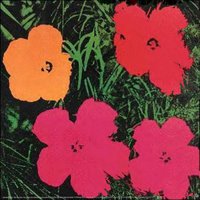
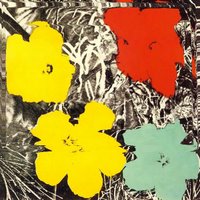
Cyrill P. Rigamonti, a research fellow at Harvard’s Berkman Center, spoke about net art and the theory of moral rights. He used the example of Cornelia Sollfrank, a German artist who commissioned a program called the net art generator. It creates pictures based on Google search results. You type in a search term; the program finds 4-8 matching pictures and manipulates them in various ways, with an element of randomness. The result is a composite picture plus information about the source pictures. Because of the random elements, the chance of creating the same picture twice is quite low. Sollfrank entered the same term again and again to create a themed set of pictures. She wanted to show a room full of the printed-out results, but the art gallery she worked with refused, because her pictures seemed to be unauthorized derivative works of Andy Warhol’s Flowers.
Andy Warhol's Flowers:

Rigamonti showed a picture of one of her results, and that seemed like an accurate characterization to me. I tried "Warhol flowers" at the art generator myself. The version I used, net art generator #3, allowed users to select 2, 4, 6 or 8 source pictures; this first set used 8:

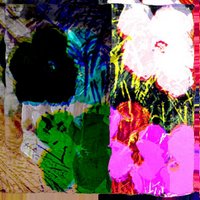
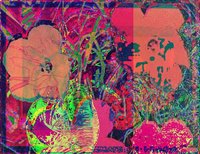
Using 2 images instead produced these results:
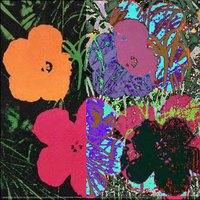
Though it's hard to see in the small version, that third has some neat distortion, but they're all pretty recognizably based on Warhol's Flowers.
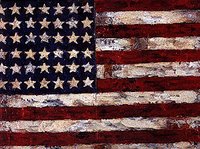
Warhol himself used Patricia Caulfield’s photo of flowers without permission to create his works; he settled the resulting copyright suit for $6000 in royalties (rejecting Warhol’s offer of 2 paintings instead; bad decision, or principled one?). Warhol also gave silkscreens to the appropriation artist Elaine Sturtevant, who used them to create works called “Warhol Flowers”; he apparently believed that she knew more about his technique than he did.
Sturtevant's Johns Flag (I couldn't find a picture of her Warhol Flowers):
Sollfrank’s response to the gallery’s concerns was to videotape four interviews with copyright lawyers reacting to the issue and showed them on four different screens for her exhibit, creating a babble effect.
Are such pictures derivative works? They were created by machines, thus perhaps lacking the necessary creative addition to qualify as independently copyrightable derivative works. Or perhaps we need some concept of co-authorship with the person who enters the search terms and the person who wrote the program.
According to Rigamonti, Sollfrank’s work challenges the theoretical foundation of moral rights – the claim that works embody an author’s personality or personhood. What are the functions of moral rights, and how should we think about them in the digital age? (1) Art preservation – though Germany doesn’t use moral rights for this purpose, as graffiti artists found out when they couldn’t protest the destruction of the painted Berlin Wall. (2) Copyright substitution, to allow continued authorial control if the author transfers economic rights. (3) Setting default or mandatory terms in copyright contracts; this matters if the accused infringer of moral rights is the copyright owner.
Rigamonti suggests that we should rethink these foundations, and particularly that we should examine how moral rights are used in practice instead of trying to cram all these objectives into one theory. Though I agree with this conclusion, I have to admit, I’m not too clear on how Sollfrank’s work operates as a challenge to moral rights: It seems like a devout moral rights proponent would be able to say that what she does isn’t art and therefore, though it can violate artists’ moral rights like any form of defacement, it can’t make competing claims to protection for Sollfrank’s personhood.
2006 AALS Meeting, Jan. 6, Section on Art Law
Art Law and Intellectual Property Law: Convergence and Conflict
Cyrill P. Rigamonti, a research fellow at Harvard’s Berkman Center, spoke about net art and the theory of moral rights. He used the example of Cornelia Sollfrank, a German artist who commissioned a program called the net art generator. It creates pictures based on Google search results. You type in a search term; the program finds 4-8 matching pictures and manipulates them in various ways, with an element of randomness. The result is a composite picture plus information about the source pictures. Because of the random elements, the chance of creating the same picture twice is quite low. Sollfrank entered the same term again and again to create a themed set of pictures. She wanted to show a room full of the printed-out results, but the art gallery she worked with refused, because her pictures seemed to be unauthorized derivative works of Andy Warhol’s Flowers.
Andy Warhol's Flowers:

Rigamonti showed a picture of one of her results, and that seemed like an accurate characterization to me. I tried "Warhol flowers" at the art generator myself. The version I used, net art generator #3, allowed users to select 2, 4, 6 or 8 source pictures; this first set used 8:


Using 2 images instead produced these results:


Though it's hard to see in the small version, that third has some neat distortion, but they're all pretty recognizably based on Warhol's Flowers.
Warhol himself used Patricia Caulfield’s photo of flowers without permission to create his works; he settled the resulting copyright suit for $6000 in royalties (rejecting Warhol’s offer of 2 paintings instead; bad decision, or principled one?). Warhol also gave silkscreens to the appropriation artist Elaine Sturtevant, who used them to create works called “Warhol Flowers”; he apparently believed that she knew more about his technique than he did.
Sturtevant's Johns Flag (I couldn't find a picture of her Warhol Flowers):

Sollfrank’s response to the gallery’s concerns was to videotape four interviews with copyright lawyers reacting to the issue and showed them on four different screens for her exhibit, creating a babble effect.
Are such pictures derivative works? They were created by machines, thus perhaps lacking the necessary creative addition to qualify as independently copyrightable derivative works. Or perhaps we need some concept of co-authorship with the person who enters the search terms and the person who wrote the program.
According to Rigamonti, Sollfrank’s work challenges the theoretical foundation of moral rights – the claim that works embody an author’s personality or personhood. What are the functions of moral rights, and how should we think about them in the digital age? (1) Art preservation – though Germany doesn’t use moral rights for this purpose, as graffiti artists found out when they couldn’t protest the destruction of the painted Berlin Wall. (2) Copyright substitution, to allow continued authorial control if the author transfers economic rights. (3) Setting default or mandatory terms in copyright contracts; this matters if the accused infringer of moral rights is the copyright owner.
Rigamonti suggests that we should rethink these foundations, and particularly that we should examine how moral rights are used in practice instead of trying to cram all these objectives into one theory. Though I agree with this conclusion, I have to admit, I’m not too clear on how Sollfrank’s work operates as a challenge to moral rights: It seems like a devout moral rights proponent would be able to say that what she does isn’t art and therefore, though it can violate artists’ moral rights like any form of defacement, it can’t make competing claims to protection for Sollfrank’s personhood.
Thirteen ways of looking at a gorilla
William Patry looks at the history of Ingagi, the "gorilla 'sex'" film that preceded RKO's King Kong and sees a copyright issue: the effect of prior sacrifice-a-girl-to-a-gorilla stories on the inevitable copyright infringement suits that attend successful films. (I learned about such suits as, "where there's a hit, there's a writ.") When I read the LA Times story, however, I was struck by Ingagi's role in the history of advertising law. Though widely denounced (and enjoyed) for its salacious exploitation of nudity in exotic Africa, what ultimately allowed legal action against the film's exhibition was the fact that it was falsely promoted as "authentic" when it was really made from stock footage and Hollywood locations. But the FTC didn't act until three years had passed, and it's not clear that audiences cared about authenticity as long as they got to see sex and violence.
Patent claims as the basis for false advertising claims -- or not
Chip-Mender, Inc. v. Sherwin-Williams Company, 2006 WL 13058 (N.D.Cal.)
Plaintiff sued defendant for patent infringement involving a touch-up paint pen. Defendant alleged a number of counterclaims, including state-law unfair competition and false advertising claims. The unfair competition claims based on plaintiff’s delay in licensing discussions and filing suit were dismissed because plaintiff’s acts didn’t threaten an incipient violation of antitrust law, didn’t violate the spirit of the antitrust law, and didn’t otherwise significantly harm competition, thus didn’t qualify as “unfair” under California state law.
Defendant also alleged that plaintiff’s attempts to license patents it knew or should have known were invalid and unenforceable constituted false advertising under California law. The statutory provision invoked by defendant, however, requires a false claim made with the intent to sell (or lease, etc.) real or personal property or to perform services, and patents are not real or personal property. Moreover, defendant’s counterclaim failed to allege facts indicating that the public, the group protected by the law, was likely to be deceived.
Defendant pointed to plaintiff’s website, which stated that the Chip-Mender pens were patented. But that’s true, until there’s a finding that the patents are invalid. The court did not address whether this claim was misleading; logically, if the patents are invalid the statement could well be misleading. Thus, this aspect of the court’s reasoning, unlike the rest, seems unsound. Other courts have held that false statements relating to patent matters can state false advertising claims under the Lanham Act. The court did not discuss these cases; perhaps the parties failed to bring them to its attention.
Finally, defendant made a counterclaim under the Ohio Deceptive Trade Practices Act, alleging the same facts as its California law-based claims. Ohio’s DTPA lists a variety of practices that violate the law, and defendant alleged that plaintiff’s statements "[r]epresent[] that goods or services have ... characteristics ... that [they] do[ ] not have ..." Again, the court relied on the fact that the patents have not been invalidated, and again this seems wrong.
My comment: an interesting attempt to use the differences between various state unfair trade practices laws to a claimant’s advantage. From what I can see, Ohio law should have offered defendant a potential for success under a theory of misleadingness – always depending, of course, on the invalidation of the patents in the same suit. Likewise, a Lanham Act claim might have been of assistance to the defendant-counterclaimant, if plaintiff's licensing attempts were sufficiently widespread to constitute "advertising or promotion." If defendant succeeds in invalidating the patents, does plaintiff instantly become a false advertiser? It seems likely, assuming the statement on the website is directed at potential customers and is material.
Sunday, January 08, 2006
The definition of commercial speech: hand me my leather
Katzkin Leather, Inc. v. Nissan North America, Inc., 2005 WL 3593999 (C.D.Cal.)
Plaintiff Katzkin makes aftermarket leather seat covers for many different kinds of cars. It sells to restylers, including a co-plaintiff, who install them in cars for auto dealers at customers’ request. Defendant Nissan has an approved aftermarket leather program (ALP) for some Nissan models, allowing Nissan dealers to buy aftermarket leather from approved vendors for installation by the vendors.
In 2003, in response to new federal air bag safety standards, Nissan began installing an “advanced” air bag in some cars. This air bag uses a pressure sensor in the seat to detect whether a child or an adult is in the front passenger seat and thus turns off the passenger-side air bag when a child is present. Nissan soon decided to exclude cars with the advanced air bag from its ALP, based on concerns that installation of aftermarket leather could cause an air bag malfunction, posing a safety hazard. Nissan didn’t conduct any tests to see whether this was true.
To get the word out to its dealers, Nissan issued a series of accessory bulletins on advanced air bags and aftermarket leather. Each bulletin stated that the removal of cars with advanced air bags from the ALP was necessary because the air bag was “specially designed and calibrated” to meet federal standards and modification of the seat could affect the pressure sensor. The bulletins also “strongly recommended” that dealers not install any aftermarket leather seats on cars with the advanced system, cautioning that modifications could require the dealers to have to recertify that the modified cars complied with safety standards.
Plaintiffs, alleging that Nissan’s motive was to sell more cars with factory leather by reducing the number of cars for which aftermarket leather is available, brought state and federal false advertising claims and common-law claims for interference with prospective economic advantage against Nissan.
The court granted summary judgment to Nissan. First, the advisory bulletins were not “advertising or promotion” under the Lanham Act. “Advertising or promotion” requires (1) commercial speech; (2) by a defendant who is in commercial competition with plaintiff; (3) for the purpose of influencing consumers to buy defendant's goods or services; (4) that is disseminated sufficiently to the relevant purchasing public. The first and third elements were at issue.
The bulletins were not classic advertising; nonetheless, they might constitute commercial speech. Important indicators of commercial speech are whether the bulletins (1) were in advertising format, (2) referred to a specific product, and (3) were made with an economic motive.
Notably, the court quoted the controversial Kasky v. Nike case, 45 P.3d 243 (Cal. 2002), holding that the bulletins were not in advertising format because they were not “speech about a product or service by a person who is offering that product or service at a price, directed to persons who may want, and be willing to pay for, that product or service.” Because the bulletins don’t mention Nissan’s factory leather seats, they aren’t in advertising format – they are solely directed at ALP safety concerns.
This seems shaky to me, for a variety of reasons. It seems from the discussion that dealers are either plaintiff's customers or at least intermediaries for car buyers who want aftermarket modifications. To the extent the bulletins disparage competitors’ products they serve the same purpose as bulletins touting Nissan’s own products. If a standard advertising campaign were divided into two parts – (1) ads that just criticize a competitor’s product and end with a sponsorship statement, like negative political ads, and (2) ads that affirmatively promote the advertiser’s product – I think most courts would agree that both (1) and (2) were commercial speech. Especially when Nissan’s speech is targeted to dealers who presumably know of the existence of factory-installed leather seats, it seems just like (1).
The court reasoned similarly that the bulletins didn’t refer to a specific product (Nissan’s factory leather seats). Nissan offered evidence that the reason it issued the bulletins really was a concern for safety, separate from promoting its factory leather seats. I have the same problem with this rationale – by stating that ALP seats could be dangerous, Nissan may have harmed its competition. Nissan’s legitimate concern might well aid the conclusion that its statements weren’t false, but it’s not a reason that its statements weren’t commercial speech. I would hope that most advertisers believe the factual claims they make, like the very scary OnStar ad I heard on the radio claiming that OnStar could save my life in an accident. Perhaps this goes to the “economic motive” factor, but the court is then at least double-counting here.
On to economic motive: The court bizarrely says that the bulletins didn’t recommend against using competitors’ products because they advised against using “any aftermarket leather seat covers,” but many of those are in fact the products of Nissan’s competitors in the seat cover market, so the fact that the bulletins didn’t use the magic words “our competitors” is not critical. Anyway, the court found no material dispute over Nissan’s motivations, which it found were safety-related rather than economic. Here we get into one of the criticisms of Kasky’s reliance on Nike’s motive to make itself look like a good corporate citizen: Almost everything a corporation does has an economic motive – charitable contributions polish corporate image; safety consciousness averts disastrous PR and lawsuits; etc.
But the court finally has a sensible story to tell – Nissan recommended against installing any aftermarket leather, including through Nissan’s own ALP. Nissan lost money by saying that cars with advanced airbags shouldn’t be in its own ALP. Before I was persuaded by this, I’d want to know whether Nissan would make as much or more money through installing factory leather in the non-ALP-eligible cars; it might be the case that factory leather has a high enough profit margin that Nissan – though not necessarily its dealers – profits from this decision even if the total number of leather seats installed in cars goes down. Still, the court goes on to find that there’s no evidence that the bulletins were meant to encourage the purchase of factory leather. The only evidence was offered by Nissan, claiming that the sole reason for the bulletins was safety concern.
Okay, so the bulletins weren’t commercial speech. The court isn’t done; it goes on to hold that the bulletins weren’t made for the purpose of influencing dealers to buy factory leather, which is a second reason they don’t count as “advertising or promotion.”
I’m not aware of much litigation on the “economic motive” aspect of defining commercial speech, but as we continue the post-Kasky expansion of First Amendment standards into advertising law, expect to see more of this – and therefore more arguments over whether discovery should be allowed or whether discovery’s costs would have such a chilling effect on corporate speech that it should be avoided. Frankly, if motive is an issue, I can’t see how discovery can be avoided, but it doesn't seem to have helped here.
Even if the bulletins had been advertising, the court ruled that Nissan would still win because there were no false statements of fact about anyone’s aftermarket leather seats. This is just plain wrong: under § 43(a)(1)(B) as amended in 1988, a plaintiff need only show false statements of fact about someone’s product, whether its own or the defendant’s. In this case, Nissan’s product was its cars and the allegedly false statement was about the safety of its cars combined with anyone’s aftermarket leather seats. Plaintiff and defendant are in competition, though defendant supplies a complement to one of plaintiff’s products. Imagine a supplement manufacturer who says “If you take our multivitamin, you shouldn’t take other iron supplements that aren’t specially formulated to work with our multivitamin because the interaction might be dangerous.” That’s a statement about both the manufacturer’s and competitors’ products. If it turns out that the manufacturer has its own specially formulated iron supplement to sell (as Nissan has factory leather seats to sell), this is a classic Lanham Act false advertising case even if the manufacturer also sells non-specially formulated supplements (like the ALP).
Of course, if the safety concerns are legitimate, Nissan should still win; and arguably plaintiff should have a high burden of showing falsity, given that safety is at issue.
The state law false advertising claims failed for the same reasons as the Lanham Act claim.
The interference with prospective economic advantage claims likewise failed. In order to state a claim for either intentional or negligent interference with prospective economic advantage, a plaintiff must show that the defendant not only knowingly interfered with the plaintiff's expectancy, but also engaged in conduct that was wrongful by some legal measure other than the fact of interference itself. Wrongfulness can include violation of a statute, regulation, rule of common law, or trade standards. Here, plaintiffs’ claims of wrongfulness were premised on the allegations that Nissan’s false advertising violated the Lanham Act and state law, and thus fall along with those allegations.
Note: this was a case where commercial disparagement claims, which are not limited to advertising, could have changed the analysis – but given the heightened fault/scienter requirements imposed on disparagement torts, query whether the outcome was likely to change.
California's false advertising law used to enforce federal banking law
Smith v. Wells Fargo Bank, N.A., 2005 WL 3588442 (Cal. Ct. App. 4th Dist.)
Sean Smith sued Wells Fargo (the Bank) over its Check Card policies, alleging that Wells Fargo, contrary to what it told customers, deliberately honored Check Card purchases that exceeded customers’ available balances in order to charge significant overdraft fees. This was a reversal of an earlier policy that transactions would be declined if there were insufficient funds in the customer’s account – unlike paper checks, Check Cards allow and indeed require the merchant to contact the bank before the transaction is complete. The Bank thus could have chosen to continue to decline authorizations for insufficient funds, resulting in immediate unhappiness and embarrassment for the consumer but saving him or her the fee. This policy change apparently promised additional revenues of between $120 and $145 million in overdraft fees per year.
Although Smith’s monthly account notice contained a statement about the Bank’s policy change, he was dissatisfied with the disclosure. He alleged that the new policy amounted to involuntary overdraft protection, contradicting marketing materials that claimed that overdraft protection was voluntary and that the Check Card operated like a credit card but without the extension of credit. In addition, he alleged that this conduct violated laws, including federal laws, that prohibit deceptive or misleading statements about financial services. The trial court ruled that federal bank regulations preempted Smith’s unfair competition, false advertising, and Consumer Legal Remedies Act (CLRA) claims. The court of appeals reversed.
Federal regulations require certain disclosures about account terms and notice of changes in those terms. The Truth in Savings Act (TISA) (12 U.S.C. § 4301 et seq.), has certain disclosure requirements for deposit fees charged by national banks, in order to allow consumers to make meaningful comparisons between competing products. Under governing regulations, state law requirements inconsistent with TISA are preempted, and 12 C.F.R. § 7.4007 states in relevant part that '[a] national bank may exercise its deposit-taking powers without regard to state law limitations concerning: ... disclosure requirements....' Nonetheless, the regulation also states that contract and tort claims are not preempted to the extent that they only incidentally affect banks’ deposit-taking powers.
Because Smith’s false advertising/unfair competition claims were based on a failure to disclose, the trial court concluded that they were preempted. On appeal, the Bank relied on express preemption under this regulation rather than arguing conflict or field preemption. The court of appeals pointed out that the Unfair Competition Law (UCL) defines "unfair competition" as "any unlawful, unfair or fraudulent business act or practice and unfair, deceptive, untrue or misleading advertising,” so that violations of other laws are actionable under the UCL, whether or not there is a private right of action for directly enforcing the other laws. “Virtually any law – federal, state or local – can serve as a predicate” for a UCL action.
Smith asserted that his UCL claim was not preempted to the extent it was based on the Bank’s alleged violations of federal disclosure requirements, and the court of appeals agreed. For instance, federal regulations require banks to disclose the amount of any fee that may be imposed in connection with an account, but the Bank’s notice of its policy change didn’t include notice of the amount. The Bank argued that 12 C.F.R. § 7.4007 nonetheless preempted the claim, but the court of appeals held that a violation of the UCL piggybacked on a violation of federal law was not a state law limitation; Smith’s claim sought only to enforce federal law using state-law means. Rather, the UCL claim can be seen as a tort law (predicated on federal law) with only an incidental effect on banking, and the same regulation that bans state-law disclosure requirements preserves state torts. Likewise, to the extent that his UCL claim is based on a systematic breach of the Bank’s contracts with its customers (which can be an unfair business practice), it is also not preempted, using similar reasoning. It followed that Smith’s false advertising and CLRA claims were not preempted. Indeed, Smith’s false advertising claims were separately preserved by 12 U.S.C. § 4302(e), which prohibits advertising about deposit accounts that is “inaccurate or misleading” or “misrepresents” deposit contracts.
The Bank additionally argued that its disclosures were adequate as a matter of law. The court of appeals found that summary judgment could not be granted; the facts were still in dispute.
My comment: this case demonstrates why companies often prefer federal regulation, at least when it’s exclusive. A single enforcer is more predictable and less aggressive than a multitude.
Ripoffreport.com loses section 230 defense
Via Eric Goldman, a case in which a court denies a defendant's claim for immunity based on Section 230 immunity for content providers. Ripoffreport.com collects gripes about companies and then offers those companies, for a fee, help resolving the complaints. Allegedly, ripoffreport.com provided some of the actionable website content itself rather than just relying on reports from others. The plaintiff's trademark claims were dismissed, since no one would confuse a gripe site with an official site, but common-law disparagement claims survived.
This is an example of the continuing importance of common-law disparagement as applied to statements not made by competitors in commercial advertising. (If the actionable content was generated by the website and not by disgruntled consumers, it's arguably commercial speech, given that ripoffreport.com then uses its criticisms to solicit business from the attacked company. But maybe not -- it would make an interesting review problem.) The First Amendment, however, imposes some significant limitations on common-law claims, so the plaintiff's task is far from over.
This is an example of the continuing importance of common-law disparagement as applied to statements not made by competitors in commercial advertising. (If the actionable content was generated by the website and not by disgruntled consumers, it's arguably commercial speech, given that ripoffreport.com then uses its criticisms to solicit business from the attacked company. But maybe not -- it would make an interesting review problem.) The First Amendment, however, imposes some significant limitations on common-law claims, so the plaintiff's task is far from over.
Saturday, January 07, 2006
AALS Annual Meeting, Section on IP, part five
Final post, the comments period. Again, I emphasize that these are my notes, not a transcript. Eventually, I'm told, a podcast will be available at aals.org.
Mark Lemley suggested that Grokster's impact on small and large companies would differ. There might be discrimination against small companies (which can't make deals with content owners, and which may only have one product & thus look more like a bad actor if that product is used for infringement compared to the same product from AOL). Small companies also don't know not to make a bad record because they're not extensively advised by counsel -- if Justin Hughes is right, only large companies pay attention to the law at the programming stage, though the law may pay attention to them at other stages. (My comment: I think there's a small-cap valley -- tech from programmers with no major commercial aspirations will pay no attention to the liability standard; big firms will pay so much attention that they won't get sued because they'll cut deals beforehand; small firms may get hammered in court.)
Lemley also worried about bleedback from Grokster into patent law, where currently selling a device with bad intent isn't enough to justify inducement liability. Justin Hughes suggested that this was unlikely, since there's already a disconnect between copyright and patent about what substantial noninfringing use is, so the two areas of law haven't done much borrowing beyond the very general terms of contributory liability. Neil Netanel added that, with an already-extant body of law on what constitutes patent infringement inducement, there probably wouldn't be much push to borrow from copyright.
In response to a question I didn't make notes on, Wendy Gordon observed that the distribution right really is contributory liability without fault -- it allows you to go after the store owner who thought he was selling legitimate products. Congress decided it was necessary to be able to go after that type of person easily even without knowledge or fault. I'm not sure what that means for other kinds of liability, but I thought it was a neat point.
AALS Annual Meeting, Section on IP, part four
Justin Hughes: Hughes argued that courts and legislatures around the world have found similar intent-based solutions to the contributory infringement problem, suggesting that (1) it might be a good solution after all and (2) in any event, it won't leave the US at a competitive disadvantage in technology (my note: this is true only if you assume that US tech developers will develop the same kinds of new applications as other developers, but I have no reason to doubt that).
He started by noting that the much-reported decision of the French Assembly to legalize downloading for a monthly fee was a 30-28 vote in a 577-member house, so maybe it won't go much further than that. As he later elaborated, in France, the right of private copying exists but is limited to cases in which the copier already owns a copy, so you can't make a copy for a friend. Two recent court decisions in the past year, though, refused to find someone liable for downloading. The vote was to expand the right of private copying explicitly to encompass this situation. The trouble is, Hughes suggested, that the levy system that is part and parcel of the private copying right is flawed, especially from an American perspective. The current levy, imposed on blank media, is given to the French collecting societies. They take 25% off the top for administration (and apparently have very nice lunches as a result). Another 25% funds French cultural activities. The remaining 50% goes to French artists ... even when the private copy is a copy of an Eminem CD. So, the distribution problems are enormous and Americans typically get screwed.
Turning back home, Hughes argued that the Grokster Court did what courts do, which is remind us that law includes notions of justice, one of the most powerful of which is that people with bad intent should suffer. This was, in his opinion, the right result -- rather than trying to make industrial policy as Neil Netanel suggested, the court was more modest. Businesses can use intent as a guide with some confidence; they do so in antitrust and trademark (here Hughes referred to his colleague Barton Beebe's study of trademark cases in which intent emerged as the single most important factor in explaining infringement case outcomes). Instead of decrying Grokster's effects on technology, we can study them -- he suggested that law professors were overly concerned because we're trying to tell ourselves that what we do is important, whereas most actual businesses don't know squat about IP and don't make business decisions based on fears of liability.
Moreover, Grokster's doctrinal weirdness (as discussed by Wendy Gordon) stems from the fact that Sony was weird in the first place. The Supreme Court, just a few years after the new Copyright Act came into effect with no express provisions about contributory liability, created a new kind of liability. There is some legislative history suggesting that the Act does contemplate contributory liability, but it would have been at least as sensible to say that the existence of contributory liability provisions in the patent law, which was revised during the same period as the copyright law, justified the negative inference that no such liability was appropriate in copyright. Congress plainly knew how to write a contributory liability provision if it wanted to, and it didn't. Instead, the Court borrowed from patent law -- but only part of patent law, not inducement. Grokster thus stands as a course correction on an already weird path.
Comparatively speaking, there has been convergence on contributory liability; courts and legislatures have used some combination of causation, knowledge and intent to judge liability. (Hughes suggested that Sony could be seen as a reverse causation case: if a technology causes substantial noninfringing use, it wins.) In Singapore, for example, "authorization" is the offense of P2P networks -- such networks are liable because they create an impression of authorization to reproduce and distribute works; this also incorporates a causation standard.
In 2003, there was a P2P case in Japan, the Rogue File case, which involved a centralized server like Napster's (the server was in Canada). Users had to agree not to infringe, and the network had a notice and takedown procedure. The Japanese court's analysis was like that in Grokster, holding that reproduction and transmissibility rights under Japanese law were both infringed. The appellate court in Tokyo adopted a balancing test taking into account the content and nature of the defendant's conduct, its ability to supervise infringement, and whether it profited from infringement. It used the language of inducement in its decision, and found that the defendant was liable because it provided the service although it "expected" infringement -- a really expansive standard, since one can expect results without intending them and even be very sorry they occurred. This illustrates how hard it is to draw the line between knowledge and intent, since it's always an exercise in mind-reading.
Another Japanese case is also instructive, the 2004 Winny case from Osaka. Winny is something like Fastrack and Gnutella; it has supernodes for P2P filesharing. According to Hughes, Winny creates a hard-to-find file on your system and caches things you didn't think you downloaded. The professor who developed Winny has been criminally indicted. So Grokster looks a little better in comparison if you worry about deterring tech.
Hughes also spoke about China's Baidu, a major search engine (not P2P). On the site, you could click a button that said "mp3s," and then a button that said "artists." A Chinese court said that this violated the distribution right.
According to Hughes, we copyright minimalists should relax a little.
AALS Annual Meeting, Section on IP, part three
Ray Ku: Should statutory damages be available in indirect infringement cases? Ku uses game theory to compare the incentives of tech companies, record companies, and individual artists, assuming that the content-owner pie is divided very heavily in record companies' favor. There turn out to be big problems with comparing values because the album pricing structure is entrenched but turns out not to be what people really want -- should we count one download as a foregone album, since people bought albums on the strength of singles, or as a foregone single? In any event, the benefits to the tech companies are different in magnitude from the harms to the content owners, which means that in a prisoner's dilemma, even iterated, tech companies may not have incentives to cooperate unless there's legal coercion.
On the other hand, the hugeness of statutory damages swings the pendulum very far in the other direction, giving content owners a really big stick to threaten with -- because many works will be involved, it's easy to aggregate trillion-dollar claims against tech companies. In the mp3.com case, for example, the plaintiffs ended up with a multiplier of several hundred thousand times more than actual damages (not sure how Ku calculates this, but I'm willing to accept it). Thus the availability of statutory damages in contributory damages cases discourages cooperation with tech providers.
On the other hand, the hugeness of statutory damages swings the pendulum very far in the other direction, giving content owners a really big stick to threaten with -- because many works will be involved, it's easy to aggregate trillion-dollar claims against tech companies. In the mp3.com case, for example, the plaintiffs ended up with a multiplier of several hundred thousand times more than actual damages (not sure how Ku calculates this, but I'm willing to accept it). Thus the availability of statutory damages in contributory damages cases discourages cooperation with tech providers.
AALS Annual Meeting, Section on IP, part two
The Direct and Indirect Infringement Issues Surrounding P2P: Sharing or Piracy?
Wendy Gordon: Gordon had problems with both the outcome and the intent standard of Grokster. She also tied her Grokster comments into a more general point about copyright's attitude towards putting people into others' shoes.
What is the meaning of decentralized networks? (1) From a copyright perspective, this network will never be fully integrated into a pay-for-play system. (2) From a democratic perspective, there is a legitimate fear of regimes strong enough to keep us separate and powerless using technology (my note: see, e.g., Chinese filtering). Samizdat was an example of decentralized distribution of dissent. We should frame our laws to avoid the biggest disasters, such as a situation in which it's too easy for a central group (government or not) to know what we're doing and nip dissent in the bud. This is what's important about technical capabilities: the future is a long time, and even if the tech is used to share top 40 songs now, it won't necessarily always be. (My note: music can be political, too, from campaign songs to today's Christian music, some of it put on P2P networks by believers trying to spread the Word.) We need these capabilities on people's computers long before repression materializes, or it will be too late.
Grokster took a bite out of Sony's safe harbor, since if there's inducement the fact that a technology is capable of substantial noninfringing uses is irrelevant, as Breyer's concurrence agreed. Tim Wu says the Court naturally steered a middle ground, being warned of apocalypse if it affirmed and if it abandoned Sony, but the middle ground does not avoid tradeoffs. Gordon thinks that the possibility of political domination outweighs a downturn in copyright revenue (which she thinks is not huge, since with a vastly increased world market, the percentage of value that needs to be recaptured to support the content industry is lower than it used to be and distribution costs are also decreasing). Political liberty is simply not fungible with revenues for copyright owners.
Gordon finds the Grokster intent standard weird because the copyright statute is strict liability generally. The law tries to further consequential aims, not to prohibit bad acts by free-riders (cf. Feist's statement that allowing free riding for unprotected elements is a deliberate part of the statutory/constitutional scheme). If we allow morally bad actors to go free in direct liability cases, adopting a moral test for contributory infringement is overbroad; also, it's not necessarily a moral wrong to help a group of people, some of whom are not committing wrongful acts.
Further, it's not always true that intent governs the moral evaluation of outcomes. Gordon gives the examples of Joseph's sale into slavery in Egypt and the invention of the internet as a warfighting technology. Sometimes, though, using intent to screen for liability makes sense even if we're not concerned with morals: (1) intent can be a proxy for the likelihood of success in causing harm; (2) intent relates to deterrence, since knowing or intentional acts are easier to deter than unknowing or unintentional ones; (3) intent may signal a higher private benefit; (4) intent may indicate a sadistic/exploitative mental state that has no social value; (5) an intent standard avoids some steering-clear costs by risk-averse folk that would be caused by strict liability; (6) intentional acts sometimes cause more harm to victims who know of the intent than unintentional ones; and (7) in copyright specifically, intent may be a proxy for bad/uncreative use of copyright. Note that many of these reasons compare an intent standard to a broader liability standard; they may not justify the existence of liability in the first place.
And, of course, intent can be difficult to discern and thus lead to more liability. Gordon referred to Grokster's famous footnote 12 -- Warhol said everyone would be famous for fifteen minutes, but instead everyone and everything is famous to fifteen people -- which says that, in the absence of other evidence, there can be no liability merely from failure to affirmatively control infringing acts. But Gordon thinks that limiting footnotes have rarely been taken up by the courts in copyright cases, giving the example of the Campbell footnote that suggests that courts should not issue injunctions in close transformative use cases. (I'd add the Campbell footnote saying that satire can indeed be fair use even if it's not as favored as parody, another footnote that has been much ignored.)
Finally, Gordon returned to the issue of standing in another's shoes. In fair use, you can't assert the fair use rights of the person for whom you're acting, as when a copy shop makes copies on behalf of students. This makes sense, she said, because the economic effects of different actors are different. In practical terms, more copying will be done when the copy shop does it than when individual students do it. (Though I have to wonder -- if this is true, is it really evidence of market harm or evidence that a licensing right is of more value to the copyright owner when copy shops show up? Probably most of that copying wouldn't have gotten done at all without the copy shop, but it probably wouldn't have been replaced by purchases of the materials -- the students just wouldn't have read the works or would have gotten them from the library, if the instructor had assigned them at all, which is less likely in a world without easy copying.) Anyway, Gordon suggested that the copyright rule was inconsistent with corrective justice, which says you look at acts and not identities, and that Grokster increased the tensions in copyright law on this point. (Is it really the same act when the copy shop copies for profit for someone else's use and when the student copies for her own education? It's been a long time since Jules Coleman's torts class.)
AALS Annual Meeting, Section on IP, part one
This year's IP panels at the Association of American Law Schools were uniformly high-quality and provocative. I'm going to post my notes, which are of course filtered through my preconceptions.
Thursday, Jan. 5
Section on Intellectual Property,
Co-Sponsored by Section on Law and Computers
The Direct and Indirect Infringement Issues Surrounding P2P: Sharing or Piracy?
Neil Netanel, UCLA: He ran through the holding, concurrences, and open issues of Grokster. The Court put aside the issues of supplying a multiuse product generally (what is "substantial" noninfringing use, what does it mean to be "capable" of such use) and focused on inducement. The Court said both that it has long been possible to be contributorily liable by inducing infringement and that it was importing the doctrine from patent law -- why say both things? Because inducement long required knowledge of specific infringing acts; now general knowledge is enough. The Court's actual test is potentially quite narrow, though Netanel is concerned with the implications. In particular:
(1) Discovery: The relevance of motive opens internal communications to discovery in future litigation against technology innovators.
(2) Procedurally: For similar reasons, it will be hard to win dismissal of contributory infringement cases at an early stage.
(3) Substantively: The Court is far from clear about what constitutes inducement. Are mixed motives enough for liability? Mistaken assumptions about what's fair use?
Risk-adverse firms will thus avoid the penumbra of the Court's ruling, with substantial impact on commercial firms but not much effect on open-source and fly-by-nighters. Congress typically works out a compromise with new technology for a compulsory copyright license; here the Court made a broad ruling of liability on a preliminary record. Netanel would prefer to see a more industrial policy-oriented, balancing approach; bad motives are beside the point in industrial policy, and courts are ill-suited to address the fundamental issues of industrial policy.
My comments on Netanel's points about which firms are most affected by Grokster: the No Electronic Theft (NET) Act was designed to criminalize noncommercially motivated deliberate infringement, which assumed much greater importance in the internet era. But it's not just wide-scale infringement that's gone noncommercial, it's the tools of infringement too. This has relevance for DMCA issues as well.
Subscribe to:
Posts (Atom)



 Posts


