Rosenthal Collins Group, LLC v. Trading Technologies International, Inc., 2005 WL 3557947 (N.D.Ill.): RCG, the plaintiff, sought a declaratory judgment of patent invalidity, non-infringement and patent misuse relating to two patents on computer software used for electronic trading in the futures market. In addition, RCG alleged antitrust, Lanham Act false advertising, and state-law unfair competition claims. The false advertising/unfair competition claims were based on a subset of the conduct alleged to violate the antitrust laws: In a press release, TT (the defendant) claimed, “By making a premier order-entry system commercially available [at a specified price], TT has truly leveled the playing field among market participants through our innovative technology.”
RCG alleged that, to the contrary, TT had introduced the technology to slant the playing field in its favor, by trying to get a monopoly on electronic trading.
The court granted TT’s motion to dismiss the false advertising claims, holding that TT’s claims could not be construed as assertions of fact. The specific thing RCG alleged was false was TT’s intent or rationale in introducing its new product. A statement of intent, said the court, is a non-actionable subjective statement, neither specific nor measurable; moreover, it was directed at a sophisticated audience and part of a larger attempt to persuade traders to go along with the proposal. (My comment: the sophisticated audience point seems hard to rely on for purposes of granting a motion to dismiss, since there’s no indication this was alleged in the complaint.) TT also argued that, if the allegation of falsity was taken to refer not to intent but to the ability of its system to “level the playing field,” that was mere puffery, and the court agreed. Moreover, the court held that no reasonable consumer (a member of the “specific sophisticated trade audience”) would rely on such a statement; indeed, the four major futures exchanges targeted by the press release did reject the proposal, showing they weren’t duped.
The court engages in a brief discussion of the state law claims, in this case based on the Illinois Consumer Fraud and Deceptive Business Practices Act (ICFA), the Illinois Uniform Deceptive Trade Practices Act (UDTPA), and common law unfair competition. As usual, “[n]either party devotes much time or effort to arguments regarding these claims, and each relies primarily on its arguments regarding the Lanham Act claims.” The court notes that Illinois courts have required ICFA claimants to plead the circumstances constituting fraud with particularity under Rule 9(b), but apparently TT didn’t notice that.
Ultimately, the state claims fail for what the court says is the same reason as the Lanham Act claims. This is so despite a brief ray of hope under the UDTPA, which prohibits (among other things) making false or misleading statements of fact “concerning the reasons for, existence of, or amounts of price reductions.” RCG didn’t show that TT’s statement of reasons for its price proposal was material to any decision RCG made or that RCG relied on the statement; materiality and reliance are necessary elements of an UDTPA claim. Comment: the UDTPA clearly contemplates that some statements about why a price is set at a certain level can be factual. “Going out of business sale,” for example, is the kind of claim at which the relevant provision of the law is clearly aimed. There is thus some tension between the court’s analysis of the Lanham Act claims and its resolution of the state claims, which the court finesses by adding in materiality and reliance. Some statements about intent may be actionable, like opinions in general, if they imply the existence of facts (“going out of business”) that affect a reasonable consumer’s assessment of the extent to which the price is a bargain.
Friday, January 06, 2006


Tuesday, January 03, 2006
Another IPod problem
From ipodmyphoto to ipodmybaby (both of which have been changed to redirect from an "ipod"-containing domain name to one using "ipop," but still offering the same iPod-based goods) and everywhere in between, the success of the iPod has generated great examples for IP professors. iPodmybaby, for instance, raises the fascinating question: assuming that the iPod's design is functional, can another party copy its image in a clearly nonfunctional manner? The black-letter law that functional trade dress is unprotectible may not apply when the trade dress is used on a nonfunctional product (compare the rule allowing a plumeria scent to be registered for thread when it could not be registered for perfume).
But today's issue is somewhat less unusual: if the University of Wisconsin starts an ad for the school with the image of an iPod and heavily features the iPod throughout the commercial (playing a techno version of "On, Wisconsin," which incidentally was written for Minnesota), does Apple have a valid trademark claim? See the ad here.
But today's issue is somewhat less unusual: if the University of Wisconsin starts an ad for the school with the image of an iPod and heavily features the iPod throughout the commercial (playing a techno version of "On, Wisconsin," which incidentally was written for Minnesota), does Apple have a valid trademark claim? See the ad here.
It's English, I swear! Or at least legalese
How embarrassing. To make my most recent post on comics and IP, I was required to use "word verification," typing in an image of characters. Apparently my blog -- just today -- has characteristics of spam blogs. Since it didn't have such characteristics this morning, I'm guessing this morning's post title, "Systematic lemon law violations justify near-10x punitive multiplier," triggered some sort of word salad detection software. While I still believe that the title makes sense, I am chastened and will try to use friendlier titles in the future.
IP Issues about Comics Issues
Mark Newport's hand-knit superhero costumes (Daredevil, Spider-Man, etc.) are neat, and the descriptions on the website make an intriguing case that merely by replicating the costumes in a new medium -- the traditionally feminine handicraft of knitting -- Newport has changed the meaning in ways that could justify a copyright fair use defense, and possibly even a trademark nonconfusion defense. But more striking to me are the embroidered comic book cover samplers -- I'd buy one if they weren't $1800.
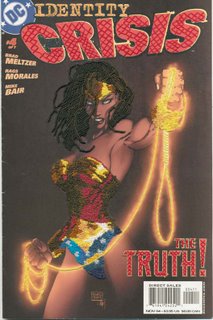
Though these covers are much more clearly appropriations of someone else's effort than the costumes -- the covers literally underlie the material Newport added, whereas he invested a lot more of his own labor in knitting full-size costumes from scratch -- their trademark and copyright status is clearer. As for trademark, as long as the underlying covers really are from the comics, selling the samplers no more infringes on DC's rights than selling a VW bus whose sides are painted with flowers would infringe on VW's. As for copyright, Peker v. Masters Collection, 96 F.Supp.2d 216 (E.D.N.Y. 2000), holds that painting in oils over a poster of a painting, so that the poster closely resembles the original painting, does not infringe the derivative works right -- but in that case the court found a violation of the reproduction right because the defendant essentially created a new painting on top of the poster. That's probably not what happens here; for one thing, as far as I can tell, the samplers only have yarn on parts of the covers. This might be a case, like the CleanFlicks case, that arguably falls into a gap between the reproduction and derivative works right: not adding enough creative work to be independently copyrightable and thus not a derivative work, but also not engaging in enough copying to be a reproduction.
Still, comics companies have been getting more litigious of late, and Newport is offering his works for sale. I wonder if Newport will receive any threat letters.
Systematic lemon law violations justify near-10x punitive multiplier
Johnson v. Ford Motor Co., --- Cal.Rptr.3d ----, 2005 WL 3508327 (Cal.App. 5 Dist.): On remand from the California Supreme Court, the Court of Appeals modifies its earlier verdict reducing a $10 million punitive damages award for concealing an automobile's history of transmission replacements and repairs, holding that just under 10 times the economic damages -- $175,000 in punitive damages on a verdict of $17,800 in economic damages – is an appropriate award under governing due process principles.
The jury initially awarded $10 million in punitive damages to Johnson based on evidence of Ford’s systematic attempts to circumvent California’s lemon law by (1) narrowly interpreting “repair attempts,” such that Ford determined that many troublesome vehicles returned to dealers for repairs didn’t qualify as lemons under the law and (2) instead of repurchasing such vehicles, which would trigger lemon reporting requirements, Ford called what it did a trade-in (not a normal trade-in, but a special program) and issued a credit to the customer rather than the dealer. In Johnson’s case, however, the customer never knew about the credit, which went straight to the dealer. The evidence was that (1) and (2) were formal Ford policies and that, if a vehicle that should have been deemed a lemon was instead treated as a trade-in, Ford saved about $10,000. There was no evidence, however, that trade-in credits routinely went to dealers rather than customers (an especially blatant flouting of the lemon law, which was designed to control dealer credits), nor was there evidence that all the several thousand vehicles a year that received trade-in credits under this program really were lemons, as opposed to troublesome vehicles that nonetheless weren’t quite so awful as to qualify as lemons and were legitimately traded in.
The Court of Appeals agreed that there was substantial evidence of Ford’s fraudulent concealment and attempts to evade the lemon law; the question was what sort of punitive damages award could be supported on these facts. The general tone of the opinion is: the California Supreme Court obviously wants us to award greater damages; Ford’s conduct was reprehensible, but the extent to which it actually damaged other people is unclear; a single-digit multiplier of economic damages to individual plaintiffs is generally constitutionally acceptable; so let’s try a 9.8 multiplier that produces a nice round number, bigger than our original multiplier of 3. The plaintiff’s theory of punitive damages offered to the jury – Ford’s overall profit from evading the lemon law – remains unacceptable, in part because of the lack of evidence that all vehicles in the special trade-in program were lemons, but also because punitive damages in individual plaintiff cases have to relate in some way to the harm suffered by the individual plaintiff.
Monday, January 02, 2006
Judicial introspection on class action settlements
Courtesy of CAFALawBlog comes In re Relafen Antitrust Litigation (D. Mass. Sept. 28, 2005) (pdf), a long opinion approving a class action settlement (with a consumer component based on consumer loss due to SmithKline's patent activities that increased the price of Relafen, a non-steroidal anti-inflammatory drug) but with an appendix decrying the rise of settlements and the corresponding demise of the jury trial. Comprehensive and full of statistics and discussions of academics' critiques of the state of the judiciary, it's well worth a read.
Why aren't public schools unconstitutional?
One of the most satisfying moments in my teaching career came when a student said, late in my First Amendment class, "Now I understand why you said on the first day that public schools ought to be unconstitutional!" (By "ought," I mean "by a consistent application of current First Amendment doctrine to the existence of public schools," not that this would be a good idea. Indeed, I think that one of the rules of modern constitutional law is that public schools are constitutional -- another is that Brown v. Board of Education was correctly decided -- and if we explicitly worked from that premise rather than skipping over the whole embarrassing issue, other areas of First Amendment law might see interesting changes.)
I don't think public schooling is an establishment/free exercise problem as some do (see also here). I don't think education is inherently a religious issue, at least not for all subjects (I've never heard a plausible explanation of why math class could interfere with someone's religious freedom). The basic problem is the government judging any idea or statement of fact at all. Suppose I believe that the reason nitrogen nodules cling to the roots of plants is love; if I write that answer on a biology test, I haven't committed fraud or otherwise harmed someone else, and yet the state can still punish me for my idiotic belief, because it's idiotic. And let's not even get started on what the state can tell me in history or social studies ...
Someday I hope to write the article about starting from the premise that public school is constitutional, and seeing how First Amendment doctrine would have to be altered to conform.
Wednesday, December 21, 2005
Intelligent Design as false advertising
Kitzmiller v. Dover Area School District, -- F. Supp. 2d -- (M.D. Pa. 2005): with all the reporting on this case, I thought I might offer specific commentary on Kitzmiller as a case about false representations.
The court’s analysis of the statement required to be read to Dover high school biology students, or “disclaimer,” resembled inquiries into other arguably misleading statements. One notable feature of the case, in contrast to commercial misrepresentation cases, is that the objective reasonable observer standard used to evaluate whether an establishment violation has occurred assumes an awful lot more knowledge and analytic sophistication than even the most rigorous reasonable consumer standard. I would argue that consumer protection law has the better of the argument – if we’re going to have an endorsement test for establishment clause violations, it should look to ordinary, median observers rather than observers who’ve undertaken extensive political, social and religious inquiries into the situation. Be that as it may, in this case every iota of information known to an observer pointed to the religious intent behind the disclaimer.
The disclaimer begins: “The Pennsylvania Academic Standards require students to learn about Darwin's Theory of Evolution and eventually to take a standardized test of which evolution is a part.” The court points out that the standards require students to learn a lot of things, only one of which is singled out for special attention. This is a type of framing; like an ad that calls attention to a product feature, it is a message that this feature of the curriculum matters more than other aspects. Here, the message is “we’d rather not teach you this, but we have to do so.”
The disclaimer continues: “Because Darwin's Theory is a theory, it continues to be tested as new evidence is discovered. The Theory is not a fact. Gaps in the Theory exist for which there is [sic] no evidence. A theory is defined as a well-tested explanation that unifies a broad range of observations.” The court pointed out that this set of statements singles out evolution, unlike everything else on the curriculum, as “just a theory,” and plays on the popular definition of “theory” as something unproven. This is akin to implicit falsity, or perhaps falsity by necessary implication: Though “theory” has several possible meanings, by singling out evolution alone for designation as theory, the disclaimer conveys that it is untrustworthy, unlike other aspects of the biology course. The reference to “gaps,” without any suggestion that other scientific theories have gaps, further solidifies this intended meaning. (Compare also the statement “Gaps in the Theory exist for which there is no evidence” to the proposal of one science teacher, recruited to draft the disclaimer, to say “there are gaps in Darwin’s theory for which there is yet no evidence” (emphasis added); the teacher also proposed to say that there was a “significant amount of evidence” supporting evolution, and a draft description of evolution as the “dominant” scientific theory was eliminated. These changes also supported the court’s conclusion that there was a deliberate attempt to denigrate evolution by comparison to supernatural explanations).
The message about evolution’s exceptional status is even more blatant because, when science teachers refused to read the disclaimer to their classes, administrators came in especially to do so. And the administrators then told students not to discuss the matter further and not to ask the teacher questions, which is surely more effective than buzz marketing in getting students to pay attention. As if that weren’t enough to ensure that the message was received as highly salient, the school also sent home an opt-out form so that students could leave while the disclaimer was read, which itself served to highlight the intended message.
The court accepts plaintiffs’ expert’s characterization of the statements in the disclaimer as misleading about the scientific status of evolutionary theory: evolution is not on particularly shaky ground; to the contrary, it is widely accepted, and students hearing the disclaimer will be confused about the level of support for evolution. (I note that all the experts were experts in their substantive fields, whether biology or theology; there does not appear to have been expert testimony on message reception, though the various professors did have pedagogical experience.) Is there an analogy to materiality here, the way “ceremonial deism” on our money, proclamations and buildings has been treated as too trivial to constitute an establishment clause violation? If there is, the confusion is probably still material, precisely because so much attention has been paid to the disclaimer – deliberate dissemination of a message and foregrounding it in advertising is often held to create a presumption of materiality.
But wait, there’s more to the disclaimer: “Intelligent Design is an explanation of the origin of life that differs from Darwin's view. The reference book, Of Pandas and People, is available for students who might be interested in gaining an understanding of what Intelligent Design actually involves.” This follows a rather traditional advertising model: problem (evolution is just a theory), followed by solution (ID is an explanation). As the court notes, the disclaimer contrasts a shaky “theory”/“view” with an “explanation,” with its implication of greater coherence and objectivity. There’s no disclaimer about the unconfirmed status of ID. Like the comparison in Tambrands, Inc. v. Warner-Lambert Co., 673 F.Supp. 1190 (S.D.N.Y. 1987), between a “one-step” pregnancy test and a “multi-step” test that used different standards to count steps for each test, the disclaimer doesn’t even offer evolution a level playing field. The juxtaposition confirms that the disclaimer operates to disparage evolution in favor of religious ideas.
The final paragraph of the disclaimer is: “With respect to any theory, students are encouraged to keep an open mind. The school leaves the discussion of the Origins of Life to individual students and their families. As a Standards-driven district, class instruction focuses upon preparing students to achieve proficiency on Standards-based assessments.”
Again, the court sees a problem of framing: Though the disclaimer encourages an open mind, the only alternative to evolution offered is ID, which the court finds to be inherently religious. One wonders whether the Flying Spaghetti Monster is an alternative the Dover board wanted students to consider.
A deeper question is to what extent the definition of “science” is up for debate, or whether it is an already-settled concept against which claims to scientific validity, like ID’s, must be tested. Advertising law tends to reject the idea that individual market participants can take non-trademark terms and make them mean something idiosyncratic – one example is “low tar,” a concept I’ll take up when I get around to blogging last week’s big false advertising case rejecting consumer fraud claims against tobacco companies. But if meaning is a matter of social consensus, as ID’s Wedge Strategy insists, then a sufficiently successful campaign should be able to redefine a term, even if purists object. For an ordinary language example, consider the change in the pronouns for an unknown person from “him/his” to “their” over the last generation. The question whether a single company can take a generic term (Thermos, Singer, Opry) out of the language by adding enough secondary meaning may be conceptually the same as whether anti-evolution forces can redefine science so that it doesn’t require natural explanations for natural phenomena, as they’ve done in Kansas.
One final point: the decision emphatically finds one particular belief “utterly false,” to wit, the belief that commitment to the truth of evolution conflicts with commitment to the existence of a divine being. That’s not exactly the same as a belief that shark cartilage cures cancer, but rejecting that belief is necessary to defeat the claim that there’s no neutral baseline – that teaching evolution is as hostile to religion as teaching ID is hostile to those who believe that science can explain natural phenomena without reference to an interventionist God.
Thursday, December 15, 2005
The history of a geographical indication
In light of persistent international debates over whether and how nations should protect geographical indications, I found Kolleen M. Guy, When Champagne Became French: Wine and the Making of a National Identity (Johns Hopkins 2003), a useful read. Guy tells the story of the nineteenth- and early twentieth-century conflicts over the definition of champagne and, in part, the definition of Frenchness as something connected to but distinct from the different parts of France.
The concept of terroir, something like the soul of the soil, that supposedly gives certain foodstuffs their unique qualities was much up for debate during the period, whereas currently the EU and France in particular give unquestioned legal protection to terms like “champagne.” Guy points out that, although often understood as a fight between capital and labor, the at-times violent disputes between vine-growers and winemakers in the Champagne region were more complicated than that. Vine-growers in the core areas of the Marne were opposed both to bottlers who wanted to use grapes from other places to make champagne and to fellow vine-growers in those other places who benefited from that practice. Meanwhile, Marne bottlers also argued that the designation champagne should be legally protected, but they wanted to limit the definition to sparkling wine bottled in the area, regardless of the source of grapes.
Guy’s story thus highlights champagne as an industrial product – not just because it requires a second processing to add the famous bubbles, but also because its production and consumption were profoundly affected by changes in transportation and modern advertising that helped make champagne the beverage of celebration and of Frenchness. The book is marred by repetitions of phrases, as if a series of journal articles had been simply stitched together, though I don’t think these chapters were in fact published elsewhere. Nonetheless, I learned a fair amount about the social construction of terroir, a concept that supposedly represents a natural and immutable connection among an area of land, its inhabitants, and the products they produce.
Monday, December 12, 2005
False statements about trademark license are actionable


Enesco Group Inc. v. Jim Shore Designs, Inc., 2005 WL 3334436 (N.D. Ill.), concerns false advertising claims related to a trademark license. Jim Shore designs the Heartland collection of figurines, garden ornaments and other decorative goods for Enesco; they generally feature quilt-like styles on Americana themes cast in resin. Enesco alleges that it is the exclusive licensee for all Jim Shore designs except bolt fabric. Recently, under a license from Jim Shore, defendant Sunshine Products, Inc. began offering Jim Shore ties, scarves and jewelry. Sunshine then entered into an agreement with defendant Department 56, Inc. (D56) to distribute its Shore products. Enesco alleges that D56 has been disseminating marketing materials that give the impression that D56 has the exclusive right to sell the Jim Shore line of scarves, neckties and jewelry. Enesco further alleges that at trade shows and in sales calls, D56 has been making representations to Enesco customers that gives the impression that D56 is an exclusive licensee of Jim Shore and that Enesco no longer has exclusive rights under the Agreement – in fact, D56 has been telling members of the trade that it will in the future be expanding the Shore line (so to speak) to include items such as Shore figurines, on an exclusive basis.
Some of Enesco’s allegations sound in trademark (or copyright), raising questions of the extent to which an exclusive licensee can assert rights against a licensor. In particular, Enesco complains of Sunshine products that are derivative works of Enesco products. (The upper left image in this post is an Enesco figurine; upper right is a Sunshine cat pin.) Moreover, Enesco has received customer inquiries asking whether Enesco still has the Shore line and customer comments about the products’ similarity. In addition, Enesco believes that the inferior quality of the Sunshine products will harm Enesco’s investment in the brand.
The district court’s opinion does not deal with the trademark/licensing aspects of the case (there is also a breach of contract claim against Shore and a tortious interference with contract claim against Sunshine). The opinion concerns D56’s motion to dismiss Enesco’s state and federal false advertising claims. The court rejects D56’s argument that the alleged oral statements by its employees aren’t sufficient to constitute “advertising or promotion” under the Lanham Act. Though other cases have held that scattered oral statements by employees aren't enough, broad-based statements made to trade show customers are more like print advertising than like isolated person-to-person sales pitches and thus suffice to trigger the Lanham Act.
Probably the most important feature of the case is that it adds to the small but entertaining body of case law interpeting the Lanham Act’s prohibition on misrepresenting the “nature, characteristics, [or] qualities” of a party’s “commercial activities,” a term added in the 1988 revision. The court holds that Enesco’s allegations state a claim for false advertising because licensee status relates to the parties’ commercial activities. (The court does not analyze whether variations in the wording of Illinois’s Uniform Deceptive Trade Practice Act and Consumer Fraud and Deceptive Business Practices Act could lead to a different result; I always wonder why people bring state-law claims in cases like this, and the defendant probably should have made some argument.)
The most notable “commercial activities” case is Proctor & Gamble Co. v. Haugen, 222 F.3d 1262 (10th Cir. 2000), which held that false statements that P&G’s profits were donated to the church of Satan were actionable under 43(a). The harm to P&G’s goodwill was obvious even if the claim didn’t concern the objective characteristics of P&G’s goods or services, and it was the kind of harm with which Congress was concerned, according to the Haugen court.
I’ve long despised the claim of Nike and various of its amici in Nike v. Kasky that consumer protection law is properly only concerned with physical characteristics of goods and services, rather than their conditions of production. That position offers a repulsive view of the consumer as a selfish, short-term-oriented being, not to mention it’s empirically obtuse as to things consumers care about. Douglas Kysar’s excellent article on the product/process distinction goes into the empirical and moral shortcomings of the product/process distinction in detail, but one thing Kysar doesn’t mention is that the 1988 revision of the Lanham Act shows a congressional recognition in the false advertising context that what a company stands for can be as or more important to consumers as whether its shoes are made of plastic or leather.
Thursday, December 08, 2005
What Roe v. Wade Should Have Said
This is actually a post about copyright and attribution, no matter what the title might have made you think. Recently, NYU Press published What Roe v. Wade Should Have Said, edited by Jack Balkin. The idea, also expressed in Balkin's earlier volume What Brown v. Board of Education Should Have Said, is to have current scholars, using only materials available at the time of decision, write opinions that improve upon or at least add insight to the original opinions. My father, Mark Tushnet, chose as his contribution a slightly edited version of Justice Douglas's concurrence.
This is unproblematic as a matter of copyright law, though only because the U.S., somewhat unusually, denies copyright to federal government works. It's not plagiarism, because he says he's using Douglas's concurrence as his contribution, and even if he didn't say so, no one reading the book could be unaware of its origin. But in what sense is it, then, "his contribution"? I think it's a very important one: By selecting Douglas's words and arguments, he makes the claim that the Justices then did the best they could have done, being who they were when they were. In a sense, he argues against Balkin's project from within. David Garrow's review treats this as a serious and worthy part of the book. It's yet another illustration of how using someone else's words, copying their expression, can serve important communicative and persuasive functions.
(On the substantive point, I read a decent essay on the question of "What Would Buffy Do?" by Jason Kawal in Buffy the Vampire Slayer and Philosophy: Fear and Trembling in Sunnydale. Kawal's argument, illustrated by that question, is that counterfactuals of this sort always involve picking a level of generality which itself largely determines the answer. That is, if I'm locked in a room and ask "What would Buffy do?" the answer is "Kick the door down." But that's because Buffy has powers unavailable to me. If the question is "What would Buffy do if she had my powers, knowledge, habits and inclinations?" we are essentially asking "What would I do?" Balkin's project asks participants to act like Justices, but Justices with thirty years of post-Roe experience, and my father's contribution suggests that asking Justice Balkin to produce an opinion in 2005 will never produce results comparable to asking Justice Blackmun to produce one in 1973. So it may be a cool way to package a book of essays about Roe, but it's not really a historical project in the sense the title suggests.)
Wednesday, December 07, 2005
Using correct password doesn't violate DMCA
The second district court to weigh in on the subject has held that a person who obtains a correct username and password to access a website, even if unauthorized, does not violate the DMCA's anticircumvention prohibition because using a password does not "circumvent" the password control. The case is Egilman v. Keller & Heckman, No. 2004-0876 (D.D.C. Nov. 10, 2005). What's particularly interesting is the extension of the previous case, I.M.S. Inquiry Mgmt. Sys., Ltd. v. Berkshire Info. Sys., Inc., 307 F. Supp. 2d 521 (S.D.N.Y. 2004), which involved a third party who wrongfully disclosed a legitimate username and password. Here, by contrast, there's no evidence that a third party disclosed the information; rather, Egilman's login was easily guessed.
I only wish someone would explain to me how this is different from obtaining the "secret handshake" in StreamBox or the CSS key in the DeCSS case. In those cases too, the code used is in fact the correct, actual key -- otherwise it wouldn't work. (At the very least, I want a better explanation of the difference between "decrypting" and, say, "guessing." What if the password wasn't guessed on the first try? What if it took ten tries? What distinguishes that from a basic computerized password attack? Cf. the great 1980s movie Wargames, in which Matthew Broderick's character substitutes a social-engineering attack, logging in as the computer's creator, for his slower programmed assault on what he thinks is a gaming computer.)
Congratulations to Jeffrey P. Cunard of Debevoise & Plimpton, who helped represent Keller & Heckman.
Federal court interprets new limits on Cal. false advertising law
Anunziato v. eMachines, Inc., --- F.Supp.2d ----, 2005 WL 3263892 (C.D. Cal.), is a putative class action alleging that certain eMachines laptops are defective and thus overheat. Along with warranty claims, plaintiff asserts California law false advertising claims. The case offered the district court an opportunity to interpret the newly enacted limit on standing under California’s Unfair Competition Law and False Advertising Law, and it ruled that, although plaintiffs must now suffer harm to have standing, they need not show reliance on the allegedly false statements.
California’s UCL/FAL was amended in one of California’s many voter propositions to address the problem of lawyers filing lawsuits on behalf of people who hadn’t suffered any real harm in order to collect a large fee. The new statutory language allows only claims brought "by any person who has suffered an injury in fact and has lost money or property as a result of such unfair competition." The court found that, though the “as a result of” language in the Consumer Legal Remedies Act has been held to impose a reliance requirement, the UCL/FAL offer public-oriented remedies (such as injunctive relief) rather than actual or punitive damages as the CLRA allows, and thus the amendment should not be interpreted to add a reliance requirement. Reliance and causation are imporant when the plaintiff seeks money damages, but not so important when the plaintiff is enforcing the public interest in truth and fairness in other ways. The court also found significant the fact that the language of the amending proposition made no mention of a reliance requirement, only a harm requirement. (The court’s other distinction, that the CLRA has a list of banned practices while the UCL/FAL are broad bans on unfair, untrue or misleading claims, seems to me one without a difference.)
Moreover, a reliance requirement would limit plaintiffs too much, since the court could see many ways in which consumer deceptions could be harmful without traditional reliance. For example: “One common form of UCL or FAL claim is a ‘short weight’ or ‘short count’ claim. For example, a box of cookies may indicate that it weighs sixteen ounces and contains twenty-four cookies, but actually be short. Even in this day of increased consumer awareness, not every consumer reads every label. If actual reliance were required, a consumer who did not read the label and rely on the count and weight representations would be barred from proceeding under the UCL or the FAL because he or she could not claim reliance on the representation in making his or her purchase. Yet the consumer would be harmed as a result of the falsity of the representation.” Worse, many Californians are functionally illiterate or not literate in English; a reliance requirement might leave them without redress. “The goal of consumer protection is not advanced by eliminating large segments of the public from coverage under the UCL or the FAL where they suffer actual harm merely because they were inattentive or for one reason or another lacked the language skills to appreciate the particular unfair or false representation in issue.”
My comment: it seems that most of what the court fears could be solved with a sufficiently broad understanding of reliance – that is, “I don’t think about this claim that the box has 24 cookies specifically, but I assume that it’s honest; I rely generally on packages having the amounts stated.” I’m reminded of the dispute in the Kraft v. FTC case over whether the difference between the calcium in five ounces of milk and the calcium in cheese slices made with five ounces of milk would be material to consumers. If you cut the cheese finely enough, the difference isn’t material, but consumers don’t often make their decisions in such delicate increments. Also, I would think that injunctive relief would cover everybody, literate or not, so even under the defendant’s interpretation of the law, once a literate/reliant class plaintiff had been found, she could represent the rest.
As for the actual false advertising claims based on the language of the laptops' user manual and a press release, the court found that most were puffery: the words "quality," "reliability," "latest technology," and "performance" were non-actionable because no reasonable consumer would rely on them. (Side note: isn't it odd to reject a reliance requirement and then go straight to puffery analysis, which is all about reliance or the inadvisability thereof?) Representations that the laptops passed "most stringent quality control tests" and were made with "brand-name components" were capable of falsification and thus could be actionable. Query whether claims made in the user manual count as advertising at all -- even without a reliance requirement, information available only postpurchase might not be actionable, as at least one Lanham Act case has held.
Tuesday, December 06, 2005
ISO a False Advertising Verdict
Bridging the Gap links to a story reporting that First Act Inc. has prevailed against Brook Mays Music Co. in its false advertising claims. The only reported decision in the case, First Act, Inc. v. Brook Mays Music Co., 311 F. Supp. 2d 258 (D. Mass. 2004), concerns the propriety of long-arm jurisdiction over the Texas defendant, whose 60 ISO Alerts sent to individuals with Massachusetts addresses, as well as other contacts, were held sufficient for both statutory and constitutional purposes.
The parties make, among other things, musical instruments for children. The case concerns an "ISO Alert" sent out by Brook Mays; ISO stands for "instrument-shaped object," and the point of the alert, which was sent by email, was that First Act's instruments were not real instruments but only ISOs. (Dismissing an inferior product as an "instrument-shaped object" is a cute concept, by the way; kudos to whoever came up with it.) Despite the lawsuit, I have found what appears to be a copy or adapted version of the Alert here. It reads:
I found a few other discussions of ISOs on the web, including one with a funny drawing of an ISO monster. Most of the statements I found came from band teachers and the like, who wouldn't count as First Act's competitors for purposes of Lanham Act liability. (Of course, there are other torts, though most would be subject to similar limitations.) Nonetheless, this discussion among band-loving types illustrates how laypeople can be concerned by the prospect of legal liability and understandably unaware of what actually might trigger such liability -- causing a real chill in their ability to discuss what instruments students ought to buy. I don't know if this story of a band leader being sued by a manufacturer for making a list of good and bad brands of instruments is true (the more likely scenario is a probably overreaching cease and desist letter), but it doesn't need to be in order to do harm. Sadly, most of the advice the band folks offer each other has little to do with the law on the books. Prefacing a statement with "in my opinion," for example, is probably pretty useless -- if I said "In my opinion, Diet Coke [my beverage of choice] is made with toxic chemicals," I've still made a representation of verifiable fact; if I said "Diet Coke sucks," no one needs a prefatory statement to understand that this is just what I think. Likewise, avoiding mention of brand names is not necessarily good enough if the class of "instruments sold in retail stores that feature clothing and other household equipment" is in practice made up of First Act's instruments, just as references to "the leading brand" in comparative advertising are understood to be direct comparisons. And this interview with First Act's CEO suggests that statements about musical instruments sold at big box retailers must refer to First Act, since it's almost alone in using that sales channel.
The parties make, among other things, musical instruments for children. The case concerns an "ISO Alert" sent out by Brook Mays; ISO stands for "instrument-shaped object," and the point of the alert, which was sent by email, was that First Act's instruments were not real instruments but only ISOs. (Dismissing an inferior product as an "instrument-shaped object" is a cute concept, by the way; kudos to whoever came up with it.) Despite the lawsuit, I have found what appears to be a copy or adapted version of the Alert here. It reads:
I.S.O. ALERT!Given that the jury awarded $21 million in damages (including returns and lost goodwill), it seems that some customers followed the alert's advice.
Instrument Shaped Object
Please be Alerted… there are a number of discount stores, Sam’s, Wal-Mart, Costco and Hastings, (to name a few) that are selling beginner "instruments", or "Instrument Shaped Objects" under the name brands of First Act Concert Series, SIMBA, Bluebird, Jean Baptiste and others.
After careful examination of these instruments, we have determined that they will not play for the long term (if even the short term)! The ISO’s break and parts are NOT available. The unfortunate fact is that the students that will be playing these instruments will likely not survive the first few months of band because of the design and quality. We are all aware that the dropout rate for beginning students is too high. Why would we, in good conscience, allow a student to begin on an instrument that dooms them for failure?
Because of the design and quality, or lack there of, we must respectfully decline to work on these or similar instruments. The liability is too great and we do not wish to be a part in the failure of a student in you schools instrumental music program.
We sincerely would like to suggest, that for the sake of the child’s future in music, these instruments be returned to the "big box" retailer for a refund and another option sought.
I found a few other discussions of ISOs on the web, including one with a funny drawing of an ISO monster. Most of the statements I found came from band teachers and the like, who wouldn't count as First Act's competitors for purposes of Lanham Act liability. (Of course, there are other torts, though most would be subject to similar limitations.) Nonetheless, this discussion among band-loving types illustrates how laypeople can be concerned by the prospect of legal liability and understandably unaware of what actually might trigger such liability -- causing a real chill in their ability to discuss what instruments students ought to buy. I don't know if this story of a band leader being sued by a manufacturer for making a list of good and bad brands of instruments is true (the more likely scenario is a probably overreaching cease and desist letter), but it doesn't need to be in order to do harm. Sadly, most of the advice the band folks offer each other has little to do with the law on the books. Prefacing a statement with "in my opinion," for example, is probably pretty useless -- if I said "In my opinion, Diet Coke [my beverage of choice] is made with toxic chemicals," I've still made a representation of verifiable fact; if I said "Diet Coke sucks," no one needs a prefatory statement to understand that this is just what I think. Likewise, avoiding mention of brand names is not necessarily good enough if the class of "instruments sold in retail stores that feature clothing and other household equipment" is in practice made up of First Act's instruments, just as references to "the leading brand" in comparative advertising are understood to be direct comparisons. And this interview with First Act's CEO suggests that statements about musical instruments sold at big box retailers must refer to First Act, since it's almost alone in using that sales channel.
Saturday, December 03, 2005
Credit card solicitations
People v. Applied Card Systems, Inc., --- N.Y.S.2d ----, 2005 WL 3204376 (N.Y.A.D. 3 Dept.)
Though better-known for pursuing investigations against Wall Street and major record companies, Attorney General Eliot Spitzer also goes after more run-of-the-mill violations of New York’s consumer protection laws. Cross Country Bank offers credit cards to consumers who have difficulty getting credit; Applied Card Systems services the bank’s accounts and collects from delinquent accounts. The state alleged that the respondents engaged in deceptive representations about how much credit would be available (representing that the credit limit would be up to $2500 when often the limits were less than $400); charged $150 in fees immediately on opening the account (further decreasing the available credit); led consumers into a downward spiral of interest, late fees and over-limit penalties; enrolled consumers into virtually useless third-party membership programs for additional fees without properly letting them know that they didn’t have to enroll to get the credit card and that the programs didn’t offer many of the described benefits to New Yorkers; and harassed consumers with delinquent accounts by, among other things, lying about callers’ identities to get consumers on the phone, calling consumers at work after having been told not to do so, using obscene and abusive language, and making unauthorized debits from consumers’ checking accounts.
The appellate court upheld an injunction against these activities. The ruling on the advertised credit limits is a standard application of the principle that advertising should reflect likely or ordinary results rather than unusual results, at least in the absence of disclosure that results are unusual. Cross Country Bank’s attempt to solve the problem with disclosure was unavailing since the disclosure was on the second page of its terms and conditions, in the same (presumably teensy) typeface as the rest of the text, and in any event respondent’s telemarketers deliberately obfuscated in their pitches to consumers. Respondents submitted an affidavit a private consultant who reviewed the terms of the solicitation from December 2001, categorizing the disclosure as "unsurpassed in the industry," but the court was unimpressed by the industry’s standards, since reasonable consumers would be misled to believe that the “up to $2500” prominently displayed on the solicitation was representative of what consumers would receive.
The most interesting aspect of the case to me is the claim that the Federal Truth-in-Lending Act (see 15 USC § 1601 et seq.) preempts consumer protection claims because the adequacy of Cross Country Bank’s disclosures is within the exclusive province of TILA. The implementing regulations state that state-law disclosure requirements are preempted to the extent inconsistent with TILA, see 12 C.F.R. 226.28[d], except that state laws prohibiting unfair or deceptive acts or practices aren’t preempted. Does that mean that any characterization of a disclosure as unfair or deceptive is enough to avoid preemption? In that case, why can’t states just put their inconsistent disclosure requirements in their UCLs? Or would preemption only be avoided if the state proceeded under the general “unfair or deceptive” provision and not under a law conclusively finding that specified disclosures/failures to disclose are unfair and deceptive? In any event, the court found that the deceptive conduct here fell under the UCL, which was not preempted.
Subscribe to:
Posts (Atom)


 Posts

