Showing posts with label design patent. Show all posts

Saturday, February 28, 2026

WIPIP Panel 6: Design and Brand; Protectable Subject Matter; Copyright Theory and Doctrine II

A Pantone Prerogative: Defining the Privilege to Standardize Color (Felicia Caponigri)

Color standards have been around for a long time. Pantone developed standards and uses its system to promote the colors; registration for the matching system and the color chip. Does it have ©? Some © in its booklets—pre 76 Act case, pre Feist, where Pantone successfully won a PI against a competing seller of booklets. © in taxonomy?

Pantone does a lot of licensing—the business model is based on collabs, licensing their chips, selling services to companies that then advertise that they are using a specific Pantone color, or has Pantone christen a color for them. Other companies describe their registrations in Pantone colors. Require companies not to reverse engineer; authenticity and consistency claims are also used.

Should brands that standardize avoid certain claims? Pantone doesn’t seem to be trying to litigate against competing standards but maybe that’s lack of competition. Maybe a patchwork of IP rights leaves room for a private standard, but not every brand can standardize color. Europe requires some kind of identifier for registration, whether Pantone or otherwise.

Fromer: does Pantone dominance allow businesses to chill each other with color ownership claims? Or does that come from the companies no matter what?

When Procedure Becomes Policy: The Hidden Substantive Effects of the Design Law Treaty (Christine Farley)

Int’l design law becoming a thing as we speak. New WIPO treaties: Treaties on IP, Genetic Resources, and Associated Traditional Knowledge, and Riyadh Design Law Treaty.

There’s no underlying harmonization with design law: thresholds, scope, etc. Once we put procedure before substance, that procedure closes the opportunity for countries that haven’t developed their own design law to debate what that law might look like.

This treaty was promoted by high-income countries: the industrial design five, which already take most advantage around the world of filing for design registrations. 75% of designs applied for around the world come from China, EU, Korea, US, and Japan. 2.9% Africa, Lat Am & Oceania; 22% rest of world. Not very important for local industry in many places.

Substantive choices hidden in procedural drafts: the idea of harmonizing application procedures—a “closed list.” Any adherent can only ask about certain things in its application. Can’t ask about whether design derived from traditional cultural expression/resources/knowledge; whether design was made from AI; whether design was made w/federal funding; any characteristics of applicant that might enable fee reduction. African group did secure disclosure that a treaty adherent may require that an application contain info, including information on TCEs and TK of which the applicant is aware, that is relevant to eligibility.  

Requires allowing for partial designs by providing for allowing matter that doesn’t form part of the claimed design if shown by visual means like dotted/broken lines; partial designs are not even contemplated by most jurisdictions.

Provision for technical assistance to implementing countries.

Room for maximalism: countries can always grant more protection.

Provision to allow maintenance of application unpublished for a minimum of six months.

Copyright & Living Organisms (Cathay Smith)

GloFish: registered trademark for glowing fish, genetically altered—but © rejected. The GloFish company owns a number of utility patents related to them; wants to look at potential design patents. Living organisms can be goods for TMs, e.g. Galactic Purple by GloFish. Could a fish be considered product design trade dress? Not sure.

Small number of decisions have rejected living matter as original works of authorship b/c they don’t owe their expression to human creativity and aren’t fixed. The GloFish, for example, was not the equivalent of using paint on a canvas. Living works of authorship can’t meet the originality requirement. Also, they just aren’t copyrightable subject matter.

But should © exclude original expression solely on the basis that the subject matter is living?

Using organism as medium of expression; canvas of expression; or work itself.

Medium: floral gardens, arrangements, Chapman-Kelly v. Chicago Parks Decision. While individual living flowers might not be ©, unique arrangement into shape of peacock could be protected.

Canvas: applying human-created art to pigs, cats via tattoos; painting cockroaches.

Work itself: the GloFish; genetically modified poinsettia plants. Modified to exhibit creative expression. The GloFish passes its genes on; the painted fish is created with injecting color and does not pass on the colors. Is that more like using the fish as a canvas?

Tree shaping can involve training living trees to have them grow naturally in design or physically trimming them to create specific designs.

Should we limit based on process of creation, or would it be better to have a straight rule about subject matter? What about dead organisms—copyrightable then? Art made with flowers, taxidermy?

Q: if allowed, why wouldn’t that allow © of dog breeds? [raises issues of visual primacy in ©]

A: can’t see getting dog breed through the © standard, but originality is possible in the future.

Q: © as a rule of evidence by Doug Lichtman: a lot of doctrines are actually evidentiary including how do you know whether there was copying. Copying in fact is going to be difficult for a living organism.

Q: patents can only cover discoveries; 102(b) says (c) doesn’t cover discoveries—seems like they’re mutually exclusive.

RT: Selection, coordination and arrangement as a principle that helps distinguish the hedge animals and trained trees from the “canvas” cases? Are these useful articles? If so: Design of/design on distinction, suggested by design patent? Program your genes to express pigment to display a tattoo, which is that?

Q: what about patents?

A: might cover different things—e.g., if GloFish is ©able then painted fish might infringe, whereas painted fish wouldn’t infringe patent on GloFish.

Copyright Theory and Doctrine II

The Snoopy Solution: Copyright Safety and Licensing Opportunities for Generative AI (Matthew Sag)

[came in late] Disney has a 1-year exclusive deal with Sora; the cost to user expression will essentially disappear. Filtering is not all bad when recognized as a licensing opportunity—social costs decline & harms of infringement reduced.

Silbey: how to think about secondary liability and photocopy machines in light of your argument—although our uses of photocopier could be licensed, the machine maker doesn’t pay.

A: AI companies aren’t just passive—they make so many choices in model design, data curation, and 1000s of steps in between, so they aren’t simply intermediaries. Ultimately the user provides the final command, but this isn’t as simple as primary and secondary actors. We have secondary liability b/c sometimes it seems appropriate to hold a noninfringer liable for infringement. But that presupposes being able to distinguish primary from secondary, which is volitional conduct. Volition is about role in selection, not just whether there’s automated behavior. Courts could say this is volitional, or that being automatic is close enough.

Rosenblatt: distributive impacts. Who’s paying for the license, and we’re asking not about the work but about the use of the work post-Warhol. Who’s negotiating the license? The big players, not independent artists. Who’s going to pay for the cost of the license? It will be transformative users.

A: yes, massive distributional consequences.

The Artist Signature as Source (Peter Karol)

Book project on TMs and art. Basic claim: larger project—artist signature or monogram is quintessential TM but long relegated to outer rim of TM practice and doctrine. Would be improved by increased acceptance of and appreciation of artist marks as historic and core TMs. And Art Law would be improved by centering TM law in regulating creation & distribution of art works—as proof, he got put on a copyright panel!

Art historical literature on history/purpose of artist signature. Western: 12th century—not beginning in the Renaissance. Michelangelo signed one work (it says that he is making it, which was common in early signatures); one subsequent account says that he resented hearing the work attributed to another.

Modern obsession w/signature: estate stamp applied by Monet estate. Warhol had works signed for him by his mother or by an assistant who copied his mother’s version.

Dual explanations in the art historical literature: Authorial (source-based): artist has aegis or authority in having supervised and given imprimatur to final product as finished good ready for public sale or consumption; signer stands behind this thing, and different from other things w/o that signature.

Autographic/auratic: the signer personally touched or physically rendered the thing under observation such that we feel we are in the embodied presence of the worshipped figure. Spiritual, akin to role of relic or letter hand written by Abraham Lincoln.

Perhaps there’s a movement from authorial to autographic after the Renaissance.

Some early signing practices were religious—wanted credit at Judgment Day; wanted people to pray for them; pride/ego. Pragmatic business considerations esp. for workshops. Especially when we see the market rise instead of direct patronage, where signing wasn’t as important as the patron already knew the commissioned artist. Advertising/goodwill function of signature as well. Also a signal of completeness. Legal benefits/requirements: required by guild or otherwise. Market demand, especially 18th C. on. All consistent w/ TM concept.

Derrida: signature tethers artist to work while making it repeatable/iterable. But individual artists’ signatures change a lot over time.

Criminal identity theft case from 2025: source is not identity; forging name on art was not identity theft b/c it didn’t involve transferring, possessing, or using the means of ID of another person as required by statute. Forgery was misrepresentation of origin, not identity.

Heymann’s previous work on The Birth of the Authornym is also relevant.

Silbey: what about when the author hides themselves in the work, like a participant?

A: yes, being broad about definition of signature. That’s a little different than TM, more like a selfie.

Fromer: Dastar!

RT: Real issue is that TM isn’t TM any more! The description is of classic TM function, but immediately it’s worrisome to think of treating a signature as modern TM b/c it would extend © infinitely and do a bunch of other things.

A: Yeah, one point is that understanding the signature as a core example could remind us of what TM was supposed to do.

Heymann: transferability of personal names—designers have signed away the right to use their names.

A: art scholarship connects the signature to the rise of notarial practices—a signature has legal effect.

Buccafusco: compare novels: people (subset) want signed copies of novels, allographic v. autographic.

Friday, January 16, 2026

CFP: Yale/Harvard/Stanford Junior Faculty Forum, May 21-22

 Please share widely! 

Request for Submissions

Harvard/Stanford/Yale Junior Faculty Forum

May 21-22, Yale Law School

 Harvard, Stanford, and Yale Law Schools are soliciting submissions for the 2026 Harvard/Stanford/Yale Junior Faculty Forum, to be held at Yale Law School on May 21-22, 2026. Ten to fifteen junior scholars (with one to seven years of teaching experience) will be chosen, through a double-blind selection process, to present their work at the Forum. A jury of accomplished scholars will choose the papers to be presented. A senior scholar will comment on each paper. The audience will include the participating junior faculty, senior faculty from the host institutions, and any invited guests. There is no publication commitment. Yale Law School will pay presenters’ travel expenses, though international flights may be only partially reimbursed. 

The goal of the Forum is to promote in-depth discussion about particular papers and more general reflections on broader methodological issues, as well as to foster a stronger sense of community among American legal scholars, particularly by strengthening ties between new and veteran professors. 

TOPICS: Each year, the Forum invites submissions on selected topics in public and private law, legal theory, and law and humanities topics, alternating loosely between public law and humanities subjects in one year, and private law and dispute resolution in the next. For the upcoming 2026 meeting, the topics will cover these areas of the law:

Antitrust

Bankruptcy

Civil Litigation and Dispute Resolution

Contracts and Commercial Law

Corporate and Securities Law

Intellectual Property

Private Law Theory and Comparative Private Law

Property, Estates, and Unjust Enrichment

Taxation

Torts 

QUALIFICATIONS: Authors who teach law in the U.S. in a tenured or tenure-track position and have not been teaching at either of those ranks for a total of more than seven years are eligible to submit their work. American citizens or permanent residents teaching abroad are also eligible, provided that they have held a faculty position or the equivalent, including positions comparable to junior faculty positions in research institutions, for not more than seven years, and that they earned their last degree after 2016. Authors must be qualified as of the date of submission. We accept jointly authored submissions, but each of the coauthors must meet the qualification requirements. Papers that will be published prior to the Forum are not eligible. There is no limit on the number of submissions by any individual author. Faculty from Harvard, Stanford, and Yale Law Schools are not eligible.


PAPER SUBMISSION PROCEDURE: Please use the following form to submit: https://docs.google.com/forms/d/e/1FAIpQLSeE-Y1decyDrkmejVoztM2oPI3MrLfxdP3kCT500H1TwUBiMg/viewform?usp=header. The deadline for submissions is February 20, 2026. Remove all references to the author(s) in the paper. The form will ask for the title of your paper; under which topic your paper falls; an affirmation that your paper satisfies the non-publication qualification above; and the year in which you began teaching in one of the qualifying positions above. Each paper may only be considered under one topic. Any inquiries about the form should be directed to Christine Jolls. 

FURTHER INFORMATION: General inquiries concerning the Forum should be sent to Christine Jolls (christine.jolls@yale.edu) at Yale Law School, Norman Spaulding (nspaulding@stanford.law.edu) at Stanford Law School, or Rebecca Tushnet (rtushnet@law.harvard.edu) at Harvard Law School.

Christine Jolls

Norman Spaulding

Rebecca Tushnet


Monday, October 28, 2024

when weak TM claims do better than seemingly strong false advertising claims

Sanho Corp. v. Kaijet Technol. Int’l, 2024 WL 4553279, --- F.Supp.3d ----, No. 1:18-cv-05385-SDG (N.D. Ga. May 20, 2024)

Note: A jury found Kaijet liable for design patent and copyright infringement after this opinion, but rejected the TM claims, which I guess says something about a jury’s ability to distinguish claims. It didn’t get a chance to decide the false advertising claims, which I think reflects courts’ relatively lax approach to TM compared to the rigors to which false advertising claims are subjected before reaching a jury; personally, I likely would have gone the other way.

Sanho sells accessories under the HyperDrive name, including MacBook dongles. Kaijet sells competing UltraDrive MacBook dongles. 

Kaijet product

Sanho product

(My spouse uses a third competitor that looks basically indistinguishable; FWIW, he says that he would not buy the same product again because it's easy to whack it in a way that detaches it from the laptop and that a cable connection would have been a better choice.)

Sanho has a registration for HYPERDRIVE.

HyperDrive logo

UltraDrive logo

The court first found that there was a factual issue about whether the hubs were “power adapters” as specified in the trademark registration. The hubs can be used “to transmit[ ] power from a ‘source’ (MacBook Pro) to a ‘sink’ (a cell phone being charged).”

The court also found a factual issue on likely confusion between UltraDrive and HyperDrive, reasoning that because a power hub is not a drive (and also that there’s a Star Wars reference), the mark was suggestive. Third-party use of the weak components “hyper” and “drive” didn’t reduce the strength of the mark (but somehow that didn’t make confusion less likely just because the overlap was in “drive”). Although the marks weren’t similar in appearance, they were “similar in sound, meaning, and usage,” since they both had a two-syllable prefix followed by the word “drive,” and “hyper” and “ultra” were roughly synonymous. They were directly competing. Although there’s a distinction between bad “[i]ntent to benefit from a competitor’s goodwill” and good “intent to copy,” they’re often related and bad can be inferred from good, as it could be here. Email communications repeatedly referenced Sanho’s design, and expressed a desire to use similar elements in its own product. Kaijet US changed its existing product name from “ultrastation” to “UltraDrive” after Sanho began selling its hubs, and as Kaijet US was preparing to introduce a competing product into the same market.

Whether there was evidence of actual confusion was a contested issue about interpreting consumer complaints.

Sanho’s false advertising claim  alleged that the defendants falsely advertised a hub as an “8-in-1” product, when it contains only seven ports. But the court agreed that this wasn’t literally false, and Sanho offered no evidence of likely confusion. It seems like a jury should at least have addressed the literal falsity issue, because it’s hard to say that no reasonable jury could have found literal falsity, when there are eight numbers for ports and the numbers don’t correspond to, or even add up to as far as I can tell, eight distinct functions. But the court reasoned that “labels do, in fact, count out eight functions. Several of those functions do seem duplicative—(5) and (6) are both labeled ‘USB 3.0.,’ (7) and (8) are both labeled ‘Memory Card’—but that suggests the labels are misleading, not literally false.” I would instead have said that means that both possible meanings—number of functions or number of ports—are literally false.  

neither eight functions nor eight ports shown
There were also factual disputes on the copyright infringement claim based on the parties’ packages.  Sanho’s packaging contained both protectable and non-protectable elements: 

Sanho packaging

Non-protectable are Sanho’s product name and description, the packaging’s selection of typographies and colors, and familiar images such as MacBooks and laptop ports.

Also non-protectible are functional elements like the listing of product information and specifications. The way in which the product-shaped cutout or window on the front of the packaging allows consumers to view the product without opening the packaging is likewise functional and therefore non-protectable.

However, there was “a spark of creativity here in Sanho’s arrangement and coordination of the packaging’s otherwise unprotectible constituent elements—most notably in the alignment of the right side of the product-shaped cutout with the left edge of a depiction of a MacBook to suggest the physical docking of the hub to the laptop.” Packaging for similar products contained “more or less the same elements—product name and description, specifications and features, cutouts or windows—but in a variety of arrangements, none of them resembling Sanho’s in overall layout, and none of them suggesting its product’s physical compatibility with another device in the way that Sanho’s does.”

packaging front comparison

packaging side comparison

The court found that defendants

appropriated the most original element of Sanho’s design: the cutout in the center showing the product hub physically interfacing with a depiction of a MacBook to the right. In addition, the front of [defendants’] packaging presents mostly the same information as Sanho’s, and in the same layout: product name at top, product description at bottom, “4K” and “50 Gbps” callouts at bottom right. The back of j5create’s packaging, like Sanho’s, depicts a MacBook, open at a similar angle and viewed from a similar perspective, with the product hub attached and its ports labeled, followed by a bulleted list detailing the ports’ capabilities. The left side panel of [defendants] packaging, like Sanho’s, depicts and labels the hub’s ports. These are significant similarities in the packagings’ arrangement and coordination of dominant design features.

But they were also “far from identical,” including differences in color and font, as well as defendants’ product carrying product specifications in four languages and depicting the product’s side profile on the side of the package. Because substantial similarity is qualitative, this was for the jury.

Finally, the court rejected Kaijet’s false advertising counterclaim based on Sanho’s allegedly false “fake review campaign” of positive product reviews on Amazon, based on failure to show materiality. It was insufficient to provide:

1. A study showing that 74% of respondents “read online reviews” from online stores like Amazon and BestBuy;

2. A study showing that 32.7% of respondents cited “[p]roduct reviews and recommendations as a “[m]ain reason for shopping at Amazon”; and

3. Sanho CEO Daniel Chin’s declaration testimony that “The UltraDrive is an inferior and lower quality version of the HyperDrive. It receives less favourable customer rating reviews on Best Buy’s website and has many complaints.”

“Evidence about where consumers read online reviews is not probative of what they do with the information in those reviews. Likewise, evidence about why consumers choose to shop at Amazon is not probative of why they would choose the HyperDrive over the UltraDrive, when the latter was sold exclusively through Best Buy.” There was no evidence tending to prove that Sanho’s alleged fake reviews caused consumers to buy Sanho’s products instead of defendants’, and self-interested testimony on superiority was insufficient. (This is a bit of conflating materiality with harm causation, but ok. Imagine a court finding evidence that consumers generally care about brand names, or other general testimony about branding, insufficient in a TM case!)

Also, defendants failed to rebut Sanho’s evidence of immateriality, which was deposition testimony that No such evidence has been produced. Furthermore, the Kaijet Defendants have failed to meaningfully rebut Sanho’s evidence of immateriality: deposition testimony that the Sanho product had a better aggregate rating on Best Buy (where it is actually sold) than it did on Amazon, and Sanho’s expert’s testimony that the sales metrics of its products, both of themselves and relative to the sales metrics of Kaijet, were uncorrelated with the timing of Sanho’s alleged fake review campaign. No reasonable jury could find, on this record, that Sanho’s fake review campaign was material.


Saturday, February 03, 2024

WIPIP session 7: Design Law

Rachael Dickson, Administrative Discrimination? At the Trademark Office

[I feel like there’s a Panic! At the Disco joke to be made here.]

ID manual: a searchable database of acceptable IDs of goods/services, regularly updated and changed to adapt; you can make suggestions to add easily, and new IDs are added regularly. Benefits: lower application filing fees: $350/class goes to $250 class; clarity and examples as to what IDs are acceptable. Potentially less back & forth communication w/ PTO=cheaper prosecution, quicker access. “Accidental” addition of medical marijuana IDs in 2010 led to rise in applications; withdrawn.

Some options are broad: medical services. Others highly specific: writing pens that may also be used to perform pen spinning tricks, arranging beauty contests for animals, financial evaluation of alpaca fiber. Dickson’s suggestions for “medical services in the nature of providing abortions,” “consultation services in the field of sexual health and wellness,” and “providing health information related to contraception” were all refused as already covered by broader categories. But: Pedodontists, nevus removal, psychological services for infants, medical clowning are all in there.

No class 44 IDs contain contraceptive, birth control, condoms; sex or sexual only shows up in class 44 in the manual for addiction treatment services. Class 44 IDs don’t contain gay, lesbian, transgender, but prostitution services in the state of Nevada are in there. Also no reference to cannabis, THC, or CBD. They instead want a very complicated specification that ought to be in the manual. Porn/adult film, sex therapy, and nudist resorts also missing. Sex toys don’t seem to have been added until 2015.

Search codes for images are very useful; many poop marks are applied for, but there is no poop codes; since there’s no search code, you will have higher prosecution and maintenance costs. No results for nudity, genitalia, or penis. They do have nude. A lot are filed under other parts of body: genitalia are treated as random other parts.

Applications w/controversial content may get an “unofficial suspension”—application to register swastika filed shortly after Tam, and wasn’t examined for over 2 years and 2 months; 8 times longer than the average 2.7 months first action pendency in 2017. Why was the obvious failure to function refusal delayed so long? Applications for goods with uncertain legality also create TM problems—waits over 2 years w/o examination for goods containing delta-8 THC, whose federal legality is questioned.

Applicants are essentially left in limbo; they don’t really have any recourse (maybe a writ of mandamus, but not clear it would work b/c there is no timeline except under the Madrid Protocol).

Gilden: the patent side has categories for, e.g., devices for genital massage. Why the difference between patent & TM sides?

A: much easier to get a more controversial good registered than a controversial service. TM office may get in the news more; articles about “how dare they grant a patent to this thing” don’t seem to appear.

Fromer: Wrote about inconsistent application of immoral/scandalous applications—is this legacy from having to police this, making them feel like they could be arbiters of prudery?

A: definitely could be a factor.

Jordana Goodman: how do they decide they need a new category? PTO did a lot of work on the patent side. Is this just in the US and do they talk to other countries?

A: classes are set internationally, but IDs can vary a lot b/t offices and US has stricter ID requirements than others; WIPO database is missing a lot of these IDs. The ID division can be very insular. Question is whether there is demand.

Calboli: every other country still has the morality rules, so they won’t have these except within the classes.

Christine Haight Farley: connecting to Katyal’s paper: “Indian man” design code. That’s highly offensive [A: but still in there!] but helpful to research. Why the whole pattern?

A: will be talking to PTO historian; they ended up offering to refund fees to 2010 applicants if they’d abandon them, so may never find out what happened there.

Rosenblatt: are there things that are fine? You say discrimination—discrimination against controversy might be different than other kinds.

A: they’re cowards—avoiding controversy is the goal. There is a design code for marijuana leaves; you just can’t get a cannabis ID.

Laura Heymann: There expressive consequences and functional consequences here. What’s the meaning and what effects does it have on competitors? Are they having trouble clearing marks?

Christine Haight Farley, Design Authenticity

Book project, still shaping up. Case study of George Nelson’s bubble lamp (mid-century modern design), how TM law creates new design rights. Nelson was second design director of Herman Miller Co. Contested origin stories: lack of clarity about who’s the designer; George Nelson had his own design firm while working as design director. Lots of stories of derivative iterations of designs where people were working together. Mazer v. Stein: a sculptural base can be © but not a midcentury modern lamp; Sears v. Stiffel: invalidated patent on another midcentury modern lamp. Attributed to Jens Risom, 1950s: a daybed can’t get a design patent, would need to flip up and fry an egg. Even without IP protection, they promote authenticity. Herman Miller makes catalogs like coffee-table books, pushing the idea of the celebrity designer (even though they weren’t exclusive to Herman Miller). Midcentury modern revives in the 1990s, so there are reproductions (since there aren’t enough old pieces around). Modernica buys the original molds etc. and starts selling them. Design w/in Reach had some “authorized” works but also was making their own versions of furniture. Herman Miller starts to fight back, saying that’s all fake. Certificate of authenticity; they mark the hell out of chairs w/designer names, signatures. “You can copy a Rembrandt and do a beautiful job but it’s not a Rembrandt.”

But this is smoke and mirrors: they claim rights b/c it’s authentic and it’s authentic b/c they claim rights. They’ve changed the design, but still claim authenticity: the authenticity is the brand. Herman Miller brings claims of unfair competition, false association, false advertising, right of publicity, TM rights including dilution, claiming designer’s name, model names, and shape of the design. Claim to have been authorized by designers and heirs—claiming to own history of design, contra Dastar’s point about not searching for the source of the Nile and all its tributaries. “Original reproductions” is the concept. They’re machine-made goods.

Eric Johnson: have they been successful in pushing others out of the market?

A: not always—Eames sought utility patents for some designs, so the PTO then didn’t allow registering the shape. Herman Miller was unsuccessful in one case but learned from that. Suing all the time, more successfully. When they’re all knockoffs, it’s a race to the bottom. Design w/in Reach was selling its copies as “museum quality reproductions.” It’s now hard to sort through the market to get a good one.

Lemley: larger problem of TM capturing the concept of authenticity; separated from traditional goal of branding. Should separate the law from the marketing.

A: most of these other designs went out of production; Herman Miller never produced some of them. They don’t have good arguments for being “authentic” except by claiming rights from the designer—lineage. They say it’s authentic b/c we are authorized by designer/heirs. Authorized how? For what? As if there were rights to pass to them. Their authenticity leans on rights—mutually constitutive. Authenticity then has a different meaning than it did in 1950.
Rosenblatt: yes, this is a story about de-tethering of authenticity from anything else. No ©, no TM—just a case study in a free-floating signifier. Also true of the “Conan Doyle Estate Ltd.” A collection of distant relatives who purchased some © from the trust to which they were willed. They have a claim to authenticity in name and backtracking, but no authenticity. Authenticity seems to matter to people even when there’s nothing tangible, like NFTs.

Q: are there patterns in authenticity judgments that differ across, e.g., clothing and furniture?

Jeanne Fromer, An Integrative Theory of Design & Utility Patents (with Chris Sprigman)

Many technologies are design-sensitive: computers, shoes, cars, phones, game systems. Design patent protection: the justification is a puzzle. Maybe historically it made sense but doesn’t match up to what’s going on now. Share commonalities w/other IP: encouraging people to create (design). Do we need that incentive? Many other IP rights protect design—©, TM. Moral considerations? TM-type concern for signifying source/distinctiveness? Beebe’s critique of sumptuary codes seems relevant to that. Thinking about what design patent is or could be doing now.

Patent has two buckets: utility for useful inventions, design for ornamental designs. The oddness is that when we look at innovating design-sensitive technologies, we see extensive, iterative interaction b/t industrial designers working with mechanical and electrical engineers. Microsoft Surface designer: design is king; industrial design defines the experience, and the form will follow the experience. Defining experience gives constraints to the engineering team, so the engineers have to find functional solutions. Similar for Xbox, but in reverse: function is king, and designers have to come in and fit the best design for the function provided. Ultimate goal is coherence. Surface is subject to utility and design patents for the hinge on the back. Overlap in inventors listed. Apple does the same thing—utility and design patents overlapping w/same inventors listed. They understand what they’re doing as highly integrated.

Design patents + utility patents = optimal protection for fusion of design and function, obverse to the conceptual framework that pervades the dichotomy of design and function in patent law. By separating them out legally, you end up protecting the merger of form and function. If you get both, you control the merger—they’re optimal together. Still, design patent lawyers are often thinking in very TM-like terms.

Implications: partial claiming and fragmented designs might be a really bad thing if we care about the fusion of form and function. We need better understandings of ornamentality/functionality. Maybe we shouldn’t be so troubled by seeing both design and utility patents for the same thing, but we do have to worry about two bites at the apple/staggered bites at the apple. Might provide a justification for design patent if we get it right.

If so we might wonder about the role of design patents for things that aren’t for merging form and function [designs on, not designs of?]

Q: subsequent effects on claiming TM protection (using design patent to get secondary meaning).

A: totally! We spend so much time in legal doctrine trying to separate form and function and designers spend so much time uniting them. Many of us are drawn to election doctrines to avoid bootstrapping one protection to another.

Monday, October 09, 2023

Amazon escapes liability for its Brand Registry advertising

Deetsch v. Lei, 2023 WL 6373073, No. 22-cv-1166-RSH-BLM (S.D. Cal. Jul. 21, 2023)

Deetsch alleged that he owned design patents for CPAP pillow products, which the Lei defendants infringed. They also allegedly used Deetch’s image in ads and on packaging, and allegedly falsely claimed on Amazon that their pillow products “were designed in the United States but are manufactured in China.”

In December 2020, Deetsch notified Amazon of his patents through the Brand Registry portal and asked Amazon to remove the Lei defendants’ products. He sent two letters by mail in March 2022, but was told he needed to use the Brand Registry … which he had already done.

Amazon’s Brand Registry advertises “Automated Protections” that are “[p]owered by Amazon’s Machine Learning.” Amazon claims its service will “save valuable time,” allows users to report “patent[ ] and design right violations,” uses “advanced machine learning that prevents bad listings,” and can “[r]emove counterfeits instantly” “without the need to contact [Amazon].” Deetch signed up for and paid for a Brand Registry service subscription, and submitted multiple complaints through that system, allegedly to no avail.


Since the designs were not plainly dissimilar, infringement was plausible.

False advertising, Lei defendants: The complaint didn’t explain how “designed in the United States but … manufactured in China” was materially deceptive and thus didn’t meet FRCP 9(b) pleading standards. A “true statement that a product was designed in the United States” is not “a representation that the product does not infringe any third party’s intellectual property rights.” Motion to dismiss granted.

False advertising, Amazon defendants: The complaint didn’t explain how any of the statements about the Brand Registry were false or misleading. It wasn’t enough to suggest that “taking all of the statements together, a consumer would reasonably expect the Brand Registry service to work better or faster than it did for Plaintiff.” Even a reasonable consumer’s “disappointment that a service did not work as well or as quickly as hoped” doesn’t show false advertising. Also, plaintiff was a customer, not a competitor, and not within the relevant zone of interests. (State law claims would have been better.)

False association, Lei defendants: Although he alleged that they used his image, he didn’t allege that this would cause confusion, mistake, or deception as to his association with the Lei defendants’ products, nor any facts that would establish that his likeness is recognizable by would-be consumers. Again, right of publicity would’ve been better.

A copyright claim was dismissed because the plaintiff had yet to receive his registration; this couldn’t be corrected by amendment in order to implement the command of Fourth Estate; the dismissal was without prejudice to refiling a new action.

Friday, February 03, 2023

WIPIP, Concurrent Session #1, Design

Christine Farley, Authenticity and Design: Why sell a chair for 10x a visually identical chair? The claim is authenticity: authorized manufacturers and retailers; they call copies counterfeits. Sometimes the replication is exact; design claimants say they’re made with cheaper materials and practices, but midcentury modern design aimed for cheapness and access: the idea that more people can have it now would be a good not a bad. The claim is that coming from certain retailers = authenticity. But what does that mean for works that are mass produced, today, in plastic and metal by factories in typical settings? When Design Within Reach started, it said in its 2007 10K: “our competitors believe they have exclusive rights” in some of their proudcts, including some of their best selling items, which were reproductions. Now they’re claiming to have legal rights to stop that when others do it.

In the 1960s, preemption was big (Sears v. Compco, etc.) and design patents were hard to get/not as valuable at the time. There’s not evidence of a litigation history of the few midcentury modern design patents, even though Herman Miller etc. had some. There was an extralegal campaign: look for the real thing.

Meanwhile, the “authorized” retailers are changing the design from the Eames design, in dimensions, colors, materials, collaborations with other designers—not “authentic” in the way you would have thought. An Eames plywood chair with an upholstered base!

More litigation now than there was when the designs were created, and the litigation is very strategic: forum selection, defendants who are not bringing a great defense. A lot of settlements. Interesting issues: secondary meaning, abandonment, functionality, likely confusion, dilution. Herman Miller litigated even against “Eames style.” In re Herman Miller, 2021 TTAB: the design of the plywood chair is functional.

Contemporary design/designers at the time thought their design was good b/c the functionality was completely integrated into the look. A far cry from Sears v. Stiffel. Almost all of these designs were abandoned/discontinued circa 1955, and only brought back after other people restored their popularity.

Tyler Ochoa: how do you fix this?

A: Not giving design patents and utility patents then sets them up for a good result now when they argue trade dress. They aren’t suing the parties who would mount a challenge, like Target and Walmart. They’re being extremely strategic. More than bad law, they’re muddling the ideas of intellectual property with authenticity, which may change the ways we think about IP as well. They’ve argued that they’re Eames’ descendants—the authorized speaker for Eames. So “Eames style” is an attribution right-style violation, but framed as TM.

Buccafusco: who are the producers and consumers of products they deem knockoffs? What do the people buying those chairs think?

A: there’s a range. A rich dialogue about this among design fans—the law is not helping them with any good information about what is not counterfeit, what is good quality. They’re sharing information about quality, but the law might be pushing towards counterfeits v. authorized rather than distinguishing quality.

Saurabh Vishnubhakat: is this a repeat of trolling issues we saw in utility patent/litigation costs?

A: the volume isn’t quite there. And the strategic choices of Herman Miller have kept it mostly successful—they get a rule established, and then they settle.

Felicia Caponigri, Iconic Copies: Exploring Heritage’s Role in Defining the Origin of Goods or Ideas and its Boundaries

How does a design become iconic? Product placement in media/cultural commentary. But that means that there is commentary, some of which the TM claimant might not like. Creates boundary problems between ©/TM. How is the word “iconic” used by brands, especially brands founded in early 20th or late 19th centuries? Looking at TTAB proceedings—puts weight on scale for commercial strength in LOC; fashion editorials can sometimes tip the scales to show secondary meaning of design and even fame for dilution. But it can also show genericity when the design seems very similar to what came before, as with the bamboo arc bag. When does it refer to the origin of the design v. the design itself?

How is “iconic” used in various ways? Traveling of the image across context; brand universe v wider cultural universe—when do we tell the story of a brand versus the culture from which the brand is feeding? Using Coke’s “iconic” status to prevent the registration of “Concealed Carry” in Coca-Cola font. (When) is iconic about household name status?

Dastar: content of an item versus producer of a physical item: iconicity does not obviously map onto one side of this. What happens when someone, e.g., makes pottery in the shape of “iconic” bags?

Silbey: Designers use that term all the time: produced in the context of how they think about their work. Complicated relationship to ownership: they think their value comes from providing iconicity/authenticity.

Alex Roberts: the problem is that brands use that word all the time to proclaim themselves iconic.

Vishnubhakat: Might get some mileage by comparing how it’s used in the market to how it’s used in courts.

Mark Lemley & Mark McKenna, Breaking the Symmetry Between Utility and Design Patents

AKA Design Patents Aren’t Patents (… and it’s a good thing too)

Three rules: (1) design patents are judged by patent rules unless statute says otherwise; (2) that which infringes if later anticipates if earlier: there is symmetry b/t infringement and anticipation; (3) infringement in design patent is completely different than infringement in utility patent, which does element by element comparison. These three things can’t all be true at the same time. Something has to give.

(2) and (3) make sense even if you don’t love Egyptian Goddess; element by element identity approach doesn’t work great for design patent. And symmetry b/t anticipation and infringement is important for scope purposes. That suggests that (1) should give. And if you look, there are a lot of differences.

Anticipation, in part b/c of the symmetry issue and for weird reasons is different and uses a different audience—the ordinary observer (or maybe a specialized observer); obviousness doctrine ignores KSR entirely—in design patents the rule is no obviousness inquiry at all w/o a single reference that is “basically the same,” which is the opposite of what we do in utility patent. Claim construction is discouraged in design patent, in part for good reasons—doesn’t make much sense to translate into words when you can compare the two designs directly. Ornamentality and functionality should in theory be part of design patent; patent prosecution is virtually nonexistent for design; even remedies are different.

Design patents aren’t patents. They lack almost all of the major features of utility patent. Probably a good thing too. Some differences driven by differences b/t design and invention. Also b/c design patents are centrally rather than peripherally claimed, as utility patents are. Design patent: are you too close to the thing I built? Utility patent: are you w/in the boundary I claim?

Separating design from utility, like every other place in the world, may help us fix inconsistencies. For example, in recent LKQ case judge ruled that Egyptian Goddess is a confusion test, so a design will only anticipate a claimed design if it would cause confusion. That’s not obviously the right way to go about it.

Judges can read the same statute differently in appropriate context, though it’s not obvious they will in the age of naïve textualism. But it is dumb to require a single reference for obviousness. We might want to replace it with an analysis based on actual design principles, but not the flat application of KSR.

Jeanne Fromer: Imagine radically—what should it look like? Do we even need obviousness?

A: there are benefits and drawbacks—maybe it would look more like a © regime. But that would require legislation; courts can adapt obviousness to the way design works.

Nicholson Price: Utility patent imperialism: why aren’t they patents if they say patents on them. Are plant patents not patents?

A: they probably bear more resemblance than design patents in what they are protecting and why. But the Plant Patent Act and Plant Variety Protection Act have a lot of similarities despite the latter not being a patent. Adding “utility” every time you say it is annoying and we don’t always succeed. It’s fine to call them all patents up to the point where we import doctrines and assume identity of concepts that aren’t identical, which is what has happened.

Vishnubhakat: should we remove exclusive appellate jurisdiction from Fed Cir?

(in response to Burstein) There’s a narrow window for Fed Cir to write a rule applying the principle of KSR to design patents in a sensible way, but a risk the textualist SCt will just say “do KSR exactly” which would be bad.

Burstein: there are design patents elsewhere, including in China. Is this really happening in many cases? They are applying 103, but differently in design patent.

A: sure, even though we’re nominally applying the same rules, in fact there’s big differences. That’s the problem of the paper.

Buccafusco: wants to hear more about what designers actually do in terms of iteration. Also, why don’t we figure out whether the constitutional language matters—are these products of authorship or products of inventorship?

Jason Rantanen: maybe authorship produces different constitutional constraints than inventorship [I’m not sure there’s much current support for that, but who knows what these folks will do?]

Are there judge effects? A few judges invested in importing utility to design concepts.

Farley: do you need to have a position on why we protect design to answer these questions?

A: to a certain extent, yes, which is why Fromer wants us to go bolder. We are thinking about how much this has to be a reconceptualization of design from the ground up. But things that require us to go to Congress are probably never going to happen and could end up much worse than we are now.

Kumar: how much work is the word patent doing? Is the EU system that different?

Friday, January 27, 2023

"out of stock" not shown to be misleading when Walmart stopped stocking P's product

Stiles v. Walmart, Inc., --- F.Supp.3d ----, 2022 WL 16806210, No. 2:14-cv-02234-DAD-DMC (E.D. Cal. Nov. 8, 2022)

Stiles invented the “Stiles Razor,” a patented disposable razor with a narrow blade for precise shaving. Many years ago, Walmart agreed to sell the Stiles Razor in its stores, but about ten years ago, Walmart terminated the relationship. Stiles alleged that it sold knockoff razors instead, infringing her patents, violating trademark and antitrust law, and interfering with her economic interests. The court granted partial summary judgment to Walmart.

The Stiles razor appeals to people who want more precision than a wider-bladed disposable razor can offer, for example with goatees, moustaches, sideburns, eyebrows, and bikini lines. Walmart shelved it with other hair-removal products in the “wet shave” department, including standard-size razors, eyebrow razors, tweezers, waxing strips, and other depilatories. “Despite some early success, sales of the razor did not meet Walmart’s or Stiles’s expectations in the long term.” Walmart moved her razors to the beauty department, but that didn’t help enough. Stiles argued that, when it moved her razors, Walmart was already offering a similar razor, at least in part because (according to sales meeting notes) “[Walmart] benefits from not needing a one sku vendor.” It accepted a proposal from another supplier that made a lot of stuff for it, at a cost and price point similar to the Stiles Razor. That supplier worked with a foreign supplier to mimic the Stiles Razor, using “photographs and physical samples of the Stiles razor as references.”

comparisons

The antitrust claims failed because they were antitrust claims.

The remaining design patent claims also failed.

design patent

First, the court filtered out the functional features: the narrow head that allowed detailed or precise shaving; the handle angle and length that allowed a comfortable shaving position; the gripping surface for a secure hold and precise control.

At least four ornamental aspects remained, two of them prominent: the gripping surface was cylindrical, and it had a constant radius along the handle’s axis, and the end of the razor opposite the shaving head was flat, not rounded. But ea side-by-side comparison of the two designs showed they were dissimilar overall:

In the accused design, the grip was much wider than the handle, but in only one dimension, and the bulge had a diamond-like shape, not a cylinder with a constant radius. The accused design’s grip was also contoured and textured, not angular and smooth. At the end of the handle, the accused design was rounded; the Stiles design was flat. “Overall, these and other features give the American razor a flowing, contoured look and the Stiles Razor an angular, minimalistic look.”

Even if differences are harder to see when the razors are still in their packaging, that’s not the test, and anyway “the differences described above are plain even when the razors are still in their packaging.”

Utility patent claims against one version also failed for noninfringement.

False advertising: Stiles alleged that Walmart showed her razor on its website even after Walmart terminated their relationship, but stated that the razor was “out of stock,” allowing Walmart to market its own razors to people searching for her razor. But she needed to show that consumers actually received the allegedly misleading message. It wasn’t enough that people have said they were frustrated not to find her razors in Walmart stores.

Dastar bars federal anticopying claims, but not state ones?

Williams-Sonoma, Inc. v. Wayfair Inc., --- F.Supp.3d ----, 2023 WL 371035, No. 1:21-12063-PBS (D. Mass. Jan. 24, 2023)

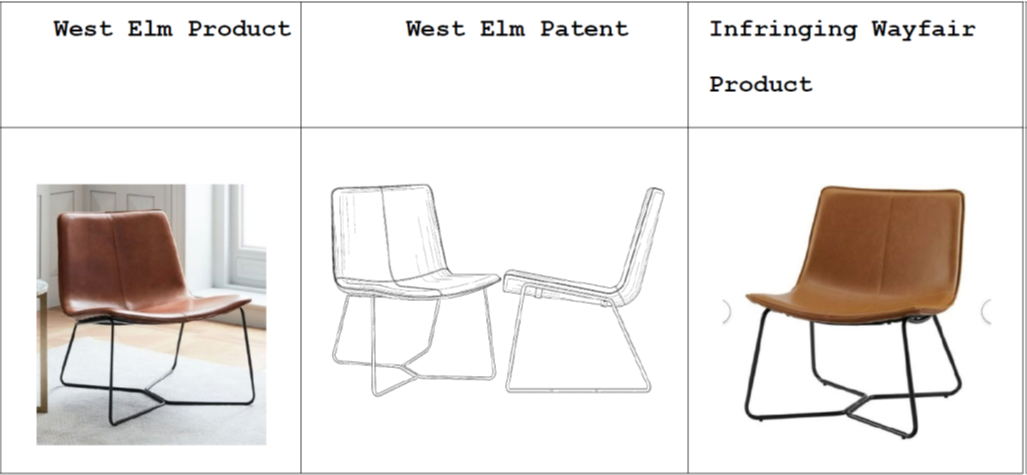
WS sued Wayfair, alleging patent infringement, Lanham Act false advertising, Massachusetts and California statutory unfair competition and Massachusetts false advertising based on alleged copying of West Elm products. Wayfair moved to dismiss the false advertising and unfair competition claims. The Lanham Act and California claims failed, but the Massachusetts claim survived.

WS has nine relevant design patents, which it alleged Wayfair infringed. Example: 

False advertising: In a video ad for its Foundstone collection, Wayfair included images of a designer sketching products, which WS alleged would lead consumers to believe that Wayfair designed the products copied from WS’s patented designs. Multiple third parties have noted the similar nature of the products, e.g. referring to Wayfair’s Foundstone products as “look-alikes,” “identical” or “mirroring” West Elm, a “West-Elm-Inspired Collection,” and that it “could easily be confused for West Elm. Again, it’s not a knock-off, but it’s fair to call it a dead ringer.” Wayfair states that products from Foundstone are available “only at Wayfair” or are “a Wayfair exclusive collection,” or “looks you’ll only find at Wayfair.”

Lanham Act: Wayfair argued that, read in context, these claims related to the collections, not to every individual product: “Foundstone” followed by the text “Only at Wayfair”; Wayfair’s “exclusive brands team has been hard at work on Foundstone a Wayfair-exclusive collection of attainable and updated mid-century furniture and décor”; and Wayfair’s “hand-curated collections are filled with the best in popular pieces, timeless designs, and looks you’ll find only at Wayfair—all at prices that fit your budget.”

The court didn’t resolve that question because it found Wayfair’s Dastar argument persuasive: the physical origin of these goods was Wayfair. And the court agreed with other courts that have held that authorship does not constitute part of the “nature, characteristics, or qualities of a good for sale” and thus isn’t the proper subject of a false advertising claim.

“However, a Chapter 93A claim can survive even if Dastar precludes a Lanham Act claim.” The court didn’t explain why; the logic of Dastar strongly suggests that copyright conflict preemption would apply if a federal claim is Dastar-barred.

California claims: No standing for a competitor-plaintiff who can’t allege its own reliance on the false or misleading statements. [Also not explaining why the court rejects the minority view that this doesn’t make sense.]

Friday, September 30, 2022

Suffolk University Law School IP Center, Fourth Annual Intellectual Property & Innovation Conference

Panel: Design Patents, moderated by Sarah Burstein, Suffolk University Law School, panelists include:

Meredith Lowry, Partner, Wright Lindsey Jennings

John Maltbie, Director of Intellectual Property, Civil Enforcement, Louis Vuitton Americas

Darrell Motley, Shareholder, Banner Witcoff; Adjunct Professor of Law & Supervising Attorney for IP Clinic – Patents, Howard University School of Law

Burstein: What role do design patents play in LV’s strategy?

Maltbie: Looking predominantly through TM, anticounterfeiting as bread and butter. Design patents play a role when we have them, typically a handbag/jewelry/diamond cuts/chain designs/shoes. Always nice to throw in but not a mainstay of protection program. Issue: legal is often the last to know of new designs, so you need to know before the design is launched: need to explain that legal needs to be part of the process. Seems like a lower bar for entry for design patent than TM protection. Growing area for us; not core but nice to have.

Lowry: For many people/products, the first few years are the only years that matter, and design patents are a tool for that. [Burstein notes that you can pay a fee for faster prosecution, 4-6 months, even 60 days is possible.]

Motley: Useful when utility patent protection isn’t available. [Burstein: even when you don’t pay, design patents issue faster than utility patents. There is a lot of demand right now that is slowing design examination.] Apple v Samsung changed perceptions. [Apparently Shark Tank also talks about design patents.]

Burstein: what changes have you seen?

Lowry: people are now more likely to be aware of design patents when they come in. More partial designs. Interest in having more assets to tout to investors/venture capitalists.

Burstein: in the past, small inventors were sometimes diverted to design patents by skeevy methods (even though the design patent may have been broader in some ways than the utility patent); this may have contributed to the disrepute/neglect of the design patent regime.

Maltbie: they used to have a bad rap but that is changing/changed.

Q: important issues now?

Maltbie: Article of manufacture definitions, as Burstein has written about. Is the text that defines the article or is it the drawing? What you call it makes a difference—and can make a difference to anticipation as well. But manipulation of the description is then a risk.

Virtual designs: how do you get potential IP protection on the design patent side for designs that don’t exist in physical space? Can you enforce physical design patents against someone in the virtual space?

Lowry: you can file hundreds of embodiments and the PTO will say one design. You either dedicate all of those other embodiments to the public or you file another application claiming priority to the first. Pending design patents are not published. If that happens there’s no real way of knowing about submarine design patents. You get the first through and 99 more are pending. Any later designs aren’t based off the first dates—they’re 15 years from issuance, not filing. So in theory there are certain product packaging manufacturers that are essentially doling those out when they see their competitors starting to use a slightly similar design & they can push one specific design through quickly while the others continue pending. Potential for continuing for 50 years! She doesn’t have a good proposal for fixing this, but it’s open. [Why not shifting to application date as with utility patents?]

Burstein: would publishing design applications after 18 months like utility patents help?

Lowry: wouldn’t help with the child applications. Instead, would propose that child applications should be disclosed with issued patents so people can understand there’s still a risk.

Burstein: there are still children pending from the iPhone application filed in 2007.

Maltbie: would like to see more on enforcement: how close does it have to be? Attorneys in practice often like a multifactor test, whereas design patents seem more black & white. Consider My Other Bag: did design patent cover a 2D image of a 3D bag printed on a tote bag? Ultimately decided not to litigate that, thought (apparently wrongly) that the TM claims were strong enough.

Lowry: lack of an ornamentality threshold is a problem. You see things that aren’t designs but, e.g., slabs of granite.

Maltbie: with fashion designs it’s possible to miss your window—you can get a TM registration and have no one to enforce it against by the time it issues. One strategy we’ve seen: use design patent period to build secondary meaning, as happened with Coca-Cola bottle.

Presentation: High Hopes: Cannabis Trademarks at the USPTO, Rachael Dickson, Visiting Assistant Professor, Intellectual Property and Entrepreneurship Clinic, Suffolk University Law School

State-legal marijuana is widespread, but TM act requires lawful use in federal commerce. PTO policy: if record indicates that goods/services violate federal law, registration is refused. If currently unlawful, ITU will be refused where actual lawful use isn’t possible at the time of filing; applicant can’t have bona fide intent to lawfully use the mark. Refusals can’t be overcome if goods contain marijuana or intended for use with marijuana. After 2018 farm bill defining hemp as distinct from marijuana: Appropriate identification w/correct wording can allow hemp goods, but FDCA refusal may still apply even if Controlled Substances Act doesn’t apply b/c hemp can’t be turned to CBD for ingestible/medicinal/therapeutic use—but huge spike in CBD-related applications occurred as a result of 2018 change. False statements to PTO do occur and are bad ideas.

CSA doesn’t apply to clothing/ornamental matter, slogans, information about controlled substances even if it seems to encourage use of marijuana, marks for clearly legal goods (e.g. smoking cessation, drug testing), and marks that include “weed” or other references but don’t actually contain cannabis and say so in the ID.

PTO is checking specimens more closely, so even if you have magic words in your ID, if your specimen clearly shows therapeutic etc. use, it can be rejected. Generally approves fabric goods infused with CBD if they don’t claim medicinal/therapeutic benefits. W/r/t non-cannabis derived CBD, other cannabinoids, other drugs, the practice is sometimes inconsistent/evolving but also generally refused.

What’s next? After Farm Bill, applicants were allowed to amend to filing date as of first legal date for hemp sales and amending ID to meet the legal requirements. PTO is likely to move slowly and conservatively post-federal legalization; FDCA refusals still likely for many products unless marijuana is completely descheduled.

RT: Interested in reaction to Robert Mikos’s recent paper which would seem to attack the statutory authority for many of these rejections.

A: Generally agree with it but getting the PTO to agree is a very different matter.

Tuesday, August 10, 2021

trolling over gnomes--no, really--on Amazon

Shenzhen Tange Li’an E-Commerce Co. v. Drone Whirl LLC, 2021 WL 3474007, No. 1:20-CV-00738-RP (W.D. Tex. Aug. 6, 2021) (R&R)

Shenzhen sought a declaratory judgment that a design patent for a toy gnome figurine was unenforceable and invalid, given that defendant/counter-plaintiff Tatiana Mironova allegedly purchased its stuffed gnome toys, then switched manufacturers and obtained a patent for an identical ornamental design without authorization. Mironova then allegedly filed intellectual property complaints against its storefront on Amazon.com fraudulently claiming infringement of her patent rights and copyrights. Amazon delisted Shenzhen’s products. Shenzen also brought claims under Texas law for unfair competition, tortious interference with existing business relationships, fraud, and business disparagement. (The parties agreed to judgment on the pleadings holding a key patent invalid. Nonetheless this is now a patent case.)

The defendants (collectively Drone Whirl) counterclaimed that Shenzhen retaliated after Drone Whirl stopped buying gnome dolls from Shenzhen by interfering with Drone Whirl’s business on Amazon.com. Shenzhen allegedly placed orders without paying for them to “lock up” Drone Whirl’s gnome inventory; bribed Shenzhen’s customers to submit bad reviews of Drone Whirl’s products; and distributed pamphlets to its customers containing false or misleading statements about Drone Whirl’s products. It counterclaimed for unfair competition under the Lanham Act, as well as Texas common-law claims of fraud, breach of contract, business disparagement, and tortious interference with existing and prospective business relations.

In relevant part, the Shenzen pamphlet began:

We are aware that there are a number of companies who are committing design infringements on our products. Producing versions of our products and selling them on the internet, particularly AMAZON. Using our products description, our pictures that we have taken of our own products even our brand to falsely exploit our reputation, in order to make quick sales. Then, they are manufacturing cheap imitations with the intent of selling them. There are only 3 shops (shop name: ITOMTE, ITOMTE INC., Hi Gnome) that are currently authorized to sell our products on AMAZON ....


Not discussed in the opinion, but relevant—the pamphlet offers various incentives for reviews of competitors. Is this legitimate, either under general advertising law, or Amazon policy?

Without discussion of the broader caselaw about legal claims, the magistrate concluded that stating that a company engaged “design infringements” to manufacture products that are “cheap imitations” of Shenzhen’s “authorized” products were all “statements of fact that are capable of being proved false or misleading.” Alleging that these statements disparaged Drone Whirl (not named, but implicated) and that they were likely to confuse consumers was sufficient for falsity/misleadingness, and alleging that the statements were in emails and a pamphlet sent to customers was sufficient to allege commercial advertising/promotion.

Friday, June 05, 2020

overstatement of claims in patent case/potential customer liability could be false advertising

Shure Inc. v. ClearOne, Inc., 2020 WL 2839294, No. 19-1343-RGA-CJB (D. Del. Jun. 1, 2020) (magistrate R&R) 

Skipping substantive design patent stuff (sorry, Sarah Burstein). The parties compete in the installed audio-conferencing market and have a history of litigation, including accusations that Shure infringed ClearOne patents. The court in that case denied a preliminary injunction on one patent and granted it on another. ClearOne also filed a separate suit against Shure. 

Shure then sued here for infringement of another patent, as well as federal false advertising, Delaware Deceptive Trade Practices Act, unfair competition, tortious interference claims based on ClearOne’s alleged marketplace misconduct; Shure then added claims based on a newly granted design patent. 

Shure alleged that ClearOne made various false or misleading statements (including statements made by its Regional Sales Manager Schnibbe and its Senior Vice President of Finance Narayanan to customers, installers and integrators regarding the status or impact of litigation between the parties, including the impact of the preliminary injunction. 

First, were these compulsory counterclaims of the other (Illinois-based) litigation? No. Shure’s non-patent claims allege that ClearOne falsely advertised regarding the “availability, legitimacy, and viability of Shure’s MXA910 product based on the ongoing litigation between the parties.” But those statements related to rulings in the earlier Illinois case and a separate IPR proceeding, not to the more recent Illinois case. Even if Shure is ultimately found to have infringed the patent at issue in the more recent Illinois case, that wouldn’t affect whether Shure’s statements about earlier litigations were misleading and/or harmed Shure at the time that they were made. And as to Shure’s patent infringemetn claim, it did involve similar conferencing and array microphone technologies as the previous patent case and implicated the same products, in the sense that ClearOne’s accused product here practices the patent ClearOne asserted and that Shure is asserting damages tied to sales of its own accused-in-Illinois product. But that wasn’t enough given the different patents in suit. 

False advertising: The claim was sufficiently pled under Rule 8. Shure alleged that “[s]ince at least March 2019” Schnibbe made false and misleading statements about the availability, legitimacy and viability of Shure’s MXA910 product in connection with the ongoing litigation between the parties to “more than a dozen installers and integrators” of Shure’s conferencing equipment. They include “that Shure’s MXA910 has been found to infringe ClearOne’s patents, that two separate court rulings found that the MXA910 infringed ClearOne’s patents, that such rulings were ‘unanimous,’ that ClearOne had ‘won’ its lawsuit against Shure, that the MXA910 will soon be unavailable, that Shure will soon have to stop selling the MXA910, that Shure was then unable to sell MXA910 products, and that integrators, installers, and/or end users will need to tear or rip out existing installations of the MXA910.” Alleging this, and that these statements were “intentionally misleading and were made in bad faith, and with the intent to induce customers to refrain from purchasing MXA910 products,” was sufficient to provide proper notice, even if Shure didn’t name a specific customer to whom the statements were made. And Shure explained why such statements were allegedly false: because they wrongly suggest that, in light of the state of the legal proceedings at issue, there is no permissible non-infringing use of the MXA910 product or that the MXA910 will no longer be available in any form.

Commercial advertising or promotion: under the alleged circumstances, statements by one person to more than a dozen customers were plausibly “part of an organized campaign to penetrate the relevant market.” 

Bad faith: because of the interaction with patent law, false statements about patent rights have to be in bad faith to be actionable under the Lanham Act. Shure alleged why the statements were false, which was sufficient to allege bad faith at this stage.

ClearOne argued that its statements were non-actionable opinion, but they could be “verifiably false statements of fact.” It wasn’t opinion to say that (1) Shure’s product had been “found to infringe” ClearOne’s patents; (2) that two court rulings came to that conclusion and were “unanimous”; (3) that ClearOne had “won” its lawsuit against Shure; and (4) that the the product would soon be “unavailable” or that Shure could not sell them or that Shure’s customers would need to rip out existing installations. These were plausibly clearly untrue, in light of the then-current state of the 2017 Illinois case and the IPR proceeding involving one patent (in which there was then no final determination of infringement, nor any order affecting sale or use).

Because Shure pled literal falsity, it was entitled to a presumption of actual deception. 

As for the state law claim, the DTPA actually has a “lower burden of proof than the Lanham Act” because “a complainant need not prove competition between the parties or actual confusion or misunderstanding” to prevail in an action under the DTPA. Because at least the allegations about Narayanan’s letter satisfied the pleading requirements, the claim should survive. (The statements were very similar to the statements discussed above; for example, the letter said that third party installers and integrators were likely infringing ClearOne’s patent by installing Shure’s product “in a drop-ceiling mounting configuration,” but this was allegedly false because some such configurations were noninfringing; it also allegedly misleadingly suggested that Shure customers could be held personally liable via the 2017 case, when that could not happen; etc.)

 The magistrate also recommended that tortious interference and unfair competition claims should survive.


Thursday, December 05, 2019

Design Law Scholars Roundtable part 3


Session 3: Shaping an Overall Approach to Protection

Introductions: Jerry Reichman and Estelle Derclaye 

In what ways should different forms of protection be tailored to various types of subject matter (construed legally as forms of intellectual property, but also subject matter construed socially or commercially)? How, if at all, should we deal with concerns about overlap/cumulation of rights? Should the current procedures and institutions for granting and challenging the validity of rights be changed? Should we channel subject matter to certain forms of protection? If so, how should we draw the lines between different subject matter? Should we limit the scope of different rights so that those rights have different effects? Provide for different remedies?

Reichman: battle on concurrent protection has been won by France. Italy abandoned separability, which we adopted. If courts take conceptual separability seriously, it becomes the German test in disguise—but even the German court has now abandoned a test of superior creativity, so there’s only one test of originality in German law, which doesn’t require superior creativity.  From a legal perspective, concurrent protection is the de facto norm in EU law.

That said, he doubts that this is as important result as it seemed a decade ago. Because today, industrial designers are more inclined to seek unending TM protection. Even © protection remains iffy where form and function are fully integrated. In his view, role of sui generis design law today is to allow designs to acquire secondary meaning through use. When that demonstrably occurs, then the design can be protected indefinitely. The most ingenious pro design legislation anywhere is the EU regime of unfair competition law, prohibiting slavish imitation of unregistered designs for 3 years. Brilliant b/c in fast moving markets a successful design may acquire secondary meaning in 3 years; TM then takes over. Or it may have little/no further value on the market, in which case neither design nor © is of interest to investors.

That isn’t to say sui generis laws are useless, but they should be simple, easy to use, and inexpensive. To his mind, the best sui generis law was the PTO/© office proposal of the 1970s, attached to the draft act as Title II, but separated from the 1976 Act at the last minute on the grounds that it was anticompetitive.  We are stuck with design patent law, which expressly requires novelty, originality, though not nonobviousness and which is thus not fine under TRIPs. Courts in England and elsewhere have managed to complicate design laws so much that it no longer looks a ton better than our design patent scheme, but he still doesn’t know why we haven’t been sued.

Separability has become a farce in ©.  Imagined separability boggles the mind as framed in Star Athletica. The opinion is so meaningless as to require Denicola to make sense of it. Still a blemish on our law, b/c we exclude a bunch of designs from © and send them to design patent, but many can’t get design patents, which thus violates TRIPS.  Enacting a 3 year law as Title II might be the best option, even 50 years late.  That would stimulate our design industries further.

Estelle Derclaye: Overlaps are not bad per se. If there are different purposes, they are acceptable. Cumulating damages for the same infringement is an issue where the harm is exactly the same. © protection can be anticompetitive, where © extends (or is attempted to be used) where patent should be. E.g., you use the contract for software that you can offer b/c of © to bar the extraction of ideas from the program.  Or use of TM to extend a patent. Or overlap during same protection where the exceptions/scope of the regimes differ. TM/patent/design interface for shapes and other characteristics giving substantial value to the goods. Several ECJ cases have interpreted. Q: does the same demarcation apply to ©? She thinks it should. Not clear whether there is negative convergence such that only patents can protect these shapes solely dictated by function.  

Designer’s option to register design to cumulate: getting rid of community unregistered design right. That happened in UK, 2014 with its own design right—trying to minimize regime clashes. But if you do that at, you need a system which has a very well crafted registered design system. If you have a patent or © approach for registered designs you’ll have cycles of over and underprotection.  A design approach has to be neither © nor patent; EU is a good starting point.

Building on Ansgar Ohly’s proposal: need a rule for how you cumulate, including w/unfair competition. Imitation alone shouldn’t be banned w/o confusion as a cause of action under unfair competition.

Remedies: courts should consider the underlying nature of the harm and identify the remedy best designed to ameliorate that harm.

Sarah Burstein: Reichman is worried that designs can’t satisfy nonobviousness—but the Federal Circuit has removed constraints.

Reichman: the Fed Cir has improved it; but still, nonobviousness means that people don’t apply—the lawyers tell the designer there’s no chance.  [A lawyer who did that now might arguably be committing malpractice.] Pre Fed Cir, almost all design patents were invalid.  With the Fed Cir, the design patent system works. But even with a flexible nonobviousness standard, you’re not going to get much protection.

Burstein: the lawyers I talk to don’t consider 102 or 103 a serious bar and don’t counsel their clients that way. Not today. We know empirically that the number that are rejected is very low. The Fed Cir has made the test for hard to satisfy that rejection for obviousness is essentially impossible.

Sprigman: Examiners also don’t have the way to examine they need. Went through design patents for yoga wear. They didn’t even make a nonobviousness inquiry

Burstein: they don’t have the prior art. The examiners try, but it’s stacked against them.

Dinwoodie: state of law or practice?

Sprigman: both! The standard requires examiners to do something they’re not equipped to do.

McKenna: b/c nonobviousness is incoherent for design, the Fed Cir has made the standard impossible.

Sprigman: racerback bras: multiple variants have been granted based on narrowness/length of straps.

McKenna: agree not a meaningful bar, but trying to craft a workable standard.

Buccafusco: drop the word, but consider the concept: a judgment of similarity at some level of abstraction. No different from idea/expression.  So far, there has been virtually no abstraction at all; just a little bit of difference is enough.

Dinwoodie: every design system has a question like this: how much difference does there have to be? Reichman argued that utility patent obviousness didn’t work in a system that regarded incremental innovation as its object (design), but the framing: how different does this have to be to give you an IP right? Is a workable framing.

Sprigman: racerback bra straps—length and thickness would be normal variations. Two criss cross straps, you can patent three. That’s a problem.

Jason Du Mont: isn’t that just formalism problems?  The formalist test restricts examiners from using primary or secondary references in a way that would take that into account.

Dinwoodie: so would Reichman abolish design patents in favor of Title II design right?

Reichman: yes, replacing it w/© like regime. If Burstein is right [she is], then they’re no longer applying utility patent standard, which is what they wanted from design right. Is that enough to satisfy TRIPs?  He doubts it.  TRIPs reaffirmed the Paris Convention; a foreigner who doesn’t get a design patent because of obviousness should object.  

Sprigman: the standard probably fits now; there was convergence.

Dinwoodie: for that regime to work, separability must work robustly. 1980-2015 law was largely pushing stuff out of © is the other part of the puzzle.

Reichman: agrees. © office knew what it was doing with separability, but at that time separability was supposed to (a) be tough and (b) coexist with a design right.

Dinwoodie: Derclaye seems to want British law before we were forced to change. If you took a design that has © and apply it industrially, we then restricted your © to the scope of registered design.  Utterly compliant w/EU law but British IPO decided it wasn’t and abolished it.  Another provision of the law prohibited rights in the article via drawing of article; if you want that do you want unregistered design right abolished?

Derclaye: should abolish the Community unregistered design right b/c © does the trick. If you keep UK unregistered design right, the prohibition on getting rights in the thing from drawing of the thing is also good. Would change to election of remedies by choosing to make industrial use of a work. So you could use © without knowing you want design right, cumulation would be no problem, it would just limit the remedies/term you could get if you used © to protect what was actually an industrial design.

Buccafusco: Canada’s law is based on the old UK system. If you make more than 50 copies you have to switch to design right.

Ansgar Ohly: © and design law: Europe is a laboratory with all the possibilities that could exist—we’ve had separability, we’ve had 25 years for industrial application, we’ve had two different levels of originality (higher for ©, lower for design—need to meet a “museum test” for a design to get © protection). Now we have no idea: open Q whether French have won full cumulation or what the judgment means when it says there shouldn’t be a full overlap b/t design and ©, without providing any criteria for avoiding full overlap.

We find separability problematic—do you know what it is?

Designs and TM overlap: Article 4(e) says when a shape gives substantial value to the goods, you can’t register the TM, even w/secondary meaning. So what does that mean?

Dinwoodie: substantial value is unclear in meaning to him. British courts may think that if it is capable of being registered as a design then it has substantial value.  That would really exclude all shapes from TM.

Ohly: ECJ gave some criteria about design attractiveness: to what extent are features highlighted in advertising, and so on. But when a design becomes really well known as good, then it acquires secondary meaning and also may give substantial value to the goods.

Dinwoodie: there’s a gap between recognition and iconicness which isn’t quite recognized.

McKenna: but being recognized as a design is not the same thing as having secondary meaning.

Ohly: but they overlap.

McKenna: no, they really don’t.  Most widely recognized designs don’t have secondary meaning in the TM sense.  (Statue of Liberty, anyone?)

Dinwoodie: there is opportunistic framing by litigants, and the circumstantial evidence usually used might indicate both.

Du Mont: that’s the marketing function. We might not like that concept, but that was what they were trying to put their finger on: the difference b/t differentiation and secondary meaning.

McKenna: it’s entirely possible to be widely recognized as a design but not say anything about source as such. Eames chair: Eames designed it, but it doesn’t tell you all designs come from one source. But b/c we have such bad proof systems for secondary meaning they do overlap. 

Burstein: Dastar.

McKenna: Yes! Being recognizable as a work of design isn’t the same thing as source. 

Ed Lee: what we would do if starting from scratch for design: the system we currently have is odd and irrational to have overlapping forms of IP. Public interchangeably uses patent, copyright, and TM, and apparently so does design even though there are important distinctions we should be using. Traffix/Dastar type system to navigate the overlaps? Functionality tests are different. Remedies are also different: seems like you could elect statutory damages for © and disgorgement of all profits for design patent in the same case, even though you couldn’t otherwise get two forms of damages for the same conduct.

McKenna: remedies are very important: people who bring trade dress/design patent claims say that they want injunctions and damages, and TM makes injunction easier and design patents make damages easier, so it’s the best of both worlds for them. The Frankenstein monster system we have now is the result of many different forces. A lot of the overlaps are the result of deliberate attempts to expand certain types of subject matter b/c of perceived sense that other systems didn’t reach them—we have design patent b/c © and TM didn’t protect them, but then people tried to expand © and TM b/c perceived design patent didn’t protect them, and it worked. We have post-sale confusion b/c fashion is supposedly not protected.  That’s a different problem from the natural internal logic of a system inherently producing overlaps; the internal logic of the system is changed to make it look like a natural outgrowth but these were engineered overlaps.  That has ancillary effects on the operation of those systems in their traditional domains: manipulating TM so it can cover product configuration changes your understanding of what source identification is, what confusion is, etc. So we should ask how much damage we’re doing to the internal system in order to reach this area of overlap.

What are the practical solutions? Creating doctrines to police boundaries; that can be done different ways. Can exclude stuff from the system entirely (Dastar). We were stupid to incorporate product configuration into TM in the first place and have created all these doctrines to deal with the effects.

A sui generis system works only if you can identify its coverage in a reasonably clean way and exclude its subject matter from other systems.  The concepts have gotten blurred since Title II was on the table. Maybe this should be about “design of certain stuff” and not just “design.”

The linedrawing difficulty wasn’t inevitable outgrowth of the internal norms of each system, and we could productively rethink each core system.

Ohly: can the legislature anticipate these strategic moves? The EU unregistered design right was supposed to avoid that. 

Sprigman: the antitrust division of DOJ really didn’t like Title II. There is no evidence that these industrial designs need encouragement.

Felicia Caponigri: the leading case for fashion © in Italy was a case about moon boots; the reason court abandons the separability test is that it evaluates how iconic the design is and how it changed the evolution of the boot historically and culturally. Not saying this is correct, but when we think about overlapping rights, we may have to consider whether there are other areas of law that may be also affecting the definitions in IP law. Cultural heritage law, GIs, concepts of authentic/not authentic may be affecting ideas of copyrightability and nonobviousness. Expand horizons to other regimes.

Laura Heymann: courts are motivated by the sense that new subject matter should be in the regime.  Post-sale confusion (e.g. for Ferrari kit cars) is invented b/c courts think this should be protected, and they don’t yet have dilution. And then we get dilution formally later. There’s a sense that this is the right thing for the subject matter—how to address that.

Caponigri: the Ferrari, subject of the post-sale confusion case mentioned, was recognized as subject to © in Italy this last year.

McKenna: agrees too. If the D feels like a bad guy, the court may try to reconfigure the doctrine to get it. But that’s not the same thing as a straightforward application of the internal logic of the system.

Derclaye: the EC was trying to address the overlap b/t regimes with the unregistered design right, but naively thought that therefore © wouldn’t be used by designers any more.  In France, they are winning the most on different bases (unfair competition, TM, ©). Good intention, but left open the copyright/design interface and thus ensured cumulation.  Negative convergence for shapes solely dictated by function (if no mess is made by © reasoning in CJEU case on Brompton Bicycle) could do the trick.

Dinwoodie: the problem isn’t the Commission, the problem is the Court. The Commission left it open for Germany and the UK to do what they did.

Derclaye: well, they left it open for cumulation assuming that © would not be used. Naïve.

Buccafusco: we could do simple things to make design patents better: they could cost more; they could have renewals. But we might therefore push people into trying to use TM/© in scarier ways.  Trade dress cases over expired design patents: if we want Traffix for design patents, that’s great, but may also further push people into using other areas of the law.  Maybe we should treat design patents as not that scary, even though they are silly, compared to the other fields.

Burstein: will the line hold? Design law as safety valve. But it’s not clear that works—Europe seems to suggest not.  In litigation: if people think there are multiple claims, they are more likely to find liability.

Lee: it also matters that you get to go to the Fed Cir if you stick a design patent claim in.

McKenna: presence of multiple claims may let the courts approach the case in broader terms—may let you get away with weaker claims on each individual cause of action. Intent evidence may contaminate similarity analysis for design patent.

If you accept that courts in many of these cases that courts have a protective instinct, the most useful intervention may be to remind them that some other right is available. You don’t have to screw up TM law to get this; they can get a design patent. That’s one reason that destroying unfair competition as a separate doctrine has been bad: the existence of a lesser remedy was a safety valve to prevent TM from expanding. Booking.com: generic terms can be generic and there can still be a very limited remedy for passing off (Blinded Veterans). Reminding courts that just b/c the structure of a doctrine doesn’t cover conduct doesn’t mean that other doctrines don’t exist. Copyright expires for a reason.

Sprigman: but the grass is always greener for doctrines you don’t know as much about. Depends a lot on the structure of unfair competition law.  Antitrust law is one thing, but letting plaintiffs’ lawyers have free rein over unfair competition is also a problem.

Stacey Dogan: there’s nothing self contained about unfair competition law. To say it’s limited to passing off is descriptive, not normative.  The impulse to have unfair competition is itself normative, but the constraints on it (remedy is labeling only) are descriptive.

Mid-point discussants: Rebecca Tushnet

Balloon problem/grass is always greener problem: there is a rule about defamation that is a channeling device and it works a ton better than the IP channeling doctrines.  If you relabel your defamation cause of action—if the gravamen of your claim is for damage to your reputation, whether you call it intentional infliction of emotional distress or tortious interference with contractual relations or even trespass by deception—you have to meet defamation standards.  Smithfield Foods, Inc. v. United Food and Commercial Workers Int’l Union, 585 F. Supp. 2d 815, 820-21 (E.D. Va. 2008) (“[I]f a plaintiff seeks damages which are ‘reputational’ in nature, constitutional libel standards (i.e., falsity and actual malice) apply to the plaintiff’s damage claims. To allow otherwise would be to countenance ‘an end-run around First Amendment strictures.’ . . . [T]he label of the claim is not dispositive ….”). (TM is an exception to this b/c no one knows what goodwill means, but it’s only a partial exception given the limits TM law has placed on suing over criticism.)

We have a better idea of what defamation is for than what © is for, and US courts are strongly committed to a distinctive First Amendment tradition, so there’s definitely no slam dunk in making this difference stick. (But … if courts start to distrust causes of action, they can be pretty rigorous. Antitrust, RICO, even some TM claims.)  If you are really committed to what these doctrines are for, you can channel. But without consensus you can’t.

Carol Rose: Crystals and mud as a useful framing device?  Bad guys and sad sacks drive the change in focus of the law.  But we are at different points in the “cleaning up the mud” phases in different fields—©, TM, design patent.  This ensures that no crystalline rule can ever get established successfully.

The centrality of functionality: Star Athletica and functionality as the remaining limit. The potential dangers of saying it allows protection of functional elements (e.g. Buccafusco Lemley Masur piece): compare to the dangers of saying fair use is unpredictable. Courts may be able to do a lot with de facto and de jure functionality as in TM.

Relation b/t costly screens and biased screens in assigning the right in the first place: if there are thresholds, who will pass them (even assuming they have the money, which is also biased)? We have to understand that screens will disproportionately burden disadvantaged groups, although it’s also true that courts won’t be better.

Jason Du Mont: Might be ok w/a different functionality rule for design patent. Thinks of design patent as a baseline: if an innovation is going to go anywhere, it ought to be there unless it makes it into utility patent (or is in the public domain). Overlaps aren’t a problem in themselves. They tend to be problems of TM or ©.  History of design rights in the US: a pure gap filler, which was in the design patent system b/c Congress just listed topics with no conceptual coherence.

Registration systems: might require greater specificity. The Star Athletica © registration, for example, should have been better nailed down. That could contribute to resolving cases earlier. Not sure how to make that work in TM w/o getting rid of unfair competition.

McKenna: de facto/de jure functionality is not a strong distinction.

Buccafusco: that still means expensive fights about what is protectable and what is excluded. Everything is protectable and it’s about scope and it may all have to go to a jury.

Du Mont: © office has started rejecting things for originality.

Fromer: that’s mostly for logos—channeling to TM.

Du Mont: also rejected a float in the shape of a piece of pizza.

Dinwoodie: de facto/de jure could be used in interpretation of separability; could also be put into originality and idea/expression—102(b). Or are you suggesting a freestanding functionality doctrine? If we want a transubstantive functionality doctrine it might make more sense to do it freestanding.

RT: yes, could do it as a matter of 102(b) (facts aren’t listed in 102(b) but we screen them out anyway).

Derclaye: that’s what we do in EU.

RT: and these decisions are always made in context of a defendant who has done something: have they taken something copyrightable? So there will always be a comparison and functionality can be part of that.

Q: would aesthetic functionality count?

RT: yes.

McKenna: Fromer has made the point that courts have never taken seriously the Q of whether the intrinsic function of the article is anything other than to portray its own appearance/convey information—it’s very broad.  Discussion: There’s very little case law playing with aesthetic functionality and whether it counts as functionality in © (in © it can get deemed merger, scenes a faire, etc.).

Reaching consensus on the meaning of functionality is one thing; operationalizing it is another. Features are going to be aesthetic and functional at the same time. The question is where along that curve it has to be. TM says: if a drop of function, it’s out. Design patent: a drop of aesthetics, it’s in. Could have the same question about what function is and different places on the curve.

If you think of functionality as alternative designs available in the market, there’s no reason to distinguish utilitarian from aesthetic functionality.

Buccafusco: the amount we are scared of functionality has to do with the limiting functions of other doctrines in the field.  Functionality in ©, which is long and has limiting doctrines like merger, idea/expression, raises different issues. [Note that TM cases do say you can’t protect an idea with TM, though conceptually that puts the cart before the horse.]

Caponigri: aesthetic functionality as a protection against speech restrictions? People use these for communication.

Dinwoodie: Kalpakian says idea/expression protects freedom to compete, so it’s not hard to locate functionality concepts in ©.

Buccafusco: design patent cases essentially have idea/expression already: Richardson tool case; Ethicon.  Without saying so, the courts are saying that the design patent doesn’t protect the concept. Very narrow level of specificity.

Du Mont: push back a little: factoring things out is problematic.

RT: but substantial similarity is the exact same difficulty.

Du Mont: EU also does that with considering designer’s degree of freedom.

Burstein: Egyptian Goddess actually does a good job of that.

Buccafusco: we don’t necessarily know what’s going on in the field. But design patent data is available. One of the things we should be doing is figuring out what we’d like to know about, e.g., design patent citations. 

Burstein: the prior art citation is very bad; they cite URLs that then disappear.

Heymann: we also don’t know what’s happening in C&D world. Rules that change the effect of what people do before they get to court are more important.

Fromer: even w/registered TMs, it’s really hard to figure out what’s registered—how much on the register is trade dress? The coding is really bad! They don’t care about data consistency, maintenance, etc. We need to push them to code consistently and keep data.

McKenna: we’re asking for data about categories that have only recently been enforced on the law: trade dress as an ontological category is new and undefined—it’s all just stuff that wasn’t a TM, so there was no reason to distinguish packaging from configuration etc. The registration system reflects that—“trade dress” or even “configuration” is a recent phenomenon.

Dastar is a rule about channeling. Defamation is channeling based on the nature of the harm the plaintiff is claiming the defendant inflicted.  Most IP channeling rules aren’t like that. Dastar is an opening for that kind of channeling: if the nature of the harm you’re claiming is that people will attribute authorship of the content to the plaintiff, then that’s a © and © only issue. Would it be easier to configure rules around what the injury claimed is?

Dinwoodie: as RT says, the problem is that we need a coherent concept of the harm.

Heymann: misuse is a group of cases geared at the same kind of thing: you’re trying to enforce your © in a way that © is not for.

Mark Janis: note that the rhetoric of dilution crept into the Apple v. Samsung case—that’s not the kind of harm design patent is for.

McKenna: there was a dilution claim there too, and that may have contaminated the reasoning.

Burstein: that was also about gaming remedies; claiming they needed an injunction for the brand.

Du Mont: is it really a legit purpose of design patent law to let people acquire brand value?

McKenna: no!  Deeper Q: is the sharpness of the defamation rule coming from the fact that we really understand the harm of defamation and so can recognize a defamation claim whatever its label?

Dinwoodie: we can do better than subject matter channeling, but with less consensus on purposes of IP it will be difficult to get as clear as the defamation rule.

Caponigri: Is the harm of © infringement that there was harm to incentives, or is it a more Abraham Drassinower like theory of harm to expressive interests?

Burstein: SCt has said it doesn’t care about overlapping subject matter.

Sprigman: so shallow: how is design patent different subject matter than trade dress?

Dinwoodie: Kohler v. Moen says there’s a difference b/t an invention (faucet) and a sign (faucet).

RT: incentivizing different things/preventing consumer confusion as the cores of patent & ©/TM respectively?

Discussion about how this is a tough and abstact line to draw, and also law & econ has contaminated the idea of incentives. RT: thinks the Trademark Cases are nonetheless good law.

Future directions:
Dinwoodie: the role of transubstantive rules (the flip side of cumulation). Some of us think there are values to that, but we might think about the merits of such rules and design is a good vehicle for that Q generally.

Fromer: the extent to which we use the same terms differently in different fields—Burstein’s faux amis.

Derclaye: Overlaps and remedies. 

Sprigman: Unfair competition as safety valve. Specify doctrinal soft spots of each IP facets that could be eliminated in favor of a meaningful unfair competition approach, e.g. post-sale confusion. Catalog where unfair competition could be useful in solving/reducing overlap problems. There was a theory of unfair competition once upon a time; could that be recovered?

McKenna: people use IP claims to complain their markets have been disrupted; they also sometimes use antitrust or other business torts. Many of those state tort doctrines have recognized the soullessness of those doctrines and built protective doctrines: you can’t bring a claim for tortious interference w/o identifying a separately tortious act—you can’t just show competition. It’s not recovering the theory, but recognizing that we lost a useful tool and reconstructing it for current purposes.

Sprigman: antitrust’s standing/injury doctrines are meant to do that. It puts the plaintiff to an early showing that injury is w/in the zone of interests.

Dinwoodie: Lexmark as innovation towards a similar thing?

RT: Courts let TM claimants get away with standing/injury very easily [b/c we don’t know what goodwill is].

Buccafusco: should think of other areas of law that shape product design: disability law, transportation law, environmental law, etc.