Monday, June 26, 2023

A&E's (c) and TM claims survive against former producer's new version of cop show

A&E Television Networks, LLC v. Big Fish Entertainment, LLC, 2023 WL 4053871, No. 22 Civ. 7411 (KPF) (S.D.N.Y. Jun. 16, 2023)

The court refused to dismiss copyright and trademark claims based on copying of a TV show format, including the hosts.

A&E owns a trademark (for entertainment services) and registered copyrights for Live PD, “which for four years featured live feeds of law enforcement activity across America, along with live narration and commentary from host Dan Abrams and others.” It developed the show with Big Fish, but the parties agreed that A&E would have exclusive ownership of the rights in Live PD. “In 2020, as America reckoned with police brutality after the death of George Floyd, the show was taken off the air.”

Two years later, defendants launched “On Patrol: Live,” which was allegedly virtually identical to Live PD.

The complaint alleged that Live PD

followed several police departments from across the country in real time as they patrolled their communities, while hosts Dan Abrams, Sergeant Sean “Sticks” Larkin, and a third host, discussed the footage from a studio. This type of documentary-style series — combining carefully selected live footage from cameras mounted on police dashboards with in-studio commentary — was the first and only series to feature the work of law enforcement in real time over a sustained period.

Slicing the numbers: Live PD was the number one program (excluding sports programs) in the key demographic of adults aged 25-54 twenty-eight times in 2018; was the most watched program on ad-supported cable television during prime time on Friday and Saturday nights in 2019; and rose to among the top spots in all of cable, drawing approximately three million viewers per weekend in 2020. A&E also greenlit spinoffs: Live PD: Rewind, Live PD: Police Patrol, Live PD: Roll Call, Live PD Presents: Women on Patrol, Live PD Presents: PD Cam, Live Rescue, Live PD Presents: Top Ten Police Vehicles, and Live PD: Wanted.

Defendants allegedly launched an ad blitz proclaiming “the return,” “relaunch,” and “revival” of Live PD on REELZ, a competitor network to A&E. On Patrol: Live used the same two hosts and also features Curtis Wilson, who previously featured as a contributor on Live PD. REELZ allegedly told advertisers that the “working title” of the show was “PD Live,” and went so far as to announce that “REELZ ADDS #1 TV SHOW TO OUR PROGRAMS LINEUP” with “ALL NEW LIVE EPISODES.” A&E alleged that the new title “On Patrol: Live” was already associated with the Live PD spinoff Live PD: Police Patrol.

On June 8, 2022, multiple articles were allegedly released announcing — erroneously — that Live PD was making its return on REELZ, including a Wall Street Journal article declaring “Live PD is coming back this summer as ‘On Patrol: Live’ ” and an Atlanta Journal-Constitution article proclaiming that Live PD would “soon be live once again” as On Patrol: Live on the REELZ network. Former Live PD host and current On Patrol: Live host and executive producer Dan Abrams tweeted “somewhat misleadingly” on that day that “Live PD is coming back” while thanking “the #livepdnation” for its “patience.” One month later, he announced a promotional tour for On Patrol: Live in a manner that allegedly suggested a continuation of the Live PD series, noting that it was “hard to believe we are almost back!!” and linked a New York Post article stating that “Live PD [was] back as On Patrol: Live two years after being canceled”

An executive producer of both shows allegedly perpetuated the continuation theory by telling Entertainment Weekly that REELZ believed in the Live PD show in its original format and did not seek to bring it back in a completely different manner. REELZ’s official Twitter account retweeted the various articles discussed above and issued a press release announcing the purportedly “new” series “from the producers of Live PD,” and quoting Abrams as being “thrilled” that the “team is finally back together.” A Facebook fan page with nearly 137,000 members changed its name from “A&E LIVE PD” to “Reelz — On Patrol Live.”

The new show was allegedly “virtually indistinguishable from Live PD,” following police and sheriff’s departments in real time across the country (including some of the same departments previously featured on Live PD), while the hosts (described above) comment on the action from a studio. 

Media critics allegedly readily observed that the new show was “a clone of A&E’s Live PD,” and that “On Patrol: Live is Live PD.” Fan reactions on social media included “Ok. I’m confused. Is Live PD back on the air? If so, how do I watch?”; “Dan Abrams really got Live PD back on the air disguised under a new name and on a new channel.”; “Watching Live PD. Yeah, yeah ok. On Patrol whatever! @danabrams, this is the best Friday night in years! Glad to have you back!”; “So awesome to be spending Friday & Saturday nights watching Live PD again. I missed it!” (Query: what percentage of social media comments about On Patrol: Live does this represent? Is that a good measure of confusion? Confusion about what, exactly?)

The new show was a hit for REELZ.

Copyright: infringement can occur when someone else  copies “the author’s original contributions” to the subject work — that is, “the original way in which the author has ‘selected, coordinated, and arranged’ the elements of his or her work,” even if those elements, standing on their own, are not protectable. (So, one thing that distinguishes this case from several other plaintiff-sues-original-author cases like Fogerty v. Fantasy is that the creators are part of a corporation and so the work began life as work for hire. Nonetheless, it doesn’t seem that shocking that people who made a work before will do something similar when hired to make another. The key question is, of course, how far copyright will go to interfere with that artistic continuity.)

At this stage, the court held that Live PD was comprised of original expressions of non-protectable elements, and applied the more discerning ordinary observer test. Unprotectable elements/scènes à faire: the idea of an unscripted police show is not itself copyrightable, police department footage, disclaimer banners, segments about missing children or wanted lists, a three-host format, a view toggling between live footage and in-studio hosts, and red and blue lights.

Of note, the court declined to find that the show’s “Missing” segment, “Wanted” segment, and “Crime of the Week” segment, along with the show’s segments before and after commercial breaks, were copyrightable in themselves. “In light of the thin degree of originality that inheres in Live PD as a whole, the Court will not find that each segment, on its own, is entitled to similar protection.”

Nonetheless, A&E successfully alleged infringement of its thin copyright: “Plaintiff and Defendants are uniquely situated in that the two shows are nearly identical and use the same creative arrangement of the same hosts, lighting, guests, camera angles, screen toggling, and other stock elements, and it is that combination of identical elements that creates two works that are virtually indistinguishable.”

The following similarities, taken together, plausibly alleged infringement:

• Both shows begin with nearly-identical percussive, fast-paced music playing while a black screen displays an introductory disclaimer in white letters with nearly identical language, and such music and display appears each time the show returns from commercial;


• Both shows toggle between footage of live or pre-packaged police patrol action and studio commentary by the show’s hosts discussing the unfolding action;

• Dan Abrams is the primary host, and Sgt. Larkin the co-host, of both shows;

• Each show features a third host, which, for On Patrol: Live is Deputy Sheriff Curtis Wilson of the Richland County Police Department, a former recurring participant on multiple episodes of Live PD;

• In both shows, the three hosts are dressed similarly and situated around a table with Abrams on the left, Larkin in the middle, and the third host on the right;


• The studio in which the hosts sit features large TV screens on the walls and blue and red lights behind the screens;

• Abrams narrates the action on screen in both shows and uses the exact same catchphrases such as “What’s the theory here?” and “Let’s take a good look at [the missing person]”;

• Both shows feature several of the same law enforcement departments and On Patrol: Live even brings back some of the same individual officers from those counties;

• Both shows include “Crime of the Week” and “Missing” segments, with the latter segments for both shows cutting to Angeline Hartmann of the National Center for Missing and Exploited Children for a description of the circumstances behind the missing person;


• Both shows include a segment featuring footage of a previously committed crime while one of the hosts explains the crime and describes the suspect for whom police officers are looking;

• Both shows display the location of the law enforcement action in a rectangular box at the lower left-hand corner of the screen and, when officers speak to the camera, the shows both flash the officer’s name and department;

• Both shows feature descriptions of the events in the lower left-hand corner (e.g., “traffic stop”) with the location of the event beneath the description;


• Both shows display the exact same “earlier in” tagline on the top corner of the screen when airing pre-recorded footage;

• Both shows at times utilize dual screens, particularly during car chases, with footage of the road displayed in a larger screen in the upper-right-hand corner and middle of the TV screen and a smaller, overlapping screen in the lower-left-hand corner displaying the officer in the car;

• When introducing footage for the first time from a specific location, both shows display a similar U.S. map on the screen that shows the viewer where the event is taking place;

• Both shows also use the same or nearly identical camera angles, motion theory (i.e., how the graphics are zoomed in and out), process to settle on and highlight a location, and palette when featuring the U.S. map (including color choices, how the colors are used, and the relationship between the chosen colors);

• Both shows use strikingly similar logos that draw on the same marks and iconographies;

• When transitioning from one location to another, both shows first flash a screen with the city or county and state of the second location before cutting to law enforcement footage;

• Both shows end virtually identically, with footage of law enforcement action playing in a rectangular box in the middle of the screen while the credits flash beneath the footage in white letters and police lights flash on dark pavement in the background; and

• The time slots (and thus the time period covered by the live action) of both shows are the same — 9:00 p.m. to 12:00 a.m. on Friday and Saturday nights. [Um, is that even something you can count in copyright? I’m dubious about whether airtime is an element of the work. Although the court is quite careful, this does seem to be TM/market analysis creeping into copyright.]

The court found that this situation “presents the rare instance of ‘very close copying’ of Plaintiff’s original expression of elements that is nearly indistinguishable from the infringing work.” None of the elements alone would suffice, but the total look & feel was the same. Although “one cannot own a copyright in an individual, like host Dan Abrams … the Court may consider a host’s identity as part of the substantial similarity analysis. Thus the relevant inquiry is not the fact that Dan Abrams and Sgt. Larkin appear in both shows, but rather that they are used in the same fashion, around virtually identical desks with virtually identical mugs, and surrounded by nearly all of the same elements across both works.”

Big Fish didn’t identify sufficient differences to avoid infringement—the hosts wore suits on Live PD while they wore polo shirts on On Patrol: Live; they didn’t always sit in the same positions; and the textual iconographies of “Crime of the Week” differed. “A slight change of clothes, fonts, or seat positions does not engender substantial enough differences to stop an average lay observer from recognizing that the work, assessed as a whole, was copied from Plaintiff’s work, even if the individual segments on their own are not substantially similar.”

Other cases rejecting infringement claims involved “substantial differences” in “concept, feel, and theme.” E.g., American Runway was distinguishable from Project Runway because, inter alia, American Runway “is much more populist and inclusive; the viewer has a powerful voice in the outcome of the show, and the program caters to engaging the fashion sensibilities of its ‘real American’ audience.”

Trademark/unfair competition: A&E smartly relied on its LIVE PD registered trademark, rather than any elements of the show, which would create serious Dastar/functionality problems. It successfully pled confusion based on the facts about the pre-launch and post-launch advertising/social media reactions alleged above. A&E plausibly pled that its mark was strong. On similarity, the court declined to consider the working title PD Live; there was no authority that advertisers should be treated as consumers for purposes of likely confusion, and there was no evidence that they were confused or confusable consumers.

“LIVE PD and On Patrol: Live are plainly dissimilar,” and “that the two share the word ‘Live’ is insufficient, on the facts alleged in the Complaint, to suggest that a consumer would plausibly confuse the two.” Indeed, A&E itself argued that defendants “deliberately fostered the misperception that On Patrol: Live was a continuation of Live PD by repeatedly using the LIVE PD mark to promote their new show,” suggesting that it didn’t think that consumers would confuse the two standing on their own. So too with “patrol.” “Both On Patrol: Live and Live PD: Police Patrol feature the words ‘live’ and ‘patrol,’ but these words are commonplace in describing the activity of police departments and a show with live action. On this record, the Court does not find that such marks, without any indication as to the two marks’ shared appearance or other contextual factors, would be likely to confuse customers as to the nature of the mark.”

Competitive proximity: Though the two shows never aired on cable simultaneously, both parties’ YouTube channels feature clips related to their respective shows. So they’re in the same online video market.

Anecdotal evidence of actual confusion on social media was also alleged. (Was the source of the confusion the use of the name, or the use of elements for which A&E lacks trademark protection? The court notes that the tweets were not dispositive, but still found that they weighed in A&E’s favor at this stage.)

Bad faith was plausibly alleged. Defendants plausibly used the LIVE PD mark to exploit the show’s good will and reputation, including by REELZ’s retweeting of various articles and headlines informing the public that Live PD would be “returning” on REELZ and issuing a press release touting the series as the “de facto” successor to Live PD. The quotes from Dan Abrams in its press release that he was “thrilled” that the “team is finally back together,” when viewed in conjunction with Abrams’s repeated tweets about Live PD’s supposed return, suggested that defendants were “capitalizing on Live PD’s reputation and recognition (and that of its host) for their own gain.” (But does “that of its host” have a separate TM existence, and what should future employers be able to say about the host? I think the court expects nominative fair use to take care of this, and that’s plenty defensible.) It was exploiting the goodwill and reputation of Live PD to tell advertisers that “REELZ ADDS #1 TV SHOW TO OUR PROGRAMS LINEUP” with “ALL NEW LIVE EPISODES” (id. ¶¶ 48, 131), and making no effort to distinguish the two shows. (Suppose all the REELZ promotions said "a new show from the producers and stars of Live PD." Sufficient to avoid a problem? Does REELZ have to avoid retweeting anyone who doesn't include that detail? Are the retweets a plausible source of causation of confusion?)

What about nominative fair use? In the Second Circuit, you add the factors to the Polaroid factors and weigh them somehow. It’s true that you can’t reasonably talk about the new work from the producers of Live PD without saying that, so this factor weighed in favor of nominative fair use. But A&E plausibly alleged that defendants used too much, making the LIVE PD mark the “centerpiece of their deceptive marketing campaign.” Defendants responded that A&E’s claims centered around third-party articles and retweets that they promoted, rather than their own words. Defendants’ only alleged statements regarding Live PD were in a press release, wherein REELZ announced the “new” series as “from the producers of Live PD.” The court noted defendants’ point, but, “at least at the motion to dismiss stage, Defendants’ retweets — i.e., their public endorsements — of news articles claiming that Live PD was making its return, and REELZ’s press release quoting Dan Abrams’s statement that he was ‘thrilled’ the ‘team is finally back together’ (especially in light of Abrams’s continued tweets indicating that the Live PD show was back), were unnecessary to identify the new show, and therefore excessive for purposes of this factor.”

So too with the third NFU factor. It was plausible that defendants acted "willfully and intentionally to confuse the public as to the affiliation and sponsorship of the work.”           

materiality dispute avoids sj in literal falsity case (also no seller standing against ingredient supplier)

World Nutrition Inc. v. Advanced Enzymes USA, 2023 WL 4105345, No. CV-19-00265-PHX-GMS (D. Ariz. Jun. 21, 2023)

WNI and defendants AST/Specialty sell enzyme supplement products. WNI and AST sell directly to consumers, while Specialty is a wholesaler that sells to other businesses, including AST. Each side alleged false advertising by the other, primarily that each falsely advertised their products as containing enteric coating, which protects an enzyme from the stomach’s acidic environment and preserves its activity until it reaches the small intestine. WNI had some additional claims of false advertising by AST (that AST is a manufacturer, that it uses a Bioactive Protein Peptide System, that it employs a formulator and master enzymologist, and that it conducts in-house laboratory testing). AST also contended that WNI falsely advertised its products as containing buffer enteric coated serrapeptase, and falsely advertised the efficacy of its two liquid products as well as its compliance with “Good Manufacturing Practices” (GMP), as established by federal law.

Relevant background: more than 20 years ago, WNI purchased an enzyme blend in bulk from Specialty; it got sued for falsely advertising a product sourced from as containing enteric coated serrapeptase. “WNI lost at trial and ceased purchasing products from Specialty.”

Previously, the court dismissed Specialty’s Lanham Act claim against WNI on standing grounds. Specialty then moved for summary judgment on WNI’s claims on the grounds that WNI didn’t have Lanham Act standing, since it was a wholesaler and WNI sells directly to consumers. The court agreed that Specialty fell outside the relevant zone of interests.

Although vicarious liability may be possible, there was no evidence that Specialty exercised control over AST or its advertiser. Nor was there evidence that Specialty induced AST to falsely advertise or knew that AST was engaging in false advertising of its products. “The mere existence of a supplier relationship does not give rise to vicarious liability.” Likewise, Arizona’s unfair competition law requires a plaintiff to “either show that it was engaged in competitive business with [defendant] or that [defendant’s] actions were likely to produce public confusion,” so the state law claims also failed.

Unclean hands couldn’t be resolved on summary judgment because of “genuine disputes of material fact underpinning most aspects of both party’s claims.” The only undisputedly false statement was WNI’s statement that its products contained buffer enteric coated serrapeptase. But “even if these statements constitute inequitable conduct that relates to the subject matter of the claims” the court couldn’t balance the parties’ wrongdoing while many disputes remained for trial.

In addition, as to that undisputedly false statement, there was a genuine dispute over materiality. Although the court gave AST a presumption of materiality, WNI sufficiently rebutted it for purposes of avoiding summary judgment: (1) Because the products are digestive enzymes, which do not require enteric coating at all, the statement was meaningless; (2) the products at issue were WNI’s digestive products, which didn’t compete with AST’s products, which are systemic products, which would rebut likely harm. Sort of weirdly, the court concludes that these put other elements into dispute, rebutting the presumption of materiality—but it seems like (2) at least would merely make the presumption of materiality insufficient for liability.

Whether advertising GMP compliance, including adjacent to statements about quality control, falsely advertised that the products themselves are high quality and safe or merely indicated that the products are manufactured in GMP compliant facilities was for the jury, as was materiality/harm.

Declining to use ordinary conversational principles, the court also found that a jury would have to resolve whether AST’s advertising of a product as containing “enteric coated serrapeptase and nattokinase” when only the former was enteric-coated. (After it allegedly resumed the enteric coating, AST changed the advertising to say “enteric-coated serrapeptase and enteric-coated nattokinase.”) Whether “enteric coated” modified both terms was a jury issue. AST also did say, during the relevant period, “the serrapeptase and nattokinase in Serracor NK are enterically coated,” but AST urged that these statements were “buried in [two] additional informational tabs and a blog post” which sufficiently challenged deception and materiality. (I’d have gone for falsity by necessary implication, myself.)

Advertising injury policy's IP exclusion means ROP claims aren't covered

Covington Specialty Insurance Company v. Omega Restaurant & Bar, LLC, --- F.Supp.3d ----, 2023 WL 2720805, No. 2:21-cv-247 (E.D. Va. Mar. 30, 2023)

This is fallout from one of the many right of publicity etc. lawsuits against clubs for advertising them with images of models without those models’ consent. Omega was sued in state court by a group of such models; Covington sought a declaration that it had no duty to defend, which it secured on summary judgment.

The relevant policy provides coverage for bodily injury, property injury, and advertising injury, subject to certain conditions and exclusions. The underlying lawsuit asserted misappropriation of images and likenesses for advertising purposes under state law; violation of the Virginia business conspiracy statute; and violations of the Lanham Act for false advertising and false association.

In Virginia, insurance contracts are interpreted according to general principles of contract law; any ambiguity is construed against the insurer. “In deciding whether coverage applies, a court may consider only the underlying complaint and the relevant policy.” A duty to defend is triggered if there’s any possibility that a judgment against the insured will be covered.

Additionally, “[l]anguage in a policy purporting to exclude certain events from coverage will be construed most strongly against the insurer.”

Covered personal/advertising injury included

d. Oral or written publication, in any manner, of material that slanders or libels a person or organization or disparages a person’s or organization’s goods, products or services;

e. Oral or written publication, in any manner, of material that violates a person’s right of privacy;

f. The use of another’s advertising idea in your “advertisement”; or

g. Infringing upon another’s copyright, trade dress or slogan in your “advertisement”.

It excluded knowing violation of the rights of another, and injury “arising out of the infringement of copyright, patent, trademark, trade secret or other intellectual property rights. … However, this exclusion does not apply to infringement, in your ‘advertisement,’ of copyright, trade dress or slogan.”

Covington argued that the ROP claim was an intellectual property right; although Omega didn’t contest this, it’s not obviously true (see what’s going on in courts’ characterizations of the ROP for §230 purposes) and it’s probably past time to add ROP (or name, image and likeness if you prefer) to that list if insurers really want it excluded. However, given how ROP claims work, they really should be treated like copyright, trade dress, and slogan—they’re routinely connected to advertising and the advertising can regularly be distinguished from the underlying goods/services. Certainly insureds have at least as much reason to want such insurance, and given the extension of the right of publicity there is a set of claims that don’t involve knowing violations of rights.

Anyway, Omega also didn’t contest that the conspiracy allegation was an excluded “criminal act” and knowing violation of rights of another, or that the Lanham Act claims aren’t one of the enumerated offenses in the definition of personal/advertising injury. Instead, it argued that the underlying lawsuit alleged misappropriation of advertising ideas and slander/libel/disparagement.

The Virginia ROP “protects both a property interest and a right to privacy.” But it is generally known as the “right of publicity” as evolved from the right of privacy. The court concluded that the ROP is an intellectual property right. Black’s Law Dictionary defines “intellectual property” as “[a] category of intangible rights” including “trade-secret rights, publicity rights, moral rights, and rights against unfair competition.”  

“The distinction between the right of privacy and the right of publicity is critical to the coverage determination here because the Policy provides coverage for violation of one (the right of privacy) but excludes coverage for infringement of the other (as an intellectual property right).” But the exclusion didn’t swallow the coverage rendering the coverage meaningless, because other personal/advertising injury offenses were covered.

There was thus no duty to defend as to the ROP, and the court also found that the policy excluded the conspiracy claim and didn’t cover Lanham Act claims based on confusion about underlying plaintiffs’ employment at and/or endorsement of Omega. This was important because false endorsement/false advertising claims could succeed without the existence of intellectual property rights.

Omega’s arguments favoring coverage failed because the underlying complaint didn’t even implicitly allege misappropriation of advertising ideas, given that there’s no general common law right against misappropriation in Virginia. Nor did the underlying complaint state a potential claim for defamation by implication despite the fact that the underlying plaintiffs alleged that the false suggestion of association with Omega “would be highly offensive to a reasonable person.”

Courts have divided on whether similar allegations can actually found a defamation claim. Here, the underlying complaint didn’t “elaborate” on how such an association or affiliation would subject the underlying to “scorn, ridicule, or contempt” or render them “infamous, odious, or ridiculous.” Plus, the underlying complaint alleged that Omega used the images to promote and draw customers to their business—not to shame or disgrace the underlying plaintiffs.

Wednesday, June 21, 2023

ESG statements are commercial speech excluded from California's anti-SLAPP law

Hicks v. Grimmway Enters., Inc., 2023 WL 3829689, No. 22-CV-2038 JLS (DDL) (S.D. Cal. Jun. 5, 2023)

Hicks alleged that defendant, a California agricultural corporation, misrepresented the environmental impact of its farming practices through its advertising and “Inaugural Report on Environmental, Social and Governance Actions.” She alleged that its statements about “regenerative farming”; its ESG commitments; and “preserving natural resources” were “false, deceptive, and misleading.” She brought the usual California statutory claims.

Defendant brought a motion to strike under the anti-SLAPP law. The anti-SLAPP law does not apply to commercial speech when:

(1) the cause of action is against a person primarily engaged in the business of selling or leasing goods or services;

(2) the cause of action arises from a statement or conduct by that person consisting of representations of fact about that person’s or a business competitor’s business operations, goods, or services;

(3) the statement or conduct was made either for the purpose of obtaining approval for, promoting, or securing sales or leases of, or commercial transactions in, the person’s goods or services or in the course of delivering the person’s goods or services; and

(4) the intended audience is an actual or potential buyer or customer, or a person likely to repeat the statement to, or otherwise influence, an actual or potential buyer or customer.

The court found that the commercial speech exception applied to the ESG report. It was undisputed that (1) was satisfied; the ESG report also contains several representations of fact about the defendant’s business operations and goods, boasting of “Environmental Stewardship,” “Leadership in Organics,” low-emission farm equipment, “Responsible Farming Practices,” and “Quality Assurance and Food Safety,” among other aspects of its business operations and goods. One section of the ESG Report is “pointedly” titled “Operations” and describes efforts to “increase productivity, food safety and quality, and accountability.”

Moreover, the ESG report was created, at least in part, to promote the defendant’s goods or services. It “repeatedly spotlights the safety and quality of Defendant’s goods. ‘Consumers can buy our products with confidence that they meet the industry’s most rigorous safety standards,’ reads the ESG Report.” Although “significant sections of the ESG Report discuss topics not strictly tied to Defendant’s goods and services,” such as “Employee Health and Wellness,” “Diversity, Equity, and Inclusion,” and various philanthropic initiatives, the “overall message” was that the defendant was an ethically responsible grower and seller of high-quality food products. “As such, the ESG Report promotes Defendant’s products and its brand more generally.”

“Finally, the ESG Report’s audience consists of actual and potential customers, as well as organizations likely to influence potential customers.” Although the defendant argued that the report was directed to “internal and external stakeholders like employees, policymakers, and advocacy groups,”  the report itself defined the term “stakeholders” as including those groups and also “Consumers” and “Customers.” The ESG Report was distributed to “Chambers of Commerce,” “various trade associations,” and “the media,” “all of which are likely to influence potential customers.” It was also published on the defendant’s website, where direct customers and end-consumers could access it. Although defendant’s VP for External Affairs & Corporate Responsibility stated that the report was only published online so that the defendant could be eligible for a global corporate governance award and “was not put online for any sales-related purpose and was not directed to end-consumers,” the plaintiff submitted evidence that links to the ESG Report were widely circulated on the defendant’s social media accounts. Whatever the initial motivation, “the subsequent promotion of the ESG Report to Defendant’s social media followers supports the conclusion that the ESG Report was used to target Defendant’s actual and potential customers.”

It did not matter whether the challenged statements were made specifically for the purpose of promoting defendant’s sales. The communication as a whole was the key.

Tuesday, June 20, 2023

"sweetened with monk fruit" and "sugar free" plausibly suggest food is entirely/predominantly sweetened with monk fruit

Scott v. Saraya USA, Inc., No. 22-cv-05232-WHO, 2023 WL 3819366 (N.D. Cal. Jun. 5, 2023)

Scott alleged that Saraya’s representations that its granola and other products are “sweetened with monk fruit” or “monk fruit sweetened” were false and deceptive because they are not entirely or predominantly sweetened with monk fruit, bringing the usual California statutory and common-law claims. The court found that Scott plausibly alleged that these statements, read alongside the statements “sugar free,” “no sugar added,” or “zero sugar” also appearing on the products’ front labels, would mislead a reasonable consumer to believe that they were solely or predominantly sweetened with monk fruit.

The complaint alleged that monk fruit was “a premium fruit which consumers value given its nutritional values, lack of impact on blood sugar, antioxidant levels, and more” and that “[c]onsumers seeking monk fruit products do so for a specific reason—they want solely, if not predominantly, monk fruit given its premium nature and understood benefits.” Further, the complaint alleged that Saraya’s competitors “offer products that are advertised similarly and are actually solely sweetened with monk fruit” and Saraya itself sells “Lakanto Monkfruit Extract Drops,” which are also advertised as having “zero sugar” and contain only monk fruit. Thus, consumers could reasonably believe that products can actually be sweetened solely with monk fruit. However, the challenged products are  allegedly“predominantly sweetened with erythritol,” a sugar alcohol that “can lead to multiple side effects, including digestive problems, diarrhea, bloating, cramps, gas, nausea, and headaches,” and that has been linked to an increased risk of heart attack and stroke. Monk fruit is allegedly less processed and “considered to be a more premium sweetener than erythritol,” and is “much more expensive.”

An earlier version of the complaint didn’t sufficiently allege why consumers would believe that

“sweetened with monk fruit” or “monk fruit sweetened,” “on their own,” meant “entirely, or at the very least predominantly, sweetened with monk fruit.” The amended complaint fixed this problem by alleging both that “sugar free,” “no sugar added,” or “zero sugar” on the front, coupled with mention of only one sweetener, misled consumers, along with the existence of monk fruit-only sweetened competitors.

Saraya argued that the product nowhere said “only monk fruit.” Although the back of the label “contains a short passage on the discovery of monk fruit, its perceived benefits, and where Lakanto harvests its monk fruit,” it also contains an ingredient list that “expressly states that the product contains ‘Non GMO Lakanto Monkfruit Sweetener (Erythritol and Monk Fruit Extract).” That wasn’t enough, given the plausible allegations of the complaint.

With no other sweetener mentioned on the front label, it is plausible that a reasonable consumer would believe that monk fruit was the products’ sole or predominant sweetener. That the sugar and monk fruit representations both appear in large font on the representative labels, with the sugar statements made above the monk fruit statements, further support this.

The existence of competitors with all monk fruit sweetening carried less weight but still helped.


literally false, material comparative ad avoids sj because of dispute about injury

MacuHealth, LP v. Vision Elements, Inc., 2023 WL 3863341, No. 8:22-cv-199-VMC-JSS (M.D. Fla. Jun. 7, 2023)

MacuHealth sells a nutritional supplement of the same name that is intended to maintain or improve eye health; Vision Elements is a competitor that sells Early Defense. Each capsule of MacuHealth’s product contains three active ingredients, LMZ carotenoids, and Vision Health states that Early Defense has the same active ingredients in the same amounts. Approximately 1 percent of Early Defense product sales are direct to consumers and 99 percent are to eyecare physicians.

MacuHealth bottle: note colors

“The LMZ carotenoids used in MacuHealth and Early Defense are extracted and derived from marigold flower petals using solvents. It is industry standard to use as solvents hexane or methanol to extract and derive the LMZ carotenoids. The solvents are largely removed from the LMZ carotenoids during the production process, but residual amounts remain in the final product.”

Vision Elements’ challenged ads stated that Early Defense had “Clean label ingredients: Solvent-free carotenoids derived from non-GMO marigold flowers through an eco-friendly super critical CO2 extraction process – No hexane, methanol, or acetone” and the bottle states that Early Defense “contains none of the following:...Class 2 solvents – hexane, methanol, acetone[.]” The FDA states that Class 2 solvents “should be limited in pharmaceutical products because of their inherent toxicity.” These claims were repeated at trade shows, in personal product pitches, and in emails to potential customers.

Vision Elements’ ads used comparisons based on the MacuHealth bottle, labeled “Competitor A.”

Vision Elements also used “Competitor Solvent Extraction Method” at trade shows, a document that includes a cover page of a patent assigned to MacuHealth’s LMZ carotenoid supplier, and compares that patent’s use of hexane as an extraction solvent to the use of supercritical CO2 extraction techniques. MacuHealth is the only competitor of Vision Elements that used that supplier.


Vision Elements comparative ads

Unfortunately for Vision Elements, it turned out that its own source also used hexane extraction. It didn’t inquire into the ultimate source or methods of production until the litigation began. Vision Elements initially relied on the certificates of analysis it received from its supplier to demonstrate that the supercritical CO2 extraction method was used on the batches it purchased, but ultimately admitted that the certificates did not provide a basis for determining whether Class 2 solvents were used. MacuHealth presented evidence of residual solvents in Early Defense capsules.Vision Elements chose not to test for the presence of solvents in Early Defense.

Vision Elements’ principal testified that the solvent claims were “highly important” to customers and that it distinguished Early Defense from competitors like MacuHealth.

An attendee at an industry conference asked, “How is it that [MacuHealth] doesn’t have a way to do things without solvents?” One substantial customer and reseller of MacuHealth for many years switched and promoted Early Defense based in part on Vision Elements’ “clean formulation,” but, along with another doctor who switched, stated in an affidavit that Vision Elements’ advertisements promoting Early Defense as free from Class 2 solvents did not affect her decision to purchase Early Defense or recommend it to patients.

Unsurprisingly, there were no genuine disputes on literal falsity; thus no additional evidence of consumer deception was required. There were no genuine disputes on materiality either—the court pointed to Vision Element’s own admission; potential consumers’ questions to MacuHealth; and the “prevalence” of the solvent claims across Vision Elements’ website, its bottle, and its oral and email pitches to potential consumers. “Through its own actions, Vision Elements has demonstrated that its solvent claims are material.”

However, there was a genuine dispute of material fact on injury. There was evidence that customers switched due to “clean” claims, but their affidavits indicated that it wasn’t because of the solvents. (Yeah, I have to wonder if they’re worried about their own liability too.) The court declined to apply a lesser standard for injunctive relief—demonstrating again that the TMA’s presumption of irreparable harm only works for trademark claims, for which harm is not a recognized element of the cause of action; where harm has to be shown as part of the claim, the presumption doesn’t do any work. FWIW, I would have presumed harm from the evident materiality of the claim and the direct comparative advertisement, at least for injunctive relief. 

This also controlled the results for FDUTPA and common law unfair competition.

Negligent misrepresentation: “To state a cause of action for negligent misrepresentation in Florida, a plaintiff must allege: ‘(1) the defendant made a misrepresentation of material fact that [it] believed to be true but which was in fact false; (2) the defendant was negligent in making the statement because [it] should have known the representation was false; (3) the defendant intended to induce the plaintiff to rely...on the misrepresentation; and (4) injury resulted to the plaintiff acting in justifiable reliance upon the misrepresentation.’ ” Here too, there was no genuine dispute on the first three elements.

To every cow her calf: claim against Organic Valley partially survives based on maternal separation

Takahashi-Mendoza v. Cooperative Regions of Organic Producer Pools, 2023 WL 3856722, No. 22-cv-05086-JST (N.D. Cal. May 19, 2023)

Plaintiff sued defendant, which does business as Organic Valley, under the CLRA and UCL, challenging labels on milk that say:

1. “Organic Valley’s commitment to the highest organic standards and animal care practices helps make all our food delicious and nutritious”;

2. “Humane Animal Practices[:] Our organic animal care focuses on holistic health practices, including daily doses of sunshine, fresh air, and pasture”;

3. “Pasture-Raised Goodness[:] Organic Valley’s commitment to high standards of animal care go above and beyond organic standards because we know the best milk comes from happy cows”;

4. “We Hold Ourselves to the Highest Standards”;

5. “Our cows are social and so are we!”

6. “We are your neighbors, a national cooperative of real farmers growing real food the right way”; and

7. “Pasture-Raised with Love.”

Along with the “idyllic imagery” of the labels – some of which feature images of human mothers and children and at least one of which includes “an image of what any reasonable consumer would infer to be a mother and her calf” – these statements allegedly lead a reasonable consumer to infer that Organic Valley’s milk products meet the highest standards for humane treatment of dairy cows, which is allegedly false.


Instead, Organic Valley’s member farms allegedly separate cows and calves “shortly after birth,” a practice which may inflict stress upon the cows and impair their immune responses. Some farms house calves individually, a practice associated with “poor growth and chronic hunger.” And male calves are sold to commercial farms to be raised and slaughtered for meat, and, once their milk production levels drop, female cows are also slaughtered. 

Surveys allegedly show the majority of consumers agree that cows should not be separated from their calves early after birth or within a few hours of birth and that participants would pay the same or more for milk from cows not separated from their calves shortly after birth. Consumers allegedly pay a premium for Organic Valley products in order to support humane farming practices, which they believe do not involve separating cows and calves shortly after birth.

Although plaintiff had standing to seek injunctive relief, she didn’t sufficiently allege that her claim for money damages under the CLRA was inadequate, so equitable relief claims were dismissed.

The court rejected reliance on several statements as “unmeasurable, subjective claims about Defendant’s products on which no reasonable buyer would rely.” Considered in context, “growing real food the right way,” “Pasture-Raised with Love,” “the best milk comes from happy cows,” and “[o]ur cows are social and so are we” were unmeasurable opinions. Dictionary definitions of “social” didn’t “provide a usable standard for defining a social cow. Further, no reasonable consumer would interpret the phrase, ‘Our cows are social and so are we,’ when followed immediately by several logos for social media networks, to mean that the cows are never alone.”

But the remaining statements, in context, were actionable statements of fact. “Whether Defendant observes ‘Humane Animal Practices’ in its milk production does not amount to puffery.” Other statements were also definite enough in context. By claiming that “Organic Valley’s commitment to high standards of animal care go above and beyond organic standards,” Organic Valley was itself claiming to meet or exceed measurable, objective standards. “We Hold Ourselves to the Highest Standards” was similarly definite, as it was immediately followed by a list of five standards, including “Humane Animal Practices[:] Our organic animal care focuses on holistic health practices, including daily doses of sunshine, fresh air[,] and pasture”; and “The Pasture-Raised Difference[:] More time on pasture means our cows’ milk naturally delivers omega-3 and CLA.” However, the court then found that the “We Hold Ourselves to the Highest Standards” and “Humane Animal Practices” claims were not plausibly deceptive, because in context they didn’t suggest that calves would be kept with their mothers but rather focused on other specific practices.]

Deceptiveness was supported by survey data showing that “76 percent of consumers shopping at conventional grocery stores, and 87 percent of consumers at premium/natural grocery stores, including consumers of dairy products, say they are concerned about the welfare of animals raised for food.” Further survey data suggests “low acceptance of any cow-calf management system involving early separation” and that consumers consider “that early separation was a breach of [the] standard of care owed to both cows and calves.” And survey data allegedly showed that consumers are willing “to pay the same or more for milk from cows who were not separated from their calves prematurely,” and that survey participants characterized “premature maternal separation as ‘unnatural,’ ‘unacceptable,’ ‘inhumane,’ and ‘cruel.’ ” This made deception plausible, not because consumers would be aware of specific third-party certification standards, but because the statement about “high standards of animal care” “potentially runs afoul of consumer expectations regarding the early separation of calves from their mothers.”

Once again, surveys fail to aid consumer-plaintiffs in greenwashing case

McGinity v. Procter & Gamble Company, --- F.4th ----, 2023 WL 3911531, No. 22-15080 (9th Cir. Jun. 9, 2023)

The court affirmed the dismissal of consumer protection claims against P&G products that used “Nature Fusion” in bold, capitalized text, with an image of an avocado on a green leaf. A concurrence expressed some discomfort, given the prevalence of “greenwashing.”

McGinity alleged that P&G’s packaging “represents that the Products are natural, when, in fact, they contain non-natural and synthetic ingredients, harsh and potentially harmful ingredients, and are substantially unnatural.” A survey of more than 400 consumers who saw only the front label indicated that 74.9% of consumers thought the label conveyed that the shampoo contained more natural than synthetic/artificial ingredients, and 77.4% of consumers thought the same about the conditioner. When asked about the phrase “Nature Fusion,” 52.6% of consumers thought that the phrase “Nature Fusion” meant that the product did not contain synthetic ingredients; 49.1% of consumers thought that the phrase “Nature Fusion” meant that the product contained only natural ingredients; and 69.2% of consumers thought that the phrase “Nature Fusion” meant that the product contained both natural and synthetic ingredients.

The court found that the front label was ambiguous, but not misleading, as shown by “the nearly 50/50 split in survey responses interpreting whether the phrase means that the products are all-natural and lack synthetic ingredients.” (I teach that false advertising is probabilistic: if a representation is likely to deceive a substantial number of reasonable consumers, it is deceptive, even if not everyone is misled—but that conclusion is most reliable for competitor-plaintiffs, as this case shows. The court doesn’t discuss “don’t know/not sure” answers, but those answers are arguably the only ones perceiving ambiguity, a concept that is maybe not super helpful as applied to a population.)

The court also used the survey’s nearly 70% “both natural and synthetic ingredients” results to reason that the back label was relevant to what consumers would reasonably take away. Whether a back label ingredients list “can ameliorate any tendency of [a] label to mislead” depends on whether the “back label ingredients list ... conflict[s] with” or “confirm[s]” a front label claim. … However, the front label must be unambiguously deceptive for a defendant to be precluded from insisting that the back label be considered together with the front label.

“Unambiguously deceptive,” based on my reading of the cases, seems to mean that the court agrees that it would be reasonable for a consumer to conclude that she need seek no further information based on the front label. But that suggests that the court is holding that nearly half of consumers who thought that the product contained only natural ingredients were unreasonable. Why? It is perfectly workable to have a normative definition of reasonability, but it’s a bit odd to have it only in consumer protection cases and use an empirical definition in Lanham Act cases.

Anyway, the front label here was ambiguous, not misleading. [This distinction also seems a bit lawyerly to me.]

“Unlike a label declaring that a product is “100% natural” or “all natural,” the front “Nature Fusion” label does not promise that the product is wholly natural. Although the front label represents that something about the product bears a relationship to nature, the front label does not make any affirmative promise about what proportion of the ingredients are natural. Instead, as the parties point out, “Nature Fusion” could mean any of a number of things: that the products are made with a mixture of natural and synthetic ingredients, that the products are made with a mixture of different natural ingredients, or something else entirely….

We hold that when, as here, a front label is ambiguous, the ambiguity can be resolved by reference to the back label. In addition to the ingredient lists, the back labels of the Nature Fusion shampoo and conditioner contain the phrases “Smoothness Inspired by Nature” and “NatureFusion® Smoothing System With Avocado Oil.” Upon seeing the back labels, it would be clear to a reasonable consumer that the avocado oil is the natural ingredient emphasized in P&G’s labeling and marketing. The ingredients list, which McGinity alleges includes many ingredients that are synthetic and that a reasonable consumer would not think are natural, clarifies that the rest of the ingredients are artificial and that the products thus contain both natural and synthetic ingredients.

The survey didn’t help because it didn’t provide access to the back label. The court says that the results confirmed the ambiguity of the term, because, “[h]ad the survey participants had access to the products’ back labels, they would have had an immediate answer to this question—they could see that the products contain avocado oil, a natural ingredient, as well as many synthetic ingredients.” But that’s not a satisfactory rebuttal to the survey because the survey suggests that nearly half the respondents didn’t think there was a question to be answered, and thus would have had no particular reason to consult the back. Now, it’s quite possible that the survey was bad—that a “don’t know/not sure/need more information” option would have received substantial endorsement—but that’s a different objection. According to the survey, most consumers didn’t find the label ambiguous, they just didn’t agree on what message was delivered, which is not the same thing as having questions about it.

Basically, courts want the flexibility to find deceptiveness when the back and the front are, in the court’s view, too distinct:

Although a back label cannot contradict deceptive statements made on the front label, the back label can be used to interpret what is conveyed by the labeling when the front label is ambiguous, as here. With the entire product in hand, we conclude, no reasonable consumer would think that the products are either completely or substantially natural. The survey results do not make plausible the allegation that the phrase “Nature Fusion” is misleading.

The court also cautioned: “it is important that potential or current litigants draft questions for consumer surveys with utmost care. Although the particular survey proved noninformative in the context of this case and the results of the survey, consumer surveys may well be relevant and helpful in other cases.” That is, as McCarthy says in the Lanham Act context, the survey will help when it reinforces the conclusion the judge has already drawn, and not otherwise.

Judge Gould, joined by Judge Berzon (odd, but ok): Concurred to express concern that P&G was treading close to “greenwashing,” “a set of deceptive marketing practices in which an entity publicly misrepresents or exaggerates the positive environmental impact or attributes of a product[.]”  The concurrence pointed to the FTC’s Green Guides, which “give general principles that all marketers can use to avoid deceiving consumers unintentionally or from mere negligence.”

Here, although there is only one natural ingredient in the products, the word “Nature” is in bold, capitalized text on the front labels and is one of the largest words on the bottles, second only to the brand name, “Pantene.” As a consumer hoping to purchase natural personal care products, McGinity was drawn to the emphasis on “Nature” and thought that the labeling meant that the products were “of, by, and from ‘Nature.’ ” … The phrase “Nature Fusion” may be more ambiguous and less deceptive than “green” or “eco-friendly,” but I still note how the use of such a phrase sounds alarm bells similar to those sounded in the Green Guides.

Monday, June 19, 2023

Even counterfeiters can make nonconfusing uses where use clearly indicates compatibility rather than source

JUUL Labs, Inc. v. Chou, --- F.Supp.3d ----, No. CV 21-3056 DSF (PDx), 2023 WL 3886046 (C.D. Cal. Jun. 8, 2023)

Juul, which makes vaping products including charging docks/cases and cables for the main devices, sued defendants for trademark infringement and counterfeiting. After a bench trial, the court found defendants liable for some counterfeiting/infringement, but also rejected claims to the extent that they were based on product listings that merely suggested compatibility with Juul products—a careful result. I’ll skip most of this to focus on the interesting bit.

At one point, the relevant website listed a “JUUL Portable Charger,” showing a picture of an OVNS-branded charger. 

OVNS branded charger

It also listed a “Universal Magnetic JUUL Charging Cable” with no trademark visible on the product in the available picture.

charging cable

The court found likely confusion with regard to a “JUUL Mobile Phone Case,” but not as to the magnetic charging cables or portable chargers. As to the charging cables, “[t]he use of the word universal implies compatibility with JUUL and not that it is a JUUL product. There is nothing else in the product description or on the picture of it that indicates it is a JUUL product.” Similarly, the OVNS branding and the supplementary nature of the charger meant that the use indicated compatibility, not source. “Here the label and branding of another logo eliminates any likelihood of confusion.”

However, where there was infringement, it was willful, so this wasn’t a case of a court bending over backwards to avoid liability, but rather avoiding precedent that would sweep in legitimate sellers of compatible goods. The court awarded $2 million in statutory damages.

Nominative fair use of a logo on a motion to dismiss: common sense has its day

Xfinity Mobile v. Globalgurutech LLC, 2023 WL 3998459, No. CV-22-01950-PHX-SMB (D. Ariz. Jun. 14, 2023)

I’ve been thinking a lot after Jack Daniel’s about the role of common sense in trademark. Judge Leval in scholarship, Trademark: Champion of Free Speech, 27 Colum. J. L. & Arts 187 (2004), and the Seventh Circuit in practice, are all about using common sense rather than doctrine to limit the scope of trademark rights. This works if we generally share common sense and a consensus about what kind of “confusion” is actionable; it fails if some judges think that free riding is unfair and therefore confusing about something.  Here, common sense works to protect activity related to resale of legitimately produced goods from trademark liability, but note that it also requires theories of implicit sponsorship/affiliation to be rejected. Those theories are probably wrong! (As Justice Sotomayor’s concurrence noted, consumers generally don’t think about these supposedly implicit claims at all, and thus aren’t confused about them, as opposed to when they see explicit claims of affiliation/sponsorship like “official partner” or “FENTY x PUMA.”)

Xfinity accuses GGT of unlawfully obtaining cell phones to be lucratively resold. Xfinity sells cell phones to customers that buy its high-speed internet service. Customers are offered financial incentives to purchase the phones, and Xfinity recoups its investment by servicing customer accounts on its mobile wireless network.

Xfinity sued for various business torts, “trafficking in computer passwords,” “unauthorized access,” and trademark/contributory trademark infringement. “Xfinity alleges GGT is using fake or stolen identities to obtain Xfinity phones, and that GGT ‘unlocks’ those phones before reselling them abroad for a profit.”

Notably, the other business torts/CFAA claims survived, so GGT is not off the hook, so to speak.

However, GGT’s website use of Xfinity’s logo was nominative fair use as a matter of law. The complaint’s only alleged use of the Xfinity mark was to identify one of the carriers from which it would buy customers’ phones. The court agreed that using Xfinity’s logo along with the logos of other carriers doesn’t suggest endorsement, rejecting the argument that GGT “falsely suggested that they were sponsored or endorsed by [Xfinity].” The website image allegedly “allow[s] co-conspirators to sell brand new carrier-locked phones by clicking on their respective logos.”

logos from D's website

This was nominative fair use:

Given the large number of mobile service providers, the mark’s use in the Complaint was to differentiate the carrier of origin for the iPhones GGT would buy. Without use of the mark, it would not be apparent to GGT which carrier an iPhone was associated with, if any. Similarly, Xfinity’s logo was used for the limited purpose of this identification and differentiation. Finally, nothing in the Complaint suggests a use by GGT that suggests sponsorship or endorsement by Xfinity. The website provides an instruction to “select carrier” and allows users to choose between Xfinity and many other carriers. At most, the Complaint alleges that GGT used Xfinity’s mark to advertise its willingness to purchase carrier-locked iPhones registered on Xfinity’s network.

Xfinity also argued that the phones were materially different and thus infringing. But the complaint only alleged that GGT used the logo to categorize the phones that it would purchase, before any alleged modification; the complaint further alleged that the iPhones GGT sold are “new” and “factory-sealed.”

"for children" plausibly misleading where adult version is the same

 Goodwin v. Walgreens, Co., No. CV 23-147-DMG (PDx), 2023 WL 4037175 (C.D. Cal. Jun. 14, 2023)

This case is part of a wave of “false differentiation” cases that has been achieving at least some success in avoiding dismissal. Goodwin alleged the usual California statutory and common law claims against Walgreens for its sale of “Cough DM” products that differentiate between adults and children on the label. The children’s product is allegedly more expensive but otherwise no different; the court agreed that reasonable consumers could be deceived into thinking that the product was specially formulated for children. (Notably, Walgreens is merely following the lead of Delsym, the comparator used on the label: “Compare to Children’s Delsym® active ingredient”/“Compare to Delsym® active ingredient.”). The children’s product costs a dollar more per ounce and has an image of a cartoon child on the label.

Walgreens argued that she didn’t identify any falsity. But “district courts have often concluded that the same types of representations at issue in this case—specifically, the labeling of a product as ‘for children’—could be misleading to reasonable consumers.” The repeated use of the word “children” and the cartoon child, without express disclosure that the medicine was the same concentration as the adult version, “could mislead a reasonable consumer into believing that the children’s product is specially formulated for children.”

Walgreens argued that the label also said it was suitable for adults by using the phrases “for children & adults” and “ages 4 and older,” but that didn’t directly contradict the alleged reasonable belief that the product was formulated for children, “a distinct point from whether it could be safely taken by adults. Even if Goodwin had consulted the dosage instructions on the back label to seek context for the representations on the front label, she would not be able to discern that the product was not formulated for children.” This also meant that claims based on partial omissions also survived.

And there was standing to seek injunctive relief. “Goodwin could certainly compare the active and inactive ingredients on the labels for both products in the future, but there is no way she could be on notice of any changes in the formulation of the Children’s Product, and whether those changes were specifically devised ‘for children.’ If the changes were made to the relative proportions of inactive ingredients, a comparison of the labels might not reflect any difference at all.”

Target of TM takedown notices has Lanham Act standing to challenge automated notice provider's ads claiming accuracy

Unlimited Cellular, INC. v. Red Points Solutions SL, 2023 WL 4029824, No. 21-cv-10638 (NSR) (S.D.N.Y. Jun. 14, 2023)

Unlimited, an “online non-authorized reseller of consumer products,” sued Red Points for defamation, tortious interference, and false advertising under state and federal law. “Red Points provides brand protection services through their automated software platform, which searches the internet for intellectual property infringements for their clients, reporting violations to the e-commerce website on which they are found.” According to the complaint, eBay responds to reported infringements by automatically removing the reported listing; reinstatement requires the trademark owner to retract the report. Red Points’ reports to eBay certify a good faith basis for the reports, but Red Points submits reports without requiring their clients to confirm that the product listed is a counterfeit. The complaint alleged that ecommerce sites will not honor removal requests where the product is authentic.

When an accused seller writes to the email address provided by Red Points, Unlimited alleged, an automated form response is sent which demands proof that the accused items are authentic. Further, Red Points allegedly has no mechanism in place to ensure prompt retraction of erroneous reports even when the rights owner agrees to retract the report.

As you might expect from these preliminaries, Red Points reported two of Unlimited’s listings on eBay as infringing and counterfeit. Allegedly, Unlimited responded the same day confirming authenticity, Red Points replied two days later with its form response and refused to withdraw its report regarding one product.

The court refused to dismiss the defamation claim. Unlimited adequately pled a false statement of fact “of and concerning” Unlimited. Private publication to a third party is sufficient, and only required negligence since “publications directed only to a limited, private audience are matters of purely private concern.” Unlimited sufficiently pled negligence by pleading that Red Points failed to take steps to confirm that the listings were counterfeit before filing the reports and failed to retract at least one report after proof of authentication. No pleading of special harm was required because the accusation constituted defamation per se. The common interest privilege was not a basis for granting a motion to dismiss; and the statements were not mere opinion—or, if they were opinion, they implied defamatory facts: “Because the VeRo reports do not need to be substantiated with proof of infringement, it is reasonable to conclude that even if these reports are statements of opinion, eBay relies on them with the presumption that facts exist which justify the opinion but are unknown to them, and they are thus actionable as mixed opinions.”

However, tortious interference failed because causing a delisting is not “harm to the underlying business relationship with the platform,” which apparently remained intact.

Lanham Act false advertising:  Unlimited sufficiently pled standing. Of note, the court thought that it sufficiently pled proximate cause from false advertising of the capabilities of Red Points’ detection software:

Plaintiff claims that although Defendants’ advertisements indicate that their services reliably detect counterfeit products and automatically remove these products from e-commerce platforms, the product listings that Defendants’ software flags and removes are often authentic because their software does not reliably distinguish between authentic and counterfeit products. There is, then, no break in continuity between this purported deceptive advertising and the removal of Plaintiff’s product listings from eBay— these listings were removed precisely because Defendants’ advertisements that their services reliably identify counterfeit products allegedly misled their customers into using their software to remove Plaintiff’s authentic listings. Plaintiff’s alleged injury thereby “flowed directly from the deception wrought by the defendant’s adverting.”

Proximate cause is a legal concept, not a factual one. (How should we think about the fact that defendant’s clients might well think that removing the occasional legitimately resold product is no big deal and also protects their market share?) For similar reasons, falsity was sufficiently pled: if the software can’t reliably distinguish between authentic and counterfeit listings, the ads were at least misleading. And Red Points’ ads for its own product were commercial advertising or promotion. The claims were material because they went to the “fundamental quality” of the software. (Same question as above.)

The GBL § 349 claim failed, however, for remoteness: the injury relied on the alleged deception of Red Points’ consumers regarding the ability of their software to differentiate between authentic and counterfeit products. “Unless and until consumers are misled by Defendants’ conduct, there is no injury to Plaintiff.”

Tuesday, June 06, 2023

The fact/opinion divide: threat or menace? 9th Cir revives suit against Malwarebytes

 Enigma Software Grp. USA, LLC v. Malwarebytes, Inc., No. 21-16466 (9th Cir. Jun. 2, 2023)

Courts generally seem more likely to find falsifiability instead of puffery when a speaker makes negative claims about rivals rather than positive claims about itself. Enigma sued its competitor Malwarebytes for Lanham Act false advertising and NY business torts for designating its products as “malicious,” “threats,” and “potentially unwanted programs” (PUPs). The district court dismissed the complaint on the grounds that these designations were “non-actionable statements of opinion.” Over a dissent, the court of appeals reverses, except as to “PUP.” “[W]hen a company in the computer security business describes a competitor’s software as ‘malicious’ and a ‘threat’ to a customer’s computer, that is more a statement of objective fact than a non-actionable opinion.” This also required reversal of the NYGBL §349 false advertising claim and tortious interference with business relations claim, though the tortious interference with contractual relations claim still failed for want of specific allegations of interfered-with contracts.

Enigma alleged that its software products “(i) detect and remove malicious software (i.e., malware)” such as “viruses, spyware, adware, ransomware, and Trojans; (ii) enhance users’ Internet privacy; (iii) offer users the choice to block ‘Potentially Unwanted Programs’ (‘PUPs’); and/or (iv) eliminate security threats and risks from problematic software programs.”

Malwarebytes software also allegedly claims to “detect and remove malware, PUPs, and other potentially threatening programs on users’ computers.” Enigma alleged that, for eight years, Malwarebytes’s products didn’t identify any Enigma products as malicious/threats/PUPs, but began to do so in 2016. This was allegedly in retaliation for Enigma suing an affiliate of Malwarebytes called Bleeping Computer, which held itself out to the public as an independent website reviewing software products; in that lawsuit, Enigma alleged that Bleeping Computer was in fact economically allied with Malwarebytes.

“Malicious” and “threats,” in this context, were falsifiable rather than opinion: “terminology that is substantively meaningful and verifiable in the cybersecurity context.” These terms were not “extremely unlikely to induce consumer reliance,” but rather “make[] a claim as to the specific or absolute characteristics of a product” and were accordingly actionable statements of fact under the Lanham Act. “As Enigma points out, its products either contain malicious files and threaten the security of users’ computers, or they do not. These statements are not the type of general, subjective claims typically deemed non-actionable opinions.”

Context was key: “malicious” and “threatening” are “adjectives [that] admit of numerous interpretations,” but when an anti-malware program specifically labeled Enigma’s software as “malicious” and a “threat,” a reasonable person would plausibly interpret that as the identification of malware. And “whether software qualifies as malware is largely a question of objective fact, at least when that designation is given by a cybersecurity company in the business of identifying malware for its customers.” (PUP, by contrast, was too vague to be factual.)

The majority relied on the “ordinary meaning” of malware: software “written with the intent of being disruptive or damaging to (the user of) a computer or other electronic device; viruses, worms, spyware, etc., collectively.” This was a verifiable claim encompassing “viruses, spyware, adware, ransomware, and Trojans.” [Prof. Goldman is going to note that one of those things is not like the others!] “[T]he term necessarily implies that someone created software with the intent to gain unauthorized access to a computer for some nefarious purpose.” Does adware count as unauthorized access if the ad part is sufficiently disclosed? The majority  thought that malware status could be determined objectively.

And Malwarebytes plausibly accused Enigma of being malware according to the complaint, which alleged that Malwarebytes’s software tells users that conducting a recommended “Threat Scan” “scans all the places malware is known to hide.” If Malwarebytes’s software detected something as a “threat” or “PUP,” the default configuration was to “treat detections as malware.” Thus, Enigma customers using Malwarebytes’s software to conduct a “Threat Scan” were allegedly left with the impression that Enigma’s products were malware; the complaint alleged that one customer contacted Enigma to inquire why “Malware bites [sic] says [Enigma’s software] is an infection” and “another customer reported the ‘malware bytes’ program keeps detecting malware every time I try to download your software.’”

In addition, “judges are not experts in the cybersecurity field.… Enigma has alleged that those terms have implied meaning in that field which was understood by a significant portion of its users, such that Malwarebytes’s allegedly false use of those terms can be proved or disproved as a matter of objective fact.” That was not implausible for purposes of a motion to dismiss.

The NYGBL § 349 and tortious interference with business relations claims were also revived; for the latter, Enigma sufficiently identified specific customers that it lost by alleging that consumers downloaded its products to try them out but decided not to buy a full subscription after Malwarebytes labeled them malware. Even without the Lanham Act/§ 349 claims, a claim for tortious interference with business relations under New York law does not require the plaintiff to show an “independent wrongful act.” Instead, Enigma only needs to allege that Malwarebytes acted “solely out of malice, or used dishonest, unfair, or improper means,” which it did. But tortious interference with contract failed because allegations that preexisting customers cancelled their subscriptions and requested refunds because of Malwarebytes’s conduct did not allege any contractual breach by those customers.

Judge Bumatay dissented, arguing that the statements at issue were subjective opinions, not readily verifiable, and thus protected by the First Amendment. The dissent pointed to Malwarebytes’ statements such as:

Analyzing and categorizing potentially unwanted software is a complex problem. Developers of potentially unwanted software rapidly evolve their products. Some even contain a few characteristics that resemble legitimate software to mask the unwanted functionality. It’s an on-going process, and we work hard to identify common behaviors that help provide you the highest level of protection. In some cases, where the behavior is questionable, we will list the application even if it does not neatly fit into the listed criteria. In other words, we use our judgment….

More details followed that covered both annoying and dangerous features. Malwarebytes also warned that “sometimes [it] get[s] it wrong” and provided an email address to ask for “reconsideration” of its decisions. The flags at issue here labeled two Enigma products as “scareware”—which Malwarebytes defines as programs that detect harmless system files and browser cookies and present them with alarming graphics “to convince users their systems have problems.”

Given the First Amendment protections for opinion even in commercial speech, when “it is highly debatable” whether a statement is verifiable enough to be actionable, courts must “err on the side of nonactionability.” Here, “potentially unwanted,” a “threat,” or “malicious” all had an “inherently subjective element.” “Even if Malwarebytes employed these terms to protect its products from competition from Enigma, there are no dispositive, objective criteria that would allow us to police whether the three terms were falsely used against Enigma.”

“Threat” was “tentative,” not absolute or specific, and whether something is a “source of harm or danger” was subjective. [Gotta say, the dissent is not exactly selling me on this point in this context.] Enigma’s allegations, including definitions of “threat” from statutes and other authorities, still had a subjective component. So too with “malicious.”

As for “malware,” Enigma never alleged that Malwarebytes explicitly labeled Enigma’s software as malware. Instead, it alleged that Malwarebytes called its programs “threats” or PUPs and its website and domains were “malicious” and “disruptive.” Malwarebytes’ user guide defines “potentially unwanted programs” as a “class[] of non-malware,” and explains that some programs “may [be] categorized as threats” even though they “are not malicious.” The user guide did discuss malware, but also looked for PUPs in the same places. “[U]ser guide statements that Malwarebytes’ program treats something as ‘malware’ or scans where malware is known to be isn’t the same thing as calling Enigma’s products ‘malware’ in commerce.” [Except the allegations of the complaint suggest that at least some, presumably reasonable, consumers, understood the identifications to mean “malware.” The dissent says that “what Enigma’s customers say about Enigma is not a basis to find Lanham Act liability against Malwarebytes,” but that’s what misleadingness is.]

The dissent also hits on the problem I noted above: adware isn’t obviously malware, even if it can be annoying; it isn’t obviously used for “some nefarious purpose.” Even if you can say “this isn’t malware,” that doesn’t make it a binary determination. “One could also say, ‘whether green is the best color is objective and verifiable, because either it is the best, or it’s not the best.’” It’s still subjective!

The dissent thought the state law claims should also have failed.

Wednesday, May 31, 2023

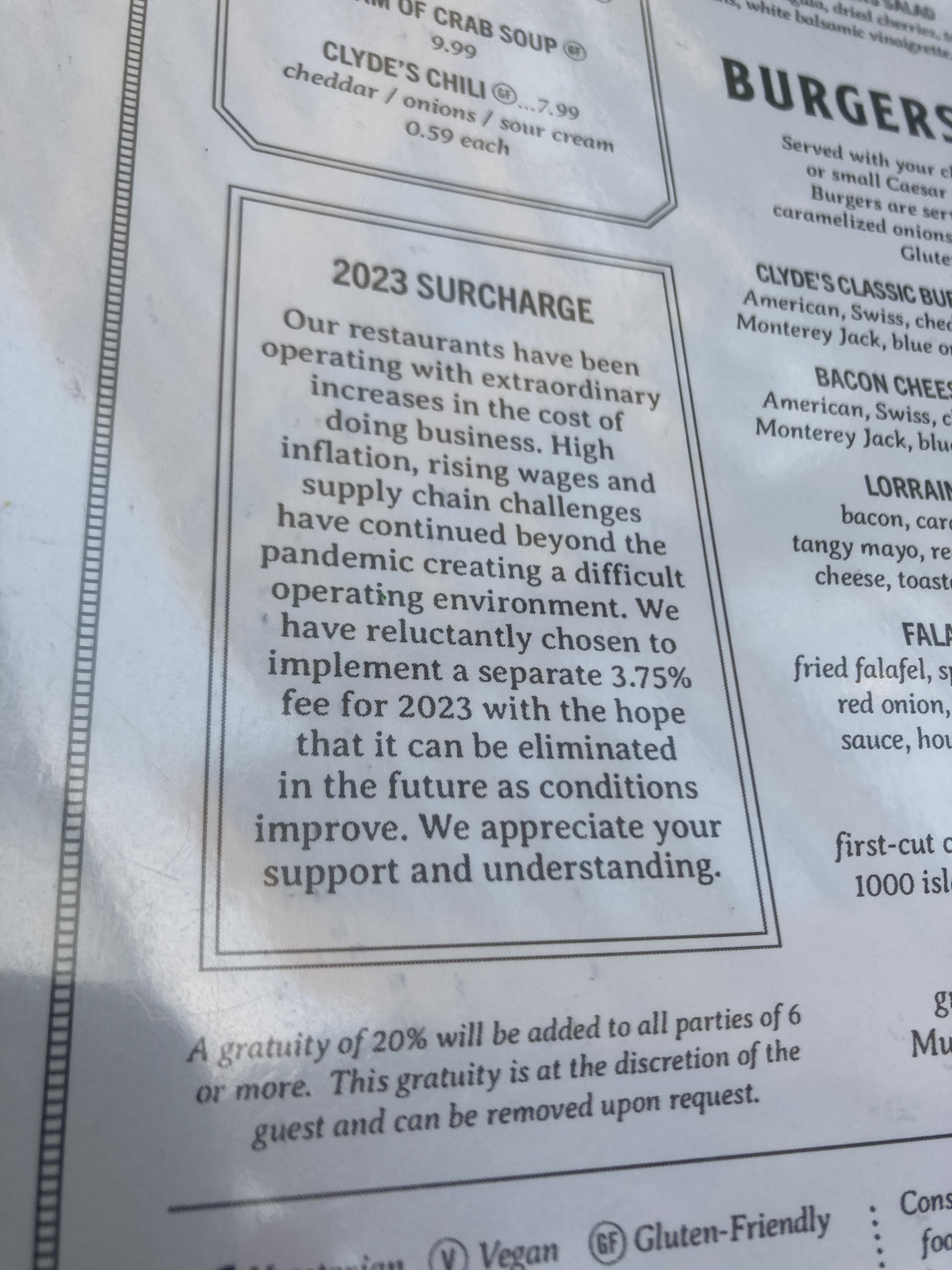
Are surcharge disclosures fair?

 Seen on a recent menu. They reprinted it to include this information; they could have reprinted with the actual higher prices, and if they ever intend to drop the surcharge they'll have to reprint again, so the only motivation seems to be to disguise the price hike/keep it out of customers' minds as they are ordering.