An enterprising law student is livetweeting from the ABA's Trademark Day at the PTO, @stemlak
Also, I'm now Twitter verified, which has yet to change my life, but I have hopes.
Wednesday, September 13, 2017


“Next Up In Apple/Samsung Smartphone Wars: Design Patent Remedies Following The SCOTUS Decision”
Panel at the National Press Club
RT: Huge debt to Sarah Burstein’s work, the best and most
scholarly work on the subject—says things that aren’t clearly on either “side”
of the present dispute, but I find persuasive. Her conclusion based on the history and early
caselaw: article of manufacture is a concept distinct from “machines” or “compositions
of matter,” and the phrase “article of manufacture” should be interpreted to
refer to a tangible item made by humans that has a unitary structure and is
complete in itself for use or for sale, as long as it isn’t also a machine or
composition of matter. The relevant question is whether anyone manufactures, uses, or sells that kind of item separately. For example, outer shells are typically the
articles of manufacture, not the entire car or other machine. I strongly recommend her recent articles on
the article of manufacture in 1887
and today,
especially her description of the temptation to “aggregate different design patents
into a single Frankenclaim,” which may be at issue here. She also suggests that the article of manufacture
at issue in any given case is primarily a legal question to be determined by a
judge in a way similar to a Markman hearing.
Howard Hogan, Gibson Dunn & Crutcher: Filed amicus brief
for Nike on neither side. SCt decision
took a lot of legal community by surprise b/c of its narrowness. Unanimous court, narrow holding rejecting
claim that design patent statute has a rule that the article of manufacture
must be the complete device as sold. Now
to figure out the alternative: unlike the Lanham Act, which has an explicit
burden-shifting provision, the design patent damages statute says “total
profits on the article of manufacture … to which the infringing design has been
applied.” Apple +at least two other
cases: courts are wrestling with burden and definition of article of
manufacture.
Carl Cecere, Counsel, Hispanic Leadership Fund and the
National Grange: amicus of coalition of rural/minority interest groups. Clients recognized potential for weaponizing
design patent damages as threat to competition and innovation. Clarity is important. Apple’s proposed test
is designed to ensure it gets the profits it got in the first trial, but the
factors are too squishy for predictability: proposes a test that includes
factors such as how the defendant sells the product and how it accounts for the
profits internally, as well as visual contribution of patent to design as a
whole. [That’s the Frankenclaim aspect
in this case, given the different patents in suit and the findings of
infringement that differed per phone.]
Designers will tell you that cupholders are part of the overall design
and flow into it/contribute to it—but Apple’s test would encourage the
cupholder patent holder to claim profits from the whole. For the phone: no one would buy the phone if
it didn’t make phone calls etc; it can’t really be the whole thing. Relatedly: the problem of partial claiming: a
curve, the bezel. The designer is in the driver’s seat. If they claim less than the whole, they think
there’s functionally severable pieces; when you partially claim, you shouldn’t
get the entire product, just the attached article. Apple’s proposed test adopted most of the gov’ts
proposed SCt test, but omitted the first factor: what is the design patent
claiming? If they really want to claim
the entire design, they should do so, but if they do less than that, the risk
of multiple awards for the same thing—3 different patents covering the front
face of the phone. Apple suggests that
an award of triple Samsung’s total profit would be appropriate (at least in
theory) and that makes no sense.
Charles Duan, Public Knowledge: Patents affect a lot of
people, not just tech/pharma. SCt has a tradition of rejecting Fed. Cir.’s
patentee-friendly rules; is there a systemic reason? Seems unlikely it’s just b/c the Fed. Cir. keeps
making mistakes; Fed. Cir. thinks patent ought to be strict rules, while SCt
goes back to more foundational, flexible concepts. History plays a role: SCt has gone back to
historical sources for patent law, e.g., Impressions v. Lexmark, TC Heartland.
Josh Landau, CCIA: design patent claim serves as notice to
public. Apple says jury should decide
what the article is; how does that correspond to the notice function? Balancing defendant’s intention & other
factors makes it harder to figure out what the article of manufacture is in
advance.
CC: yes, also confuses parts of the test—what role does this
part play in the entirety of the product?
RT: I want to emphasize that Apple’s premise has clear support
in the caselaw, that the article described or illustrated in the patent does
not limit the article to which an infringing defendant may apply the patented design (from that, Apple concludes
that you should not look at what the design patent claims to determine the
article of manufacture, a conclusion that is not logically entailed by the premise, especially where the parties
are competitors). Though it’s not vitally important to the outcome here because
the parties are in fact competitors, this is an interesting and important
argument for two reasons: (1) design patents are currently granted on known
designs applied to new objects: a rubber ducky USB. If you get a design patent on a rubber ducky
USB, should that allow you to bring an infringement claim against a
manufacturer of ordinary, tub-time rubber duckies? If the answer is no, then the
novelty/anticipation inquiries should probably be very different: you shouldn’t
get the design patent just for deciding to put a rubber ducky around a USB core. (2) 2D designs, such as the icons on the
screen, can be fully reproduced by many forms of reporting, including
newspapers and online news sources.
Unlike ©, patent has no fair use doctrine. Did the NYT infringe when it printed a
newspaper showing the design patent Samsung was found to infringe? If yes, we have a number of problems, not
least of them a free speech one; if no, we have to somehow adapt the claim
about the breadth of potentially infringing articles.
Hogan: The NYT wouldn’t infringe b/c it’s not a design
applied to an article of manufacture.
RT: According to what test for article of manufacture? The paper is definitely sold to me.
Duan: That’s the problem with overlapping IP. This is
basically a © type issue. Recently, © is
even more likely to apply to these types of things—Star Athletica—you have ©,
TM and patent overlapping.
CC: Samsung’s test could deal w/the NYT problems—look for a
severable component. Apple’s patents don’t
cover any possible application of the 16 icons everywhere—just for a screen. Profits attributable to NYT putting design
into the paper are also minimal. The squishier/more subjective the test, the
more troublesome it becomes.
Hogan: other tests protect the interests described here:
there’s examination and enforcement—requires novelty/lack of anticipation. Pretty exacting test. Test for infringement is identical to the
obviousness/anticipation test. Whether a reasonable observer would think they’re
buying the same item. [but partial claiming]
There’s a difference b/t the point of novelty entitling one to the design
patent and the article at issue—appropriate to look at design patent to
determine the article: here a screen with a layout like Apple’s. Might weigh against saying a newspaper can
infringe. SCt wants courts to wrestle
with these issues. Why design patents
exist: to encourage design—overlapping is ok, as in the rest of the
industrialized world. Most of the rest of the world has separate industrial
design. Design patent is less protective
of investment/IP. We haven’t seen the
parade of horribles from design; the current statute was in reaction to a SCt
case that limited damages recovery.
Tuesday, September 12, 2017
Allegedly disingenuous "not for human consumption" label can't avoid supplement false ad. claims
Nutrition Distribution LLC v. PEP Research, LLC, No.
16cv2328, 2017 WL 3972509 (S.D. Cal. Sept. 7, 2017)
Plaintiff sells natural supplements, specifically for
bodybuilding. It alleged that its
natural supplements directly competed with PEP’s “Research Chemicals.” PEP allegedly falsely advertised its “research
peptides and chemicals,” including prescription-only drugs such as Sildenafil
Citrate (brand name Viagra), Selective Androgen Receptor Modulators (‘SARMS’)
and synthetic peptides. PEP allegedly mislabeled these products as “not for
human consumption” and intended for laboratory research only. SARMs allegedly pose significant health and
safety risks to consumers, which PEP didn’t disclose, nor the fact that SARMs
are specifically prohibited for use in sporting events by the World Anti-Doping
Agency and the U.S. Anti-Doping Agency, even though PEP marketed its products
to bodybuilders, competitive athletes, and other similar consumers for personal
use. [Interesting falsity question: if
the falsehood is “not for human consumption,” but you’re not supposed to
believe that, can there be any reliance on the falsehood? It wouldn’t be a problem under California “unlawful”
jurisprudence, but under the Lanham Act?
Or is the relevant falsity the alleged implication that these can be
safely and legally consumed by humans? The complaint seems a little cagey,
claiming that consumers were likely to be deceived “into believing that they
are purchasing a product with different characteristics,” and also relies on
failure to disclose the serious risks of using the substances.]
PEP allegedly advertised that its “research chemical”
Sermorelin was commonly used as a “doping substance in sports,” and assures
consumers of the product’s safety for personal use: “Sermorelin alone or
combined with GHRP-2 and GHRP-6 is a harmless and efficient way to stimulate
and enhance your body’s growth hormone production.” Similarly, PEP advertised, “Clenbuterol has
been popularized in the public mind recently by media potrayals of off-label
use for fat loss, as well as some professional athlete doping scandals
involving the drug.” A contest for a
free bottle ended with a bottle given to a fitness instructor—not a researcher
(query whether winning your research substances in a contest is a
valid/reproducible method).
PEP challenged standing, but the court accepted the
plaintiff’s argument that PEP’s customers “have little incentive to use
Plaintiff’s natural nutritional supplements until they are hurt or the
‘Research Chemicals’ are taken off the market.” The "we really are competitors" argument seems quite sensible, given the allegations.
The court also declined to apply the primary jurisdiction
doctrine. Determining whether PEP’s ads
were false and misleading because they market “research chemicals” for personal
use and consumption despite also labeling the products as “not for human
consumption” would not require the FDA’s technical and policy expertise.
The RICO claims failed because they were RICO claims.
Thursday, September 07, 2017
Panel on design patent remedies, Sept. 13
“Next Up In Apple/Samsung Smartphone Wars: Design Patent
Remedies Following The SCOTUS Decision”
Wednesday, September 13th
9:00am – 10:30am
The National Press Club
Zenger Room
529 14th Street NW
Speakers include:
Carl Cecere, Counsel, Hispanic Leadership Fund and the
National Grange
Charles Duan, Director, Patent Reform Project, Public
Knowledge
Howard Hogan, Partner, Gibson, Dunn & Crutcher
Joshua Landau, Patent Counsel, CCIA (moderator)
Rebecca Tushnet, Frank Stanton Professor of First Amendment
Law, Harvard Law School
Please Note: Due to National Press Club security measures,
RSVPs are strongly encouraged. This will allow identification information to be
entered into the system in advance of the event.
Tuesday, September 05, 2017
False indication of Hawaiian origin might violate consumer protection law, not warranty
Broomfield v. Craft Brew Alliance, Inc., No. 17-cv-01027, 2017
WL 3838453 (N.D. Cal. Sept. 1, 2017)
“Hawaii is a state as well as a state of mind. When adults
want to escape the mainland, they can go to their local grocery store, purchase
a package of Kona Brewing Company beer, and feel as though they are transported
to the beaches of Hawaii. This case is about the importance of where that beer
actually is brewed.” Defendant CBA, d/b/a Kona Brewing Co., allegedly intentionally
misled consumers into believing that Kona Brewing Company beer was exclusively
brewed in Hawaii. The court granted in
part and denied in part CBA’s motion to dismiss the resulting claims.
The Kona brand includes a variety of beer that references
Kona’s Hawaiian origins, including “Longboard Island Lager,” “Big Wave Golden
Ale,” “Fire Rock Pale Ale,” “Wailua Wheat Ale,” “Hanalei Island IPA,” “Castaway
IPA,” “Lavaman Red Ale,” “Lemongrass Luau,” “Koko Brown,” and “Pipeline
Porter.” Kona has a Hawaiian brewery that makes its draft beer sold in Hawaii, but
all of its bottled and canned beer, as well as its draft beer sold outside of
Hawaii, are brewed in Oregon, Washington, New Hampshire, and Tennessee. Despite this, on the top of the box for
twelve-packs of Kona beer there is an image of a map of Hawaii which marks the
location of the Kona Brewing Co. Brewery on the Big Island. The packaging also
includes the statement: “We invite you to visit our brewery and pubs whenever
you are in Hawaii.” An image of the Hawaiian island chain and the phrase “Liquid
Aloha” are embossed on the front of each bottle, and each variety’s packaging
has its own Hawaiian-related images, including orchid flowers,
volcanoes, palm trees, surfers, canoes, waterfalls, and hula dancers. The
bottom of the package for the six-pack includes the image of a Hawaiian island,
such as Oahu, the Big Island, or Molokai. Plaintiffs alleged that the only
address listed on the packaging was “75-5629 Kuakini Highway, Kailua-Kona,
Hawaii 96740,” though CBA indicated that its Island Hopper Variety twelve-pack
included a list of five brewing locations next to the address in Kona.


Plaintiffs also allged that CBA misrepresented Kona as “craft
beer” when it isn’t, though they argued that this claim went to CBA’s intent to
deceive rather than to a deception that they relied upon.
First, CBA argued that the words and images on the packaging
were “mere puffery,” and that no reasonable consumer would be misled into
believing that the Kona beer he or she purchased was brewed exclusively in
Hawaii. The court disagreed.
Deceptiveness is usually a question of fact. CBA argued that none of its “references” to
Hawaii was “ a specific and measurable factual statement about where the beer
is made.” The labels disclosde five locations where the beer is brewed, only
one of which is Hawaii, so representations on the six- and twelve-pack
packaging couldn’t amount to actionable misrepresentations. While “pictures of
surfboards and the vague phrase ‘Liquid Aloha’ on the beer packaging” would be
insufficient, the fact that the only listed address on the outer packaging was
Hawaiian, the image of the Hawaiian map identifying the location of Kona’s Big
Island Brewery, and the invitation to visit “our brewery” whenever you are in
Hawaii were “specific and measurable representations of fact that could deceive
a reasonable consumer into believing that the six- and twelve-packs of Kona
beer were brewed in Hawaii.” “[M]erely referencing Hawaii and its culture on
the packaging is not enough on its own to confuse a reasonable consumer regarding
the origin of the beer” (citing Pernod Ricard USA, LLC v. Bacardi U.S.A., Inc.,
653 F.3d 241 (3d Cir. 2011)). But the
address, map, and invitation went beyond those references to spirit or style.
CBA argued that the disclaimer on the labels of Kona beer was
enough to contradict the representations on the outer packaging. But reasonable
consumers are “not required to open a carton or remove a product from its outer
packaging in order to ascertain whether representations made on the face of the
packaging are misleading.” There was no disclaimer identifying Kona’s brewing
locations on the packaging except on the Island Hopper Variety twelve-pack. Plus, the disclaimer on the beer label listed five
locations, including “Kona, HI, Portland, OR, Woodinville, WA, Portsmouth, NH,
and Memphis, TN” which encompass “all locations where the beers are brewed.” “A
list of multiple locations on a product label does not amount to an explicit
statement that the beer is brewed and packaged at a particular location.” A
reasonable consumer could easily think that the beer was brewed in Kona—and plaintiffs
alleged that no bottled or canned beer bearing the Kona label was actually
brewed in Kona. Thus, even consumers who read this “vague” disclaimer could be
deceived.
 |
| Label, with locations listed on left side |
While the consumer protection claims survived, the express warranty
claims failed because the representations weren’t “an unequivocal statement or
promise to the consumer that Kona beer is brewed exclusively in Hawaii.” The
implied warranty claim also failed without an affirmative misrepresentation;
the factual claims on the label were true, albeit potentially misleading.
Injunctive relief claims were dismissed for lack of standing
(noting that, even if plaintiffs would be willing to buy properly labeled beer
in the future, they alleged they wouldn’t have bought it at Kona’s price/they
paid extra for beer they thought was from Hawaii.)
Friday, September 01, 2017
More outlet cases: traditional price claims survive; value claims are harder
Two cases:
Dennis v. Ralph Lauren Corp., 2017 WL 3732103, No. 16cv1056
(S.D. Cal. Aug. 29, 2017)
Plaintiff stated a consumer protection claim by alleging
that Polo Ralph Lauren’s clothing sold at factory stores uses a price tag which
represents two prices to the consumer, the “Value Was” price, and the “Our
Price” price,” conveying to the consumer that the clothing previously sold at
the “Value Was” price, when in fact that was never the prevailing market price,
at the factory store or otherwise.
Comment: I don’t see the sense in trying to use “Value” to evade falsity
about prices; among other things, if you distinguish “Value” from market price,
“Value Was” suggests that the “value”
has now diminished.
Marino v. Coach, Inc., 2017 WL 3731954, No. 16-CV-1122
(S.D.N.Y. Aug. 28, 2017)
Plaintiffs alleged that Coach misled consumers into
believing that products sold at Coach outlet and factory stores were deeply
discounted, when, in fact, the goods are manufactured exclusively for Coach
Factory stores and are not being sold at a discounted price at all. They
brought claims for fraud, breach of express warranty, unjust enrichment, and
violations of at least twenty state consumer protection statutes.
Coach allegedly manufactures certain goods exclusively for
sale in Coach Factory stores, identified by a style number beginning with “F,”
whereas mainline or retail products have five-digit style numbers with no
letters. Coach Factory goods are marketed with an “MFSRP” or “Manufacturer’s
Suggested Retail Price,” which is allegedly “illusory” because Coach Factory
goods are never actually sold for the MFSRP. Coach apparently agreed that the MFSRPs were
intended to give an impression of quality. According Coach’s own declaration,
disclaimers posted in Coach Factory stores state that the MFSRPs are “an
indication of value based on the quality of the material used, our commitment
to craftsmanship and the high standards demanded by Coach.” (Uh-hunh.
I thought modern economics indicated that price reflects value in an
efficient marketplace.) Plaintiffs allegedly purchased accessories – wristlets,
sunglasses, and a handbag – and paid prices ranging between 40% and 70% less
than the purported MFSRPs. These labels
allegedly created a false impression of the existence of a discount, as well as
a false impression of quality, enhanced by comparison to Coach retail products
and prices given that at least some of Coach’s factory-only products are
designed to appear similar to Coach goods sold in retail stores. For example,
the CAC includes a side-by-side comparison of the Coach Factory “Phoebe”
handbag is visually similar to the “Edie” bag sold in Coach retail stores. The
Phoebe bag is sold in Coach Factory stores with a hangtag showing an MFSRP of
$395, while the Edie bag is sold in retail stores for $325. Consumers viewing
the two similar bags allegedly base their expectations for the quality of the
Phoebe bag on its similarity to the Edie, but the Phoebe bag is actually of
lesser quality, made from “fabric remnants” rather than a larger, more
desirable, single piece of fabric.
Coach challenged plaintiffs’ standing under Spokeo, Inc. v.
Robins, __ U.S. __, 136 S. Ct. 1540 (2016), arguing that the plaintiffs
alleged, at best, bare procedural violations that didn’t amount to cognizable
injury under Article III. Nope. Plaintiffs alleged that they wouldn’t have
bought the products without the allegedly false advertising; that’s a concrete
injury in fact. However, they didn’t
have standing to seek injunctive relief.
Coach also argued that plaintiffs lacked standing to bring claims on
behalf of a multi-state subclass because they didn’t personally possess claims
under the consumer protection laws of any other state. That depended on what
law applies to the absent class members’ claims and whether the injury
recognized by those laws was sufficiently similar to plaintiffs’ injury that
class treatment is appropriate, so the court deferred consideration of this
until certification.
The court analyzed the consumer protection claims under Rule
9(b); plaintiffs didn’t disagree that Rule 9(b) applied. The court found that the “how” and “why” of
the fraud was in part inadequately alleged. The straightforward theory of
deception was that MFSRPs were deceptive because consumers understand them to
represent former prices, but they don’t; that was adequately pleaded. The “more nuanced” theory of deception was
that Coach designs outlet-only goods that appear similar to retail products and
tags the outlet-only products with MFSRPs that are similar to the prices of the
retail goods, causing consumers to believe they are buying products of similar
quality to the similar retail products.
The court found that the complaint didn’t adequately allege the “how” or
“why” of this product-confusion theory. Plaintiffs didn’t allege that they
bought the Phoebe bag, or identify any Coach mainline products – or family of
products – to which plaintiffs believed the outlet goods that they purchased
were similar. To proceed on this theory, plaintiffs would have to identify the
retail goods that are deceptively similar to the outlet goods that the
Plaintiffs actually purchased.
Under New York’s consumer protection law, it isn’t enough to
allege that one wouldn’t have bought an item but for the appearance of a discount;
that’s not injury under New York law, or Massachusetts law. It is sufficient injury under California law. Assuming that New Hampshire followed the East
Coast model, it was still possible that the New Hampshire plaintiff could amend
her complaint to allege injury distinguishable from such “ephemeral” injury, if
the MFSRP’s caused her to believe that she was purchasing a product of higher
quality than she received. It wasn’t
enough if she merely believed she was getting a bargain.
The New Hampshire plaintiff also plausibly alleged that the
MFSRPs were misleading. Coach argued that disclaimers in its stores explain
that the MFSRPs are intended to be indicators of “value.” “Whether, in the face
of such disclaimers, a reasonable consumer could nonetheless believe that the
MFSRPs are former prices is an issue of fact to be resolved at a later stage of
this litigation, as is the significance of Coach’s disclaimers.” Further, unlike
“compare at” advertising, MFSRPs – “Manufacturer’s Suggested Retail Prices” –
allude directly to a price for the item, “which makes it more plausible that a
reasonable consumer could believe that the MFSRP on the hangtag represents a
former price.”
The express warranty claim failed, because at best the MFSRPs were “implicit” warranties of a
former price. They also weren’t warranties of product quality, because an
inference that the Coach Factory products are of better quality than they actually
are was “too vague and general to be actionable as an express warranty of
anything related to the actual goods.”
Thursday, August 31, 2017
Outlet sales of outlet-only clothes under brand name aren't inherently deceptive
Rubenstein v. The Gap, Inc., --- Cal.Rptr.3d ----, No. B272356,
2017 WL 3634212 (Ct. App. Aug. 24, 2017)
The court affirmed the trial court’s dismissal of a claim
against the Gap for selling lesser-quality products at its Gap and Banana
Republic factory/outlet stores that were never sold at its ordinary stores. Rubenstein didn’t sufficiently allege a
misrepresentation or actionable omission. Rubenstein didn’t identify any advertising
or promotional materials or any Gap other statements that its factory store
clothing items “were previously for sale in traditional Gap stores or were of a
certain quality.” The mere use of its own brand names wasn’t deceptive just
because the apparel wasn’t of the quality that Rubenstein had come to expect. “As
a matter of law, Gap’s use of its own brand name labels on clothing that it
manufactures and sells at Gap-owned stores is not deceptive, regardless of the quality
of the merchandise or whether it was ever for sale at other Gap-owned stores.
Retailers may harm the value of their brands by selling inferior merchandise at
factory stores, but doing so does not constitute false advertising.” [This line of cases directly addresses,
perhaps for the first time in litigation, the occasional debate in the
literature about whether trademark owners should be responsible to consumers
when they break their own promises about consistent quality that are
communicated by a trademark with secondary meaning.]
Plaintiff alleged that “[r]easonable consumers believe
outlet stores sell products that were previously available for purchase at
retail stores,” but didn’t allege specific facts showing this to be true.
Moreover, a consumer for whom the
retail history of factory store items is material can ask Gap employees about
this. A reasonable consumer would also inspect the quality of factory store
clothing items before buying them and could return items after purchase if they
turn out to be unsatisfactory. In the end, the allegation that Gap is not
living up to the quality standards it has set for Gap and Banana Republic
brands fails to state a cause of action for a fraudulent business practice
under the UCL.
There was also no duty to disclose; the use of the brand
name didn’t constitute a partial representation “even if the products are
alleged to be inferior to other brand name products.”
Nor was selling nonidentical brand-name clothing in a
factory store “unfair.” In particular, “[t]he
injury alleged is not substantial because consumers are getting Gap and Banana
Republic brand name items for low prices.”
This interestingly suggests that there’s no quality differential to the
extent that consumers are just buying the brand name, not the clothes. Plus, consumers could have asked sales
associates about the items’ history and examined their quality before purchase.
name alone doesn't ID average people in internet search ROP case, court rules
Dobrowolski v. Intelius, Inc., No. 17 CV 1406, 2017 WL
3720170 (N.D. Ill. Aug. 29, 2017)
Defendants sell online reports on people using information
compiled from public records and other sources.
When a consumer uses a search engine to search a person’s first and last
names, dynamic keyword ads appear, with the first and last name automatically
plugged into an otherwise generic ad. The
ads “give the appearance that the reports contain valuable information about
the searched-for person, such as arrest records, background check, phone
number, and address.” Plaintiffs sued Intelius and other entities under the
Illinois Right of Publicity Act for this advertising; Intelius got out for lack
of personal jurisdiction but the others got out on a motion to dismiss on the
merits.
The Illinois Right of Publicity Act prohibits the use of “an
individual’s identity for commercial purposes during the individual’s lifetime
without having obtained previous written consent from the appropriate person.” IRPA
defines “identity” as “any attribute of an individual that serves to identify
that individual to an ordinary, reasonable viewer or listener, including but
not limited to (i) name, (ii) signature, (iii) photograph, (iv) image, (v)
likeness, or (vi) voice.” Defendants
argued that they didn’t use plaintiffs’ “identities” because the ads only
reflect the coincidental result of a third-party’s internet search for their
names, without any additional information to identify one “Anna Dobrowolski” or
“Nicole Vinci” over another. Even though IRPA specifically uses “name,” that’s
in the context of identifying a particular individual; a name alone isn’t
necessarily sufficient to identify an individual, since many people have the
same name. The use at issue must serve “to identify that individual to a
reasonable audience.”
Plaintiffs argued that defendants designed their ads to make
a person searching the internet for “Nicole Vinci” or “Anna Dobrowolski”
believe that the defendants had located the plaintiffs and had information on
them. But that wasn’t enough. Though a
plaintiff need not allege facts sufficient to show that she was identified to
the exclusion of all other persons bearing their name or likeness, she must
still allege facts to plausibly infer that she was identified to a reasonable
audience by the defendant’s use. Without any additional context, “Anna
Dobrowolski” or “Nicole Vinci” didn’t identify the plaintiffs. The complaints
do not suggest that the ads identify the plaintiffs in any manner except for
name. The fact that the defendants benefited from designing their ads in the
way they did still didn’t mean they identified the plaintiffs in particular.
To deal with a possible amended complaint, the court also
addressed defendants’ arguments that because the names “Anna Dobrowolski” and
“Nicole Vinci” were automatically populated into defendants’ generic ads as the
result of a third-party’s search, the plaintiffs could not show that the
defendants intended to appropriate
the names “Anna Dobrowolski” and “Nicole Vinci.” But the requisite intent is
simply “to use the material about the plaintiff for trade purposes”; the
defendants’ intent to use full names in their otherwise generic ads was enough.
Defendants also argued that a ROP claim required the
plaintiff’s identity to have intrinsic or commercial value before the
defendant’s use. Though some pre-IRPA case law required this, IRPA did not—it’s
about each individual’s “right to control and to choose whether and how to use
[their] identity for commercial purposes” and isn’t limited to protecting
celebrities or public figures. [Query,
as usual, how this is at all compatible with the First Amendment in the absence
of falsity/misleadingness.]
Nor did an IRPA claim require an apparent endorsement. Even
if ads stating “Anna Dobrowolski Located” or “We Found Nicole Vinci” don’t
suggest to a reasonable viewer that Anna Dobrowolski or Nicole Vinci endorse
defendants’ products, IRPA doesn’t require that the defendant’s commercial
purpose be an apparent endorsement. “IRPA’s definition of ‘commercial purpose’
is broad, and the act contains no endorsement requirement. Neither does IRPA
have a falsity requirement.” Which is
why it’s unconstitutional, especially as applied to services like this one.
Wednesday, August 30, 2017
Comparison to former licensor's products isn't trademark infringement
Alpha Pro Tech, Inc. v. VWR Int’l, LLC, No. 12-1615, 2017 WL
3671264 (E.D. Pa. Aug. 23, 2017)
APT sued VWR, a competitor in the market for nonwoven,
disposable laboratory apparel for use in clean rooms and similar environments. VWR
formerly carried APT’s Critical Cover line of laboratory apparel products, but
transitioned to its own private line of products, prompting this lawsuit, which
survived a motion to dismiss but not summary judgment.
APT used a proprietary fabric coating method to produce its products. For a time, the parties agreed
that VWR would be APT’s exclusive distributor of Critical Cover, and that VWR
had the exclusive license to use the Critical Cover trademark and promotional
literature. APT began outsourcing components of Critical Cover products
in the early 2000s, using XXPC, a company that made lab apparel for other
competitors. APT disclosed its resins
and recipe for the extrusion coating with XXPC, under an oral confidentiality
agreement.
VWR sought bids from suppliers in China to use as
comparators with the APT garments, and XXPC submitted a successful bid. APT ran tests and monitored the resins it sent to XXPC and concluded
that XXPC didn’t use APT’s materials to produce VWR’s products.
In 2010, VWR launched its private label line, branded Basic,
Advanced, and Maximum Protection. The marketing materials explained that it was
transitioning from the Critical Cover line to its new line and explained that
VWR “ha[d] not changed the manufacturer, manufacturing location, or the
manufacturing process for 95% of the products in [the] new line. For the
majority of the portfolio, only the brand name and part numbers w[ould] change.”
It also certified that some of the new private label products did not
experience a change in raw materials from the Critical Cover line. VWR referred
to a number of APT marks as points of comparison for VWR’s new Basic, Advanced,
and Maximum protection lines, including a comparison chart with specs and
drawings.
There were initial concerns about VWR’s shoe covers flaking
more than Critical Cover shoe covers, and XXPC produced a second generation of
shoe covers that addressed those issues. Independent testing established that
the performance specifications of VWR’s new line were superior to APT’s in some
respects and used a different combination of resins. VWR issued a correction
letter advising end users to conduct their own testing, as it could no longer
verify that the raw materials it used were exact.
The court found that APT couldn’t show misappropriation of
trade secrets, because its resin recipe could be reverse engineered, which
precludes trade secret protection in Pennsylvania.
Trademark infringement/false designation of origin: APT
argued that VWR’s representations caused customers to believe that VWR’s new
product line was comprised of Critical Cover products under a different brand
name, thereby falsely representing its origin/causing initial interest
confusion. The court accepted the basic
theory to avoid a situation in which “a defendant could escape liability for
passing off simply by using another’s mark—a false designation of origin—to
establish the equivalency of the other’s mark and the defendant’s new mark, and
then shift to using only its new mark.”
[Of course, that description is an overgeneralization: if the products
are equivalent, then an equivalence claim is not false; it’s just comparative
advertising.]
VWR argued that Dastar
barred this claim, but the court disagreed; the case could be analyzed as a
regular passing off case. Still, on
summary judgment, APT didn’t raise a triable issue on likely confusion. Customer care and attention “casts great
doubt on any likelihood of confusion,” given that the relevant purchasers were
experienced professionals buying apparel for use in clean room/controlled
environments, “where customers’ validating procedures tend to be thorough.”
Likewise, the evidence of actual confusion and the length of
time the mark was used without actual confusion weighed against a likelihood of
confusion. Three customers “engaged in conversation with APT about the
transition, asking APT for further explanation of the differences between VWR’s
new product line and the Critical Cover products.” This wasn’t trademark
confusion, but rather confusion about “whether a VWR-produced product they
purchased was equivalent to APT’s Critical Cover products.” Other communications identified by APT didn’t
indicate any confusion. For example, communications
noting problems with VWR’s first generation of shoe covers “might support that
the customers believed they were receiving an equivalent product that would
perform in the same manner as APT’s products,” that again wasn’t trademark
confusion.
VWR’s intent also weighed against finding likely
confusion. VWR knew that it could be
easier to proceed through certification and testing procedures if it
represented that was the same product that APT produced, but that’s different
from adopting a similar mark. It didn’t “adopt”
a similar mark at all; it compared its products to those of APT. (Again, “use as a mark” is a shortcut/an
explanation for why there’s no confusion.)
False advertising: This is a better theory, but it fares no
better in the end. APT argued that VWR
falsely equated the parties’ products, causing customers to believe that VWR’s
products were Critical Cover products under a different brand name (because
they had the same components and processes).
APT tried to rely on a presumption of causation and materiality based on
literal falsity, but those presumptions don’t apply when a plaintiff seeks only
monetary damages, not an injunction. (I’d
think the customer complaints about the first generation might tend to show
materiality, even without a presumption.
Separately, I haven’t seen this distinction articulated for actual
deception before—it seems to get rid of the literal falsity/misleadingness
distinction for money damages cases, requiring evidence of deception, probably
a consumer survey, no matter what the theory is—which doesn’t make a lot of
sense for a straight-up literal falsity case.)
Even if some of VWR’s statements were literally false, APT failed to
show (1) actual deception or a tendency to deceive and (2) materiality. “These
requirements are not easily satisfied.” There was no non-hearsay customer
testimony that the statements misled customers or influenced their purchasing
decisions.
"100% grated parmesan cheese" doesn't have to be all cheese, court rules
In re: 100% Grated Parmesan Cheese Marketing & Sales
Practices Litig., 2017 WL 3642076, No. 16 C 5802, MDL 2705 (N.D. Ill. Aug. 24,
2017)
Ah, implicature, how I wish judges understood you. A product labeled “100% Grated Parmesan
Cheese” is, apparently, ambiguous—it could mean the product has a bunch of
different ingredients, but the parmesan component is 100% grated, rather than
only partially grated. This is nonsense
for a product that purports to be cheese, though it would make sense for a non-cheese-only product with a “made with 100% grated parmesan cheese” label. In fact, the common-sense comparison is the
challenged phrase with or without “made with”—on its own, the “100%” naturally
applies to all the words following it.
Anyway, plaintiffs alleged that they were misled by the labels
because the products contained a nontrivial amount of cellulose. Each product’s ingredient list disclosed the
non-cheese ingredients, in smaller, less conspicuous print. Each ingredient
list states that the cellulose is added “to prevent caking.”
The court agreed that plaintiffs had Article III standing,
having purchased a product allegedly worth less than what they paid and what
they were promised.
Synthesizing consumer protection precedents from multiple
jurisdictions, the court concluded that “[w]here a plaintiff contends that
certain aspects of a product’s packaging are misleading in isolation, but an
ingredient label or other disclaimer would dispel any confusion, the crucial
issue is whether the misleading content is ambiguous; if so, context can cure
the ambiguity and defeat the claim, but if not, then context will not cure the
deception and the claim may proceed.” This
isn’t entirely consistent with the cases the court quotes, such as the 9th
Circuit’s Williams—here’s the quote
the court pulls from Williams: deceptive
marketing claims survived a motion to dismiss where there were “a number of
features of the [front of the packaging] … which could likely deceive a
reasonable consumer,” and a consumer thus “should [not] be expected to look
beyond misleading representations on
the front of the box to discover the truth from the ingredient list” (emphasis
added). The question is whether a
consumer might rely on the product name without checking the ingredient list,
and ambiguity can certainly play a role there, but a consumer might make
inferences even from a theoretically “ambiguous” claim and not check the
label. Of course, the larger problem
here is that there’s nothing ambiguous about “100% Grated Parmesan Cheese” in
context.
The court continued: “consumers who interpret ambiguous
statements in an unnatural or debatable manner do so unreasonably if an
ingredient label would set them straight.”
The court conflates “unnatural” with “debatable” here, I think—if a
substantial portion of consumers are confused by a claim, the fact that others
aren’t, and that the question in general is “debatable,” shouldn’t matter
(absent some cost-benefit analysis, at least—so if there’s a good way of
communicating the truth to avoid deceiving the relevant subset of consumers,
that should be used).
The court analogized people who thought that “100% Grated
Parmesan Cheese” meant that the product was 100% parmesan cheese to people who
thought that Froot Loops were made with fruit.
The phrase was ambiguous because “it also might be an assertion that
100% of the cheese is parmesan cheese, or that the parmesan cheese is 100%
grated. Reasonable consumers would thus need more information before concluding
that the labels promised only cheese and nothing more, and they would know
exactly where to look to investigate—the ingredient list.” Thus, the labels
weren’t deceptive.
Comment: that statement might avoid perjury because of this
equivocation, but that’s not the standard for consumer protection cases. A reasonable consumer shouldn’t have to ask
follow-up questions when the product says on the front that it’s 100% one
thing.
The court thought that the nothing-but-cheese reading was
the least plausible of its three
possible interpretations, because it thought that consumers should know that a
product that was packaged and shelf-stable at room temperature could not be
pure cheese. Really? Because I buy
parmesan in unrefrigerated-but-sealed chunks, and I’ve also been known to buy
Parmalat, a shelf-stable unrefrigerated milk.
We live in an age of miracles and wonders; I’m not saying I’d expect
cheese to last centuries, but leaving a dry cheese like parmesan sealed but
unrefrigerated seems plausible to me. Still, I’m apparently unreasonable,
because reasonable consumers “would still suspect that something other than
cheese might be in the container [of unrefrigerated, shelf-stable cheese], and
so would turn it around, enabling them to learn the truth from a quick skim of
the ingredient label.”
Anyway, warranty and unjust enrichment claims failed for the
same reason.
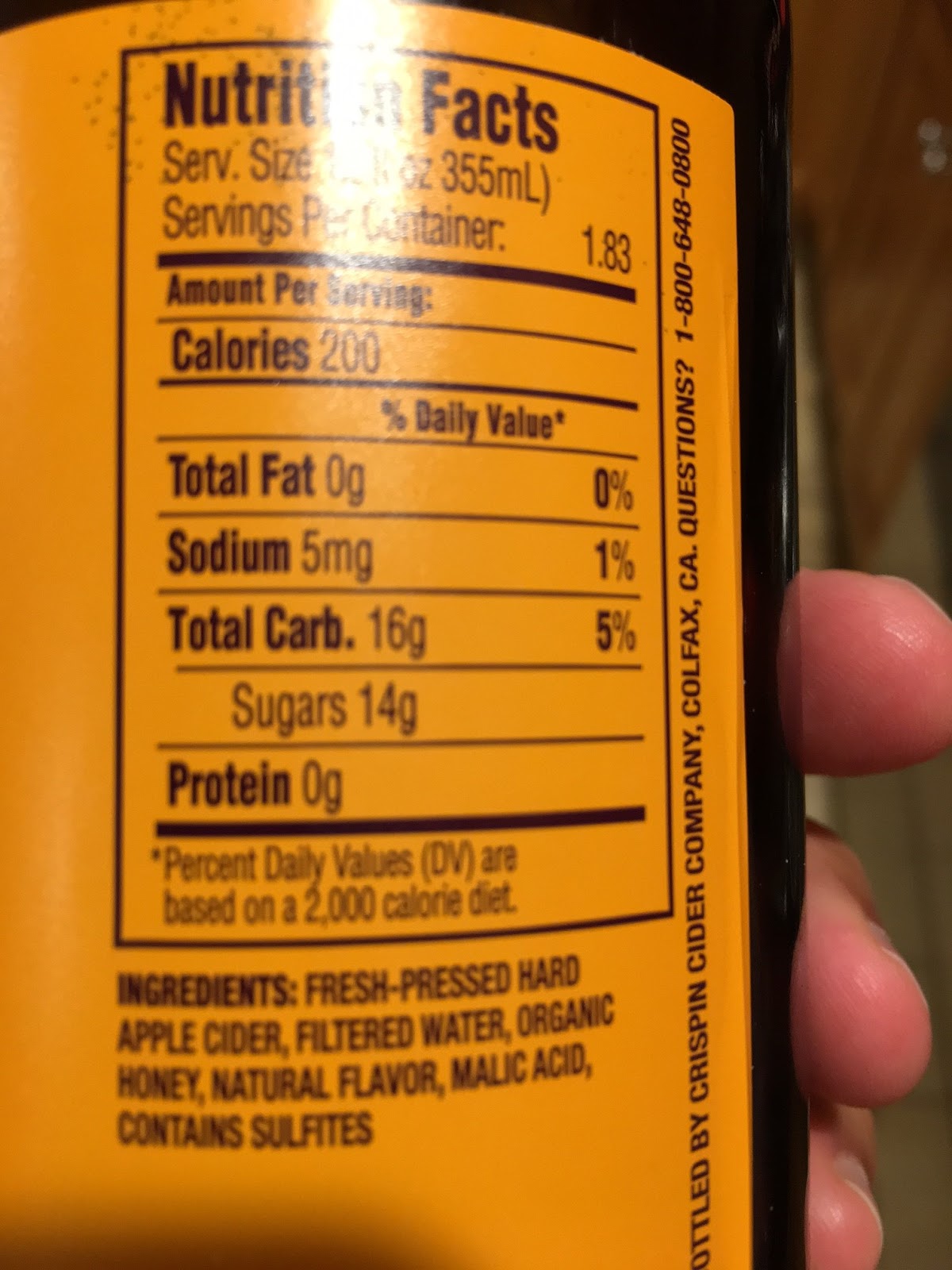
Advertising question of the day: Honeycrisp or honey crisp?
Assuming this alcoholic beverage is not made from honeycrisp apples--but that it does contain honey--would the product name be false or misleading? H/T Adam Levitin. Note that the manufacturer doesn't disclose the apple variety one way or another, as far as I can tell.


"universal" is generic for churches
Universal Church, Inc. v. Universal Life Church/ULC Monastery,
2017 WL 3669625, No. 14 Civ. 5213 (S.D.N.Y.
Aug. 8, 2017)
The Universal Church, Inc., is a Pentecostal/Charismatic
church with “around 30,000 members,” while its Brazilian affiliate has millions
of members. Defendant ULC is a nonprofit that offers free ordinations to its
members; it’s an offshoot of a church founded in California in the 1950s that
was initially called the “Universal Church.” The plaintiff registered “Universal Church,”
“The Universal Church,” and “Universal Church of the Kingdom of God.” The first
and third were registered for use in “evangelistic and ministerial services,
namely, conducting religious worship services” and became incontestable in
2012. “The Universal Church” was registered in 2012 for use in “religious
counseling and ministerial services,” “newsletters and informational brochures
all about religious beliefs and practices,” and “t-shirts distributed in
connection with religious groups.”
In 2009, defendants attempted to register “Universal Life
Church” and several similar marks; they were rejected on 2(d) grounds and the cited
marks included “Universal Church” and “Life Church.” They abandoned the
applications.
Plaintiff challenged five types of uses: (1) 17 domain
names, including universalchurch.org (registered in 2010), containing the
phrase “universal church”; (2) use of “Universal Church” on the
universalchurch.org website;

(3) use of “Universal Church” in the website’s metadata so
that the website’s name shows up as “The Universal Church” in search results;

(4) bidding on
advertising keywords, including “the universal church,” so that defendants’
websites appear in Internet search engine ads; and (5) “hijacking” map-based
searches so that defendants’ website is associated with the location of
plaintiff’s churches. For example, the Google Maps search result for plaintiff’s
church at 1077 Southern Boulevard in the Bronx was linked to defendants’
website, themonastery.org, as shown below:

The court found that “Universal Church” was generic for the
services at issue—in a useful point that reminds me of the Seventh Circuit’s Car Freshner case on descriptive fair
use, the court noted that the question of who bears the burden of proof on
protectability “turns on whether plaintiff is attempting to enforce its
trademark within the class of services for which it was registered.” The court interpreted “evangelistic and
ministerial services, namely conducting religious worship services,” broadly,
since ordaining ministers as defendants do is a “ministerial service.” Also, plaintiff had apparently objected to
many other uses by other religious and even non-religious organizations,
indicating the breadth of its interpretation of the class. Thus, plaintiff was entitled to a presumption
of validity.
Still, “universal” was generic for churches. There was lots of evidence, dictionary and
historical, that “universal” is understood as referring to the entire Christian
Church or all Christians collectively. “Universal” for churches has a similar
meaning to “catholic,” which is simply the transliteration of the Greek word
for “universal,” “καθολικóς” or “katholikos.” (The court later says it isn’t
opining on whether Catholic is itself generic.)
The parties agreed that this meaning was “well-established within the
Roman Catholic Church and that at least some non-Catholics understand and use
the term in this sense.” The use had
existed for hundreds of years, or thousands if you add in the original Latin
and Greek versions. Defendants also presented
evidence that numerous churches use “universal” and “universal church” in their
name. It’s even part of the name of a
denomination, Unitarian Universalism.
Plaintiff’s evidence of trademark meaning was minimal. It claimed that it used the mark in
connection with its 230 physical locations and weekly broadcasts that reach
800,000 people. But this was based on testimony from its own employees, which
had little probative value; it couldn’t substantiate the viewership claims with
documentary evidence. Even if the court
accepted the plaintiff’s claim to use the “Universal Church” mark in connection
with its physical churches and broadcasts, that didn’t show how the mark is
understood by the vast majority of the “relevant public” who don’t belong to the
church. The only evidence about that public was two articles referring to
plaintiff as the “Universal Church.”
Based on this record, “the primary significance of ‘universal
church’ to the relevant public is a type of church rather than plaintiff,
namely one that considers itself to be universal in the sense of representing
the entire Christian church.” The court
declined to grant the plaintiff a monopoly over “universal” in church names, “a
monopoly which plaintiff has already indicated that it would enforce
aggressively. We are persuaded that the trademark law is simply not intended to
allow the mark to be weaponized by plaintiff in this way.”
Even if the court found that “Universal Church” was
descriptive, it would still reject the plaintiff’s claim, due to the weakness
of the mark and other factors. As to
actual confusion, “plaintiff’s evidence suggests that someone searching the
Internet for ‘universal church’ will sometimes land on defendants’ website.” But the evidence didn’t show that this was
because of defendants’ use of the mark, or that people conducting such a search
were actually looking for the plaintiff.
And there was no evidence that anyone purchasing ordination services was
confused by defendants’ use of “Universal Church.” Plaintiff’s survey allegedly showing likely
confusion “attempts to measure the extent to which someone googling ‘the
universal church’ would believe that he had landed on a website for an entity
called “The Universal Church.”
(Googling!) But that was of
limited value because the survey takers were just told they were searching “for
a generic entity named ‘The Universal Church,’ without any attempt to measure
whether the survey takers associated such an entity with plaintiff.”
Plaintiff’s VP testified that “many” of its pastors and
members “had a hard time trying to reach our correct Web site while they were
searching for our domain.” This was too vague to show actual confusion, or that
such confusion “resulted from defendants’ use of plaintiff’s trademarks, as
opposed to, for example, defendants’ non-infringing search optimization
strategies.” Neither party discussed IIC
separately, but the court doubted whether initial interest confusion is even
relevant here, because IIC requires confusion, not mere diversion. Similarly, instances where individuals
“refer[red] to the defendants by the misnomer Universal Church” weren’t
relevant to confusion claim because “universal church” wasn’t being used to
refer to the plaintiff.
The court did note that a reasonable juror could come out
either way on defendants’ intent; it just didn’t matter, even if intent favored
the plaintiff.
The quality of defendants’ services, which the Second
Circuit hasn’t gotten around to eliminating, was interesting if only because
the court was called on to judge the quality of religious services. “Plaintiff
argues that defendants’ ordination services are inferior because they allow
anyone to become ordained online without committing to a particular teaching or
faith, without formal education, without training, and without committing to
attend to the spiritual needs of others. On the other hand, the features that
plaintiff views disparagingly are likely the very features that defendants’
customers value. Thus, we find that defendants’ services are not inherently
inferior.”
Cybersquatting claims failed too, of course; even if the
mark weren’t generic, the primary cybersquatting claim would still have failed because the mark was not
distinctive at the time universalchurch.org was registered, in 2010, before the
“Universal Church” registration became inconstestable and before it acquired
any secondary meaning.
The court granted summary judgment sua sponte on the NYGBL
claims because they couldn’t succeed; ordinary trademark or trade dress infringement
claims are not cognizable under §§ 349 and 350 unless there is a “specific and
substantial injury to the public interest over and above ordinary trademark
infringement or dilution.” The plaintiff
argued that there would be harm from getting the wrong religious services, but “the
injury is precisely the type of injury that results from ordinary trademark
confusion and does not constitute a separate public injury.”
Monday, August 28, 2017
state courts do nominative fair use too
Instant Infosystems, Inc. v. Open Text, Inc., 2017 WL
3634547, No. B276691 (Cal. Ct. App. Aug. 24, 2017)
Another illustration of the principle that courts don’t like
to do two dilution analyses—this state court only talks about federal dilution,
assuming that the analysis is the same for both. Open Text owns RightFax, software that allows
users to fax documents via computer, without a fax machine. Instant and Open Text had a contractual
relationship; after that ended, Open Text allegedly told customers that Instant
wasn’t permitted to service RightFax. Instant disagreed and sued for tortious
interference and violation of the UCL.
Open Text counterclaimed for trademark infringement, dilution, and false
advertising under state and federal law, as well as breach of contract, and
sought a preliminary injunction, which the trial court denied. The false
advertising claim was based on emails from Instant stating that certain
RightFax products would be reaching its “support end of life” or “end of life.”
The court of appeals affirmed the denial of the preliminary injunction.
The court reviewed the denial of the preliminary injunction
for abuse of discretion; the factors are (1) likelihood of success on the
merits and (2) interim harm to the plaintiff absent an injunction compared to
harm to the defendant with an injunction.
The court of appeals used the Ninth Circuit nominative fair
use “defense,” holding that all three prongs are factual questions. Though the trial court issued only a one-line
order, California courts of appeal presume the trial court made all findings
necessary to support the order, and thus affirm if substantial evidence exists
to support such findings. Factor one:
there was evidence that the service Instant provides for support of RightFax is
not readily identifiable without specifically naming RightFax. Factor two: Instant submitted evidence that
it used only so much of the mark as was reasonably necessary to identify its
own service. On Instant’s RightFax webpage, Instant states: “Instant
InfoSystems has been providing world-class technical support for RightFax for
nearly 20 years. Our vast experience and depth of technical expertise with
RightFax has helped large and small companies implement reliable, secure, and
cost-effective solutions for sending and receiving documents ....” Factor three: There was evidence that Instant’s
homepage, which displays a list of Instant InfoSystems’s partners, doesn’t list
Open Text as a partner. It also had a Web page dedicated to explaining the
company’s history, the previous partnership with Open Text, and that the
partnership had come to an end. Though Instant at one point referred to itself
as “the Right Fax Experts,” this was replaced with “the Fax Experts,” and
Instant removed all references to partnership awards from Open Text from its
website. (Query whether these last steps
were necessary; certainly it would seem fair and truthful to put the awards on
the history page.) Based on all this,
substantial evidence supported the trial court’s implied finding of nominative
fair use.
Nominative fair use also precludes a finding of trademark
dilution because, by definition, it doesn’t “create an improper association in
consumers’ minds between a new product and the trademark holder’s mark.”
False advertising: the parties submitted conflicting
evidence pertaining to whether a consumer would be deceived regarding the term
“end of life.” Open Text’s declaration from its RightFax product manager stated
that he had to make on-site visits to customers to convince them RightFax would
continue to be supported after the emails, and that Instant had informed
several customers RightFax was dead, which required him to respond. But
Instant’s declaration from a former employee at RightFax’s previous owner stated
that “end of life” was used properly by Instant as it was understood in the
industry, and was even used in such a way by Open Text’s current partners when
referring to RightFax. Presuming that
the trial court resolved the conflicting evidence in favor of Instant, the
court of appeals affirmed the finding of no likely success on the merits.
Finally, substantial evidence supported the implied finding
that the balance of harms didn’t tip in favor of Open Text. Instant’s harm if
the preliminary injunction was granted was the loss of business involving
RightFax services, which it had been performing for 15 years. The status quo was seven months of Instant using
the RightFax trademark on its Web site and in other communications, which an
injunction would immediately change. Further, Open Text waited more than seven
months after terminating the parties’ agreement to object to the continued use
of the RightFax mark, supporting the trial court’s finding on the balance of
harms.
Plaintiff can't win false advertising claim because there's evidence on both sides
Korolshteyn v. Costco Wholesale Corp., No. 15-cv-709, 2017
WL 3622226 (S.D. Cal. Aug. 23, 2017)
Ugh. Costco’s TruNature Gingko labels represent that the
product “supports alertness & memory,” that “Gingko biloba can help with
mental clarity and memory,” and that “[i]t also helps maintain healthy blood
flow to the brain to assist mental clarity and memory, especially occasional
mild memory problems associated with aging.” Plaintiff alleged that these were
false or misleading under the UCL and CLRA.
Relying on In re GNC Corp., 789 F.3d 505 (4th Cir. 2015), the court here
found that this was an impermissible lack-of-substantiation claim, and that
therefore a private plaintiff can never prove falsity “when a defendant offers
scientific evidence and admissible expert testimony supporting an advertising
claim about the efficacy of the product in question.” To prove falsity, all reasonable experts in
the field must agree that the representations are false. The court found that California would follow GNC, because no state court cases have
rejected it, but I doubt that given the state’s tradition of consumer
protection and its occasional rejection of the Lanham Act analogy ostensibly
underneath GNC (occasional because
there’s so much California consumer protection law that the analogy is only
rarely made).
Mullins v. Premier Nutrition Corp., 178 F.Supp. 3d 867 (N.D.
Cal. 2016), held that a plaintiff could prove claims “literally false if a
reasonable jury concludes that all reasonable scientists agree,” or that the
claims are “misleading by showing that the vast weight of the competent
evidence establishes that those health claims are false.” This is an attempt to
draw off some of GNC’s poison, but as
we will see it doesn’t work well. The
main reasons that this formulation isn’t a good one are that (1) the Lanham
Act’s false/misleading distinction, from which GNC’s consumer protection law reasoning is supposedly drawn,
doesn’t have anything to do with “all reasonable scientists” v. “vast weight of
the competent evidence,” but rather with issues of consumer perception, and (2)
the way scientific evidence works doesn’t generally allow for such a
distinction; the most you can say about any given study is that, at various
levels of quality, it provides support for an affirmative claim or it doesn’t
provide support for that claim. Mullins said that, for misleadingness, a
plaintiff “can concede the existence of scientific studies substantiating a
representation, but argue that those studies are poorly designed, incredible,
or represent the view of a minority of scientists.” But now we are firmly
detached from the idea of consumer perception, and the existence of poorly
designed or “incredible” studies shouldn’t be allowed to avoid a finding
literal falsity anyway!
It is one thing to say that “[i]nconclusive findings and
unsettled science are insufficient to meet Plaintiffs’ burden of raising a
question of fact on the issue of falsity,” and quite another to say, as if it
were a mere restatement, that “mixed evidence demonstrates at most that the
science on [the product’s] effectiveness is inconclusive.” This is the fallacy of the excluded middle:
in the former situation, even crediting all the evidence, the plaintiff
couldn’t meet its burden of proof at trial on the merits; in the latter, it
might be the case that, depending on which evidence you credited, the plaintiff
could meet its burden. This distinction
may seem fine, but it makes a big difference because it is about whether courts
will throw up their hands when truth is in question—the very essence of the
factfinding project. And that’s not hyperbole on my part, that’s from the
courts following GNC: “where there
are studies demonstrating both the effectiveness and ineffectiveness of the
Products, a reasonable jury could not find that the advertising claims are
false.”
So, the court here reasoned, “when a defendant presents
scientific studies supporting its advertising claim, a plaintiff must do more
than present its own studies that do not support the advertising claim, thereby
demonstrating that evidence is equivocal.” Mullins, with which the court here
disagreed, held that the plaintiff could offer “principled, supported
critiques” of the defendant’s studies, allowing the jury to disregard them or
to find the plaintiff’s studies more persuasive and thus find the advertising claims
misleading.
The court here also found that the plaintiff was only
alleging falsity, not misleadingness, because it thought misleadingness had
nothing to do with consumer perception.
Though she used the words “false and misleading,” she was really arguing
that the claims were misleading because they were false. Again, the court didn’t seem to understand
misleadingness as something that happened on the consumer end. In fact, consumers might—and, we know from
other studies, in fact do—think that a claim on the label of a supplement has
substantial scientific weight behind it, including FDA approval; they are thus
misled, quite possibly materially, about the quality of the claim.
“Whether the Label Claims are true or false is a binary
choice—they are true, or they are false. When the scientific evidence is
equivocal, it is impossible to prove that an advertised claim is either
literally true or literally false.”
Comment: This is (ironically?) at best misleading. Not all cases in which there are factual
disputes—even cases where there is enough on both sides to get past summary
judgment—are “equivocal.” Many of them
are merely contested, something that courts see easily enough in the ordinary
partisan context. That doesn’t deprive
the factfinder of the ability to determine which is the truth, and if it can’t
do so, then the burden of proof does the necessary work. GNC,
as I feared, has led to a series of false equivalences, with slippages in
meaning each time—from judge-made Lanham Act doctrine to consumer protection
law, from false to misleading, from “equivocal” to “equipoise.”
“Essentially, Plaintiff is arguing that the Label Claims
could be misleading because a jury could find that Defendants have not proven
them to be literally true, which is little more than a ‘lack of substantiation’
claim.” Comment: No, the jury could find that the statement “this product aids
memory” is false, because the plaintiffs’ evidence about the studies makes its
falsity more likely than not. If a good
study would likely have shown an effect, and a good study exists that didn’t
show this effect, that tends to make it more likely that there is no
effect—indeed, that’s why you try to disprove a hypothesis. “Literally false” and “lie” are not the same
thing (even if “literally false” was a part of consumer protection law).
“In sum, when a plaintiff presents admissible expert
testimony that scientific studies do not support an advertised claim, and a
defendant presents admissible expert testimony that scientific studies support
the advertised claim, the evidence is equivocal and all reasonable scientists
do not agree. No jury conclusion would change either of these facts.” Comment:
Note how misleadingness, in the ordinary sense of causing consumers to have
false beliefs regardless of literal truth, has become conceptually impossible
as well. Under the court’s reasoning,
attempting to prove misleadingness would also cause the impermissible
“substantiation” problem—because the fact that a statement deceived consumers
about the level of proof would also not change the fact that there was
scientific evidence on both sides.
Missing from the court’s reasoning about substantiation is
the role of the burden of proof. A
substantiation requirement means that the defendant has the burden of showing
that its claim is true. A falsity or
misleadingness requirement means that the plaintiff has the opposite burden;
scientific studies showing no effect are one way of meeting that burden. In fact, they are the best way to do so,
though whether they are sufficient in any given case may well be a matter for
the jury.
I think the courts who follow GNC have been confused about the concept of “scientific study” and
its intersection with a very different mode of factfinding, the judicial trial.
Consider the following claim: X sold the most houses in the county last
year. This might or might not be true; we
have various means of getting at the truth; we might even have conflicting
evidence (records, after all, may be imperfect; sometimes the best evidence
comes from fallible human memory, or human testimony that might require a
factfinder’s credibility evaluation).
Could anyone seriously maintain that “X sold the most houses in the
county last year” cannot be false if the defendant possesses evidence
sufficient to avoid a verdict on summary judgment? What’s so different about “science”?
What the GNC line
of cases is really saying is that courts will not engage in the very process
they’re constituted to engage in if a consumer protection case requires a
factfinder, as the court makes clear when it says “under California law a
Plaintiff cannot maintain a false advertising claim when the defendant offers
admissible expert testimony and scientific evidence supporting the
advertisement in question.” That is, the
court will only look at one side of the evidence; I would call that not very
judicious. And by the way, this
formulation means that in fact there is a substantiation requirement under
California law—just one in which the quality of the substantiation is judged by
a minimal standard, that of admissibility. When a rationale for a rule makes
the rule a failure on its own terms, there is something deeply wrong.
Because there was competent evidence on both sides, the
defendant won on summary judgment. If
you see something wrong with that previous sentence, then you see the problem
with GNC.
Friday, August 25, 2017
Suing critics using copyright doesn't work
Hosseinzadeh v. Klein, No. 16-cv-03081 (S.D.N.Y. Aug. 23,
2017)
Hosseinzadeh posts original video content on YouTube,
playing a character known as “Bold Guy.” Ethan and Hila Klein criticized “Bold
Guy vs. Parkour Girl,” in which the Bold Guy flirts with a woman and chases her
through various sequences, in a video titled “The Big, The BOLD, The Beautiful.”
The accused video is almost fourteen minutes long, and intersperses long
segments of commentary with short clips of the Bold Guy video, ultimately using
three minutes and fifteen seconds of that five minute, twenty-four second long
video. “As critical as it is, the Klein video is roughly equivalent to the kind
of commentary and criticism of a creative work that might occur in a film
studies class.” From that, you can fill in the rest of the fair analysis:
Kleins win.
Remaining claims: a §512(f) false DMCA counternotification
claim and defamation based on statements about the lawsuit. Those fare no
better. If a subjective good faith belief is enough to submit a §512 notice, as
the Ninth Circuit has held, then the same is true for a counternotification.
Since the video was fair use, there weren’t any misrepresentations in the
counternotification. But even had the court found otherwise, the §512(f) claim
still fails because the Kleins “clearly had a subjective ‘good faith belief’ that
their video did not infringe plaintiff’s copyrights.” The court emphasized that
it was “undisputed that defendants understand the concept of fair use and have
an established practice for ensuring their videos make fair use of copyrighted
material,” which was enough to clearly
establish their good faith belief/win summary judgment.
Defamation: nothing in the lawsuit video was defamatory; it
was either substantially true or opinion. E.g,, Ethan Klein’s statement “I
think that the heart and soul of this is . . . he doesn’t like that we made fun
of him, and so he’s suing us” was “a quintessential statement of pure opinion.”
The plaintiff also challenged Ethan Klein’s statement that “several months
passed [and] nothing happen[ed]” prior to plaintiff’s first settlement offer
and threat of litigation, when plaintiff sent a warning email during that time.
A statement is “substantially true” “if the statement would not have a
different effect on the mind of the reader from that which the pleaded truth
would have produced.” Plaintiff argued that Klein’s statement portrayed him as
“a trigger-happy litigant who immediately activates his lawyers when he is criticized.”
But (1) in context, the statement was clearly about the Kleins’ surprise and
disappointment that a lawsuit was filed several months after they first posted
the video, and didn’t necessarily mean that the parties had no communication
during that period. And (2) anyway, mention of the warning email wouldn’t have
changed anything—if the actual statement would lead a viewer to see plaintiff
as a “trigger-happy litigant,” “it is exceptionally unlikely that knowledge of
the April 2, 2016 email, in which plaintiff explicitly threatened ‘costly’
legal action if defendants did not comply with his demands within twenty-four
hours, would change that perception.”
Subscribe to:
Posts (Atom)



 Posts

