Dymatize Enterprises Inc. v. Maximum Human Performance, Inc., 2010 WL 6111631 (N.D. Tex.)
This slightly older magistrate judge’s recommendation just showed up in my Westclip; I thought it was interesting enough to share. Dymatize sued MHP for a declaratory judgment that it wasn’t engaging false advertising; after some venue manuevering, MHP counterclaimed for false advertising and unfair competition under the Lanham Act and New Jersey law. MHP sells Probolic-SR, a “nutritional supplement that contains whey, soy and casein protein, and employs proprietary, time-release micro-feed technology to deliver protein and amino acids over a 12-hour period after ingestion.” Its sustained release technology is patented, and, until 2007, it was the only 12-hour protein product on the nutritional supplement market.
Then Dymatize launched Elite 12, also a mix of whey, soy, and casein proteins. It made a number of claims about Elite 12, such as “Elite-12 Hour Meal Replacements are engineered to fuel muscles up to 12 hours whether taken as a meal or a snack”; “Extended protein release fuels muscles up to 12 hours”; “Dymatize understands that building muscle is an around-the-clock process only when there is protein available around the clock. Elite 12-Hour Protein has been formulated with this in mind; Elite 12-hour's protein blend is formulated for sustained release so you get positive nutritional support for Repair, Recovery, and Growth 24-7” ; “Engineered to feed your muscles all day long”; and so on.
MHP commissioned a number of dissolution tests for Probolic-SR and Elite 12 to test these claims. Unfortunately for MHP, the initial tests showed that MHP’s Probolic-SR was 37.3% dissolved after 12 hours, Elite 12 was 51.7% dissolved after 12 hours, and George Foreman, a control substance, was 29.5% dissolved after 12 hours. MHP representatives remarked in e-mail that the results were the revserse of what they expected. MHP was further frustrated in its attempts to design an experiment to prove falsity. Another dissolution test showed that Probolic-SR was 93.5% dissolved at twelve hours, and its dissolution curve line continued upward over the twelve-hour period, while Elite 12 was 81.4 % dissolved at twelve hours, and the dissolution curve line peaked at nine hours. Yet another test showed that Probolic-SR was 95.3% dissolved at twelve hours, while Elite 12 was 93.8% dissolved at twelve hours and its dissolution curve peaked at nine hours.
Dymatize then filed for declaratory judgment. During discovery, Dymatize admitted that it didn’t, as previously asserted, use specific coating ingredients, or indeed any other aqueous coating system, to extend the product’s nitrogen levels. It also admitted that, though it used a blend of oils, the oil blend was "probably mostly for the flavor and mouth feel" and that "longer absorption would be a side-effect of going for a better mouth feel and flavor."
MHP presented an expert report relying on published studies and on Dymatize’s admission that it didn’t use the previously specified coating ingredients, as well as Dymatize’s manufacturing records and certificates of analysis. The expert opined that there were no ingredients in the product that would have the ability to provide “12 Hour Protein.” The proteins in Elite 12 are whey, casein, and soy, each with expected release rates. The expert concluded that, without a coating compound, despite individual variation, in no event would the release period exceed 8 hours or reach 12 hours. There was “no substantiation” for a 12-hour release claim. (Very interesting teeing up of whether an unsubstantiated claim is false.)
Dymatize’s expert opined that “release” was ambiguous and could infer dissolution of protein or circulation of amino acids from digested protein. Also, Elite 12 had additional proteins and ingredients not studied in the publications on which MHP’s expert relied. He opined that those ingredients would change the dissolution rate of protein, and that any oils included in Elite 12 could also affect the dissolution rate.
The court addresssed the New Jersey consumer protection claims along with the Lanham Act claims, though it pointed to “some confusion in the Fifth Circuit” over whether the same standard applies to unfair competition and false advertising claims under §43(a). These were all false advertising claims; if the statements were literally false “a court must assume that the statements actually misled consumers, without requiring any evidence of their impact on consumers,” while with ambiguous or literally true but misleading claims, a plaintiff must present evidence of actual consumer deception (citing Pizza Hut, which mushed up deception and materiality).
Dymatize argued that MHP had no evidence of harm. Injury can be shown without proving actual damages; there must simply be evidence sufficient for a jury to infer that the plaintiff was in some way injured. Dymatize cited IQ Product Company v. Pennzoil Products Company., 305 F.3d 368, 375 (5th Cir. 2002) and its progeny “for the proposition that a false advertising plaintiff must present evidence that consumers would have bought the plaintiff's products instead of the accused advertiser's products absent the accused's advertisements.” But an earlier Fifth Circuit case to the contrary, Logan v. Burgers Ozark Country Cured Hams Inc., 263 F.3d 447 (5th Cir.2001), was binding, since a panel can’t overrule an earlier panel. MHP offered testimony by its president to show injury. His declaration said that Elite 12’s introduction to the market negatively affected Probolic sales, since Probolic was the only 12-hour protein on the market until then. MHP also argued that a jury could infer injury from its competitive relationship with Dymatize. The court found that MHP had offered sufficient evidence to survive summary judgment.
Dymatize also moved for summary judgment on literal falsity. MHP had the burden of showing literal falsity. Dymatize argued that promising “up to” 12 hours of protein was not false, since even MHP’s evidence substantiated 8 hours. (I would think this argument is (1) laughable—if 8 is “up to” 12, why isn’t it “up to” 24? 96?—and (2) for that reason, in conflict with various guidelines for price—when you advertise “up to” 30% savings, it has to be reasonably possible for an ordinary consumer to achieve those savings.) “Whether a product that fuels muscles for 12 hours literally satisfies the condition of fueling muscles up to 12 hours is a question of fact more appropriate for the jury to decide, especially when there is an expert report stating that in no event would the protein release period of that product exceed eight hours or reach up to twelve hours.”
The court then pointed out that many of the challenged statements went beyond “up to,” such that a jury could find that the literal claims were that Elite 12 could provide the release of protein for 12 hours, not “up to” 12 hours, especially in the overall context of the ad: "Elite 12 is a 12 Hour Protein", "12 Hours of complete muscle resurgence"; "Engineered to feed your muscles all day long"; and "Elite 12-Hour protein's time release formula works overtime to develop and repair your muscle mass all day long."
MHP’s expert report that none of the ingredients would give the product the ability to provide “12 hour protein,” explaining that the proteins in the product have expected release rates of well under 12 hours and that the product doesn’t use a coating compound to slow release, was enough to create a genuine issue of material fact on literal falsity.
What about MHP’s own dissolution tests? The court concluded that, even if this evidence supported Dymatize’s claims, the expert report could lead a reasonable jury to find literal falsity “[w]hether or not MHP can design an experiment to prove its point.” This seems to accept that complete absence of substantiation is equivalent to falsity, a move I support, since there's no benefit in allowing advertisers to make claims for which they have no evidence. But I'm still not quite sure what's going on here --if the dissolution tests prove that the stuff is still hanging around, even if no one knows why, doesn't that provide substantiation? Or do the dissolution tests not measure the same thing as the release rate?
Friday, March 25, 2011


Donald Duck, patents, copyright, and other innovations
Tuesday, March 22, 2011
Customer's Lanham Act claim proceeds
Lufthansa Systems Infratec GMBH v. Wi-SKY Inflight, Inc., 2011 WL 862314 (E.D. Va.)
A noncompetitor can maintain a Lanham Act false advertising claim against a potential supplier—at least as long as the supplier doesn’t make the right argument. Here, Wi-SKY claims rights in a technology for internet service for airline passengers. It began negotiations with Lufthansa, a potential buyer. Then two individuals who also claim rights in the technology allegedly broke their agreement with Wi-SKY and began negotiating with Lufthansa on their own. As the threats escalated and Wi-SKY sued the individuals and relevant financiers in Georgia. Lufthansa then sued and included Lanham Act claims because Wi-SKY posted the complaint against those parties on its website, allegedly in an attempt to sabotage a deal with Lufthansa. Lufthansa sought a preliminary injunction to compel the removal of the complaint from Wi-SKY’s website, but the parties then agreed that Wi-SKY would remove “certain information” from the website. (I would think that the usual doctrines making it harder to sustain a Lanham Act claim against an accurate report that a lawsuit has been filed would apply, but the court doesn’t seem interested, at least at this stage; it doesn’t end up holding Lufthansa to a requirement of pleading that the suit was frivolous/in bad faith, for example.)
Wi-SKY argued that Lufthansa failed to plead that the statements were made in commercial advertising or promotion, that it made a misrepresentation by posting information regarding the Georgia lawsuit on its website, that the statements would influence a consumer’s purchasing decision, or that the posting occurred “in commerce.” The court disagreed. The complaint stated that Wi-SKY “made false statements and representations on the investor relations section of its public website concerning a business relationship between itself and Lufthansa.” The complaint then alleged that this generated confusion and deception, resulting in injury to Lufthansa’s commercial interests. “Further details concerning the nature of Wi-SKY's misrepresentations or the extent of Lufthansa's injuries are unnecessary.”
Frankly, I’m surprised that the court didn’t take the “commercial advertising or promotion” part more seriously, even if Wi-SKY didn’t raise standing separately. The test used by basically every court highlights that the Lanham Act targets only speech by a competitor. I see no competition here.
A noncompetitor can maintain a Lanham Act false advertising claim against a potential supplier—at least as long as the supplier doesn’t make the right argument. Here, Wi-SKY claims rights in a technology for internet service for airline passengers. It began negotiations with Lufthansa, a potential buyer. Then two individuals who also claim rights in the technology allegedly broke their agreement with Wi-SKY and began negotiating with Lufthansa on their own. As the threats escalated and Wi-SKY sued the individuals and relevant financiers in Georgia. Lufthansa then sued and included Lanham Act claims because Wi-SKY posted the complaint against those parties on its website, allegedly in an attempt to sabotage a deal with Lufthansa. Lufthansa sought a preliminary injunction to compel the removal of the complaint from Wi-SKY’s website, but the parties then agreed that Wi-SKY would remove “certain information” from the website. (I would think that the usual doctrines making it harder to sustain a Lanham Act claim against an accurate report that a lawsuit has been filed would apply, but the court doesn’t seem interested, at least at this stage; it doesn’t end up holding Lufthansa to a requirement of pleading that the suit was frivolous/in bad faith, for example.)
Wi-SKY argued that Lufthansa failed to plead that the statements were made in commercial advertising or promotion, that it made a misrepresentation by posting information regarding the Georgia lawsuit on its website, that the statements would influence a consumer’s purchasing decision, or that the posting occurred “in commerce.” The court disagreed. The complaint stated that Wi-SKY “made false statements and representations on the investor relations section of its public website concerning a business relationship between itself and Lufthansa.” The complaint then alleged that this generated confusion and deception, resulting in injury to Lufthansa’s commercial interests. “Further details concerning the nature of Wi-SKY's misrepresentations or the extent of Lufthansa's injuries are unnecessary.”
Frankly, I’m surprised that the court didn’t take the “commercial advertising or promotion” part more seriously, even if Wi-SKY didn’t raise standing separately. The test used by basically every court highlights that the Lanham Act targets only speech by a competitor. I see no competition here.
Accusations of cheating state defamation claim, not Lanham Act claim
American Board of Internal Medicine v. Von Muller, 2011 WL 857337 (E.D. Pa.)
ABIM has sued a number of doctors for allegedly unlawfully copying and disseminating ABIM’s copyrighted and/or trade secret-protected Board Certification exam questions. In this suit, ABIM alleged that before taking an exam for board certification in gastroenterology, Von Muller purchased infringing exam questions from Arora Board Review for $480 and a promise to provide test questions to Arora after the exam. Despite agreeing to abide by ABIM’s policies including a promise not to disclose or copy any part of the exam, Von Muller allegedly sent 77 questions “substantially similar” to those contained on the exam to Arora. Von Muller denied most of the allegations and counterclaimed.
The court dismissed Von Muller’s claim for failure to afford due process because she didn’t sufficiently allege that ABIM was a state actor.
Von Muller also counterclaimed for tortious interference. Review of the elements: (1) the existence of a contractual or prospective contractual relation between the complainant and a third party (this requires something less than a right but more than a hope); (2) purposeful action on the part of the defendant, specifically intended to harm the existing relation, or to prevent a prospective relation from occurring; (3) the absence of privilege or justification on the part of the defendant; and (4) the occasioning of actual legal damage as a result of the defendant's conduct.
This counterclaim was sufficiently alleged. Von Muller pled that many hospitals in Tulsa, where she lives and practices, require board certification to get admitting privileges, and that admitting privileges are required for a doctor to have access to hospital facilities and patient referrals from the hospital. After seeing ABIM’s report of her suspension, one of the hospitals at which she had admitting privileges revoked them, allegedly causing her business to decline by $229,000 from the same quarter the previous year.
Commercial disparagement: this applies to statements attacking the quality of goods or services, as opposed to defamation, which is about the qualities of the person providing those goods or services. Elements: (1) the statement is false; (2) the publisher either intends the publication to cause pecuniary loss or reasonably should recognize that publication will result in pecuniary loss; (3) pecuniary loss does in fact result; (4) the publisher either knows the published statement is false or acts in reckless disregard of its truth or falsity. Damages must be pled with considerable specificity, with customer names and amounts, though this requirement is relaxed where the disparagement arises to the level of defamation per se.
The allegedly false statements here were made to the Wall Street Journal: ABIM stated that Von Muller and a number of others had cheated and that their certifications had been suspended. ABIM allegedly suspended her without any opportunity to defend herself, then publicized that on its website, contacted the WSJ, and emailed copies of the WSJ article to "many, if not all, of the residency programs in the U.S." ABIM allegedly then backpedaled, given that its rules preclude it from suspending doctors without a process including three levels of appeals, and now lists her status as “suspension recommended/appeal pending.” Von Muller alleged that ABIM knew its actions would have a devastating effect on her career and medical practices. These allegations were sufficiently plausible to state a claim. “Certainly, the statement that a doctor has cheated on a certification examination and has therefore had her board certification revoked … arguably equates to defamation per se.”
Unsurprisingly, defamation too was adequately pled. “We believe that accusing anyone of cheating on an examination is indeed a very serious charge which would unquestionably harm the reputation of and lower the accused individual in the eyes of his community and would likely deter third persons from associating or dealing with him or her. Furthermore, given that the accused here is a physician to whom her patients entrust their health and well-being, the cheating accusation and the subsequent announcement that her board certification had been revoked clearly ascribes to Dr. Von Muller conduct, character and/or condition that would likely have an adverse effect on her fitness to perform her chosen profession.”
False light requires that (1) the false light in which the plaintiff was placed would be highly offensive to a reasonable person; and (2) the defendant had knowledge or acted in reckless disregard as to the falsity of the publicized matter and the false light in which the plaintiff would be placed. Given the allegations, this counterclaim also survived.
Lanham Act/unfair competition: Pennsylvania law recognizes a broad tort of unfair competition that mirrors the Lanham Act. Von Muller failed to state a claim: First of all, the truth or falsity of the cheating accusation remains to be seen. I can’t see why this matters to whether the complaint properly alleges a claim. Second, even if the accusation were true, it didn’t implicate Von Muller’s product or service, only her personal character and status (whether she is in fact “Board Certified” in gasteroenterology). This one’s just as wrong—it’s not only inconsistent with the holdings above, it’s also inconsistent with Lanham Act jurisprudence, which recognizes false statements about certification/lack thereof as actionable, because reasonable consumers could certainly consider board certification relevant to a purchase decision. Third, “even more fatal” (because the counts were only mostly dead, I guess), ABIM wasn’t in competition with Von Muller. Bypassing/ignoring the terrible Conte Bros. test entirely, the court stated that the Third Circuit requires an unfair competition plaintiff to be in competition with the defendant. Not that I think that Conte Bros. would have helped Von Muller, though maybe if there's no comepting certification entity in a better position to bring the claims there's some argument to be made.
ABIM has sued a number of doctors for allegedly unlawfully copying and disseminating ABIM’s copyrighted and/or trade secret-protected Board Certification exam questions. In this suit, ABIM alleged that before taking an exam for board certification in gastroenterology, Von Muller purchased infringing exam questions from Arora Board Review for $480 and a promise to provide test questions to Arora after the exam. Despite agreeing to abide by ABIM’s policies including a promise not to disclose or copy any part of the exam, Von Muller allegedly sent 77 questions “substantially similar” to those contained on the exam to Arora. Von Muller denied most of the allegations and counterclaimed.
The court dismissed Von Muller’s claim for failure to afford due process because she didn’t sufficiently allege that ABIM was a state actor.
Von Muller also counterclaimed for tortious interference. Review of the elements: (1) the existence of a contractual or prospective contractual relation between the complainant and a third party (this requires something less than a right but more than a hope); (2) purposeful action on the part of the defendant, specifically intended to harm the existing relation, or to prevent a prospective relation from occurring; (3) the absence of privilege or justification on the part of the defendant; and (4) the occasioning of actual legal damage as a result of the defendant's conduct.
This counterclaim was sufficiently alleged. Von Muller pled that many hospitals in Tulsa, where she lives and practices, require board certification to get admitting privileges, and that admitting privileges are required for a doctor to have access to hospital facilities and patient referrals from the hospital. After seeing ABIM’s report of her suspension, one of the hospitals at which she had admitting privileges revoked them, allegedly causing her business to decline by $229,000 from the same quarter the previous year.
Commercial disparagement: this applies to statements attacking the quality of goods or services, as opposed to defamation, which is about the qualities of the person providing those goods or services. Elements: (1) the statement is false; (2) the publisher either intends the publication to cause pecuniary loss or reasonably should recognize that publication will result in pecuniary loss; (3) pecuniary loss does in fact result; (4) the publisher either knows the published statement is false or acts in reckless disregard of its truth or falsity. Damages must be pled with considerable specificity, with customer names and amounts, though this requirement is relaxed where the disparagement arises to the level of defamation per se.
The allegedly false statements here were made to the Wall Street Journal: ABIM stated that Von Muller and a number of others had cheated and that their certifications had been suspended. ABIM allegedly suspended her without any opportunity to defend herself, then publicized that on its website, contacted the WSJ, and emailed copies of the WSJ article to "many, if not all, of the residency programs in the U.S." ABIM allegedly then backpedaled, given that its rules preclude it from suspending doctors without a process including three levels of appeals, and now lists her status as “suspension recommended/appeal pending.” Von Muller alleged that ABIM knew its actions would have a devastating effect on her career and medical practices. These allegations were sufficiently plausible to state a claim. “Certainly, the statement that a doctor has cheated on a certification examination and has therefore had her board certification revoked … arguably equates to defamation per se.”
Unsurprisingly, defamation too was adequately pled. “We believe that accusing anyone of cheating on an examination is indeed a very serious charge which would unquestionably harm the reputation of and lower the accused individual in the eyes of his community and would likely deter third persons from associating or dealing with him or her. Furthermore, given that the accused here is a physician to whom her patients entrust their health and well-being, the cheating accusation and the subsequent announcement that her board certification had been revoked clearly ascribes to Dr. Von Muller conduct, character and/or condition that would likely have an adverse effect on her fitness to perform her chosen profession.”
False light requires that (1) the false light in which the plaintiff was placed would be highly offensive to a reasonable person; and (2) the defendant had knowledge or acted in reckless disregard as to the falsity of the publicized matter and the false light in which the plaintiff would be placed. Given the allegations, this counterclaim also survived.
Lanham Act/unfair competition: Pennsylvania law recognizes a broad tort of unfair competition that mirrors the Lanham Act. Von Muller failed to state a claim: First of all, the truth or falsity of the cheating accusation remains to be seen. I can’t see why this matters to whether the complaint properly alleges a claim. Second, even if the accusation were true, it didn’t implicate Von Muller’s product or service, only her personal character and status (whether she is in fact “Board Certified” in gasteroenterology). This one’s just as wrong—it’s not only inconsistent with the holdings above, it’s also inconsistent with Lanham Act jurisprudence, which recognizes false statements about certification/lack thereof as actionable, because reasonable consumers could certainly consider board certification relevant to a purchase decision. Third, “even more fatal” (because the counts were only mostly dead, I guess), ABIM wasn’t in competition with Von Muller. Bypassing/ignoring the terrible Conte Bros. test entirely, the court stated that the Third Circuit requires an unfair competition plaintiff to be in competition with the defendant. Not that I think that Conte Bros. would have helped Von Muller, though maybe if there's no comepting certification entity in a better position to bring the claims there's some argument to be made.
Monday, March 21, 2011
Nonnammed competitor has standing but still no luck against HP
Turbon International, Inc. v. Hewlett-Packard Co., --- F.Supp.2d ----, 2011 WL 924025 (S.D.N.Y.)
Turbon sued HP for misappropriation of trade secrets, unfair competition, and false advertising. Turbon acquires empty printer cartridges, including HP cartridges, refills them, and sells them. HP invited Turbon to meet at HP’s corporate HQ, at which time Turbon learned that HP planned to begin offering remanufactured cartridges to its customers and had identified Turbon as one of three potential suppliers of such cartridges. Their ultimate agreement was short-lived, however, and HP terminated its relationship with Turbon after a few months because it decided not to offer remanufactured cartridges to its customers. (For extensive reporting on the trade secret aspects and the relevance to the remanufacturing industry in general, see this article.)
HP subsequently ran ads to discourage the purchase of aftermarket cartridges, such as one depicting a seller opening his coat to reveal printer cartridges. The headline: “BEWARE: 1 IN 3 BARGAIN TONERS LEAK OR FAIL.” HP’s website stated, “Lower-priced laser printer toner delivers just what you'd expect. Lower quality. QualityLogic asked real business printing customers about the level of print quality they require for different business purposes. Often, remanufactured cartridge print quality degrades, resulting in pages that are not good enough for distribution to customers and others outside the company or even for circulation within the company.” HP-Thailand allegedly also sent two letters to a hospital in Thailand to convince it not to use Turbon’s cartridges, after Turbon had orally been promised the contract, saying that refilled cartridges would not work, might cause print quality problems, would harm the printers, would be “hazardous to your health,” and suchlike. Turbon lost the contract.

The court found Turbon failed to state a claim for misappropriation of trade secrets or unfair competition.
Lanham Act: HP argued that Turbon lacked standing because its ads and website referred only to “bargain toner” and “remanufactured cartridges” generically. But Turbon wasn’t required to show that it was named, rather that it had "(1) a reasonable interest to be protected against the alleged false advertising and (2) a reasonable basis for believing that the interest is likely to be damaged by the alleged false advertising." Famous Horse Inc. v. 5th Avenue Photo Inc., 624 F.3d 106, 113 (2d Cir.2010). Where, as here, the parties compete, courts strongly favor standing.
Turbon alleged a reasonable interest to be protected: “its reputation for producing functional laser printer cartridges at a low cost.” Likewise, it alleged a reasonable basis for believing that its interest was likely to be damaged because, if HP's "suggestions of competitive superiority" were "effective," they were likely to harm Turbon’s sales.
However, Turbon didn’t properly allege literal falsity. The ads referred to the industry as a whole, but Turbon didn’t allege “any facts regarding the quality or reliability of after-market cartridges in general that could support a finding of falsity.” Instead, Turbon made allegations about the quality of its own products. What about misleadingness? Turbon argued that the court could presume misleadingness where a misrepresentation was intentional, but the complaint didn’t support a reasonable inference of falsity, and thus couldn’t support a reasonable inference of knowledge of falsity.
Tortious interference/fraudulent inducement claims remained, with uncertainty over the court’s jurisdiction over HP-Thailand.
Turbon sued HP for misappropriation of trade secrets, unfair competition, and false advertising. Turbon acquires empty printer cartridges, including HP cartridges, refills them, and sells them. HP invited Turbon to meet at HP’s corporate HQ, at which time Turbon learned that HP planned to begin offering remanufactured cartridges to its customers and had identified Turbon as one of three potential suppliers of such cartridges. Their ultimate agreement was short-lived, however, and HP terminated its relationship with Turbon after a few months because it decided not to offer remanufactured cartridges to its customers. (For extensive reporting on the trade secret aspects and the relevance to the remanufacturing industry in general, see this article.)
HP subsequently ran ads to discourage the purchase of aftermarket cartridges, such as one depicting a seller opening his coat to reveal printer cartridges. The headline: “BEWARE: 1 IN 3 BARGAIN TONERS LEAK OR FAIL.” HP’s website stated, “Lower-priced laser printer toner delivers just what you'd expect. Lower quality. QualityLogic asked real business printing customers about the level of print quality they require for different business purposes. Often, remanufactured cartridge print quality degrades, resulting in pages that are not good enough for distribution to customers and others outside the company or even for circulation within the company.” HP-Thailand allegedly also sent two letters to a hospital in Thailand to convince it not to use Turbon’s cartridges, after Turbon had orally been promised the contract, saying that refilled cartridges would not work, might cause print quality problems, would harm the printers, would be “hazardous to your health,” and suchlike. Turbon lost the contract.

The court found Turbon failed to state a claim for misappropriation of trade secrets or unfair competition.
Lanham Act: HP argued that Turbon lacked standing because its ads and website referred only to “bargain toner” and “remanufactured cartridges” generically. But Turbon wasn’t required to show that it was named, rather that it had "(1) a reasonable interest to be protected against the alleged false advertising and (2) a reasonable basis for believing that the interest is likely to be damaged by the alleged false advertising." Famous Horse Inc. v. 5th Avenue Photo Inc., 624 F.3d 106, 113 (2d Cir.2010). Where, as here, the parties compete, courts strongly favor standing.
Turbon alleged a reasonable interest to be protected: “its reputation for producing functional laser printer cartridges at a low cost.” Likewise, it alleged a reasonable basis for believing that its interest was likely to be damaged because, if HP's "suggestions of competitive superiority" were "effective," they were likely to harm Turbon’s sales.
However, Turbon didn’t properly allege literal falsity. The ads referred to the industry as a whole, but Turbon didn’t allege “any facts regarding the quality or reliability of after-market cartridges in general that could support a finding of falsity.” Instead, Turbon made allegations about the quality of its own products. What about misleadingness? Turbon argued that the court could presume misleadingness where a misrepresentation was intentional, but the complaint didn’t support a reasonable inference of falsity, and thus couldn’t support a reasonable inference of knowledge of falsity.
Tortious interference/fraudulent inducement claims remained, with uncertainty over the court’s jurisdiction over HP-Thailand.
Tuna surprise: false patent marking leads to multimillion award
King Tuna, Inc. v. Anova Food, Inc., 2011 WL 839378 (C.D. Cal.)
Anova counterclaimed against King Tuna for false patent marking, false advertising under the Lanham Act, and state law unfair competition, based on its argument that King Tuna knew it was not processing its filtered wood smoke ("FWS") treated tuna according to the relevant patent(s), though it was licensed to practice those patents. Anova competes with King Tuna in the FWS tuna market.
King Tuna advertised that its FWS tuna was made in accordance with the relevant patent(s), and marked its products accordingly. Its principal told all his customers that the tuna was protected by the patent, so that they wouldn’t worry about infringement suits from another party. King Tuna’s former sales and marketing director testified that marketing the tuna "as consistent with a patented process" was a "key" part of their marketing. He testified: "I think the ability to establish that there was a patent and that we had the patent was an important way of establishing our credibility." The sales brochure given to all customers said that King Tuna "utilizes 'original' Filtered Wood Smoke licensed under two U.S. Patents. This technology is applied to [King Tuna's] highest quality brand--King Tuna as the best means of preserving fish color under household refrigeration. 1) U.S. Pat. # 5,484,619--extends shelf life under household refrigeration. Inventor: Kanemitsu Yamaoka of Japan, 01/16/96. Process fully FDA/USDC compliant."
King Tuna was aware of the falsity in at least one way: it never precooled the smoke down to 0° to 5° C before applying it to the tuna to be treated with FWS, one of the three steps required by the patent. Its principal received notices from judicial bodies construing the patent’s one independent claim, which showed the cooling step requirement. He read the patent and saw that the drawing required a cooling chamber; he knew that was different from the process his company used: cooling the FWS down to ambient temperature, stored around the plant until actual use in processing. He knew that a Philippine patent body had ruled, in the course of finding that another company hadn’t infringed, that the Philippine patent (which was similar to the US patent) required precooling. In response to direct questioning from the court, he said that he learned of the precooling requirement in mid-2007 (the Philippine rulings were in 2004 and 2006).
False advertising: the ads weren’t true. The patent claim was important to establish “credibility” with customers. (I sometimes say that patents probably aren’t material to most customers. But if you’re a wholesaler and your customers are retailers, matters may be very different.) Anova lost business to King Tuna. Also, King Tuna knew its statements were false as of late 2006, when the Philippine body made its final determination.
Anyway, King Tuna’s conduct constituted false marking. False advertising with knowledge of falsity sufficed to show intent to deceive the public. Likewise, this constituted false advertising under the Lanham Act. Though a false representation of patent infringement is not actionable under §43(a) (compare the recent decision finding that a false representation of noninfringement is actionable), a false representation to be an exclusive source of a certain type of product because of the patent is actionable.
Though the Lanham Act doesn’t usually require bad faith, a false advertising claim based solely on false patent marking must show bad faith to survive. I suppose there’s a little Dastar-esque justification here, but given the Lanham Act’s other requirements for recovery—competition, materiality, “advertising or promotion”—I don’t think this rule is as necessary. Also, because Anova didn’t discuss its California law claims separately, the court found that the standards should be the same as those governing the Lanham Act. Interesting question of what would’ve happened if Anova had pressed the argument that only falsity, not knowledge, is required under California law.
Intent to deceive is judged by an objective standard. Misrepresentation coupled with knowledge of falsity is enough to warrant an inference of fraudulent intent, and that existed here.
The court awarded over $1.5 million to Anova based on King Tuna’s sales during the relevant period at a 20% profit margin, using an unjust enrichment rationale under the Lanham Act. False marking penalties are assessed on a “per article” basis. FWS tuna is individually packaged and sold as steaks in 4 oz., 6 oz., 8 oz., 10 oz. and less frequently 12-14 oz. sizes. “Accordingly,” the court picked one pound as the relevant “article,” and assessed $1 per article. (RT: say what? Isn’t one pound clearly not the relevant article, since according to the court the tuna is never sold in one-pound packages?). King Tuna sold over 1.8 million pounds of FWS tuna during the relevant period. Half of the penalty went to Anova, and half to the US treasury.
Anova counterclaimed against King Tuna for false patent marking, false advertising under the Lanham Act, and state law unfair competition, based on its argument that King Tuna knew it was not processing its filtered wood smoke ("FWS") treated tuna according to the relevant patent(s), though it was licensed to practice those patents. Anova competes with King Tuna in the FWS tuna market.
King Tuna advertised that its FWS tuna was made in accordance with the relevant patent(s), and marked its products accordingly. Its principal told all his customers that the tuna was protected by the patent, so that they wouldn’t worry about infringement suits from another party. King Tuna’s former sales and marketing director testified that marketing the tuna "as consistent with a patented process" was a "key" part of their marketing. He testified: "I think the ability to establish that there was a patent and that we had the patent was an important way of establishing our credibility." The sales brochure given to all customers said that King Tuna "utilizes 'original' Filtered Wood Smoke licensed under two U.S. Patents. This technology is applied to [King Tuna's] highest quality brand--King Tuna as the best means of preserving fish color under household refrigeration. 1) U.S. Pat. # 5,484,619--extends shelf life under household refrigeration. Inventor: Kanemitsu Yamaoka of Japan, 01/16/96. Process fully FDA/USDC compliant."
King Tuna was aware of the falsity in at least one way: it never precooled the smoke down to 0° to 5° C before applying it to the tuna to be treated with FWS, one of the three steps required by the patent. Its principal received notices from judicial bodies construing the patent’s one independent claim, which showed the cooling step requirement. He read the patent and saw that the drawing required a cooling chamber; he knew that was different from the process his company used: cooling the FWS down to ambient temperature, stored around the plant until actual use in processing. He knew that a Philippine patent body had ruled, in the course of finding that another company hadn’t infringed, that the Philippine patent (which was similar to the US patent) required precooling. In response to direct questioning from the court, he said that he learned of the precooling requirement in mid-2007 (the Philippine rulings were in 2004 and 2006).
False advertising: the ads weren’t true. The patent claim was important to establish “credibility” with customers. (I sometimes say that patents probably aren’t material to most customers. But if you’re a wholesaler and your customers are retailers, matters may be very different.) Anova lost business to King Tuna. Also, King Tuna knew its statements were false as of late 2006, when the Philippine body made its final determination.
Anyway, King Tuna’s conduct constituted false marking. False advertising with knowledge of falsity sufficed to show intent to deceive the public. Likewise, this constituted false advertising under the Lanham Act. Though a false representation of patent infringement is not actionable under §43(a) (compare the recent decision finding that a false representation of noninfringement is actionable), a false representation to be an exclusive source of a certain type of product because of the patent is actionable.
Though the Lanham Act doesn’t usually require bad faith, a false advertising claim based solely on false patent marking must show bad faith to survive. I suppose there’s a little Dastar-esque justification here, but given the Lanham Act’s other requirements for recovery—competition, materiality, “advertising or promotion”—I don’t think this rule is as necessary. Also, because Anova didn’t discuss its California law claims separately, the court found that the standards should be the same as those governing the Lanham Act. Interesting question of what would’ve happened if Anova had pressed the argument that only falsity, not knowledge, is required under California law.
Intent to deceive is judged by an objective standard. Misrepresentation coupled with knowledge of falsity is enough to warrant an inference of fraudulent intent, and that existed here.
The court awarded over $1.5 million to Anova based on King Tuna’s sales during the relevant period at a 20% profit margin, using an unjust enrichment rationale under the Lanham Act. False marking penalties are assessed on a “per article” basis. FWS tuna is individually packaged and sold as steaks in 4 oz., 6 oz., 8 oz., 10 oz. and less frequently 12-14 oz. sizes. “Accordingly,” the court picked one pound as the relevant “article,” and assessed $1 per article. (RT: say what? Isn’t one pound clearly not the relevant article, since according to the court the tuna is never sold in one-pound packages?). King Tuna sold over 1.8 million pounds of FWS tuna during the relevant period. Half of the penalty went to Anova, and half to the US treasury.
Repeat failures to show infringement lead to fee award
Miller's Ale House, Inc. v. Boynton Carolina Ale House, LLC, 2011 WL 855276 (S.D. Fla.)
Boynton won summary judgment against Miller’s copyright and trademark infringement claims. The trademark claims were barred by issue preclusion; Ale House is just as generic as it was the first time this was litigated. Miller’s trade dress was not inherently distinctive, nor did it show secondary meaning; its false advertising claims failed; and, as a matter of law, it couldn’t show substantial similarity in the parties’ internal layout.
Boynton sought attorneys’ fees, which are available in exceptional trademark cases, which are malicious, fraudulent, deliberate and willful. In copyright cases, fees may be awarded to the prevailing party based on a variety of factors, including frivolousness, motivation, objective unreasonableness, and compensation/deterrence concerns.
Boynton argued that Miller’s had pursued meritless commercial litigation against various licensees of LM Restaurants, Inc. (LMR), Boynton’s licensor/franchisor, identifying four separate lawsuits. It further argued that Miller’s knew that “ale house” was generic when it sued, that the trade dress claim was unsupported by the evidence, and that Miller’s continued the case after it knew it couldn’t succeed. Miller’s responded that it did not act in bad faith or fraudulently.
The court awarded fees to Boynton. The heart of the case was the dispute over “ale house,” but Miller’s was well aware that the term was generic, as determined by the Fourth Circuit, and there was “compelling evidence” that Miller’s used litigation as a “competitive ploy.” When LMR applied to register its Carolina Ale House Food Sports Fun stylized logo, for example, Miller’s opposed on genericness grounds, contrary to the position it took in the present case. Miller’s sued LMR licensees for offering a “chicken zinger” appetizer, and also sued Boynton in Florida state court on the “ale house” claim. In the previous Fourth Circuit case, the court affirmed an award of attorneys’ fees against Miller’s predecessor in interest. The present case simply sought to relitigate many prior disputes, and thus the court concluded that it was brought in order to harass Miller’s competitors.
Moreover, the summary judgment and preliminary injunction orders highlighted the weakness of the entire case, including the trade dress claim. That and the false advertising claims were mere add-ons to the main trademark claim and Miller’s failed to provide any evidence to raise a genuine issue of material fact on them. Such groundless claims supported a fee award.
The above discussion was also relevant to the copyright claims, though under the Copyright Act the touchstone is whether awarding fees will further the interests of that act—in encouraging people to bring/raise objectively reasonable claims/defenses. “Given the significant differences between the two floor plans at issue in the restaurants,” the court found that Miller’s motivation was anticompetitive/work-suppressive, not based in reasonable copyright concerns. Thus, a fee award served the goal of the Copyright Act.
Boynton won summary judgment against Miller’s copyright and trademark infringement claims. The trademark claims were barred by issue preclusion; Ale House is just as generic as it was the first time this was litigated. Miller’s trade dress was not inherently distinctive, nor did it show secondary meaning; its false advertising claims failed; and, as a matter of law, it couldn’t show substantial similarity in the parties’ internal layout.
Boynton sought attorneys’ fees, which are available in exceptional trademark cases, which are malicious, fraudulent, deliberate and willful. In copyright cases, fees may be awarded to the prevailing party based on a variety of factors, including frivolousness, motivation, objective unreasonableness, and compensation/deterrence concerns.
Boynton argued that Miller’s had pursued meritless commercial litigation against various licensees of LM Restaurants, Inc. (LMR), Boynton’s licensor/franchisor, identifying four separate lawsuits. It further argued that Miller’s knew that “ale house” was generic when it sued, that the trade dress claim was unsupported by the evidence, and that Miller’s continued the case after it knew it couldn’t succeed. Miller’s responded that it did not act in bad faith or fraudulently.
The court awarded fees to Boynton. The heart of the case was the dispute over “ale house,” but Miller’s was well aware that the term was generic, as determined by the Fourth Circuit, and there was “compelling evidence” that Miller’s used litigation as a “competitive ploy.” When LMR applied to register its Carolina Ale House Food Sports Fun stylized logo, for example, Miller’s opposed on genericness grounds, contrary to the position it took in the present case. Miller’s sued LMR licensees for offering a “chicken zinger” appetizer, and also sued Boynton in Florida state court on the “ale house” claim. In the previous Fourth Circuit case, the court affirmed an award of attorneys’ fees against Miller’s predecessor in interest. The present case simply sought to relitigate many prior disputes, and thus the court concluded that it was brought in order to harass Miller’s competitors.
Moreover, the summary judgment and preliminary injunction orders highlighted the weakness of the entire case, including the trade dress claim. That and the false advertising claims were mere add-ons to the main trademark claim and Miller’s failed to provide any evidence to raise a genuine issue of material fact on them. Such groundless claims supported a fee award.
The above discussion was also relevant to the copyright claims, though under the Copyright Act the touchstone is whether awarding fees will further the interests of that act—in encouraging people to bring/raise objectively reasonable claims/defenses. “Given the significant differences between the two floor plans at issue in the restaurants,” the court found that Miller’s motivation was anticompetitive/work-suppressive, not based in reasonable copyright concerns. Thus, a fee award served the goal of the Copyright Act.
Friday, March 18, 2011
Nominative fair use in the Third Circuit: a district court applies the standard

Keurig makes single-serve coffee machines and a corresponding line of coffee-filled cartridges. Sturm makes cartridges for use in Keurig machines under the Grove Square brand name. Keurig alleged trademark infringement, trade dress infringement, dilution, and related state and federal claims (along with patent claims not addressed here). Keurig moved for a preliminary injunction and Strum moved to dismiss in part; the court denied both motions.
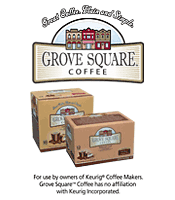
Keurig’s cartridges are known as K-Cups, and has registrations for KEURIG and K-CUP. The Strum package has small text on the bottom left front that reads “*For use by owners of Keurig® coffee makers.” On the bottom, a disclaimer to the left of the directions states, “*Sturm Foods, Inc. has no affiliation with Keurig, Incorporated.” The package also contains images of two Grove Square cartridges grouped together, one on its side to show its top better, and one standing up, surrounded by coffee beans. The package also shows a sliding bar graph indicating whether the coffee inside is a light, medium or dark roast, and the front has a v-shaped perforated opening ending in a u-shaped tab. The top and back of the box have “short stories that are seemingly intended to evoke a romantic association with drinking coffee.” The back promises “some of the world's highest quality Arabica beans, roasted and ground to ensure peak flavor, then packaged to lock in optimum freshness."
The court discussed nominative fair use. Under the Third Circuit rule, the plaintiff must first prove that confusion is likely. But the court nonetheless proceeded under a confusion analysis modified by nominative fair use. There was no dispute that Keurig owned its marks and that they were distinctive, but that’s not helpful to the plaintiff in a nominative fair use case: in a nominative fair use case, confusion is not inevitable simply because defendant uses an identical mark. Nor is marketing through the same sales channels or to the same group of consumers helpful to the plaintiff in such a case, because the defendant isn’t trying to use plaintiff’s marks to refer to its own products. Presumably because of the time on market and the stage of the litigation, neither the length of time used without actual confusion nor the absence of evidence of actual confusion mattered either.
The price of the goods is low, even in bulk, favoring Keurig. Strum’s intent in using the mark (the factor says “adopting,” but of course that’s not really what happened) was to inform customers of the cartridge compatibility. The disclaimer of affiliation supported this. Strum used the smallest amount of the mark possible, in plain text without stylization. “Given this minimalist use, coupled with a disclaimer on the bottom, this factor strongly favors defendant's use of the mark.”
What about the relationship of the goods in consumers’ minds? Here, Keurig’s attempts at product differentiation worked against it.
Keurig's own website shows 241 different flavors of K-Cups with dozens of different brand names. Given the fact that customers are encouraged to try different K-Cups from this wide variety, there is no reason to assume that customers would associate the poor taste or poor function of a single brand of K-Cup with the Keurig system instead of with the K-Cup's brand itself. Plaintiff's own customer testimonials show that customers are willing to switch from one brand of K-Cup to another if the brand does not meet their performance or taste criteria. Even if some customers were initially confused as to whether Grove Square coffee is authorized by plaintiff, it is of little concern to the court because "some possibility of consumer confusion must be compatible with fair use."But isn’t Keurig’s use of different brands consistent with the idea that the consuming public might expect the plaintiff to provide both products or expand into the market? Again, in a nominative fair use case, because defendant and plaintiff necessarily compete in the same market, this factor is neutral.
So, even had Keurig shown likely success on the merits, Strum would be likely to succeed on the fair use defense. Strum satisfied the first two prongs of the Third Circuit defense: The use of plaintiff's mark was necessary to describe (1) plaintiff's product or service and (2) defendant's product or service, and only so much of the mark as necessary was used. Keurig focused on the third prong, whether the defendant's conduct or language reflects the true and accurate relationship between plaintiff and defendant's products or services. Keurig argued that courts have to consider the defendant’s failure to state or explain some aspect of the relationship, and, where a disclaimer exists, it must be considered in whether the alleged infringer accurately portrayed the relationship. (The court noted that the Third Circuit said that a court can, not must, consider the defendant’s failure to explain some aspect of the relationship.) The disclaimer here was blunt. Although it’s on the bottom of the box, it’s direclty across from the directions and “best by” date. There was no evidence that consumers wouldn’t look at it.
Thus, Keurig didn’t show likely success on the merits. Comments: nice to see a court applying the potentially over-rigid Third Circuit test sensibly. Also, given how nominative fair use affects the likely confusion analysis, is it really fair to say that the plaintiff has to show likely confusion before the court considers nominative fair use as a defense? At a minimum, the analysis happens in tandem, and courts should admit that.


False advertising: the state law claim had a lower burden of proof than the Lanham Act since a plaintiff need not prove competition or actual confusion to prevail (don’t know why that latter is a lower burden of proof, but ok). But Keurig lumped them together, so the court would too.
Keurig maintained that it routinely tests over 2000 cartridges for every new line of K-Cups, and any failure results in disqualification. It internally tested 30 of Strum’s cartridges, and over 25% supposedly failed under normal use. (Wonder how you do that trial double-blinded? Maybe teach the actual experimenter, who doesn’t know anything about the litigation, how to test a cartridge, and having her do it to a bunch of both parties’ cartridges.) Keurig argued that this made the statement “for use by owners of Keurig coffee makers” literally false, because the necessary implication is that the cartridges are “functionally suitable” for such use.
The court agreed that this was the necessary implication, but “functionally suitable” does not mean “up to the same quality standards” as Keurig cartridges. “Nowhere on the box does defendant claim that its products have the same failure rate or quality level as plaintiff's. Defendant's products are marketed at a less expensive price than plaintiff's products which could imply an inferior quality.” Even if the court required Strum to meet Keurig’s quality standards, the competing evidence prevented likely success on the merits. Strum’s independent testing firm tested over 100 cartridges without failure.
Keurig also briefly argued that the words “fresh brewed” on the package were false because the cartridges didn’t disclose that it contained instant coffee. This was suggestive at most and required consumer survey evidence, which was not present.
The court also, without further explanation, denied Strum’s motion to dismiss for failure to state a claim, though on this opinion Keurig would need to provide considerably more favorable facts to avoid summary judgment.
Claim that service doesn't infringe patent may be false advertising
Optigen, LLC v. International Genetics, Inc., 2011 WL 841506 (N.D.N.Y.)
Optigen has two patents for testing dog DNA for certain inherited diseases. InGen’s principal Dobbins founded PinPoint, offering “Pawsitive I.D.” for DNA testing cats and dogs. Optigen informed PinPoint and Dobbins in 2008 that PinPoint was infringing Optigen’s patents. Dobbins then established InGen in the Bahamas and purchased PinPoint’s assets, including Pawsitive I.D. and the related website. InGen’s website says it offers the test “that PinPoint was forced to withdraw in April 2008 due to patent issues.... InGen does not have these issues ….” The website suggest InGen’s knowledge that InGen’s services would amount to patent infringement if offered in the US, Canada, or EU (e.g., "[t]hese patents[, which] prohibit unlicensed use of the scientific techniques used in the detection of genetic mutations for some diseases[,] ... were never filed in The Bahamas and therefore it is perfectly legal and ethical to use the scientific processes needed to determine if an animal has the mutation in this jurisdiction”), and InGen offers its services to customers in the US, who make up 80-85% of its customers.
Optigen alleged patent infringement and inducement, as well as false advertising and unfair competition. I will only discuss the false advertising claims, though the inducement/“offer to sell” issues seem quite interesting.
Optigen contended that InGen falsely claimed that it didn’t infringe Optigen’s patent. InGen defended on the ground that this was true. The court disagreed, on the current record. “Because a patent is not a good or service, a misleading statement about the ownership of a patent does not give rise to a false advertising claim.” However, a plaintiff may prevail by showing that a false or misleading statement involved an inherent or material quality of a product or service. Here, InGen advertises a test for sale; the test is a good. It further advertised that its sale is legal because the test doesn’t infringe. This statement concerns the nature, quality, or characteristics of this good. (In other words, reasonable consumers care if their supplier is breaking the law, even if the consumer is not breaking the law by buying the product! Somehow I have the feeling this is more of a normative conclusion than an empirical one.) So, if InGen’s statements are false—which has to go to a factfinder, per the court’s decision on the patent claims—then InGen might be liable for false advertising. (Query whether, under this holding, materiality goes to the jury too, or whether the court resolved it as a matter of law.)
Optigen has two patents for testing dog DNA for certain inherited diseases. InGen’s principal Dobbins founded PinPoint, offering “Pawsitive I.D.” for DNA testing cats and dogs. Optigen informed PinPoint and Dobbins in 2008 that PinPoint was infringing Optigen’s patents. Dobbins then established InGen in the Bahamas and purchased PinPoint’s assets, including Pawsitive I.D. and the related website. InGen’s website says it offers the test “that PinPoint was forced to withdraw in April 2008 due to patent issues.... InGen does not have these issues ….” The website suggest InGen’s knowledge that InGen’s services would amount to patent infringement if offered in the US, Canada, or EU (e.g., "[t]hese patents[, which] prohibit unlicensed use of the scientific techniques used in the detection of genetic mutations for some diseases[,] ... were never filed in The Bahamas and therefore it is perfectly legal and ethical to use the scientific processes needed to determine if an animal has the mutation in this jurisdiction”), and InGen offers its services to customers in the US, who make up 80-85% of its customers.
Optigen alleged patent infringement and inducement, as well as false advertising and unfair competition. I will only discuss the false advertising claims, though the inducement/“offer to sell” issues seem quite interesting.
Optigen contended that InGen falsely claimed that it didn’t infringe Optigen’s patent. InGen defended on the ground that this was true. The court disagreed, on the current record. “Because a patent is not a good or service, a misleading statement about the ownership of a patent does not give rise to a false advertising claim.” However, a plaintiff may prevail by showing that a false or misleading statement involved an inherent or material quality of a product or service. Here, InGen advertises a test for sale; the test is a good. It further advertised that its sale is legal because the test doesn’t infringe. This statement concerns the nature, quality, or characteristics of this good. (In other words, reasonable consumers care if their supplier is breaking the law, even if the consumer is not breaking the law by buying the product! Somehow I have the feeling this is more of a normative conclusion than an empirical one.) So, if InGen’s statements are false—which has to go to a factfinder, per the court’s decision on the patent claims—then InGen might be liable for false advertising. (Query whether, under this holding, materiality goes to the jury too, or whether the court resolved it as a matter of law.)
Wednesday, March 16, 2011
ANA part 3
Luncheon Keynote
Jim Davidson, Executive Director of the Alliance for American Advertising and The Advertising Coalition, Chair, Public Policy Group, Polsinelli Shughart PC
Unprecedented level of attacks: taxes on ads (limits on deductibility); restrictions on food ads, especially for those under 18; online ads for prescription drugs (stalemate at FDA about this); limits on online consumer research.
100 new Republican members with no commitment to prior priorities. Having difficulty setting priorities and implementing them. Hostility towards certain types of ads, particularly pharma. Tax poses a major threat. Republicans were behind 2 of 3 of the major attempts to tax ads in the last 15 years—it’s a way to raise revenues without being seen. On the table to fund the Bush tax cuts.
Ending deduction for DTC pharma ads alone, as approved last year in House Ways & Means, could raise $37 billion over 10 years. The debt is big, so everything is on the table.
FDA is catatonic on the issue of social media to communicate information on prescription drugs.
Various proposals: maybe all businesses should take a haircut to share the pain. (Interestingly his examples are 2/5 individuals: mortgage deduction and retirement age.) Deductions are attractive targets in this environment.
Under 18: proposal from interagency group of USDA, CDC, FTC, and FDA to ban all food ads to those under 18. Another: extend FTC powers to regulate ads (he means, move from Magnusson-Moss rulemaking to APA rulemaking, though he didn’t mention notice and comment). Proposal to tax ads for unhealthy foods and use them to fund PE, but why pick on ads? Major advocacy campaign to label food ads the next tobacco.
Interagency nutrition standards would affect most advertised foods, including peanut butter, yogurt, vegetable soup, almost all cereals. (I’ve got to say, maybe you shouldn’t put quite so much sugar into that yogurt, then.) Would affect adult ads because of crossover viewing; 1700 programs rely on these ads for funding. Also, Institute of Medicine 2005 study say there’s no current evidence of a causal connection between marketing to children and childhood obesity. Academics are trying to disprove this. Our mission is to keep on top of that and provide contrary research.
Ads are a vital part of the US economy in every state. IMS Global Insight used a model developed by Lawrence R. Klein, Nobel laureate. Every dollar of ad spending generates just under $20 of economic output (RT: advertising encourages consumption, but it still doesn’t affect obesity—a miracle!). Every $1 million of spending “supports” 69 American jobs. Ads contribute $5.8 trillion of economic activity.
Meetings with Senators/Representatives in their home states/districts are most effective. Explain the impact of ads—local broadcasters, ad agencies, etc. should be part of meetings to bring the message home.
Keynote Address
Bryant Godfrey, Regulatory Counsel, Division of Drug Marketing, Advertising and Communications, Food and Drug Administration
Standard disclaimer: these are his views. DTC is legal but consumers sometimes walk away with misleading impressions. DDMAC has initiatives to promote voluntary compliance; encourages presubmission of ads, issues guidance documents, travels around the country for outreach efforts.
FDA looks at net impression of the promotional piece as a whole. Social media: public hearing in Nov. 2009. 12 FDA panelists and 77 presentations by industry, advocacy groups.
2007 act allowed FDA to pre-review DTC TV ads, give monetary penalties for violations, and make rules on the major statement. Existing regs require broadcast ads to disclose major side effects and contraindications in audio or audio and visual (the major statement); also require fair balance between information relating to risks and to effectiveness. Proposed rule, issued March 2010: a major statement is clear, conspicuous and neutral if the info is presented in language readily understandable by consumers; audio standards for volume, articulation and pacing; textual information has standards for contrasting background in size and style of font that allows easy reading; should not have distracting representations in any medium that detract from the information.
Info should be provided in other languages, especially for communities with limited English proficiency. Target community wants to be involved in development of message to ensure it’s relevant and culturally sensitive.
Risk based enforcement approach, looks at impact on public health, with factors including newly approved products, scope/breadth of advertising, health risks, whether the company has been a violator in the past, and competitor complaints. Common violations: omission/minimization of risk information; unsubstantiated claims of efficacy/safety; unsubstantiated comparative claims; promotion of unapproved uses (huge settlements with DoJ); broadening of FDA-approved indication.
We like to start off with untitled letters for violations that aren’t as egregious; warning letters are for more egregious violations.
Example of violation: Viva Viagra ad that was mostly a song, but called the drug the most prescribed “for erectile dysfunction”—tiny super said consult doctor for risk information. This was not enough.
Bad Ad Program: dedicated email and phone line for submitting complaints. Derma-Smoothe warning letter: company webpages. Violations included omission/minimization of risk information (many limits on who can use the product and where—but the page said “no adrenal suppression” and that it could be applied on over 90% of the body, neither of which were true; warning says that it should be prescribed with caution to those with peanut allergies, but the site said “peanut allergies are not a problem”); unsubstantiated claims of efficacy/safety; unsubstantiated comparative claims; and broadening of FDA-approved indication. Also made a claim that the patient would only need one bottle to treat the condition, but there was no evidence this was true.
Green Marketing
John Feldman, Partner, Reed Smith LLP
Green claims are credence claims, leaving consumers particularly vulnerable: cost of determining truth of claim far exceeds value of determination. And yet green claims are of increasing import to consumers who are clamoring for more environmentally friendly options.
Proposed Green Guides—focused on deception, not environmental policy. International standards were not a priority. Most important was the consumer perception data.
Consumers take myriad messages from general environmental claims. 50-60% think green/ecofriendly means recycled; 40% think compostable, and 36% think made with renewable energy. When the FTC tested green claims with qualifications, miscommunication went down considerably (though was not eliminated). Interpreted results as demonstrating that general unqualified claims were likely to communicate a variety of messages, all of which require substantiation; unlikely that advertiser could do so. Thus the new version of the guides say that you’re so unlikely to be able to substantiate that the default should be not to make an unqualified green claim. Ensure that the context, even with qualification, isn’t deceptive through implication. “Buy my wrapping paper because it’s not made with chlorine, which has been shown to harm the environment.” This would be deceptive if the alternative bleaching agent was equally harmful to the environment. How far does this principle go?
James A. Dudukovich, Marketing Counsel, Coca-Cola North America
FTC is worried that people are dumb and need to be spoonfed. He agrees to a great extent, because environmental action has such a positive halo, because optimistic consumers are likely to round up.
Feldman: suppose you stop bleaching, but then you need a new pigment formulation with greater toxicity. So it’s not exactly a tradeoff; but could there be an implied claim here?
Dudukovich: Absolutely. If you brag about the good, may have to disclose the bad.
Feldman: certification/seals of approval. Is it deceptive, as the Green Guide proposal says, to use a third party seal if you’re a member of the third party trade organization? Will this survive to the final, and how does it relate to the Endorsement guides?
Dudukovich: We still don’t really know how the Endorsement guides will be enforced. But the area of seals is definitely ripe for action, because consumers will round up unless you explain what that seal means. In terms of trade association membership, for which we pay membership dues, do we need to disclose the material connection? He doesn’t know what the consumer takeaway is—what they need for an informed decision. If we pay $500 a year to belong, if the seal clearly discloses what it means and the product actually complies, does it matter? He believes that years back some Coca-Cola products participated in “gold medal taste award” programs that it paid for. Go back to the fact that these are faith-based, untestable claims.
Feldman: recent FTC action on “Tested Green Green Certified” logo available to anyone who paid a fee; Tested Green did not confirm anything and also portrayed itself as endorsed by other entities, in fact not independent.
Dudukovich: this is everything you could do wrong in one almost unbelievable package. The statement is meaningless and it wasn’t even tested!
Feldman: degradable—FTC guidance requires breakdown within a reasonably short period of time after customary disposal—FTC proposes 1 year. But shouldn’t science be built on science rather than public opinion? FTC turns to consumer research for guidance on meaning of compostable as well. Compostable: there should not be any unqualified compostable claims unless facilities are available to a substantial majority of consumers/communities—60%. This entails rejection of ASTM standards for meaning.
Dudukovich: can present a daunting task for new players to substantiate.
Feldman: and therefore raises competition issues. Legal tension between consumer perception and science in an area that has been heavily based on the latter.
Recyclable: FTC has continued its focus on availability of recycling stations. Unqualified claim can be made when facilities are available to 60% or more (substantial majority); when facilities are available to a significant percentage, you can make the claim with a disclaimer; when facilities are not available to a significant percentage, you have to be specific about where/what percentage.
Free of/nontoxic: may be deceptive even if true, if the item has substances that pose the same or similar environmental risk as the substance not present, or the substance has never been associated with the product category. Background levels/trace amounts of a substance ok.
If a manufacturer takes out ozone-depleting substances from its refrigerant, and calls it environmentally friendly, FTC example says that’s deceptively broad if the AC unit consumers a substantial amount of energy/relies on greenhouse gases.
Dudukovich: this seems like it’s covered elsewhere (don’t make unqualified claims)—do you have to do a lifecycle analysis for everything? If you don’t, what’s up with this example.
Feldman: various new claims addressed for the first time—carbon offsets. Mostly these are logical extensions of principle: you need substantiation; you need to be consistent with consumer perception; you need to avoid double-counting. Based on consumer perception survey, FTC recommends that carbon offsets that take more than 2 years be disclosed as to their length. FTC also recommends that you can’t use things you’ve been required to do by regulation as advertising benefits (additionality), apparently because consumers can’t figure that out.
Guides didn’t address sustainability, organic/natural, or life cycle analysis, in part because of First Amendment concerns. “Sustainable” meant “durable” to consumers, not a general environmental claim—an aspirational type of claim. FTC will look at life cycle claims on a case by case basis, requiring substantiation.
Young companies, unless irresponsible, will not be able to make cutting edge claims. FTC needs to be cautious about the costs it’s imposing on marketers.
Dudukovich: the environment isn’t going to go away as an issue. As corporate citizens, companies may be focusing not entirely on message, but on doing the right thing—so there may be some activities that are environmentally beneficial, and as we get our feet under us our ability to talk about them will grow.
Q: seems to be a growing FTC distrust of the value of disclaimers.
Feldman: distinguish mouse print from full-size disclosure right next to the claim; this is difficult next to the seals/certification marks which the FTC treats as unqualified green claims—they want it right there on the logo, impacting creative decisions.
Dudukovich: creatives sometimes lump disclaimers all together and put them in a lump in the bottom—compliance w/network standards is not the same as clear and conspicuous.
Feldman: note that our presentation is US-focused; should also consider world marketing.
Putting It All Together: New Media and the Future of Advertising (Social Media, Behavioral Advertising, Blogging, Astroturfing and More)
Moderator:
Rebecca Tushnet, Professor of Law, Georgetown University Law Center
Panelists: Matt Forsyth, Vice President, Legal and Assistant General Counsel, Sapient
Jeffrey Greenbaum, Partner, Frankfurt Kurnit Klein & Selz PC
Felix Hofer, Partner, Hofer Lösch Torricelli
Peter Le Guay, Partner, Thomsons Lawyers
John Salloum, Counsel, Heenan Blaikie
Sarah Stuart, Associate General Counsel, Reebok International Ltd.
We had a very good conversation which I can’t replicate, though we talked about Etsy’s recent trouble with switching all user profiles (including items they’d listed as favorites) to “public,” making real names searchable along with usernames if the user had filled that out back when it was private. Hofer reminded us that Europe takes privacy much more seriously, as a human right and not a consumer protection issue, and that written consent is required for disclosure of sensitive personal information—which some of the “favorites” information might qualify as, given that Etsy sells sex toys.
Stuart talked about a couple of Reebok promotions making use of social media—getting consumers to design custom Reeboks, and asking their friends to “like” their designs in order to qualify for the final round, where a celebrity endorser picked the winner. Another upcoming initiative involves “checking in” at physical stores and sending a photo of oneself engaging with the product, in order to earn points redeemable for rewards. A couple of points on this one: be extremely careful with photos; again, written consent would be required in Europe and maybe here to use them to promote the product to other people. Reebok’s plans don’t include that, but they still have to provide for data security. If the use were more extensive—if, for example, the check-in was shared on Facebook, and the consumers received rewards for doing this, issues of endorsement would arise, both under the FTC’s Guides and under the laws of other countries.
Devolution of marketing: what happens when affiliates or other entities—franchisees, individual authors promoting their books on behalf of their publishers—do things online? Example: many authors these days blog and give away free copies by random selection, sometimes for comments and sometimes for retweeting book announcements. Salloum suggested that this was a sweepstakes and needed to comply with relevant regulations, and said that Canada had actually jailed a poet for running an unlawful sweepstakes—it’s a criminal regulation in Canada—so one ought to take this seriously. It’s not just that you want to train your affiliates about endorsement guidelines, though that’s true—you don’t want your authors going to jail!
Jim Davidson, Executive Director of the Alliance for American Advertising and The Advertising Coalition, Chair, Public Policy Group, Polsinelli Shughart PC
Unprecedented level of attacks: taxes on ads (limits on deductibility); restrictions on food ads, especially for those under 18; online ads for prescription drugs (stalemate at FDA about this); limits on online consumer research.
100 new Republican members with no commitment to prior priorities. Having difficulty setting priorities and implementing them. Hostility towards certain types of ads, particularly pharma. Tax poses a major threat. Republicans were behind 2 of 3 of the major attempts to tax ads in the last 15 years—it’s a way to raise revenues without being seen. On the table to fund the Bush tax cuts.
Ending deduction for DTC pharma ads alone, as approved last year in House Ways & Means, could raise $37 billion over 10 years. The debt is big, so everything is on the table.
FDA is catatonic on the issue of social media to communicate information on prescription drugs.
Various proposals: maybe all businesses should take a haircut to share the pain. (Interestingly his examples are 2/5 individuals: mortgage deduction and retirement age.) Deductions are attractive targets in this environment.
Under 18: proposal from interagency group of USDA, CDC, FTC, and FDA to ban all food ads to those under 18. Another: extend FTC powers to regulate ads (he means, move from Magnusson-Moss rulemaking to APA rulemaking, though he didn’t mention notice and comment). Proposal to tax ads for unhealthy foods and use them to fund PE, but why pick on ads? Major advocacy campaign to label food ads the next tobacco.
Interagency nutrition standards would affect most advertised foods, including peanut butter, yogurt, vegetable soup, almost all cereals. (I’ve got to say, maybe you shouldn’t put quite so much sugar into that yogurt, then.) Would affect adult ads because of crossover viewing; 1700 programs rely on these ads for funding. Also, Institute of Medicine 2005 study say there’s no current evidence of a causal connection between marketing to children and childhood obesity. Academics are trying to disprove this. Our mission is to keep on top of that and provide contrary research.
Ads are a vital part of the US economy in every state. IMS Global Insight used a model developed by Lawrence R. Klein, Nobel laureate. Every dollar of ad spending generates just under $20 of economic output (RT: advertising encourages consumption, but it still doesn’t affect obesity—a miracle!). Every $1 million of spending “supports” 69 American jobs. Ads contribute $5.8 trillion of economic activity.
Meetings with Senators/Representatives in their home states/districts are most effective. Explain the impact of ads—local broadcasters, ad agencies, etc. should be part of meetings to bring the message home.
Keynote Address
Bryant Godfrey, Regulatory Counsel, Division of Drug Marketing, Advertising and Communications, Food and Drug Administration
Standard disclaimer: these are his views. DTC is legal but consumers sometimes walk away with misleading impressions. DDMAC has initiatives to promote voluntary compliance; encourages presubmission of ads, issues guidance documents, travels around the country for outreach efforts.
FDA looks at net impression of the promotional piece as a whole. Social media: public hearing in Nov. 2009. 12 FDA panelists and 77 presentations by industry, advocacy groups.
2007 act allowed FDA to pre-review DTC TV ads, give monetary penalties for violations, and make rules on the major statement. Existing regs require broadcast ads to disclose major side effects and contraindications in audio or audio and visual (the major statement); also require fair balance between information relating to risks and to effectiveness. Proposed rule, issued March 2010: a major statement is clear, conspicuous and neutral if the info is presented in language readily understandable by consumers; audio standards for volume, articulation and pacing; textual information has standards for contrasting background in size and style of font that allows easy reading; should not have distracting representations in any medium that detract from the information.
Info should be provided in other languages, especially for communities with limited English proficiency. Target community wants to be involved in development of message to ensure it’s relevant and culturally sensitive.
Risk based enforcement approach, looks at impact on public health, with factors including newly approved products, scope/breadth of advertising, health risks, whether the company has been a violator in the past, and competitor complaints. Common violations: omission/minimization of risk information; unsubstantiated claims of efficacy/safety; unsubstantiated comparative claims; promotion of unapproved uses (huge settlements with DoJ); broadening of FDA-approved indication.
We like to start off with untitled letters for violations that aren’t as egregious; warning letters are for more egregious violations.
Example of violation: Viva Viagra ad that was mostly a song, but called the drug the most prescribed “for erectile dysfunction”—tiny super said consult doctor for risk information. This was not enough.
Bad Ad Program: dedicated email and phone line for submitting complaints. Derma-Smoothe warning letter: company webpages. Violations included omission/minimization of risk information (many limits on who can use the product and where—but the page said “no adrenal suppression” and that it could be applied on over 90% of the body, neither of which were true; warning says that it should be prescribed with caution to those with peanut allergies, but the site said “peanut allergies are not a problem”); unsubstantiated claims of efficacy/safety; unsubstantiated comparative claims; and broadening of FDA-approved indication. Also made a claim that the patient would only need one bottle to treat the condition, but there was no evidence this was true.
Green Marketing
John Feldman, Partner, Reed Smith LLP
Green claims are credence claims, leaving consumers particularly vulnerable: cost of determining truth of claim far exceeds value of determination. And yet green claims are of increasing import to consumers who are clamoring for more environmentally friendly options.
Proposed Green Guides—focused on deception, not environmental policy. International standards were not a priority. Most important was the consumer perception data.
Consumers take myriad messages from general environmental claims. 50-60% think green/ecofriendly means recycled; 40% think compostable, and 36% think made with renewable energy. When the FTC tested green claims with qualifications, miscommunication went down considerably (though was not eliminated). Interpreted results as demonstrating that general unqualified claims were likely to communicate a variety of messages, all of which require substantiation; unlikely that advertiser could do so. Thus the new version of the guides say that you’re so unlikely to be able to substantiate that the default should be not to make an unqualified green claim. Ensure that the context, even with qualification, isn’t deceptive through implication. “Buy my wrapping paper because it’s not made with chlorine, which has been shown to harm the environment.” This would be deceptive if the alternative bleaching agent was equally harmful to the environment. How far does this principle go?
James A. Dudukovich, Marketing Counsel, Coca-Cola North America
FTC is worried that people are dumb and need to be spoonfed. He agrees to a great extent, because environmental action has such a positive halo, because optimistic consumers are likely to round up.
Feldman: suppose you stop bleaching, but then you need a new pigment formulation with greater toxicity. So it’s not exactly a tradeoff; but could there be an implied claim here?
Dudukovich: Absolutely. If you brag about the good, may have to disclose the bad.
Feldman: certification/seals of approval. Is it deceptive, as the Green Guide proposal says, to use a third party seal if you’re a member of the third party trade organization? Will this survive to the final, and how does it relate to the Endorsement guides?
Dudukovich: We still don’t really know how the Endorsement guides will be enforced. But the area of seals is definitely ripe for action, because consumers will round up unless you explain what that seal means. In terms of trade association membership, for which we pay membership dues, do we need to disclose the material connection? He doesn’t know what the consumer takeaway is—what they need for an informed decision. If we pay $500 a year to belong, if the seal clearly discloses what it means and the product actually complies, does it matter? He believes that years back some Coca-Cola products participated in “gold medal taste award” programs that it paid for. Go back to the fact that these are faith-based, untestable claims.
Feldman: recent FTC action on “Tested Green Green Certified” logo available to anyone who paid a fee; Tested Green did not confirm anything and also portrayed itself as endorsed by other entities, in fact not independent.
Dudukovich: this is everything you could do wrong in one almost unbelievable package. The statement is meaningless and it wasn’t even tested!
Feldman: degradable—FTC guidance requires breakdown within a reasonably short period of time after customary disposal—FTC proposes 1 year. But shouldn’t science be built on science rather than public opinion? FTC turns to consumer research for guidance on meaning of compostable as well. Compostable: there should not be any unqualified compostable claims unless facilities are available to a substantial majority of consumers/communities—60%. This entails rejection of ASTM standards for meaning.
Dudukovich: can present a daunting task for new players to substantiate.
Feldman: and therefore raises competition issues. Legal tension between consumer perception and science in an area that has been heavily based on the latter.
Recyclable: FTC has continued its focus on availability of recycling stations. Unqualified claim can be made when facilities are available to 60% or more (substantial majority); when facilities are available to a significant percentage, you can make the claim with a disclaimer; when facilities are not available to a significant percentage, you have to be specific about where/what percentage.
Free of/nontoxic: may be deceptive even if true, if the item has substances that pose the same or similar environmental risk as the substance not present, or the substance has never been associated with the product category. Background levels/trace amounts of a substance ok.
If a manufacturer takes out ozone-depleting substances from its refrigerant, and calls it environmentally friendly, FTC example says that’s deceptively broad if the AC unit consumers a substantial amount of energy/relies on greenhouse gases.
Dudukovich: this seems like it’s covered elsewhere (don’t make unqualified claims)—do you have to do a lifecycle analysis for everything? If you don’t, what’s up with this example.
Feldman: various new claims addressed for the first time—carbon offsets. Mostly these are logical extensions of principle: you need substantiation; you need to be consistent with consumer perception; you need to avoid double-counting. Based on consumer perception survey, FTC recommends that carbon offsets that take more than 2 years be disclosed as to their length. FTC also recommends that you can’t use things you’ve been required to do by regulation as advertising benefits (additionality), apparently because consumers can’t figure that out.
Guides didn’t address sustainability, organic/natural, or life cycle analysis, in part because of First Amendment concerns. “Sustainable” meant “durable” to consumers, not a general environmental claim—an aspirational type of claim. FTC will look at life cycle claims on a case by case basis, requiring substantiation.
Young companies, unless irresponsible, will not be able to make cutting edge claims. FTC needs to be cautious about the costs it’s imposing on marketers.
Dudukovich: the environment isn’t going to go away as an issue. As corporate citizens, companies may be focusing not entirely on message, but on doing the right thing—so there may be some activities that are environmentally beneficial, and as we get our feet under us our ability to talk about them will grow.
Q: seems to be a growing FTC distrust of the value of disclaimers.
Feldman: distinguish mouse print from full-size disclosure right next to the claim; this is difficult next to the seals/certification marks which the FTC treats as unqualified green claims—they want it right there on the logo, impacting creative decisions.
Dudukovich: creatives sometimes lump disclaimers all together and put them in a lump in the bottom—compliance w/network standards is not the same as clear and conspicuous.
Feldman: note that our presentation is US-focused; should also consider world marketing.
Putting It All Together: New Media and the Future of Advertising (Social Media, Behavioral Advertising, Blogging, Astroturfing and More)
Moderator:
Rebecca Tushnet, Professor of Law, Georgetown University Law Center
Panelists: Matt Forsyth, Vice President, Legal and Assistant General Counsel, Sapient
Jeffrey Greenbaum, Partner, Frankfurt Kurnit Klein & Selz PC
Felix Hofer, Partner, Hofer Lösch Torricelli
Peter Le Guay, Partner, Thomsons Lawyers
John Salloum, Counsel, Heenan Blaikie
Sarah Stuart, Associate General Counsel, Reebok International Ltd.
We had a very good conversation which I can’t replicate, though we talked about Etsy’s recent trouble with switching all user profiles (including items they’d listed as favorites) to “public,” making real names searchable along with usernames if the user had filled that out back when it was private. Hofer reminded us that Europe takes privacy much more seriously, as a human right and not a consumer protection issue, and that written consent is required for disclosure of sensitive personal information—which some of the “favorites” information might qualify as, given that Etsy sells sex toys.
Stuart talked about a couple of Reebok promotions making use of social media—getting consumers to design custom Reeboks, and asking their friends to “like” their designs in order to qualify for the final round, where a celebrity endorser picked the winner. Another upcoming initiative involves “checking in” at physical stores and sending a photo of oneself engaging with the product, in order to earn points redeemable for rewards. A couple of points on this one: be extremely careful with photos; again, written consent would be required in Europe and maybe here to use them to promote the product to other people. Reebok’s plans don’t include that, but they still have to provide for data security. If the use were more extensive—if, for example, the check-in was shared on Facebook, and the consumers received rewards for doing this, issues of endorsement would arise, both under the FTC’s Guides and under the laws of other countries.
Devolution of marketing: what happens when affiliates or other entities—franchisees, individual authors promoting their books on behalf of their publishers—do things online? Example: many authors these days blog and give away free copies by random selection, sometimes for comments and sometimes for retweeting book announcements. Salloum suggested that this was a sweepstakes and needed to comply with relevant regulations, and said that Canada had actually jailed a poet for running an unlawful sweepstakes—it’s a criminal regulation in Canada—so one ought to take this seriously. It’s not just that you want to train your affiliates about endorsement guidelines, though that’s true—you don’t want your authors going to jail!
ANA part 2
What’s Happening in Washington
Dan Jaffe, Executive Vice President, Government Relations, ANA
It’s within our power to affect how present challenges are resolved. Ad tax proposals: they come at times of economic distress, and politicians don’t treat them as increases (because they are usually attempts to limit deductibility/require amortization either of ads in general or of certain types of ads).
Do not track/behavioral advertising. It’s done anonymously and by machines, not creepily tracking individuals around the way congressional representatives think. Self-regulation allows opt-outs even of anonymous tracking. Scare statements that anonymity will only exist if it’s mandated are mistaken. Cookies are useful for many things other than tracking; help keep the same ad from being shown over and over again, for one thing. Killing tracking cookies on the internet will kill the internet, and it’s our job to educate regulators and legislators because they still don’t fully understand.
David Vladeck was blunt: FTC statements in regard to online behavioral advertising were directed to put industry’s feet to the fire, accelerate online self-regulation. It’s up to us to win in the marketplace or face the legislative response. Please go back and see that your companies are involved in self-regulation; overly restrictive legislation is otherwise almost inevitable.
Key law on sale of doctors’ prescribing histories for use in marketing—most significant commercial speech case since Nike. Is this an economic practice or an inextricable part of commercial speech? SG and 35 state AGs have weighed in claiming that data mining does not merit First Amendment protection. If it’s primary conduct, not speech, then the ability to develop data to provide targeted ads will be profoundly eroded. (RT: If legislators then restrict such collection in other circumstances.)
Sixth Circuit also considering appeal of challenge to tobacco law; lower court struck down ban on colors and images in ads but let the warning label requirements stand. The government has gone way too far and is violating fundamental First Amendment norms. Proposed FDA pictures: graphic and gruesome pictures required to be placed on every pack of cigarettes. ANA agrees the government can require neutral and factual disclosures, but anyone can clearly see that the proposed warnings are not neutral or strictly factual: non-neutral and emotive words and pictorial disclosures. (RT: I am writing about the use of images in law right now!) This violates the First Amendment; may take up 50% of the pack; if upheld, will not stop with cigarettes because the justification is that images are the only/best way to reach children. (And part of what I’m writing about is this: images seem to work better than words; this is a key source of their danger and their power—note the connection between images, emotion, and effectiveness.)
Another issue: who is a child? Ad industry: under 12. Concerted effort to expand this to anyone under 17. Especially critical with food/beverage advertising. FTC is also considering expanding COPPA, which applies to those under 13. SCt denied cert on a case upholding ban on alcohol ads in college newspapers even though the majority of students are above drinking age. Leaves a circuit split, because the 3d Circuit (Alito) held the contrary. Treating near-adults as little children.
“Your own safety is at stake when your neighbor’s wall is ablaze.” Not just a food industry issue. (RT: He almost sounds like a union member.)
Q: How do we deal with bad actors through self-regulation?
A: we may never be able to get 100% agreement, but that’s also true with legislation. Major ad networks, advertisers, and educated consumers looking for our icon can improve the situation. 90% of major markets will be enough for the legislators.
A Word From Our Critics
Margo Wootan, Director, Nutrition Policy, Center for Science in the Public Interest
Of course the goal of food marketing is to change children’s preferences. You wouldn’t do it if it didn’t work, and studies show marketing influences choices and even the whole way they think about food. Parents say no over and over and over again. The problem is that the types of food marketing to children are very different than the kinds of food they should be eating.
Concerned about characters used to market food, not just in advertising but also in other ways—on the food packages themselves. On-package marketing is key for kids. Snack brand books: addition with Hershey’s Kisses—brilliant marketing. Marketing via cellphones: mobile games, ringtone and wallpaper giveaways, text-in trivia contests and sweepstakes—good to cover this with self-regulatory guidelines. Companies’ own websites with products incorporated into advergames and marketing on third party websites; marketing on toys, where brand is incorporated into the toy—picture of Barbie’s McDonald’s toy set.
TV ads on Nickelodeon for foods of poor nutritional quality: compare 2005 and 2009, no real progress. With self-regulation, we saw the first change in the mix of products marketed to kids—some promise, but very disappointed with the extent of that promise: before self-regulation, 90% of the food ads were for foods of poor nutritional quality, but after all companies’ pledges were in full effect, 80% of the ads were for those foods.
We analyzed 120 companies: food/beverage, entertainment, etc.—75% earned an F, mostly for having no policy at all on marketing to kids. Food companies were most likely to have a marketing policy: 2/3rds. Restaurants/entertainment companies: only ¼ have policies. Some companies say they don’t market to kids; many of them don’t do major TV ads during children’s programming, but they have marketing in other ways—branded fundraisers in schools (Pizza Hut’s “Book It” program that promotes pizza more than reading), children’s menus, character marketing, and so on.
The majority of pledge-approved products (60%) don’t meet third party standards. People favor their own product portfolio: cereal companies have good sodium standards, but lax sugar standards, whereas McDonald’s has decent sugar standards but no sodium standards. Our standards are modest and consistent with others’; it’s just that the individual standards favor the company.
Key failure of self-regulation: in schools. A lot of work addresses food sales in schools; companies have responsibly agreed not to sell unhealthy products through vending machines and a la carte. But various kinds of sponsorships/ads aren’t covered; too much in-school marketing is ignored. Also, the self-regulation only covers elementary schools. At the very least, companies should be covering middle schools; average 6th grader is 11 years old. Also need to apply to high schools. Schools are a special place: taxpayer funded, supposed to be teaching and modeling healthy eating; parents aren’t there to supervise choices.
Another gap in self-regulation: on package marketing, covered by very few companies’ policies. It’s 2nd or 3rd largest category of marketing aimed at kids. Directly creates parent-child conflict in inappropriate ways. If it’s up to parents to say no, then market to parents; if you market to kids you interfere with and undermine parents’ ability to feed their children. Related merchandise: characters on cereal bowls and T-shirts, etc.
Entertainment companies: 80% have no marketing policy, and those that do usually (50%) just address the use of licensed characters.
Basic groundwork for self-regulation is laid. The policy could work, but it’s not working. All companies need to have a marketing policy; nutrition standards need to be consistent; it should cover all marketing—on packages, schools; need a strong and consistent definition of kid-targeted marketing (sees movement forward on this last).
Q: teenagers?
A: Practically, teenagers are watching what adults are watching; schools will be covered by guidelines but probably not other things like TV (though there might be cellphone etc. teen-specific marketing).
Q: any rumors about when new guidelines will emerge?
A: probably in the next month or so, but no promises.
Q: As proposed, guidelines would wipe out a great deal of advertising—only 100% fruit juice would be allowed; no peanut butter and jelly, some yogurts would be barred. Is this too stringent?
A: I don’t know anyone actually marketing peanut butter to kids. The standards were rough in draft, but we did take those standards and compare all the pledge-approved/self-regulatory products. About 25% met the standards as written. 50% couldn’t be analyzed because the draft standards weren’t clear enough—didn’t have meal standards so whole meals couldn’t be evaluated. If the standards were extended to meals, many products marketed to kids would be okay.
Q: should the proposals be extended to restaurants, not just supermarket standards?
A: FTC said very clearly that it would have meal standards. They have to be tweaked; couldn’t extend them directly the way they were written. Only certain food categories were allowed—fruits, vegetables, whole grains. That’s not the way she’d structure the standards; CSPI has its own recommendations available on its website: any food marketed to kids needs a positive nutritional benefit, either from an under-consumed food group like fruits/vegetables or from nutrients missing from kids’ diets. This would lead to a lot more foods being included.
Q: Disney has been doing interstitial messages to kids about what’s good to eat. Can we reinforce those positive messages and promote them to other companies as a way to promote the brand?
A: we do look at positive steps. Not many companies have any data on how their PSAs affect eating habits, so we don’t know the impact. We don’t count that as making up for lots of ads for unhealthy foods. Disney’s nutrition standards are strong for the main channel, but not on Disney XD, which lacks the PSAs as well as having the bad foods advertised. Nutrition PSAs: can’t have an educational message about sugars without addressing drinks—telling them to read the label of regular foods for tiny amounts of sugar is almost doing more harm than good; ketchup is not a problem for kids—it’s drinks and desserts.
Q: do you ever worry about the effects of these arguments on things like gun control and abortion? (RT: Do you ever worry about the effects of these arguments on things like underage drinking or taxation? After all, if the government can take 1% of my income, couldn’t it take 100%? If it can ban 12-year-olds from drinking, can’t it ban all of us?)
A: she doesn’t believe in slippery slopes. Congress accepts an argument in a particular fact situation. She has no professional opinion on gun control, but if banning one type of gun is reasonable and another isn’t, you support the reasonable one and oppose the unreasonable. Food marketing is different. You’re marketing to children. You should do it in a way that doesn’t make them sick and undermine their health. After smoking, obesity and nutrition are the major contributors to disease. I’m asking you to be responsible. If we give up on self-regulation and ask the government to step in, we then have to ask whether marketing to kids is inherently deceptive.
There are reasons to focus on food marketing to kids that are unique to them; doesn’t mean consequences for teens/adults.
Q: He’s seen a report that eating anything for breakfast, even cereal, decreases the chance of obsesity.
A: of course kids should eat breakfast. She’s concerned with the specific cereals, and the sweetness. American kids are being acculturated to eat supersweet.
Collateral Consequences
Ron Urbach, Chairman, Partner/Co-Chair, Advertising, Marketing & Promotions, Davis & Gilbert LLP
Class actions: the modern-day boogeyman.
Jerry Karnick, Associate General Counsel, Marketing and Consumer Law, Verizon Wireless
We want to solve problems with our competitors’ ads; we don’t necessarily want to go to court. Develop good relationships with competitors’ legal departments to resolve potential ad issues informally. Sometimes ads get run without going through the legal department—this happens all the time; can resolve it in-house. Good relations mean you can present the facts/claims to the other side and stay out of court.
Lanham Act: when you do need immediate relief. Be aware that once you sue/are sued, you can’t control the press. Are you willing to take that risk?
Regulatory attention: regulators are generally looking out for our consumers; there is an opportunity for dialogue, education on what’s going on in the industry, etc. Not the same with plaintiffs’ lawyers where you’re not sure where the interest lies.
NAD: much more limited relief, no discovery—but less disruptive for clients, also private. There are times when you want to depose the other expert, and he’s been happy with how the NAD deals with these situations. People want to keep their credibility with the NAD because they are repeat players. In his industry (wireless) there are also industry self-regulators that help avoid a scorched-earth policy. The same people you may have an ad dispute with are the people you may be side by side with on a regulatory issue.
Urbach: recent FTC actions in substantiation: Danone, Kellogg’s, Pom, etc. Importance: some of you may think that the FTC actions don’t apply to you because you have sophisticated inside and outside counsel and you review data. The days of thinking that the FTC and the states are focused solely on the issues of fraudsters and scammers are (if they ever existed) gone. Consider yourself a potential target.
Karnick: Focus on health, safety, privacy, digital media/innovative practices—and we’re all engaged in those these days.
Urbach: class action counsel are fundamentally focused on the fact of making a lot of money. There may be a benefit to consumers, but in many cases they don’t care about effecting change, just about making money. Result: may not be as concerned with prospective relief, which may be either a positive or negative. Positive: opportunity to resolve issues; negative: may not understand the business and may ignore good solutions.
One case: Cohen v. Windsor Fashions: violation of Cal. Privacy law, lawyer paid $125,000 in gift cards—this was overturned on appeal though. CAFA: greater scrutiny of settlements, particularly coupon settlements.
Advertisers can manage PR around settlements with regulators. While accepting that lawyers aren’t PR agents, have some input—timing, exposure, characterization (though you can’t necessarily control it). Some class action counsel monitor FTC/regulators’ reports, but it’s the ones that go to the general media that attract the attention of lawyers.
Class actions can also stimulate regulatory actions—Dannon was originally a class action and then the FTC brought an action. NY AG intervened in a class action in Massachusetts against Webloyalty to ensure full refunds; previously only 2 months were provided.
Consumer class actions increased 172% between 2001 and 2007, in part substituting for securities litigation. 28% of all federal class actions. Challenge major companies—Apple, Google, Facebook—on major issues, from privacy to health benefits. Facebook’s been sued for right of publicity violations; Pineda v. Williams-Sonoma, Cal. SCt ruled that retailers can’t ask for zip codes from consumers. Zip was used to derive information about the individual and market to them.
Karnick: industry implications—class action against another has meaning for you. Now we put arbitration/class action waivers in our agreements—we’ll even pay for dispute resolution, but don’t bring class action lawyers in. This increases complexity of the agreement and interpretation thereof (and may not be valid in the 9th Circuit).
Urbach: plaintiff-friendly states: California, with Kwikset case. E.D. Tex., difficult to deal with patent filings there—less educated jury pools allow plaintiffs’ attorneys to overstate the rigors and complications of patent process, plaintiffs win 78% of the time, 20 points over national rate. Alabama is plaintiff-friendly but possibly on its way out; regulators have moved in and out of class action counsel status. Defendant friendly jurisdictions: federal court.
Private state AG actions: this is something you should focus on. AGs in some states can appoint private class counsel to litigate a regulatory matter. There is no class certification process; no set class because it’s on behalf of all citizens; no requirement of notice to absent class members. This happened in tobacco cases, where they needed expertise of outside counsel. Complex cases/subject matters in which AGs are not experts. Budget cuts have hit AGs’ offices. Can appoint their friends and the state gets a piece of the action at the end of the day. “Offshoring” regulatory action.
South Carolina AG appointed three private firms to represent the state against Eli Lilly in Zyprexa litigation. AG has broad discretion and power to hire counsel on contingency fee basis. Vacco v. Phillip Morris (1997): NY AG hired firms that made big donations before and after. Private attorneys were major contributors to state AGs in several states. Cases in California and Rhode Island have been critical of government contingency fee arrangement—unconstitutional/against public policy. George W. Bush issued an executive order banning contingency fee arrangements with outside counsel. (I guess privatization has its limits, outside the battlefield anyway.)
Karnick: bigger risk to companies—make sure that any injunctive relief is something the company can deal with. Also try for a time limit on regulatory/settlement injunctions—doesn’t make sense to be bound forever given how business environment changes—suppose your agreement requires paper disclosures or something like that.
Urbach: conversations with executives—do you really want to sue (under the Lanham Act)? Sometimes they say “but you don’t let us say X”! Regulators also need to understand the psychology of executives; once they sue, they may be in for a fight.
Making The Case For Self-Regulation In Regulatory World
Lee Peeler, President and Chief Executive Officer, National Advertising Review Council (NARC)/Executive Vice President, National Advertising Self-Regulation, Council of Better Business Bureaus (CBBB)
Children’s Food & Beverage Advertising Initiative: how industry can come together to address concerns.
Last year, 10 cases were referred to the government; 95% were resolved voluntarily, including when they involved ongoing advertising that was hard to change.
New self-regulatory program for online behavioral advertising: 7 principles agreed to by broad cross section of industry in 2009. We focus on transparency and consumer control. OBA is data collection over time and across websites. If you just collect info on your own website and use it to serve ads this definition doesn’t apply to you. Coverage is relatively simple: if you serve ads based on behavioral data or collect it, you’re covered. If you run a website on which this occurs, you’re covered.
 Advertising option icon with information for consumers: clicking on it gives info on what’s collected and an option to opt out. CBBB and Digital Marketing Ass’n will monitor/offer compliance guides. CBBB has a new director for interest based advertising accountability; contract with Evidon to provide monitoring data; initiating enforcement procedures.
(I had to take a quick phone call and missed some of the details on the ad choices icon, spilling over into the beginning of the next presentation.)
Stuart Ingis, Partner, Venable LLP
Big push on consumer education about the icon. Consumers can opt out of some or all participating companies’ online ads. Working with European regulators to see if this program is extensible overseas. Issues with identifying people: you know the browser, but you don’t know who’s using it (a child?). Issues with definition of health/other sensitive data. New principle: demystify concerns by making sure data used for online behavioral advertising (OBA) won’t be used for eligibility for employment or insurance.
Scott Meyer, Chief Executive Officer, Evidon
Monitoring and compliance: done with panel data (300k participants), automated compliance checks, and privacy database tracking more than 500 companies looking at consistency of data collection and use of privacy policies. BBA and DMA will be the ones evaluating the data for compliance. Have no financial interest in media sales. We work with a large number of agencies, advertisers, and networks.
Q: how will opt-out work when the data company never has direct contact with the consumer?
A: The reality is that’s where the data resides—in the third party. The key is in how you explain it to the consumer. Have to solve the problem for Grandma, who’s just freaked out, and for a hardcore privacy geek.
In answer to Facebook Q: most ads on Facebook are not considered OBA because data’s all collected on Facebook.
Dan Jaffe, Executive Vice President, Government Relations, ANA
It’s within our power to affect how present challenges are resolved. Ad tax proposals: they come at times of economic distress, and politicians don’t treat them as increases (because they are usually attempts to limit deductibility/require amortization either of ads in general or of certain types of ads).
Do not track/behavioral advertising. It’s done anonymously and by machines, not creepily tracking individuals around the way congressional representatives think. Self-regulation allows opt-outs even of anonymous tracking. Scare statements that anonymity will only exist if it’s mandated are mistaken. Cookies are useful for many things other than tracking; help keep the same ad from being shown over and over again, for one thing. Killing tracking cookies on the internet will kill the internet, and it’s our job to educate regulators and legislators because they still don’t fully understand.
David Vladeck was blunt: FTC statements in regard to online behavioral advertising were directed to put industry’s feet to the fire, accelerate online self-regulation. It’s up to us to win in the marketplace or face the legislative response. Please go back and see that your companies are involved in self-regulation; overly restrictive legislation is otherwise almost inevitable.
Key law on sale of doctors’ prescribing histories for use in marketing—most significant commercial speech case since Nike. Is this an economic practice or an inextricable part of commercial speech? SG and 35 state AGs have weighed in claiming that data mining does not merit First Amendment protection. If it’s primary conduct, not speech, then the ability to develop data to provide targeted ads will be profoundly eroded. (RT: If legislators then restrict such collection in other circumstances.)
Sixth Circuit also considering appeal of challenge to tobacco law; lower court struck down ban on colors and images in ads but let the warning label requirements stand. The government has gone way too far and is violating fundamental First Amendment norms. Proposed FDA pictures: graphic and gruesome pictures required to be placed on every pack of cigarettes. ANA agrees the government can require neutral and factual disclosures, but anyone can clearly see that the proposed warnings are not neutral or strictly factual: non-neutral and emotive words and pictorial disclosures. (RT: I am writing about the use of images in law right now!) This violates the First Amendment; may take up 50% of the pack; if upheld, will not stop with cigarettes because the justification is that images are the only/best way to reach children. (And part of what I’m writing about is this: images seem to work better than words; this is a key source of their danger and their power—note the connection between images, emotion, and effectiveness.)
Another issue: who is a child? Ad industry: under 12. Concerted effort to expand this to anyone under 17. Especially critical with food/beverage advertising. FTC is also considering expanding COPPA, which applies to those under 13. SCt denied cert on a case upholding ban on alcohol ads in college newspapers even though the majority of students are above drinking age. Leaves a circuit split, because the 3d Circuit (Alito) held the contrary. Treating near-adults as little children.
“Your own safety is at stake when your neighbor’s wall is ablaze.” Not just a food industry issue. (RT: He almost sounds like a union member.)
Q: How do we deal with bad actors through self-regulation?
A: we may never be able to get 100% agreement, but that’s also true with legislation. Major ad networks, advertisers, and educated consumers looking for our icon can improve the situation. 90% of major markets will be enough for the legislators.
A Word From Our Critics
Margo Wootan, Director, Nutrition Policy, Center for Science in the Public Interest
Of course the goal of food marketing is to change children’s preferences. You wouldn’t do it if it didn’t work, and studies show marketing influences choices and even the whole way they think about food. Parents say no over and over and over again. The problem is that the types of food marketing to children are very different than the kinds of food they should be eating.
Concerned about characters used to market food, not just in advertising but also in other ways—on the food packages themselves. On-package marketing is key for kids. Snack brand books: addition with Hershey’s Kisses—brilliant marketing. Marketing via cellphones: mobile games, ringtone and wallpaper giveaways, text-in trivia contests and sweepstakes—good to cover this with self-regulatory guidelines. Companies’ own websites with products incorporated into advergames and marketing on third party websites; marketing on toys, where brand is incorporated into the toy—picture of Barbie’s McDonald’s toy set.
TV ads on Nickelodeon for foods of poor nutritional quality: compare 2005 and 2009, no real progress. With self-regulation, we saw the first change in the mix of products marketed to kids—some promise, but very disappointed with the extent of that promise: before self-regulation, 90% of the food ads were for foods of poor nutritional quality, but after all companies’ pledges were in full effect, 80% of the ads were for those foods.
We analyzed 120 companies: food/beverage, entertainment, etc.—75% earned an F, mostly for having no policy at all on marketing to kids. Food companies were most likely to have a marketing policy: 2/3rds. Restaurants/entertainment companies: only ¼ have policies. Some companies say they don’t market to kids; many of them don’t do major TV ads during children’s programming, but they have marketing in other ways—branded fundraisers in schools (Pizza Hut’s “Book It” program that promotes pizza more than reading), children’s menus, character marketing, and so on.
The majority of pledge-approved products (60%) don’t meet third party standards. People favor their own product portfolio: cereal companies have good sodium standards, but lax sugar standards, whereas McDonald’s has decent sugar standards but no sodium standards. Our standards are modest and consistent with others’; it’s just that the individual standards favor the company.
Key failure of self-regulation: in schools. A lot of work addresses food sales in schools; companies have responsibly agreed not to sell unhealthy products through vending machines and a la carte. But various kinds of sponsorships/ads aren’t covered; too much in-school marketing is ignored. Also, the self-regulation only covers elementary schools. At the very least, companies should be covering middle schools; average 6th grader is 11 years old. Also need to apply to high schools. Schools are a special place: taxpayer funded, supposed to be teaching and modeling healthy eating; parents aren’t there to supervise choices.
Another gap in self-regulation: on package marketing, covered by very few companies’ policies. It’s 2nd or 3rd largest category of marketing aimed at kids. Directly creates parent-child conflict in inappropriate ways. If it’s up to parents to say no, then market to parents; if you market to kids you interfere with and undermine parents’ ability to feed their children. Related merchandise: characters on cereal bowls and T-shirts, etc.
Entertainment companies: 80% have no marketing policy, and those that do usually (50%) just address the use of licensed characters.
Basic groundwork for self-regulation is laid. The policy could work, but it’s not working. All companies need to have a marketing policy; nutrition standards need to be consistent; it should cover all marketing—on packages, schools; need a strong and consistent definition of kid-targeted marketing (sees movement forward on this last).
Q: teenagers?
A: Practically, teenagers are watching what adults are watching; schools will be covered by guidelines but probably not other things like TV (though there might be cellphone etc. teen-specific marketing).
Q: any rumors about when new guidelines will emerge?
A: probably in the next month or so, but no promises.
Q: As proposed, guidelines would wipe out a great deal of advertising—only 100% fruit juice would be allowed; no peanut butter and jelly, some yogurts would be barred. Is this too stringent?
A: I don’t know anyone actually marketing peanut butter to kids. The standards were rough in draft, but we did take those standards and compare all the pledge-approved/self-regulatory products. About 25% met the standards as written. 50% couldn’t be analyzed because the draft standards weren’t clear enough—didn’t have meal standards so whole meals couldn’t be evaluated. If the standards were extended to meals, many products marketed to kids would be okay.
Q: should the proposals be extended to restaurants, not just supermarket standards?
A: FTC said very clearly that it would have meal standards. They have to be tweaked; couldn’t extend them directly the way they were written. Only certain food categories were allowed—fruits, vegetables, whole grains. That’s not the way she’d structure the standards; CSPI has its own recommendations available on its website: any food marketed to kids needs a positive nutritional benefit, either from an under-consumed food group like fruits/vegetables or from nutrients missing from kids’ diets. This would lead to a lot more foods being included.
Q: Disney has been doing interstitial messages to kids about what’s good to eat. Can we reinforce those positive messages and promote them to other companies as a way to promote the brand?
A: we do look at positive steps. Not many companies have any data on how their PSAs affect eating habits, so we don’t know the impact. We don’t count that as making up for lots of ads for unhealthy foods. Disney’s nutrition standards are strong for the main channel, but not on Disney XD, which lacks the PSAs as well as having the bad foods advertised. Nutrition PSAs: can’t have an educational message about sugars without addressing drinks—telling them to read the label of regular foods for tiny amounts of sugar is almost doing more harm than good; ketchup is not a problem for kids—it’s drinks and desserts.
Q: do you ever worry about the effects of these arguments on things like gun control and abortion? (RT: Do you ever worry about the effects of these arguments on things like underage drinking or taxation? After all, if the government can take 1% of my income, couldn’t it take 100%? If it can ban 12-year-olds from drinking, can’t it ban all of us?)
A: she doesn’t believe in slippery slopes. Congress accepts an argument in a particular fact situation. She has no professional opinion on gun control, but if banning one type of gun is reasonable and another isn’t, you support the reasonable one and oppose the unreasonable. Food marketing is different. You’re marketing to children. You should do it in a way that doesn’t make them sick and undermine their health. After smoking, obesity and nutrition are the major contributors to disease. I’m asking you to be responsible. If we give up on self-regulation and ask the government to step in, we then have to ask whether marketing to kids is inherently deceptive.
There are reasons to focus on food marketing to kids that are unique to them; doesn’t mean consequences for teens/adults.
Q: He’s seen a report that eating anything for breakfast, even cereal, decreases the chance of obsesity.
A: of course kids should eat breakfast. She’s concerned with the specific cereals, and the sweetness. American kids are being acculturated to eat supersweet.
Collateral Consequences
Ron Urbach, Chairman, Partner/Co-Chair, Advertising, Marketing & Promotions, Davis & Gilbert LLP
Class actions: the modern-day boogeyman.
Jerry Karnick, Associate General Counsel, Marketing and Consumer Law, Verizon Wireless
We want to solve problems with our competitors’ ads; we don’t necessarily want to go to court. Develop good relationships with competitors’ legal departments to resolve potential ad issues informally. Sometimes ads get run without going through the legal department—this happens all the time; can resolve it in-house. Good relations mean you can present the facts/claims to the other side and stay out of court.
Lanham Act: when you do need immediate relief. Be aware that once you sue/are sued, you can’t control the press. Are you willing to take that risk?
Regulatory attention: regulators are generally looking out for our consumers; there is an opportunity for dialogue, education on what’s going on in the industry, etc. Not the same with plaintiffs’ lawyers where you’re not sure where the interest lies.
NAD: much more limited relief, no discovery—but less disruptive for clients, also private. There are times when you want to depose the other expert, and he’s been happy with how the NAD deals with these situations. People want to keep their credibility with the NAD because they are repeat players. In his industry (wireless) there are also industry self-regulators that help avoid a scorched-earth policy. The same people you may have an ad dispute with are the people you may be side by side with on a regulatory issue.
Urbach: recent FTC actions in substantiation: Danone, Kellogg’s, Pom, etc. Importance: some of you may think that the FTC actions don’t apply to you because you have sophisticated inside and outside counsel and you review data. The days of thinking that the FTC and the states are focused solely on the issues of fraudsters and scammers are (if they ever existed) gone. Consider yourself a potential target.
Karnick: Focus on health, safety, privacy, digital media/innovative practices—and we’re all engaged in those these days.
Urbach: class action counsel are fundamentally focused on the fact of making a lot of money. There may be a benefit to consumers, but in many cases they don’t care about effecting change, just about making money. Result: may not be as concerned with prospective relief, which may be either a positive or negative. Positive: opportunity to resolve issues; negative: may not understand the business and may ignore good solutions.
One case: Cohen v. Windsor Fashions: violation of Cal. Privacy law, lawyer paid $125,000 in gift cards—this was overturned on appeal though. CAFA: greater scrutiny of settlements, particularly coupon settlements.
Advertisers can manage PR around settlements with regulators. While accepting that lawyers aren’t PR agents, have some input—timing, exposure, characterization (though you can’t necessarily control it). Some class action counsel monitor FTC/regulators’ reports, but it’s the ones that go to the general media that attract the attention of lawyers.
Class actions can also stimulate regulatory actions—Dannon was originally a class action and then the FTC brought an action. NY AG intervened in a class action in Massachusetts against Webloyalty to ensure full refunds; previously only 2 months were provided.
Consumer class actions increased 172% between 2001 and 2007, in part substituting for securities litigation. 28% of all federal class actions. Challenge major companies—Apple, Google, Facebook—on major issues, from privacy to health benefits. Facebook’s been sued for right of publicity violations; Pineda v. Williams-Sonoma, Cal. SCt ruled that retailers can’t ask for zip codes from consumers. Zip was used to derive information about the individual and market to them.
Karnick: industry implications—class action against another has meaning for you. Now we put arbitration/class action waivers in our agreements—we’ll even pay for dispute resolution, but don’t bring class action lawyers in. This increases complexity of the agreement and interpretation thereof (and may not be valid in the 9th Circuit).
Urbach: plaintiff-friendly states: California, with Kwikset case. E.D. Tex., difficult to deal with patent filings there—less educated jury pools allow plaintiffs’ attorneys to overstate the rigors and complications of patent process, plaintiffs win 78% of the time, 20 points over national rate. Alabama is plaintiff-friendly but possibly on its way out; regulators have moved in and out of class action counsel status. Defendant friendly jurisdictions: federal court.
Private state AG actions: this is something you should focus on. AGs in some states can appoint private class counsel to litigate a regulatory matter. There is no class certification process; no set class because it’s on behalf of all citizens; no requirement of notice to absent class members. This happened in tobacco cases, where they needed expertise of outside counsel. Complex cases/subject matters in which AGs are not experts. Budget cuts have hit AGs’ offices. Can appoint their friends and the state gets a piece of the action at the end of the day. “Offshoring” regulatory action.
South Carolina AG appointed three private firms to represent the state against Eli Lilly in Zyprexa litigation. AG has broad discretion and power to hire counsel on contingency fee basis. Vacco v. Phillip Morris (1997): NY AG hired firms that made big donations before and after. Private attorneys were major contributors to state AGs in several states. Cases in California and Rhode Island have been critical of government contingency fee arrangement—unconstitutional/against public policy. George W. Bush issued an executive order banning contingency fee arrangements with outside counsel. (I guess privatization has its limits, outside the battlefield anyway.)
Karnick: bigger risk to companies—make sure that any injunctive relief is something the company can deal with. Also try for a time limit on regulatory/settlement injunctions—doesn’t make sense to be bound forever given how business environment changes—suppose your agreement requires paper disclosures or something like that.
Urbach: conversations with executives—do you really want to sue (under the Lanham Act)? Sometimes they say “but you don’t let us say X”! Regulators also need to understand the psychology of executives; once they sue, they may be in for a fight.
Making The Case For Self-Regulation In Regulatory World
Lee Peeler, President and Chief Executive Officer, National Advertising Review Council (NARC)/Executive Vice President, National Advertising Self-Regulation, Council of Better Business Bureaus (CBBB)
Children’s Food & Beverage Advertising Initiative: how industry can come together to address concerns.
Last year, 10 cases were referred to the government; 95% were resolved voluntarily, including when they involved ongoing advertising that was hard to change.
New self-regulatory program for online behavioral advertising: 7 principles agreed to by broad cross section of industry in 2009. We focus on transparency and consumer control. OBA is data collection over time and across websites. If you just collect info on your own website and use it to serve ads this definition doesn’t apply to you. Coverage is relatively simple: if you serve ads based on behavioral data or collect it, you’re covered. If you run a website on which this occurs, you’re covered.

(I had to take a quick phone call and missed some of the details on the ad choices icon, spilling over into the beginning of the next presentation.)
Stuart Ingis, Partner, Venable LLP
Big push on consumer education about the icon. Consumers can opt out of some or all participating companies’ online ads. Working with European regulators to see if this program is extensible overseas. Issues with identifying people: you know the browser, but you don’t know who’s using it (a child?). Issues with definition of health/other sensitive data. New principle: demystify concerns by making sure data used for online behavioral advertising (OBA) won’t be used for eligibility for employment or insurance.
Scott Meyer, Chief Executive Officer, Evidon
Monitoring and compliance: done with panel data (300k participants), automated compliance checks, and privacy database tracking more than 500 companies looking at consistency of data collection and use of privacy policies. BBA and DMA will be the ones evaluating the data for compliance. Have no financial interest in media sales. We work with a large number of agencies, advertisers, and networks.
Q: how will opt-out work when the data company never has direct contact with the consumer?
A: The reality is that’s where the data resides—in the third party. The key is in how you explain it to the consumer. Have to solve the problem for Grandma, who’s just freaked out, and for a hardcore privacy geek.
In answer to Facebook Q: most ads on Facebook are not considered OBA because data’s all collected on Facebook.
Tuesday, March 15, 2011
Association of National Advertisers, Advertising Law and Policy Conference
Welcome from ANABob Liodice, President and CEO, ANA
Liodice made an interesting point: by taking the lead in self-regulation, US advertisers/groups become models worldwide, and that has important consequences for how self-regulation can substitute for government regulation in countries that don’t have a First Amendment and aren’t particularly constrained in what they could make advertisers do if they decided to.
Also said that taxes were a huge issue. The industry pays its fair share, but doesn’t want to fund government programs. Advertising powers 15% of American jobs, and taxes would drag on that.
Keynote Address
Edith Ramirez, Commissioner, Federal Trade Commission
Consumers have too much trouble understanding and managing their privacy options. Privacy by design: products and services should have privacy protection built in at the design stage, not in a retrofit. Good data practices: limit collection and retention, provide security, ensure accuracy. Simplified consumer choice: consumers shouldn’t have to sift through privacy policies that seasoned lawyers find confusing. Eliminate unnecessary information and options—don’t clutter policies with commonly accepted practices; notice and choice for things that fall outside common practices. Comprehensive privacy policies are useful, so they should be improved rather than eliminated—should be clear and easily compared.
(I’m reminded of the current problem with Etsy’s flip of a switch that revealed customers’ purchases and favorites to public view. Since etsy sells everything from tea cozies to customized dildos, this is not necessarily something the customers wanted.)
Transparency for brokers who have no direct contact with consumers but aggregate vast amounts of data. Should consumers have access for accuracy/transparency? How should such companies provide notice?
Do not track: why now? Methods used to capture information are becoming increasingly more powerful—scan consumer behavior in realtime, including what consumers type or where they place their mouse; can use browser configuration to identify consumer; deep packet inspection is poised for a comeback. Consumers aren’t in a position to deal with this. Also deanonymizing is developing—we can’t safely assume we’ll remain anonymous as we surf the web. With few legal limits on how online profiles may be used, this is especially unsettling. Frenzied competition for more and more data about consumers. Consumers need a counterweight to mining of their moment to moment thoughts and actions online—give consumers a say about what information is being collected and used.
Main objection: undermine availability of free online content and services. Advertising does support a great deal of content and targeted ads demand a premium; many consumers value personalized ads. But the concern is overstated. Digital Ad Alliance: consumers feel more positively towards brands with greater transparency and control, such as an ability to opt out. Do not track should not be all or nothing—consumers should be able to make more precise choices. Some may be comfortable based on interest in yoga or hiking but not based on demographics. Advertisers can create conditions of continued high participation.
For the moment, the ball is in industry’s court to deploy a solution that will avoid the need for legislation.
Yesterday, the FTC announced a complaint and settlement with an online ad network: Chitika offered consumers the ability to opt out but didn’t tell them the opt-out lasted for only 10 days. Prohibits future privacy misrepresentations and requires a permanent opt-out option, as well as requiring destruction of any data collected when the prior bad opt-out was in use.
Health claims in advertising—a lot of action. Is there a shift in the way the FTC has treated substantiation? No, not a heightened standard or an abandonment of flexibility. First, wanted brighter lines/greater clarity for companies under order, and greater ease of enforcement. Broad standard presented enforcement challenges—viewed as a license to continue making the same false claims that brought them to the FTC’s attention in the first place; relied on outlier studies; took many resources to enforce. FDA approval is a much simpler proxy. FDA approval is a form of fencing-in relief. Also note that back in 1994 the FTC made clear that FDA standards would be its principal guide in evaluating food marketing claims. Pom Wonderful: we aren’t seeking to ratchet up substantiation guidelines for companies not under order. Complaint advances same theory of liability that existed for decades: Pom made claims without sufficient substantiation.
Same thing for the two independent clinical studies requirement: our experts agreed that this was the appropriate level of substantiation for weight loss claims. It’s a transparent, clear standard for what competent and reliable substantiation means. It’s case by case. In some cases, a single study may be appropriate if experts in the field would agree that’s sufficient. But when evidence is mixed or claims are broad, two independent studies may be the level that experts agree on.
Endorsement: one marketer said, “Reviews are the new advertising.” Consumers trust other consumers’ opinions. This means increased potential for deception. Today, consent order with Legacy Learning—used blog posts, endorsements, and other online methods to promote guitar courses. Legacy paid its affiliates to write positive reviews, but failed to ensure they disclosed ties; many did not and passed themselves off as independents/ordinary consumers. FTC went after Legacy for failing to monitor affiliates; held Legacy liable for their undisclosed endorsements. Disgorgement remedy imposed. Don’t do this!
Green claims: resulted in greenwashing, which makes consumers skeptical/numb.
In Q&A, Ramirez said that the FTC distinguishes between disease claims and other health claims for purposes of fencing-in orders, thus explaining the difference between the FDA approval requirements for some claims and two good studies requirements for other health claims.
Q: does the FTC intend to give guidelines for microblogs/Twitter?
A: the key is whether the consumer would understand that there’s been payment; if not, disclosure is required. There are more examples on the FTC’s website.
Q: EU just issued a regulation on cookies—is the FTC considering anything like that?
A: following that very closely and working with Commerce Department here.
Keynote Address
Robert E. Cooper, Jr., Attorney General, State of Tennessee
Pay particular attention to companies that can influence competitors/set industry standards. Tenn. has played a leading role in multistate investigations of DirecTV and Dish Networks. Ads for “5 months free” of DirecTV. But what does it mean to get “5 months free with NFL Sunday Ticket”? Is the Sunday Ticket free, or do you get the 5 months free if you pay $60/month for the ticket? Is any of it free if the customer has to commit to a 2 year contract? Disclosure was tiny and confusing, and not in proximity to discussion of pricing and terms in main part of ad. AGs took the position that DirecTV failed to disclose material terms on total cost and term of contract, meaning consumers couldn’t get accurate picture of package/total obligations.
BlueHippo: computer retailer targeted low-income and credit-challenged consumers. Currently in bankruptcy. (Try this: search “Blue Hippo” and see what targeted ads you get. It sheds some light on what the AG says next.) Relatively small player, but Tenn. was concerned that the business model had been adopted by others—frontloading payments for goods that won’t be delivered for a year and that are charged inflated prices. “We don’t check your credit! Approval guaranteed!” Failed to disclose many things, including onerous default terms. $33 million judgment and permanent judgment prohibiting collection.
Lessons learned—what state AGs are looking for: material limitations should be clearly and conspicuously disclosed to consumers. When you advertise price, material terms must be disclosed in direct proximity. Businesses should be clear with consumers when entering into a contract. AGs often receive complaints that consumers weren’t aware they’d entered into a longterm contract. Clear language will help.
The AGs are interested in the same things the FTC is—multistate settlement with Danone based on the same Activia etc. claims. Also mentioned green claims as of particular interest.
AGs also took action against caffeinated/energy drink alcoholic beverages attractive to younger consumers.
ConsumerDepot: when consumers gave it bad reviews online, it would automatically give consumers retaliatory bad feedback, hurting the customer’s credibility among other users. AG argued that automatic retaliatory feedback was an unfair practice under state law and prevailed.
AGs also monitor class action settlements, many of which they receive automatic notice of under CAFA. Will oppose approval of bad settlements—coupon settlements that don’t provide value to consumers, as with claims that Honda exaggerated the cleanness of its cars. Not all coupon settlements are bad, but those that do nothing more than drive more business to the defendant are suspect. Also concerned where the claims seem strong but the relief is weak.
Sorrel v. IMS Health Inc.—whether a state can require market research firms/data miners to get permission of doctors before selling their prescribing histories to marketers. Tenn., and 34 other states, joined an amicus brief urging the SCt to reverse the invalidation of such a law. Prescription records are private and highly regulated; interest in preventing unauthorized use for marketing—data miners/pharmacies have no First Amendment right to buy/sell histories, but even if that is speech, it’s appropriately regulated as commercial speech. Invalidation puts into question many state laws protecting sensitive data from unauthorized disclosure for commercial purposes.
Q: comment on interaction between FTC, AGs, and class actions?
A: we like to work with the FTC when there’s an opportunity to share information/coordinate relief.
The Do’s and Don’ts in Managing Talent Agreements
Paul Muratore, President/CEO, Talent Partners (note: attributions may be wrong; there was a lot of back and forth and this is also outside my core areas, though I found it totally fascinating)
Covering mostly celebrities/over scale talent rather than noncelebrity talent. More a part of the business than ever before. 500% increase in Oscars in celebrities in commercials; 50% increase in Grammys. Celebrities can now show up anywhere in new media, increasing complexity.
Tips: be comprehensive with your needs. War stories from experienced clients with significant infrastructure and advertisers who’ve worked with celebrities in the past. Celebrity involved in a set of campaigns, well-clad in expensive designer clothes, which she decided were hers and walked off the set wearing them. Designer disagreed and was quite upset. Had to negotiate an addendum to sell the clothes at 50% discount. (Heidelberger interjected that he faced an inverse situation with a celebrity who insisted on wearing his own clothes, which were branded with someone else’s brand.)
Also: insurance—may not cover a print campaign, even though celebrities have issues and sometimes don’t show up.
Talent agreements are not always signed by the talent; important to be sure the talent is the one signing.
Spillover of knowing what you got yourself into. A bunch of scale performers hanging around while dealing with unhappy talent in high heat in Times Square—they invented “heat pay,” not part of the contract, and also delivered bottles of water.
Contract checklist—territory, number of days, etc. (Heidelberger pointed out that if you figure out later that you want something, it will be more expensive or even impossible to get it later.)
Have a backup plan: short list of other celebrities, though you can only negotiate with one at a time. (H: this is critical if you care about money. Because everyone is moving so fast, if there’s no backup plan, the talent has the advertiser over a barrel when the shoot is tomorrow. Your leverage is at the beginning. Companies pay too much because they have no choice at a late date.)
Brian Heidelberger, partner, Winston & Strawn LLP
Negotiating the best agreement: lawyer’s job to decide between letter of intent, deal memo, or formal agreement. You can do all three, but if you start that way, everyone will be exhausted by the time you get to formal agreement and that may collapse/take forever. Deal memo: short bullet points with material terms. People get tired of going to formal agreement; he likes to do the formal agreement first. If you can’t, then be clear on what goes in the deal memo: time, territory, exclusivity, confidentiality, disclosure of what celebrities have already done; do we say this is binding (subject to a more formal agreement) or that it isn’t binding until there’s a formal agreement? His experience: make it binding, because of the sunk costs. That’s why he doesn’t like letters of intent.
Social media: when you engage celebrities, there’s almost always a provision about Twitter/Facebook. Even if you don’t say, it’s likely they will act themselves. FTC Guides: everyone knows about disclosure. But the guidelines also require training. Attach your social media policy to the agreement and make the talent agree to it. Also you need to monitor: just because you have something in the contract doesn’t mean you have to monitor their Twitter feed for false/deceptive/unsubstantiated claims—you have to be able to cause them to take down problematic claims. If you’re dealing with someone on the edge, ask for their password. Two recent social media disasters: Gilbert Godfrey (voice of AFLAC duck) has been saying a lot of negative things about the Japanese situation; AFLAC dropped him, but it’s too late. Maybe they can terminate him for a morals clause violation, but were they monitoring? Did they have the ability to take down the tweets? Chrysler also had a problem with swearing in their official feed. This was a contract employee.
Muratore: this is consistent with what Commissioner Ramirez said about reviews being the new advertising.
H: exclusivity. Sometimes gets short shrift. Talent will want just exclusivity on the product, but that can be problematic. Nokia could get mobile phone exclusivity, but what if Apple engages that talent for their computers? Maybe should be “manufacturers of mobile phones,” or name specific companies you really hate; keep the list as short as you can because all of this costs. Sometimes advertisers get a little crazy on exclusivity. Individual celebrity sponsorships are actually few and far between, so you have to balance cost and risk.
M: Advertiser’s view: if you have a really good celebrity doing really good work, chances are no one else will want to hire them in the category because of the existing association—this means you can ask for exclusivity but be willing to give ground in negotiating.
Multiservice agreements for entertainers; nonentertainers/models have separate agreements—pro athletes. Advertising a product within the sport and without are treated differently. These are guidelines available on the ANA website, and there is arbitration available. Check those agreements and understand which aspects you’re working with.
H: If your agency is a signatory to SAG, SAG can see your contract even if you’re not a signatory. They take the position that a large portion of the agreement relates to TV, even if it’s really small. We had a case with Tiger Woods as an endorser, mostly print/airport dioramas. But they did create a TV commercial; SAG sued, saying that even if it was only 10% of budget, that wasn’t enough allocation (which has implications for payments owed to pension funds etc.). Have a separate contract for TV in a smaller deal, with a reasonable amount for the actual TV ad, and the other contract isn’t auditable by SAG. SAG takes the position that even the right to produce a TV ad should result in allocating money to SAG even if the right is never excercised.
M: new media uses: now there’s free bargaining with a floor. New way to pay talent and the rates have changed. You can negotiate exclusivity in the new media but there’s no definition, so we have to figure it out as we go.
Talent complaining about old ads on the internet: if you post it yourself, you will be liable, so don’t do that outside the paid-for term. But sometimes consumers post the ads to YouTube. Talent wants payments because the ads are running. Ongoing dispute. Advertisers don’t believe they’re liable for that, but not worth a fight with talent/SAG. While the takedown notice might not be legally required, if you send a takedown notice, you can remove your liability for that even if you can’t get the content removed. Ads go up in farflung countries, and they might ignore the notice, but you can stop liability if you send the notice. Key thing to know: you have to be the copyright owner; don’t send the notice unless you’re the copyright owner. SAG agreed that takedowns will not be considered precedential.
In your contract, you should write that you give a couple of hours of brand-specific media training. Overlooked a lot, but this person will be out and about, becoming part of the message.
Reasons not to ignore the guilds: if you use professional actors, you will bump into the union. If you’re going to direct people, even if you just get them out of a bar, there’s an opportunity for the union to ask questions.
H: talent will often ask for approval over everything. Need to push back at certain levels. Reasonable for them to have approval over beginning concepts. Creative copy—these days they probably will need approval over copy, but might be able to limit it to approval over how they’re featured. Exclude approval for rough cuts/final finished version. If Tom Cruise decides he doesn’t like the way he looks in the finished ad, big problem. Early stage approval is fine. Also provide that you don’t have to seek approval for changes made for legal/network approval/minor changes that don’t change substance.
M: need to say that there’s a time limit for approval and that the advertiser has final approval.
H: b roll approval: probably want to give them approval if you’re filming them in the makeup chair and you want to post that to your website.
Another problem: failure to include options. What if the TV commercial is successful? Then we’ll want a radio spot, tweeting, etc.—it will cost a lot more than what you could have negotiated before. Include the right to renew, at the same price, or maybe a 10% bump if they won’t take the same price. Old Spice guy—his contract is undoubtedly more expensive now than when they initially negotiated it.
M: pro athlete—negotiate options if they make it to the Superbowl, etc.
Don’t pay the talent upfront. How you track internet uses is of use.
H: talent will say that upfront is right because all their work is upfront. You say: but your work continues; that’s the morals clause. They may say: 80% of the total contract price should be considered earned on the date the ad was created, even if it’s paid over time; he would resist because the morals clause should trump that.
M: All things video: don’t assume it’s not subject to SAG. Many consumers follow the celebrity as a brand in themselves. Look at opportunities for soft news—how they made the commercial, how they got involved in an event (the celebrity might donate one day of a fee to charity)—look at how that will show up online and make sure you’re covered. You may say “that’s not an ad,” but if the agency creating it is a signatory then you’re in an argument. Just because it’s not 30 seconds on TV doesn’t mean it’s not an ad. SAG will take the position that even product placement, without a brand tag at the end, makes it an ad.
H: GM/Glee successfully blurred the lines between the show and the ads in the Superbowl presentation—multiple agreements were in play.
Don’t give up too easily on the morals clause. Kobe Bryant, Michael Jackson, Charlie Sheen. Don’t agree to convicted or even accused of a felony—anything that might damage your brand. Tell them this is a dealbreaker, but you’ve got to be consistent and serious. Nine times out of ten you’ll prevail if you hold your ground. Explain: costs us so much money to pull this that it’s not worth it if we can’t protect ourselves. If you lose on that point, you can pull your ads and still make additional payment to the talent; not the end of the world, but still worth fighting.
M: don’t confuse the celebrity with the character. May not want to be typecast; celebrities come with a bunch of their own issues, and may not want to do the things the character does.
H: note that the celebrity won’t have rights to the character, and the studios won’t do it for free. Also, networks won’t want to run ads using competitive characters promoting a show on a different network. Another problem he sees all the time: we make a firm offer, but the talent’s attorneys say: “as my client has yet to review the document I must reserve the right to make additional changes.” Under California law, an email that says we’ve agreed on material terms is binding. If the client/agency changes their mind, saying that we haven’t signed anything yet is insufficient. You have to say it’s a firm offer to be taken seriously, but you need to do what the talent’s attorneys do and say: “as is standard with my client, we cannot be fully bound until we formally execute an agreement.”
Failure to negotiate separately with identifiable singers: a gentleman out there is very good at finding singers you haven’t negotiated with. You get the rights from the publisher, and from the record label, but SAG requires you negotiate separately with identifiable singers. Many times that’s just contacting the singer who will take scale because they’re getting a cut from the record label. But if you don’t take care of this they’ll come back later and demand more. Pepsi commercial using the Flamingos—thought they didn’t need union jurisdiction because the song was so old; whoops. Because singers take minimum as a matter of rote, sometimes people just send the check, and one singer argued that merely cashing the check was not “negotiation.” In another case, the ad never even aired but they argued that SAG requires negotiation when the ad is produced, not when it’s aired.
Q: SAG/AFTRA—celebrities have obligations not to work nonunion; not all take them seriously but their agents generally do. Don’t assume that anything the celebrity does will be nonunion. Issue of allocation for union contributions—we have problems with intra-union allocation. A client who did all radio paid all to AFTRA; now SAG wants 90% of that money. (The contract says it should be 90/10, but the client thought that didn’t make sense for all radio.)
M: Try to stay out of that fight. Contact the joint committee for SAG/AFTRA—guidelines exist because people were getting harassed by the funds, and that’s worrisome because as ERISA plans treble damages might be at issue.
Q: third-party rights problems: do you need permission for all the cars/brands in a video?
A: that’s a trademark issue; their position is that incidental uses in a web video may be worth the risk. Debrand as much as possible, especially with competitors and other celebrities.
There are also certain landmarks you can’t use—narrow the field of vision/blur the background. The further you come out from under the radar, with the Eiffel Tower glowing behind you, the more risk you take on.
Q: creative competitions—those organizations take no liability for SAG; how should this be handled?
A: Agencies have the right to show ads for promotional purposes without SAG liability. Advertisers don’t have the same freedoms. We haven’t seen claims like that.
Q: if you don’t specify broadcast/nonbroadcast allocation, is there a risk SAG will demand 100% allocation to broadcast?
A: if you don’t allocate, they’ll take a position you don’t like about allocation. If it’s all TV and some media training, they’ll demand 100%. 4 days of TV and 2 days of personal appearances: will demand 80% because they don’t think that personal appearances count much. Specify in your agreement how much is allocated to union covered services, or do separate contracts if time permits/there’s big money, because they will dispute your allocation.
Q: at what point will we see celebrities using the new FTC guidelines? Questioner thinks they haven’t permeated.
A: celebrities say, yeah, yeah, yeah, we understand. That’s the lawyer talking. Is the celebrity going to think about that when they tweet? Well, Kim Kardashian is not going to be the subject of an FTC action—the FTC will go after the advertiser who fails to monitor. If you don’t trust them and you don’t believe your monitoring can handle them, start by making sure they put sponsor logos on their webpages. That’s not a perfect solution because twitter followers won’t see that; you need to monitor to make sure it’s in the tweet.
“Hidden Liabilities in Media Offerings of Integration and Adjacencies” or “Whatever We Call the Right of Publicity in Brand Integration”
Rick Kurnit, Partner, Frankfurt Kurnit Klein & Selz PC
Focus on commercial appropriation/right of publicity—the right has now expanded to almost anything, including a gesture. Case involving the Sugar Hill Gang led to $2.8 million in punitive damages, even though the Sugar Hill Gang had agreed to promote the product at a concert. Endorsement was worth $180,000, but the punitive damages dwarfed that. Another case: model put on Taster’s Choice can; $15.6 million because his expert claimed a percentage of worldwide sales. Reversed on appeal (note costs of appeal/bond): damages shouldn’t be the value of the label but the value of his face instead of someone else’s face. Lookalikes are also dangerous. (Woody Allen case: Allen claimed a copyright on the hapless Allen character; the judge denied that claim and even found that the lookalike wasn’t enough like Allen, but came up with a Lanham Act claim for false endorsement. Likelihood of endorsement confusion also contribued over $250,000 to the award in the Vanna White case.) Punitive damages of $2 million in Tom Waits case.
It doesn’t take a whole lot to make a Lanham Act claim, as we learned when the M&M Mars company got sued for making a Naked Cowboy M&M—Judge Chin dismissed the right of publicity claim, since New York knows the difference between a piece of candy and a person, but couldn’t dismiss the Lanham Act claim. In today’s world, what does the consumer think about the relationship between products and people? Do people think that M&M needs the Naked Cowboy’s permission to put a diaper on an M&M? Do people think that a company needs Lindsay Lohan’s permission to name a “milkaholic” baby Linsday?
Convergence: opportunities to put the brand’s message into content outside traditional ad formats. How do these old concepts of advertising and the right of publicity interact with the First Amendment? Nike v. Kasky said that everything is advertising. Infomercial: entire program may be an ad; what about when you sponsor a documentary, as in Facenda, where documentary about creation of Madden 06 was held to be an ad, creating a right of publicity claim for Facenda’s estate. Media look at these things as documentaries protected by the First Amendment.
Came to a head with adjacency case, Stewart v. Rolling Stone. Under Stewart, the court approved a “wall” of separation, but what happens with brand integration into the program? Perfectmatch.com saw a Lifetime show about a dating service, and they paid to be featured. The head of the dating service made an outrageous statement about how many matches perfectmatch.com had. Competitor brought a NAD claim, but the NAD held that it wasn’t advertising because it wasn’t slanderous.
Merely commercializing content—selling comic book to hockey fans—can lead to a verdict for a hockey player whose name was used in a comic book, $15 million based on expert testimony that sports figures receive this much for their endorsements.
We have long dealt with the notion that the integration of content with marketing causes a possible right of publicity claim—even being featured in a calendar given as a gift to those who donated to an organization led to a successful claim.
Can you put user-generated content in a press release that truthfully reports on public events? People in PR have long been protected by submitting material to the media and using the First Amendment as a shield, but today press releases go up on the company’s website. Thus, Chuck Yeager sued Cingular successfully for using his name in a press release. People doing PR have rarely had training in the Lanham Act/right of publicity.
Rebecca Sanhueza, Vice President and Deputy General Counsel, Time Inc.
We have reader services like “celebrity looks for less”—no quid pro quo for advertisers or product placement; it’s editorial. We think advertisers like to advertise on our sites because we have credibility.
She would be hesitant about executions that blur the line between selling and editorial.
What about media tie-ins? Time clears photos that appear in its magazines even when celebrities attend Time events.
Kurnit: people in charge of websites think that they can do these things without clearance. Why can’t we do this? Well, are the other sites doing this good litigation targets? That which a judgment proof college student puts up on the internet is fair use. A company with a bank account and an address is an infringer. Summer intern: created a MySpace page for the company using its marketing materials, none of which were cleared for the internet.
Sanhueza: suppose Jordache reuses a picture of Hayden Panettiere from People wearing Jordache? Time would never give permission for reuse of its covers without rep/warranty and indemnity from advertiser for clearing the rights of publicity.
Kurnit: check the “in the news” feature on your website. Have you cleared the copyright in the paparazzi photograph? What about the celebrity appearance on the cover of the publication that features your product?
Facebook is not going to indemnify you for right of publicity claims by children (current class action!) who are featured in your ads as a result of Facebook’s promotion features.
Sanhueza: for social media use, we are pretty clear that we aren’t responsible for anything other than our own materials on the social media site/page. We don’t clear every context/potential use.
Kurnit: new service—allows tagging of photographs with information about products celebrities are wearing—their position is that it’s editorial, but the celebrities are likely to disagree.
Sanhueza: the key is independence. Are you writing about something because you’re interested in covering it or your readers are, or are you influenced by a media buy? (Can you really separate these?)
Kurnit: one case where ad agency was merely informed what the picture of the week would be—Kobe Bryant dunking—and agency created an adjacent ad for a camera saying “capture every bead of sweat.” Unfortunate for the agency that it submitted the two-page spread for an award.
Q: suppose a celebrity tweets “I love my new iPhone!”—can Apple reuse this?
Kurnit: truth is no defense to a right of publicity claim. (RT: Which, not for nothing, is why the current right of publicity is unconstitutional.) Don’t be lured into endorsement from an individual. Also keep in mind that the owner of the copyright in Cheers lost a case for licensing it for bars—there’s a presumption in California that this sort of thing goes to a jury.
Facebook again: NY law requires both written consent of child and written consent of parent; there’s a case finding a problem where there’s written consent from a 17-year-old but not the parent, when the minor was a professional model. This creates risks for use of profile pictures. With kids, there’s a presumption of punitive damages for wrongful use of name/picture.
Woody Allen’s last case, $5 million for using a picture of him on a billboard. Numbers keep going up and up.
Q: Suppose you have a Facebook page, in part to avoid others creating one for you. You post pictures from your public events. Do you need to clear rights under Nike v. Kasky?
Kurnit: never gives an opinion about California law, but you want to be very careful that you’re not doing that in conjunction with selling a product. It’s different where you are selling a product. We spend a lot of time convincing managers of the commerce part of the website that putting the “buy now” button on someone’s nose is going to far. Separate where people shop from the information. Ideally have them go back to a homepage/across the top bar to separate commerce from marketing; at that point he’s prepared to defend your First Amendment right as an entity to publish. If Nike v. Kasky were truly implemented there’d be no media in America.
Q: what about friends/fansites created by employees?
Kurnit: in the US, you have to assume that what your employees do is the responsibility of the company. We all have social media policies distributed to employees. If you don’t have one, get one.
And then, sadly, I had to leave to teach. So far, though, I’m enjoying the conference!
Liodice made an interesting point: by taking the lead in self-regulation, US advertisers/groups become models worldwide, and that has important consequences for how self-regulation can substitute for government regulation in countries that don’t have a First Amendment and aren’t particularly constrained in what they could make advertisers do if they decided to.
Also said that taxes were a huge issue. The industry pays its fair share, but doesn’t want to fund government programs. Advertising powers 15% of American jobs, and taxes would drag on that.
Keynote Address
Edith Ramirez, Commissioner, Federal Trade Commission
Consumers have too much trouble understanding and managing their privacy options. Privacy by design: products and services should have privacy protection built in at the design stage, not in a retrofit. Good data practices: limit collection and retention, provide security, ensure accuracy. Simplified consumer choice: consumers shouldn’t have to sift through privacy policies that seasoned lawyers find confusing. Eliminate unnecessary information and options—don’t clutter policies with commonly accepted practices; notice and choice for things that fall outside common practices. Comprehensive privacy policies are useful, so they should be improved rather than eliminated—should be clear and easily compared.
(I’m reminded of the current problem with Etsy’s flip of a switch that revealed customers’ purchases and favorites to public view. Since etsy sells everything from tea cozies to customized dildos, this is not necessarily something the customers wanted.)
Transparency for brokers who have no direct contact with consumers but aggregate vast amounts of data. Should consumers have access for accuracy/transparency? How should such companies provide notice?
Do not track: why now? Methods used to capture information are becoming increasingly more powerful—scan consumer behavior in realtime, including what consumers type or where they place their mouse; can use browser configuration to identify consumer; deep packet inspection is poised for a comeback. Consumers aren’t in a position to deal with this. Also deanonymizing is developing—we can’t safely assume we’ll remain anonymous as we surf the web. With few legal limits on how online profiles may be used, this is especially unsettling. Frenzied competition for more and more data about consumers. Consumers need a counterweight to mining of their moment to moment thoughts and actions online—give consumers a say about what information is being collected and used.
Main objection: undermine availability of free online content and services. Advertising does support a great deal of content and targeted ads demand a premium; many consumers value personalized ads. But the concern is overstated. Digital Ad Alliance: consumers feel more positively towards brands with greater transparency and control, such as an ability to opt out. Do not track should not be all or nothing—consumers should be able to make more precise choices. Some may be comfortable based on interest in yoga or hiking but not based on demographics. Advertisers can create conditions of continued high participation.
For the moment, the ball is in industry’s court to deploy a solution that will avoid the need for legislation.
Yesterday, the FTC announced a complaint and settlement with an online ad network: Chitika offered consumers the ability to opt out but didn’t tell them the opt-out lasted for only 10 days. Prohibits future privacy misrepresentations and requires a permanent opt-out option, as well as requiring destruction of any data collected when the prior bad opt-out was in use.
Health claims in advertising—a lot of action. Is there a shift in the way the FTC has treated substantiation? No, not a heightened standard or an abandonment of flexibility. First, wanted brighter lines/greater clarity for companies under order, and greater ease of enforcement. Broad standard presented enforcement challenges—viewed as a license to continue making the same false claims that brought them to the FTC’s attention in the first place; relied on outlier studies; took many resources to enforce. FDA approval is a much simpler proxy. FDA approval is a form of fencing-in relief. Also note that back in 1994 the FTC made clear that FDA standards would be its principal guide in evaluating food marketing claims. Pom Wonderful: we aren’t seeking to ratchet up substantiation guidelines for companies not under order. Complaint advances same theory of liability that existed for decades: Pom made claims without sufficient substantiation.
Same thing for the two independent clinical studies requirement: our experts agreed that this was the appropriate level of substantiation for weight loss claims. It’s a transparent, clear standard for what competent and reliable substantiation means. It’s case by case. In some cases, a single study may be appropriate if experts in the field would agree that’s sufficient. But when evidence is mixed or claims are broad, two independent studies may be the level that experts agree on.
Endorsement: one marketer said, “Reviews are the new advertising.” Consumers trust other consumers’ opinions. This means increased potential for deception. Today, consent order with Legacy Learning—used blog posts, endorsements, and other online methods to promote guitar courses. Legacy paid its affiliates to write positive reviews, but failed to ensure they disclosed ties; many did not and passed themselves off as independents/ordinary consumers. FTC went after Legacy for failing to monitor affiliates; held Legacy liable for their undisclosed endorsements. Disgorgement remedy imposed. Don’t do this!
Green claims: resulted in greenwashing, which makes consumers skeptical/numb.
In Q&A, Ramirez said that the FTC distinguishes between disease claims and other health claims for purposes of fencing-in orders, thus explaining the difference between the FDA approval requirements for some claims and two good studies requirements for other health claims.
Q: does the FTC intend to give guidelines for microblogs/Twitter?
A: the key is whether the consumer would understand that there’s been payment; if not, disclosure is required. There are more examples on the FTC’s website.
Q: EU just issued a regulation on cookies—is the FTC considering anything like that?
A: following that very closely and working with Commerce Department here.
Keynote Address
Robert E. Cooper, Jr., Attorney General, State of Tennessee
Pay particular attention to companies that can influence competitors/set industry standards. Tenn. has played a leading role in multistate investigations of DirecTV and Dish Networks. Ads for “5 months free” of DirecTV. But what does it mean to get “5 months free with NFL Sunday Ticket”? Is the Sunday Ticket free, or do you get the 5 months free if you pay $60/month for the ticket? Is any of it free if the customer has to commit to a 2 year contract? Disclosure was tiny and confusing, and not in proximity to discussion of pricing and terms in main part of ad. AGs took the position that DirecTV failed to disclose material terms on total cost and term of contract, meaning consumers couldn’t get accurate picture of package/total obligations.
BlueHippo: computer retailer targeted low-income and credit-challenged consumers. Currently in bankruptcy. (Try this: search “Blue Hippo” and see what targeted ads you get. It sheds some light on what the AG says next.) Relatively small player, but Tenn. was concerned that the business model had been adopted by others—frontloading payments for goods that won’t be delivered for a year and that are charged inflated prices. “We don’t check your credit! Approval guaranteed!” Failed to disclose many things, including onerous default terms. $33 million judgment and permanent judgment prohibiting collection.
Lessons learned—what state AGs are looking for: material limitations should be clearly and conspicuously disclosed to consumers. When you advertise price, material terms must be disclosed in direct proximity. Businesses should be clear with consumers when entering into a contract. AGs often receive complaints that consumers weren’t aware they’d entered into a longterm contract. Clear language will help.
The AGs are interested in the same things the FTC is—multistate settlement with Danone based on the same Activia etc. claims. Also mentioned green claims as of particular interest.
AGs also took action against caffeinated/energy drink alcoholic beverages attractive to younger consumers.
ConsumerDepot: when consumers gave it bad reviews online, it would automatically give consumers retaliatory bad feedback, hurting the customer’s credibility among other users. AG argued that automatic retaliatory feedback was an unfair practice under state law and prevailed.
AGs also monitor class action settlements, many of which they receive automatic notice of under CAFA. Will oppose approval of bad settlements—coupon settlements that don’t provide value to consumers, as with claims that Honda exaggerated the cleanness of its cars. Not all coupon settlements are bad, but those that do nothing more than drive more business to the defendant are suspect. Also concerned where the claims seem strong but the relief is weak.
Sorrel v. IMS Health Inc.—whether a state can require market research firms/data miners to get permission of doctors before selling their prescribing histories to marketers. Tenn., and 34 other states, joined an amicus brief urging the SCt to reverse the invalidation of such a law. Prescription records are private and highly regulated; interest in preventing unauthorized use for marketing—data miners/pharmacies have no First Amendment right to buy/sell histories, but even if that is speech, it’s appropriately regulated as commercial speech. Invalidation puts into question many state laws protecting sensitive data from unauthorized disclosure for commercial purposes.
Q: comment on interaction between FTC, AGs, and class actions?
A: we like to work with the FTC when there’s an opportunity to share information/coordinate relief.
The Do’s and Don’ts in Managing Talent Agreements
Paul Muratore, President/CEO, Talent Partners (note: attributions may be wrong; there was a lot of back and forth and this is also outside my core areas, though I found it totally fascinating)
Covering mostly celebrities/over scale talent rather than noncelebrity talent. More a part of the business than ever before. 500% increase in Oscars in celebrities in commercials; 50% increase in Grammys. Celebrities can now show up anywhere in new media, increasing complexity.
Tips: be comprehensive with your needs. War stories from experienced clients with significant infrastructure and advertisers who’ve worked with celebrities in the past. Celebrity involved in a set of campaigns, well-clad in expensive designer clothes, which she decided were hers and walked off the set wearing them. Designer disagreed and was quite upset. Had to negotiate an addendum to sell the clothes at 50% discount. (Heidelberger interjected that he faced an inverse situation with a celebrity who insisted on wearing his own clothes, which were branded with someone else’s brand.)
Also: insurance—may not cover a print campaign, even though celebrities have issues and sometimes don’t show up.
Talent agreements are not always signed by the talent; important to be sure the talent is the one signing.
Spillover of knowing what you got yourself into. A bunch of scale performers hanging around while dealing with unhappy talent in high heat in Times Square—they invented “heat pay,” not part of the contract, and also delivered bottles of water.
Contract checklist—territory, number of days, etc. (Heidelberger pointed out that if you figure out later that you want something, it will be more expensive or even impossible to get it later.)
Have a backup plan: short list of other celebrities, though you can only negotiate with one at a time. (H: this is critical if you care about money. Because everyone is moving so fast, if there’s no backup plan, the talent has the advertiser over a barrel when the shoot is tomorrow. Your leverage is at the beginning. Companies pay too much because they have no choice at a late date.)
Brian Heidelberger, partner, Winston & Strawn LLP
Negotiating the best agreement: lawyer’s job to decide between letter of intent, deal memo, or formal agreement. You can do all three, but if you start that way, everyone will be exhausted by the time you get to formal agreement and that may collapse/take forever. Deal memo: short bullet points with material terms. People get tired of going to formal agreement; he likes to do the formal agreement first. If you can’t, then be clear on what goes in the deal memo: time, territory, exclusivity, confidentiality, disclosure of what celebrities have already done; do we say this is binding (subject to a more formal agreement) or that it isn’t binding until there’s a formal agreement? His experience: make it binding, because of the sunk costs. That’s why he doesn’t like letters of intent.
Social media: when you engage celebrities, there’s almost always a provision about Twitter/Facebook. Even if you don’t say, it’s likely they will act themselves. FTC Guides: everyone knows about disclosure. But the guidelines also require training. Attach your social media policy to the agreement and make the talent agree to it. Also you need to monitor: just because you have something in the contract doesn’t mean you have to monitor their Twitter feed for false/deceptive/unsubstantiated claims—you have to be able to cause them to take down problematic claims. If you’re dealing with someone on the edge, ask for their password. Two recent social media disasters: Gilbert Godfrey (voice of AFLAC duck) has been saying a lot of negative things about the Japanese situation; AFLAC dropped him, but it’s too late. Maybe they can terminate him for a morals clause violation, but were they monitoring? Did they have the ability to take down the tweets? Chrysler also had a problem with swearing in their official feed. This was a contract employee.
Muratore: this is consistent with what Commissioner Ramirez said about reviews being the new advertising.
H: exclusivity. Sometimes gets short shrift. Talent will want just exclusivity on the product, but that can be problematic. Nokia could get mobile phone exclusivity, but what if Apple engages that talent for their computers? Maybe should be “manufacturers of mobile phones,” or name specific companies you really hate; keep the list as short as you can because all of this costs. Sometimes advertisers get a little crazy on exclusivity. Individual celebrity sponsorships are actually few and far between, so you have to balance cost and risk.
M: Advertiser’s view: if you have a really good celebrity doing really good work, chances are no one else will want to hire them in the category because of the existing association—this means you can ask for exclusivity but be willing to give ground in negotiating.
Multiservice agreements for entertainers; nonentertainers/models have separate agreements—pro athletes. Advertising a product within the sport and without are treated differently. These are guidelines available on the ANA website, and there is arbitration available. Check those agreements and understand which aspects you’re working with.
H: If your agency is a signatory to SAG, SAG can see your contract even if you’re not a signatory. They take the position that a large portion of the agreement relates to TV, even if it’s really small. We had a case with Tiger Woods as an endorser, mostly print/airport dioramas. But they did create a TV commercial; SAG sued, saying that even if it was only 10% of budget, that wasn’t enough allocation (which has implications for payments owed to pension funds etc.). Have a separate contract for TV in a smaller deal, with a reasonable amount for the actual TV ad, and the other contract isn’t auditable by SAG. SAG takes the position that even the right to produce a TV ad should result in allocating money to SAG even if the right is never excercised.
M: new media uses: now there’s free bargaining with a floor. New way to pay talent and the rates have changed. You can negotiate exclusivity in the new media but there’s no definition, so we have to figure it out as we go.
Talent complaining about old ads on the internet: if you post it yourself, you will be liable, so don’t do that outside the paid-for term. But sometimes consumers post the ads to YouTube. Talent wants payments because the ads are running. Ongoing dispute. Advertisers don’t believe they’re liable for that, but not worth a fight with talent/SAG. While the takedown notice might not be legally required, if you send a takedown notice, you can remove your liability for that even if you can’t get the content removed. Ads go up in farflung countries, and they might ignore the notice, but you can stop liability if you send the notice. Key thing to know: you have to be the copyright owner; don’t send the notice unless you’re the copyright owner. SAG agreed that takedowns will not be considered precedential.
In your contract, you should write that you give a couple of hours of brand-specific media training. Overlooked a lot, but this person will be out and about, becoming part of the message.
Reasons not to ignore the guilds: if you use professional actors, you will bump into the union. If you’re going to direct people, even if you just get them out of a bar, there’s an opportunity for the union to ask questions.
H: talent will often ask for approval over everything. Need to push back at certain levels. Reasonable for them to have approval over beginning concepts. Creative copy—these days they probably will need approval over copy, but might be able to limit it to approval over how they’re featured. Exclude approval for rough cuts/final finished version. If Tom Cruise decides he doesn’t like the way he looks in the finished ad, big problem. Early stage approval is fine. Also provide that you don’t have to seek approval for changes made for legal/network approval/minor changes that don’t change substance.
M: need to say that there’s a time limit for approval and that the advertiser has final approval.
H: b roll approval: probably want to give them approval if you’re filming them in the makeup chair and you want to post that to your website.
Another problem: failure to include options. What if the TV commercial is successful? Then we’ll want a radio spot, tweeting, etc.—it will cost a lot more than what you could have negotiated before. Include the right to renew, at the same price, or maybe a 10% bump if they won’t take the same price. Old Spice guy—his contract is undoubtedly more expensive now than when they initially negotiated it.
M: pro athlete—negotiate options if they make it to the Superbowl, etc.
Don’t pay the talent upfront. How you track internet uses is of use.
H: talent will say that upfront is right because all their work is upfront. You say: but your work continues; that’s the morals clause. They may say: 80% of the total contract price should be considered earned on the date the ad was created, even if it’s paid over time; he would resist because the morals clause should trump that.
M: All things video: don’t assume it’s not subject to SAG. Many consumers follow the celebrity as a brand in themselves. Look at opportunities for soft news—how they made the commercial, how they got involved in an event (the celebrity might donate one day of a fee to charity)—look at how that will show up online and make sure you’re covered. You may say “that’s not an ad,” but if the agency creating it is a signatory then you’re in an argument. Just because it’s not 30 seconds on TV doesn’t mean it’s not an ad. SAG will take the position that even product placement, without a brand tag at the end, makes it an ad.
H: GM/Glee successfully blurred the lines between the show and the ads in the Superbowl presentation—multiple agreements were in play.
Don’t give up too easily on the morals clause. Kobe Bryant, Michael Jackson, Charlie Sheen. Don’t agree to convicted or even accused of a felony—anything that might damage your brand. Tell them this is a dealbreaker, but you’ve got to be consistent and serious. Nine times out of ten you’ll prevail if you hold your ground. Explain: costs us so much money to pull this that it’s not worth it if we can’t protect ourselves. If you lose on that point, you can pull your ads and still make additional payment to the talent; not the end of the world, but still worth fighting.
M: don’t confuse the celebrity with the character. May not want to be typecast; celebrities come with a bunch of their own issues, and may not want to do the things the character does.
H: note that the celebrity won’t have rights to the character, and the studios won’t do it for free. Also, networks won’t want to run ads using competitive characters promoting a show on a different network. Another problem he sees all the time: we make a firm offer, but the talent’s attorneys say: “as my client has yet to review the document I must reserve the right to make additional changes.” Under California law, an email that says we’ve agreed on material terms is binding. If the client/agency changes their mind, saying that we haven’t signed anything yet is insufficient. You have to say it’s a firm offer to be taken seriously, but you need to do what the talent’s attorneys do and say: “as is standard with my client, we cannot be fully bound until we formally execute an agreement.”
Failure to negotiate separately with identifiable singers: a gentleman out there is very good at finding singers you haven’t negotiated with. You get the rights from the publisher, and from the record label, but SAG requires you negotiate separately with identifiable singers. Many times that’s just contacting the singer who will take scale because they’re getting a cut from the record label. But if you don’t take care of this they’ll come back later and demand more. Pepsi commercial using the Flamingos—thought they didn’t need union jurisdiction because the song was so old; whoops. Because singers take minimum as a matter of rote, sometimes people just send the check, and one singer argued that merely cashing the check was not “negotiation.” In another case, the ad never even aired but they argued that SAG requires negotiation when the ad is produced, not when it’s aired.
Q: SAG/AFTRA—celebrities have obligations not to work nonunion; not all take them seriously but their agents generally do. Don’t assume that anything the celebrity does will be nonunion. Issue of allocation for union contributions—we have problems with intra-union allocation. A client who did all radio paid all to AFTRA; now SAG wants 90% of that money. (The contract says it should be 90/10, but the client thought that didn’t make sense for all radio.)
M: Try to stay out of that fight. Contact the joint committee for SAG/AFTRA—guidelines exist because people were getting harassed by the funds, and that’s worrisome because as ERISA plans treble damages might be at issue.
Q: third-party rights problems: do you need permission for all the cars/brands in a video?
A: that’s a trademark issue; their position is that incidental uses in a web video may be worth the risk. Debrand as much as possible, especially with competitors and other celebrities.
There are also certain landmarks you can’t use—narrow the field of vision/blur the background. The further you come out from under the radar, with the Eiffel Tower glowing behind you, the more risk you take on.
Q: creative competitions—those organizations take no liability for SAG; how should this be handled?
A: Agencies have the right to show ads for promotional purposes without SAG liability. Advertisers don’t have the same freedoms. We haven’t seen claims like that.
Q: if you don’t specify broadcast/nonbroadcast allocation, is there a risk SAG will demand 100% allocation to broadcast?
A: if you don’t allocate, they’ll take a position you don’t like about allocation. If it’s all TV and some media training, they’ll demand 100%. 4 days of TV and 2 days of personal appearances: will demand 80% because they don’t think that personal appearances count much. Specify in your agreement how much is allocated to union covered services, or do separate contracts if time permits/there’s big money, because they will dispute your allocation.
Q: at what point will we see celebrities using the new FTC guidelines? Questioner thinks they haven’t permeated.
A: celebrities say, yeah, yeah, yeah, we understand. That’s the lawyer talking. Is the celebrity going to think about that when they tweet? Well, Kim Kardashian is not going to be the subject of an FTC action—the FTC will go after the advertiser who fails to monitor. If you don’t trust them and you don’t believe your monitoring can handle them, start by making sure they put sponsor logos on their webpages. That’s not a perfect solution because twitter followers won’t see that; you need to monitor to make sure it’s in the tweet.
“Hidden Liabilities in Media Offerings of Integration and Adjacencies” or “Whatever We Call the Right of Publicity in Brand Integration”
Rick Kurnit, Partner, Frankfurt Kurnit Klein & Selz PC
Focus on commercial appropriation/right of publicity—the right has now expanded to almost anything, including a gesture. Case involving the Sugar Hill Gang led to $2.8 million in punitive damages, even though the Sugar Hill Gang had agreed to promote the product at a concert. Endorsement was worth $180,000, but the punitive damages dwarfed that. Another case: model put on Taster’s Choice can; $15.6 million because his expert claimed a percentage of worldwide sales. Reversed on appeal (note costs of appeal/bond): damages shouldn’t be the value of the label but the value of his face instead of someone else’s face. Lookalikes are also dangerous. (Woody Allen case: Allen claimed a copyright on the hapless Allen character; the judge denied that claim and even found that the lookalike wasn’t enough like Allen, but came up with a Lanham Act claim for false endorsement. Likelihood of endorsement confusion also contribued over $250,000 to the award in the Vanna White case.) Punitive damages of $2 million in Tom Waits case.
It doesn’t take a whole lot to make a Lanham Act claim, as we learned when the M&M Mars company got sued for making a Naked Cowboy M&M—Judge Chin dismissed the right of publicity claim, since New York knows the difference between a piece of candy and a person, but couldn’t dismiss the Lanham Act claim. In today’s world, what does the consumer think about the relationship between products and people? Do people think that M&M needs the Naked Cowboy’s permission to put a diaper on an M&M? Do people think that a company needs Lindsay Lohan’s permission to name a “milkaholic” baby Linsday?
Convergence: opportunities to put the brand’s message into content outside traditional ad formats. How do these old concepts of advertising and the right of publicity interact with the First Amendment? Nike v. Kasky said that everything is advertising. Infomercial: entire program may be an ad; what about when you sponsor a documentary, as in Facenda, where documentary about creation of Madden 06 was held to be an ad, creating a right of publicity claim for Facenda’s estate. Media look at these things as documentaries protected by the First Amendment.
Came to a head with adjacency case, Stewart v. Rolling Stone. Under Stewart, the court approved a “wall” of separation, but what happens with brand integration into the program? Perfectmatch.com saw a Lifetime show about a dating service, and they paid to be featured. The head of the dating service made an outrageous statement about how many matches perfectmatch.com had. Competitor brought a NAD claim, but the NAD held that it wasn’t advertising because it wasn’t slanderous.
Merely commercializing content—selling comic book to hockey fans—can lead to a verdict for a hockey player whose name was used in a comic book, $15 million based on expert testimony that sports figures receive this much for their endorsements.
We have long dealt with the notion that the integration of content with marketing causes a possible right of publicity claim—even being featured in a calendar given as a gift to those who donated to an organization led to a successful claim.
Can you put user-generated content in a press release that truthfully reports on public events? People in PR have long been protected by submitting material to the media and using the First Amendment as a shield, but today press releases go up on the company’s website. Thus, Chuck Yeager sued Cingular successfully for using his name in a press release. People doing PR have rarely had training in the Lanham Act/right of publicity.
Rebecca Sanhueza, Vice President and Deputy General Counsel, Time Inc.
We have reader services like “celebrity looks for less”—no quid pro quo for advertisers or product placement; it’s editorial. We think advertisers like to advertise on our sites because we have credibility.
She would be hesitant about executions that blur the line between selling and editorial.
What about media tie-ins? Time clears photos that appear in its magazines even when celebrities attend Time events.
Kurnit: people in charge of websites think that they can do these things without clearance. Why can’t we do this? Well, are the other sites doing this good litigation targets? That which a judgment proof college student puts up on the internet is fair use. A company with a bank account and an address is an infringer. Summer intern: created a MySpace page for the company using its marketing materials, none of which were cleared for the internet.
Sanhueza: suppose Jordache reuses a picture of Hayden Panettiere from People wearing Jordache? Time would never give permission for reuse of its covers without rep/warranty and indemnity from advertiser for clearing the rights of publicity.
Kurnit: check the “in the news” feature on your website. Have you cleared the copyright in the paparazzi photograph? What about the celebrity appearance on the cover of the publication that features your product?
Facebook is not going to indemnify you for right of publicity claims by children (current class action!) who are featured in your ads as a result of Facebook’s promotion features.
Sanhueza: for social media use, we are pretty clear that we aren’t responsible for anything other than our own materials on the social media site/page. We don’t clear every context/potential use.
Kurnit: new service—allows tagging of photographs with information about products celebrities are wearing—their position is that it’s editorial, but the celebrities are likely to disagree.
Sanhueza: the key is independence. Are you writing about something because you’re interested in covering it or your readers are, or are you influenced by a media buy? (Can you really separate these?)
Kurnit: one case where ad agency was merely informed what the picture of the week would be—Kobe Bryant dunking—and agency created an adjacent ad for a camera saying “capture every bead of sweat.” Unfortunate for the agency that it submitted the two-page spread for an award.
Q: suppose a celebrity tweets “I love my new iPhone!”—can Apple reuse this?
Kurnit: truth is no defense to a right of publicity claim. (RT: Which, not for nothing, is why the current right of publicity is unconstitutional.) Don’t be lured into endorsement from an individual. Also keep in mind that the owner of the copyright in Cheers lost a case for licensing it for bars—there’s a presumption in California that this sort of thing goes to a jury.
Facebook again: NY law requires both written consent of child and written consent of parent; there’s a case finding a problem where there’s written consent from a 17-year-old but not the parent, when the minor was a professional model. This creates risks for use of profile pictures. With kids, there’s a presumption of punitive damages for wrongful use of name/picture.
Woody Allen’s last case, $5 million for using a picture of him on a billboard. Numbers keep going up and up.
Q: Suppose you have a Facebook page, in part to avoid others creating one for you. You post pictures from your public events. Do you need to clear rights under Nike v. Kasky?
Kurnit: never gives an opinion about California law, but you want to be very careful that you’re not doing that in conjunction with selling a product. It’s different where you are selling a product. We spend a lot of time convincing managers of the commerce part of the website that putting the “buy now” button on someone’s nose is going to far. Separate where people shop from the information. Ideally have them go back to a homepage/across the top bar to separate commerce from marketing; at that point he’s prepared to defend your First Amendment right as an entity to publish. If Nike v. Kasky were truly implemented there’d be no media in America.
Q: what about friends/fansites created by employees?
Kurnit: in the US, you have to assume that what your employees do is the responsibility of the company. We all have social media policies distributed to employees. If you don’t have one, get one.
And then, sadly, I had to leave to teach. So far, though, I’m enjoying the conference!
Subscribe to:
Posts (Atom)



 Posts
Posts

